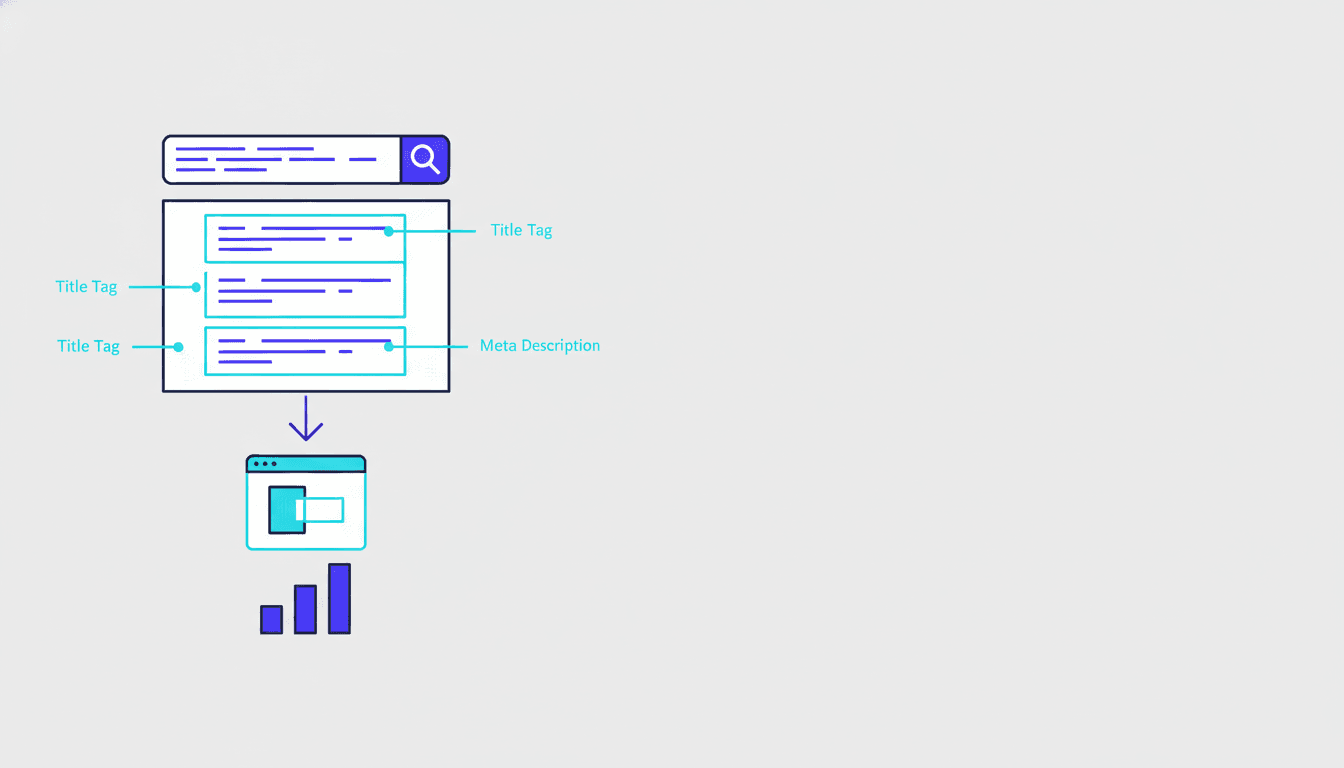
SEO in digital marketing is the practice of making your website earn higher positions in organic search results so more of the right people find you without paid ads. It works by aligning your content, site structure, and authority signals with what search engines reward, and what real searchers actually want. Get it right, and search becomes your most scalable, cost-efficient acquisition channel.
That definition sounds simple. The execution is not, and the stakes in 2026 are higher than they have ever been. AI-generated answer boxes now sit above traditional results on many queries. Voice search, zero-click answers, and tools like ChatGPT and Perplexity intercept traffic before a user ever clicks. Brands that treat SEO as a checkbox risk losing ground to those who treat it as a core growth system.
What Does SEO Actually Do in a Digital Marketing Plan?
SEO gives every other digital marketing channel a more durable foundation. Paid search stops the moment you cut the budget. Social reach is governed by an algorithm you cannot control. Email needs a list you first have to build. Organic search traffic, earned through strong SEO, compounds. A page that ranks today can still drive leads two years from now.
BrightEdge research puts organic search at 53% of all trackable website traffic across industries, with paid search accounting for just 15%. That gap matters for budget allocation decisions. If you are an agency advising a SaaS client or a brand deciding where to invest, those numbers make the argument for SEO better than any pitch deck.
SEO also shapes what kind of traffic arrives. A page optimised for a specific search intent draws visitors who are already asking the question your product answers. That intent alignment is why organic visitors typically convert better than display ad clicks.
How Search Engines Actually Rank Pages
Search engines run three core processes: crawling, indexing, and ranking. A crawler visits your pages, follows links, and reads your content. The indexer stores what it found and builds a model of what each page is about. The ranking system then scores every indexed page against hundreds of signals when a query fires.
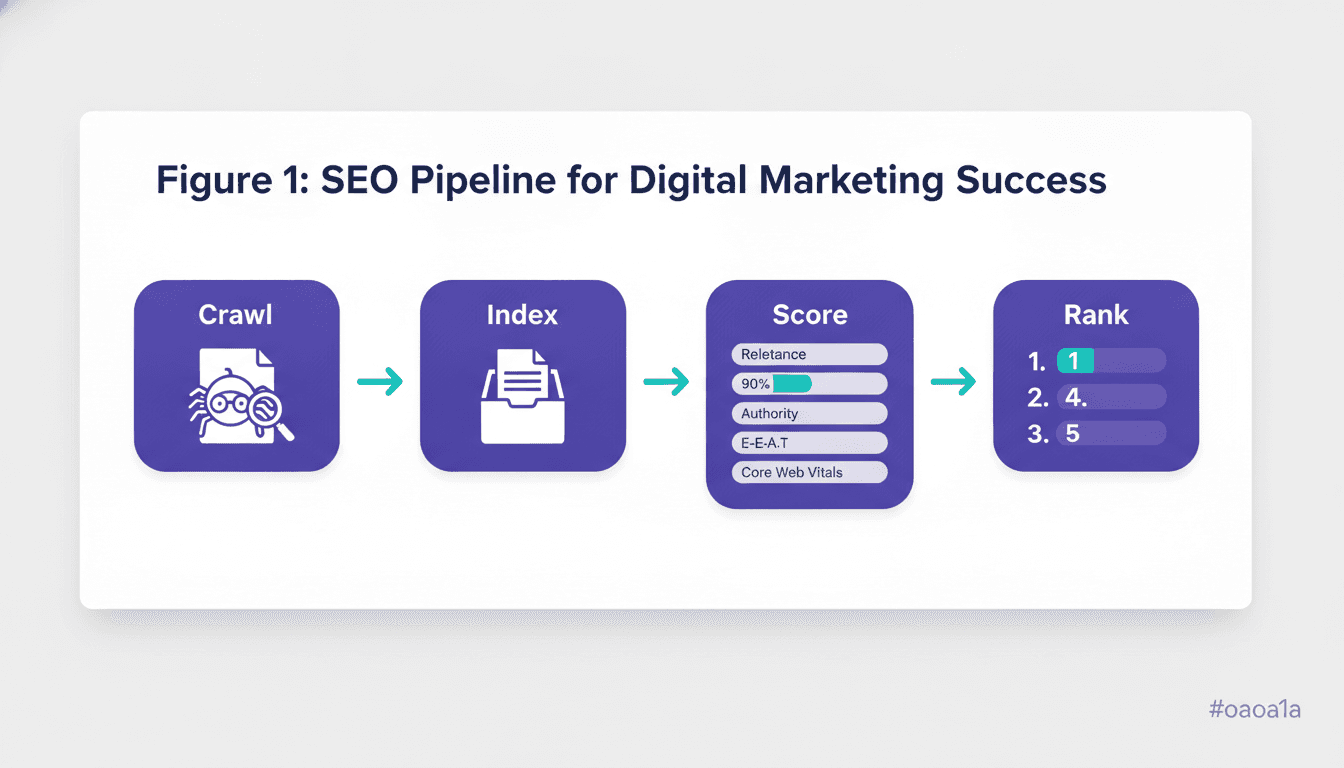
The signals that move rankings the most fall into four groups.
Relevance signals tell the engine whether your content actually answers the query. This is where keyword use, semantic coverage, and content depth come in. A page that covers a topic thoroughly, with related terms used naturally, ranks higher than one that just repeats the target phrase.
Authority signals tell the engine whether your site can be trusted on this topic. Links from credible, relevant sites are still the strongest external authority signal. Branded search volume and citation mentions in other sources also feed into this.
E-E-A-T stands for Experience, Expertise, Authoritativeness, and Trustworthiness. Google's Search Quality Evaluator Guidelines make clear that pages demonstrating first-hand experience and subject-matter expertise are rated higher, especially in health, finance, and legal categories where bad information causes real harm. For content teams, this means bylines matter, author credentials matter, and citing sources matters.
UX and performance signals tell the engine whether users have a good experience on your page. Core Web Vitals are Google's measurable proxy for this. The three thresholds to target are: Largest Contentful Paint under 2.5 seconds, Interaction to Next Paint under 200 milliseconds, and Cumulative Layout Shift below 0.1. Pages that miss these thresholds lose ranking ground to faster competitors, all else being equal.
The Three Types of SEO: On-Page, Off-Page, and Technical
Most introductions to SEO list these three types but treat them as equally weighted. They are not. Think of technical SEO as the prerequisite, on-page as the multiplier, and off-page as the proof.
On-Page SEO
On-page SEO covers every element you control on the page itself: the title tag, meta description, heading structure, body copy, internal links, image alt text, and URL. The goal is to make both the crawler and the reader immediately clear on what the page is about and why it answers their query.
The most common on-page mistake is keyword stuffing, which is writing for the phrase count rather than the reader. Modern ranking systems detect this easily. Write for the person first. Use LSI keywords and semantically related terms naturally in context, because search engines now model topic coverage, not keyword density.
Off-Page SEO
Off-page SEO in digital marketing is everything that builds your site's authority from outside your own domain. Backlinks are the anchor, but the category is broader than most teams realise. It includes brand mentions (even unlinked ones), citation building for local brands, digital PR coverage, and the branded search volume that signals a real audience knows you exist.
Link earning, not link buying, is the sustainable path. A single editorial link from a respected industry publication carries more weight than fifty directory submissions. Focus your off-page effort on creating content others want to cite and then promoting it to the people who write about your topic.
Technical SEO
Technical SEO makes sure search engines can crawl, index, and understand your site without friction. This is the prerequisite layer. A brilliant piece of content on a page with a broken canonical tag, slow server response, or accidental noindex directive will not rank.
The most impactful technical fixes for most sites are: resolving crawl errors in Google Search Console, compressing images and enabling caching to hit Core Web Vitals thresholds, fixing duplicate content with canonical tags, and adding structured data (schema markup) so search engines can extract key facts. For a full technical checklist, a proper SEO audit covers all three layers systematically.
Here is a quick comparison of the three types so the distinctions stay clear:
| Type | Where it lives | Core actions | Primary ranking signal |
|---|---|---|---|
| On-Page SEO | Your own pages | Title tags, headings, content depth, internal links | Relevance to query |
| Off-Page SEO | External sites and mentions | Earning backlinks, digital PR, citations, brand mentions | Domain authority and trust |
| Technical SEO | Site infrastructure | Crawlability, page speed, schema, canonical tags, indexing | Accessibility and UX signals |
SEO vs. SEM: Why the Difference Matters for Your Budget
SEO and SEM are often used interchangeably. They are not the same thing, and conflating them leads to bad budget decisions.
SEM (Search Engine Marketing) is the umbrella term for all search-based marketing, both organic and paid. SEO is the organic subset. PPC (pay-per-click) advertising, including Google Ads, is the paid subset. When someone says "SEM" and means "paid search only", they are using the term loosely but the error is widespread enough that you will see it constantly.
The strategic difference is timing versus permanence. PPC delivers traffic on day one and stops on day zero of your next budget cut. SEO takes time to build but pays forward. Ahrefs data shows the average top-ranking page is over two years old, which illustrates why SEO is a long game. Expect 3-6 months before measurable movement on competitive terms, and 12+ months to reach full compounding effect.
For most brands, the right answer is both channels working together. PPC covers short-term demand and new product launches. SEO builds the organic floor that lowers your blended cost per acquisition over time.
What Are the Key Components of an Effective SEO Campaign?
An effective SEO campaign in 2026 is built on four components that work together rather than in sequence.
1. Keyword and intent research. Start with what your audience is actually searching, not what you think they search. Group keywords by intent: informational ("what is SEO"), navigational ("Project Rankup login"), commercial ("best SEO tools for agencies"), and transactional ("buy SEO audit"). Each intent type needs a different content format and different conversion goal. Surface-level keyword lists miss this entirely.
2. Topical authority through content clusters. Google's systems reward sites that cover a topic deeply and connectedly. A single post about keyword research is weaker than a cluster of interconnected posts covering keyword research, search intent, LSI keywords, and competitor gap analysis, all linking to each other. This cluster model is how E-E-A-T signals are built at scale.
3. Technical health as a baseline. No content strategy outperforms a broken site. Run a crawl-based audit quarterly. The metrics to track are: crawl errors, index coverage, Core Web Vitals scores per page, and canonical accuracy. Using a dedicated SEO optimizer tool speeds this up considerably for larger sites.
4. Link and authority building. Map your current domain rating against the pages you are trying to rank. If the gap is large, no amount of on-page work closes it alone. Prioritise earning links from sites that cover your topic, not just sites with high domain authority in unrelated niches. A relevant link from a mid-authority site in your space beats a generic link from a high-authority news outlet.
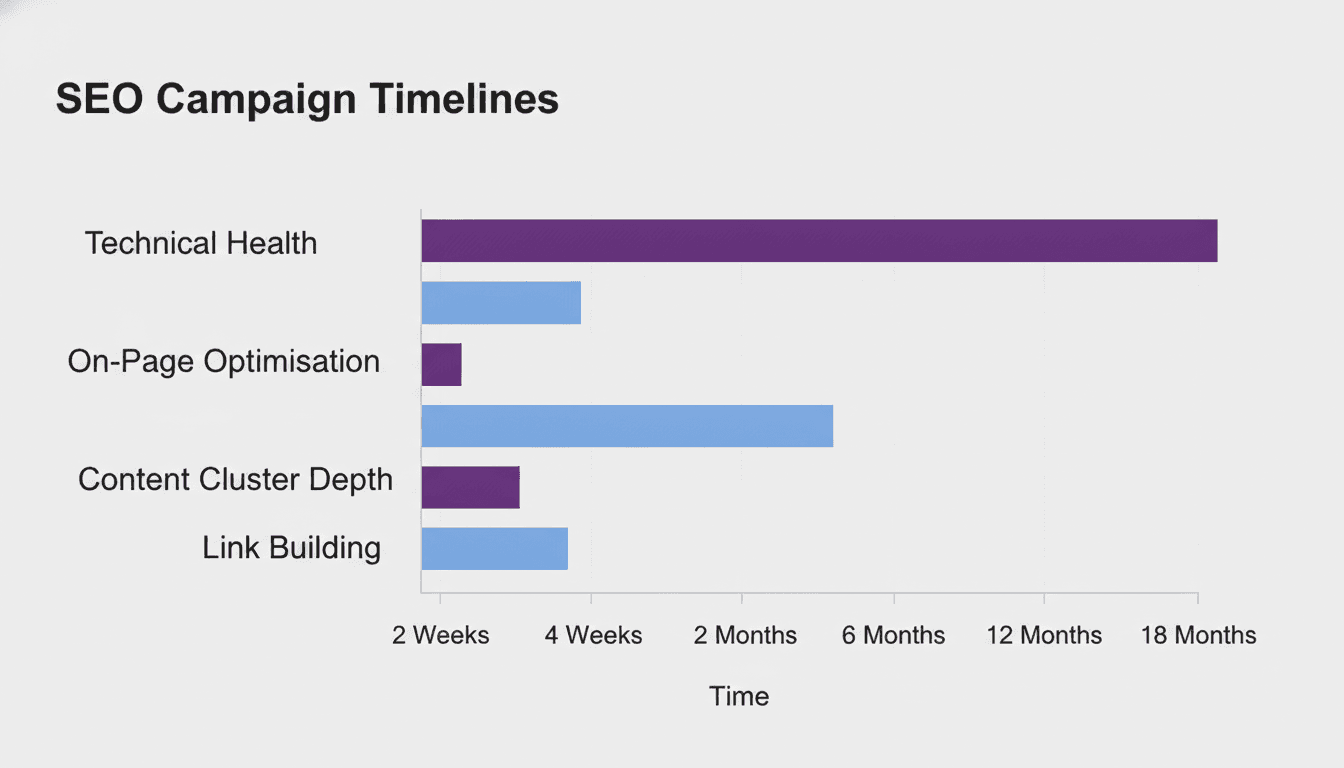
Here is a prioritised framework for where to focus first:
| Priority | Component | Signal it builds | Timeframe to see impact |
|---|---|---|---|
| 1 | Technical health | Crawlability, indexing | 2-6 weeks |
| 2 | On-page optimisation | Relevance, click-through rate | 4-12 weeks |
| 3 | Content cluster depth | Topical authority, E-E-A-T | 3-6 months |
| 4 | Link and authority building | Domain trust, competitive ranking | 6-18 months |
Local SEO: The 46% of Searches Most Strategies Ignore
Nearly half of all Google searches have local intent, according to Google's own data. A user searching "digital marketing agency" or "SEO services near me" is looking for something geographically relevant. Yet most SEO guides skip local entirely.
Local SEO has two distinct layers. The first is your Google Business Profile, which controls what appears in the map pack for local queries. An optimised profile with accurate NAP (Name, Address, Phone) data, consistent categories, regular posts, and genuine reviews dramatically improves map pack visibility. The second layer is local on-page and citation work: making sure your city and service area appear in key on-page elements, and that your business data is consistent across directories like Yelp, Apple Maps, and industry-specific listings.
For small business SEO, local optimisation often delivers faster, more measurable ROI than trying to compete on broad national terms.
The Future of SEO: AEO, GEO, and AI Search
Search in 2026 is not one thing anymore. It is a fragmented set of surfaces: traditional blue-link results, Google's AI Overviews, ChatGPT's browsing answers, Perplexity's cited summaries, and voice assistants. Each surface rewards slightly different content properties, but the underlying logic is consistent.
Answer Engine Optimisation (AEO) is the practice of structuring content so AI systems extract and cite it directly in generated answers. The core tactic is answer-first writing: lead each section with a complete, self-contained answer that makes sense without the surrounding context. AI search systems pull these passage-level answers because they are the easiest to verify and present confidently.
Generative Engine Optimisation (GEO) goes a step further. Where AEO focuses on being extracted, GEO focuses on being cited. AI tools cite sources that are authoritative, specific, and easy to attribute. That means: named data with a year and source, clear authorship, and content that makes a definite claim rather than hedging every sentence. According to a 2024 study by researchers at Princeton, Georgia Tech, and The Allen Institute, AI-generated answers preferentially cite sources with higher factual specificity and domain authority.
The brands winning in AI search are the ones that already did the work on traditional SEO. E-E-A-T, topical depth, clean structure, and authoritative backlinks all feed the same signals that AI systems use to decide what to surface. The difference is execution speed: deep search AI systems evaluate pages in milliseconds, so the clarity of your answers matters more than ever.
For teams developing an SEO plan for 2026, the practical implication is this: write content that a knowledgeable human would want to quote, and you are already writing content that AI systems want to cite.
How to Measure SEO ROI
SEO gets dismissed as untrackable. That is an excuse for not setting up measurement properly. Here are the metrics that actually matter, and what they tell you.
- Organic traffic by landing page: Shows which content earns search visits and whether optimisation changes moved the needle.
- Keyword rank tracking: Tracks position changes on target terms. Use this to confirm whether a page improvement resulted in ranking movement within 6-8 weeks.
- Click-through rate (CTR) from Search Console: A page ranking in position 3 with a 2% CTR has a title or meta description problem. Fix it before adding more content.
- Assisted conversions from organic: In any multi-touch attribution model, organic search frequently appears as the first touch for high-value customers. Measure this separately from last-touch conversion.
- Cost per lead versus paid channels: SEO has high upfront cost (content, technical work, link building) and low marginal cost per visit thereafter. Calculate the 12- and 24-month blended cost per lead to make the ROI case to stakeholders.
The one metric most teams skip is content decay tracking: monitoring pages that once ranked but have lost positions over six months. Refreshing a decayed high-performing page is often five times faster than writing a new one, and the SEO payoff is immediate. Tools designed for this job, including the SEO tools Project Rankup covers in depth, make the process systematic rather than manual.
Frequently asked questions
What is SEO in digital marketing?
SEO in digital marketing is the process of improving a website's visibility in organic search results so it earns more relevant traffic without paying for each click. It covers on-page content optimisation, technical site health, and off-page authority building. Done well, it becomes a compounding growth channel that reduces reliance on paid advertising over time.
What is SEO and sem in digital marketing?
SEM (Search Engine Marketing) is the broader category covering all search-based marketing, both organic and paid. SEO is the organic component, focused on earning rankings through content and authority. Paid search (PPC, Google Ads) is the paid component. The key difference is cost structure: SEO has upfront build costs but near-zero marginal cost per visit, while PPC charges per click indefinitely.
What is technical SEO in digital marketing?
Technical SEO is the infrastructure layer of search optimisation. It ensures search engine crawlers can access, read, and index your pages without errors. Core areas include site speed and Core Web Vitals, canonical tags to prevent duplicate content, structured data (schema markup), XML sitemaps, and crawl error resolution. Technical SEO is the prerequisite; content and link strategies cannot compensate for a site crawlers cannot properly read.
What is on page SEO in digital marketing?
On-page SEO covers all optimisation done directly on a web page: title tags, meta descriptions, heading hierarchy, body content, image alt text, internal linking, and URL structure. The goal is to make the page's topic clear to both the search engine and the reader, and to match the content depth and format to what the searcher actually wants.
What is off page SEO in digital marketing?
Off-page SEO in digital marketing refers to actions taken outside your own website to build its authority and trust. Earning backlinks from credible, relevant sites is the primary tactic. It also includes digital PR, brand mention monitoring, citation building for local brands, and strategies that grow branded search volume. Off-page signals tell search engines that other sources vouch for your content's credibility.
How long does SEO take to show results?
SEO typically takes 3-6 months to show measurable ranking movement on competitive terms, and 12 or more months to reach full compounding effect. Technical fixes can move the needle in 2-6 weeks. Newer sites, thin content, and competitive niches extend the timeline. The payoff is that rankings built on solid SEO continue delivering traffic long after the work is done.
What are Core Web Vitals and why do they matter for SEO?
Core Web Vitals are Google's three performance metrics used as ranking signals: Largest Contentful Paint (target under 2.5 seconds), Interaction to Next Paint (under 200 milliseconds), and Cumulative Layout Shift (below 0.1). They measure real-user loading speed, interactivity, and visual stability. Pages that fail these thresholds rank below technically equivalent pages that pass them.
Key Takeaways
- SEO in digital marketing earns organic search traffic by aligning content, authority, and technical health with what search engines reward.
- Organic search drives 53% of trackable website traffic across industries, making it the largest single digital channel by volume.
- Technical SEO is the prerequisite, on-page is the multiplier, and off-page authority is the proof; all three must work together.
- SEO typically takes 3-6 months for measurable results and 12+ months to compound, which makes it a strategic investment, not a quick fix.
- Local SEO affects nearly half of all Google searches and is underused by most content and agency teams.
- AEO and GEO have made answer-first, citation-ready writing the standard for content that wins both traditional rankings and AI-generated answers.
- Measuring SEO ROI requires tracking organic traffic, rank movement, CTR, assisted conversions, and content decay together, not just rankings alone.
SEO in 2026 rewards brands that commit to it as a system, not a task list. If you want to go deeper on any of these layers, including AI search strategy, AEO, and GEO, Project Rankup's resources and services are built for exactly that.