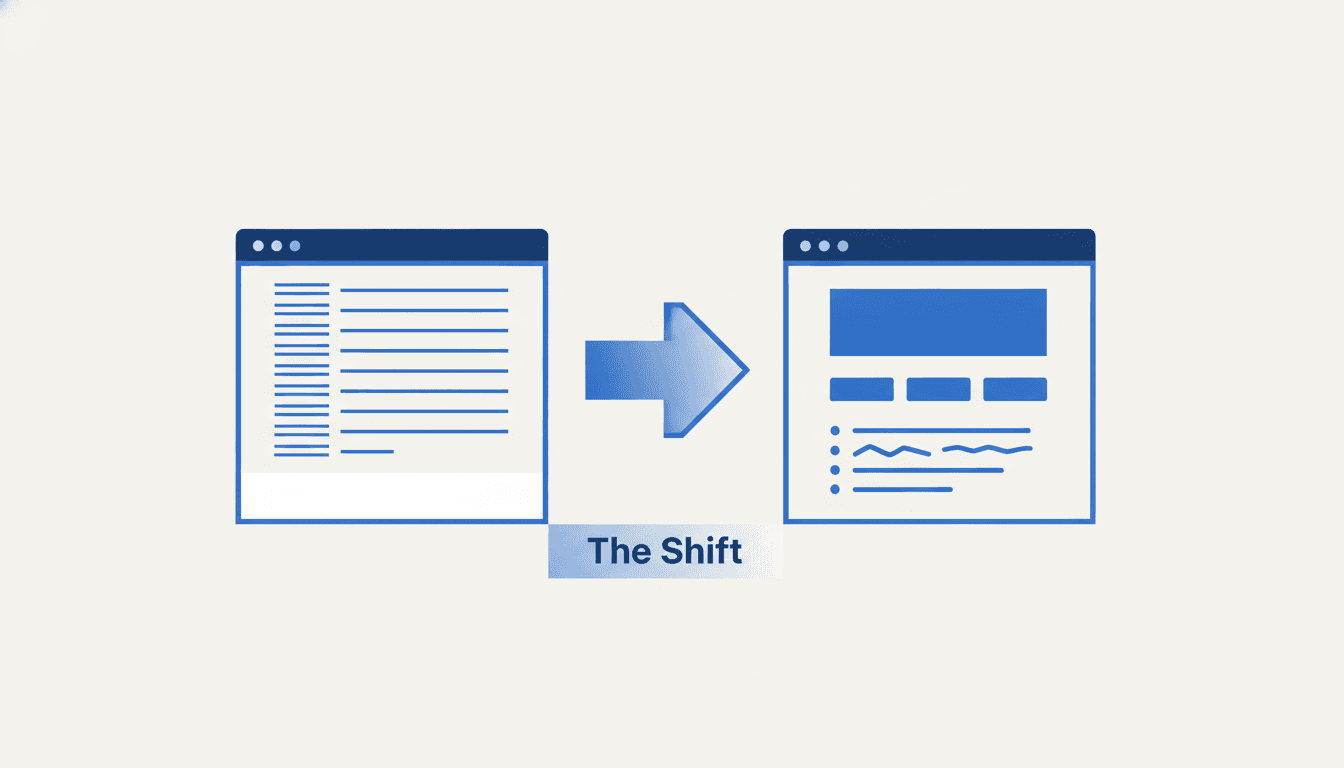

Deep search AI refers to search systems that use large language models and deep learning to understand, synthesize, and answer queries rather than returning a ranked list of links. Instead of scoring ten blue links by relevance signals, these systems read across thousands of sources simultaneously, reason through the content, and produce a single synthesized response with citations. For anyone managing search visibility in 2026, that shift is the most consequential change to how content gets discovered, and it demands a fundamentally different content strategy.
Also Read: Mastering AI Search: Essential Strategies for Businesses and Marketers
What Is Deep Search AI?
Deep search AI is an umbrella term for AI-powered search systems that go far beyond keyword matching. Traditional search engines rank documents by correlating query terms with indexed content using signals like backlinks, on-page optimization, and user engagement. Deep search AI layers large language models (LLMs) on top of that index, or replaces the index entirely, to reason about intent, synthesize multiple sources, and generate a direct answer.
The clearest public examples right now are Google's AI Overviews, Microsoft Copilot Search in Bing, Perplexity AI, and OpenAI's ChatGPT Search. Each runs a variant of the same core mechanic: the user types a query, the system retrieves a broad set of candidate documents, and a language model synthesizes a response with source citations. The retrieval-augmented generation (RAG) architecture underlying most of these tools is what makes them "deep." They are not guessing from training data alone. They actively read current web content at query time, weight it for relevance and credibility, and distill it into prose.
Gartner predicted in early 2024 that traditional search engine query volume will fall 25% by 2026 as AI chat interfaces absorb question-based searches. That is not a slow-moving forecast. Click-through rate data across industries already reflects the shift.
One angle competing articles on this topic consistently miss: deep search AI is not a single product. It is a capability layer now embedded across multiple platforms simultaneously. Optimizing for it means optimizing for a class of systems, not chasing one algorithm update.
How Deep Learning in Search Engines Processes Your Content
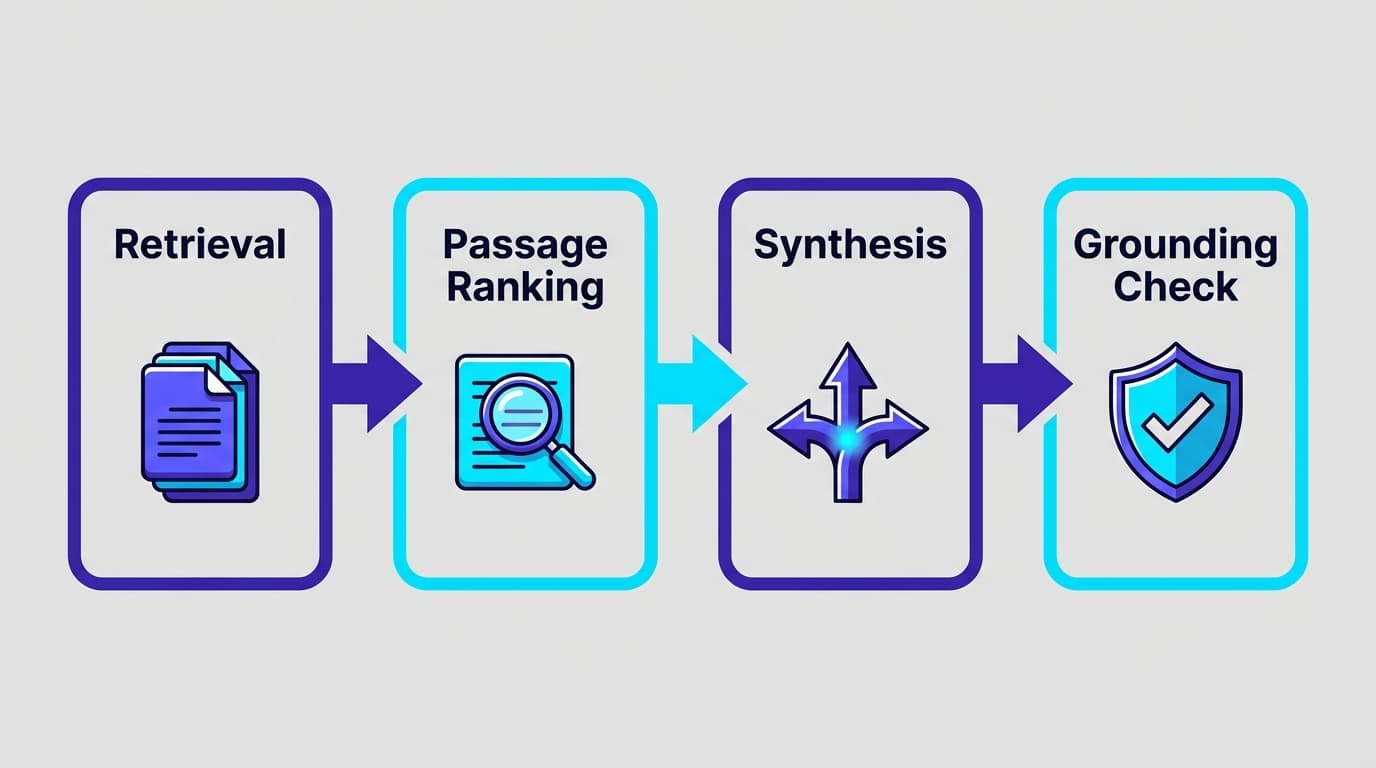
Deep learning in search engines operates through several stacked processes that happen in milliseconds. Understanding the sequence shows you exactly where your content either gets selected for an AI-generated answer or quietly gets skipped.
Retrieval: Finding the Candidates
The system first identifies candidate pages using a combination of traditional index signals (relevance, freshness, domain authority) and semantic vector search. Vector embeddings allow the system to find content that matches the meaning of a query even when the exact phrase does not appear on the page. A piece titled "How to Reduce Customer Churn" can surface for the query "why do SaaS users cancel" because the embedding space recognizes conceptual overlap.
Ranking for Extraction: Scoring Passages, Not Pages
From the retrieved candidates, the LLM scores individual passages, not whole pages, for how directly they answer the query. Short, self-contained paragraphs with a clear subject and direct answer score higher than dense, qualifier-heavy prose. This is why ai-powered content discovery rewards structured writing over keyword-stuffed content. A 3,000-word page with a buried answer will lose to a 600-word page where the answer appears in the first paragraph.
Synthesis and Citation
The model writes its answer by combining insights from multiple sources, then attaches source citations. Being cited does not require ranking first organically. It requires your content being the clearest, most citable expression of a specific claim on the web.
Grounding and Verification
Most enterprise-grade deep search systems run a verification pass to reduce hallucinations. Content that makes specific, falsifiable claims and provides attributable data clears this pass more reliably than vague benefit statements. This is why factual density is no longer optional for high-performing content.
Pew Research Center found that 60% of Google searches that began with question words such as "who," "what," "when" or "why" produced an AI summary in March 2025. That single finding should reframe where content teams invest their development time.
Is Deep Search AI Real? (Clearing Up the Confusion)
Yes, deep search AI is real, it is in production at massive scale, and it is already reshaping traffic patterns for publishers and brands. The skepticism you will encounter usually conflates two separate concerns.
The first concern is whether specific apps or browser extensions marketed as "deep search ai free" tools are legitimate. Some are. Perplexity's free tier, Bing Copilot, and Google's AI Overviews are verifiable, well-documented products from organizations with billions in R&D behind them. Free deep search ai tools from smaller vendors are a different story. If a tool does not disclose which underlying model powers it, or cannot explain its retrieval methodology, treat the claim carefully.
The second concern is whether the traffic and visibility changes SEOs report are signal or noise. The data points to signal. The direction of impact varies by query type: commercial and transactional queries retain strong click rates, while purely informational queries see the sharpest organic CTR declines when an AI Overview is present.
The honest read: deep search AI is real, its impact is uneven across query types, and the brands taking the biggest hit are those whose content was thin, undifferentiated, or built to rank rather than genuinely inform. Thin content that ranked on domain authority alone is the first casualty.
The Impact of Deep Search on SEO: What Actually Changes
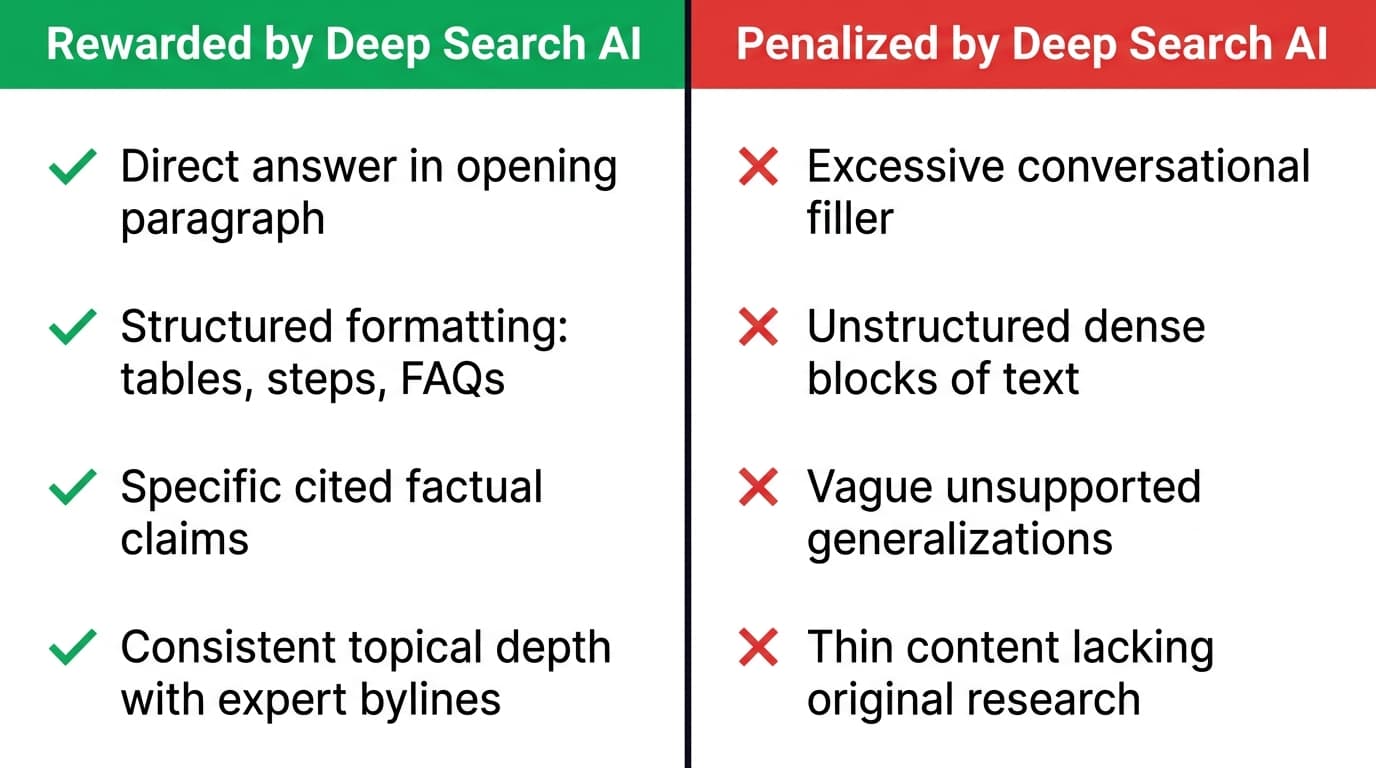
The impact of deep search on SEO falls into three clear categories: what gets rewarded in the new environment, what gets penalized by irrelevance, and what simply disappears as a viable organic traffic channel.
What gets rewarded:
- Content that answers a specific question completely in the opening paragraph
- Structured formatting: numbered steps, comparison tables, definition blocks, FAQ sections
- Pages with strong E-E-A-T signals: named authors, cited sources, verifiable claims, consistent publication history
- Brand mentions in third-party sources, which the AI retrieval layer reads as a credibility proxy
What gets penalized by irrelevance:
- Informational content that paraphrases what already exists at the top of the SERP without adding original insight
- Pages optimized for a keyword but not structured around an actual user question
- Content without clear factual claims. Vague benefit statements do not survive the AI extraction process
What disappears as a standalone traffic channel:
- Zero-click informational queries where the AI-generated answer is complete. If a user asks a factual question and gets a full answer, a generic blog post that only addresses that one fact loses the click entirely.
For e-commerce and SaaS teams, the opportunity is sharper than the threat. Transactional and commercial investigation queries still drive high-intent clicks because users want to make a decision, not just read a synthesized paragraph. Knowing how to rank in Google AI Overviews for those commercial queries is now a core competency, not an experimental tactic.
One pattern that practitioners consistently miss: internal linking architecture now affects AI citation frequency. Pages that receive contextually related internal links are crawled more deeply and more frequently. That freshness and context signal influences which pages the retrieval layer surfaces as candidates for synthesis. A well-structured SEO tools stack can help you monitor both factors together.
| Query Intent | AI Overview Impact | Organic Click Opportunity |
|---|---|---|
| Purely informational (definitions, facts) | High presence, significant CTR reduction | Low without citation in AI answer |
| Commercial investigation (comparisons, reviews) | Moderate presence | High for cited and ranked pages |
| Transactional (buy, sign up, download) | Low presence | High, AI answers rarely complete the action |
| Local (near me, city-specific) | Moderate presence | High via map pack and local links |
| Navigational (brand + site) | Very low presence | Essentially unaffected |
AI Search Optimization Strategies That Actually Work in 2026
Most ai search optimization strategies guides stop at "write better content." That is true but useless without specifics. These are the moves that actually shift citation rates and organic visibility in the current environment.
1. Lead every page with a dense answer paragraph
Your opening 60-90 words should fully answer the page's primary question. No preamble, no throat-clearing, no "in this article we will explore." The AI retrieval layer reads your first paragraph first. If it does not find a clear answer there, it moves on to a competitor's page that does.
2. Structure for extraction, not for reading flow
Phrase H2 headings as the questions your audience actually searches. Break sub-topics into H3s. Every section should be self-contained enough that it makes sense quoted in isolation. Think of each section as a potential answer snippet, not a chapter in a narrative.
3. Build factual density with inline citations
Every non-obvious claim needs a named source. Not because Google demands it explicitly, but because the AI grounding layer rewards attributable content. Claims that cannot be verified get dropped; cited claims get synthesized and attributed back to your domain.
4. Prioritize topics where you have genuine depth
The future of search with ai is not friendly to content farms. Sites that demonstrate consistent subject-matter depth, multiple interconnected pieces, expert bylines, original data, earn higher citation rates in AI-generated answers. AI keyword research tools that track brand mention rates in AI responses now give you a measurable way to audit that depth.
5. Run content audits through an AI lens
Content audits have evolved beyond pruning thin pages for crawl budget. The goal now is identifying which pages have the structure, factual density, and E-E-A-T signals to compete as AI sources, and upgrading those that do not. Our best AI content audit tools roundup covers the platforms built specifically for this evaluation.
6. Map content to question-format secondary keywords
Search queries are getting longer and more conversational. Aligning your content architecture to specific questions rather than broad topic clusters is the clearest way to match how deep search AI retrieves and presents information.
7. Build cross-platform citation surface area
AI systems like Perplexity and ChatGPT pull from the open web, but they also weight content that earns mentions in industry forums, structured databases, and editorial publications. Getting cited off your own site expands your presence in the datasets these systems draw from at query time.
Generative Engine Optimization and Answer Engine Optimization AI
Generative engine optimization (GEO) is the practice of shaping content so that generative AI systems select and cite it when answering user queries. It works alongside traditional SEO and answer engine optimization ai practices, but has its own mechanics that reward different content decisions.
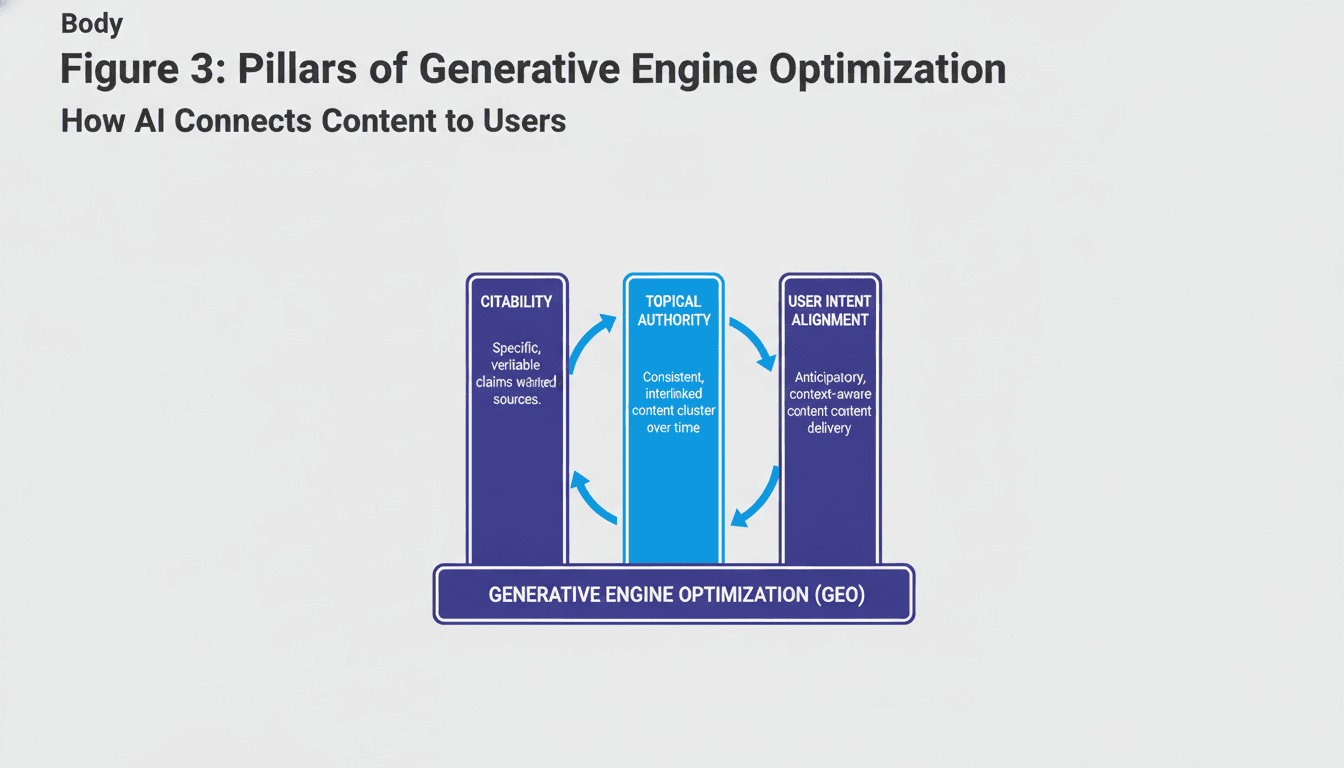
Generative engine optimization deep search comes down to three principles:
Citability: Your content needs to make a claim specifically enough that an AI can attribute it to you. "Studies show better results" is not citable. "A 2025 Gartner survey found that 60% of enterprise marketing leaders increased their AI search budgets year over year" is citable. The more specific and verifiable your claims, the more useful your content is to a language model trying to synthesize an accurate answer.
Topical authority: AI retrieval systems weight recency and depth of coverage together. A site that has published twelve well-structured, interlinked pieces on a single topic is more likely to be selected as a source than a site with one comprehensive guide published two years ago and nothing since. This is a content calendar argument. Consistent, focused publication builds the kind of topical footprint that ai-powered content discovery systems recognize as authoritative. Thinking through what is a content calendar and how to execute it systematically matters more now than it did in 2023.
Structured answer design: The answer engine optimization ai layer within GEO targets the question-answer architecture of AI responses directly. Every content asset should have a clear question it answers, a direct answer in the first paragraph, supporting evidence below it, and attribution for any factual claim. That structure is what the synthesis layer extracts. FAQ sections, definition blocks, and comparison tables are extracted into AI answers at a disproportionately high rate compared to pure prose.
For SaaS teams and agencies, this changes the ROI calculation for content. A single well-structured piece written to be cited, not just to rank, can generate brand mentions across dozens of AI-generated answers on multiple platforms simultaneously. That is a different distribution model than a top-three Google ranking, but in 2026 it is an equally valuable one, and for some verticals it is becoming more valuable.
The brands that will win this transition are those treating GEO and AEO as systematic disciplines with measurable outputs, not as vague "thought leadership" exercises. Track your citation rate in AI responses. Measure it by topic cluster. Prioritize upgrading the clusters where you have strong organic rankings but low AI citation rates, because that gap is where the opportunity concentrates.
Frequently asked questions
What is deep search AI?
Deep search AI describes search systems that use large language models and retrieval-augmented generation to synthesize answers from multiple web sources rather than returning a ranked list of links. Google AI Overviews, Perplexity, and Microsoft Copilot Search are the most widely used examples. The defining characteristic is active content reasoning at query time, not just keyword matching against an index.
Is deep search AI real?
Yes, deep search AI is real and operating at production scale. Google's AI Overviews reach billions of users globally, and Perplexity AI processes millions of queries daily. The underlying technology is publicly documented and academically reviewed. Some smaller tools use the label without the capability, so verify which model and retrieval method powers any tool you evaluate before investing time in it.
Is deep search AI safe?
Deep search AI is generally safe to use as a research and information tool. The main risks are accuracy-related, not privacy-related. AI-synthesized answers can contain errors or omit important nuance, particularly on fast-moving or contested topics. Enterprise systems like Google and Microsoft implement grounding checks to reduce hallucinations, but no system is error-free. Treat AI-generated answers as a starting point that warrants verification against primary sources.
What is deep search AI assistant?
A deep search AI assistant is a conversational interface, such as Perplexity, ChatGPT with web search enabled, or Google Gemini, that combines real-time web retrieval with language model reasoning to answer questions in natural language. Unlike a standard chatbot, it cites sources and grounds its answers in current web content rather than relying solely on its training data cutoff.
What is deep search AI app?
Deep search AI app typically refers to applications like Perplexity AI, You.com, or the Bing mobile app with Copilot enabled, tools that put AI-synthesized search into a standalone mobile or desktop interface. Several free deep search AI options exist, including Perplexity's free tier and Bing Copilot, making AI-powered search accessible without a paid subscription. Capability and citation depth vary significantly between free and paid tiers.
Does deep search AI affect e-commerce and local SEO differently than informational content?
Yes, meaningfully. Local queries with geographic intent still drive map pack results and direct clicks, so local SEO fundamentals remain essential. E-commerce product queries also retain strong click-through rates because users need to complete a purchase, not just read a synthesized paragraph. The sharpest traffic declines from deep search AI hit generic informational content with no clear transactional next step attached to it.
How do you measure whether your content is being cited by AI search systems?
Track brand mentions in AI Overview citations using platforms like SE Ranking's AI Overview tracker or BrightEdge's generative AI monitoring module. Monitor direct traffic changes on pages that rank in positions 1-5 but are covered by AI Overviews, since organic CTR drops there signal AI absorption. A structured content audit helps identify which pages have the density and format that AI systems prefer as citation sources.
Key Takeaways
- Deep search AI synthesizes answers from multiple sources using large language models, replacing the traditional ranked list with a single AI-generated response and citations, that structural shift is already measurable in click-through rate data.
- Gartner projected a 25% drop in traditional search query volume by 2026. The shift to AI-mediated search is structural, not a passing trend.
- Content that opens with a direct answer, uses structured formatting, and makes specific citable claims consistently performs best in AI retrieval and synthesis.
- SEO and AEO must work together: ranking for traditional search still matters, but earning citations in AI-generated answers requires a separate content architecture focused on extraction and citability.
- Generative engine optimization and answer engine optimization ai are not replacements for SEO, they are layers on top of it that reward the same fundamentals of expertise, clarity, and trustworthiness, applied with more structural discipline.
- Regular content audits through an AI lens are now a baseline practice, not an annual clean-up exercise.
- E-commerce, SaaS, and local brands face a smaller threat from deep search AI than pure informational publishers do, because transaction-intent queries still drive clicks even when AI Overviews are present.
If you want your content ranked and cited in the deep search AI era, the starting point is understanding exactly where your current assets stand against the structure, authority signals, and factual depth that AI retrieval systems require. Project Rankup's content audit and AI optimization services are built for exactly this moment. Reach out to the Project Rankup team to start building a content strategy that earns visibility in 2026 and beyond.