

Small business SEO is the practice of optimizing your website, local listings, and content so customers find you through organic search before they find a competitor. Organic search drives roughly 43% of website traffic for most small businesses, yet fewer than 20% have actively built a strategy around it. This guide covers the fundamentals, realistic timelines, and affordable tactics that work in 2026, whether you're starting from scratch or fixing a strategy that stalled.
What Small Business SEO Is (and Why It's Different)
Small business SEO focuses on winning visibility within a defined geography or niche rather than competing globally for high-volume keywords. A local plumbing company in Austin doesn't need to outrank a national directory. It needs to appear when someone in Austin searches 'emergency plumber near me.' That's a different problem than what a Fortune 500 marketing team solves, and it requires a different approach.
Three differences set small business SEO apart from enterprise SEO:
- Scale: You're targeting hundreds of relevant keywords, not thousands. Depth within a niche outperforms breadth across many topics.
- Authority baseline: Large brands carry years of backlinks and brand signals. Small businesses build authority through local citations, community content, and documented niche expertise.
- Resource constraints: Most small teams have 5-10 hours a week for SEO, not a dedicated department. Strategy has to reflect that reality.
Google's Search Quality Evaluator Guidelines center on E-E-A-T: Experience, Expertise, Authoritativeness, and Trustworthiness. For small businesses, demonstrating genuine local experience is often the strongest E-E-A-T signal available, and it's one a national competitor can't replicate. A dentist who publishes detailed answers to the questions patients actually ask carries more topical authority for local searches than a generic health portal ever will.
How Long Does SEO Take for a Small Business?
SEO for a small business typically shows measurable movement in 3-6 months, with meaningful ROI arriving by month 9-12. The exact timeline varies considerably by business type, existing domain authority, competition density, and how consistently you execute. A new local service business with no domain history will rank for local pack queries faster than an e-commerce site trying to compete nationally, by several months in most cases.
These benchmarks reflect realistic industry patterns:
| Business Type | First Rankings | Noticeable Traffic | ROI Positive |
|---|---|---|---|
| Local service (plumber, dentist) | 2-4 months | 4-6 months | 6-9 months |
| Brick-and-mortar retail | 3-5 months | 5-8 months | 8-12 months |
| E-commerce (product-based) | 4-7 months | 7-10 months | 10-15 months |
| SaaS / B2B | 5-9 months | 9-14 months | 12-18 months |
What accelerates results: a clean technical foundation from day one, consistent publishing, and targeted local citations built before you need them. What stalls progress: thin pages, duplicate content, an incomplete Google Business Profile, and inconsistent NAP (Name, Address, Phone) data across directories.
The most common failure pattern is quitting at month two because nothing visible has happened. Ranking on Google for small business is a compounding process. Each piece of optimized content and each new citation adds to a base that keeps working after you stop actively pushing it.
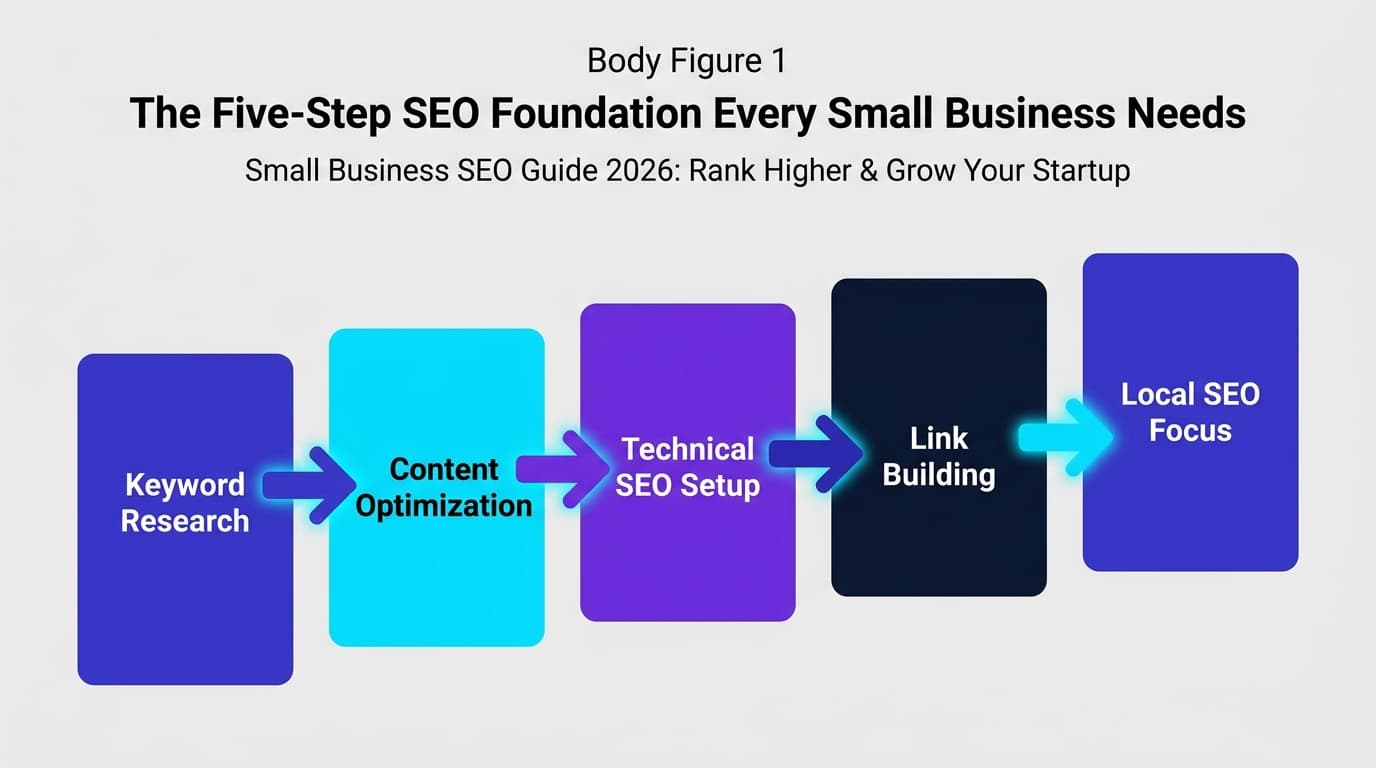
The Five-Step SEO Foundation Every Small Business Needs
Most small businesses skip straight to tactics. That's why the basics remain a genuine competitive advantage: most of your local competitors haven't done them properly either. Get these five right and you're ahead of the majority of the field before you publish a single blog post.
1. Keyword Research Focused on Intent
Start with keywords your customers actually type, not industry jargon. Map them to three categories: transactional (ready to buy, book, or call), informational (researching options), and navigational (looking for your business by name). Prioritize transactional keywords first. A page targeting 'emergency roof repair [city]' drives leads immediately; a page targeting 'how roofs work' builds traffic over time.
Free tools like Google Keyword Planner and Google Search Console cover the basics. For deeper competitive data, the tools reviewed in Project Rankup's SEO tools guide give you keyword gap analysis without enterprise pricing. AI-assisted keyword research can also surface question-based queries your customers are typing that traditional tools miss entirely.
2. On-Page Optimization
Each page should target one primary keyword. Include it in the title tag, H1, first 100 words, and at least one subheading. Keep title tags under 60 characters. Write meta descriptions that clearly describe what the page delivers. Every image needs descriptive alt text, not a filename like 'image1.jpg' but something specific like 'emergency plumber fixing burst pipe Austin TX.' These details take minutes and they compound.
3. Technical Basics
Website optimization for small businesses starts with speed and crawlability. Run Google's PageSpeed Insights on your key pages. Fix broken internal links. Submit your sitemap to Google Search Console and confirm every important page is indexed. If your site loads in over three seconds on mobile, that's already costing you positions before a single user has a chance to read your content.
4. Local Citations
Claim and fully complete your Google Business Profile. Fill every available field: hours, services, photos, service areas, and a keyword-rich description. Then build consistent NAP citations across Yelp, Apple Maps, Bing Places, and the main industry directories for your niche. Inconsistent citation data, such as three slightly different address formats across directories, is one of the top reasons local businesses fail to appear in the Google local pack.
5. Content That Answers Real Questions
Google's Helpful Content updates have reinforced a pattern building for years: pages that genuinely help people outperform pages optimized for algorithms. Write content that answers the specific questions customers ask before they buy. A content calendar keeps publishing consistent without scrambling to find topics each week when the pressure is on.
Local SEO for Startups: Win Your Neighborhood Before You Scale
Local SEO for startups is often the fastest path to real results. Competing for broad national keywords can take years. Ranking in your city for high-intent phrases is achievable in months, sometimes weeks for very local searches with limited competition. It's the one area where a small business can genuinely outmaneuver a larger competitor that isn't paying attention.
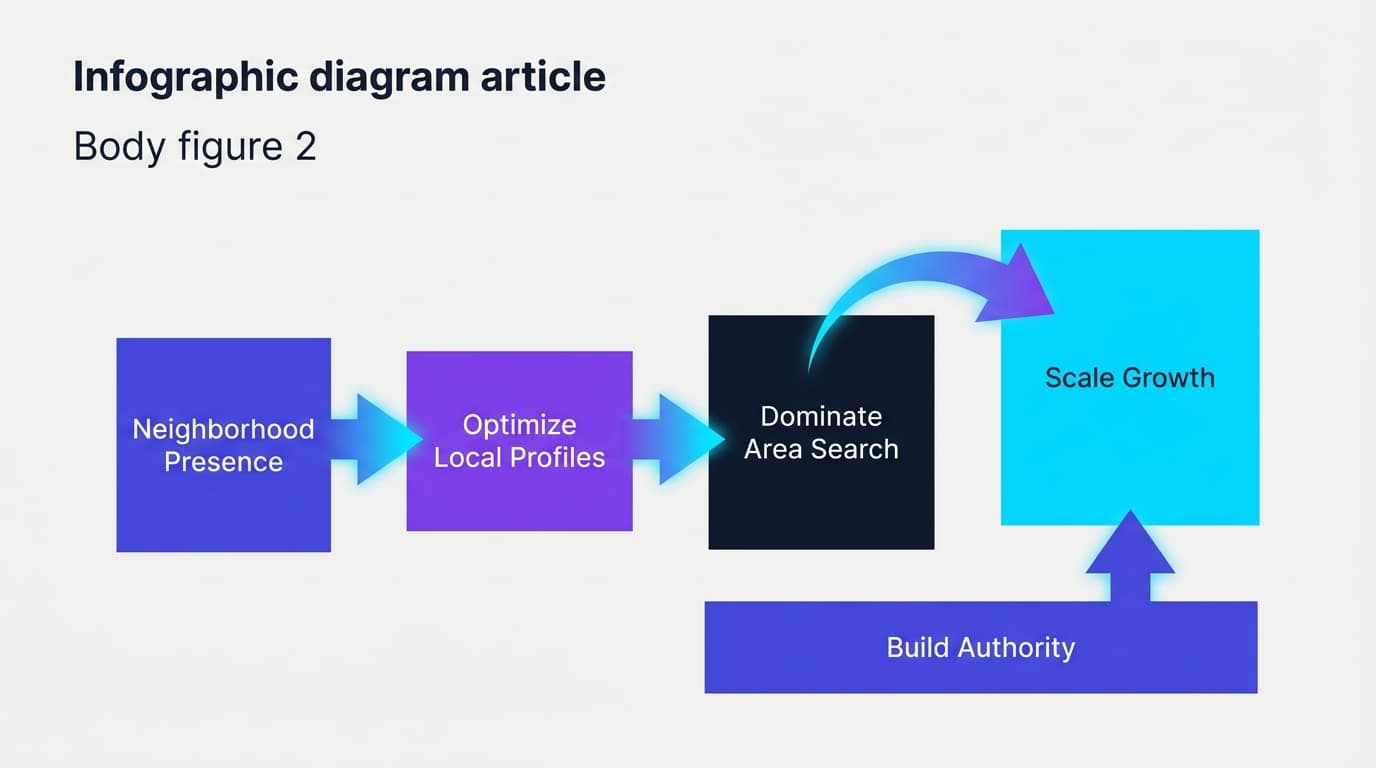
BrightLocal's 2025 Local Consumer Review Survey found that 98% of consumers used the internet to find local businesses in the past year. Reviews carry serious weight: businesses with more than 50 Google reviews earn significantly higher click-through rates than those with fewer than 10, and the gap widens for searches with immediate purchase intent.
Three tactics that move the needle fastest:
- Google Business Profile posts: Treat your GBP like a lightweight blog. Post weekly about offers, new services, or local events. Active profiles appear more consistently in competitive local pack results than neglected ones.
- Location-specific landing pages: If you serve multiple areas, build a dedicated page for each city or neighborhood. Don't just swap the city name in the title tag. Write content with local references, area-specific context, and local landmarks that a national page can't replicate.
- A systematic review process: Ask every satisfied customer for a review immediately after service. A text with a direct link to your Google review page converts far better than a verbal request. Build a system, and the reviews follow. Wait for them organically, and they rarely do.
Local SEO services for small business can accelerate this process, but these three tactics are entirely DIY-friendly and cost nothing to execute.
How Do Small Businesses Measure SEO ROI?
Tracking SEO impact goes beyond watching traffic numbers rise and fall. Real attribution ties specific keyword rankings to leads and revenue, and it is achievable without a dedicated analytics team or expensive reporting software. The four-step framework below gives small businesses a defensible way to calculate cost-per-lead from organic search and compare it directly to paid advertising spend.
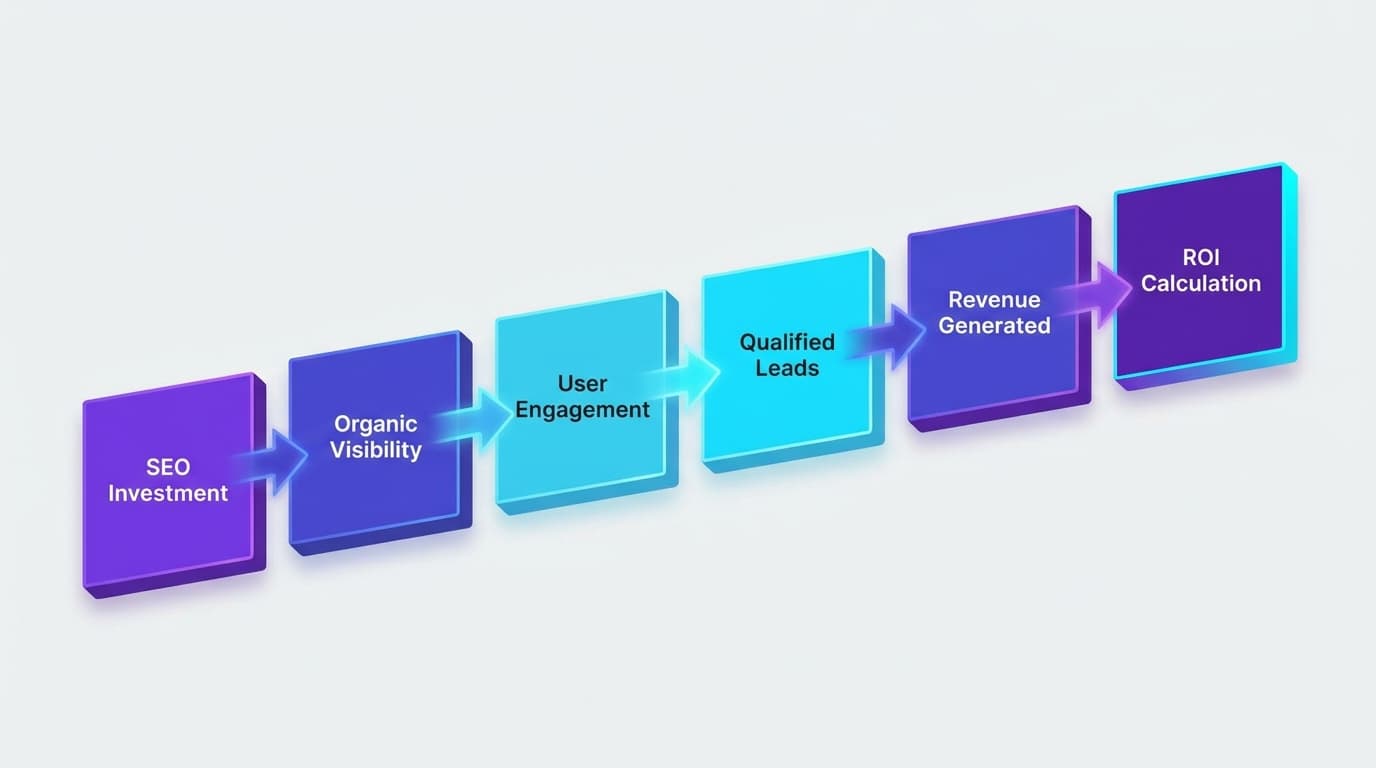
Step 1: Connect Google Search Console and Google Analytics 4. Both are free. Link them inside GA4 so you can see which search queries drive traffic and which pages convert that traffic into leads or sales.
Step 2: Set up conversion events. Define what converting means for your business: a contact form submission, a phone call click, a purchase, a booking. Tag these as conversion events in GA4. Without this step, you're tracking activity, not revenue.
Step 3: Calculate cost-per-lead from organic search. Divide your total monthly SEO investment (tools plus your time at your hourly rate, plus any freelancer cost) by the organic leads attributed in GA4. Then compare to your paid search cost-per-lead. Many local businesses find organic search cost-per-lead runs 60-80% below equivalent PPC spend after the first year.
Step 4: Track rank movement as a leading indicator. Traffic can fluctuate for seasonal reasons, algorithm updates, or competitor activity that has nothing to do with your work. Rank movement is the early signal that confirms your SEO is improving before traffic numbers reflect it. Project Rankup is built specifically for this: rank tracking and SEO project management in one place, sized for small business budgets rather than enterprise teams. See how it fits with Project Rankup's pricing.
Can a Small Business Do SEO Without Hiring an Agency?
Yes, with one honest condition: DIY SEO works well for local businesses targeting defined geographies and lower-competition niches. It becomes meaningfully harder for e-commerce sites competing nationally, where technical complexity and link-building scale require dedicated resources. The right approach depends on your market, your competition, and how much your time is actually worth, a calculation most small business owners never run before choosing.
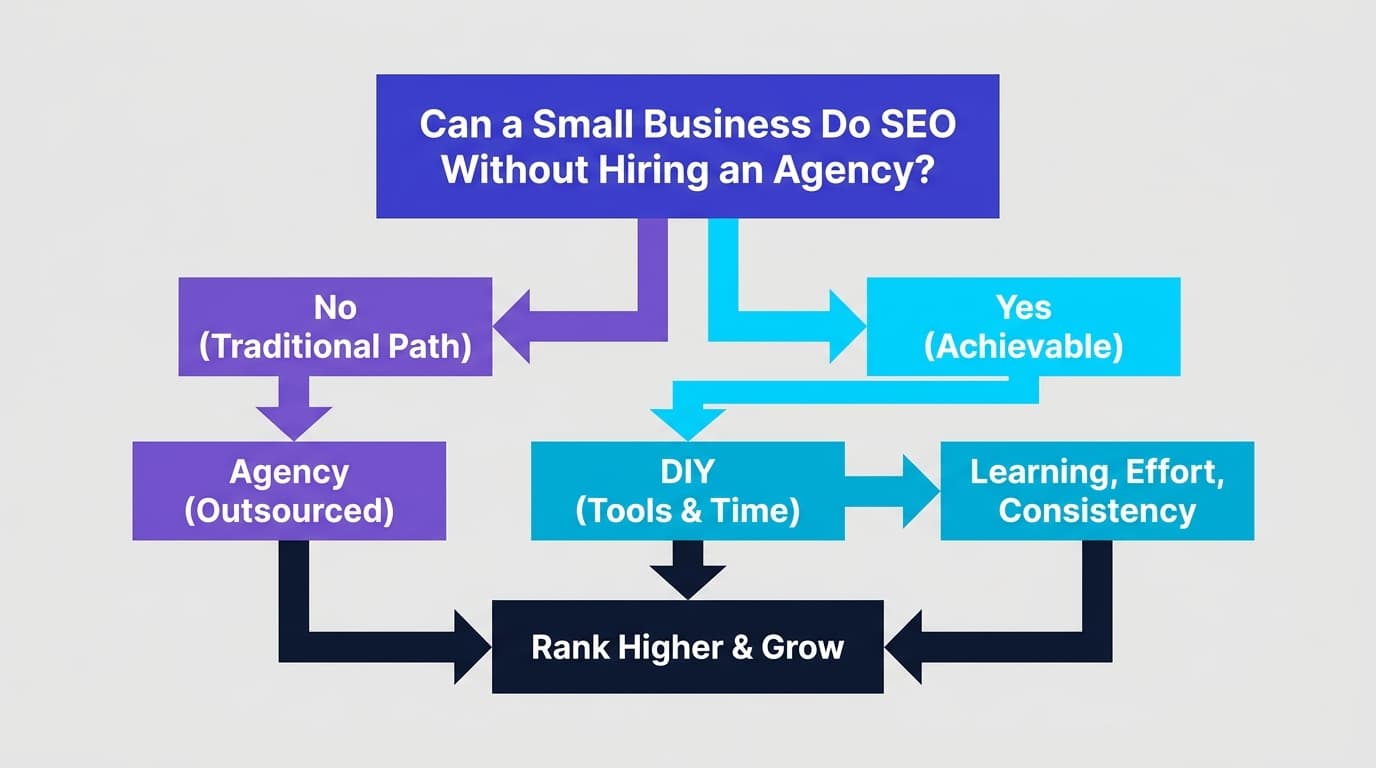
Here's what each budget level realistically delivers:
| Approach | Monthly Cost | Best For | Typical Timeline |
|---|---|---|---|
| DIY (free tools + your time) | $0-$150 | Local, low-competition markets | 9-15 months |
| Freelancer | $500-$2,000 | Single niche, defined geography | 6-12 months |
| Small business SEO services (agency) | $1,500-$5,000 | Competitive markets, e-commerce | 4-9 months |
The honest cost of DIY is not just tools. A business owner spending eight hours per week on SEO at $80/hour is making a $2,560/month investment before paying for a single tool. For many, hiring a freelancer is the cheaper option once time is counted.
The calculation most businesses skip: what would you spend on Google Ads to generate the same organic visibility? Competitive local keywords cost $8-$25 per click. A local business generating 200 monthly organic visits through SEO is replacing $1,600-$5,000 in recurring ad spend at zero marginal cost per visit once rankings hold.
On seo packages for small business: avoid packages that deliver only automated reports and generic posts. Ask any provider directly, 'What will you actually change on my site, and what original content will you publish?' If the answer is vague, keep looking. Affordable SEO strategies are defined by real outcomes, not low price tags.
Industry Playbooks: SEO That Fits Your Business Model
Generic small business seo advice produces generic results. The tactics that move a local restaurant to the top of the Google local pack differ substantially from what works for a B2B SaaS startup trying to rank for competitive commercial keywords. Understanding which playbook fits your model is what separates focused SEO from scattered effort that shows no results after 12 months.
Local Service Businesses (Plumbers, Dentists, Lawyers, Electricians)
Priority: Google local pack visibility and review volume. Your homepage must state your service area, core services, and contact details above the fold. Build a dedicated page for each service line. Earn citations from local chambers of commerce and industry-specific directories. A single, well-documented case study or before-and-after page often outperforms a generic blog for local conversions, because the intent is already buying-ready.
E-Commerce
Priority: category page SEO before product page SEO. Most e-commerce small businesses underinvest in category pages and overinvest in individual product descriptions. A well-optimized category page targeting 'waterproof hiking boots under $100' captures far more search demand than 50 thin product pages. Adding product schema markup for price, availability, and reviews also lifts click-through rates directly in search results.
SaaS and B2B Startups
Priority: bottom-of-funnel content first, then informational. A SaaS startup should rank for '[problem your product solves] + software' before attempting to rank for broad educational terms. Transactional intent converts now; informational intent takes months to nurture. Our post on digital marketing for SaaS covers the full channel mix that complements SEO for software companies at different growth stages.
Frequently asked questions
Why SEO is important for small business
SEO gives small businesses sustainable visibility without the recurring cost of paid ads. Organic search is the largest single traffic channel for most small business websites, and unlike pay-per-click campaigns, rankings you earn keep driving traffic after you stop paying. For businesses with tight marketing budgets, that compounding return is difficult to match with any other channel.
Why local SEO is important for small business
Local SEO connects you to buyers in your area at the exact moment they're ready to act. BrightLocal's 2025 survey found that 98% of consumers searched online to find a local business in the past year. Ranking in the Google local pack converts at higher rates than generic organic traffic because searcher intent is immediate and location-specific.
How much does SEO cost for a small business
SEO costs range from near-zero using free tools to $1,500-$5,000 per month for full-service small business seo services. A realistic DIY budget with paid rank tracking tools runs $50-$150 monthly. Freelancers typically charge $500-$2,000 per month. Most small businesses reach positive ROI from professional SEO within 9-12 months, making it cost-effective compared to sustaining PPC on the same keyword set.
Can I rank on Google without building backlinks?
For local searches, often yes. Google's local pack ranks on relevance, proximity, and prominence, where reviews and citations carry more weight than links. For competitive non-local keywords, backlinks still matter. A small business with optimized pages and strong local signals can reach page one in lower-competition niches without an active link-building campaign, particularly in service categories with clear geographic limits.
What is the difference between seo services for small business and a small business seo company?
The terms overlap but carry a useful distinction. SEO services typically refers to specific deliverables: a technical audit, content creation, or link outreach. A small business seo company usually manages the entire channel on an ongoing retainer. Starting with defined freelance services and scaling to an agency when growth justifies it is the lower-risk path for most small businesses.
How do I know if my SEO is working?
Track three metrics: keyword rankings for your target phrases, organic sessions in Google Analytics, and organic leads or conversions. Rankings should improve steadily over 3-6 months. Traffic typically lags rankings by 4-8 weeks. If rankings improve but conversions stay flat, the issue is usually a mismatch between keyword intent and what your page delivers, not an SEO failure.
Should I hire a small business seo company or manage it myself?
DIY works well when your market is local, competition is moderate, and you can commit 5-8 hours per week consistently. Hiring makes more sense when competition is high, your site has unresolved technical issues, or your time is more valuable running the business. Calculate your hourly rate, multiply by the hours SEO requires monthly, and compare that total to what a freelancer charges. The math often surprises people.
Key Takeaways
- Small business SEO targets local relevance and niche authority, not global competition for high-volume keywords.
- Realistic timelines: local service businesses hit ROI-positive around month 6-9; e-commerce and SaaS take 10-18 months.
- The five foundations (keyword research, on-page optimization, technical hygiene, local citations, consistent content) outperform any advanced tactic built on a weak base.
- DIY SEO is viable for most local businesses under $150/month in tools; the real cost is 5-8 hours per week of your time.
- Measure SEO by cost-per-lead and rank movement, not just traffic volume, to make the investment defensible.
- Local SEO typically delivers faster wins than broad organic SEO. Start there before scaling to competitive national keywords.
- Review generation and consistent publishing compound over time and cost nothing but discipline.
Ready to stop guessing where you rank and start tracking what actually moves? Get started with Project Rankup for rank tracking and SEO project management built specifically for small business growth.