
An SEO optimizer is a professional, a software system, or a combination of both that systematically improves a website's visibility in search engines through technical fixes, content improvements, and authority signals. That definition has not changed. What has changed, sharply and permanently, is where rankings actually matter. In 2026, appearing in Google's AI Overviews, ChatGPT's cited sources, and Perplexity's answer cards is often worth more than holding the number-three organic result, because a growing share of searchers never scroll past the synthesized answer.
Quick Answer: A modern SEO optimizer must master three compounding disciplines: classic SEO (technical health, E-E-A-T, backlinks), Answer Engine Optimization (AEO) for AI-generated answer boxes, and Generative Engine Optimization (GEO) to earn citations from large language models. Tools, content quality, and structured data are the levers; the payoff is visibility across every surface where your audience searches.
What Is an SEO Optimizer, and Why Has the Job Changed?
An SEO optimizer, whether a freelancer running a five-client retainer or a platform with automated audit pipelines, closes the gap between where a site currently ranks and where its content deserves to rank. For most of the discipline's history, that meant fixing crawl errors, matching keyword intent, and earning links. Those fundamentals remain load-bearing. But Gartner forecast in 2024 that traditional search engine volume would decline 25% by 2026 as users migrate queries to AI assistants. By mid-2026, McKinsey research indicated that over 40% of enterprise search queries were being redirected to AI-powered answer engines rather than traditional search results (McKinsey, 2026). That shift has already arrived in partial form: AI Overviews now appear across a substantial slice of commercial and informational queries, and tools like Perplexity handle millions of searches daily without ever sending users to a results page.
The practical consequence is this: an seo optimizer who only chases blue-link rankings is optimizing for a shrinking surface. The role now requires fluency across three overlapping disciplines: classic SEO, Answer Engine Optimization (AEO), and Generative Engine Optimization (GEO). None replaces the other. They compound.
SEO Optimizer Job Description: What the Role Actually Requires
The modern seo optimizer job description reads differently than it did even two years ago. At its core, the role still requires keyword research, on-page optimization, technical auditing, and link analysis. But layered on top of those are skills most job postings from 2022 would not have listed.
Core competencies in 2026:
- Technical SEO: Core Web Vitals, crawl budget management, log-file analysis, structured data implementation
- Content strategy: E-E-A-T signals, topical authority mapping, content gap analysis
- AEO and GEO: Writing for AI extraction, FAQ schema, passage optimization, citation earning in LLMs
- Data fluency: GA4, Google Search Console, rank-tracking platforms, custom dashboards
- AI tool operation: Prompt engineering for AI keyword research, automated audit interpretation, AI content review workflows
The most valuable SEO optimizers right now are the ones who understand why a piece of content gets cited by ChatGPT versus why it ranks in position one. Those are related but not identical problems. Citation happens when your content is the clearest, most authoritative answer to a query in the model's training data or live retrieval layer. Ranking happens when your page scores across dozens of on-page and off-page signals. Getting both requires a different workflow than getting either alone.
The future of SEO roles will bifurcate between generalists who manage the full stack for SMBs and specialists who own one layer (technical, content, AEO, link acquisition) inside larger teams. Both tracks are growing.
Best SEO Optimization Software 2026: A Practical Breakdown
Choosing seo optimizer software starts with knowing which problem you need solved first. A SaaS startup with thin content needs different tools than an e-commerce brand with 50,000 URLs. Below is a practical breakdown of the main categories, with honest notes on where each one earns its cost.
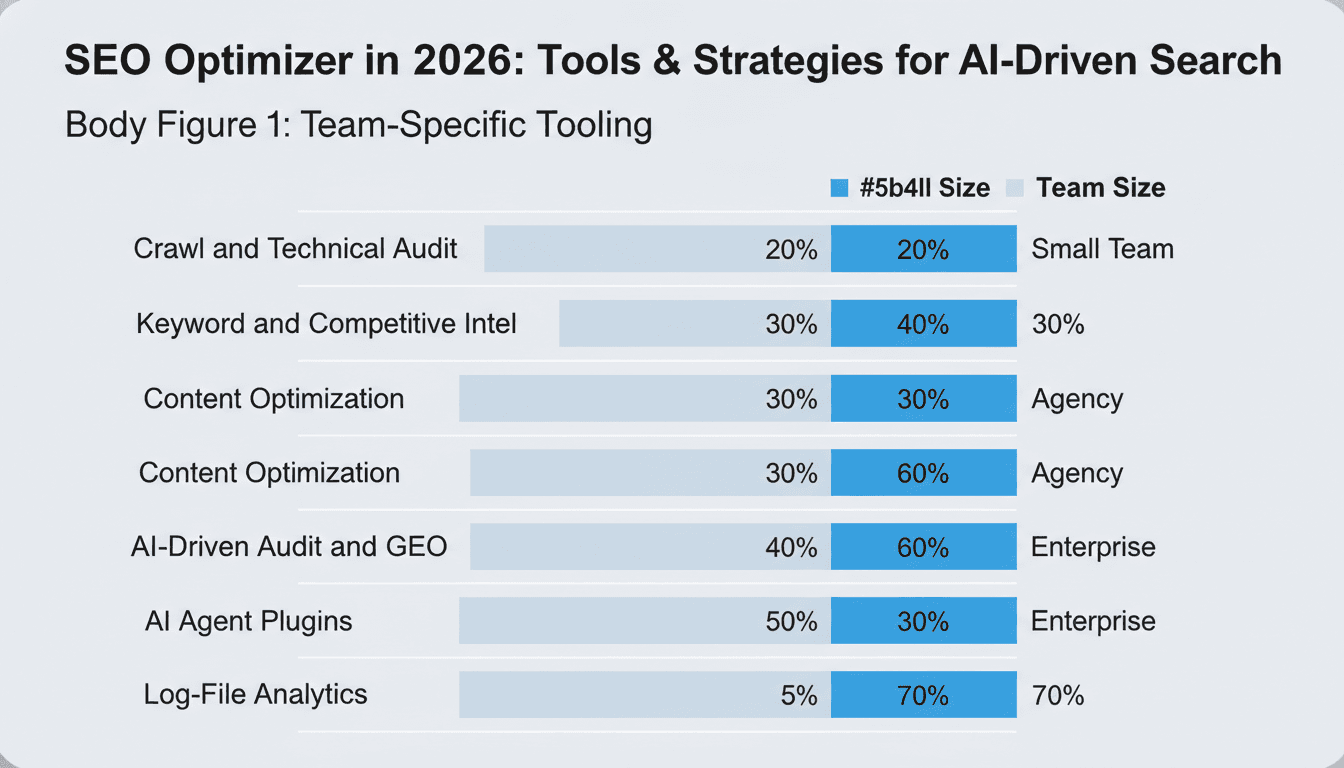
| Category | Primary Use | Best For | Notable Platforms |
|---|---|---|---|
| Crawl and technical audit | Site health, indexability, Core Web Vitals | Agencies, enterprise | Screaming Frog, Sitebulb |
| Keyword and competitive intel | Gap analysis, SERP tracking, backlink data | All team sizes | Ahrefs, Semrush |
| Content optimization | NLP scoring, entity coverage, readability | Content teams, SaaS | Surfer SEO, Clearscope |
| AI-driven audit and GEO | Automated insight, citation readiness, AEO scoring | Agencies, startups | Project Rankup |
| AI agent plugins | Automated on-page fixes, schema injection | Site owners, developers | GaiSEO AI SEO optimizer website plugin, RankMath AI |
| Log-file and crawl analytics | Server-side crawl behavior, bot analysis | Enterprise, large e-commerce | Botify, Lumar |
A few honest observations about this list. First, the keyword platform category is now table stakes, not a differentiator. Almost every serious seo optimizer runs Ahrefs or Semrush; the competitive moat comes from what you do with the data, not from having access to it. Second, the AI-driven audit category is where the most meaningful product development is happening in 2026. Platforms that can ingest a full site, score content against E-E-A-T signals, flag AEO readiness, and surface prioritized fixes in a single workflow save hours per client per week.
For a deeper comparison of audit platforms, the best AI content audit tools guide on the Project Rankup blog covers the leading options in detail, including how they handle GEO readiness scoring.
The seo optimizer ai agent category deserves a separate mention. These are systems, sometimes plugins like the GaiSEO AI SEO optimizer website plugin, sometimes API-connected workflows, that can execute optimization tasks rather than just surface recommendations. Think automated meta-tag rewrites, schema injection, internal link suggestions pushed directly to a CMS. They reduce the gap between identifying an issue and fixing it, which is where most optimization work actually stalls.
Also Read: Advanced SEO Tools for Agency Growth in 2026
AI-Powered SEO Strategies That Move Rankings in 2026
AI-powered SEO strategies are not about using AI to write more content faster. Every team with a subscription to an LLM can do that, which means undifferentiated AI-generated content is already the baseline, not the edge. The teams winning in 2026 use AI at the diagnostic and structural layer, then bring human expertise to the execution.
The high-leverage AI strategy stack:
- Topical authority mapping at scale. Use AI tools to cluster your existing content against the full semantic landscape of your niche. Gaps reveal where competitors are pulling citations from sources that should be yours.
- Passage-level optimization. Google and LLMs both extract specific passages, not whole pages. AI tools can score each paragraph for clarity, authority signal density, and answer completeness. Rewrite the weak passages first.
- Schema automation. Structured data is the clearest signal you can send to both crawlers and AI retrieval systems. Automate FAQ, HowTo, and Article schema generation using AI, then validate with Google's Rich Results Test.
- Competitive citation analysis. Tools that show which sources ChatGPT or Perplexity cite for your target queries let you reverse-engineer what makes those pages citation-worthy. Match their depth. Exceed their specificity.
- Content velocity with quality gates. AI drafts content; human editors enforce E-E-A-T signals, add proprietary data, and verify claims. The bottleneck shifts from writing to reviewing, which is the right bottleneck to have.
For SaaS companies specifically, the digital marketing for SaaS playbook integrates these AI strategies with product-led content that earns both rankings and bottom-of-funnel conversions.
Answer Engine Optimization Tactics and Generative Engine Optimization Best Practices
Answer Engine Optimization and Generative Engine Optimization are not interchangeable, though they share infrastructure. AEO targets the specific mechanisms Google uses to generate AI Overviews and featured snippets: direct question-answer structure, FAQ schema, concise definitional paragraphs, and high E-E-A-T signals. GEO targets the broader set of AI systems, including ChatGPT, Claude, Gemini, and Perplexity, that may or may not use live retrieval. GEO content needs to be citation-worthy in the sense that an LLM would quote it when answering a related question, which means it needs authoritative depth, original insight, and attribution to verifiable sources.
Practical AEO tactics:
- Structure every major piece around the exact question the searcher types, with the answer in the first two sentences of the relevant section
- Add FAQ schema to any page with a questions section
- Keep definitional paragraphs under 90 words and self-contained: they should make sense extracted completely out of context
- Target queries with clear informational intent first; product pages can earn AEO too, but they need a strong educational component
Generative Engine Optimization best practices:
- Include original data, proprietary frameworks, or first-hand observations that cannot be found in the mass of existing content LLMs have already ingested
- Cite primary sources inline, with author and publication year visible in the text, not just as bare hyperlinks
- Use clear entity signals: your brand name, author credentials, publication date, and topical cluster should all be readable by both humans and models
- Build topical authority across a cluster, not just on isolated pages; models learn that a source is authoritative by pattern-matching across many documents from the same domain
For a deeper look at how AI search engines retrieve and rank content, the deep search AI guide explains the retrieval mechanisms that underpin both AEO and GEO. And if you want a step-by-step breakdown of earning inclusion in Google's AI Overviews specifically, the how to rank in Google AI Overviews post is the right starting point.
The Content Audit Process for SEO: Where Most Optimization Actually Happens
The content audit process for SEO is the highest-leverage activity most teams chronically underinvest in. Building new content on top of a weak existing foundation is like painting a house with a cracked frame. An audit first, always.
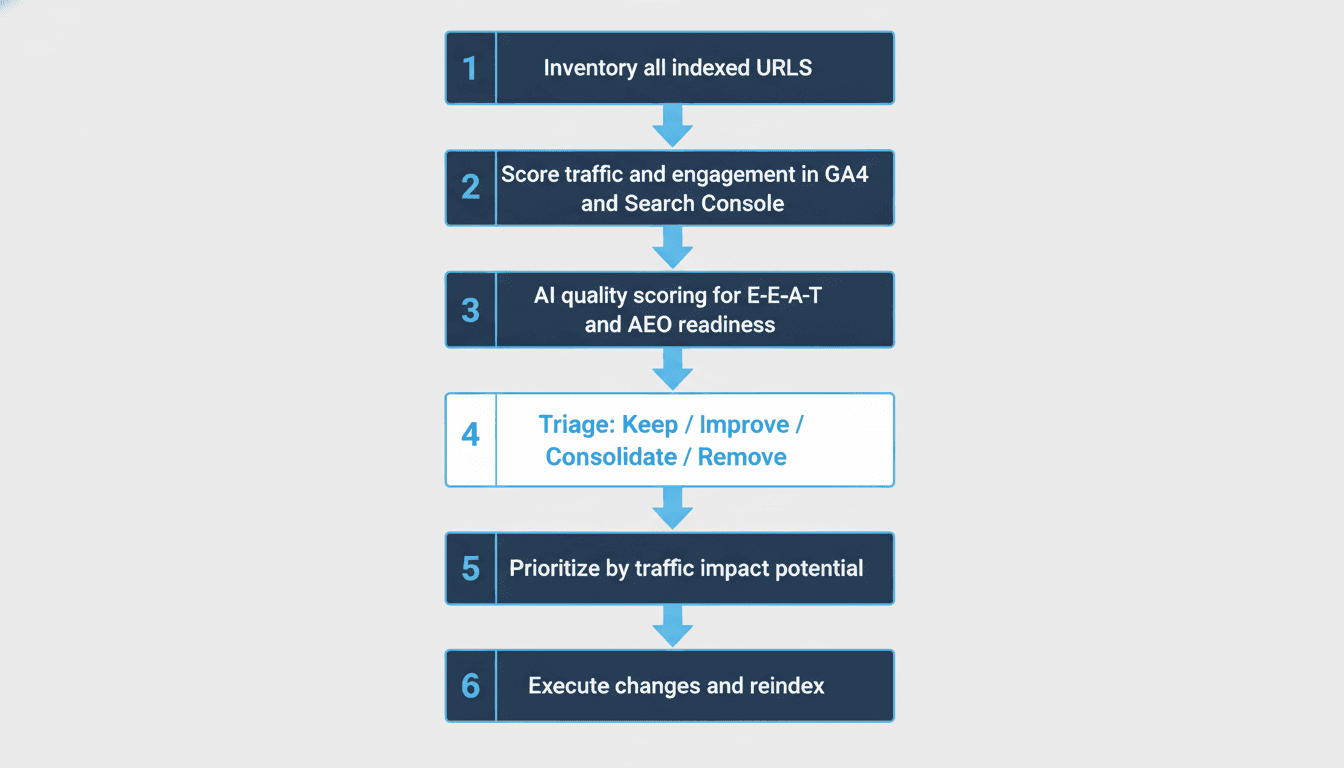
A repeatable content audit workflow for 2026:
- Inventory. Pull every indexed URL using a crawler or your XML sitemap. Tag each page by type (blog, product, category, landing page) and by its primary keyword target.
- Traffic and engagement scoring. In GA4 and Google Search Console, assign each URL a traffic tier (high, medium, low, dead) and note click-through rate, average position, and engagement time.
- Content quality scoring. Use an AI audit tool to score each page for E-E-A-T signals, topical depth, readability, and AEO readiness. Flag pages below threshold for rewrite or consolidation.
- Decision triage. Every page gets one of four labels: keep (performing well), improve (traffic but weak content, or good content but low traffic), consolidate (thin or cannibalizing), or remove (no traffic, no purpose, no recovery path).
- Prioritize by impact. Improving a page ranking in position 8-15 for a high-volume keyword is almost always higher ROI than creating a net-new page. Sort your improve list by potential traffic gain and work top-down.
- Execute and reindex. Make changes, submit updated URLs to Google Search Console, and track the result in rank-tracking software over a 30-60 day window.
A quarterly audit cadence is realistic for agencies and content teams. For e-commerce sites with large SKU sets, a rolling audit process, where a different site section gets reviewed each month, prevents the audit from becoming an overwhelming annual event.
SEO Performance Metrics Worth Tracking in 2026
SEO performance metrics have always included organic traffic, keyword rankings, and backlink growth. Those still matter. But in 2026 the measurement layer needs to extend to surfaces that traditional rank trackers do not cover natively.
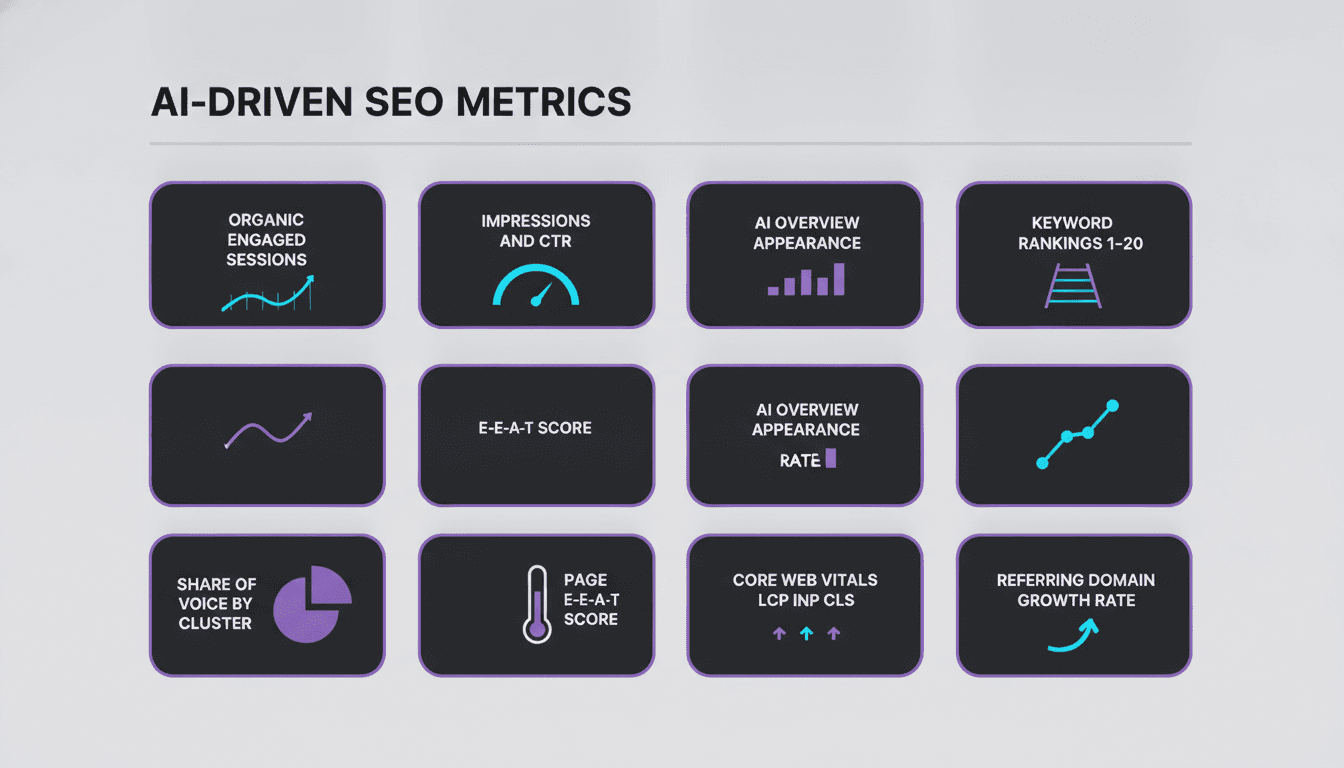
The full-stack metric set:
| Metric | Tool | Why It Matters Now |
|---|---|---|
| Organic sessions and engaged sessions | GA4 | Core traffic health signal |
| Impressions and CTR by query | Search Console | Identifies AEO cannibalization |
| AI Overview appearance rate | AI visibility trackers | Measures GEO/AEO success |
| Keyword rankings (positions 1-20) | Ahrefs / Semrush | Classic ranking health |
| Share of voice by topic cluster | Rank tracker + custom reporting | Topical authority measurement |
| Page-level E-E-A-T score | AI audit platform | Content quality proxy |
| Core Web Vitals (LCP, INP, CLS) | Search Console / PageSpeed Insights | Technical ranking factor |
| Referring domain growth rate | Ahrefs / Semrush | Link authority trend |
The metric most teams miss is AI Overview appearance rate. If a competitor's content is being cited in AI Overviews for your target queries and yours is not, that is a quantifiable AEO gap with a clear fix path. Several emerging platforms now track this; making it part of your monthly reporting is a concrete way to demonstrate GEO progress to clients who cannot yet see it in their traffic numbers.
BrightEdge's one-year review of AI Overviews (May 14, 2025) found that impressions on all content rose by over 49% since the launch of AI Overviews, while click-throughs declined by nearly 30% since May 2024. The business case for AEO is brand authority and top-of-funnel influence, not necessarily direct traffic. Clients need to understand this before they see the numbers.
Frequently asked questions
What is an SEO optimizer?
An SEO optimizer is a person or software system that improves a website's search engine rankings through technical fixes, on-page content improvements, and off-page authority building. In 2026, the role also includes optimizing for AI-generated answer engines like Google's AI Overviews and Perplexity, not just traditional ranked results.
What you have to learn to be an SEO optimizer in 2026?
To be an effective SEO optimizer today, you need fluency in technical SEO (crawlability, Core Web Vitals, structured data), content strategy grounded in E-E-A-T, keyword and competitive research using platforms like Ahrefs or Semrush, and the newer disciplines of Answer Engine Optimization and Generative Engine Optimization. Comfort working with AI tools is essential, not optional.
What is the best SEO content optimizer?
The best SEO content optimizer depends on your workflow. Clearscope and Surfer SEO lead for NLP-based content scoring against top-ranking pages. For teams that also need AEO readiness scoring and automated audit workflows, AI-native platforms like Project Rankup that span content quality, technical health, and citation readiness in one dashboard deliver more leverage per hour spent.
How does an SEO optimizer ai agent differ from traditional SEO software?
An SEO optimizer ai agent executes tasks, not just surfaces them. Traditional platforms report that a meta description is too short; an AI agent rewrites it, submits it for review, and pushes the approved version to the CMS. The distinction matters for agencies and large sites where the bottleneck is implementation speed, not insight generation.
How often should a content audit be run as part of SEO optimization?
For most sites, a quarterly content audit is the right cadence. Large e-commerce sites with thousands of URLs benefit from a rolling monthly audit covering different site sections. The key output is a prioritized action list, not a comprehensive report. Audits that produce actions rather than observations directly improve ranking performance.
What is the difference between AEO and GEO in an SEO optimizer's workflow?
Answer Engine Optimization targets Google-specific surfaces: AI Overviews, featured snippets, and the Knowledge Panel. Generative Engine Optimization targets the broader ecosystem of LLMs, including ChatGPT, Perplexity, and Claude, that generate answers from retrieved or trained content. AEO relies heavily on structured data and direct question-answer formatting. GEO relies more on citation-worthiness, original data, and topical authority signals.
Which SEO performance metrics should I prioritize in 2026?
Prioritize organic engaged sessions (not just sessions), AI Overview appearance rate for target queries, Core Web Vitals (LCP and INP specifically), and share of voice by topic cluster. Click-through rate from Search Console is an underused signal: a page with high impressions and low CTR almost always has a fixable title or meta-description problem.
Key Takeaways
- A modern seo optimizer works across classic SEO, Answer Engine Optimization, and Generative Engine Optimization simultaneously, because rankings now span multiple AI-driven surfaces.
- The future of SEO roles favors specialists who can bridge technical execution and AI content strategy, not generalists who treat every year the same.
- The best SEO optimization software 2026 has shifted from data-access tools to AI-driven audit and execution platforms that reduce the gap between insight and implementation.
- The content audit process for SEO is the highest-leverage activity available to most teams; improving existing pages that rank 8-15 typically outperforms creating net-new content.
- AI-powered SEO strategies win when AI handles the diagnostic and structural layer, and humans add proprietary insight, first-hand evidence, and genuine editorial judgment.
- SEO performance metrics must now include AI Overview appearance rate alongside traditional ranking and traffic signals.
- Structured data, passage-level clarity, and original data are the three inputs most consistently associated with citation in both AI Overviews and LLM-generated answers.
If you are ready to close the gap between where your site ranks and where it should, explore Project Rankup's AI-powered audit tools and content engine to see how a modern SEO optimizer workflow can be built around your specific growth goals.