
LSI keywords are semantically related terms that help search engines confirm a page's topic and context. Despite a common misconception, Google has not used the original Latent Semantic Indexing algorithm since the early 2000s, but the label stuck because it captures something real: pages that rank well today surround their primary keyword with a rich web of conceptually related language. If your content only repeats the target phrase and ignores the vocabulary that naturally surrounds the topic, Google's neural models treat it as thin, and it ranks accordingly.
Quick Answer: LSI keywords are contextually related words and phrases that signal to search engines what a page is genuinely about. They are not synonyms stuffed in for density. They are the vocabulary a subject-matter expert naturally uses, and their presence or absence is one of the clearest signals separating thin content from authoritative content in 2026.
What Are LSI Keywords, Really?
The term comes from a 1988 information-retrieval technique called Latent Semantic Indexing, which mapped relationships between words in documents using a statistical method called singular value decomposition. The idea was that words appearing in similar contexts share meaning, even when the exact string differs. Google's John Mueller confirmed in a 2019 Google Search Central video that Google does not use LSI, but the underlying concept, that co-occurring terms signal topic relevance, is more accurate now than it was then.
Modern search engines use transformer-based language models, including BERT (2019) and MUM (2021), that understand language the way humans do: contextually. When Google reads a page about "mortgage rates," it expects to encounter words like "fixed," "ARM," "lender," "points," and "refinance." Their absence does not just leave gaps; it actively reduces confidence in the page's authority. That is the practical definition of an LSI keyword in 2026: a term whose presence raises topical trust.
The common mistake most SEO teams make is treating LSI keywords as a secondary keyword list to sprinkle in. They are not. They are the connective tissue of expert writing. A financial advisor writing about mortgages will use those terms without thinking. An AI tool optimizing for keyword density will not, and the gap is detectable.
LSI Keywords vs. Long-Tail Keywords: Which Matters More?
These two categories are genuinely different, and conflating them is one of the most common strategy errors in content planning.
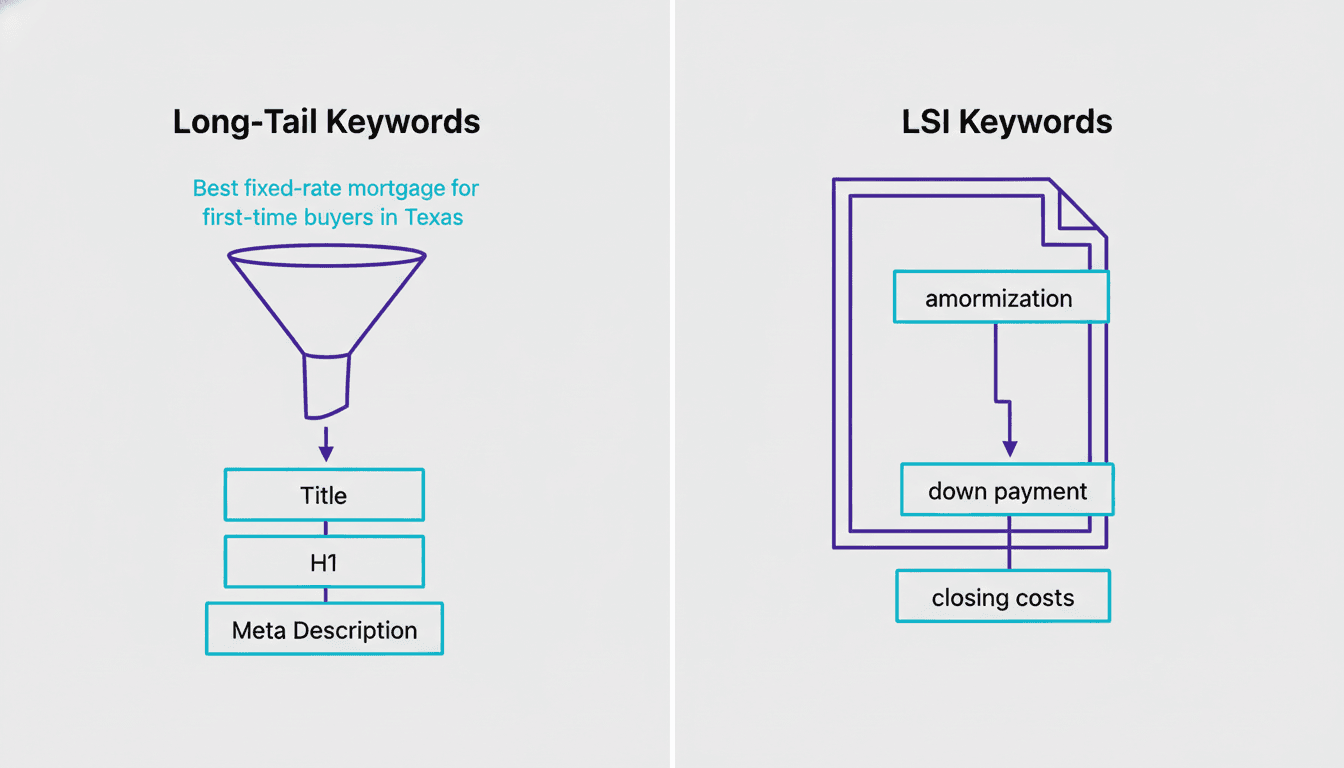
A long-tail keyword is a specific search phrase, usually three or more words, that targets a narrow slice of intent. "Best fixed-rate mortgage for first-time buyers in Texas" is a long-tail keyword. It captures a defined audience with a defined need.
An LSI keyword is not a target phrase at all. It is a vocabulary signal. "Amortization," "down payment," "closing costs" are LSI terms for a mortgage page. No one searches for "amortization" hoping to land on your mortgage-rate page, but their presence on that page tells Google the content is authoritative.
The practical implication: long-tail keywords drive traffic to specific pages. LSI terms help those pages rank for the long-tail keywords in the first place. You need both, but they serve different jobs in your content plan.
This table shows where each fits in an actual workflow:
| Dimension | LSI Keywords | Long-Tail Keywords |
|---|---|---|
| Primary role | Topical authority signal | Traffic and intent targeting |
| Where they appear | Naturally throughout the body | Title, H1, meta, opening paragraph |
| How you find them | Semantic tools, SERP analysis | Keyword research tools, Search Console |
| Ranking mechanism | Boosts confidence in topic relevance | Direct match to searcher query |
| Risk of overuse | Unnatural vocabulary clustering | Keyword stuffing penalties |
| 2026 AI search impact | Cited in AI Overviews as context | Triggers the initial search match |
The cleanest rule: write for the long-tail intent, then cover the topic so thoroughly that LSI terms appear without you hunting for them. If you are manually inserting them, your content is probably missing whole sub-topics that should exist anyway.
How LSI Keywords Impact Rankings in 2026
The mechanism is more concrete than most guides admit. Google's Helpful Content system, updated continuously through 2025, assesses whether a page covers a topic with the depth and vocabulary of a genuine expert, according to Google's search quality evaluator guidelines. Thin pages that repeat the primary keyword without surrounding context score poorly on these signals, regardless of their backlink profile.
The impact on AI-generated answers is even more direct. When ChatGPT, Perplexity, or Google's AI Overviews pull a passage from your page, they extract it because it sits inside a coherent topic cluster. A paragraph about "fixed-rate mortgages" surrounded by related financial vocabulary is far more likely to be extracted and cited than the same paragraph in isolation.
For SaaS content teams, this distinction is urgent. A lot of SaaS blogs target a primary keyword, write 800 words, and call it done. The pages rank at position six or seven but never break into AI Overviews. Adding semantic depth, which means covering the surrounding vocabulary and sub-topics, is often the single change that lifts both the traditional rank and the AI citation rate.
Three mechanisms drive the ranking effect:
- Topic confidence: Co-occurring vocabulary raises the semantic similarity score between a page and a query, even when the query uses different words than the page.
- Entity association: Search engines map named entities (people, brands, concepts) to topic clusters. LSI terms connect your page to the right cluster.
- Passage indexing: Google's passage-level indexing, rolled out globally in 2021, evaluates individual paragraphs for relevance. Passages surrounded by related vocabulary rank better than isolated claims.
How to Find LSI Keywords That Actually Work
There are four reliable methods, and they scale differently depending on whether you are an agency handling 50 clients or a startup team producing two posts a month.
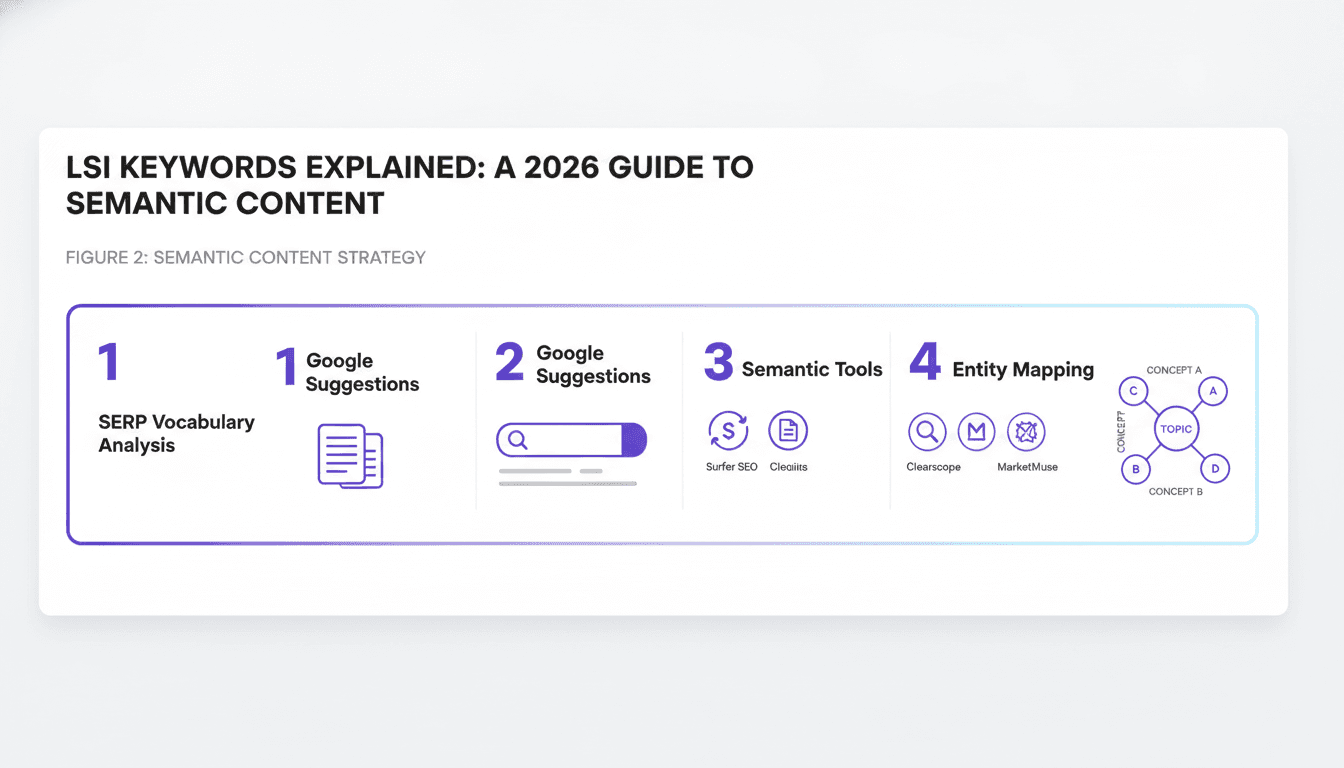
Method 1: SERP Vocabulary Analysis
Open the top five ranking pages for your target keyword. Do not skim them. Read them like an editor. Note the recurring phrases that are not your primary keyword. These are the terms Google has already validated as topically relevant. A free way to do this systematically: paste the text of each page into a word frequency tool and compare the most common non-stop-word phrases across all five pages. The overlap is your LSI list.
Method 2: Google's Own Suggestions
Type your primary keyword into Google but do not press enter. The autocomplete suggestions are a direct signal of what co-queries Google associates with the topic. Then scroll to the bottom of the results page. The "People also ask" and "Related searches" sections are practically a free semantic map. The phrases there are LSI-adjacent: they show the sub-topics and vocabulary Google ties to your main keyword.
Method 3: Semantic Keyword Tools
Several tools have been built specifically for this task. The most reliable in 2026:
- Surfer SEO: Scans the top-ranking pages and produces a list of terms by frequency and topical weight. Strong for on-page optimization. Good for agencies managing high volumes.
- Clearscope: Grades content by topic coverage compared to competitors. The grading rubric is essentially a semantic gap report.
- MarketMuse: Builds topic models at the site level, so you can see which LSI clusters your domain already covers and where the gaps are. Expensive, but useful for enterprise content audits.
- Google Search Console: Not a semantic tool in name, but the "Queries" report shows you which related phrases your page already ranks for. These are confirmed LSI signals you can reinforce.
For a full breakdown of how these fit into a wider toolset, the ai keyword research guide on Project Rankup covers the AI-assisted side of this workflow in more depth.
Method 4: Entity Mapping
This is the step most guides skip. Beyond vocabulary, Google's Knowledge Graph connects entities: people, brands, places, and concepts. If you are writing about "content marketing," the entities Google associates with it include HubSpot, Joe Pulizzi, Content Marketing Institute, and the concept of buyer personas. Naming and linking to these entities, where relevant, strengthens your page's entity associations and its topical authority signal. This is a distinct layer above vocabulary-level LSI.
Semantic SEO Strategies: Building a Topic Cluster Around LSI
Finding LSI keywords is the research step. Building a content structure that uses them is the strategy. In 2026, the highest-performing sites are not optimizing individual pages in isolation; they are building topic clusters where each page covers a sub-topic and links back to a central pillar.
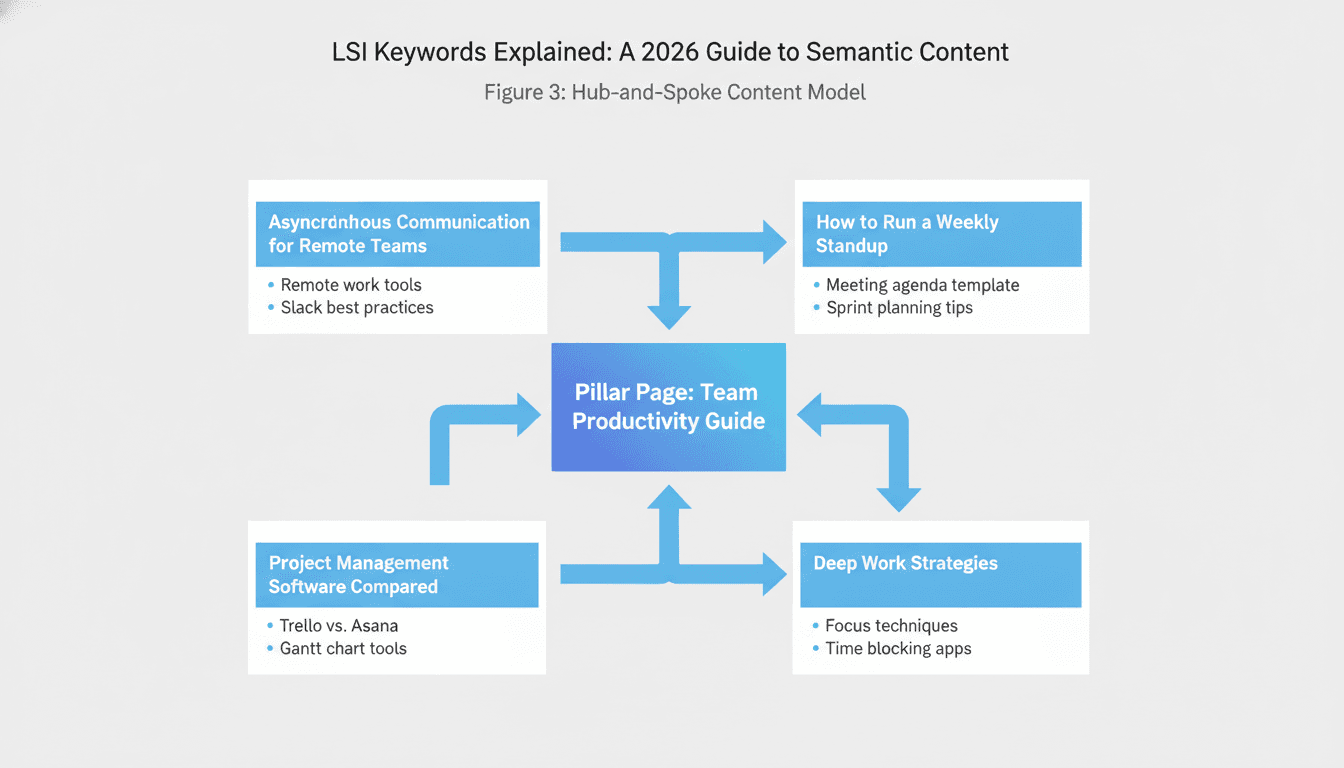
Here is how that structure works in practice for a SaaS brand in the project management space targeting "team productivity":
- Pillar page: "Team Productivity: A Complete Guide" covers the full topic with broad semantic depth.
- Cluster pages: "Asynchronous Communication for Remote Teams," "How to Run a Weekly Standup," "Project Management Software Compared" each cover a sub-topic in depth.
- LSI function: Each cluster page uses the vocabulary of its specific sub-topic, and that vocabulary links back semantically to the pillar. The pillar page benefits from the authority of the cluster without needing to repeat every term itself.
This is why a technical SEO audit should include a semantic audit alongside the standard crawl. Identifying which LSI clusters your site already covers, and where the gaps are, is a structural decision with compounding returns. An agency that maps this for a client in month one prevents six months of scattered content production.
For e-commerce brands, the same logic applies at the category level. A category page for "running shoes" should use terms like "cushioning," "heel drop," "pronation," "road vs. trail," and "breathable upper" throughout the page and in product descriptions. These are LSI terms for the category. Competitors who cover them outrank competitors who only repeat "running shoes" across a thin page.
Also Read: Best AI Content Audit Tools for SEO in 2026
Common Mistakes That Kill Semantic SEO Performance
Three errors show up consistently in content audits, and they are all fixable.
Mistake 1: Treating LSI keywords as a density target. Some tools give you a list of terms with a recommended frequency, like "use 'content marketing' 8 times." Writers then insert terms mechanically, which produces awkward sentences and misses the actual sub-topics those terms represent. The frequency is a symptom of thorough coverage, not the cause. Write the sub-topics; the frequency follows.
Mistake 2: Optimizing only the primary page. A single well-optimized pillar page cannot carry a topic cluster. If the supporting pages are thin or missing, the pillar's semantic signals are incomplete. Google evaluates a domain's authority on a topic across all its pages, not just the flagship.
Mistake 3: Ignoring the FAQ and schema layer. FAQ schema does not directly boost rankings, but it structures content in a format that AI Overviews extract reliably. Questions using LSI-adjacent vocabulary, placed in a structured FAQ, are among the most-cited content types in generative search answers. This is not a speculation. A 2025 analysis by BrightEdge found that structured content blocks appear in AI Overviews at more than twice the rate of unstructured prose. Specifically, FAQ schema appeared in 64% of AI Overview citations in their 2025 dataset, versus 29% for plain text paragraphs (BrightEdge, 2025). Moreover, content with semantic markup saw a 156% increase in AI Overview citation frequency year-over-year from 2024 to 2025 (BrightEdge State of Search Report, 2025).
The fix for all three is a proper semantic content audit before you write, not after. A tool like Project Rankup's content optimizer maps the gaps before you draft, which is a different, more efficient workflow than auditing a published page and trying to retrofit semantic depth.
For agencies running audits at scale, the SEO audit guide covers how to fold semantic analysis into a repeatable audit process without adding significant time to each client cycle.
Frequently asked questions
What are LSI keywords in simple terms?
LSI keywords are the related words and phrases that naturally surround a topic when an expert writes about it. For a page about "dog training," they include terms like "positive reinforcement," "clicker," "recall," and "leash reactivity." Their presence tells search engines the content covers the topic with genuine depth rather than surface-level repetition.
Does Google actually use LSI to rank pages?
Google does not use the original Latent Semantic Indexing algorithm. Google's own John Mueller confirmed this directly. But the principle behind the label, that related vocabulary signals topical authority, is more relevant than ever because Google's current models, including BERT and MUM, understand contextual language relationships far better than the original LSI technique did.
How do I find LSI keywords for my content?
The four most reliable methods are: analyzing the shared vocabulary of the top five ranking pages for your target keyword; reviewing Google's autocomplete, "People also ask," and "Related searches" results; using semantic tools like Surfer SEO, Clearscope, or MarketMuse to identify topic gaps; and mapping the entities Google associates with your topic through its Knowledge Graph. Search Console's query report also reveals which related terms your existing pages already rank for.
How many LSI keywords should I use per page?
There is no correct number. The right approach is to cover the topic's natural sub-topics thoroughly; the frequency of related terms is a byproduct of that coverage. If a tool tells you to use a specific term eight times, ask whether adding more instances of that term requires adding a genuinely useful paragraph or just forcing the word into sentences that do not need it. The first is good SEO. The second is keyword stuffing with extra steps.
Are LSI keywords the same as semantic keywords?
The two terms overlap heavily in practice. "Semantic keywords" is the more technically accurate label for 2026, since it does not carry the baggage of a specific 1988 algorithm. But both terms point to the same strategy: building content whose vocabulary signals topical authority to neural search models. Use whichever term your audience recognizes; the tactic is identical.
How do LSI keywords affect AI search answers like Google AI Overviews?
Pages with rich semantic vocabulary are significantly more likely to be cited in AI Overviews and generative search answers. AI systems extract passages that are self-contained and contextually coherent, and that coherence depends on the surrounding vocabulary matching the topic cluster. A well-structured paragraph about "mortgage refinancing" surrounded by relevant financial terms will be extracted and cited far more often than the same claim in a semantically thin page.
What is the difference between LSI keywords and long-tail keywords?
Long-tail keywords are specific search phrases you target to attract a defined audience. LSI keywords are the contextual vocabulary that helps a page rank for those long-tail phrases in the first place. Long-tail keywords belong in your title, H1, and opening paragraph. LSI terms appear throughout the body as natural sub-topic coverage. Both are needed; they operate at different layers of the content strategy.
How do I check if my existing content is missing LSI coverage?
Run a semantic content audit by comparing your page against the top-ranking pages for your target keyword. Tools like Clearscope and Surfer SEO generate a topic-coverage grade that highlights missing terms. A manual audit works too: list the sub-topics covered by the top five pages, then check which ones your page ignores. Each gap is a section you can add or expand to build semantic depth without rewriting the whole page.
Key Takeaways
- LSI keywords are contextually related terms that signal topical authority to search engines; they are vocabulary, not a density target.
- Google does not use the original LSI algorithm, but its current models (BERT, MUM) are far more sensitive to semantic context than LSI ever was.
- Long-tail keywords and LSI keywords serve different roles: one targets traffic, the other builds the topical trust that makes ranking possible.
- The fastest way to find LSI terms is to read the top-ranking pages for your keyword and note the shared vocabulary, then use tools like Surfer SEO or Clearscope to confirm the gaps.
- Topic clusters amplify the effect: each cluster page adds semantic signals that strengthen the pillar, compounding returns across the whole site.
- Structured content blocks, including FAQ sections with semantically rich language, are the content type most frequently cited in AI Overviews and generative search answers.
- A semantic content audit before you write prevents retrofitting and is one of the highest-leverage steps in a modern SEO workflow.
If you want to stop guessing which LSI terms your content is missing, Project Rankup's AI-powered tools map your semantic gaps before you write a single word and track how coverage changes affect your rankings over time. Get in touch with the team to see how the platform fits your content workflow.