
What is content marketing? It's a strategic approach to attracting and keeping an audience by publishing useful, relevant material rather than interrupting people with ads. Instead of pitching a product, you earn attention by answering questions, solving problems, and building trust over time. Done right, it is one of the few channels that compounds: content you published two years ago still pulls in leads today.
Quick Answer: Content marketing means creating and distributing content (articles, videos, podcasts, guides) that your audience genuinely wants, with the goal of turning strangers into buyers and buyers into advocates. It differs from traditional advertising because value comes first; the sale follows.
What Is Content Marketing, Really?
Content marketing is the practice of publishing material your audience seeks out, rather than material you push at them. A software brand that publishes a weekly newsletter on growth metrics is doing content marketing. A SaaS tool that maintains a free keyword research guide ranking on page one is doing content marketing. The commercial intent is real, but it is subordinated to genuine usefulness.
The Content Marketing Institute, which tracks the discipline annually, defines it as "a strategic marketing approach focused on creating and distributing valuable, relevant, and consistent content to attract and retain a clearly defined audience." That word consistent carries weight. A single blog post is not a content marketing programme; a publishing cadence you can sustain is.
Three terms often get tangled up here, so a quick separation:
| Term | What It Covers | What It Does Not Cover |
|---|---|---|
| Content marketing | The plan to attract and convert an audience through content | Production schedules, CMS workflows |
| Content strategy | The governance layer: audience, voice, formats, channels, success metrics | Distribution or promotion tactics |
| Content management | The operational work: publishing, updating, archiving, version control | Why you are producing content at all |
You need all three, but conflating them is how brands end up publishing lots of content that converts nobody.
What Is Content Marketing in Digital Marketing?
Within digital marketing, content marketing is the foundation layer that makes every other channel work better. Paid ads convert better when landing pages are built on clear, authoritative writing. Email click rates rise when the newsletter has trained readers to expect value. Social reach grows when the underlying content is worth sharing.
Content marketing in digital marketing covers owned channels (your blog, your email list, your YouTube channel) as well as earned placements (guest posts, podcast appearances, citations in AI answers). Paid amplification of content exists too, but the content itself is the asset. That distinction matters because owned content survives platform algorithm shifts in a way that paid placements never do.
For SEO specifically, content is the mechanism by which you earn keyword rankings and topical authority. A page cannot rank for a query that no page on your site addresses. Building content deliberately around a keyword map is still the clearest path to organic traffic growth.
How Content Marketing Works: The Funnel You Actually Need
Content marketing works by meeting buyers at each stage of their decision process, not just at the moment they are ready to buy. Most brands publish too much bottom-funnel content (product pages, comparison posts) and too little top-funnel material that builds the audience in the first place.
Here is how content type maps to journey stage:
| Funnel Stage | Searcher's Mindset | Best Content Formats | Goal |
|---|---|---|---|
| Awareness | "I have a problem" | Blog posts, short videos, social carousels, podcasts | Drive discovery, earn first visit |
| Consideration | "What are my options?" | Comparison guides, webinars, long-form articles, email sequences | Build trust, capture email |
| Decision | "Should I choose you?" | Case studies, demos, testimonials, free trials | Convert to customer |
| Retention | "How do I get more value?" | Onboarding docs, tutorials, community content | Reduce churn, increase LTV |
The mistake most SaaS and e-commerce brands make is treating content as a top-of-funnel-only tactic. Post-purchase content (onboarding guides, feature tutorials) can lift retention as much as any paid campaign. A customer who learns from your content stays longer.
Personas drive the whole system. Before you decide whether to publish a podcast or a LinkedIn carousel, you need a specific answer to: who is this for, what do they already know, and what objection are they sitting with right now? Format selection without audience research is guesswork dressed up as strategy.
Types of Content Marketing
The types of content marketing your brand should use depend on where your audience spends time and what format they trust. There is no universal ranking. A B2B SaaS brand selling to engineers gets more traction from detailed technical documentation than from Instagram Reels. A D2C skincare brand has the inverse problem.
The table below maps each format to its core strength:
| Format | Best For | Effort Level | ROI Timeline |
|---|---|---|---|
| Long-form blog / guide | SEO traffic, E-E-A-T, lead capture | Medium | 3-9 months |
| Short-form video (Reels, Shorts) | Awareness, social reach | Medium-High | 1-4 weeks |
| Podcast | Thought leadership, loyalty | High | 6-18 months |
| Email newsletter | Retention, direct conversion | Low-Medium | Immediate to 4 weeks |
| Infographic / data visual | Backlink earning, shareability | Medium | 1-6 months |
| Case study | Decision-stage conversion | Medium | 1-8 weeks |
| Interactive tool / calculator | Lead gen, time-on-site | High | 3-12 months |
| Social carousel | Repurposed reach, community building | Low | 1-2 weeks |
Repurposing is the scaling lever most teams ignore. One well-researched 2,000-word guide can become a LinkedIn carousel, a short video script, three email sequences, and a podcast episode. The research is the asset; the formats are just distribution vectors. Teams that repurpose deliberately publish far more without burning out.
Benefits of Content Marketing (With the Numbers)
The benefits of content marketing are not theoretical. The evidence is now consistent enough across multiple large-scale studies to state them as facts rather than hopes.
Demand Metric's oft-cited benchmarks show content marketing generates about three times more leads than outbound marketing while costing roughly 62% less per lead. That ratio holds across B2B and B2C when the content programme is at least 12 months old.
Businesses using a documented content strategy are more likely to report positive ROI than those producing content without a plan. The strategy document is not bureaucracy; it is the variable that separates the winning programmes from the ones that stall.
HubSpot's 2024 State of Marketing data showed that blogs, short-form video, and podcasts remain the top three formats for ROI across industries. Video in particular saw the highest year-over-year increase in reported effectiveness, which aligns with Google's continued investment in video results inside AI Overviews.
Specific benefits that hold up in practice:
- Compounding organic traffic. A blog post that ranks drives traffic every month with no incremental spend. Paid ads stop the moment you stop paying.
- E-E-A-T signals. Google's quality guidelines reward demonstrated expertise. A deep content library is the clearest signal of subject-matter authority.
- AI answer citations. LLMs and AI Overviews pull from content that answers questions directly and cites sources. Being cited in an AI Overview is 2026's version of ranking in position one.
- Sales cycle compression. Buyers who arrive having already read your content show up with fewer objections. Sales teams at SaaS brands consistently report shorter cycles for inbound leads versus outbound.
- List and community building. Every content subscriber you earn is an asset you own, unlike a social following that lives on a rented platform.
Content Marketing vs SEO: They Are Not the Same Thing
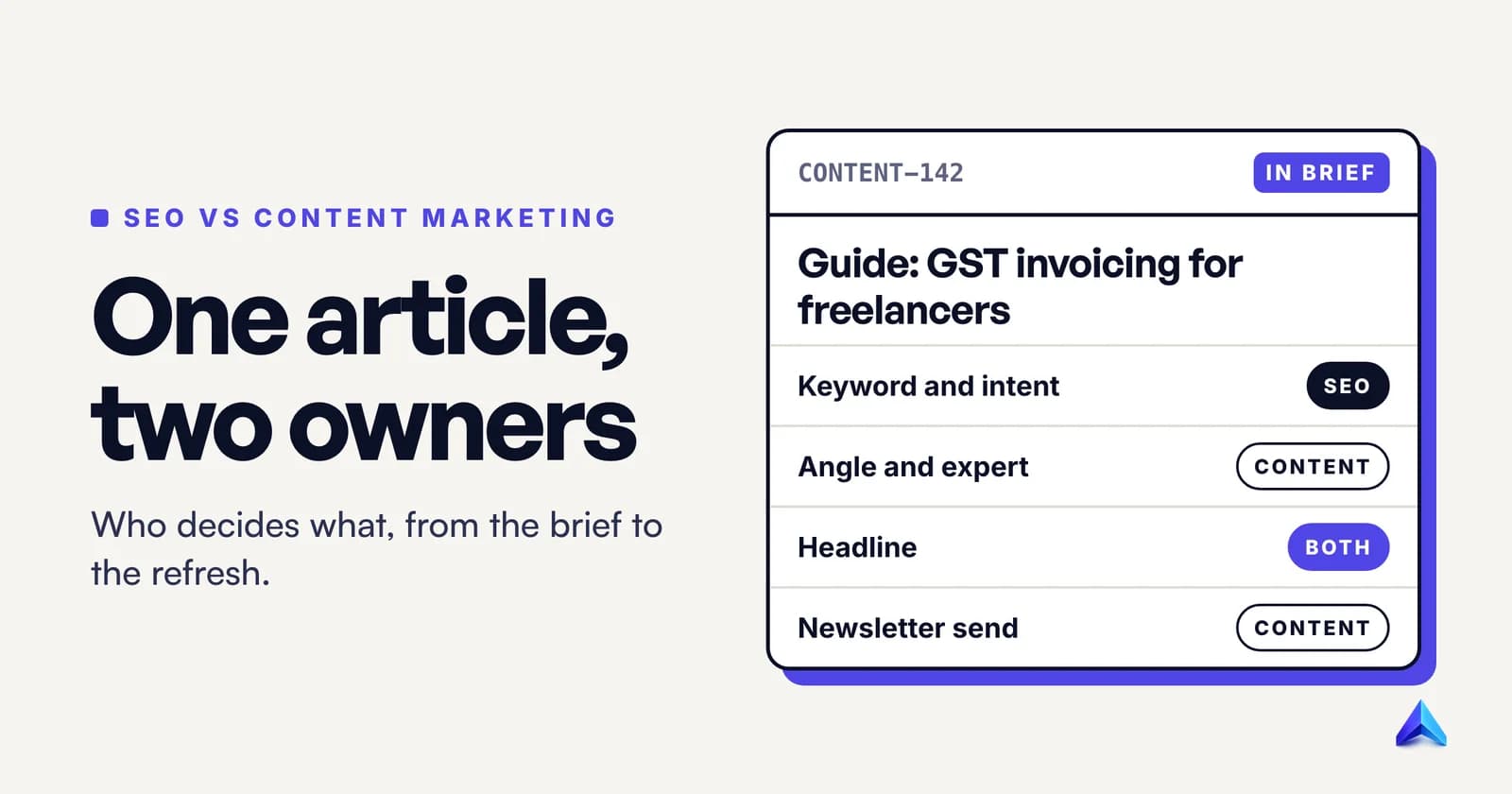
Content marketing vs SEO is one of the most common false dilemmas in digital marketing. They are different disciplines that work best together, not alternatives to each other.
SEO is the technical and structural work that makes content findable: crawlability, site speed, schema markup, link authority, canonical tags. A thorough SEO audit will find all the gaps that prevent even excellent content from ranking. Content marketing is the editorial work that gives searchers a reason to visit and return.
Here is where they differ, and where they overlap:
| Dimension | SEO | Content Marketing |
|---|---|---|
| Primary goal | Visibility in search results | Audience building and conversion |
| Main inputs | Technical fixes, backlinks, keyword targeting | Writing, video, research, distribution |
| Time to results | 3-6 months (technical), longer for authority | 3-12 months for organic; faster for email/social |
| Who owns it | SEO specialist, dev team | Content team, marketing |
| Overlap zone | On-page optimisation, topical authority, E-E-A-T | Both need keyword research, both need quality signals |
The practical implication: you can do SEO without content marketing (fixing technical issues, building links to existing pages), but you cannot scale organic traffic without content marketing. Most brands that plateau at a certain traffic level have hit the ceiling of what technical SEO can do alone.
For agencies and freelancers managing client content programmes, pairing LSI keyword mapping with content planning is the fastest way to close the topical authority gap against established competitors.
Content Marketing in the Age of AI Search
The arrival of AI Overviews, ChatGPT search, and Perplexity has changed where content surfaces, but not what makes content worth surfacing. LLMs pull from sources that answer questions directly, cite evidence, and demonstrate genuine expertise. That is a description of good content marketing, not a new standard.
What has changed is the stakes around content that is vague, thin, or derivative. AI systems are ruthless at identifying whether a piece adds new information or just rearranges what already exists. A 500-word blog post that rephrases a Wikipedia summary no longer earns citations. A 2,000-word guide that provides a framework, cites named research, and answers follow-up questions gets extracted into AI answers regularly.
Three specific shifts worth building into your content plan for 2026:
-
Answer-first structure. Open each page with a complete, standalone answer to the primary question. AI systems extract the first coherent passage that addresses a query. If your introduction is three paragraphs of scene-setting before the actual answer, you will lose the citation to the page that answers immediately.
-
Named, dated citations. "Studies show" is invisible to AI systems. "According to Semrush's State of Content Marketing 2024" is quotable. Every factual claim needs a source name and year attached to it.
-
Structured content blocks. Tables, numbered steps, and FAQ sections are extracted into AI answers at a far higher rate than equivalent information buried in paragraphs. Format the information the way an answer engine would want to reproduce it.
A regular content audit is essential here. AI search surfaces the best-performing content across your site and your competitors' sites simultaneously. If you have old pages on a topic that contradict your newer thinking, they will both surface and confuse the picture.
What Is a Content Marketing Strategy?
A content marketing strategy is the document that connects your audience research to your publishing plan, your formats to your goals, and your distribution channels to your metrics. Without it, content production becomes activity mistaken for progress.
A working content marketing strategy for 2026 covers six components:
-
Audience definition. Named personas with specific pain points, not demographic buckets. "SaaS founder, 30-45, Series A, struggling to attribute MQL to content" is a persona. "Marketing professionals" is not.
-
Goal and metric alignment. Each content type gets a primary KPI: blog posts get organic traffic and time on page; email gets open rate and click-to-lead; case studies get sales cycle length. ROI without stage-level metrics is unmeasurable.
-
Keyword and topic map. Built from search volume data and competitor gap analysis. Keyword research is the input; the topic map is the output. Publish in clusters, not randomly.
-
Format and channel selection. Driven by audience preference and team capacity, not trend-chasing. Three formats executed well beat eight formats executed poorly.
-
Content calendar. A publishing calendar converts the strategy into a schedule. Cadence matters more than volume; consistent monthly publishing outperforms sporadic bursts.
-
Distribution and amplification plan. Every piece needs a promotion plan: email send, social adaptation, internal linking, outreach for backlinks. Publishing without distribution is shelf stocking without a store.
Measurement sits at the end of each cycle and feeds back into step one. The KPIs that signal a healthy programme at 12 months: organic sessions growing month-on-month, email list growth rate above 5% monthly, and demo or trial requests attributable to content touchpoints increasing as a share of total pipeline.
Frequently asked questions
What is content marketing?
Content marketing is a planned approach to building an audience by publishing material those people actively seek out: articles, videos, guides, and podcasts that answer their questions or solve their problems. The brand earns trust and visibility first; commercial conversions follow. It differs from advertising because the content itself delivers value before any sale is attempted.
What is content marketing on social media?
Content marketing on social media means distributing value-first content through platforms like LinkedIn, Instagram, or YouTube rather than pushing promotional posts. Examples include educational carousels, short how-to videos, and data-driven threads. The goal is audience building and trust, with social as the distribution channel rather than the content format itself.
What is content marketing in digital marketing?
In digital marketing, content marketing is the owned-media layer that makes all other channels more effective. It covers blog content for SEO, email newsletters for retention, video for social reach, and long-form guides for lead generation. It works alongside paid media and technical SEO rather than replacing them, and it builds assets that compound in value over time.
What is the primary goal of content marketing?
The primary goal of content marketing is to attract and retain a clearly defined audience by consistently delivering content they find useful, which builds enough trust to turn that audience into customers over time. Secondary goals vary by stage: awareness content drives traffic, consideration content captures leads, and retention content reduces churn.
Is content marketing the same as copywriting?
No. Copywriting is writing designed to drive an immediate action: a purchase, a click, a sign-up. Content marketing is a longer-term editorial programme aimed at building an audience and trust over months and years. Good content marketing uses strong copywriting within it, but the two are different disciplines with different timelines and success metrics.
How long does content marketing take to show ROI?
Organic content (blog posts targeting search traffic) typically shows meaningful ROI between three and nine months after publishing, depending on domain authority and competition. Email and social content can return results within weeks. The full compounding effect, where a content library drives predictable pipeline, usually takes 12 to 18 months of consistent publishing.
What is the difference between owned and earned content?
Owned content lives on channels you control: your blog, email list, or YouTube channel. You decide what publishes and when. Earned content is coverage you did not pay for: a journalist quoting your research, a podcast inviting you on, or an AI Overview citing your guide. Content marketing builds owned content first; earned placements follow when the owned content is credible enough to cite.
Key Takeaways
- Content marketing is a plan to earn an audience through useful content, not interrupt them with ads. The commercial intent is real, but value comes first.
- Content marketing, content strategy, and content management are three distinct disciplines; conflating them is the most common reason programmes stall.
- Content maps to funnel stage: awareness content drives discovery, consideration content builds trust, decision content converts, and retention content keeps customers.
- The benefits of content marketing compound over time: it generates roughly 3x the leads of outbound at 62% lower cost when a strategy is documented and sustained.
- Content marketing and SEO are not alternatives; technical SEO makes content findable, content marketing gives searchers a reason to visit and stay.
- AI search rewards the same qualities as good journalism: direct answers, named sources, structured formats, and genuine expertise.
- A content marketing strategy for 2026 needs six components: defined personas, stage-level KPIs, a keyword map, format selection, a publishing calendar, and a distribution plan.
If you want to turn these principles into a programme that actually moves rankings and pipeline, explore how Project Rankup approaches content strategy and optimisation, or check what a full SEO services engagement looks like in practice.