
Google's AI Mode alone had surpassed one billion monthly users by May 2026, according to Google, and that number keeps climbing. AI search isn't a future trend you can plan for later. It's the current reality reshaping how your customers find you, evaluate you, and decide whether to trust you. If your content strategy hasn't caught up, competitors who have adapted are already taking your traffic.
This guide gives you a clear framework for understanding what's changed, what actually matters for rankings and citations in 2026, and what steps you can take right now.
What Is AI Search, and Why Does It Change Everything?
AI search refers to search engines and answer platforms that use large language models and machine learning to generate direct answers, summaries, and recommendations rather than returning a list of blue links. Google's AI Overviews, Perplexity, ChatGPT Search, and Microsoft Copilot are the most prominent examples in 2026.
Traditional search matched keywords to pages. An AI search engine synthesizes information across multiple sources and presents a single, confident answer. The user often gets what they need without clicking through at all.
That shift has real consequences. Gartner predicted in 2024 that traditional search engine volume would drop 25% by 2026 due to AI chatbots and virtual agents (Gartner, 2024). By June 2026, 39.4% of Google desktop searches included an AI Overview, according to Comscore's Q2 2026 AI Intelligence Report (published September 22, 2026). That's not a warning about some distant future. It's happening now.
Understanding how AI influences search results is the first step toward adapting. The second step is doing something about it.
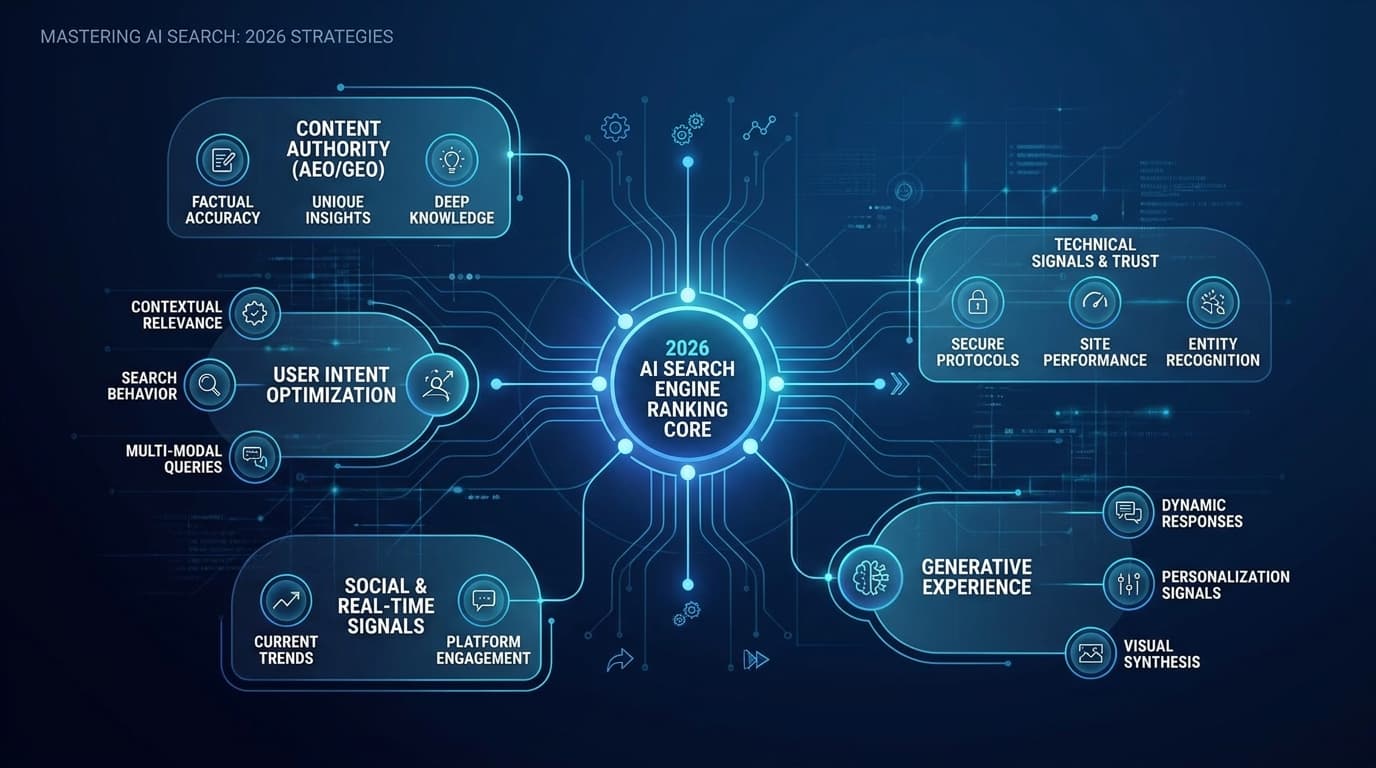
AI Search Engine Ranking Factors 2026
The signals that move the needle in an AI search engine are not identical to what drove traditional Google rankings. Keyword density is nearly irrelevant. Authority, clarity, and structured information have become the primary currency.
Here's how the two systems compare side by side:
| Factor | Traditional SEO | AI Search in 2026 |
|---|---|---|
| Content format | Long-form, keyword-rich | Clear, structured, answer-first |
| Authority signals | Backlinks | Citations, entity recognition, E-E-A-T |
| Query matching | Exact or phrase match | Semantic intent understanding |
| Content freshness | Important | Critical for cited answers |
| Structured data | Helpful | Near-essential |
| Page speed | Ranking factor | Baseline expectation |
The practical takeaway is this: AI engines favor content that answers questions directly, demonstrates expertise, and is structured in a way machines can parse cleanly.
Schema.org markup plays a bigger role than most small business owners realize. FAQ schema, HowTo schema, and Article schema all help AI systems understand and surface your content in generated answers.
Content Strategies for AI Search
Content strategies for AI search start with one shift in mindset: stop writing for clicks and start writing for citations.
AI engines lift specific passages from content that is self-contained and factually grounded. A paragraph that answers a question fully, without relying on context from earlier in the article, is far more likely to be extracted and cited. This is called Generative Engine Optimization (GEO), and it's becoming as important as traditional SEO in 2026.
Three content principles that consistently work:
- Answer first. Lead every section with a direct answer to the question it covers. Expand after. Never bury the answer at the end of a long setup.
- Cite your sources inline. AI systems trust content that references authoritative data. According to McKinsey's State of AI report, organizations that integrate AI into their core operations see measurable gains in content quality and decision speed, with 72% of business leaders reporting improved decision-making efficiency (McKinsey, 2026). Ground your claims in real data.
- Use structured formatting. Tables, numbered lists, and clear H2/H3 hierarchies make your content easier for AI to parse and quote. Walls of unbroken prose get skipped.
If you're not sure where your current content stands, a thorough review of your existing articles and pages is the fastest way to spot gaps before they cost you more traffic.
Optimizing for Generative AI Search: Deep Search AI and Beyond
Optimizing for generative AI search means preparing your content for systems that don't just retrieve information but reason about it. Deep search AI tools, like those powering Perplexity's deep research mode and Google's multi-step reasoning in AI Overviews, conduct multi-turn queries, cross-reference sources, and synthesize answers from dozens of pages simultaneously.
What that means for your content strategy:
- Topical depth beats topical breadth. Cover a narrower topic more thoroughly rather than touching many topics shallowly. Deep search AI rewards genuine expertise over surface-level coverage.
- Entity clarity matters. Be explicit about who you are, what you do, and where you operate. AI systems build knowledge graphs. If your brand isn't clearly defined in your own content, it won't appear in those graphs.
- Freshness is non-negotiable. Content that hasn't been updated since 2022 rarely gets cited. Audit and refresh on a regular schedule.
It's also useful to understand how enterprise-grade tools like azure ai search work. Azure AI Search is Microsoft's cloud-based service that uses vector search and semantic ranking to power AI applications, helping it surface results based on meaning rather than exact word matches. Understanding that architecture clarifies why semantic relevance now outranks keyword frequency across all major AI search platforms.
Features like gemini ai photo search signal that multimodal AI, where images, text, and structured data are processed together, is reshaping how users interact with search entirely. Visual content optimization is becoming part of a complete strategy, not just an optional add-on.
AI Search Optimization Tips for Small Business
Small businesses often assume AI search optimization requires an enterprise budget. That's not accurate. These AI search optimization tips for small business work without a developer or a six-figure tool stack:
- Build a dedicated FAQ page. FAQ content is among the most consistently cited content type in AI Overviews. Answer the ten questions your customers ask most often, directly and concisely.
- Claim and complete your Google Business Profile. Local AI search pulls heavily from verified business data. Incomplete profiles get passed over in favor of competitors who filled theirs out.
- Add structured data to your key pages. Google's structured data documentation is approachable even without deep technical skills, and the payoff in AI citations is real.
- Write author bios that establish credentials. E-E-A-T (Experience, Expertise, Authoritativeness, Trustworthiness) is how AI systems assess whether to trust and cite your content. Anonymous pages with no named author are at a disadvantage.
- Refresh your best-performing content quarterly. A single outdated statistic can signal to an AI engine that your whole page is stale.
These aren't shortcuts. They're the fundamentals that adapting SEO for AI search is built on, and they compound over time.
Future-Proofing SEO with AI Search
Future-proofing SEO with AI search is less about chasing algorithm updates and more about building a content foundation that's inherently trustworthy and machine-readable. Two things will remain constant regardless of how AI search systems evolve: quality signals and entity authority.
Quality signals include original research, first-hand experience, and verified data. Entity authority means your brand, your authors, and your products are clearly identifiable across the web, from your website to your social profiles to third-party mentions.
The businesses holding rankings and citations in 2027 are the ones investing in both right now. If you're curious about what a complete optimization plan looks like for your specific situation, check out Project Rankup's pricing and service options to find an approach that fits your goals and budget.
Key Takeaways
- AI search generates direct answers from synthesized content, reducing reliance on click-through traffic across all industries.
- AI search engine ranking factors in 2026 prioritize authority, structured data, semantic clarity, and content freshness over keyword density.
- Content strategies for AI search should lead every section with a direct answer, cite authoritative sources, and use clean structured formatting.
- Deep search AI rewards topical depth and entity clarity. Shallow, broad content rarely earns a citation.
- Small businesses can compete by building FAQ pages, completing structured data, and establishing clear author credibility.
- Future-proofing SEO with AI search means investing in quality signals and brand entity authority now.
- Adapting SEO for AI search is the baseline for staying visible in 2026, not an advanced optional step.
Frequently asked questions
What is AI-powered search?
AI-powered search uses large language models to understand query intent and generate synthesized answers rather than returning a ranked list of links. Systems like Google AI Overviews, Perplexity, and ChatGPT Search analyze multiple sources simultaneously and present a single contextual response, often without requiring the user to click through to any individual page.
What is deep search AI?
Deep search AI refers to advanced search systems that perform multi-step reasoning across many sources to answer complex queries. Rather than a single keyword lookup, these tools research a topic iteratively, cross-reference data points, and synthesize a comprehensive answer, similar to how a thorough human researcher would approach a detailed question.
Ready to see how your current content holds up against the real demands of AI search? Book a free consultation with Project Rankup and we'll assess where your strategy stands, identify the specific gaps, and build a tailored optimization plan to help you rank higher and get cited more across every major AI search platform.