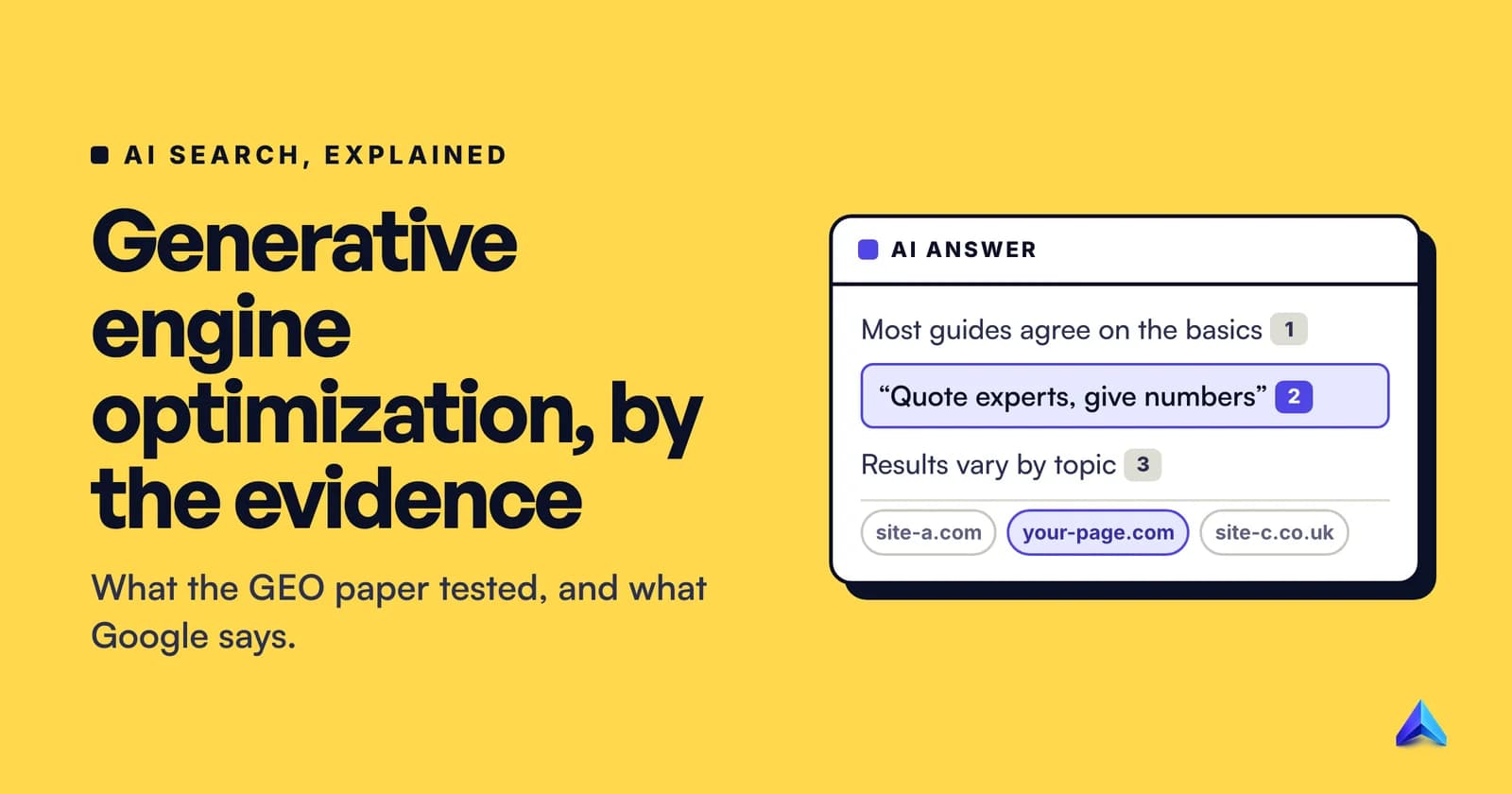
Generative engine optimization (GEO) is the work of making your pages easy for AI search systems such as Google's AI Overviews, ChatGPT search and Perplexity to find, quote and cite. The term comes from a 2023 research paper, published at KDD 2024. In its tests, adding quotations, statistics and cited sources raised a page's share of AI answers by 30 to 40% in relative terms. Keyword stuffing did not help.
That is the defensible core. Around it has grown an industry of checklists, scores and acronyms, some backed by evidence and a lot of it not. This guide reads the original paper closely, sets it next to what Google, OpenAI and Perplexity document about how they pick sources, and sorts the popular GEO advice into what is evidenced and what is opinion.
Where the term "generative engine optimization" comes from
The name was coined in an academic paper, not by a marketing agency. GEO: Generative Engine Optimization was written by Pranjal Aggarwal, Vishvak Murahari, Tanmay Rajpurohit, Ashwin Kalyan, Karthik Narasimhan and Ameet Deshpande, from IIT Delhi, Princeton University and two independent researchers. It was first posted to arXiv on 16 November 2023 and published at KDD 2024, the ACM data-mining conference held in Barcelona that August.
The authors defined a "generative engine" as a system like BingChat, Google's SGE or Perplexity that combines a conventional search engine with a language model. Instead of returning ten links, it writes one answer and attaches citations. Their worry was the website owner: when an answer is written for the reader, the click, and the visibility that came with ranking first, can disappear.
GEO, in their framing, is a set of edits a site owner can make to raise how visible a page is inside those answers, without knowing how the engine works internally.
Two related labels cause confusion. Answer engine optimization (AEO) usually means structuring content so a system can lift a direct answer from it, an idea that predates large language models and grew out of featured snippets and voice search. Our AEO vs SEO breakdown covers that overlap. "LLMO" and "AI SEO" are looser marketing terms for the same territory as GEO.
How AI search engines pick their sources
Every system that cites sources runs some version of the same pipeline. The details differ, but the order does not, and the order explains most of what GEO can and cannot do.
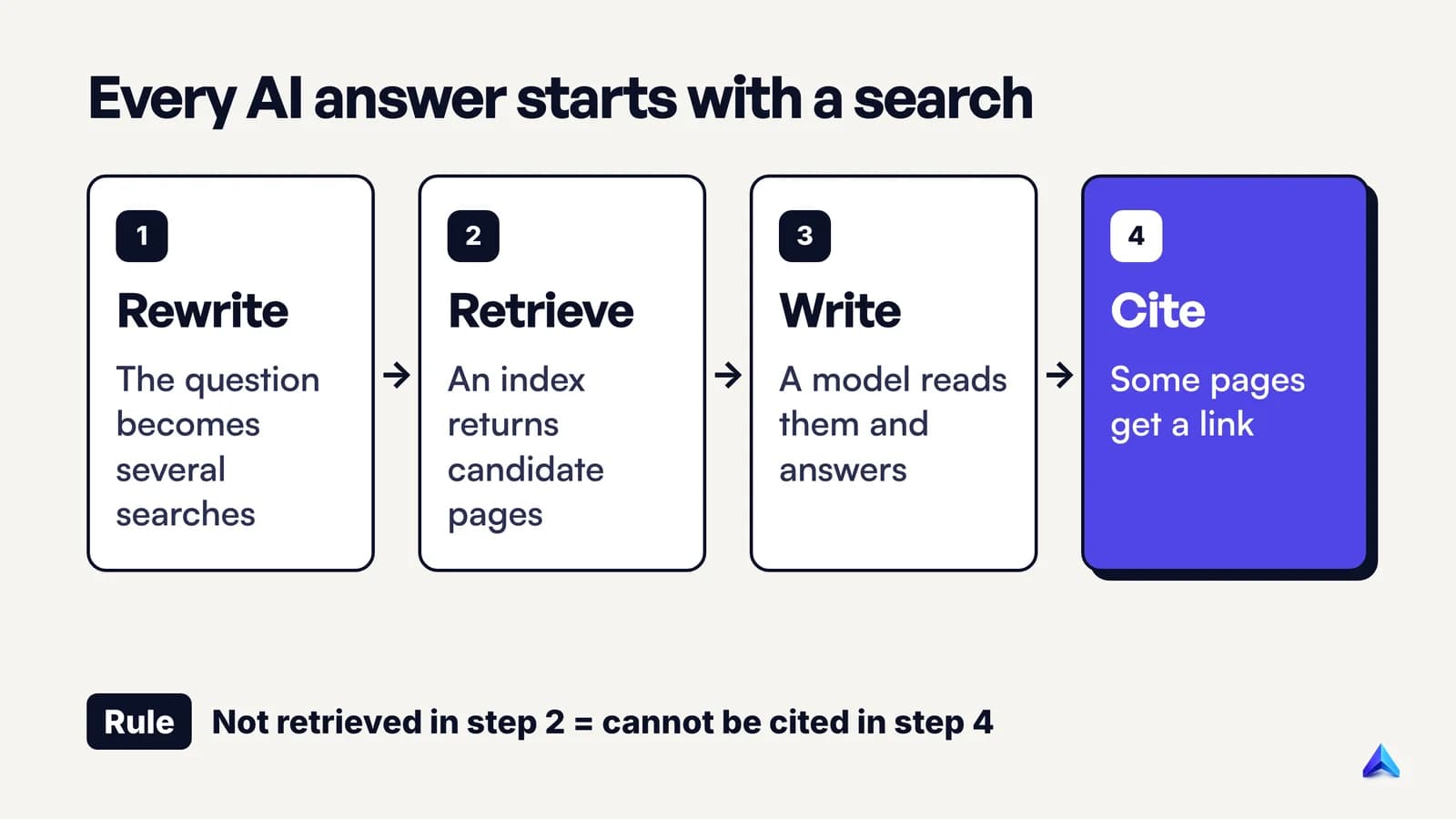
- The question is rewritten. Google calls this query fan-out: the model generates related searches to gather more material. Its own example turns "how to fix a lawn that's full of weeds" into searches such as "best herbicides for lawns". OpenAI's ChatGPT search help page describes the same step, saying ChatGPT search typically rewrites a question into one or more targeted queries that it sends to search partners.
- A search index returns candidate pages. For Google, that index is the regular Search index. Google says its AI features are "rooted in our core Search ranking and quality systems."
- A model reads the retrieved pages and writes the answer. This is retrieval-augmented generation, or grounding.
- Some of those pages are cited. Being read and being cited are separate outcomes.
The practical consequence is blunt. A page that is not retrieved in step 2 cannot be cited in step 4, however well it is written. Each engine also controls retrieval through its own crawler:
- Google: to appear as a supporting link in AI Overviews or AI Mode, a page must be indexed and eligible to show a snippet in regular Search. Nothing extra is required.
- ChatGPT: OpenAI's crawler documentation says sites that block OAI-SearchBot "will not be shown in ChatGPT search answers", though they can still appear as navigational links. GPTBot, its training crawler, is a separate switch.
- Perplexity: its bot documentation says PerplexityBot is designed to surface and link websites in Perplexity's results, and is not used to collect training data.
If you have ever blocked "AI bots" in one sweep at your CDN, check which of these you blocked. Our post on Cloudflare's AI crawler defaults covers how that happens without anyone deciding it.
What the GEO paper actually tested
Most articles quote the paper's headline, "up to 40%", and stop. The setup behind that number matters more than the number.
The queries. The authors built GEO-bench, 10,000 queries drawn from nine sources, including real Bing and Google query sets, Perplexity's Discover feed, Reddit's ELI5 questions and queries generated by GPT-4. They span 25 domains such as Arts, Health and Games. About 80% are informational, with 10% each transactional and navigational.
The engine. For each query, the system took the top five Google results and had gpt-3.5-turbo write an answer with citations, sampling five responses per query.
The edits. For each query, one of the five source pages was picked at random and rewritten by a language model, using one of nine methods: Authoritative (more persuasive tone), Statistics Addition, Keyword Stuffing, Cite Sources, Quotation Addition, Easy-to-Understand, Fluency Optimization, Unique Words and Technical Terms.
The scores. Visibility was measured two ways. Position-Adjusted Word Count is the share of the answer's words that sit in sentences citing your page, weighted so that sentences near the top count for more. Subjective Impression asked GPT-3.5 to rate seven qualities of each citation, such as relevance and how likely a reader would be to click it.
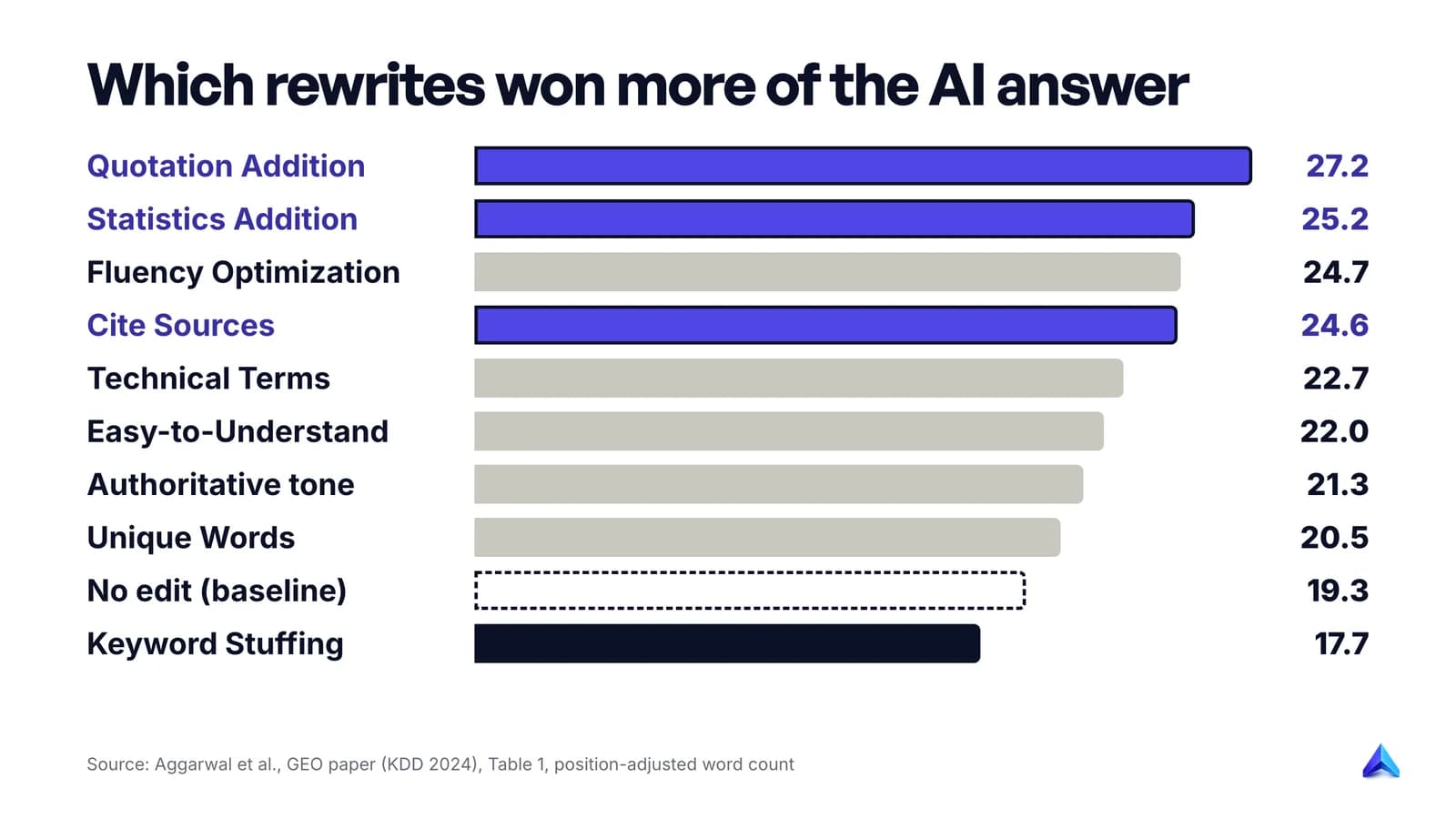
| Method | Visibility score (position-adjusted word count) | Change vs no edit |
|---|---|---|
| No optimization (baseline) | 19.3 | n/a |
| Keyword Stuffing | 17.7 | Lower |
| Unique Words | 20.5 | Slightly higher |
| Authoritative tone | 21.3 | Slightly higher |
| Easy-to-Understand | 22.0 | Higher |
| Technical Terms | 22.7 | Higher |
| Cite Sources | 24.6 | Higher |
| Fluency Optimization | 24.7 | Higher |
| Statistics Addition | 25.2 | Higher |
| Quotation Addition | 27.2 | Highest |
The paper's own summary: Cite Sources, Quotation Addition and Statistics Addition achieved "a relative improvement of 30-40%" on the word-count metric and 15 to 30% on the subjective one. A more persuasive, authoritative tone produced "no significant improvement" overall. Keyword stuffing, the oldest trick in SEO, scored below the untouched page.
What "up to 40%" actually means
The baseline of 19.3 is not an accident. Scores within one answer add up to 100, and each answer drew on five pages, so an average page holds roughly a fifth of it. Quotation Addition moved the edited page from 19.3 to 27.2. That is a 41% relative gain, and about eight points of the answer in absolute terms.
So the claim is narrow: in this test engine, a page edited this way took up a larger share of the generated answer. It is not 40% more traffic, 40% more citations, or a result measured on Google or ChatGPT.
Lower-ranked pages gained the most
The most interesting table in the paper is about rank. The edits helped pages that sat lower in Google's top five far more than the page in first place. With Cite Sources, the page ranked fifth gained 115.1% in visibility, while the top-ranked page lost 30.3% on average.
Two readings follow. For a small site that already reaches page one, evidence-rich writing is one lever that does not depend on backlinks. And visibility in an answer is roughly zero-sum: when one source takes more of it, another takes less.
The Perplexity check
The authors also ran a smaller test on Perplexity itself. Quotation Addition again did best on the word-count metric, with a 22% gain over the baseline. Statistics Addition reached 37% on the subjective metric. Keyword stuffing did 10% worse than leaving the page alone. That is the closest the paper gets to a production system, and it was Perplexity as it ran when the paper was written.
What the paper does not prove
The paper is careful about its limits. Much of the coverage of it is not. Before applying it to your site, keep five caveats in view.
- It tested a 2023 engine. gpt-3.5-turbo reading five pages is far simpler than today's AI Mode or ChatGPT search, which fan out to many searches and read many more pages.
- It held retrieval fixed. The edited page was already in the top five. GEO-bench measures how much of the answer you get once you are retrieved, not whether you get retrieved.
- A model did the judging. The subjective scores came from GPT-3.5, normalised because the raw scores were, in the authors' words, "poorly calibrated".
- It did not measure rankings. The authors write that they "didn't evaluate how GEO methods affect search rankings". A rewrite that wins inside an answer could still lose the Google position that got the page retrieved.
- Results varied by domain. Statistics helped most on law and government queries, quotations on people and society and history. The authors expect their methods to "adapt over time as GEs evolve".
None of this makes the paper weak. It is a controlled experiment that answers one question well. The mistake is quoting it as a measurement of commercial AI search in 2026.
What Google says about GEO
Google answers the question directly in its guide to optimizing for generative AI features, last updated in July 2026. It names GEO and AEO and says many suggested "hacks" "aren't effective or supported by how Google Search actually works." It then lists things you can ignore for Google Search:
- llms.txt files and other special markup. Google Search does not use them. Our explainer on what llms.txt is covers who does read the file.
- Chunking content. "There's no requirement to break your content into tiny pieces for AI to better understand it."
- Rewriting content just for AI systems. Google says its systems understand synonyms, so you do not need every phrasing of a question.
- Seeking inauthentic mentions. Planted forum posts and paid mentions run into the same spam systems as the rest of Search.
- Overfocusing on structured data. There is no special schema for AI features, though structured data still helps with rich results.
The guide also warns that building pages for every fan-out variation of a query, primarily to manipulate AI answers, violates Google's scaled content abuse policy.
What Google asks for instead is familiar: indexable pages, a clean technical setup, and "non-commodity" content. Google says unique, useful content "will likely influence your website's presence in generative AI search in the long run more than any of the other suggestions in this guide."
This is a real tension with how GEO is sold, including by companies in our own category. Many GEO checklists open with llms.txt, chunking and mention campaigns: three of the five items Google tells you to ignore. Read Google's guide fairly, though. It speaks for Google Search only. It says nothing about how ChatGPT or Perplexity choose sources, and a vendor could reasonably argue those systems behave differently.
Google's two AI surfaces are covered in detail in our guides to AI Overviews and AI Mode.
Evidence or opinion? Sorting common GEO advice
Most GEO advice is presented with the same confidence whether it rests on a controlled study, a platform's own documentation or one agency's hunch. The table traces each common claim back to where it comes from.
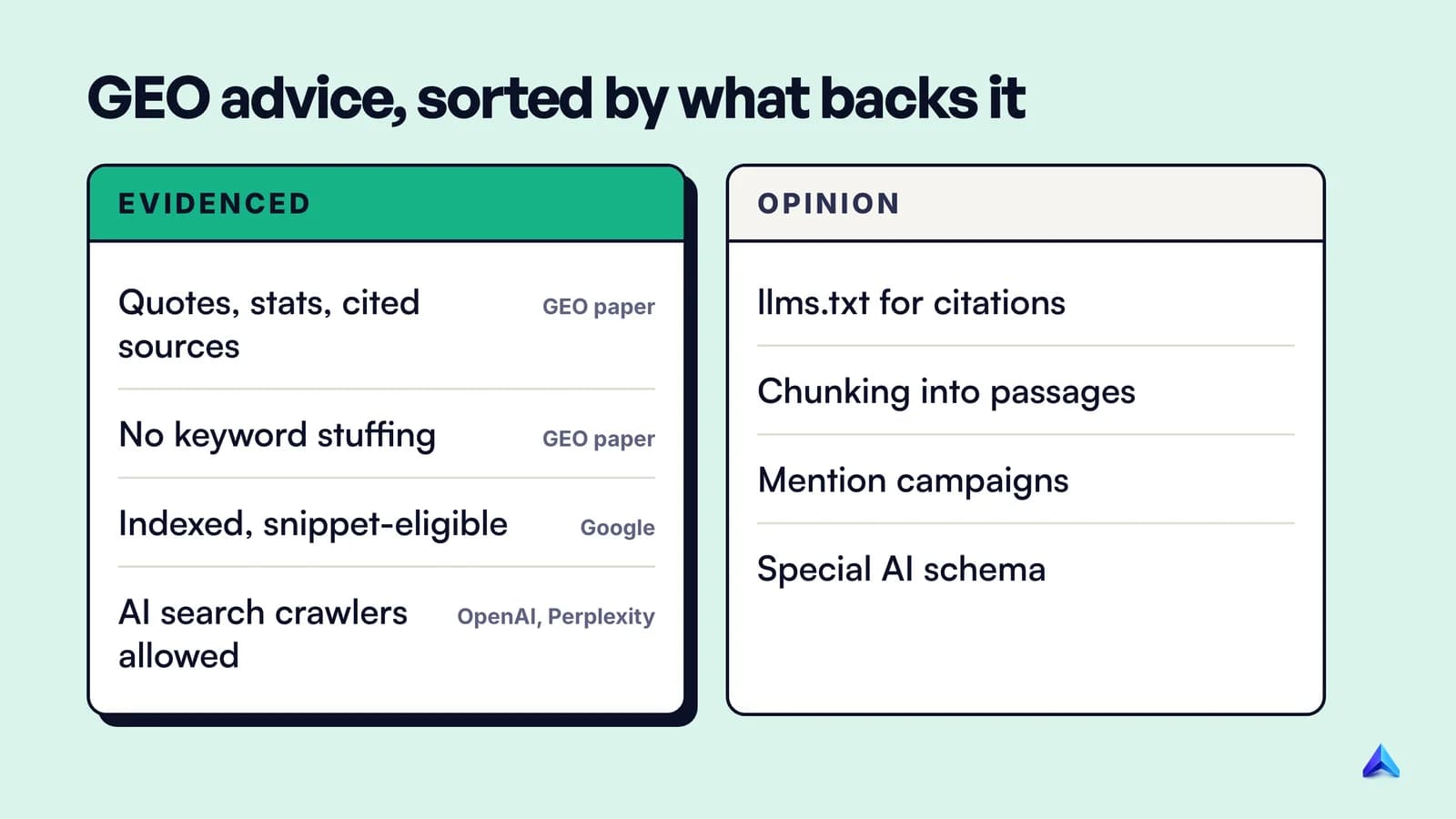
| Claim | Status | Where it comes from |
|---|---|---|
| Adding quotations, statistics and cited sources increases visibility in AI answers | Evidenced, in a 2023 test engine and Perplexity | GEO paper |
| Keyword stuffing does not help | Evidenced | GEO paper, both engines |
| A page must be indexed and snippet-eligible to appear in AI Overviews or AI Mode | Documented | |
| Blocking OAI-SearchBot keeps you out of ChatGPT search answers | Documented | OpenAI |
| Blocking PerplexityBot keeps you out of Perplexity's search results | Documented | Perplexity |
| llms.txt improves AI citations | Opinion; Google says Search ignores it | Vendors |
| Content must be chunked into short passages | Opinion; Google says it is not required | Vendors |
| Brand mentions on forums drive AI citations | Opinion; Google warns against inauthentic mentions | Vendors |
| Special schema helps you get into AI answers | Opinion; Google says no special schema exists | Vendors |
| A third-party "AI visibility score" reflects how Google sees you | Opinion | Vendors |
"Opinion" does not mean wrong. Some of those ideas may matter on engines nobody has documented publicly. It means you are spending effort on a bet, and you should know that when you prioritise.
The strongest case for GEO as its own discipline
The best argument for treating GEO separately from SEO goes like this. Google's guide covers one company. ChatGPT and Perplexity run their own crawlers and use their own search partners or indexes. Answers can mention a brand with no link at all. And none of it shows up cleanly in the rank tracker you already use.
That argument is right about access and measurement. Each AI engine has a separate crawler you can block by accident, and a separate place where your visibility either does or does not appear. That is new operational work, and calling it GEO is reasonable.
It is weaker on content. The one controlled study behind the term found that the edits that worked were the ones a good editor would ask for anyway: name your sources, quote the people who know, give the number. The edit that failed, keyword stuffing, is the one SEO abandoned years ago. Google's documentation lands in the same place from the other direction.
Our position: treat GEO as SEO plus three additions. Check crawler access for each engine. Write with more evidence per paragraph than you think you need. Measure AI visibility separately. Skip anything that requires producing a second, machine-only version of your site.
A GEO checklist that holds up
Each step below traces to the paper or to a platform's own documentation. Work through them in order, because the early steps gate the later ones.
- Confirm the page is indexed and can show a snippet. If it is not in Google's index, it cannot appear in AI Overviews. A
nosnippetor very lowmax-snippetvalue also limits what Google can show. Use our guide on how to check if a page is indexed first. - Check robots.txt and your CDN for each AI search crawler. Look for Googlebot, OAI-SearchBot and PerplexityBot by name. Training crawlers such as GPTBot are a separate decision; blocking them does not remove you from ChatGPT search.
- Add the evidence the paper rewarded. Name the source in the sentence, quote a named expert where one exists, and replace "many businesses" with the actual figure. A Pune accounting firm explaining GST late fees should cite the CBIC notification and state the fee; a UK solicitor should quote the rule, not paraphrase it.
- Say something the other results do not. Google's "non-commodity" test is the same idea as information gain: if your page repeats the five pages already retrieved, a model has no reason to cite yours.
- Write clearly for people. Fluency Optimization and Easy-to-Understand both beat the baseline in the paper. Put the answer where a reader expects it, keep paragraphs short and use descriptive headings. Do not rewrite the page into fragments for a machine.
- Do not build fan-out page farms. Twenty near-identical pages for twenty phrasings of one question is the pattern Google names as scaled content abuse.
- Measure what you can. Search Console's generative AI performance report shows impressions for links to your site in AI Overviews and AI Mode, and Google says it reached all sites worldwide on 31 August 2026. For ChatGPT and Perplexity, watch referral traffic from their domains in your analytics.
Project Rankup, which publishes this blog, covers steps 3 to 5 for new drafts: it writes answer-first articles with cited sources and gives each draft an SEO and a GEO score. It does not track citations or share of voice inside AI answers, so step 7 still happens in Search Console and your analytics.
Frequently asked questions
Is GEO better than SEO?
No, because they are not alternatives. Google says its AI features run on its core ranking systems, and the GEO paper only tested pages that already ranked in Google's top five. GEO adds work on crawler access, evidence and measurement on top of SEO. Without the SEO foundation, there is nothing for an AI engine to retrieve.
Is SEO dead now with AI?
No. AI Overviews and AI Mode draw their supporting links from Google's Search index, ChatGPT search sends rewritten queries to search partners, and Perplexity runs its own search crawler. Every one of them starts by retrieving pages. What has changed is that only some retrieved pages get a visible citation, so being the clearest and best-evidenced result matters more.
Is SEO still worth it in 2026?
Yes, for any business that wants to be found through search, including AI search. Google's 2026 guidance for AI features is essentially its SEO guidance: indexable pages, clean technical structure and content that adds something new. The work that ranks a page is also the work that makes it eligible to be cited.
What is the difference between GEO and AEO?
AEO, answer engine optimization, focuses on making a page easy to lift a direct answer from, a practice that started with featured snippets and voice assistants. GEO, named in the 2023 paper, targets AI systems that write a new answer from several sources and cite some of them. In practice the advice overlaps heavily.
Who coined the term generative engine optimization?
Researchers from IIT Delhi and Princeton University, led by Pranjal Aggarwal and Vishvak Murahari, in a paper first posted to arXiv in November 2023. It was published at KDD 2024. The paper also introduced GEO-bench, a 10,000-query benchmark for measuring how visible a web page is inside AI-generated answers.
Does llms.txt help with GEO?
We have not found published evidence that it does. Google's AI optimization guide lists llms.txt among the things you can ignore for Google Search, and the GEO paper never tested it. Publishing one is harmless, but treat it as a convenience for AI agents, not as a citation strategy.