Search engine optimization is the practice of making your content easy for search engines to find, understand, and rank above competitors. In 2026, that definition still holds, but the target has split in two: you now need to rank on Google's traditional blue-link results AND get cited inside AI-generated answers from tools like ChatGPT, Perplexity, and Google's AI Overviews. The brands winning both are not doing twice the work. They are doing smarter work, built on a framework that serves humans and machines at the same time.
Quick Answer: Search engine optimization (SEO) is the process of improving a page's relevance and authority so search engines rank it higher. In 2026, effective SEO also means structuring content so AI answer engines pull it as a source. The core levers remain technical health, on-page relevance, and off-page authority, but a fourth layer, Answer Engine Optimization (AEO), now sits on top.
What Is Search Engine Optimization, Really?
Search engine optimization means earning unpaid visibility in search results by improving how well your content matches what a searcher wants and how much a search engine trusts your site. Learn more about core SEO principles from Google's Search Central. It is not a trick. It is not a one-time project. It is an ongoing process of building relevance, trust, and clarity across everything you publish.
The search engine optimization meaning gets muddied because the phrase covers a wide range of activities. Writing a better title tag is SEO. Earning a link from an industry publication is SEO. Fixing a crawl error that blocks Googlebot from reading your page is also SEO. Three very different tasks, same label. That breadth is why people underestimate how much coordination it takes.
Search engine optimization in digital marketing sits at the intersection of content, technical infrastructure, and brand authority. Unlike paid search, where you buy position and lose it the moment you stop spending, SEO compounds. A well-optimized page published today can generate traffic for years. That compounding effect is why, according to BrightEdge's 2019 Channel Share Report, organic search drove 53.3% of trackable website traffic, more than any other single channel.
The Three-Pillar Framework (and the Fourth One Everyone Is Adding)
Most guides split SEO into two buckets: on-page and off-page. That framing is too thin to be useful in 2026. The full framework has three structural pillars, and a fourth layer is now non-optional.
Technical SEO is the foundation. It covers everything that affects whether search engines can crawl, index, and render your pages correctly. Core Web Vitals, mobile usability, canonical tags, structured data markup, and site architecture all live here. If Google cannot read your page, the best content in the world ranks nowhere. A technical SEO audit should be your first step before touching anything else.
On-page SEO is about relevance. It covers how well a given page matches the intent behind a search query: title tags, heading hierarchy, keyword placement, content depth, internal linking, and meta descriptions. The goal is to make it obvious to both the searcher and the algorithm exactly what the page is about and why it is the right answer.
Off-page SEO builds authority. Backlinks from credible sites remain the strongest trust signal Google uses. But in 2026, off-page also includes brand mentions without links, co-citation patterns, and the digital footprint your entity has across the web. If your brand is mentioned on authoritative sites in your niche, that shapes how Google understands who you are.
The fourth layer is Answer Engine Optimization (AEO), and it changes how you write, not just what you write about. AEO means structuring content so that AI systems can extract a clean, quotable answer and attribute it to you. That means direct answers at the top of each section, FAQ blocks with precise wording, and schema markup that labels your content's structure explicitly.
Here is how the four pillars map to outcomes:
| Pillar | What It Covers | Primary Signal | Outcome |
|---|---|---|---|
| Technical SEO | Crawlability, speed, structure | Core Web Vitals, indexing | Pages get into the index |
| On-page SEO | Relevance, content depth | Keyword match, E-E-A-T signals | Pages rank for target queries |
| Off-page SEO | Authority, trust | Backlinks, brand mentions | Rankings hold against competition |
| AEO | Answer clarity, extractability | Structured data, FAQ schema | Content cited in AI answers |
How Search Algorithms Actually Work in 2026
Understanding the SEO-to-AI pipeline starts with understanding how Google's algorithm has changed. In earlier years, ranking was largely about keyword frequency and link count. Today, Google's systems use a layered approach: crawling collects pages, indexing organizes them by topic and entity, and ranking matches the best result to each query's specific intent.
The future of search algorithms in 2026 is being shaped by three forces. First, Google's AI Overviews (the answer boxes that appear above organic results) appeared on 39.4% of Google desktop searches in June 2026, according to Comscore's Q2 2026 AI Intelligence Report (published September 22, 2026). Second, large language models used in tools like ChatGPT and Perplexity draw their cited sources from pages that are authoritative, clearly structured, and factually specific. Third, entity understanding has replaced keyword matching as the core ranking mechanism: Google does not look for the words "best CRM software" on your page, it looks for evidence that your page is an authoritative document about CRM software as a concept.
This last point drives entity SEO best practices in 2026. You build entity authority by being consistent about who you are across the web (same brand name, same descriptions, same claims), earning mentions on topically relevant sites, and using structured data to declare relationships explicitly. An FAQ schema block on a product page is not just good for featured snippets, it tells Google's knowledge graph what questions your brand answers.
Also Read: How Deep Search AI is reshaping SEO and AEO
SEO vs. SEM vs. AEO: Clearing Up the Confusion
These three terms get used interchangeably, and they should not. The differences are operational, not just definitional.
SEO earns organic placement through relevance and authority. It takes time to build (typically three to six months before measurable traffic movement) but costs nothing per click once rankings are established.
SEM (Search Engine Marketing) buys placement through paid search ads. Results are immediate, but traffic stops the moment the budget does. SEM is excellent for testing and for capturing demand while SEO builds.
AEO is the practice of optimizing specifically for AI-generated answer surfaces: Google's AI Overviews, Perplexity citations, ChatGPT browsing results, and similar outputs. AEO overlaps heavily with SEO but prioritizes different structural signals: direct answers, FAQ schema, and factual precision over comprehensive topical coverage.
For most brands, the right approach is not to pick one. A funded SaaS brand should run paid search for high-intent bottom-of-funnel terms while building organic authority for educational queries, and structure both content streams with AEO in mind so AI systems pull them as sources.
A Practical On-Page SEO Checklist for 2026
The on-page fundamentals have not changed much, but the bar has risen. Here is a working checklist:
- Title tag: Contains the primary keyword, under 60 characters, written for a human reader, not stuffed.
- Meta description: 150-160 characters, answers the implied question, includes the keyword naturally.
- H1: Matches or closely mirrors the title tag; appears exactly once on the page.
- Heading hierarchy: H2s cover major subtopics, H3s cover sub-points under each H2; no levels skipped.
- Keyword placement: Primary keyword in the first 100 words, in at least one H2, and distributed naturally through the body.
- Internal links: Three to six links to related pages on your own site, using descriptive anchor text.
- Schema markup: FAQ schema for Q&A content, Article schema for editorial content, HowTo schema for step-by-step guides.
- Content depth: Covers the topic more thoroughly than the current top three ranking pages, with specific data and examples.
For most teams, the biggest gap is item eight. Pages that rank for competitive terms in 2026 are genuinely more useful than the ones they displaced. Thin content gets filtered out faster than it ever did, because Google's quality raters and automated systems are better at detecting it.
If you want to know how your current pages score on these points, an SEO audit gives you a prioritized gap list rather than an overwhelming to-do pile.
Adapting Content for AEO and Generative Engine Optimization
Adapting content for AEO is not about writing differently from scratch. It is about adding a layer of extractability to content you would write anyway.
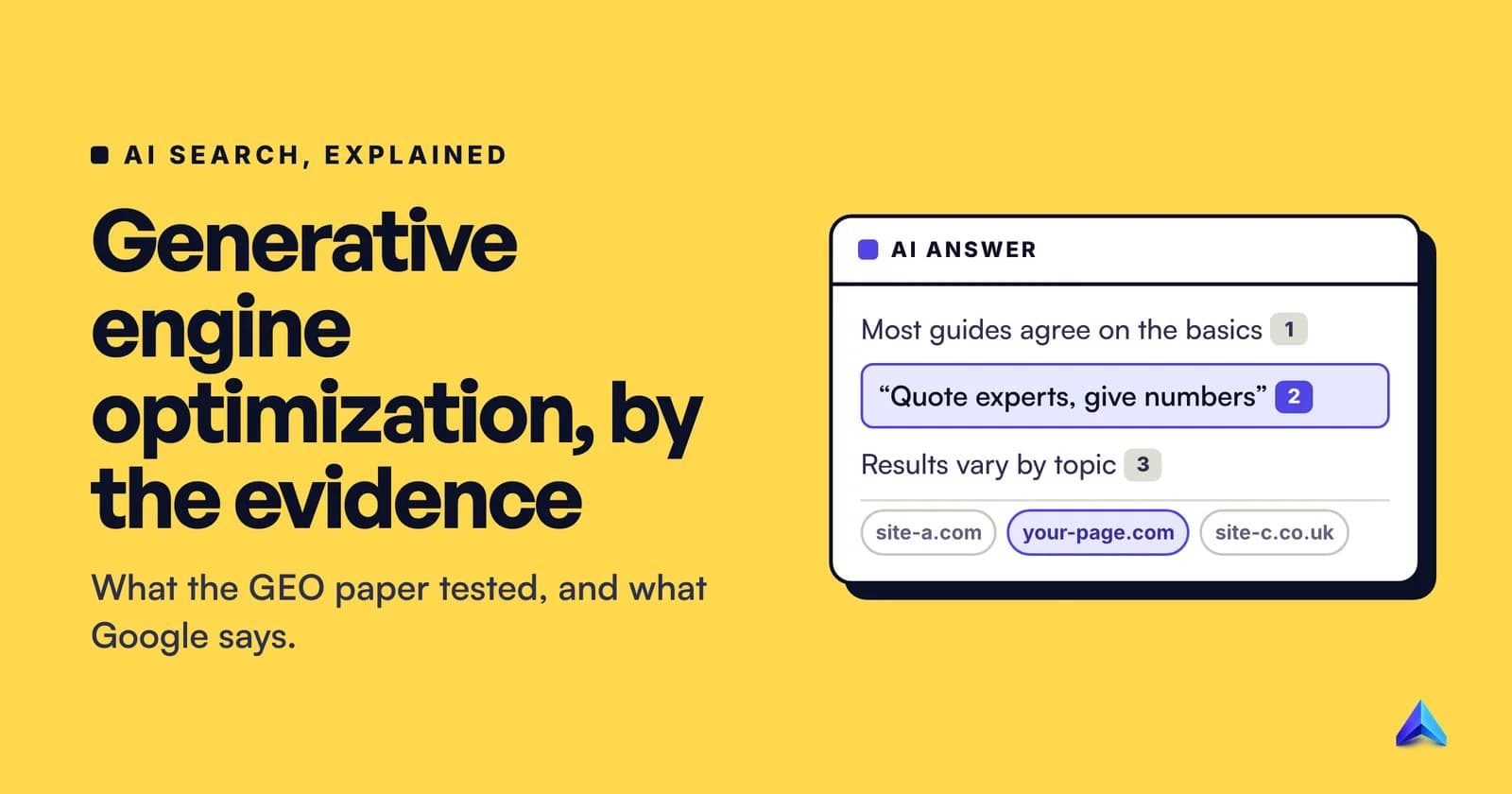
Generative engine optimization (GEO) techniques focus on making your content the source an LLM chooses when assembling an answer. Research published by Princeton, Georgia Tech, and The Allen Institute for AI in 2024 found that adding statistics, citing authoritative sources, and using clear quotable sentences significantly increased the rate at which AI systems selected content as a citation source. That finding has practical implications:
- State facts with numbers. "Organic search drives 53% of trackable traffic" is more citation-worthy than "organic search drives a lot of traffic."
- Answer directly before you explain. Open each section with the answer, then provide the reasoning. AI extractors grab the first clear statement.
- Use FAQ schema. FAQ-structured content is extracted into AI Overviews at a disproportionately high rate compared to unstructured prose.
- Name your entities. Use your brand name, your product names, and the names of concepts you discuss consistently. LLMs learn associations from repeated co-occurrence.
- Earn citations on authoritative sites. Being mentioned on .edu and .gov domains, major industry publications, and high-authority news sites signals to both Google and LLMs that you are a credible source.
The SEO strategy for AI search in 2026 comes down to a single principle: write content a knowledgeable person would quote, then mark it up so a machine can find the quotable bit.
Also Read: AI keyword research strategies for 2026
Measuring SEO ROI in the AI Era
Measuring SEO ROI in the AI era is harder than it used to be, and pretending otherwise leads to bad budget decisions. Here is what has changed and how to account for it.
Organic clicks are down on some query types. When Google's AI Overview answers a question fully, the user does not need to click. This is called a zero-click result, and it is real. SparkToro's 2026 zero-click study (published June 9, 2026) found that 68.01% of Google searches in the US ended without a click in the first four months of 2026. For informational queries, that share is even higher.
But branded search and direct traffic are rising for cited brands. When your content is cited in an AI Overview or a ChatGPT answer, users who want more depth click through to your site. This is a new traffic pattern: fewer clicks on broad informational terms, more high-intent clicks from users who were pre-qualified by the AI answer.
What to track in 2026:
- Organic click-through rate by intent type (informational vs. commercial vs. transactional)
- Share of voice in AI Overviews for target queries (manual spot-checks plus tools like Semrush's AI Toolkit)
- Branded search volume trend (a proxy for AI-driven awareness)
- Assisted conversions attributed to organic channels in your analytics platform
- Rankings for featured snippet positions, which correlate strongly with AI Overview inclusion
Connecting SEO activity to revenue still means tracking the full funnel, from keyword entry to session to lead or sale. The keyword research process you use upstream shapes which queries you appear for, which determines the intent quality of the traffic you get, which predicts conversion rates downstream. None of that logic has changed. What has changed is that a page can now generate brand equity and AI citations even when it does not generate a direct click.
Frequently asked questions
What is search engine optimization?
Search engine optimization is the process of improving a website's content, structure, and authority so that search engines rank it higher in unpaid results. It covers technical factors like site speed and crawlability, on-page factors like content relevance, and off-page factors like backlinks and brand mentions. In 2026, it also includes optimization for AI-generated answer surfaces.
What is search engine optimization in digital marketing?
In digital marketing, search engine optimization is the channel responsible for generating organic (unpaid) traffic from search engines. It works alongside paid search, social, and email to build long-term visibility. SEO is typically the highest-ROI channel over a 12-month-plus horizon because rankings compound over time, unlike paid placements that stop delivering the moment spend stops.
How does search engine optimization work?
Search engines crawl the web to discover pages, index them by topic and entity, then rank them against each query using hundreds of signals. The strongest signals are content relevance to the searcher's intent, page authority (measured partly by the quality of inbound links), technical accessibility, and E-E-A-T signals like author credentials and factual accuracy. Optimizing for these signals is what SEO practitioners do.
How long does SEO take to show results?
Most sites see measurable organic traffic movement three to six months after sustained optimization work begins. Competitive niches with established rivals can take nine to twelve months. The timeline depends on the site's existing authority, the competition for target keywords, and how much content and technical work is needed. New sites with no backlink history fall on the longer end.
Is SEO still worth it when AI Overviews reduce clicks?
Yes, with a recalibrated expectation. Zero-click results affect informational queries most. Commercial and transactional queries still generate clicks at high rates because AI Overviews rarely resolve "I want to buy" intent on their own. Additionally, being cited in AI answers builds brand recognition that drives branded searches and direct traffic. The brands that drop SEO investment now hand market share to competitors who understand this shift.
What are the three types of SEO?
The three types are technical SEO (site infrastructure, crawlability, page speed), on-page SEO (content relevance, keyword placement, heading structure), and off-page SEO (backlinks, brand authority, external mentions). In 2026, a fourth type, Answer Engine Optimization, is increasingly treated as its own discipline because it targets AI answer surfaces rather than traditional ranked results.
How to search engine optimization for a new site?
Start with a technical audit to confirm Google can crawl and index your pages. Then do keyword research to find queries where your content can genuinely compete. Publish well-structured, specific content that answers real questions. Build internal links between related pages. Earn your first external links through genuine outreach or original data. Measure, iterate, and repeat. SEO services for small business contexts often benefit from focusing on long-tail, local, or niche queries first.
Key Takeaways
- Search engine optimization in 2026 covers four pillars: technical, on-page, off-page, and Answer Engine Optimization.
- AI Overviews appeared on 39.4% of Google desktop searches in June 2026 (Comscore); getting cited in them requires the same structural clarity that earns featured snippets.
- Zero-click results are real but mostly affect informational queries; commercial and transactional terms still drive clicks.
- Entity SEO and structured data markup are no longer advanced tactics; they are table stakes for competitive visibility.
- Measuring ROI now means tracking branded search volume and AI citation share alongside traditional organic traffic metrics.
- Content written to be quoted directly (clear answers, specific numbers, named sources) outperforms content written to be read linearly.
- SEO takes three to six months to show measurable results; starting or stopping based on short-term signals destroys compounding value.
The gap between brands that thrive in 2026 search and those that fade is not budget. It is clarity of strategy. If you are unsure whether your current SEO plan accounts for AI Overviews, entity authority, or AEO-ready content structure, that gap is worth closing before your competitors do. Book a consultation with Project Rankup and we will map out a personalized 2026 SEO plan built around your specific goals, competitive landscape, and content assets.