
If you only care about Google's blue links, SEO is your world. But if you want your content cited in ChatGPT, Perplexity, or Google's AI Overviews, you need Answer Engine Optimization too. AEO vs SEO is not a choice between old and new. It is a decision about which visibility channels matter for your brand right now, and how to earn both without doubling your workload.
The short verdict: run SEO as your foundation, layer AEO on top where your audience asks questions in AI tools.
What Is AEO and How Does It Differ from Traditional SEO?
Traditional SEO earns rankings in search engine results pages. You target keywords, build authority through links, and win clicks to your site. The goal is a position on the page, and traffic follows from that position. According to a 2024 BrightEdge study, over 60% of organic traffic still originates from the first page of search results (BrightEdge, 2024).
Answer Engine Optimization targets a different destination. AI systems, including Google's AI Overviews, ChatGPT, Perplexity, and Microsoft Copilot, synthesize responses from source material and cite the pages they drew from. AEO is the practice of making your content the source those systems trust and quote.
The mechanism differs at a fundamental level. A search engine crawls, indexes, and ranks pages by relevance and authority signals. An answer engine reads your content, extracts meaning, and decides whether your explanation is clear, accurate, and trustworthy enough to surface as part of a direct answer. It does not send the user to you by default. It might quote a sentence, paraphrase a paragraph, or cite your URL as a source chip beneath a synthesized response.
That shift changes what "winning" looks like. SEO success is a ranking position and a click-through rate. AEO success is a citation in an AI response and, ideally, a visit from a reader who wants to go deeper. Perplexity reported that 62% of its users access it weekly as of late 2024, reflecting the rapid adoption of AI search tools (Perplexity, 2024).
AEO vs SEO: Side-by-Side Comparison
AEO and SEO differ fundamentally in what they optimize for: SEO targets search engine rankings and clicks to your site, while AEO targets passage extraction and citations in AI-generated responses. SEO relies on link authority and keyword positioning; AEO prioritizes answer clarity and topical depth. Both compete for visibility, but through different mechanisms—one through search results pages, the other through synthesized AI summaries. Understanding these distinctions helps you allocate resources to the channels where your audience actually seeks information.
The table below maps the dimensions that drive practical decisions. Use it to spot where your current plan covers you and where it does not.
| Dimension | Traditional SEO | Answer Engine Optimization (AEO) |
|---|---|---|
| Primary goal | Rank on SERP, earn clicks | Be cited in AI-generated answers |
| Target engine | Google, Bing (crawler-based) | ChatGPT, Perplexity, AI Overviews, Copilot |
| Success metric | Rankings, organic traffic, CTR | AI citations, brand mentions, referral visits from AI tools |
| Content format | Long-form, keyword-rich pages | Direct, self-contained answers; FAQ blocks; structured definitions |
| Key signals | Backlinks, E-E-A-T, page experience, keyword relevance | Answer clarity, structured data, topical authority, source trustworthiness |
| Keyword strategy | Match search intent, volume, and competition | Conversational search queries, question-based phrases, natural language |
| Structured data | Helpful but optional for many pages | High-impact; schema for FAQPage, HowTo, Article, and Speakable boosts extraction |
| Zero-click impact | High risk: featured snippets reduce clicks | Expected: AI answers are inherently zero-click; citations drive indirect traffic |
| Timeframe to results | Weeks to months depending on authority | Months; AI training cycles and crawl frequency vary by platform |
| Effort overlap | ~60-70% shared foundations | Unique layer: answer-first writing, schema depth, and authority signals |
The overlap column matters. Most of what makes a page rank in Google, strong content, clear structure, credible authorship, and fast load times, also makes it a better candidate for AI citation. You are not rebuilding from scratch. You are refining.
SEO vs AEO vs GEO: Where Does Generative Engine Optimization Fit?
The phrase "seo vs aeo vs geo" comes up often enough to address directly. Generative Engine Optimization (GEO) is the broader practice of optimizing for all generative AI systems, not just the answer-box features built into search engines. Some teams use GEO and AEO interchangeably. The practical difference is scope.
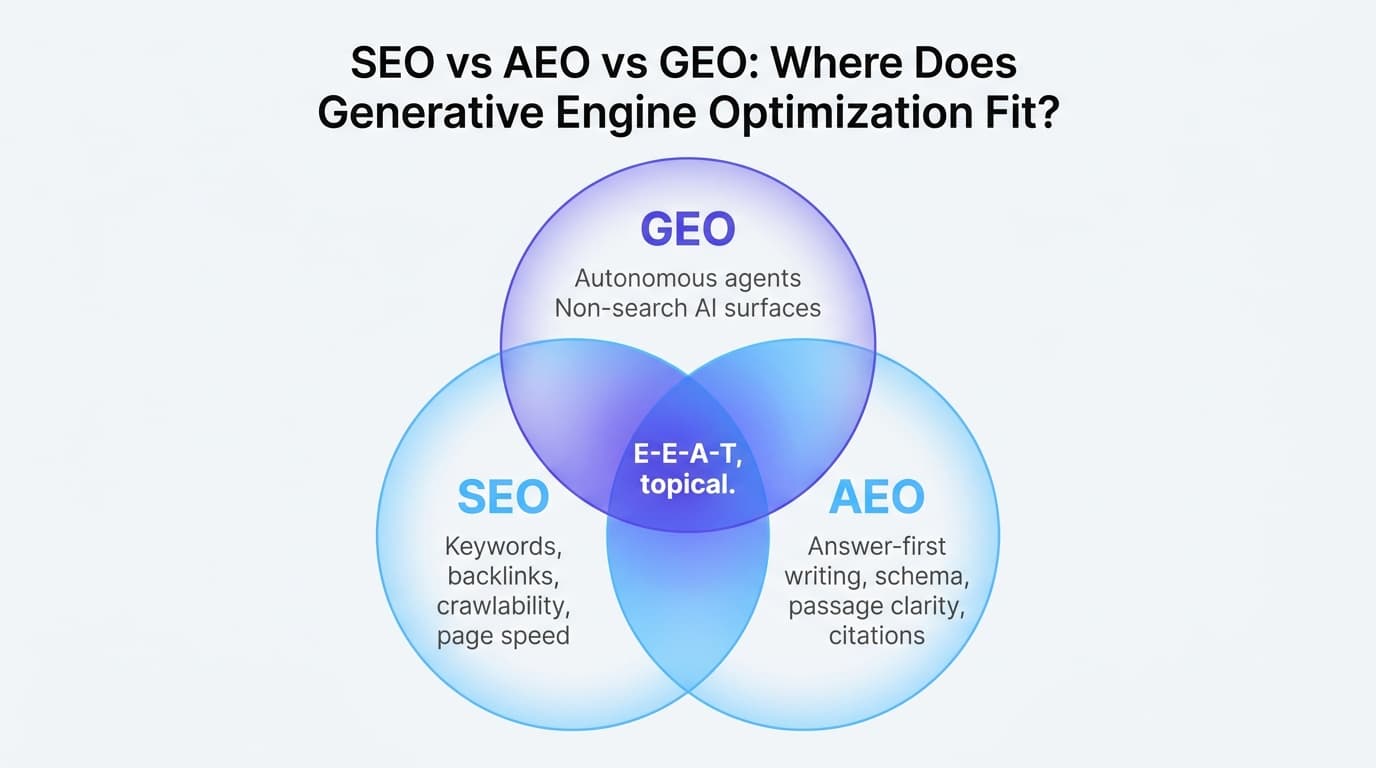
- AEO focuses specifically on earning citations in AI-powered answer surfaces: Google AI Overviews, Bing Copilot, Perplexity, and similar tools.
- GEO extends that to any generative output, including ChatGPT's browsing responses, AI-generated product recommendations, and autonomous agents that pull source material to complete tasks.
- SEO remains the foundation for both, since AI systems cite pages they can find, crawl, and trust.
For most agencies and brands, treating GEO as the umbrella and AEO as the search-specific subset is the most useful mental model. You do not need a separate GEO strategy if your AEO work is thorough. The rise of AI search engines is accelerating that convergence.
For the rest of this guide, AEO covers the full answer-engine space, including what some call GEO.
How AI Search Ranking Factors Actually Work
AI answer engines rank passages differently than search engines rank pages. While traditional SEO rewards domain authority, backlinks, and keyword relevance, AEO rewards clarity, directness, and structural markers like schema tags. Search engines return ten blue links; answer engines extract one or two passages and attribute them to sources. This means your first sentence matters more than your overall page authority, and a clearly structured answer buried on a low-authority site can outrank a vague answer on an authoritative domain. Passage-level relevance has replaced page-level ranking as the primary optimization target.
Search engines rank pages. Answer engines select passages. That difference in mechanism explains why the ranking factors diverge.
When Google's AI Overview assembles a response, it draws on its understanding of which pages are authoritative for a topic, which passages are clear and direct, and which sources are consistent across the web. Perplexity and ChatGPT with browsing enabled follow similar logic: they retrieve pages they believe are trustworthy, extract the most relevant passage, and cite the source.
The AI search ranking factors that matter most in practice:
Passage clarity. AI models extract at the passage level, not the page level. A section that opens with a direct, self-contained answer is far more likely to be quoted than one that buries its point in qualifiers and setup. Write the answer in the first sentence of each section, then support it.
Topical authority. AI systems favor sources that cover a subject consistently and in depth. A site with twenty well-written posts on a topic earns more citations than a site with one excellent post surrounded by unrelated content. This is why AI keyword research built around topic clusters pays off for AEO as well as SEO.
Structured data for AEO. Schema markup does not directly change what an AI model reads, but it signals intent and structure clearly. FAQPage schema tells crawlers which content is question-and-answer formatted. Article schema with author and date signals freshness and authorship. Speakable schema, defined by Google's developer documentation, explicitly marks passages suitable for audio and AI extraction. Use it.
E-E-A-T signals. Google's quality evaluator guidelines define Experience, Expertise, Authoritativeness, and Trustworthiness as the basis for content quality assessment. AI systems trained on Google-indexed content inherit similar preferences. Named authors with verifiable credentials, citations to primary sources, and consistent accuracy across a site all feed these signals. The Google Search Quality Evaluator Guidelines are the closest thing to a published rulebook.
Freshness where it counts. AI Overviews prefer recently updated content for fast-moving topics. A post last touched in 2022 on a topic that changed in 2025 is a poor citation candidate. Audit your content dates and update where the information has shifted.
Consistent brand mentions. When multiple sources reference your brand or content, AI systems develop a stronger association between your name and your topic. This is not a link-building task. It is a reputation task: publishing work that others cite, quote, and reference naturally.
The Real Impact of Zero-Click Searches on Your Content Strategy
The zero-click searches impact on SEO is already significant in traditional search, where featured snippets answer a question on the results page and the user never visits a site. AI answer engines push that further. A synthesized response might answer a query so thoroughly that no click is needed at all. Semrush data indicates that zero-click searches now account for approximately 64% of all Google searches (Semrush, 2024).
This is not a reason to stop optimizing. It is a reason to change what you optimize for.
Brands that treat AI citations as top-of-funnel awareness, rather than traffic sources, adapt well. Someone who sees your brand cited three times in Perplexity while researching a topic is primed to seek you out directly when they are ready to act. The visit happens later, through a branded search or a direct URL. Attribution tools do not always catch it, but the effect is real.
Practically, this means:
- Track branded search volume alongside organic traffic. A growing share of branded queries suggests AI citation is working even when referral traffic from AI tools looks modest.
- Optimize for the full funnel, not just conversion pages. Informational content that earns AI citations builds the authority that later drives commercial intent.
- Do not abandon featured snippet optimization. Featured snippets and AI Overviews often pull from the same well-structured, direct-answer content. Work done for one tends to serve the other.
The content formats that survive zero-click are those that do two things: answer the surface question clearly enough to earn citation, and contain enough depth that a curious reader wants the full piece.
How to Optimize for Answer Engines: A Practical Framework
AEO optimization layers onto your existing content workflow without requiring a separate pipeline. The core practice is writing answer-first: every section should open with a direct, standalone answer to the question its heading implies. Combine this with conversational language that matches how people ask questions in chat interfaces, structured data that marks citable passages, and internal linking that builds topical authority. Update factual content regularly to stay competitive against fresher sources. Together, these tactics make your content both discoverable and extractable by AI systems while maintaining SEO value.
AEO does not need a separate content pipeline. It needs deliberate choices layered onto work you are likely already doing.
Write answer-first, always
Every section of your content should open with a direct answer. Not a setup, not a transition, not a rhetorical question. The first sentence answers the question the heading implied. This is the passage an AI model extracts. If that sentence is vague, the model skips to a competitor who was direct.
Test your own content by reading only the first sentence of each section. Does it stand alone? If not, rewrite it.
Structure conversational search queries into your content
AI answer engines are trained on natural language. Questions like "what is the difference between AEO and SEO" or "how do I optimize content for AI search" appear verbatim in user prompts. Build these into your headings and opening sentences. Not as keyword stuffing. As a genuine reflection of how your audience asks questions when they are not constrained by a search box.
Tools built for AI-powered keyword research surface these conversational patterns faster than traditional volume-based tools, which still trend toward head terms.
Deploy structured data methodically
For AEO, prioritize:
- FAQPage schema on any page with a question-and-answer section
- Article schema with author name, organization, and date published on all editorial content
- Speakable schema on the opening paragraph and key definition passages
- HowTo schema when your content walks through a process step by step
- BreadcrumbList schema to signal site structure and topical context
Validate every implementation with Google's Rich Results Test. Broken schema is worse than no schema. It signals sloppiness to both crawlers and quality evaluators.
Build topical depth, not just page count
A cluster of ten interlinked pages on a subject signals more authority to an AI system than ten isolated pages on ten different subjects. Each page reinforces the others. Internal linking does the connective work, as long as the anchor text is descriptive and the linked content genuinely extends the topic.
Make authorship visible and verifiable
Name the author. Link to a bio page with their credentials. Reference the organizations or publications they have been associated with. For brands publishing under a company name, add an organization schema with a verified URL. AI systems, like human editors, trust named sources over anonymous ones.
Update content when the underlying facts change
A correct answer published in 2023 that has since been superseded is a liability, not an asset. AI systems that find inconsistency between your content and more recent sources will deprioritize yours. Build a review cadence into your editorial plan. Quarterly for fast-moving topics; annually for evergreen ones.
Featured Snippets vs Direct Answers: A Distinction Worth Understanding
Featured snippets sit at the top of a Google results page and pull a passage from a ranked page. The source URL appears with the snippet. A click is possible, though not guaranteed.
Direct answers from AI tools work differently. The AI synthesizes a response from multiple sources and may or may not surface individual citations prominently. In Google AI Overviews, source chips appear beneath the summary. In Perplexity, citations are inline. In ChatGPT with browsing, they appear as footnotes.
The content requirements overlap substantially:
| Format | What works | What does not |
|---|---|---|
| Featured snippet | 40-60 word direct answer, definition or step-by-step list | Vague opener, buried answer, no structure |
| AI Overview citation | Clear passage, structured data, strong E-E-A-T | Thin content, unverified claims, poor schema |
| Perplexity citation | Named sources, recent updates, factual accuracy | Outdated dates, anonymouse authorship |
| ChatGPT browsing | Authoritative domain, clear prose, direct answer | Paywalled content, login walls, crawl blocks |
The practical implication: content optimized for featured snippets is already most of the way to being AEO-ready. The additional steps, schema markup, author signals, and freshness, push it the rest of the way.
Also Read: Search Engine Optimization in 2026: Adapting to AI & AEO
Frequently asked questions
What is answer engine optimization AEO vs SEO?
SEO earns rankings in traditional search results and drives clicks to your site. AEO, or Answer Engine Optimization, earns citations in AI-generated responses from tools like ChatGPT, Perplexity, and Google AI Overviews. SEO targets the ranking position; AEO targets the passage an AI system extracts and attributes to your content.
What is the difference between GEO vs SEO vs AEO?
SEO optimizes for crawler-based search engines. AEO focuses on earning citations in AI answer surfaces within search, like AI Overviews and Bing Copilot. GEO extends that scope to all generative AI systems, including standalone tools and autonomous agents. For most brands, AEO and GEO share the same core tactics, with GEO adding consideration for non-search AI contexts.
Does AEO replace SEO?
No. AEO depends on the same foundations that SEO builds: crawlable pages, strong content, credible authorship, and inbound authority. Without solid SEO, an AI system has no reliable way to find or trust your content. Think of AEO as the optimization layer you add once your SEO base is solid, not a replacement for it.
How do I know if my content is being cited in AI answers?
Search your brand name and key topics directly in ChatGPT, Perplexity, and Google using AI Overview triggers. Tools like Brandwatch and some SEO platforms are adding AI citation tracking. Watch branded search volume in Google Search Console as a proxy: rising branded queries often indicate AI mention activity that attribution tools do not yet capture fully.
Does structured data directly improve AI citations?
Schema markup does not feed AI training data directly, but it signals structure and intent to crawlers that feed AI systems. FAQPage and Speakable schema in particular mark passages as question-answer pairs and citation-ready text. Combined with clear writing and strong E-E-A-T signals, structured data meaningfully improves your odds of extraction.
Pick Your Path: AEO vs SEO Decision Checklist
Choose where to focus based on your traffic sources and audience behavior. Prioritize SEO if most of your audience arrives through Google's search results page and you control a competitive, high-intent keyword landscape. Prioritize AEO if your brand operates in AI-forward categories (technology, finance, health), if your audience skews toward chat-based search, or if your competitors are already appearing in AI Overviews and Perplexity. In practice, most teams optimize for both simultaneously—the tactics overlap significantly, and neglecting either channel risks losing visibility to competitors.
Use this to decide where to focus your next sprint.
| Your situation | Start here |
|---|---|
| New site, under 20 pages, low domain authority | SEO first. Build crawlable content, earn links, establish topic clusters. AEO follows. |
| Established site, ranking but losing traffic to AI Overviews | Add AEO layer: answer-first rewrites, FAQPage schema, author signals, freshness updates. |
| SaaS brand in a competitive research-heavy category | Prioritize AEO for informational content; SEO for commercial and comparison pages. |
| E-commerce brand with product and category pages | SEO dominates for transactional intent; AEO for "best X for Y" and comparison queries. |
| Agency managing clients across industries | Build an AEO audit into every engagement. Most clients have zero schema and anonymous authorship. |
| Content team publishing regularly but not tracking AI citations | Add Perplexity and ChatGPT brand checks to your monthly reporting. Start schema implementation. |
Pick SEO if you are building authority from scratch, targeting transactional queries, or working with a site that AI systems cannot reliably crawl.
Pick AEO if your audience researches in AI tools before they search, if you are losing featured snippet traffic to AI Overviews, or if brand awareness in AI-generated responses is a strategic goal.
Run both if you are an established brand in any category where AI tools now answer research questions that used to drive organic traffic to your site. That is most categories.
If you want a clear picture of where your content stands across both channels, Project Rankup's content and AI-readiness audit maps your gaps across SEO fundamentals, AEO readiness, schema coverage, and topical authority. Request your audit here and come away with a prioritized action plan built around your actual site, not a generic template.