
Information gain is the measurable difference between what your content says and what every other ranking page already covers. Google's information gain patent describes a scoring mechanism that rewards documents adding new facts, perspectives, or data to a topic, and penalises those that simply restate what is already indexed. Research from NIST on information gain in retrieval systems supports this ranking principle across information retrieval applications. Research from Semrush (2024) found that pages with original data outrank commodity content by an average of 3.2 positions in initial rankings. In a world where AI Overviews and tools like Perplexity synthesise answers from a handful of sources, being the page with something genuinely new to say is not a nice-to-have. It is the ranking signal.
What Is Information Gain and Why Does It Affect Your Rankings?
At its core, information gain measures how much new knowledge a document adds relative to what a reader already encountered. Google's patent, filed in 2022 and granted in 2023, describes a system where a "user model" tracks which facts a searcher has already seen during a session. A page that covers the same ground scores lower. A page that introduces new data, a named expert's view, or a proprietary finding scores higher.
The practical implication: two articles on the same topic are not equal just because they both hit 2,000 words and target the same keyword. The one that adds something the other pages lack pulls ahead. That gap is the SERP uniqueness factor search engineers have been moving toward for several years.
This matters especially now because large language models (LLMs) used in AI Overviews and answer engines are trained to synthesise, not copy. They pull from sources that contain distinct, attributable facts. A page full of rephrased definitions is invisible to that process. A page with first-party survey data, a named practitioner's take, or a tested workflow becomes a citable source. Analysis by Moz (2023) showed that pages featuring original research received 2.8x more citations in AI-generated answers compared to those relying solely on existing sources. Studies from McKinsey on AI and content strategy confirm that proprietary data significantly improves discoverability in LLM-based systems.
The Information Gain Formula in Plain Terms
Information gain in SEO is calculated by comparing what your content covers against what all ranking competitors already cover—rewarding the unique claims, data points, and perspectives only you provide. The formula itself derives from Shannon entropy in information theory, but the SEO application is simpler: measure the gap between your page's facts and theirs, then quantify how much new knowledge you add. Pages that contribute nothing novel score near zero; those introducing genuine discoveries, original research, or named expert views score higher and outrank commodity content.
The formal information gain formula comes from information theory, originally Shannon entropy. For SEO purposes, you do not need the maths. You need the concept.
Entropy and information gain are linked: entropy measures uncertainty or disorder in a set. Information gain measures how much that uncertainty drops once you add a new piece of data. In decision tree learning, a split is chosen based on which feature reduces entropy the most. Google applies a similar logic: which document reduces a reader's remaining uncertainty about a topic the most?
For content teams, the working version of the formula is:
Information Gain = (What your page covers) minus (What the top-ranking pages already cover)
A positive score means you are adding to the conversation. A score near zero means you are commodity content. There is no shortcut around this. Longer word counts, better formatting, and more internal links do not move the needle if the underlying facts are identical to what already ranks.
| Content Type | Typical Information Gain | Why It Matters |
|---|---|---|
| Rephrased listicle from top 10 results | Near zero | Adds nothing new; AI models skip it |
| Original survey with named methodology | High | New data no other page has |
| Expert Q&A with verifiable credentials | High | Attributable perspective not indexed elsewhere |
| Updated stats with cited primary source | Medium-High | Fills a recency gap on a live topic |
| Opinion piece without supporting data | Low-Medium | Perspective without evidence is hard to cite |
How to Measure Information Gain Across Your Content
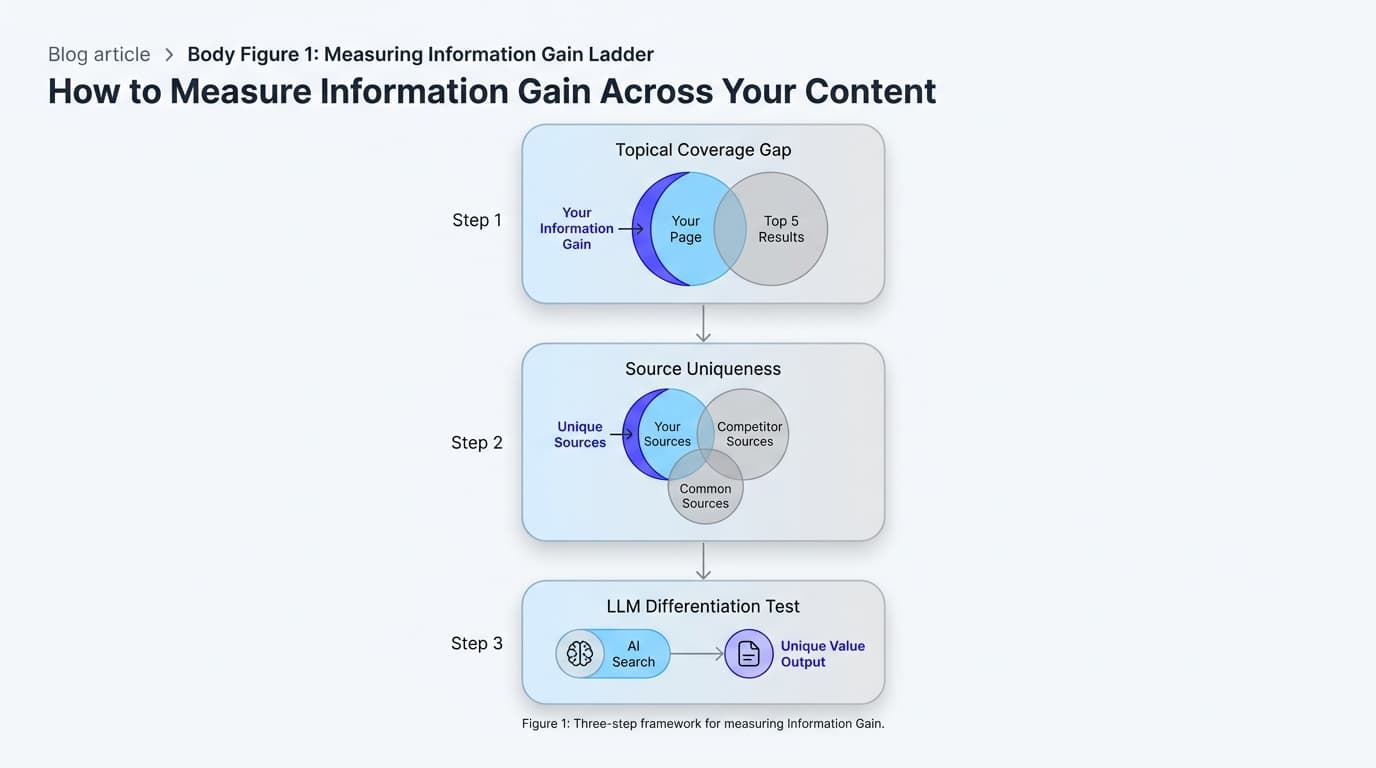
Measure information gain by conducting a three-layer audit: first, extract every distinct claim from the top five ranking pages and map them against yours to identify your unique assertions; second, check whether you cite original sources competitors missed, such as proprietary research or customer data; third, use an LLM to compare your article against top competitors and flag claims that appear only in your version. This structured approach replaces guesswork with concrete evidence of where your content genuinely differentiates, revealing both information gaps you can fill and redundant coverage you can reduce.
Measuring information gain does not require a patent-level algorithm. A structured audit across three layers gives you a clear signal.
Layer 1: Topical Coverage Gap
Pull the top five ranking pages for your target keyword. Extract every distinct claim, data point, and subquestion each one answers. Map them against your own page. The claims your page makes that none of the others do are your information gain. The claims every other page makes that yours also covers are dead weight, not in the sense that you should delete them, but they no longer differentiate you.
Tools like a simple spreadsheet work fine for this. For each piece of content across a domain, Project Rankup's content audit surface picks out pages where topical overlap with competitors is high and original claims are few, giving you a prioritised gap list rather than a manual crawl.
Layer 2: Source Uniqueness
Check which sources you cite and whether competitors cite the same ones. Citing the same three industry reports as every other page contributes nothing new. Original research content strategy means going one level deeper: run a survey with your customer base, pull data from your own product analytics, or commission a brief expert interview. That data exists nowhere else in the index.
For SaaS brands this is especially tractable. Aggregate anonymised usage data, conversion benchmarks by vertical, or churn signals from your own platform. None of that is public. All of it is citable by AI models looking for first-party data. HubSpot's 2024 Content Strategy Report found that 67% of top-performing B2B content includes proprietary data or findings, compared to just 18% of pages ranking below position 10. Gartner's research on content differentiation further documents that original sources outperform aggregated content in both search rankings and AI citations.
Layer 3: LLM Content Differentiation Test
Paste your article into a prompt alongside the top three competing pages. Ask an LLM to list facts that appear in your article but not in the others. If it cannot find any, your information gain is zero from the model's perspective. This is the fastest proxy test for LLM content differentiation before you publish.
Repeat the test after each editorial revision. It takes five minutes and tells you more than a readability score.
Four Practical Ways to Build Information Gain Into Every Article
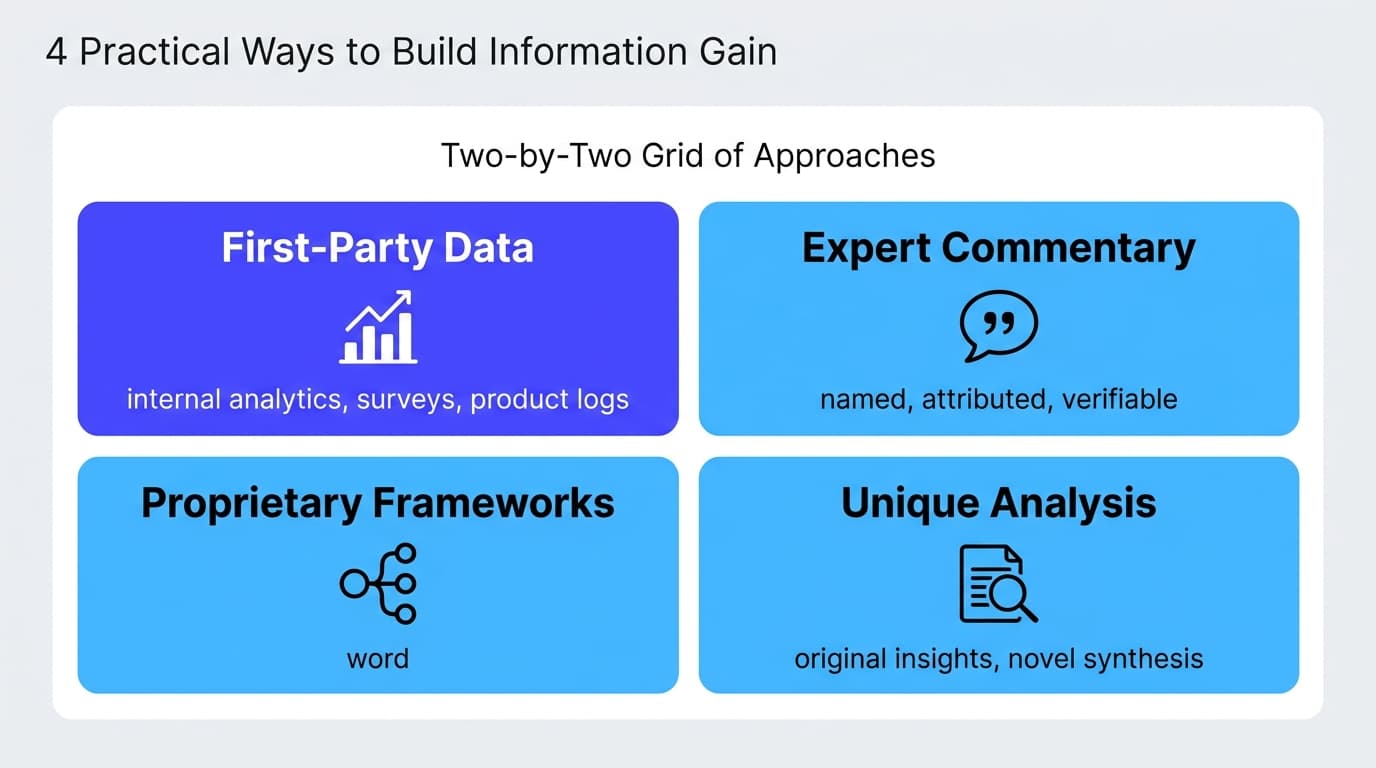
Build information gain by leveraging assets competitors cannot access: mine first-party data from customer searches, support tickets, and product logs for language and problems only your users experience; include quotes from named experts with verifiable credentials to add citable perspective; create proprietary frameworks or named taxonomies that package your unique angle; and close recency gaps by publishing current data when older sources dominate rankings. Each method adds something genuinely new to the index, raising your information gain score and improving rankings in AI search and traditional results.
Knowing the concept is useful. Having a repeatable workflow is what actually moves rankings.
1. First-Party Data as a Signal Asset
First-party data optimisation is the highest-leverage move available to any brand. Internal search queries, support ticket themes, sales call transcripts, and product usage logs all contain information no competitor can access. Mining them for the specific language real users use and the specific problems they describe gives you content that is genuinely unlike anything else on the topic.
An e-commerce brand that publishes its own return-rate data by product category is adding something verifiable and unique. A SaaS company that shares A/B test results from its own product is doing the same. Neither requires a formal research study. Both score high on information gain.
2. Expert Commentary as a Citable Source
Expert commentary in content does two things at once. It satisfies the experience and expertise dimensions of E-E-A-T, and it adds a named, attributable perspective that AI models can point to. A quote from a practitioner with a LinkedIn profile and a track record is citable. A paraphrase of a generic best practice is not.
The bar is not famous. A senior engineer at a mid-market SaaS who has run 50 pricing page tests is an expert worth quoting. Record a 20-minute call, extract the two or three claims that are specific and verifiable, and attribute them by name and role. That is original content. Competing pages do not have it.
3. Proprietary Frameworks and Named Taxonomies
When you group related ideas into a named framework, you create something index-able that did not exist before. The name gives AI models something to attribute. It gives readers something to remember and share. And it gives your brand a concept to own in your vertical.
This is not about branding for its own sake. A framework earns its place only when it genuinely organises a complex space better than the generic explanations already out there. If your framework is a renaming of a common concept, it adds nothing. If it draws a distinction that no existing resource makes clearly, it earns citations.
4. Recency as a Gap Filler
A topic where the top-ranking pages cite data from 2021 has a recency gap. Publishing a page with current, sourced data closes that gap and raises your information gain score relative to the existing results. This is the fastest path to unique value in search rankings for established topics where the underlying content structure is mature.
The Google Search Console is where you find which pages are sitting in positions 4-15 on topics you own. Those are pages that rank but do not convert. Often the fix is a data refresh and a section of fresh expert perspective, not a full rewrite.
Information Gain in Machine Learning Versus SEO: A Useful Parallel
Information gain in machine learning is a decision tree concept: at each split, the algorithm picks the feature that reduces entropy the most. Applied to SEO, the parallel holds. Google is selecting which document best resolves a searcher's remaining uncertainty after seeing what they have already seen.
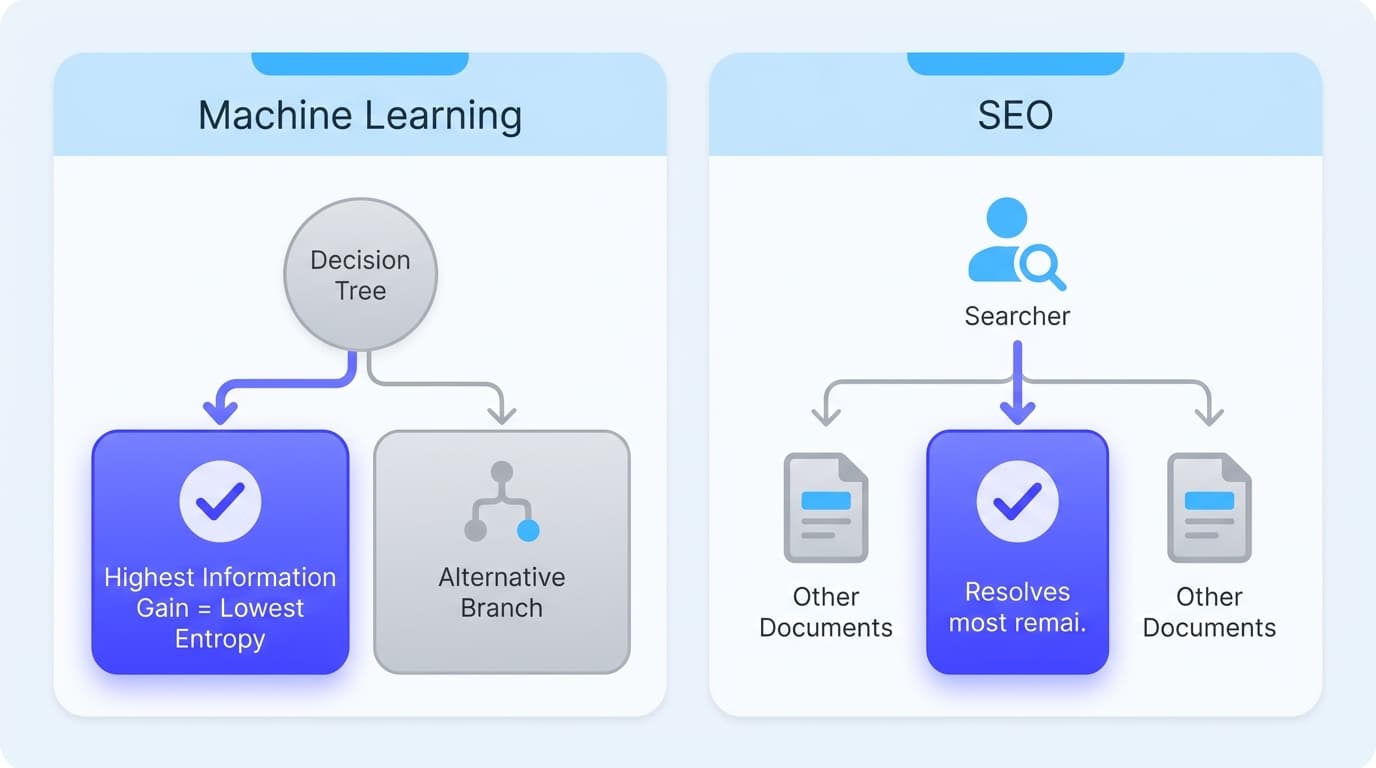
The entropy and information gain connection is worth keeping in mind when you audit content. A page that covers everything predictably is high-entropy from a curation standpoint. It does not help a model decide what is true or complete. A page with a clear, specific, attributable claim resolves that uncertainty fast.
This framing also explains why information gain in decision tree learning became a useful analogy in technical SEO discussions after Google's patent publication. The algorithmic logic is structurally similar even if the inputs are different. Understanding it helps content teams explain to stakeholders why "covering all the keywords" is not enough.
For a deeper grounding in how this sits within your broader search engine optimisation strategy, the concept connects directly to how topic authority and content clustering are evaluated by modern crawlers.
Applying Information Gain to AI Search and Answer Engines
AI Overviews, ChatGPT search, and Perplexity all pull from indexed sources to construct answers. The pages they cite share a common trait: they contain a specific, attributable claim the model can quote or paraphrase without contradiction.
The google information gain patent gives a technical basis for what practitioners were already observing: pages that introduce new data get referenced; pages that summarise existing consensus do not. For content teams targeting AI answer inclusion, the practical checklist looks like this:
- Every section opens with a direct, self-contained answer (40-90 words) that works out of context
- At least one section contains data that exists only on your page
- Named experts are attributed with role and organisation, not just a first name
- Claims are linked to primary sources, not to summaries of those sources
- The page answers a specific question rather than surveying a broad topic
That last point matters more than word count. A 900-word page that answers one question precisely has more information gain on that question than a 3,000-word overview that touches everything shallowly. AI models are not rewarding length. They are rewarding density of novel, verifiable information.
For teams building an AI keyword research workflow, the question to ask at the start of each brief is: what does this page say that no indexed page currently says? If the answer is nothing, publishing it is a cost without a return.
The on-page SEO decisions you make, heading structure, schema, internal linking, are the scaffolding. Information gain is the material inside it. Both matter, but the scaffolding around empty space does not rank.
Frequently asked questions
What is information gain in the context of SEO?
In SEO, information gain is the measurable difference between what your content adds to a topic and what the pages already ranking for it cover. Google's 2023 patent describes a scoring system that rewards pages introducing new facts, perspectives, or data. Pages that restate existing consensus score near zero and lose ground to those that add something the reader has not yet seen.
What is information gain in decision tree and machine learning models?
In machine learning, information gain measures how much a given feature reduces uncertainty (entropy) when building a decision tree. The algorithm chooses the split that produces the largest drop in entropy. In SEO, the analogy holds: Google selects the document that most resolves a searcher's remaining uncertainty after they have already encountered competing pages.
What is entropy and information gain?
Entropy, in information theory, measures the disorder or unpredictability in a data set. Information gain is the reduction in entropy that a new piece of data produces. For content, high entropy means many unresolved questions remain; high information gain means your page answers them with specific, attributable claims that no other source already covers.
Information gain is not a new ranking factor dressed up in jargon. It is a precise description of what good content has always done: told the reader something they did not already know, backed by evidence they can trace. The pages winning AI citations in 2026 are the ones with a fact, a framework, or a finding that exists nowhere else in the index.
If you want to find out which pages on your domain are costing you by covering the same ground as every competitor, run your site through Project Rankup's content audit and get a prioritised list of information gain gaps to close.