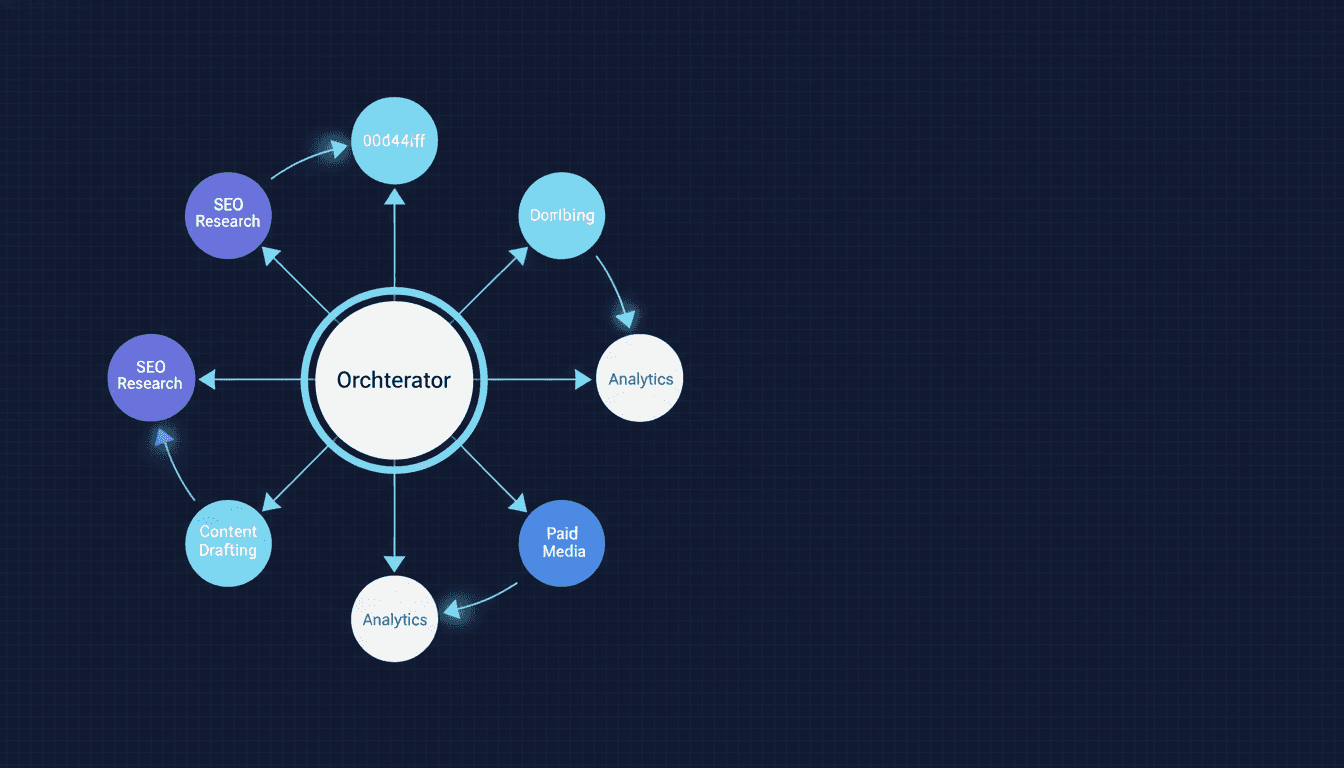
Agentic marketing systems are AI-powered architectures where autonomous agents plan, execute, and refine marketing tasks without a human approving each step. Unlike a chatbot that answers one question, an agentic system pursues a goal, monitors its own results, and adjusts its approach mid-run. For teams doing SEO, paid media, or content at scale, this shift is less about replacing people and more about removing the coordination tax that slows everything down.
Quick Answer: An agentic marketing system connects specialized AI agents (one for keyword research, one for content drafting, one for performance monitoring) through an orchestration layer that routes tasks, shares memory, and triggers the next action when the previous one completes. The result is a marketing workflow that runs around the clock and improves with each cycle.
What Are Agentic Marketing Systems?
Agentic marketing systems are multi-agent AI architectures where each agent handles a distinct function and hands off outputs to the next agent automatically. Think of it as the difference between hiring one generalist freelancer versus running a small, self-managed squad: a researcher, a writer, a publisher, and an analyst who each do their job and brief the next person without you scheduling every handoff.
The three defining properties are autonomy (the system acts on goals, not single prompts), persistence (it maintains memory across tasks and sessions), and feedback loops (it reads performance data and changes behavior accordingly). A single large-language-model prompt is not agentic. A system that monitors rank changes, identifies content gaps, drafts new sections, and pushes them to your CMS for review, and does this weekly without you kicking it off, is.
This distinction matters for SEO teams specifically. Keyword research and content auditing are tasks that benefit enormously from agents that can hold context across hundreds of URLs and update their findings as Google's index shifts.
How Agentic AI Transforms Marketing Workflows
The clearest way to see the shift is to map a real workflow before and after. Take a content refresh cycle for an e-commerce brand with 400 product pages. Before agentic systems, a team would manually pull rank data, sort by traffic loss, prioritize pages, assign writers, wait for drafts, edit, and publish. Four to six weeks, minimum, and that is assuming no one is pulled onto another project.
An agentic workflow runs the same cycle in days. An analytics agent pulls GSC data nightly and flags pages where click-through rate dropped more than 15% week-over-week. A research agent checks the top-ranking pages for those queries, notes structural or semantic changes, and writes a brief. A drafting agent rewrites the flagged sections and queues them in the CMS with a confidence score. A human editor reviews the queue each morning and approves or rejects in bulk.
The human is still in the loop, but at the decision point, not the execution point.
According to McKinsey's 2025 State of AI report, brands that have moved from single-model AI tools to multi-agent systems report 30-50% reductions in time spent on repetitive marketing tasks. The gains compound: each cycle produces cleaner training data for the next one.
For SaaS brands running SEO at scale, this connects directly to technical SEO audit workflows, where crawling, issue prioritization, and fix verification can all be handed to specialized agents.
Building Agentic Marketing Architecture: The Core Layers
A working agentic marketing system has four layers. Skipping any one of them is why most early builds stall after the proof-of-concept stage.
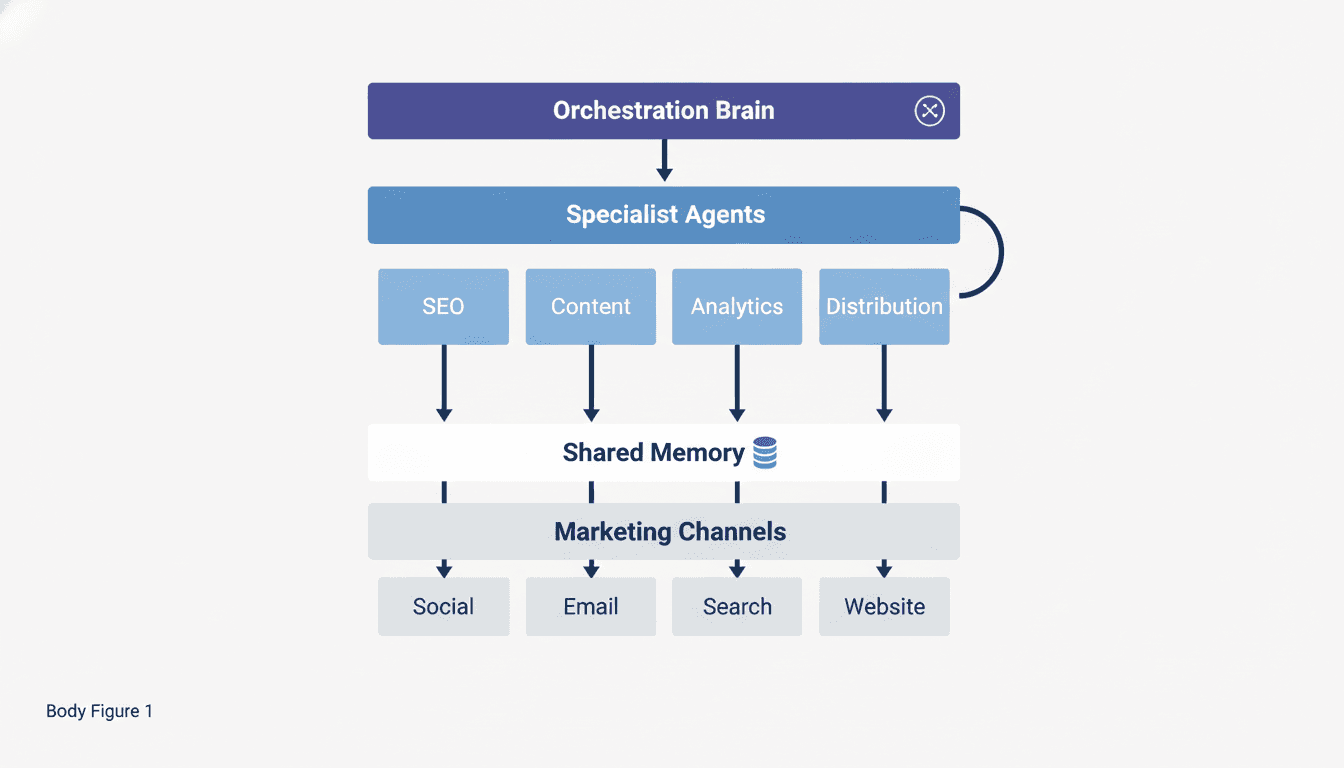
Layer 1: The Orchestration Brain
The orchestrator is the agent that receives the high-level goal ("improve organic traffic to the blog by 20% in Q1"), breaks it into subtasks, assigns them to specialist agents, and manages dependencies. Popular orchestration frameworks in 2026 include LangGraph for Python-native teams and Microsoft's AutoGen for enterprises already on Azure. The orchestrator does not do the work itself; it routes, monitors, and recovers from failures.
Layer 2: Specialist Agents
Each specialist agent is a narrowly scoped model or pipeline built for one function. Common marketing agents include:
- SEO research agent: monitors rank changes, scrapes SERP features, identifies topical gaps
- Content drafting agent: generates or rewrites copy to a brief, respects brand voice guidelines stored in memory
- Distribution agent: schedules and posts to CMS, social, or email platforms via API
- Analytics agent: ingests performance data, calculates deltas, and writes plain-language summaries
- Paid media agent: adjusts bid strategies and creative rotation based on ROAS thresholds
Specialization matters. A single general-purpose agent asked to do all five of these will produce mediocre results on each. Narrow agents with clear inputs and outputs beat wide agents every time.
Layer 3: Shared Memory and Context
This is the layer most teams underinvest in. Agents need a shared memory store where brand guidelines, past decisions, approved content, competitor data, and performance history all live. Without it, each agent starts from scratch. Vector databases (Pinecone, Weaviate, Chroma) are the standard choice for semantic retrieval, but even a well-structured relational store with good indexing works for teams early in the journey.
Layer 4: Human Review Gates
Agentic does not mean unattended. Well-designed systems define clear gates where human judgment is required: before publishing any content publicly, before changing a bid strategy beyond a set threshold, before any action that touches customer data. The gates are narrow and fast, but they are non-negotiable. A system without them will eventually publish something embarrassing or spend money it should not.
| Layer | Function | Common Tools (2026) |
|---|---|---|
| Orchestration | Task routing, dependency management | LangGraph, AutoGen, CrewAI |
| Specialist Agents | Domain-specific execution | Custom GPT-4o / Claude pipelines |
| Shared Memory | Context persistence, brand guardrails | Pinecone, Weaviate, Postgres |
| Human Review Gates | Approval before high-stakes actions | CMS review queues, Slack integrations |
Benefits of Agentic Marketing for SEO
SEO is one of the domains where agentic systems deliver the most measurable value, and the reason is timing. Google's index updates continuously. Competitor pages change. New SERP features appear. A traditional team reviews performance monthly, or weekly if they are disciplined. An agentic system reviews it daily and acts the same day.
Four concrete benefits stand out:
- Faster content velocity without quality drops. Agentic systems can produce first drafts tuned to a specific keyword cluster, tone guide, and internal link structure in minutes. Editors raise quality; they do not create from scratch.
- Continuous technical monitoring. Rather than scheduling quarterly audits, an agent can run crawl checks nightly and surface new canonical errors, broken links, or Core Web Vitals regressions before they compound. This pairs well with a structured SEO audit process.
- Semantic coverage at scale. Agents can map an entire topic cluster, find the pages with thin coverage of LSI keywords, and generate targeted additions that improve topical authority without a human manually combing through each URL.
- AI answer optimization. As AI Overviews and Perplexity pull answers directly from indexed content, agentic systems can test and refine how pages are structured to maximize passage-level citation. This is a capability most teams have not touched yet, and it is a real competitive advantage.
For agencies managing 20 or more client sites, this scales in ways manual processes simply cannot. The SEO services model is shifting from monthly deliverables to continuous optimization loops, and agentic systems are the engine that makes that shift viable.
Implementing Agentic Marketing Strategies in 2026: A Practical Roadmap
Most teams that fail at this do so because they try to build everything at once. Start narrow, prove value, then expand.
Phase 1: Instrument before you automate (weeks 1-4)
Before any agent can make good decisions, you need clean data pipelines. Connect Google Search Console, GA4, your CMS, and your rank tracker to a central data warehouse. An agent that cannot read reliable performance data will optimize for the wrong signals.
Phase 2: Build one specialist agent (weeks 5-8)
Pick the highest-friction, most repetitive task your team does. For most SEO teams, that is the weekly rank report and content brief cycle. Build a single agent that pulls rank data, identifies the top 10 pages to review, and drafts a brief for each. Run it alongside your manual process for four weeks and compare output quality.
Phase 3: Add the orchestrator and second agent (weeks 9-14)
Once the first agent is trusted, add a drafting agent and connect the two through an orchestrator. The research agent feeds briefs to the drafting agent; the orchestrator manages the queue. Add a human review gate before anything goes to the CMS.
Phase 4: Close the feedback loop (weeks 15+)
Add the analytics agent. Now the system can see what it published, measure how it performed, and inform the next research cycle. This is the point where the system starts improving itself. Monitor for drift: agents that optimize for a proxy metric (time-on-page) while missing the real goal (conversions) are common and easy to fix once you are watching for them.
Teams building on this foundation should also review their SEO tools stack to confirm their existing platforms expose APIs that agents can call. A tool that only works through a GUI is a bottleneck.
Agentic Marketing Use Cases for Agencies
For agencies and freelancers, the value proposition is capacity. An agency running agentic systems can service more clients at higher quality, not by cutting corners but by removing the administrative overhead that currently consumes senior team time.
Practical use cases that are working in production today:
- Automated content gap analysis: An agent crawls a client's site and top competitors weekly, maps topic coverage, and outputs a prioritized list of net-new content opportunities with estimated traffic potential.
- Link prospecting: An agent searches for unlinked brand mentions, relevant directories, and broken link opportunities, surfaces the top 20 each week, and drafts the outreach email for each. A human sends it.
- Reporting and client communication: An agent ingests all performance data, writes a plain-language summary of what moved and why, and populates a client deck template. Reporting that used to take four hours takes twenty minutes of review.
- Penalty detection: An agent monitors traffic and ranking patterns for sudden drops consistent with a manual action or algorithmic penalty, fires an alert within 24 hours, and generates a preliminary diagnosis.
For SaaS brands, the use case extends to product-led SEO: agents that track which features competitors are ranking for, identify programmatic content opportunities, and maintain a live map of the keyword landscape as the product evolves. This connects to broader digital marketing for SaaS strategy, where the content and SEO functions need to move at product speed.
Agentic Marketing Challenges and How to Solve Them
None of this is frictionless. The teams that get the most out of agentic systems are the ones who anticipated the failure modes instead of discovering them expensively.
Hallucination and factual drift. Drafting agents will occasionally invent statistics, misattribute quotes, or state outdated information confidently. The fix is a fact-checking agent in the pipeline, plus a human reviewer who knows to look for specific claims. Never publish agentic content without a human reading it for factual accuracy.
Prompt and context decay. Over long workflows, agents can lose track of brand guidelines or earlier decisions. This is a memory architecture problem, not a model problem. Invest in the shared memory layer early.
Over-optimization for the wrong metric. An agent optimizing for organic impressions will sometimes produce pages that rank for high-volume, low-intent queries. Define your success metrics at the goal level (qualified leads, conversions, revenue-attributed traffic) and make sure the analytics agent reports on those, not proxies.
Regulatory and compliance risk. In regulated industries, an agent publishing content about financial products, health claims, or legal advice without a compliance review gate is a liability. Map your compliance requirements before you build, not after.
The deep search AI capabilities that power many of these agents are also evolving fast. What works today may need recalibration in six months. Build your architecture to swap models without rebuilding the whole system.
Frequently asked questions
What is an agentic marketing system?
An agentic marketing system is a multi-agent AI architecture where specialized agents handle distinct marketing tasks, such as SEO research, content drafting, and performance analysis, and hand off outputs to each other automatically. Unlike single-prompt AI tools, agentic systems pursue goals, retain memory across tasks, and adjust based on results without human approval at each step.
How is agentic AI different from marketing automation?
Marketing automation executes predefined rules: if a user visits page X, send email Y. Agentic AI sets goals and figures out the steps itself. An agentic system can notice that email Y is underperforming, hypothesize a reason, draft a variant, test it, and update the rule, all without a human writing new logic. The key difference is adaptive reasoning versus scripted execution.
What are the biggest risks of building agentic marketing systems?
The three most common failure points are factual hallucination in content agents, over-optimization for proxy metrics instead of real business outcomes, and missing human review gates before high-stakes actions. Each is solvable with good architecture: a fact-checking step in the pipeline, goal-level analytics, and clearly defined approval workflows.
How long does it take to build a working agentic marketing system?
A first working agent, covering a single workflow like weekly rank monitoring and content briefing, can be production-ready in six to eight weeks for a team with clean data infrastructure. A full multi-agent system with an orchestrator, three or more specialist agents, shared memory, and feedback loops typically takes three to five months to reach reliable production performance.
Do small brands and agencies benefit from agentic marketing, or is it only for enterprises?
Small teams arguably benefit more on a per-person basis because they have the least capacity to absorb repetitive work. A two-person agency running an agentic content research and reporting system effectively doubles its operational capacity without hiring. The entry cost has also dropped sharply: open-source orchestration frameworks and API-accessible models mean the barrier is technical knowledge, not budget.
What SEO tasks are best suited for agentic automation?
The highest-value tasks to automate first are rank monitoring and alerting, content gap identification, technical issue detection, content brief generation, and performance reporting. These are high-frequency, data-heavy, and rule-following enough that agents perform them reliably. Creative strategy, editorial judgment, and client relationship management are best kept with humans.
How do agentic systems help with AI Overviews and answer engine optimization?
Agentic systems can continuously test and refine how content is structured to maximize the chance of being cited in AI Overviews, ChatGPT responses, and Perplexity answers. A research agent can monitor which pages from your site are cited in AI answers, an analysis agent can identify the structural patterns those pages share, and a drafting agent can apply those patterns to other pages in the cluster systematically.
Key Takeaways
- Agentic marketing systems use multiple specialized AI agents connected through an orchestrator to pursue marketing goals autonomously, not just respond to individual prompts.
- The four core layers are orchestration, specialist agents, shared memory, and human review gates. Skipping any one breaks the system.
- SEO teams gain the most from agentic systems through faster content velocity, continuous technical monitoring, semantic coverage at scale, and AI answer optimization.
- Start with one agent covering your highest-friction task, prove its value over four to six weeks, then expand to a full multi-agent architecture.
- The main risks are hallucination, metric misalignment, and missing governance gates. All three are solvable with deliberate architecture choices.
- Agencies and freelancers can use agentic systems to scale client capacity without proportional headcount growth.
- Agentic marketing is not a future trend. Teams building these systems now are already compounding advantages that will be hard to close in 2027.
Ready to stop managing tasks and start managing outcomes? Project Rankup's AI-driven SEO and content solutions are built for teams that want to move at this speed. Reach out and let us show you what a purpose-built agentic content system looks like in practice.