
SEO services have never been a single thing, but in 2026 the gap between what agencies sold three years ago and what actually drives traffic has become impossible to overlook. Gartner's 2024 research predicted that traditional search engine volume would drop 25% by 2026 due to AI chatbots handling queries directly. That prediction is now playing out in analytics dashboards across every industry. Brands watching organic sessions fall despite solid rankings are not imagining things. The search landscape has bifurcated: there is the old blue-link world, and there is the new answer world. Winning in 2026 means showing up in both.
Modern seo services combine traditional search optimization with answer engine optimization (AEO) and generative engine optimization (GEO). AEO structures your content to be extracted and cited by AI Overviews and ChatGPT. GEO positions your brand as a trusted source inside tools like Perplexity and Google's AI Mode. Treat them as separate disciplines and you leave measurable traffic on the table.
Quick Answer: In 2026, professional seo services cover on-page and technical SEO, content strategy, link acquisition, AEO (structuring content for AI-generated answers), and GEO (earning citations in generative AI tools). Providers who only offer the first three are selling an incomplete product.
What Do SEO Services Actually Include in 2026?
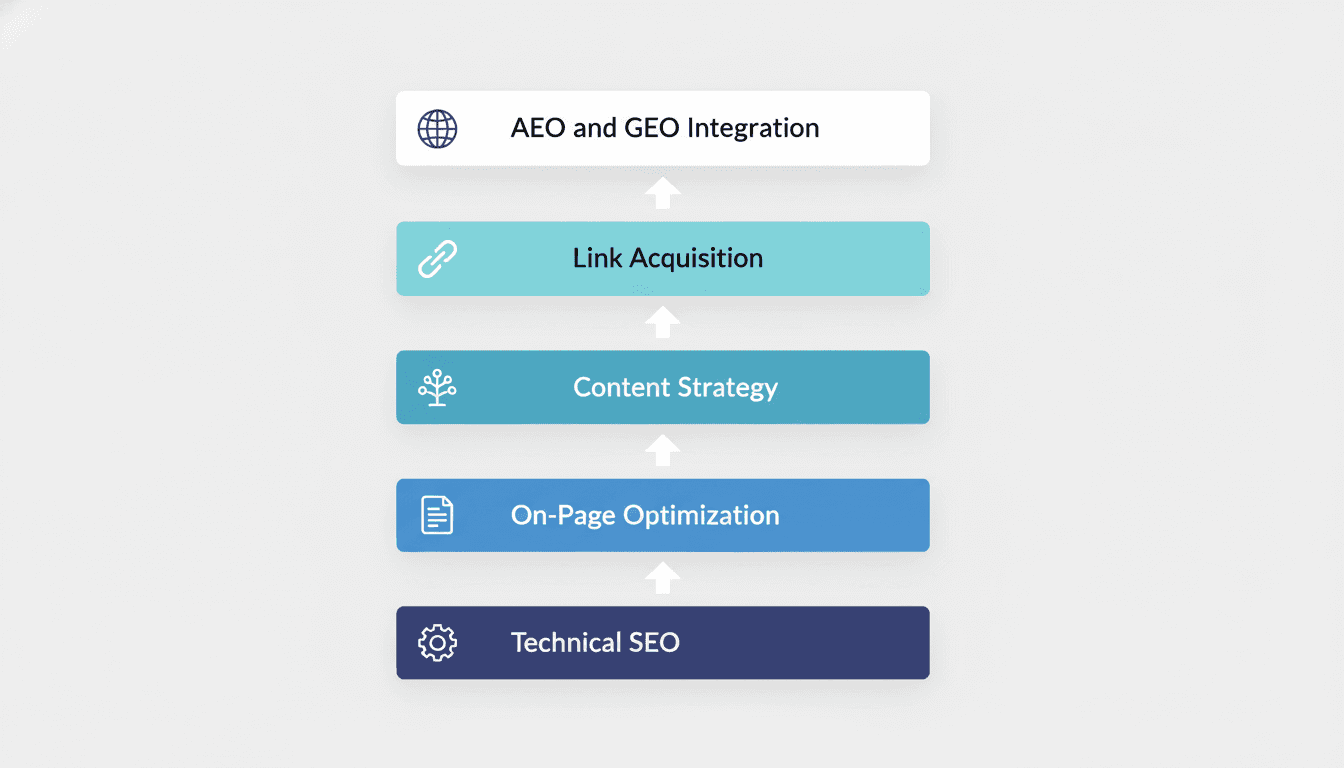
The honest answer to "what do seo services include" has changed more in the last two years than in the previous decade. A credible provider in 2026 should be delivering across five distinct layers, not just keywords and backlinks.
| Service Layer | What It Covers | Why It Matters in 2026 |
|---|---|---|
| Technical SEO | Core Web Vitals, crawlability, site architecture, schema markup | Prerequisite for indexing and AI parsing |
| On-Page Optimization | Title tags, headings, internal linking, entity alignment | Controls how content is understood and ranked |
| Content Strategy | Topical authority, content clusters, freshness signals | Drives AI citation and depth scoring |
| Link Acquisition | Editorial backlinks, digital PR, authority building | Still a core ranking signal across all engines |
| AEO and GEO | Answer formatting, structured data, generative citation optimization | The new frontier for AI-driven visibility |
The table above is not exhaustive, but it is the minimum viable scope. An agency selling only keyword research and monthly blog posts in 2026 is not offering complete seo services. They are offering a fraction of what's needed.
One angle most competing guides miss: schema markup has graduated from a "nice to have" to a strict prerequisite for AI extraction. Google's AI Overviews, ChatGPT's web browsing, and Perplexity all parse structured data before freeform prose when deciding what to surface. If your pages lack proper FAQ schema, HowTo schema, or Article schema, you are essentially invisible to the answer layer of search.
How AI Is Reshaping the Core of SEO Services
AI-driven SEO service trends in 2026 are not just about using ChatGPT to write faster. The structural shift is deeper. Search engines themselves now use large language models to evaluate content quality, not just match keywords to queries. Google's systems score pages on expertise signals, factual consistency, and topical depth in ways that 2020-era optimization never anticipated.
For agencies, this means the deliverable has changed. Comscore's Q2 2026 AI Intelligence Report (published September 22, 2026) found that 39.4% of Google desktop searches included an AI Overview in June 2026. If your client's content is not structured to be extracted into those overviews, a competitor's content is.
Practically, ai seo services now include:
- Passage-level optimization: Writing H2 sections that answer a specific sub-question completely within 90 words, so AI models can extract them without needing surrounding context.
- Entity mapping: Aligning page content to named entities in Google's Knowledge Graph, which directly influences how confidently AI systems cite a source.
- Freshness architecture: Building content update schedules that signal recency, because generative AI systems heavily favor recently verified information.
- AI content audit: Running existing pages through tools that identify which sections are AI-extractable and which are too vague to cite. Our own guide to AI content audit tools covers the top options worth evaluating.
The practical failure mode most brands hit is this: they invest in ai seo services for new content but ignore the existing library. Pages published in 2021 and 2022, even if technically accurate, often lack the structural clarity that modern AI engines reward. A content audit is not optional. It is the starting point.
What Is AEO and Why Every SEO Package Needs It Now?
Answer engine optimization (AEO) is the practice of structuring content so that AI-powered answer engines, including Google AI Overviews, ChatGPT, and Perplexity, select it as a cited source when responding to user queries. AEO and GEO integration in SEO services is no longer a premium add-on. It is table stakes for any brand competing in a high-intent niche.
The core principle of AEO is directness. Answer engines reward content that front-loads the answer, uses clean paragraph breaks, and avoids burying conclusions in qualifiers. If your page about pricing opens with three paragraphs of context before stating a number, an AI model will skip it and cite the page that leads with the number.
Four AEO practices that produce measurable results:
- Open every H2 section with a standalone answer paragraph of 40-90 words that makes complete sense without the surrounding article.
- Use FAQ schema on any page targeting question-format queries. This is the single fastest structural change an agency can implement.
- Write comparison tables with labeled columns. Tables are extracted into AI answers at a significantly higher rate than prose with the same information.
- Cite your claims inline. Generative AI systems are more likely to cite pages that themselves reference authoritative sources, because it signals factual reliability.
For a deeper look at how Google's AI Mode processes these signals, our post on how to rank in Google AI Overviews walks through the mechanics in detail.
GEO: The Third Pillar That Most Agencies Are Still Ignoring
Generative engine optimization (GEO) targets a different surface than AEO. Where AEO focuses on Google's own answer layer, GEO is about earning citations inside tools like Perplexity, Claude, ChatGPT with web search, and Microsoft Copilot. The audience using these tools skews toward researchers, professionals, and high-intent buyers, which makes GEO disproportionately valuable for B2B brands, SaaS companies, and premium e-commerce.
Business buyers increasingly use generative AI tools as part of their vendor research process. If your brand is not appearing in those AI-generated summaries, you are absent from a fast-growing share of the buyer journey.
GEO differs from AEO in one critical way: the citation triggers are broader. Generative tools pull from a wider source pool than Google's index, which means brand mentions across industry publications, podcast transcripts, Reddit threads, and forum discussions influence whether your brand is included in AI-generated answers. Digital PR is suddenly a GEO tactic, not just a link-building one.
For brands running ecommerce seo services programs, GEO creates a specific opportunity. Product comparison queries, "best [category] for [use case]" questions, and review-style prompts are all handled by generative AI tools. Brands with detailed, independently cited product content consistently appear. Brands with thin product descriptions consistently do not.
How to Select an SEO Agency in 2026: A Decision Framework
Knowing how to select an seo agency in 2026 requires a sharper filter than it did even two years ago. The market is saturated with providers who updated their website copy to include "AI" and "AEO" without updating their actual delivery.
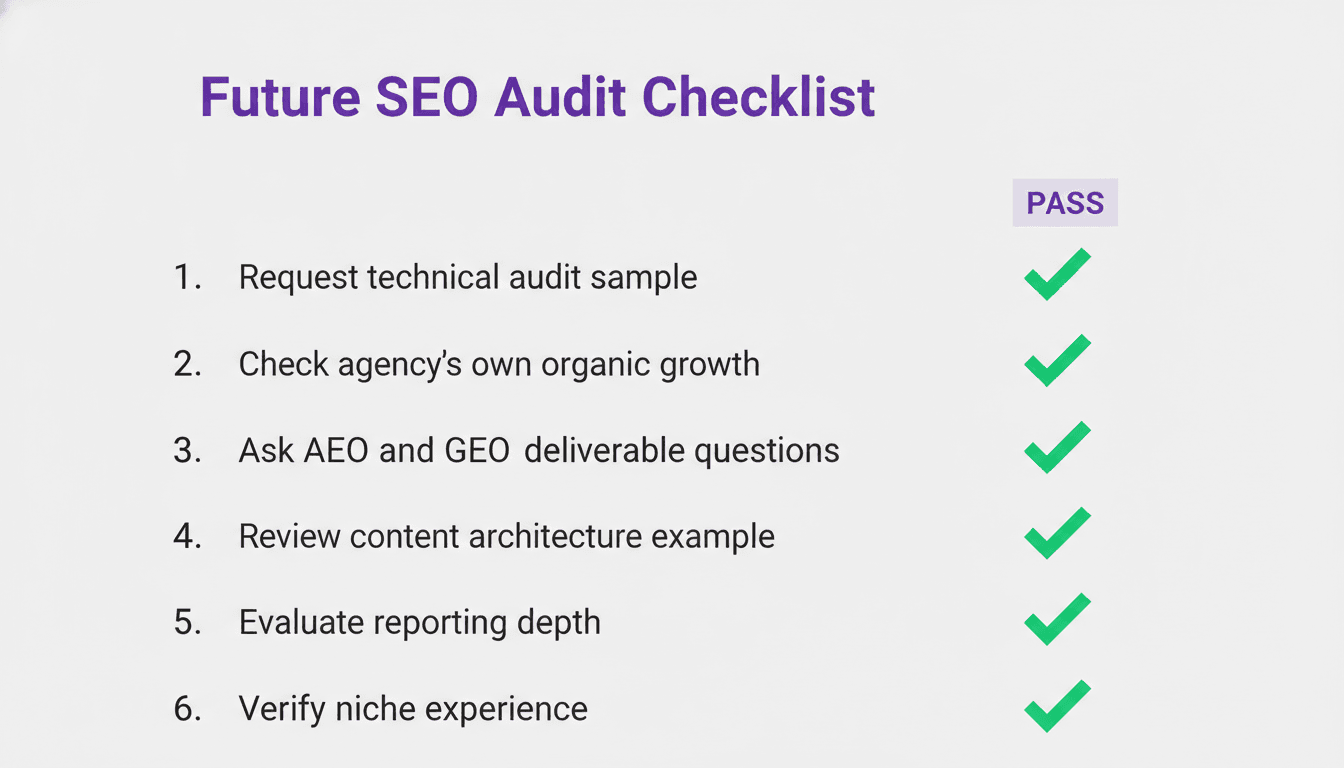
Here is a six-step evaluation framework that works in practice:
- Ask for a technical audit sample. A competent agency can produce a one-page technical SEO summary for any live URL in under an hour. If they cannot, their process is not systematic.
- Check their own organic visibility. Use a tool like Ahrefs or Semrush to see whether the agency's own domain has grown in the past 12 months. An SEO provider with flat or declining organic traffic is a red flag.
- Ask specifically about AEO and GEO deliverables. Get them to describe, in concrete terms, what they do to improve AI Overview citation rates. Vague answers about "quality content" are not acceptable in 2026.
- Request a content architecture example. Ask to see how they structure a topical cluster. Providers who understand topical authority can show you a content map. Those who do not will show you a keyword list.
- Evaluate reporting depth. Monthly reports should cover ranking changes, organic traffic by intent category, featured snippet wins, and AI citation tracking. Reports that only show keyword positions are measuring the wrong things.
- Verify niche experience. A firm that excels at local seo services for service businesses operates very differently from one specializing in enterprise ecommerce. The tools, link strategies, and content formats are distinct. Ask for examples from your category.
For teams evaluating options in the Indian market specifically, seo services in india and seo services in mumbai providers have matured considerably. The best ones now offer full-stack AEO and GEO delivery at competitive price points, but the same evaluation framework applies regardless of geography. Credentials and process matter more than location.
The most common mistake brands make during agency selection is optimizing for the lowest monthly retainer. A provider charging $500 per month for what should be a $3,000 scope is either cutting corners on link quality, content depth, or reporting frequency. Usually all three. For a broader look at evaluating tools and platforms alongside agency selection, our advanced SEO tools guide covers the stack a serious provider should be using.
Types of SEO Packages and What They Should Cost
Understanding the types of seo packages available is essential before any procurement decision. The market in 2026 broadly segments into four tiers, each with a distinct scope and realistic price range.
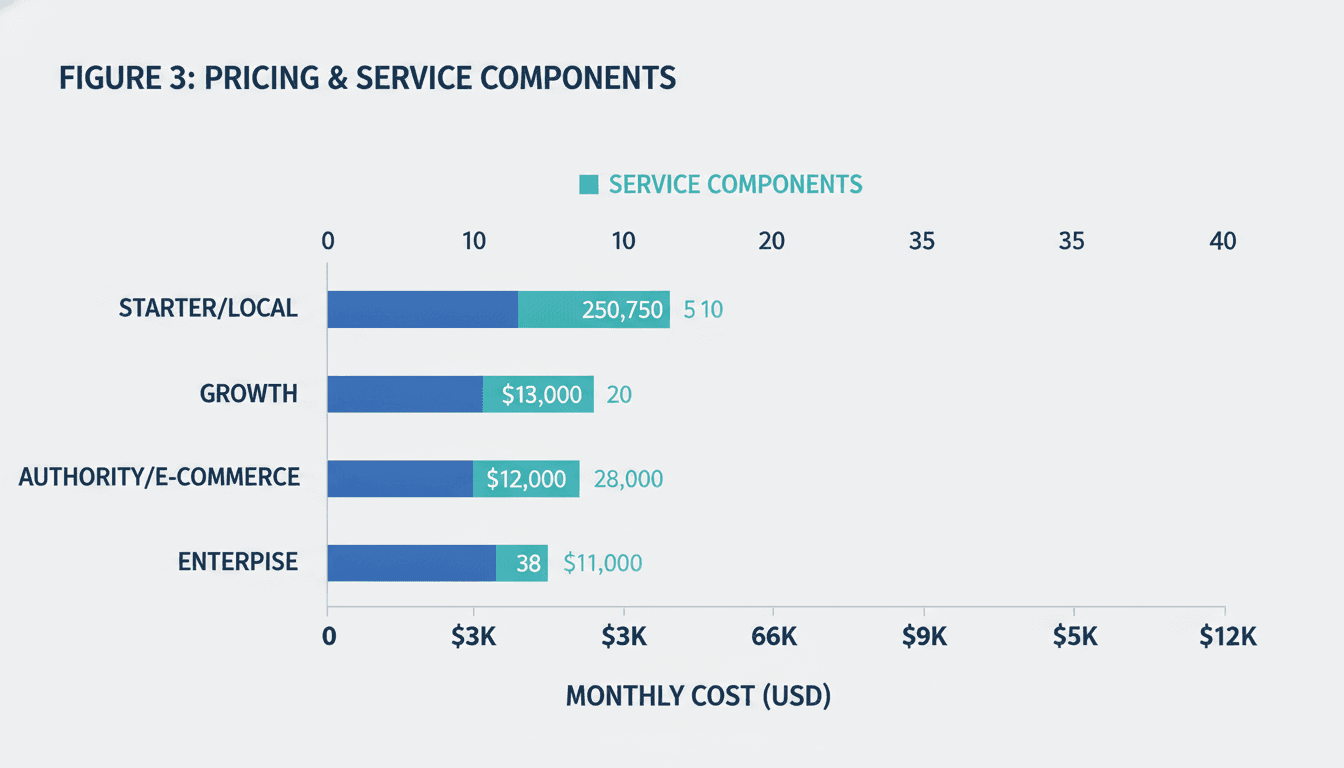
| Package Type | Typical Scope | Realistic Monthly Cost (USD) | Best For |
|---|---|---|---|
| Starter / Local | Local SEO, GMB optimization, basic on-page, monthly reporting | $500 - $1,500 | Local service businesses, solo practices |
| Growth | Full on-page, content strategy, link building, AEO basics | $1,500 - $4,000 | SaaS startups, regional brands, SMBs |
| Authority / E-commerce | Technical SEO, content clusters, digital PR, AEO and GEO integration | $4,000 - $10,000 | E-commerce brands, competitive verticals |
| Enterprise | Custom strategy, dedicated team, AI search monitoring, international SEO | $10,000+ | Enterprise brands, global e-commerce |
The cost of seo services for small business sits firmly in the starter and growth tiers. A local restaurant or service provider with a $500-$1,000 monthly budget can get meaningful results from focused local seo services: Google Business Profile optimization, local citation building, and location-specific content. Expecting enterprise-level link acquisition at that budget is not realistic, and agencies who promise it are padding their link reports with low-authority placements.
One cost consideration that rarely appears in agency proposals: content migration and audit costs. Businesses with existing content libraries often need a structural audit before new content investment makes sense. Spending $2,000 per month on new articles while 80 existing pages have thin, unoptimized content is a poor allocation. Always negotiate a content audit into the first 60 days of any new engagement. Our post on SEO services for small business breaks down budget allocation by business size in more detail.
For seo services in hyderabad and other Tier 2 Indian markets, growth-tier delivery is frequently available at 40-50% of US pricing from competent local agencies, making it an attractive option for bootstrapped startups willing to manage the relationship closely.
The Benefits of Professional SEO for Brands in 2026
The benefits of professional SEO for brands extend well beyond traffic volume in 2026. The compounding nature of organic visibility, unlike paid media, means a well-executed program builds equity that persists even when budgets shift. But the specific benefits have evolved alongside the technology.
Brands investing in integrated seo services see three distinct advantages today:
AI citation credibility. Brands that appear regularly in AI-generated answers gain a passive credibility signal that no ad campaign can replicate. When a potential customer asks an AI tool "which [category] brand is most reliable" and your brand is cited three times across different tools, it creates purchase confidence that shortens the sales cycle.
Reduced paid media dependency. Brands with strong organic programs can spend less on paid search to achieve equivalent conversion volumes. For SaaS companies and e-commerce brands facing rising cost-per-click rates, this is a material financial benefit.
Compounding topical authority. A content cluster built correctly in 2024 continues to attract links, citations, and AI references through 2026 and beyond. The same $5,000 spent on content that month generates returns for years. A $5,000 ad spend stops the moment the campaign ends.
For SaaS founders weighing channels, our digital marketing for SaaS post offers a framework for deciding when and how much to invest in organic relative to paid acquisition.
Frequently asked questions
What is seo services and what are seo services in plain terms?
SEO services are professional activities that improve a website's visibility in search engines and, increasingly, in AI-generated answer tools. They typically include technical optimization, content strategy, link building, and structured data implementation. In 2026, credible providers also include answer engine optimization and generative engine optimization as core service components.
What do seo services include beyond keyword research?
SEO services in 2026 include technical audits, on-page optimization, content cluster development, editorial link acquisition, schema markup, Core Web Vitals improvements, AEO content structuring, GEO citation strategies, and performance reporting. Keyword research is the starting point, not the deliverable. Providers who treat it as the primary output are not offering a complete scope.
What are the three types of seo services?
The three foundational types of SEO services are on-page SEO (optimizing content and HTML elements on individual pages), off-page SEO (building authority through backlinks and brand mentions), and technical SEO (improving crawlability, site speed, structured data, and indexation). In 2026, most providers add AEO and GEO as a fourth functional layer.
What is local seo services and who needs it?
Local seo services focus on improving a business's visibility for geographically specific searches, such as "plumber near me" or "best dentist in [city]." The core deliverables include Google Business Profile optimization, local citation consistency, location-specific content, and review strategy. Any business with a physical location or service area benefits from a dedicated local program.
How do I evaluate whether an SEO provider actually delivers AEO and GEO?
Ask the provider to show you a page they optimized for AI Overview citation and verify it by running the target query in Google's AI Mode or Perplexity. If their content appears as a cited source, the evidence speaks for itself. If it does not appear at all, the AEO and GEO capability exists only in their pitch deck.
How long does it take to see results from professional seo services?
Technical and on-page changes often show measurable ranking movement within 4-8 weeks. Content and authority-building programs typically show compounding results between months 3-6. AEO citation wins can appear faster if content is well-structured from launch. No credible provider promises page-one rankings in 30 days for competitive terms.
Should a SaaS startup invest in SEO services before reaching product-market fit?
Generally, no. SEO services compound over time, which makes them most valuable when the target audience and messaging are stable. Pre-PMF, the ideal scope is narrow: own a few specific long-tail terms that your ICP searches, build basic technical hygiene, and use AI-driven keyword research to identify demand signals rather than chasing volume.
Key Takeaways
- SEO services in 2026 must cover technical optimization, content strategy, link building, AEO, and GEO to be considered complete.
- Gartner documented a 25% projected decline in traditional search volume by 2026, making AI answer visibility non-optional for competitive brands.
- AEO structures content for extraction into AI Overviews and similar features; GEO earns citations inside generative tools like Perplexity and ChatGPT.
- Schema markup is now a prerequisite for AI extraction, not an optional enhancement.
- When evaluating SEO service providers, ask for a content architecture example, verify their own organic growth, and get specific on AEO and GEO deliverables.
- The cost of seo services for small business ranges from $500 to $4,000 per month depending on scope; local-focused programs sit at the lower end.
- Content audits should precede new content investment in any program inheriting an existing library.
If your current SEO program does not include AEO and GEO, you are optimizing for a search landscape that is already changing under you. Project Rankup builds integrated strategies that connect traditional search optimization with AI citation visibility, so your brand shows up wherever your buyers are looking. Schedule a strategy consultation to assess where your current program stands and what a complete 2026 approach would look like for your business.