An SEO plan is a short written set of decisions: which business outcome search should serve, what is stopping Google from showing your pages, which keywords your site can realistically win, what page each one needs, and how you will judge progress over the next six to twelve months. The task list matters less than the order. For most sites, the deciding factor is the gap between your domain's authority and the difficulty of the keywords you want.
That last point is where most plans go wrong. Template articles hand every site the same seven steps, but a three-month-old SaaS site in Austin, a Shopify store in Pune and a plumber in Leeds should not be running the same plan, because the thing holding each of them back is different.
What an SEO plan is, and what it is not
A plan is narrower than a strategy and broader than an audit. The strategy is the bet: "organic search will bring us qualified demo requests for our invoicing product." The audit is a list of what is broken. The plan sits between them. It picks which of the broken things to fix, which topics to publish, in what order, and what you will deliberately leave alone this quarter.
A good SEO plan fits on one page. Forty slides usually means every possible task with no ranking, and a list with no ranking is not a plan. Expect to rewrite the keyword section after the first review, once you see which pages Google starts to show.
What a plan should never contain is a promise of positions. Google's own advice on hiring help is blunt: no one can guarantee a #1 ranking on Google. Rankings are an outcome you track, not a deliverable you schedule.
The five decisions every SEO plan makes
Strip away the templates and every plan answers the same five questions, in this order:
- Outcome. What should search produce for the business: leads, sales, calls or footfall?
- Blockers. Is anything stopping Google from crawling, indexing or understanding your pages?
- Winnable demand. Which keywords can a site with your authority actually reach page one for?
- Page type. What kind of page does each keyword need to rank: a guide, a category page, a comparison, a location page?
- Measurement. Which numbers will tell you, month by month, that the plan is working before revenue does?
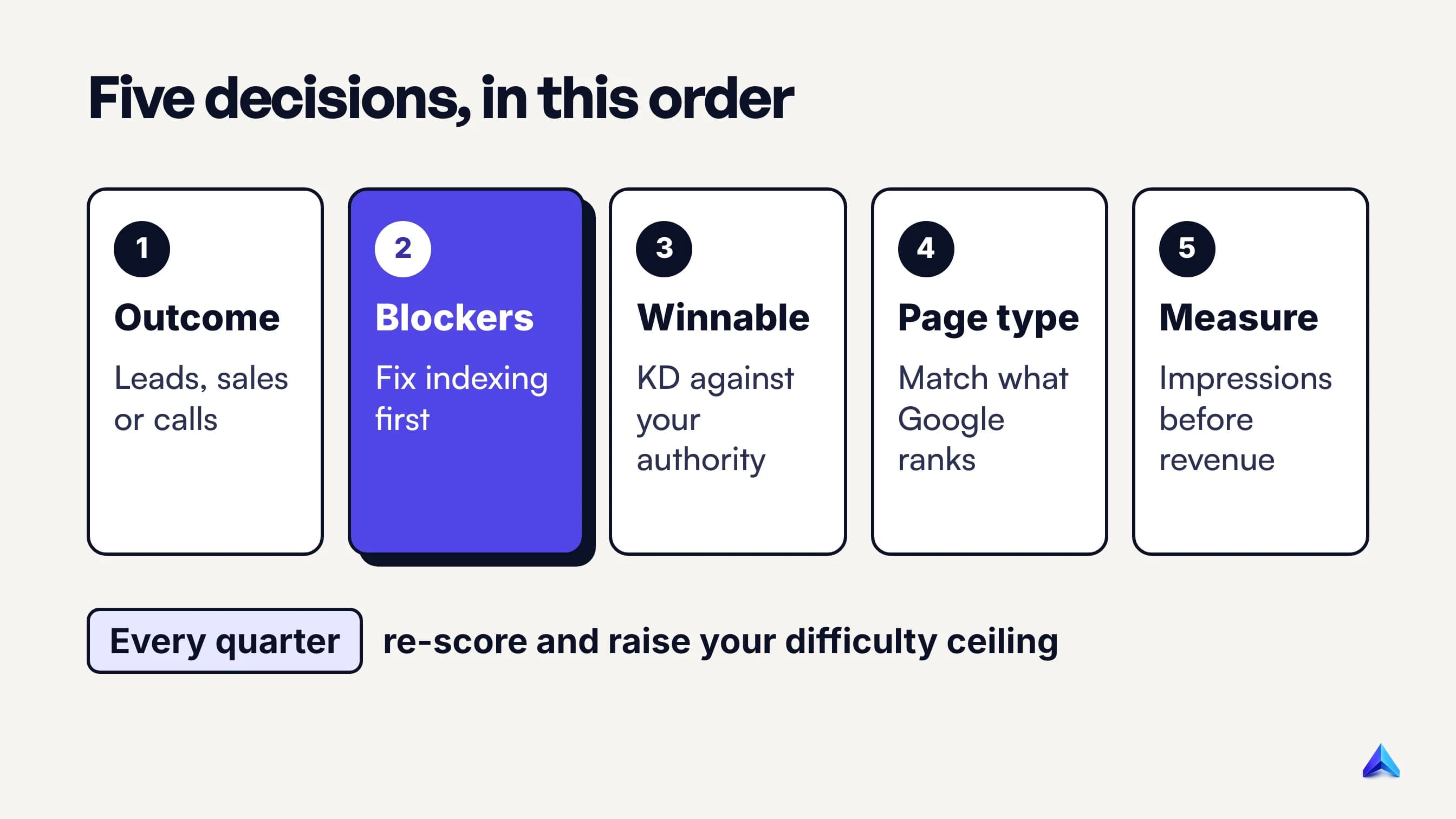
The order is the point. A blocker found at step two makes steps three and four pointless until it is fixed, and a keyword list built before step three is usually a wish list.
Decision 1: what the plan is for
Start with the money, not the keywords. Write one sentence that names the outcome and who it comes from: "more trial sign-ups from finance teams at UK agencies", or "more orders for our cotton kurtas outside Maharashtra". That sentence decides which keywords count.
Each outcome points to a different kind of search, and a different measure of success:
| Business outcome | Searches that move it | What to track first |
|---|---|---|
| B2B leads or trials | Problem and comparison queries ("invoice approval workflow", "X vs Y") | Impressions on those pages, then sign-ups from organic |
| Ecommerce sales | Category and product queries ("linen shirts for men") | Category page rankings, organic revenue |
| Local calls and visits | "Near me" and town-name queries | Google Business Profile calls and direction requests |
| Audience or ad revenue | Broad informational queries | Organic sessions, returning readers |
If you cannot write the sentence, do not start on keywords yet. A plan without an outcome drifts toward the highest search volume, which is usually the traffic hardest to turn into revenue.
Decision 2: is anything blocking Google?
Before you plan a single article, check that Google can see what you already have. Open Search Console, look at the Pages report, and compare the number of indexed pages with the number you think the site has. A large gap is the first item in your plan, ahead of everything else.
You do not need a two-hundred-point audit to answer this. Four checks catch most real blockers:
- Indexing. Are your important pages indexed? Pages stuck as crawled but not indexed are a quality signal, not a technical one, and need a content fix.
- robots.txt and noindex. Is a leftover staging rule blocking a section? Check after every launch or migration.
- Rendering. Does the main text appear in the page source, or only after JavaScript runs?
- Duplicates. Do filtered URLs, tracking parameters or HTTP and HTTPS versions compete with the real page?
If all four are clean, do not let technical work eat the quarter. Schedule a full technical SEO audit once or twice a year and move on to the decision that matters most.
Decision 3: which keywords you can actually win
Keyword difficulty is not a property of the keyword alone. Ahrefs explains that its score pulls the top 10 ranking pages for a keyword and counts how many websites link to each of them. The more linking domains those pages have, the higher the score. The same article tells readers to interpret it as "Personal Keyword Difficulty": the score is the baseline, and your own site's authority is the context.
In practice that means a new site with no links cannot treat a KD 70 keyword as a slow win. It is close to no win at all. Ahrefs' study of its own index found that 96.55% of pages get zero traffic from Google, and its advice for staying out of that group comes down to two routes: target uncompetitive topics that rank with few or no backlinks, or target competitive ones and build the links to compete. A plan has to choose which route each keyword is on.
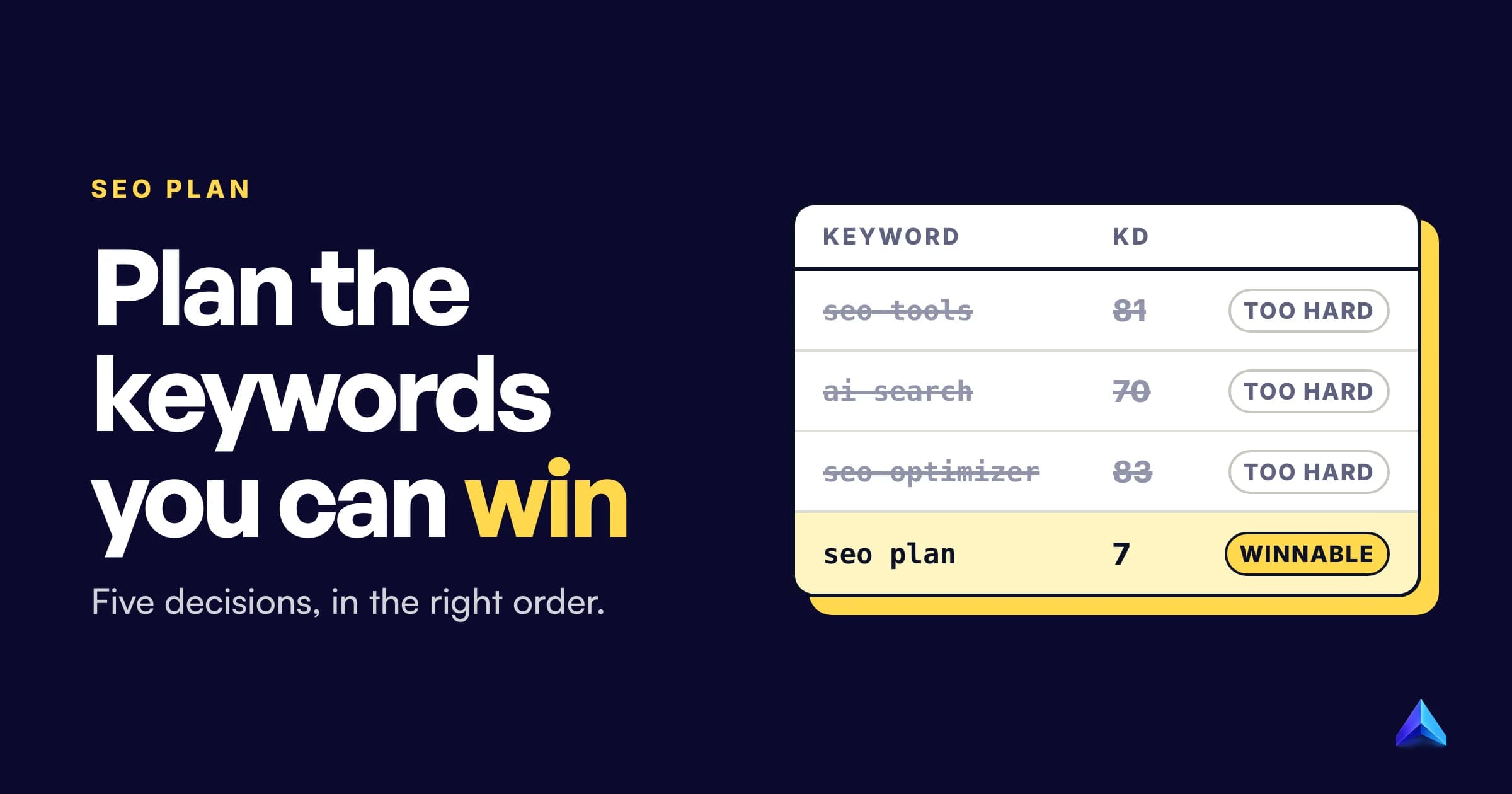
We learned this on our own site. On 1 September 2026, projectrankup.com had a Domain Rating of 0, no organic keywords and no organic traffic, despite 19 well-structured posts with clean schema. The posts targeted "seo tools" (KD 81), "seo optimizer" (KD 83), "ai keyword research" (KD 82) and "ai search" (KD 70). Our working rule is that a DR 0 site tops out around KD 8, and only 1 of 12 targets we sampled fell under it.
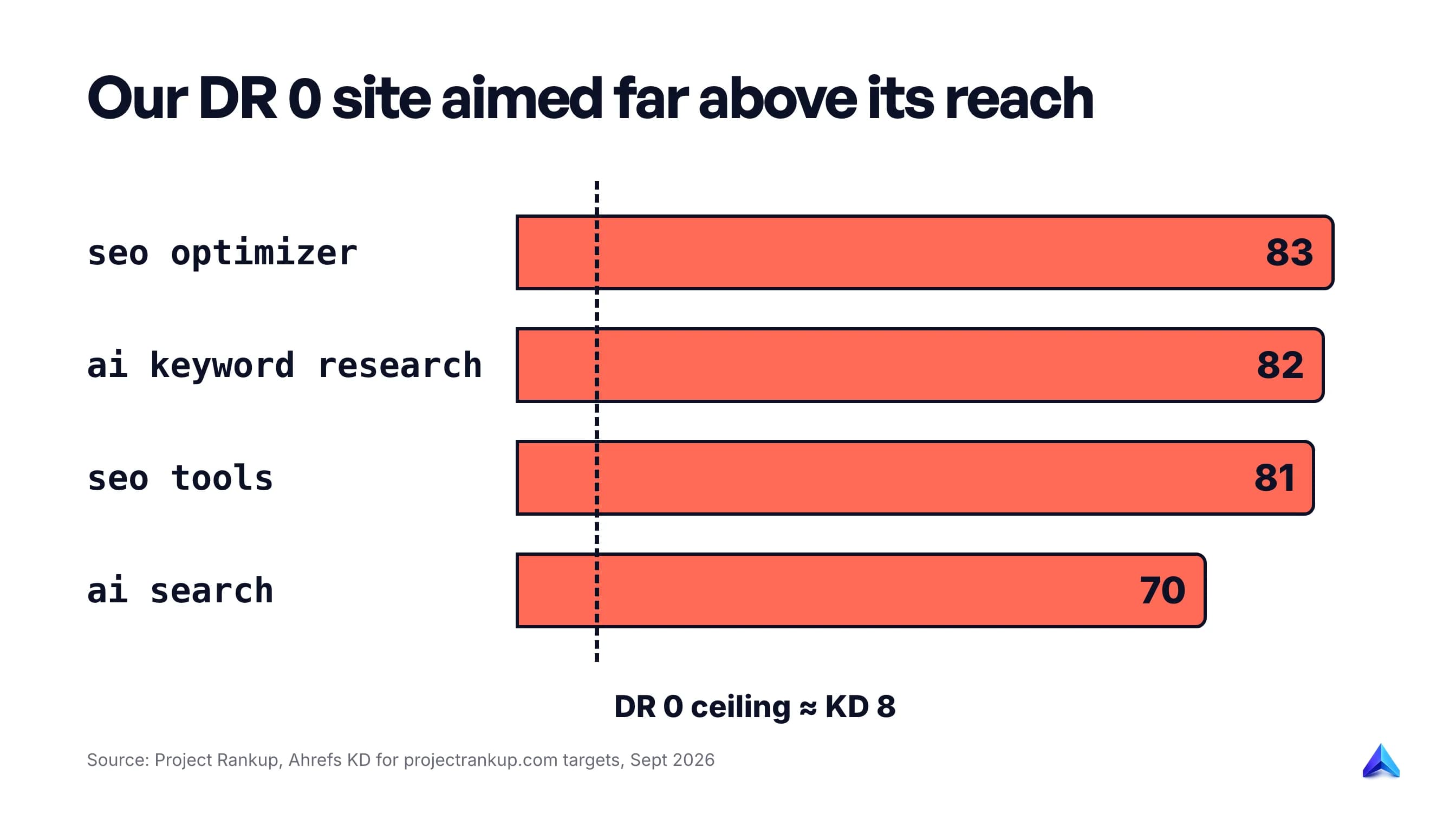
The content was not the problem. The keyword choice was. Our own scoring gave search volume up to 40 points, difficulty only 15, and ignored the site's authority entirely, so it kept picking keywords held by the strongest domains. This post targets "seo plan" at KD 7 for exactly that reason.
To build the winnable list for your own site:
- Find your authority number. Domain Rating in Ahrefs or Authority Score in Semrush. Pick one and stick with it.
- Pull keyword ideas around your outcome, not around your industry name. Our guide to keyword research covers the mechanics.
- Filter by difficulty against your number. A young site should start with the lowest-difficulty terms that still connect to revenue. Raise the ceiling as links and rankings arrive.
- Check the actual results page. A low score with forums, thin pages or low-authority sites in the top five is a real opening. A low score with three government sites on top is not.
- Park the high-difficulty terms you need eventually. They go in the plan as "authority targets" with a link-earning task attached, not as next month's articles.
Ahrefs is candid that the hard terms are still worth chasing when they matter: for many of its own KD 70+ rankings, it says it took four to five rewrites, lots of promotion and many years of patience. Start early on the few you truly need, and keep them off a new site's calendar.
Decision 4: what page each keyword needs
Every keyword already has an answer from Google about what kind of page it wants. Search it in a private window, in the country you are targeting, and note what ranks: guides, category pages, product pages, tools, videos or local listings. If the top results are all category pages and you planned a blog post, change the page, not the keyword.
For local businesses this decision changes the whole plan. Google says local results are mainly based on relevance, distance and how well-known a business is, and the last factor includes how many websites link to the business and how many reviews it has. A solicitor in Manchester or a dental clinic in Bengaluru gets more from a complete Business Profile, steady reviews and one strong page per service than from twenty general articles.
Ecommerce sites usually under-invest here. Category pages carry the commercial searches ("cotton bedsheets king size"), and a plan that only schedules blog posts leaves them as product grids with no text and no reason to rank.
How to weigh the decisions: a scoring sheet
Once you have a winnable list and a page type for each keyword, you still have more work than time. Score each candidate on three things, from 1 to 3:
| Factor | 3 points | 2 points | 1 point |
|---|---|---|---|
| Business value | Searcher is close to buying what you sell | Searcher has the problem you solve | Related topic, distant from revenue |
| Winnability | KD under your ceiling, weak pages in the top five | Near your ceiling | Above your ceiling |
| Effort | An existing page to improve | A new page you can write in a week | A new section, tool or link campaign |
Multiply the three scores rather than adding them. Multiplication punishes any single weak factor, which is the behaviour you want: a keyword worth 3 on value but 1 on winnability scores 3 to 9, and should lose to a modest keyword you can actually rank for. Adding the scores lets a big, unwinnable keyword sneak to the top on the strength of its value alone.
Work the list top-down. The first ten or so items are your quarter. Anything scoring 1 on winnability joins the authority-target list, however valuable it looks.
Three SEO plans, side by side
The same five decisions produce very different plans. Consider three typical sites.
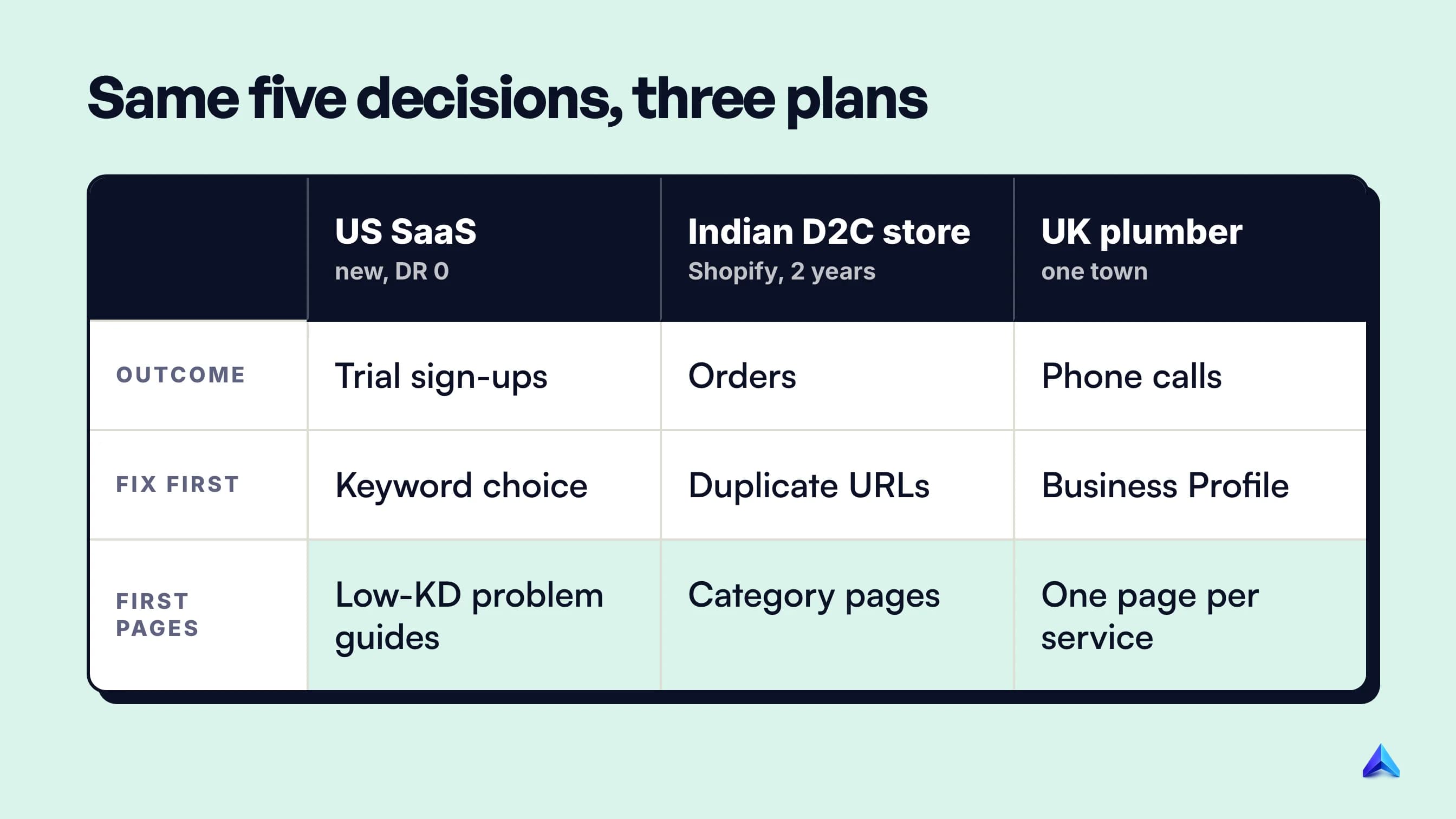
A new B2B SaaS site in the US, DR 0, six months old. The outcome is free-trial sign-ups. Indexing is usually fine on a small modern site, so Decision 2 takes a day. The whole plan hinges on Decision 3: twelve to fifteen low-difficulty problem queries a finance or operations buyer actually types, each answered by one thorough guide, plus two or three honest comparison pages once the product has a few named rivals. The head terms ("invoicing software") go on the authority-target list with a plan to earn links from integration partners and original data.
An Indian D2C clothing store on Shopify, two years old, some links from press coverage. The outcome is orders. The likely blocker is duplication: filtered collection URLs and variant pages that split signals across near-copies. Fixing that comes first. After that, the best returns are category pages ("cotton kurta sets for women", "linen shirts men") with useful text and internal links, ahead of any blog. Blog posts earn their place later, aimed at sizing, fabric care and gifting questions that lead back to categories.
A UK plumbing business in Leeds, one location, a five-page website. The outcome is phone calls. Google's local factors make the Business Profile the main asset, so the plan starts there: categories, service area, photos, and a routine for asking every finished job for a review. The site gets one page per service with the town name used naturally, and nothing more for the first quarter. Google itself says a small local business can probably do much of this work without hiring anyone.
None of the three starts with "publish four blog posts a week". Our small business SEO guide goes further into the local and shop cases.
How long before an SEO plan shows results
Set the review dates before you start, and set them honestly. Ahrefs followed a million random URLs its crawler saw in September 2023 and found that only 1.74% of newly published pages reached the top 10 within a year. A second sample of non-empty English pages put the figure at 6.11%, which Ahrefs calls the fairer number. Either way, most new pages never reach page one.
The same study has a more encouraging detail. Of the pages that did reach the top 10, 40.82% got there within a month. Winners tend to show early. Ahrefs suggests updating any page still outside the top 10 after about six months, because its chances are low after that without changes.
Age still favours incumbents: 72.9% of pages in Google's top 10 are more than three years old. A plan should therefore budget for updating its own pages, not only for publishing new ones.
A sensible rhythm:
- Weeks 1 to 4: fix blockers, publish or upgrade the first winnable pages.
- Month 2 to 3: check impressions on every new page. No impressions at all usually means an indexing or targeting problem, not a waiting problem.
- Month 6: rewrite or merge anything outside the top 10, and re-score the keyword list.
- Month 12: re-check your authority number and raise the difficulty ceiling if it has moved.
What AI Overviews change in the plan
AI summaries change what a ranking is worth. Pew Research Center's analysis of browsing data from 900 US adults found that people who saw an AI summary clicked a traditional result in 8% of visits, against 15% for those who did not see one. Links inside the summary itself were clicked in just 1% of visits.
The effect is uneven, which matters for planning. In Pew's March 2025 data, 18% of all Google searches produced an AI summary, but the rate was 8% for one- or two-word searches and 53% for searches of ten words or more. Long, question-shaped queries are the ones most likely to be answered on the results page. Short queries rarely trigger a summary.
Two adjustments follow. First, weight your scoring sheet toward short commercial and local queries, and treat long informational keywords as visibility plays whose value is being cited, not clicked. Second, ignore the shortcuts. Google's guide to generative AI features in Search says site owners can ignore tactics such as "chunking" content or creating AI text files like llms.txt, and that unique, useful content will likely influence presence in AI search more than any other suggestion it gives. It also names what does not qualify: commodity content built on common knowledge, with "7 Tips for First-Time Homebuyers" as its example.
If AI answers matter for your outcome, our walkthrough on ranking in Google AI Overviews covers the page-level work.
How to measure the plan
Revenue is the outcome, but it arrives last and noisily. Measure the plan with numbers that move in the order search works:
- Indexed pages. Search Console's Pages report.
- Impressions per target page. The Performance report, filtered by page. Impressions arrive weeks before clicks.
- Average position for the target query. Useful as a trend, misleading as a single number.
- Clicks and click-through rate. Check for an AI summary on the query before blaming the title.
- Conversions from organic. Trials, orders or calls, from your analytics or CRM.
Search Console now also has a Generative AI performance report, which Google points to for measuring visibility in AI features. Use it alongside the standard report rather than a third-party "AI score". Our guide to Google Search Console for SEO shows where each report lives.
Review monthly, re-plan quarterly. If you use Project Rankup, its keyword winnability check runs Decision 3 for you by judging each keyword's difficulty against your own domain's authority before it reaches the calendar.
A one-page SEO plan template
Copy this, fill it in, and keep it to one page. If a line is hard to fill, that is the decision you have not made yet.
SEO PLAN: <site>            Quarter: <Q1 2027>        Owner: <name>

1. OUTCOME
   Search should produce: <e.g. 40 trial sign-ups a month from UK agencies>

2. BLOCKERS (fix first)
   Indexed pages vs real pages: <312 of 340>
   Known issues: <filtered URLs indexed; blog noindexed on /amp/>

3. WINNABLE DEMAND
   Authority (DR or AS): <12>        Difficulty ceiling this quarter: <KD 15>
   Targets (score = value x winnability x effort):
     <keyword>  KD <n>  vol <n>  page type <guide>   score <18>
   Authority targets (need links, not this quarter):
     <keyword>  KD <n>  link task <original survey data>

4. PAGES
   Improve: <3 existing pages>   New: <8 pages>   Retire or merge: <5 thin posts>

5. MEASUREMENT
   Monthly: indexed pages, impressions per target page, organic conversions
   Month 6 rule: rewrite or merge any target page outside the top 10

NOT DOING THIS QUARTER: <site redesign, KD 60+ head terms, new subdomain>
The last line is the one people leave blank, and it is the one that keeps the plan honest.
Frequently asked questions
How much does SEO cost per month?
It depends on who does the work and how much there is. A local business following its own plan can spend mostly time, since Google says small local businesses can do much of the work themselves. Agencies and freelancers price by scope, so ask for the plan first and compare quotes against the same written list of tasks.
What is the 80/20 rule in SEO?
It is the idea that a small share of pages and keywords produces most of the results. In planning terms it means improving the few pages that already earn impressions, and the few keywords that score highest on value and winnability, before spreading effort across everything. It is a heuristic, not a measured law.
Can I write an SEO plan myself?
Yes. The five decisions in this guide need Search Console, one keyword tool and an honest view of your business, not a specialist. Bring in help when the blockers are technical, such as rendering or large-scale duplication, or when the plan depends on earning links you cannot earn alone.
How often should an SEO plan be updated?
Review the numbers monthly and rewrite the plan quarterly. The keyword section changes most, because your difficulty ceiling rises as authority grows and some targets prove harder or easier than they looked. Update immediately after a site migration, redesign or a large drop in indexed pages.
What should a 90-day SEO plan include?
The first two weeks should clear blockers. The rest of the quarter should go on a short list of winnable pages, typically eight to fifteen, each matched to the page type Google already ranks. End the 90 days with a review of impressions per page and a re-scored keyword list for the next quarter.
Is an SEO plan the same as a content calendar?
No. A content calendar schedules what gets published and when. An SEO plan decides what deserves to be published at all, along with the technical fixes, page upgrades and link work that a calendar does not cover. The calendar is one output of the plan.