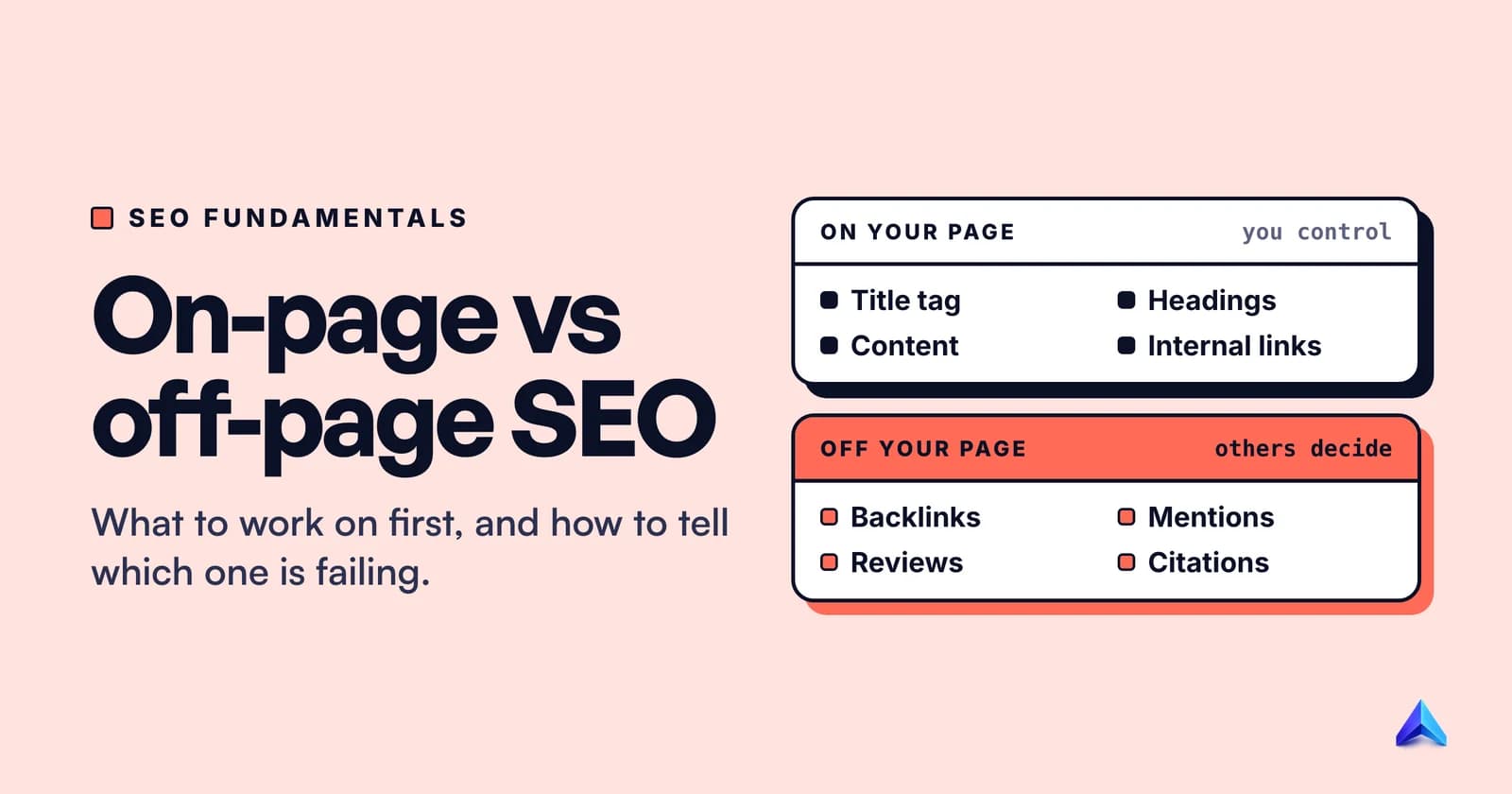
On-page SEO is everything you change on your own pages so Google understands them and people want them: content, titles, headings, internal links. Off-page SEO is the reputation other people give you: links, mentions, reviews. Technical SEO, the part people confuse with on-page, decides whether Google can crawl and index the page at all. The verdict: a new site should put almost all its effort into technical basics and on-page work, and only turn to off-page once good pages stall below competitors with stronger reputations.
That ordering is the useful part, and it is where most explanations of on page vs off page SEO stop short. They define the two terms, list ten factors under each, and conclude that you need both. You do need both. The question that costs people months is which one deserves the next hour of work, and that depends on where your site is.
The verdict: where to spend effort at each stage
Relevance comes before reputation. Google cannot reward a page for being well linked if it cannot tell what the page is about, and it will not rank a page it never indexed. So the order of work is fixed even when the mix is not.
| Your site | Spend most of your time on | Off-page work worth doing | Skip for now |
|---|---|---|---|
| New site, under ~30 pages, no links yet | Technical basics, then on-page: one page per search intent, written properly | A Google Business Profile if you serve a local area; telling real customers and partners the site exists | Outreach campaigns, link packages, guest-post networks |
| Growing site, pages indexed, ranking on pages 2-4 | On-page: rewriting and expanding the pages that already get impressions | Earning links to the few pages that are close to page one | Building links to the homepage for the sake of it |
| Established site, content as good as the pages above it | Keeping pages current; fixing decay | Digital PR, original data, partnerships: off-page becomes the tiebreaker | Chasing every new on-page "factor" |
| Local business (clinic, plumber, salon) | Service and location pages, plus the Business Profile itself | Reviews and local citations, which feed local rankings directly | National link building |
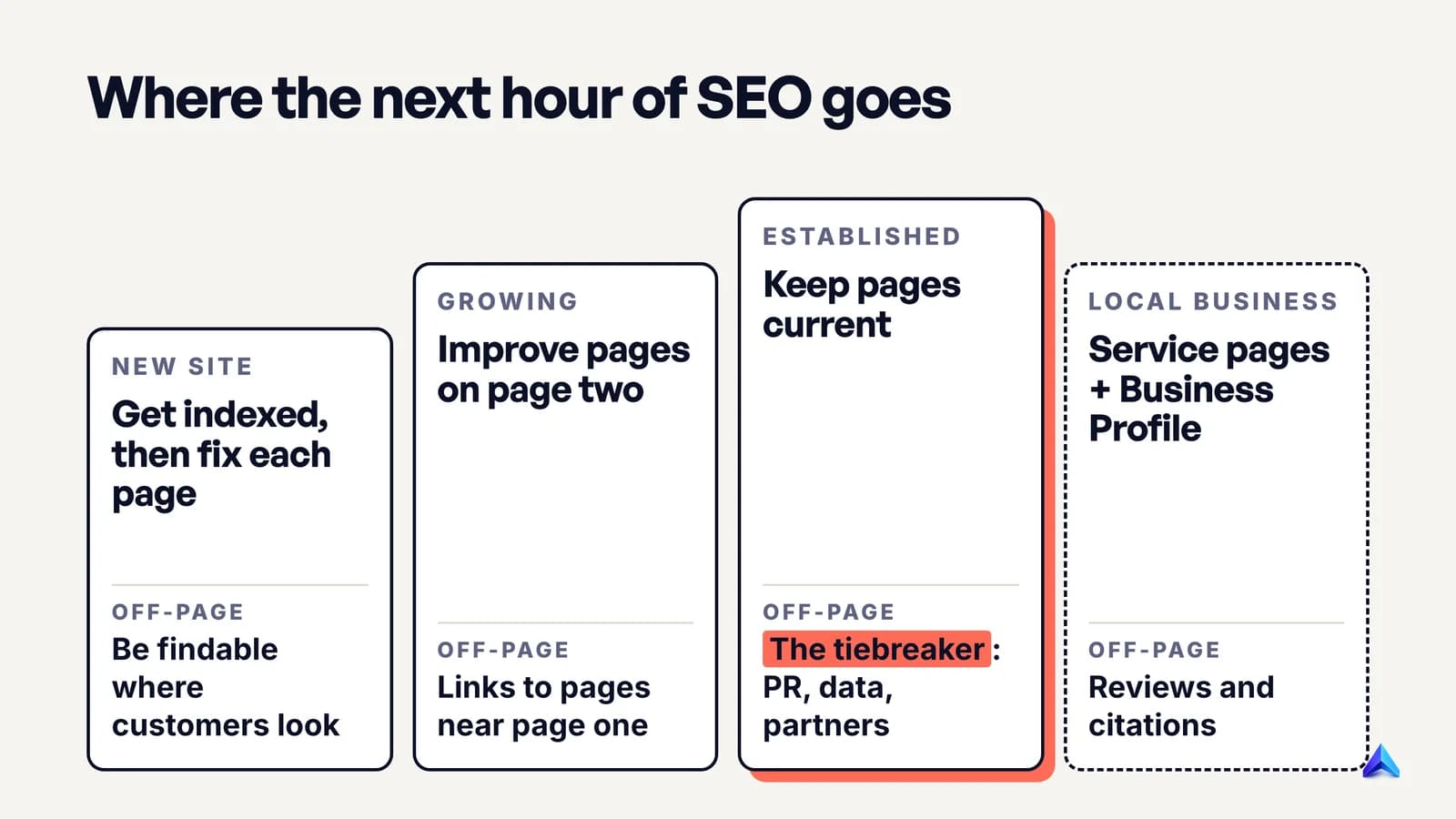
Two things in that table surprise people. First, even a brand-new site has an off-page job, but it is not "build backlinks". It is being findable and known where customers already look. Second, the established site does not stop doing on-page work. It just stops getting big wins from it, because its competitors have done the same work.
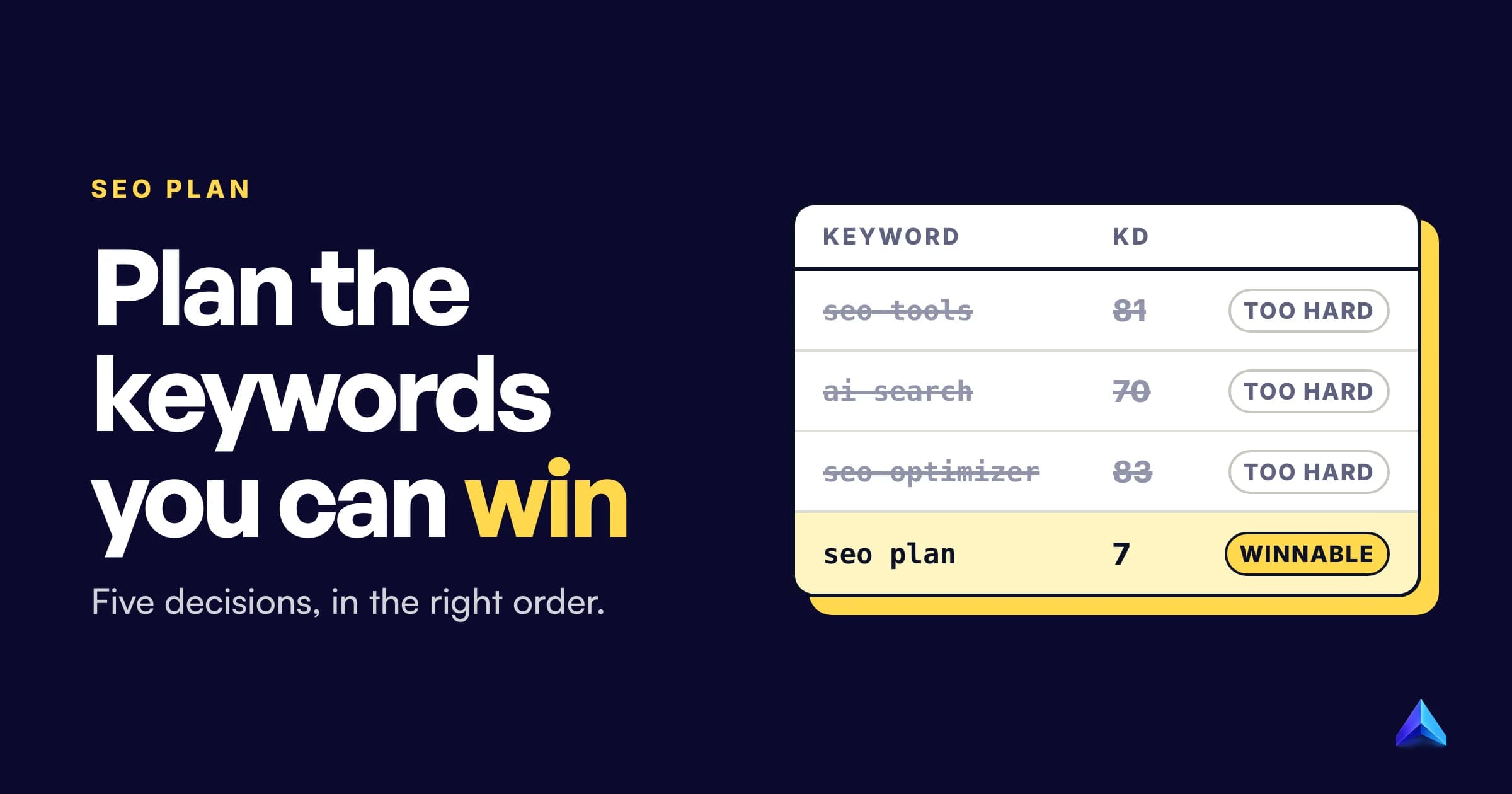
If you want to decide where your own site sits, start from the keywords you are targeting. A site with no links trying to rank for terms where every result has hundreds of referring domains has an off-page gap that no amount of on-page polish will close. Our guide to building an SEO plan walks through matching keyword difficulty to the authority you actually have, which is usually the faster fix.
On-page vs off-page vs technical SEO, side by side
Most comparisons have two columns. They should have three, because half of what gets filed under "on-page" in checklists is really infrastructure.
| On-page SEO | Off-page SEO | Technical SEO | |
|---|---|---|---|
| Question it answers for Google | What is this page about, and is it the best answer? | Do other people trust and recommend this site? | Can Google crawl, render and index this page? |
| Who controls it | You, page by page | Other people; you can only influence it | You or your developer, usually site-wide |
| Typical work | Search intent match, content depth, title tag, headings, internal links, images and alt text | Links from other sites, brand mentions, reviews, Business Profile, citations, PR | Indexing, robots.txt, sitemaps, canonicals, redirects, status codes, speed, mobile rendering, HTTPS |
| Where you check it | The page itself, Search Console's Performance report | Ahrefs, Semrush or Moz link data; your Business Profile | Search Console's Pages report and URL Inspection; Lighthouse |
| How it fails | The page ranks for nothing, or for the wrong queries | Good pages stall on page 2 behind stronger domains | Pages never get indexed, or drop out after a release |
| Risk of doing it badly | Keyword stuffing, thin pages | Link spam, which Google's policies cover in detail | Accidentally blocking or noindexing the whole site |
| Cost profile | Mostly writing and editing time | Time, relationships and sometimes money; slowest to compound | Mostly developer time, often a one-off fix |
A useful shorthand: technical SEO gets you into the index, on-page SEO decides which queries you deserve, and off-page SEO decides how high you go when several pages deserve the same query.
Where on-page ends and technical begins
The line between on-page and technical SEO is blurry, and arguing about the label wastes time. What matters is who has to do the work and how many pages it touches. Content changes made by a writer on one page are on-page. Changes made in templates, server settings or site-wide configuration are technical.
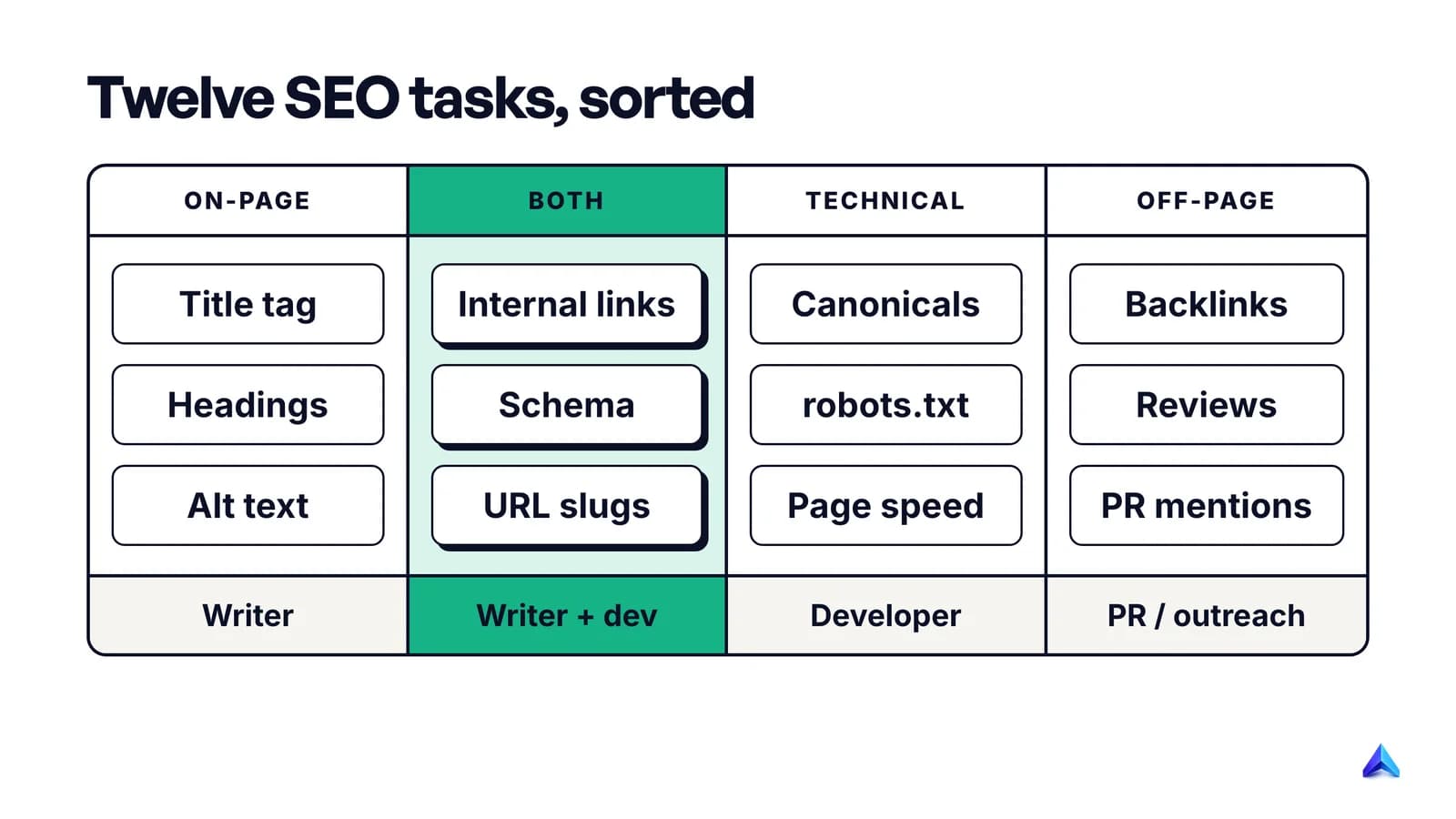
The grey-zone tasks are where beginners and interview candidates get tripped up. This is how we would sort them:
- Internal links. On-page when a writer adds a contextual link inside an article. Technical when the question is whether your navigation, pagination or JavaScript menus let crawlers reach pages at all.
- Schema markup. Usually technical, because it lives in templates and needs validating. The content it describes, such as the FAQ answers, is on-page.
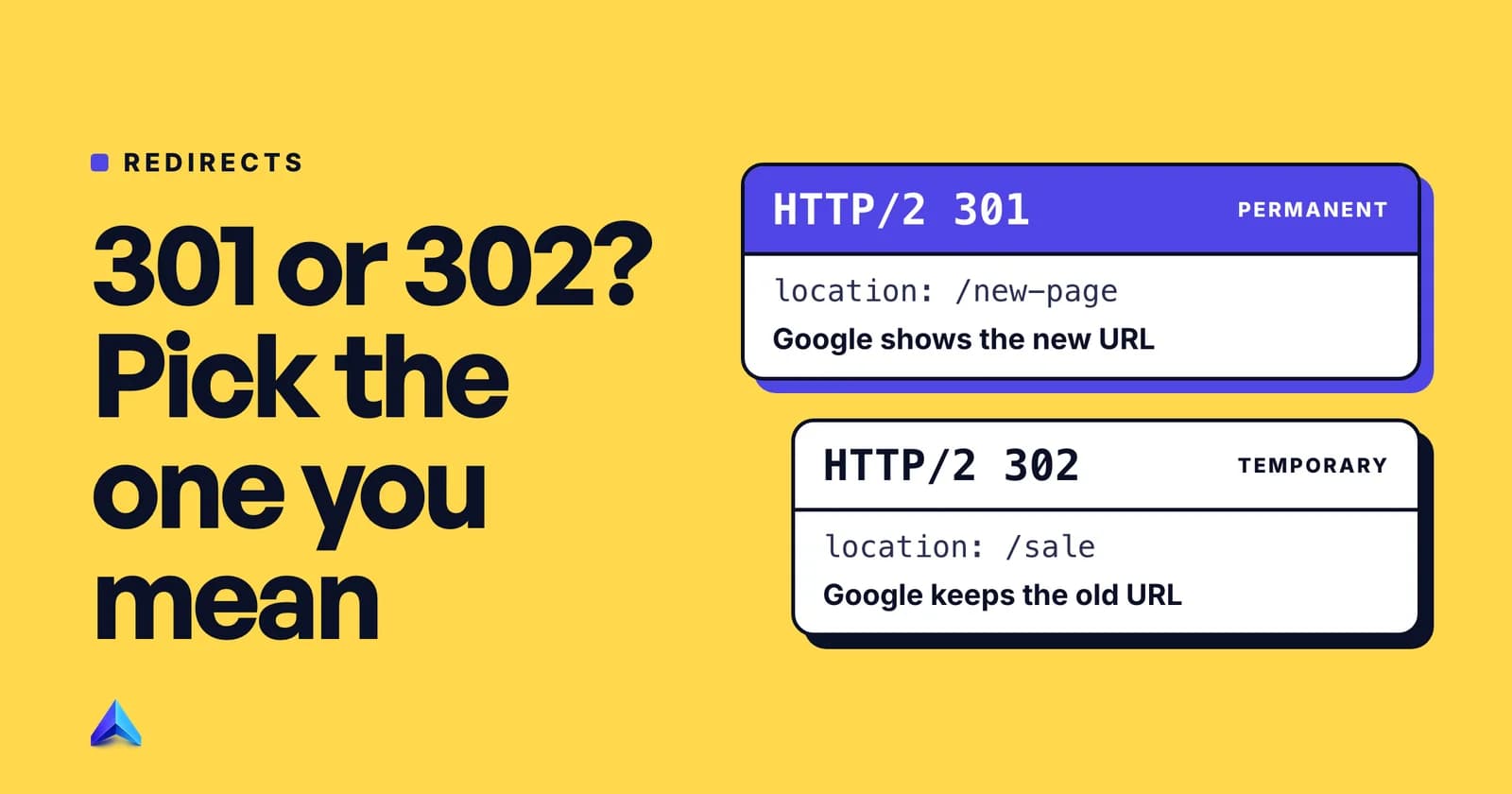
- Canonical tags. Technical. They tell Google which URL is the main version of duplicate pages, which is a site-architecture decision, not a writing one.
- Page speed and Core Web Vitals. Technical. Google says Core Web Vitals are used by its ranking systems, but it also says it "always seeks to show the most relevant content, even if the page experience is sub-par." Speed helps you win close contests. It does not rescue an irrelevant page.
- URL slugs. On-page for new pages, where you simply write a good one. Technical once you change existing URLs, because that means redirects.
- Image alt text. On-page. It is content about the image, written per page.
If you are preparing for an SEO executive role at an agency, this distinction comes up because it maps to how work gets assigned. Writers own on-page changes, developers own technical ones, and outreach or PR people own off-page. A task in the wrong queue sits there for weeks.
For the full technical checklist, a technical SEO audit covers crawling, indexing and site health in order. The first item on it is always the same: confirm the page is actually indexed. Checking whether a page is indexed takes two minutes in Search Console and rules out the most common reason good on-page work shows no result.
What on-page SEO decides
On-page SEO is the only part of search you fully control, which is why it comes first. It decides two things: which queries a page is eligible for, and whether it is a better answer than the pages already ranking.
The first is mostly mechanical. Put the topic in the title, answer the question early, use headings that match how people phrase it, and link to the page from related pages on your own site. The second is not mechanical at all. A page that covers the same ground as the top five results, in the same order, gives Google no reason to prefer it. Google's own SEO starter guide opens by saying "there are no secrets here that'll automatically rank your site first in Google."
A few on-page habits are still common and still worthless. Google does not use the keywords meta tag. Repeating the target phrase in every paragraph is keyword stuffing, which its spam policies cover. Neither helps, and the second can hurt.
We are not going to repeat the element-by-element checklist here. Our on-page SEO checklist goes through intent, titles, meta descriptions, headings, alt text, internal linking and schema one at a time. If your question is less "which element" and more "is this page good enough", read how Google defines helpful content, because that is the standard the on-page work is ultimately judged against.
If you would rather have a tool flag the on-page problems for you, Project Rankup's Content Audit Studio scores a live URL or a pasted draft and lists plain-English fixes. It does no link building; the off-page side is yours.
What counts as off-page SEO now
Off-page SEO is everything that happens away from your site that affects how search engines see it. In practice that comes down to four things.
Links from other sites. Links still matter. Google's ranking systems guide says it has systems that use how pages link to each other "as a way to determine what pages are about and which might be most helpful", and that PageRank "continues to be part of our core ranking systems." Links also do a job before ranking: Google primarily finds new pages through links from pages it has already crawled.
They matter less than the industry likes to admit, though. At a conference in Bulgaria in April 2024, Google's Gary Illyes said, as reported by Search Engine Journal: "We need very few links to rank pages… Over the years we've made links less important." The same report notes he had told PubCon Austin in 2023 that links were not in the top three ranking factors, and quotes John Mueller warning that "over-focusing on links will often result in you wasting your time doing things that don't make your website better overall."
Read those together and the picture is consistent. Links are a real signal and a discovery route. A handful of relevant ones from sites in your field do far more than hundreds from anywhere.
Mentions and word of mouth. Not every recommendation is a link. Google's starter guide calls word of mouth "one of the most effective and lasting ways" to promote a site, and is candid that it takes time. Press coverage, podcast appearances, being named in an industry newsletter or a Reddit thread: these build the reputation that links and searches for your brand name follow from.
Reviews and local signals. For local businesses this is the most direct off-page lever there is. Google's guidance on local rankings says local results are mainly based on relevance, distance and popularity, and that popularity draws on "how many websites link to your business and how many reviews you have." For a dental clinic in Pune or a plumber in Leeds, a steady flow of genuine reviews is worth more than a guest post on some unrelated blog. Our local SEO guide for UK businesses covers the Business Profile and citation work step by step, and the same mechanics apply in India and the US.
What does not count, and what gets you in trouble. Google's spam policies define link spam as "creating links to or from a site primarily for the purpose of manipulating search rankings." The examples are specific, and most of them are offers you have probably received:
- buying links, or posts that contain links, including in goods or services instead of cash;
- "link to me and I'll link to you" exchanges at scale;
- links created by automated programs or services;
- guest posts and press releases with keyword-rich anchor text;
- low-quality directory and bookmark sites;
- forum comments with optimised links in the post or signature.
So when someone offers 100 "high-DA backlinks" for ₹2,000 or £40, the offer is for exactly what the policy lists. Paid placements are allowed if you label them: Google asks you to mark paid links with rel="sponsored", which means they pass no ranking credit. That is the honest test of a paid link. If it is only worth buying because it passes credit, it is link spam.
Bad links pointed at you by someone else are a different, much rarer problem. If you suspect that, read our guide on negative SEO before you touch a disavow file.
Which one is holding your page back?
Arguing about which type matters more in general is less useful than finding out which one is failing on a specific page. Check in this order, because each step rules out the cheaper explanation before you move to the expensive one.
- Is the page indexed? In Search Console, paste the URL into URL Inspection. If it is not indexed, the problem is technical, or Google judged the page not worth indexing. On-page tweaks and links both wait until this is fixed. Google is explicit that it does not guarantee it will crawl, index or serve any page.
- Is it getting impressions for the right queries? Open the Performance report, filter to the page and read the Queries tab. No impressions at all after a few weeks, or impressions only for loosely related queries, is an on-page problem: the page does not match what people searching your keyword want.
- Where does it sit for the target query? Average positions in the 30s and beyond usually mean the page is relevant but not competitive. Compare it with the top five results. If they answer more of the question, more clearly, the fix is still on-page.
- Is it stuck between roughly 5 and 15 with content as good as the pages above? Now look off-page. Put the top results and your page into Ahrefs, Semrush or Moz and compare referring domains to the page and to the site. A large gap, with similar content quality, is an authority gap.
- Is it a local query? Check the map pack separately. Distance and reviews decide much of it, so compare review counts and Business Profile completeness before anything else.
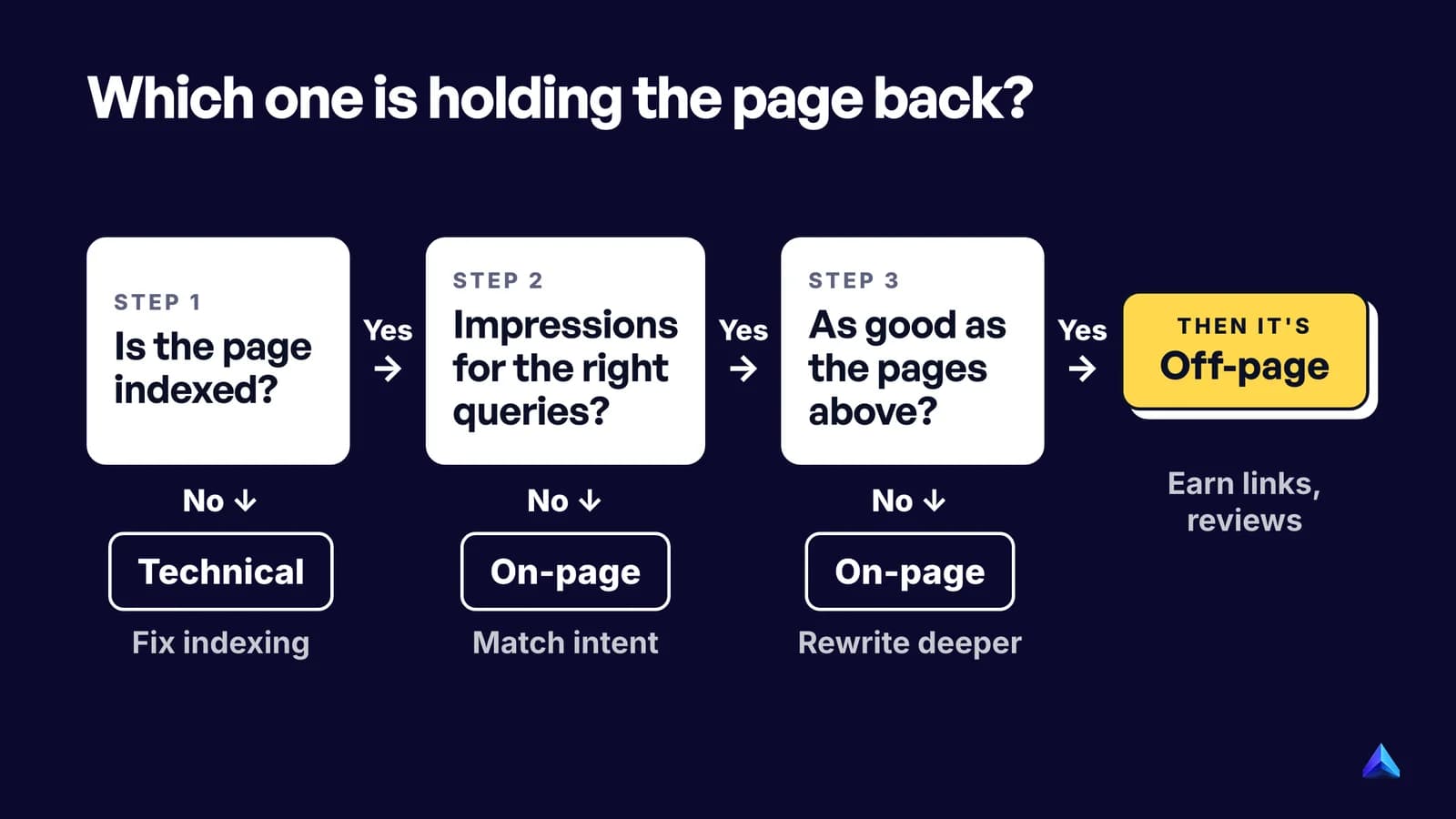
Most pages fail at step 2 or 3. Off-page is the right answer far less often than people assume, which is one reason link building has such a poor reputation among site owners who tried it early: they were solving step 4 for a page that had a step 2 problem.
How long each one takes to show
Every SEO article quotes week ranges for this. Google's own answer is less tidy and more honest. The starter guide says some changes "might take effect in a few hours, others could take several months", and recommends waiting "a few weeks to assess whether your work had beneficial effects." It also warns that not every change produces a noticeable result.
The relative order is predictable, though, because it follows from how each one works:
- Technical fixes show up as fast as Google recrawls the affected pages. Unblocking a page that robots.txt was hiding matters the moment Google fetches it again. Fixing a slow template rarely moves rankings much on its own, for the reason Google gives above: relevance comes first.
- On-page changes take effect once the page is recrawled and re-evaluated. Pages that already get impressions respond fastest, which is why rewriting a page sitting on page two usually beats publishing a new one.
- Off-page work is slowest and least predictable. Links have to be earned, found, crawled and weighed, and reputation builds from many small signals over time. It is also the only one of the three where the effect lasts after you stop working, because the links and reviews stay.
The practical consequence is about measurement. Judge on-page and technical work after a few weeks, page by page, in Search Console. Judge off-page work over quarters, by whether the pages it pointed at moved, not by a count of links acquired.
One last pattern worth avoiding: running all three at once on a new site and then not knowing which change did anything. Fix indexing, then improve the pages, then go and earn the reputation, and you will know what worked at each step.
常見問題
Which is more important, on-page or off-page SEO?
On-page comes first, because a page has to be relevant before reputation can lift it. Off-page decides close contests between pages of similar quality. For a new or small site, on-page and technical work give far more return per hour. For a mature site that already matches its competitors on content, off-page becomes the deciding factor.
Is off-page SEO still relevant in 2026?
Yes, in a narrower form. Google still uses links through PageRank, and local rankings still draw on links and reviews. What has faded is volume link building: Google's Gary Illyes said in 2024 that it needs "very few links to rank pages." A small number of relevant mentions and links matter; bulk links do not.
What are the four types of SEO?
The usual split is on-page, off-page, technical and local SEO. Local SEO overlaps the other three: it uses on-page work (location pages), off-page signals (reviews, citations, links) and technical setup (consistent business details and structured data). Some lists swap local for content SEO. The labels matter less than knowing who owns each task.
What is the 80/20 rule in SEO?
It is the Pareto idea applied to SEO: a small share of pages, keywords or fixes produces most of the results. In practice it means finding the few pages already getting impressions on page two and improving those first, rather than spreading effort evenly across a whole site or chasing links for every page.
Is internal linking on-page or off-page SEO?
On-page, because the links live on your own site and you control them. Internal links help Google find pages and understand how they relate, and they pass some authority between your own pages. Off-page links are the ones other websites place on their pages pointing to you.
Does social media count as off-page SEO?
Indirectly. Google's starter guide lists social media as a way to promote content so people and search engines discover it faster. Sharing a post does not count as a backlink in the usual sense, but it can lead to coverage, mentions and links from people who see it, which do count.
Can a website rank without backlinks?
Yes, for low-competition queries, especially when the site's content answers the query better than anything else ranking. Google can find pages through sitemaps and internal links. For competitive keywords, where every top result has strong links, a site with none will usually stall below them however good the page is.