Keyword difficulty (KD) is a 0 to 100 score that SEO tools use to estimate how hard it would be to get a page into Google's top 10 organic results for a keyword. Each tool builds it mostly from the backlinks and authority of the pages ranking there now. A higher number means stronger pages to beat, but the score knows nothing about your site, and scores from different tools are not interchangeable.
That last part causes most of the confusion. The same keyword can score very differently in two tools, and both can be right, because they measure different things on different scales. Below: what each of the three best-known scores counts, what none of them count, and how to read KD against your own domain.
What does keyword difficulty mean?
In plain terms, keyword difficulty is a summary of the competition you would face on page one. A tool looks at the pages Google currently ranks for a query, measures how strong they are, and compresses that into one number. Strong pages with lots of links pointing at them produce a high score. Weak or barely linked pages produce a low one.
It is about the top 10, not position one. Ahrefs says its score evaluates the chances of getting into the top 10, not the top 3 or the top spot. Moz and Semrush also define their scores against page one. A low KD tells you page one is reachable. It says nothing about beating the result at the top.
It describes a snapshot. The score is calculated from whatever is ranking when the tool last checked the results page. Ahrefs recalculates KD each time it refreshes a keyword's SERP, does this more often for higher-volume keywords, and greys the number out once the SERP is 20 days or more out of date. When we planned this article, Ahrefs showed "what is keyword difficulty" at KD 9. On 9 October 2026 the same keyword read KD 8. Nothing about the keyword changed. The pages did.
It is an organic metric. Google Keyword Planner has a column called "Competition", and beginners often read it as difficulty. It is not. Ahrefs points out that Competition refers only to paid search results, while keyword difficulty applies to organic results. A keyword can have high ad competition and almost no organic competition, or the reverse.
How Ahrefs, Semrush and Moz calculate keyword difficulty
All three vendors publish their method. They share a starting point, the current top 10, and split on almost everything else.
Ahrefs: linking websites to the top 10 pages
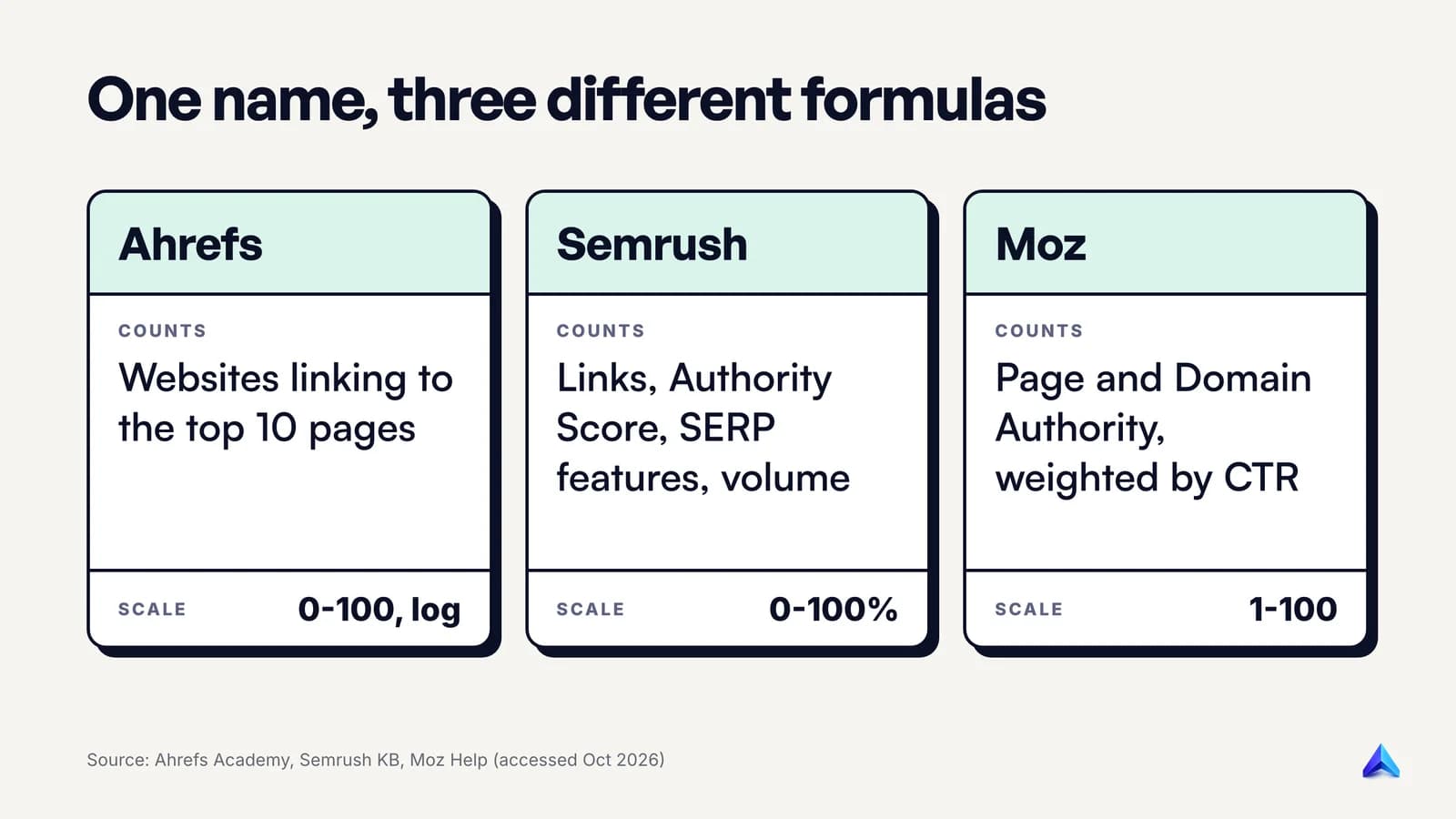
Ahrefs keeps its score deliberately narrow. Its help centre says KD is based on the number of referring domains, meaning unique websites linking in, that the top 10 organic pages for a keyword have. Its Academy describes the maths: Ahrefs takes a weighted average of the number of linking domains to the top-ranking pages, removes certain outliers, and plots the result on a logarithmic scale from 0 to 100.
What it leaves out is stated just as plainly: KD does not consider any on-page factors. Ahrefs also warns that link counts can mislead, because some backlinks cast a stronger vote than others. The score counts linking sites. It does not judge them.
Semrush: a weighted mix of links, authority and SERP features
Semrush's KD% uses more inputs. Its knowledge base entry on KD% lists the median number of referring domains pointing at the ranking URLs, the median ratio of followed to nofollowed links, the median Authority Score of the ranking domains, and "SERP-related qualities" of the keyword itself.
When Semrush rebuilt the metric, it published the weight each input carries. In its methodology write-up, median referring domains account for 41.22% of the score and median Authority Score for 16.99%. Search volume carries 9.47% and the follow/nofollow ratio 9.17%. Smaller weights go to SERP features such as a featured snippet (4.74%) or a local pack (3.39%), and a results page with no SERP features pulls the score down. Semrush also adjusts the final number for the country database, so the same keyword can score lower in a smaller market.
That answers a question people often search: KD in Semrush means a percentage built mostly from the link strength of the top 10, nudged by search volume and the layout of the results page.
Moz: page and domain authority, weighted by visibility
Moz builds its Difficulty score from its own authority metrics rather than raw link counts. According to Moz's documentation for Keyword Explorer, the score takes the Page Authority and Domain Authority of the results on page one and adjusts for projected click-through rate, so higher, more visible positions count for more than lower ones. Moz says the result roughly corresponds to a weighted average of the Page Authority of the top 10, modified by other inputs such as Domain Authority, homepages and how the query terms are used.
Moz's scale runs from 1 to 100 rather than 0 to 100, and Moz frames the number as a predictor of the challenge an "average" website would face.
| Ahrefs KD | Semrush KD% | Moz Difficulty | |
|---|---|---|---|
| Scale | 0 to 100, logarithmic | 0 to 100% | 1 to 100 |
| Main input | Referring domains to the top 10 pages | Median referring domains (41.22% of weight) | Page Authority of the top 10 |
| Domain strength | Not directly | Median Authority Score | Domain Authority as a modifier |
| SERP features | No | Yes, weighted | No |
| Search volume | No | Yes | No |
| On-page factors | No | No | No |
Why the same keyword gets different scores in different tools
Look at that table again and the mismatch is obvious. Ahrefs counts linking websites to pages. Moz reads its own authority scores, which it builds from its own link data. Semrush mixes links with volume and SERP layout. Three formulas fed by three separate link databases will not land on the same number, and none of them is wrong for doing so.
The scales also stretch differently. Ahrefs publishes a table that turns its KD into the approximate number of referring domains a page needs to reach page one. The curve is steep at the top:
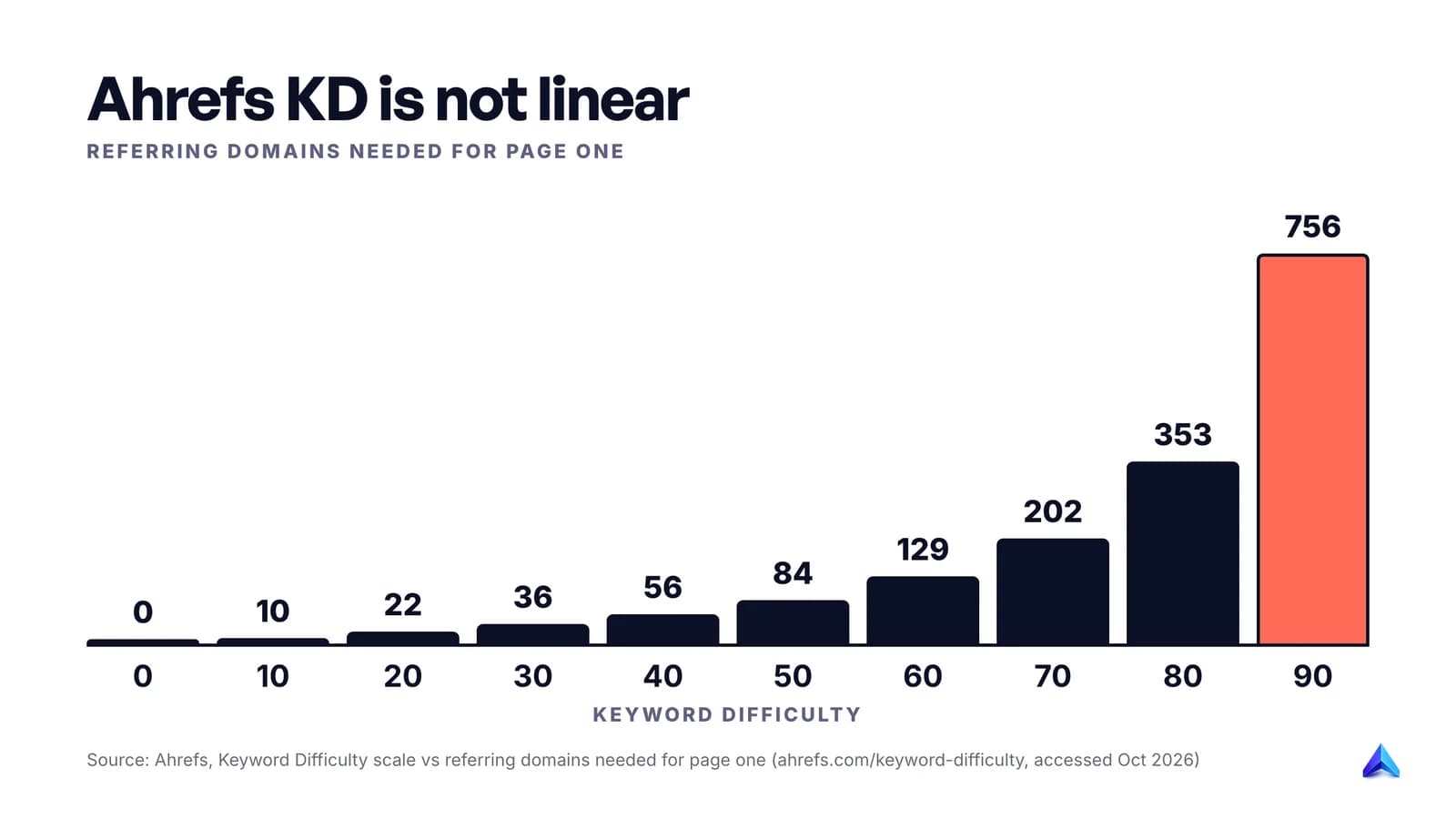
Going from KD 10 to KD 40 multiplies the estimated links needed by about five and a half. Going from KD 40 to KD 80 multiplies them by more than six. A "KD 40" is not twice as hard as a "KD 20" in Ahrefs. It is roughly two and a half times the link requirement, 56 referring domains against 22.
Each vendor also labels its own bands differently:
- Semrush calls 0 to 14 very easy, 15 to 29 easy, 30 to 49 possible, 50 to 69 difficult, 70 to 84 hard and 85 to 100 very hard.
- Moz says keywords get significantly tougher at around 40, and describes 20 to 35 as quite low, 36 to 50 as the middle, 51 to 65 as pretty tough and 66 to 80 as very difficult.
- Ahrefs ties every value to an estimated referring-domain count instead of a label.
The practical rule follows directly. Pick one tool and compare keywords inside it. A KD from Ahrefs, a KD% from Semrush and a Difficulty from Moz belong in three separate spreadsheets. If a client report mixes them, the numbers will look precise and mean nothing.
What keyword difficulty leaves out
Every KD formula reduces page one mostly to link and authority data. Google does not. Its own explanation of how Search ranks results lists many factors, including the meaning of the query, the relevance, quality and usability of pages, the expertise of sources, and the searcher's location and settings. It adds that the weight of each factor varies with the query: for current news, freshness plays a bigger role than it does for a dictionary definition.
Links do appear on Google's list: whether other prominent websites link to a piece of content is one of the factors it uses to judge quality. They are one input among several, though, and KD treats them as nearly the whole story. Five gaps matter most.
Search intent. KD measures how strong the ranking pages are, not what kind of pages they are. If every result for a keyword is a free tool and you planned an essay, the score will not warn you. You can only see the mismatch by looking at the results yourself.
SERP features. Only Semrush feeds features into the score, and only at small weights. An AI Overview, a video carousel or a local pack can push the first organic result well down the page. A keyword with a low score can still send very few clicks if most of the screen is taken before the blue links start. Our guide to what AI Overviews are covers how those summaries sit above organic results.
Content quality and on-page work. Ahrefs says outright that its score ignores on-page factors, and the other two do not measure them either. A page with few links can hold its position because it answers the query better than anything else. KD sees only the links, so it reads that page as weak.
Your own site. This is the biggest gap. A KD score is the same for a brand-new blog and for a site that has published on the topic for ten years. Moz is unusually direct about the effect: a brand-new site may find even keywords in the 20s or 30s "pretty tough", and a site trying to rank far outside its subject will find it much harder than the score suggests. Its example is Moz.com trying to rank for "pizza recipes".
Location. Google's own example is "football", which returns American football in Chicago and soccer in London. KD is calculated per country database, so a US score tells you little about the results a searcher in Manchester or Mumbai sees. Check the database that matches your market.
A worked example: reading KD 8 for this article's own keyword
The keyword this article targets makes a useful test case, because the score and the results page tell slightly different stories. We pulled both from Ahrefs for the US on 9 October 2026.
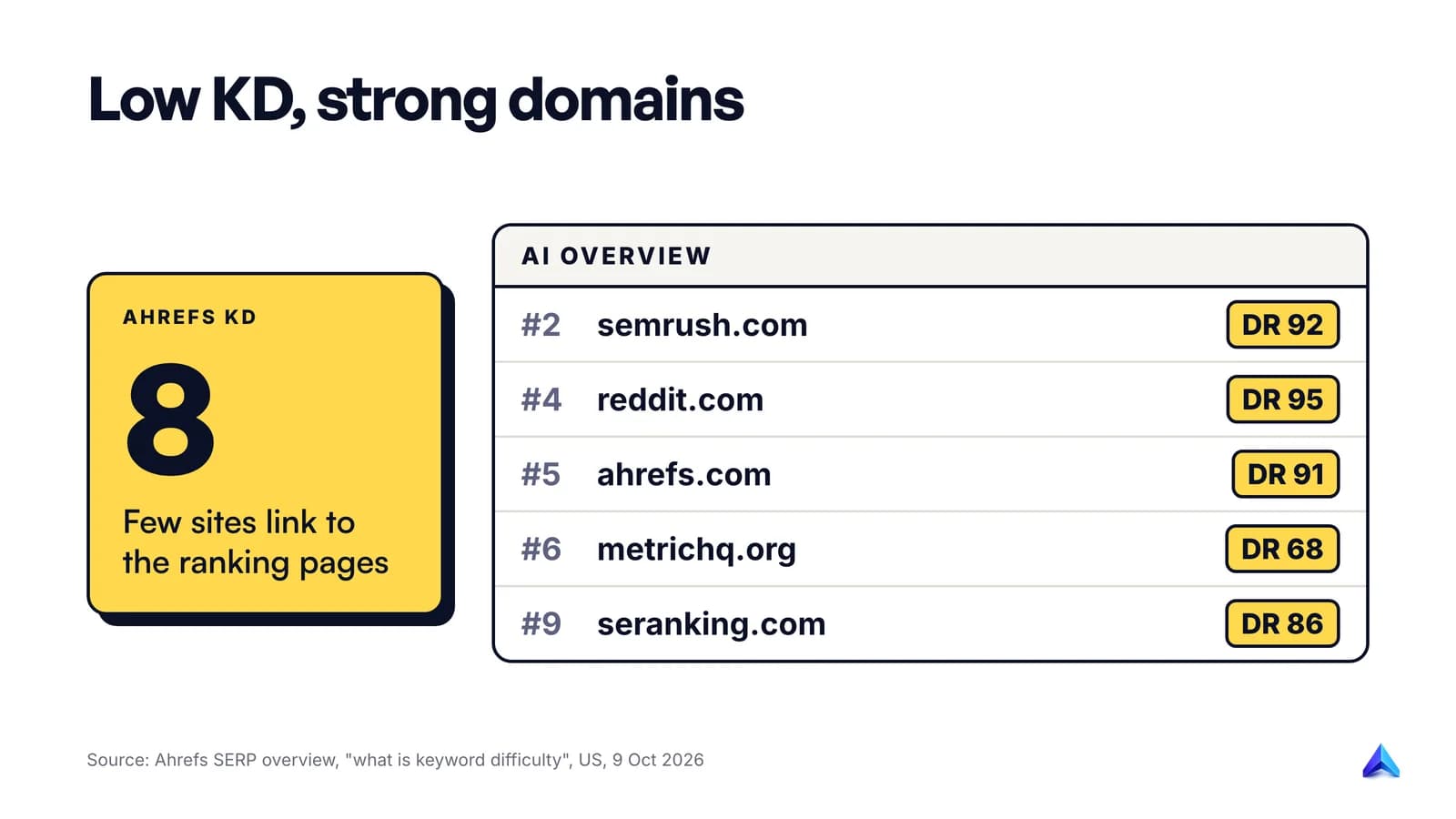
The score. Ahrefs shows "what is keyword difficulty" at KD 8 with 1,200 searches a month in the US. On Ahrefs' published scale, KD 10 corresponds to about 10 referring domains, so the top 10 pages here have very few websites linking to them.
The results page. An AI Overview sits at the top. Below it, the organic results include Semrush's blog at DR 92, a Reddit thread at DR 95, Ahrefs' own free checker at DR 91 and pages from seoClarity, DataForSEO, SE Ranking and Seobility at DR 77 to 86. The weakest domain in the top 10 is a metrics glossary at DR 68.
What the two together say. The pages are lightly linked, which is why KD is low. The domains are not. Ahrefs' KD counts links to the ranking pages, not the strength of the domains hosting them, so a strong domain with a thinly linked page still produces a low score. Domain Rating, which Ahrefs defines as the strength of a whole website's backlink profile on a 100-point scale, is a separate metric. If you are unsure how it differs from Moz's version, read our comparison of Moz DA and Ahrefs DR.
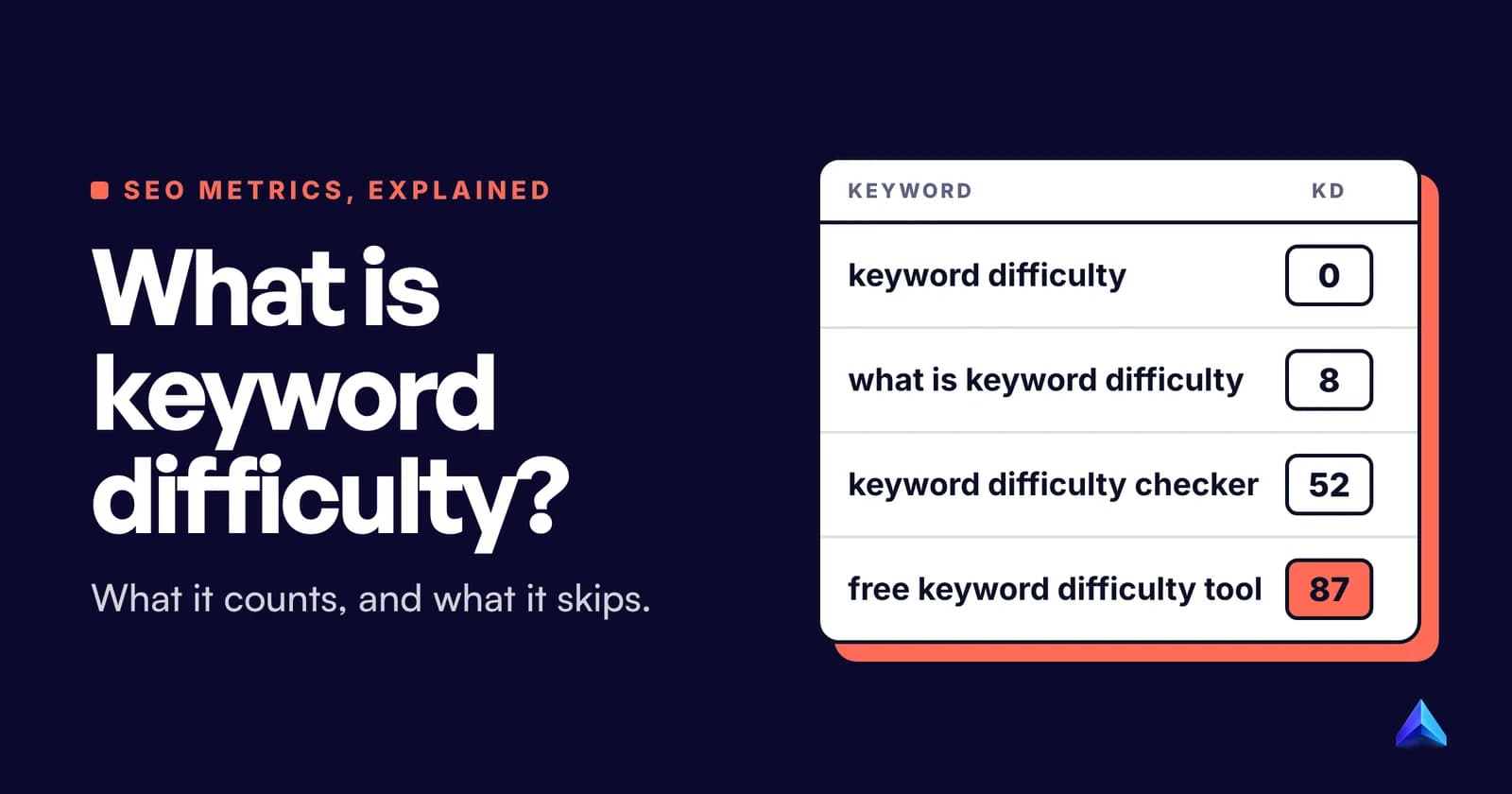
Related phrasings swing wildly. In the same Ahrefs data, the shorter "keyword difficulty" shows KD 0. "Keyword difficulty checker" shows KD 52, and "free keyword difficulty tool" shows KD 87. The topic is the same, but the pages ranking for each phrase are not. Tool pages collect links. Explanations rarely do. That gap is exactly what KD is built to show, and it is why KD belongs to individual keywords, not to topics.
So the honest read of KD 8 here is this: the pages are beatable on links, the domains carry authority a new site does not have, and an informational article is the right format because the results are mostly explanations. That is a winnable target for a site that can publish the best explanation on page one. It is not a guaranteed one.
How to read KD against your own domain
Ahrefs puts the principle in one line: its score is the baseline, and your site's authority provides the context. The steps below turn that into a routine you can run on any keyword list.
- Know your own authority number, in the same tool. Domain Rating in Ahrefs, Authority Score in Semrush, Domain Authority in Moz. Mixing tools here causes the same problem as mixing KD scores.
- Compare yourself with the pages that rank, not with the score. Open the results for the keyword and note the authority of each ranking domain and the links to each ranking page. If sites close to yours already sit on page one, the keyword is open to you whatever the KD says. If every result is a household name, treat the score with suspicion.
- Use the personal score where one exists. Semrush offers Personal Keyword Difficulty (PKD%), which estimates difficulty for your domain based on its authority. Ahrefs suggests reading its KD as a "personal" difficulty in the same way, by holding it against your own site.
- Check topical fit. A score that looks achievable on a topic your site has never covered will behave like a harder one, as Moz's pizza example shows. Prefer keywords next to what you already rank for.
- Check intent and layout before you write. Confirm the results are the format you plan to publish, and note how much of the screen the AI Overview and other features take.
- Rank the list inside one tool. Use KD to sort keywords of similar value against each other, then raise the ceiling as your links and rankings grow.
Project Rankup's keyword discovery runs this comparison for you: it judges each keyword's difficulty against your own domain's authority and marks how winnable it is, so a list does not quietly fill up with terms held by much stronger sites. We told the story of why we built that, from our own site's mistakes, in our guide to building an SEO plan. If your list is still at the brainstorming stage, start with keyword research. Finding low-competition keywords in the first place gets its own guide soon.
What is a good keyword difficulty score?
There is no universal good score, because "good" depends on your site. A useful answer has two parts: the bands each vendor publishes, and where your own domain sits.
| Tool | Low | Middle | High |
|---|---|---|---|
| Semrush KD% | 0 to 29 (very easy, easy) | 30 to 69 (possible, difficult) | 70 to 100 (hard, very hard) |
| Moz Difficulty | 20 to 35 (quite low) | 36 to 50 (middle) | 51 to 80 (pretty tough to very difficult) |
| Ahrefs KD | KD 10 to 20: about 10 to 22 referring domains | KD 40: about 56 | KD 70: about 202 |
For a new or small site, start at the bottom of whichever tool you use. Semrush describes its 0 to 14 band as the best opportunities to start ranking new pages, and Moz warns that a new site may struggle even in the 20s. Choose keywords with real demand inside that band, publish the best answer to each, and only move up once pages start ranking and earning links.
For an established site, use your strongest competitors as the yardstick. If you already rank on page one for keywords at a certain level in your tool, keywords at that level on related topics are fair game. Higher scores are not off limits for anyone. They are a budget question: Ahrefs' table puts a KD 70 keyword at roughly 202 linking websites to the ranking page, and those links take time to earn. Our breakdown of on-page vs off-page SEO covers where link-earning fits next to the work on the page itself.
Whichever band you work in, re-check the score before you write. A keyword shortlisted three months ago may have new, stronger pages on it.
Frequently asked questions
What does a keyword difficulty of 0 mean?
It means the pages ranking in the top 10 have very few or no websites linking to them, according to that tool's link data. It does not mean ranking is effortless. The ranking domains may still be strong, the intent may not match your page, or features such as an AI Overview may take most of the clicks. Always look at the results page.
Is keyword difficulty the same as keyword competition?
No. "Competition" in Google Keyword Planner describes competition among advertisers in paid search. Keyword difficulty is an SEO metric about organic results, calculated by third-party tools from the strength of the pages already ranking. A keyword can be cheap to advertise on and hard to rank for organically, or the other way round.
Why does keyword difficulty change over time?
Because it is recalculated from whatever ranks at the time. When new pages enter the top 10, existing pages gain links, or the tool updates its link index, the score moves. Ahrefs recalculates KD whenever it refreshes a keyword's results page, and higher-volume keywords are refreshed more often than rare ones.
Can a new website rank for high keyword difficulty terms?
Sometimes, but rarely early on. High scores mean the current page-one results have many linking websites, and a new site has to match that strength or offer a clearly better answer. Most new sites do better targeting low-difficulty keywords first, earning rankings and links, and then working up to harder terms on the same topics.
Which keyword difficulty tool is most accurate?
No single tool can claim that fairly, because each estimates difficulty from its own link data and its own formula. Ahrefs and Semrush both describe their own score as the most accurate, and both are measuring something slightly different. Pick the tool whose method you understand, use it consistently, and judge the score against the real results page and your own site.