
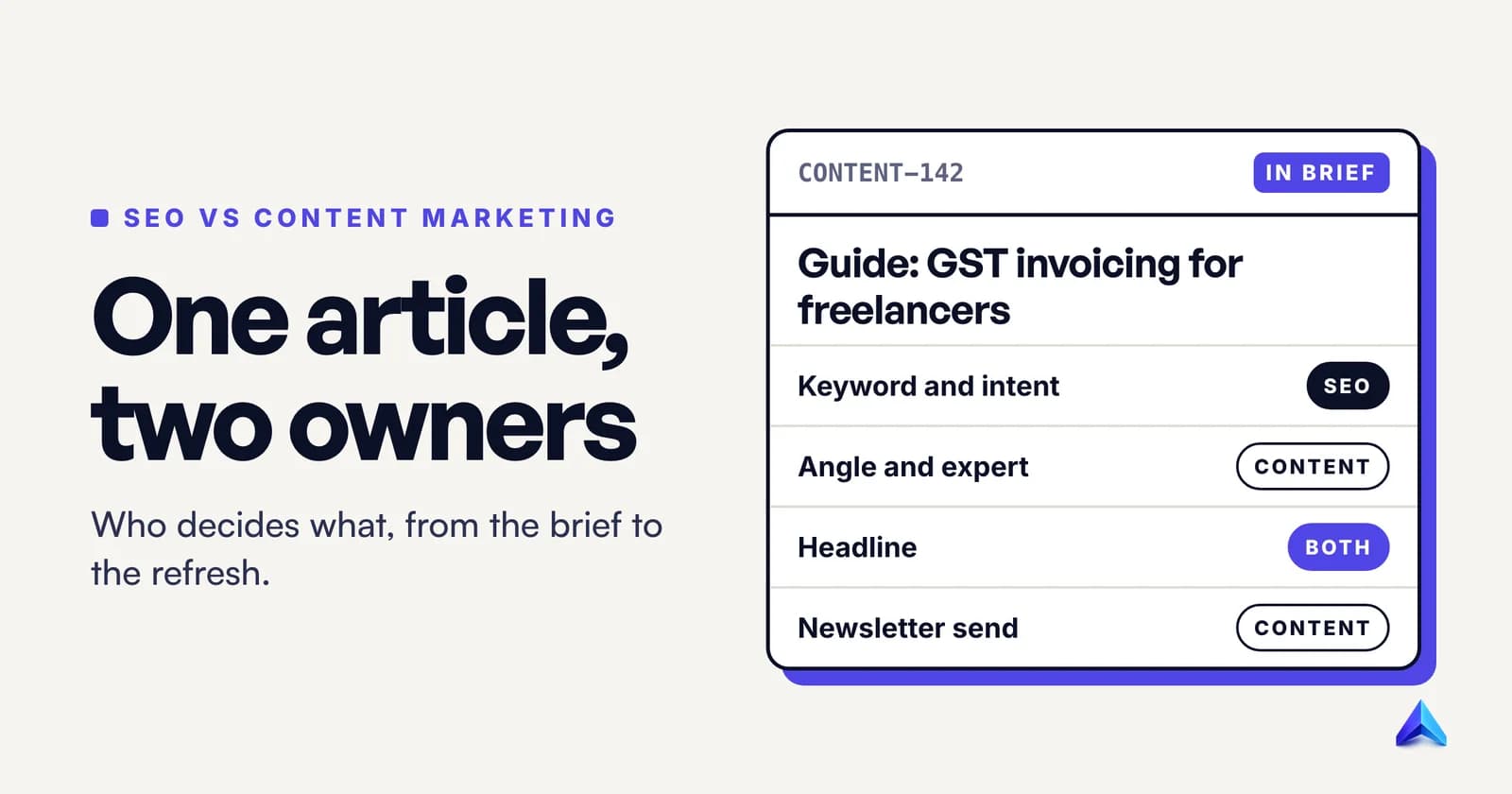
SEO vs content marketing is a false choice, but the split between them is real. Content marketing decides what you publish, for whom, and on which channels. SEO makes the search-facing part of that work get found, and keeps the site itself crawlable. If your buyers already search for what you sell, lead with search-led content. If they do not search for it yet, lead with distribution and let SEO follow the demand.
Most articles on this topic stop at "do both". That is correct and not very useful, because the hard questions are practical ones. Who chooses the topic? Who has the final word on the headline? Which budget line pays for a refresh of an old post? This guide answers those, using Google's own documentation and the Content Marketing Institute's latest survey of B2B marketers.
The short verdict: which one to lead with
The deciding question is whether demand for your product already exists in search. Everything else follows from that.
- People already search for what you sell. A plumber in Leeds, a GST invoicing tool in India, a payroll provider for US restaurants. Lead with SEO-led content: find the searches, write the best page for each, and fix anything technical that stops those pages being indexed.
- You sell something people do not know to search for yet. A new category, a new method, a product that solves a problem buyers have not named. Lead with content marketing: LinkedIn, newsletters, webinars, communities and partners. Search demand shows up later, and SEO's job is to catch it when it does.
- You have a long B2B sale with a small number of buyers. Content marketing does most of the work through case studies, comparison pages for the sales team and founder posts. SEO matters for a smaller set of pages: the product, pricing, integrations and the handful of problems your buyers search for.
- Your site has technical problems. Fix them first. A page that is blocked, redirected in a loop or never indexed gets no search traffic, however good the writing is.
Most businesses sit in the first group for some products and the second for others. That is normal, and it is why the rest of this guide is about splitting the work rather than picking a winner.
What each one covers, and what it does not
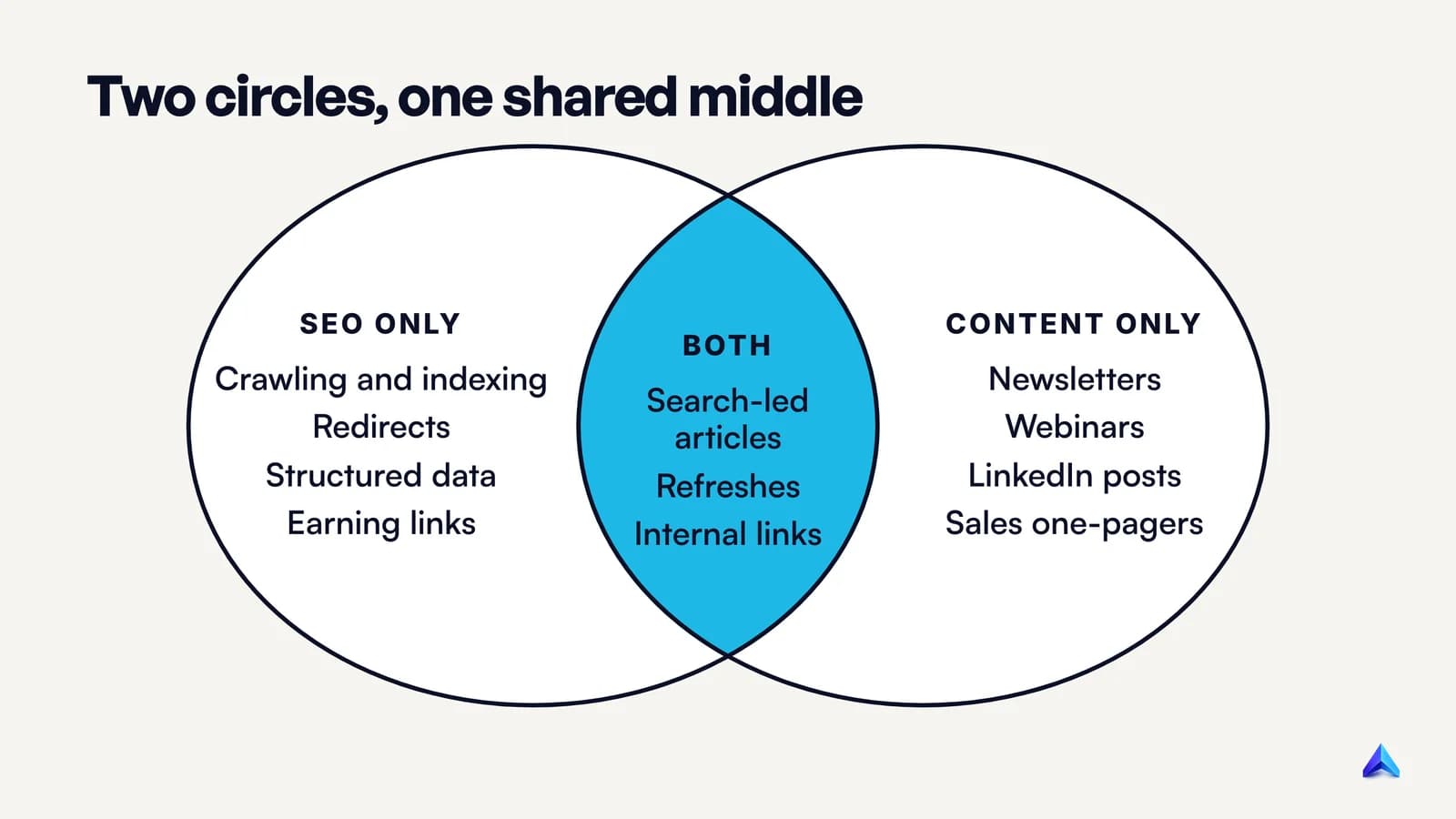
Google's SEO starter guide defines SEO as "helping search engines understand your content, and helping users find your site". That definition is about one channel, search, and it includes plenty of work that has nothing to do with writing: crawling and indexing, redirects, site structure, page speed, structured data and earning links from other sites.
Content marketing is the wider idea. It covers creating and distributing useful material to attract and keep a defined audience, on any channel. If you want the full definition, the types of content and how a programme runs, our explainer on what content marketing is and how it works covers it. For this comparison, one point matters: a lot of content marketing never touches search. A customer newsletter, a webinar series, a sales one-pager and a founder's LinkedIn posts are all content marketing, and Google never sees most of them.
So the two are not rivals, and neither contains the other. They are two circles that overlap in one place: content made to be found through search. Most of the arguments between SEO people and content people happen inside that overlap.
SEO vs content marketing, side by side
The table below compares them on the dimensions that decide budget and staffing. The third column is where the two have to agree.
| SEO | Content marketing | Where they meet | |
|---|---|---|---|
| Demand it serves | Demand that already exists as searches | Demand it creates through attention and trust | Searches your audience makes while learning about the problem |
| Main channels | Google, Bing, AI answers built on search results | LinkedIn, email, events, communities, sales calls, search | Your blog and resource pages |
| Unit of work | A page, a template, a site-wide fix | A piece, a series, a campaign | An article written to answer a specific search |
| Typical first signal | Impressions in Search Console after indexing | Opens, replies, registrations in the first week | Impressions first, then traffic months later |
| Biggest cost | Specialist time, tools, developer hours | Writers, subject experts, editors, design, promotion | Expert writing time per article |
| Main failure | Pages that rank for nothing or for the wrong query | Good work that nobody sees | Articles written for a keyword instead of a reader |
| Who has the final say | Whether a page can be found and understood | What the reader needs and how it sounds | The brief, agreed before writing starts |
Two rows deserve a comment. "Demand it serves" is the real difference, and it is why the verdict above starts there. "Who has the final say" is the row most teams never write down, and it is where most friction comes from.
Most content marketing is not built for search
Search people tend to assume content means blog posts. The people who run content programmes do not see it that way, and the data backs them.
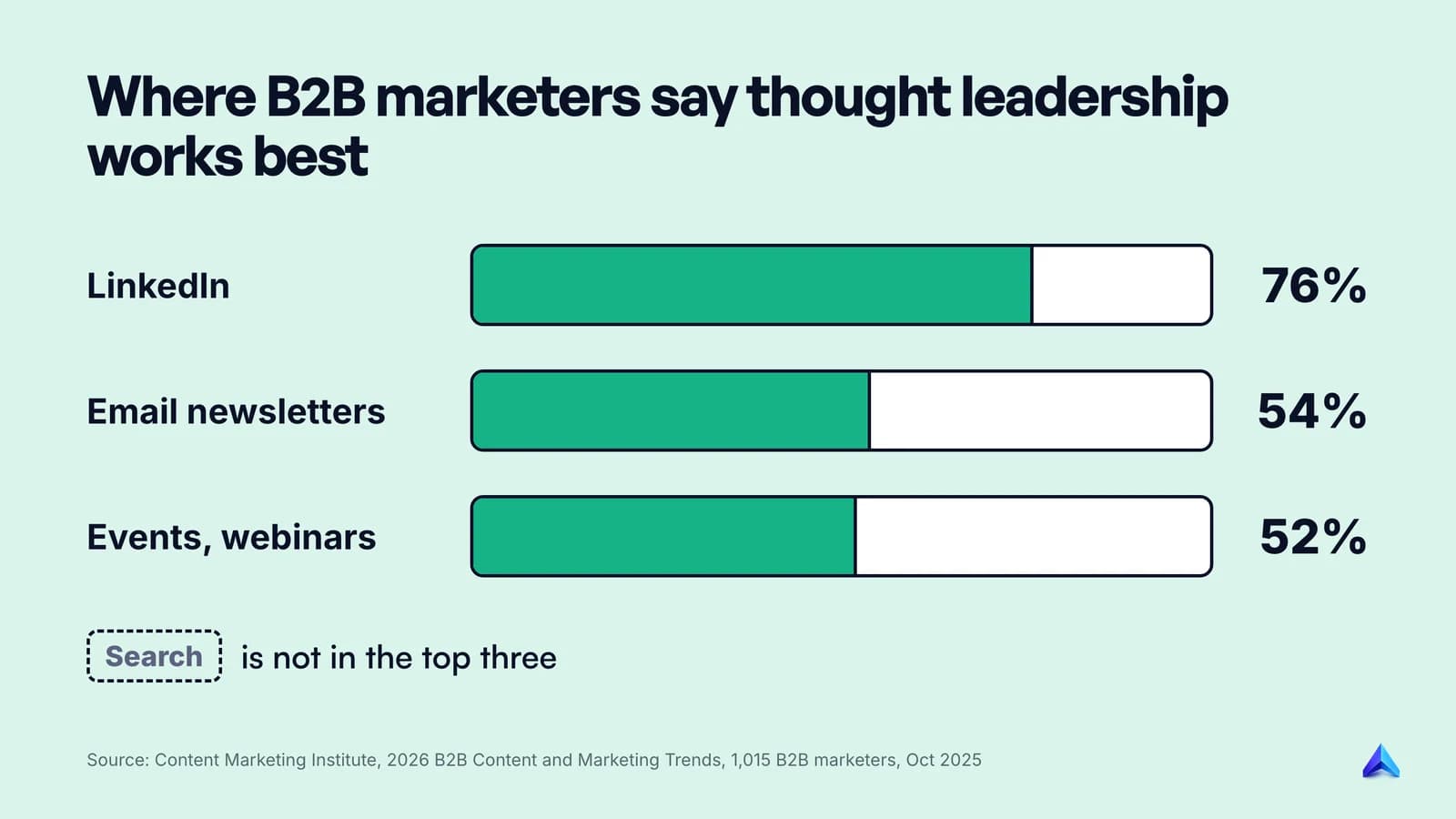
The Content Marketing Institute's 2026 B2B content and marketing trends research surveyed 1,015 B2B marketers, mostly in North America, between June and August 2025. Asked which channels work best for thought leadership, they named LinkedIn (76%), email newsletters (54%) and speaking events or webinars (52%). Search was not in the top three.
The same survey shows how those teams judge success. 80% measure thought leadership by audience engagement such as views, downloads and shares, and 63% by business impact such as leads and pipeline. Neither is a ranking or an organic session.
This matters for the split in three ways:
- Content teams are not wrong to work off-search. For a lot of B2B audiences, the buyer meets you in a feed or an inbox long before they type anything into Google.
- SEO cannot take credit for, or blame for, that work. If a webinar fills up, search had little to do with it. If a newsletter has no readers, better keyword research will not fix it.
- Budget is shifting towards owned channels. In the same research, 32% of B2B marketers plan to increase investment in owned media (content assets, website, blog and email) in 2026. The overlap with SEO lives inside that line.
One more figure explains why the two teams increasingly share tools. Among the marketers who use AI, 41% use SEO tools that analyse search patterns, recommend keywords and optimise content. The content team is already doing some SEO, whether or not the org chart says so.
Where they overlap: search-led content
The overlap is content planned around what people search for, written to be the best answer, and kept current. On most company websites it is the blog, the guides and the resource pages.
Google's position on this overlap is clear, and it settles a lot of internal arguments. The guidance on helpful, people-first content includes a section that asks whether SEO itself is "search engine-first". Its answer: "SEO can be a helpful activity when it is applied to people-first content, rather than search engine-first content." The SEO starter guide goes further and says compelling, useful content will likely influence your presence in search "more than any of the other suggestions in this guide".
Read together, those two lines give each side a job. Content decides whether the page is worth reading. SEO decides whether the right people can find it and whether Google understands what it is about. Neither can do the other's half.
The same Google page also lists warning signs that SEO has started steering content the wrong way. Three of them come up constantly in mixed teams:
- "Is the content primarily made to attract visits from search engines?"
- Writing to a particular word count, where Google adds that it has no preferred one.
- Entering "some niche topic area without any real expertise" because it looked like a traffic opportunity.
If you want a working test for those signs, our guide to helpful content and how to test it turns Google's questions into a checklist.
Who owns what on a single article
The cleanest way to split responsibility is to walk through one article from idea to refresh and give every decision an owner. The labels below assume two people, but the same split works when one person wears both hats on different days.
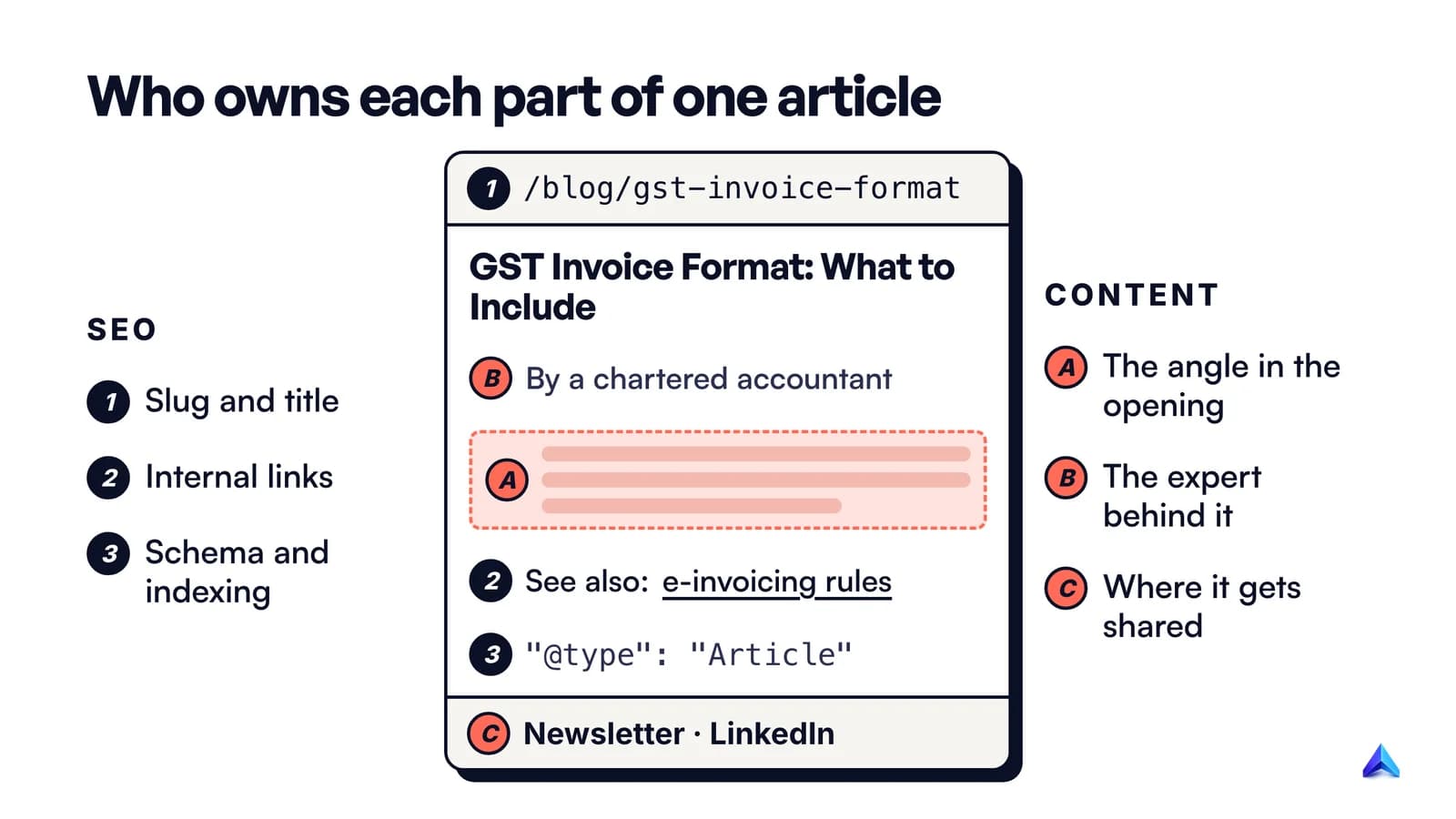
SEO owns:
- The keyword list, the search intent behind each keyword, and whether the site can realistically rank for it. A new domain should not be briefing articles at keyword difficulty levels it cannot reach; our explainer on what keyword difficulty measures covers how to judge that.
- The title tag, URL slug and meta description, within limits the content lead agrees to.
- Internal links in and out, so the article joins the right cluster of pages.
- Structured data, indexing checks, and canonical and redirect decisions.
- The refresh trigger: noticing in Search Console that a page is losing clicks or ranking for a query it does not answer.
The content lead owns:
- The angle, the argument and the point of view.
- Who supplies the expertise: the product manager, the founder, the accountant on the team.
- Sources, examples, original data and the voice.
- Distribution after publishing: the newsletter, LinkedIn, sales enablement, repurposing into other formats.
- Whether a piece should exist at all, if it does not serve the audience.
Both sign the brief. The brief is where the two meet before a word is written: the target query, the reader, the question the first paragraph must answer, the sources and the internal links. A disagreement about the H1 settled in a brief costs five minutes. The same disagreement after publication costs a rewrite.
When they disagree later, use one tie-break. On anything about what the reader needs, the content lead wins. On anything about whether the page can be found and understood, the SEO wins. A headline usually has to satisfy both, which is why it belongs in the brief.
How to split the budget
Arguing about percentages rarely helps, because the right split depends on the verdict section. Splitting by line item is more useful, since each line has an obvious owner.
Fixed SEO costs. A rank and keyword tool subscription and developer time for technical fixes; Search Console itself costs nothing. These do not grow much with output. On a small site they are modest; during a migration or redesign they spike.
Variable content costs. Writers, subject experts' time, editing, design and video. These scale with how much you publish, and they are usually the largest line.
Shared costs. Briefs, refreshes of existing articles and internal linking work. Put refreshes in the budget on purpose. Teams that fund only new articles end up with a growing archive of decaying pages nobody owns.
Distribution costs. Paid promotion, event fees, newsletter platforms and partner placements. These belong to content marketing, and they are the line SEO people most often forget exists.
Resourcing is the real constraint for most teams. In the CMI research, 39% of B2B marketers named resource constraints (time, people and budget) as a top challenge, just behind creating content that prompts action (40%). Only 9% plan to increase investment in human resources in 2026, the lowest of any category. If your budget is tight, the cheapest improvement is often a shared brief template, not another tool.
Hiring: one person or two?
For a small business, Google's own advice on whether you need an SEO is direct: "If you run a small local business, you can probably do much of the work yourself." The same page lists the services SEOs offer, and the list includes content development, keyword research and optimizing for generative AI. Agencies sell across the line, so read any proposal carefully to see who does the writing.
A practical rule: hire the person whose skill your verdict needs first. A plumber in Manchester or a dental clinic in Pune with a weak site needs someone who can fix the site and write service pages, which is an SEO generalist. A B2B software company in a new category needs a content lead who can build an audience, with technical SEO bought in as a short project. If you hire an SEO agency and a content agency at the same time, write down which of them owns keyword research. Otherwise both assume the other does it, or both do it differently.
Project Rankup sits inside the overlap: it reads your site into a project brief, judges keyword difficulty against your own domain's authority, and turns the result into a content calendar, so the SEO and content halves start from the same list.
Measuring each one without double counting
Each side needs its own scoreboard, plus one shared line that nobody claims twice.
SEO metrics: indexed pages, impressions, clicks and average position in Search Console, and organic conversions in analytics. These are the right measures for the search-facing work, and they move slowly. Google's starter guide says some changes "could take several months" to take effect and suggests waiting "a few weeks" before judging whether a change worked.
Content marketing metrics: newsletter subscribers and replies, event registrations, engagement on LinkedIn, content used in sales conversations, and pipeline that touched a piece of content. CMI found 33% of B2B marketers struggle to measure content effectiveness at all, so pick a small number and keep them steady.
Shared metric: conversions that came from organic search to search-led content. Agree in advance that this number belongs to the overlap, not to either team, and report it once.
The common double count happens when a reader finds an article through Google, subscribes to the newsletter, and buys after a webinar. SEO reports the conversion as organic, content reports it as webinar-sourced, and the board sees two wins for one customer. Pick one attribution model and use it for both. For working out whether the search side pays for itself, our guide to calculating SEO ROI walks through the arithmetic and the traps.
How each side breaks the other
Most failures in this relationship come from one side running without the other.
SEO without content marketing produces pages built for a keyword list rather than a reader. The extreme version breaks Google's rules. The spam policies define scaled content abuse as "when many pages are generated for the primary purpose of manipulating search rankings and not helping users", whatever tool produced them. The milder version is merely useless: articles padded to a target length, every heading a keyword, nothing the reader could not find on the page above.
Content marketing without SEO produces work that nobody finds after launch week. Common symptoms:
- Clever titles that nobody would ever type into a search box.
- The best material locked in gated PDFs and webinar recordings that Google cannot read.
- Posts on topics where the site has no chance of ranking, published anyway because they were fun to write.
- New articles that duplicate old ones, so two pages compete for the same query.
- No internal links, so each post sits alone and inherits nothing from the rest of the site.
AI search raises the stakes on both sides. Google's documentation on AI features in Search says a page must be indexed and eligible to show with a snippet before it can appear as a supporting link in AI Overviews or AI Mode. Content that never gets indexed is invisible there too, and indexed content with nothing distinctive to say gives the AI answer no reason to link it. The overlap wins: a clear, expert answer near the top of a page Google can read. If you are deciding how much this should change your plan, our explainer on how AI Overviews work covers what they pull from and what they do not. And if you need to decide which pages to fix first across both disciplines, the on-page vs off-page SEO breakdown shows where effort pays at each stage of a site's growth.
常見問題
What is the relationship between content marketing and SEO?
Content marketing is the wider strategy of using useful content to attract and keep an audience on any channel. SEO is the discipline of getting found in search. They overlap in search-led content: articles planned around real searches, written by people who know the subject, and kept up to date. That shared ground is where most budget and ownership arguments happen.
Is SEO still relevant if content marketing works on LinkedIn and email?
Yes, for any business whose buyers search for the problem or the product. Social and email reach people who already follow you. Search reaches people at the moment they look for an answer, including through AI answers built on indexed pages. A business can lean on one more than the other, but very few can ignore search entirely.
Is Google Ads part of SEO?
No. Google Ads is paid search, and SEO covers unpaid, organic results. Google states that advertising with Google will not have any effect on your site's presence in its search results. The two can share keyword research, and ads can test which messages earn clicks before you invest in organic pages.
Is content marketing a part of SEO?
Not exactly. Content creation is part of SEO when the content is made for search, but most content marketing, such as newsletters, webinars and sales material, never goes through search. It is more accurate to say search-led content is the shared ground between the two disciplines.
Should I hire an SEO specialist or a content marketer first?
Hire for the verdict. If your buyers already search for what you sell and your site has technical gaps, start with an SEO generalist who can also write service pages. If you are building a new category or selling to a small set of B2B buyers, start with a content lead and buy technical SEO as a short project.
Can you do SEO without content?
Partly. Technical fixes, site structure and earning links are SEO work that is not writing. But Google's starter guide says useful, compelling content will likely influence your presence in search more than any other suggestion it makes, so a site with nothing worth reading has little for SEO to work with.