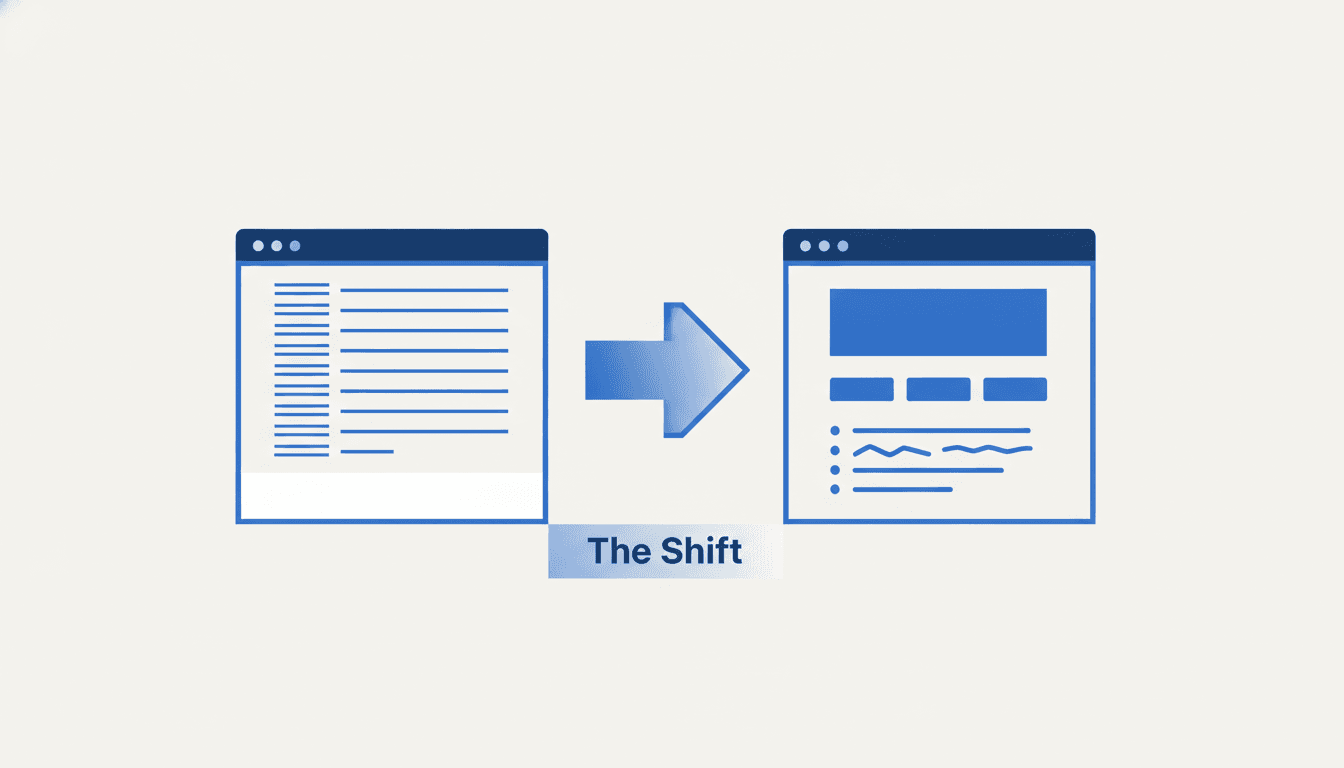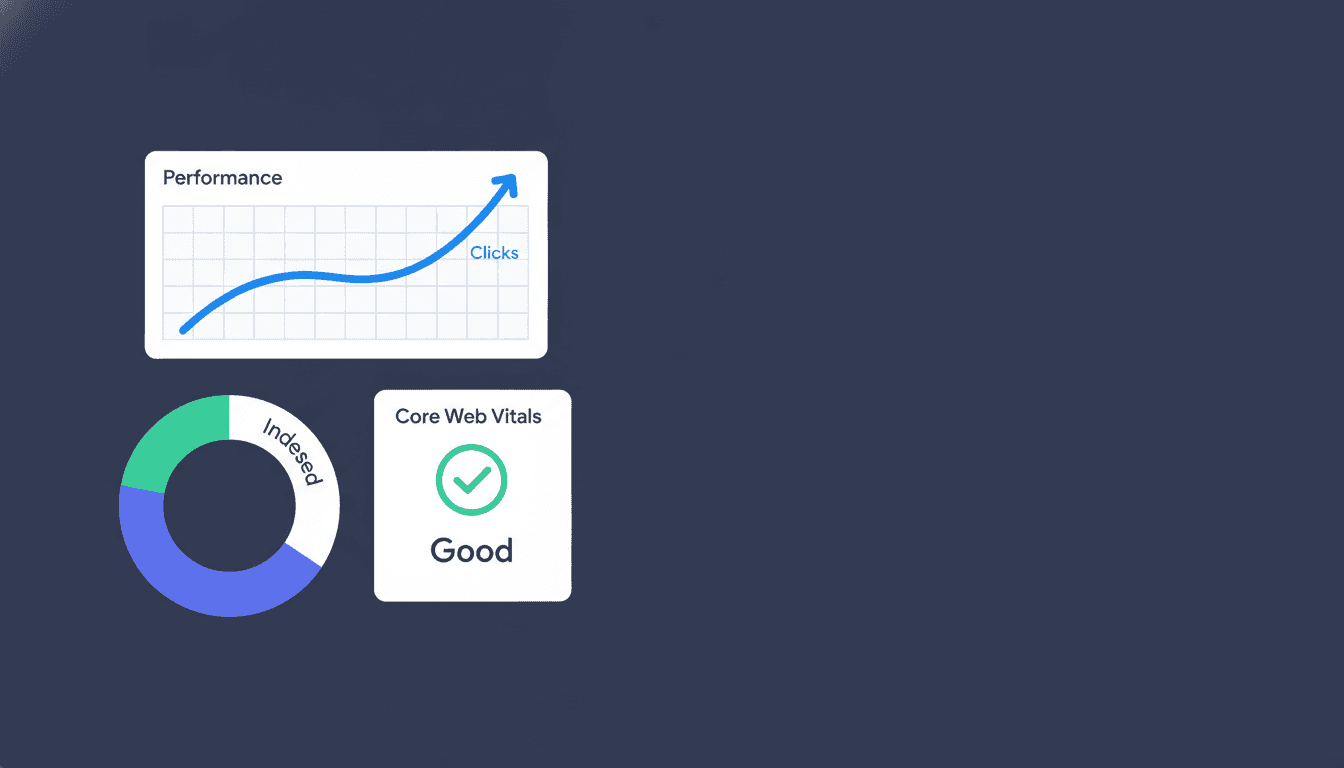

An SEO site checkup is a structured analysis of a website's technical health, on-page signals, and content quality to find what is blocking search visibility and fix it. Run one today using only traditional criteria and you will miss roughly half the picture, because search in 2026 runs on two tracks: Google's ranked list and AI answer engines like ChatGPT, Perplexity, and Google's own AI Overviews. A complete checkup now audits for both, or it leaves rankings and citations on the table.
What an SEO Site Checkup Actually Covers
A proper SEO site checkup is not a single score from a single tool. It spans four distinct layers, each with its own failure modes and its own fix workflow. Conflating them is the most common mistake agencies make when pitching an "audit" to a new client.
Here is what each layer covers and why it matters:
| Layer | What Gets Checked | Why It Matters | Red Flags |
|---|---|---|---|
| Technical | Crawlability, indexability, Core Web Vitals, robots.txt, canonical tags, HTTPS, redirects | Search engines must be able to reach and read the page before anything else matters | Soft 404s, crawl blocks on live content, duplicate canonical chains |
| On-Page | Title tags, meta descriptions, heading structure, keyword placement, image alt text | Signals that tell crawlers what each page is about | Missing H1s, stuffed keywords, mismatched meta titles |
| Content Quality | Depth, E-E-A-T signals, topical authority, freshness, internal link structure | Determines whether the page deserves to rank above competing results | Thin pages under 300 words, no author attribution, stale data |
| AEO / GEO Readiness | Structured data, FAQ schema, answer-first formatting, quotable claims, citation signals | Determines whether AI engines pull from this site in generated answers | No schema markup, prose-only answers, no sourced statistics |
The fourth layer is new. Three years ago you could ignore it. Now it is the difference between a site that appears in AI Overviews and one that does not.
An improperly configured robots.txt can block entire site sections from indexing, which means no amount of content work will produce rankings. Fix the technical layer first, always.
How to Perform an SEO Site Checkup: A Step-by-Step Workflow
Running a checkup without a workflow produces a list of issues with no sense of order or ownership. This five-step process gives you a repeatable system whether you are auditing your own site or a client's.
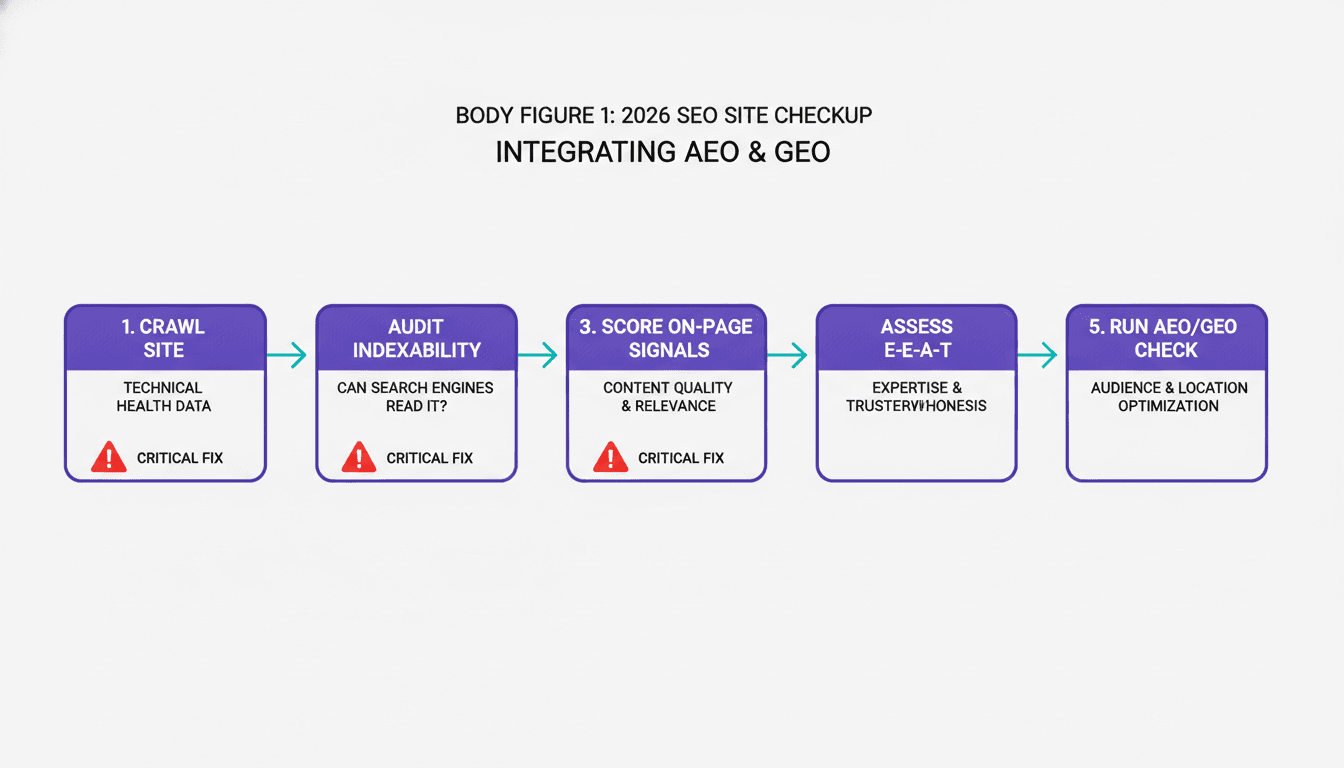
- Crawl the site. Use a crawler such as Screaming Frog, Sitebulb, or a cloud-based tool to pull every URL, status code, and on-page element. Export the full report before touching anything.
- Audit indexability. Cross-reference crawl data with Google Search Console. Any URL blocked by robots.txt or a noindex tag that should be live is a critical fix. Google Search Console shows which pages are excluded and why.
- Score on-page signals. Check every page for a unique H1, a meta description under 160 characters, and a title tag that matches search intent. Flag pages with duplicate titles or missing descriptions first, as these are quick wins.
- Assess content quality and E-E-A-T. Look for pages with fewer than 500 words, no author byline, no sourced data, and no internal links pointing to them. These are your thin-content risks. Our guide on how to improve E-E-A-T for Indian websites covers the specific signals Google's quality raters look for.
- Run an AEO and GEO check. Audit structured data coverage using Google's Rich Results Test. Check whether key pages open with a direct answer to the implied question, include a FAQ block, and cite at least one external source. These are the three features AI answer engines extract most often.
After completing steps one through five, build a priority matrix: critical (blocks indexing or causes ranking loss), high (limits click-through or content authority), medium (AEO gaps that reduce AI citation chances), low (cosmetic or minor).
Re-audit within 30 days of implementing fixes to confirm the issues are resolved and no new ones have appeared.
Free SEO Site Checkup Tools vs. Paid Platforms: Which Do You Actually Need?
Free tools are good enough to find the most obvious problems. Paid platforms are needed when you want depth, historical data, competitor comparison, or bulk site analysis.
The honest take: a free seo site checkup will catch the crawl errors and missing meta tags that account for most quick wins on smaller sites. If you are auditing a site with more than 500 pages, managing multiple clients, or trying to benchmark against competitors, free tools hit their ceiling fast.
| Tool Category | Best For | Depth of Check | AEO / Schema Check | Competitor Data |
|---|---|---|---|---|
| Free browser extensions | Quick single-page checks | Surface-level | Partial | No |
| Free online auditors (up to 500 URLs) | Small business sites, first-pass audits | Moderate | Basic | No |
| Mid-tier paid tools ($50-$150/mo) | Freelancers, small agencies, startups | Deep | Yes | Limited |
| Enterprise platforms ($300+/mo) | Large agencies, e-commerce, SaaS | Full crawl at scale | Full schema validation | Full |
Choose a free seo site checkup tool if your site has fewer than 200 pages and you need a one-time snapshot. Move to a paid platform if you need to track changes over time, audit competitors, or produce a client-ready SEO health check report.
One important caveat: no free tool checks AEO readiness in any meaningful way. That still requires manual review or a specialist platform. Our roundup of AI content audit tools covers which platforms have built schema and answer-readiness checks into their workflow.
Also Read: The Full SEO Audit Guide
Reading Your SEO Health Check Report: What the Numbers Mean
An SEO health check report from most tools assigns a score between 0 and 100. That number is useful for tracking progress over time. It is not a reliable predictor of rankings on its own.
What actually matters is the distribution of issues by severity. A site with a score of 62 and three critical crawl errors is in worse shape than one with a score of 55 and only medium-priority issues. Score comparison is meaningful only between audits of the same site over time, not across different sites or tools.
Here is a practical severity framework:
- Critical: Pages returning 5xx errors, canonical tags pointing to the wrong URL, pages blocked by robots.txt that should be indexed, missing HTTPS. Fix within 48 hours.
- High: Missing or duplicate H1s, title tags over 60 characters or under 30, pages with no internal links pointing to them, Core Web Vitals failing on mobile. Fix within two weeks.
- Medium: Missing schema markup, no FAQ block on informational pages, thin content pages without a clear consolidation plan, meta descriptions missing on secondary pages. Fix within 30 days.
- Low: Minor image compression opportunities, cosmetic anchor text variety, secondary keyword placement. Address in the next content sprint.
According to Semrush's 2024 State of Search, 42% of websites have duplicate content issues and 35% have broken internal links. Both categories fall in the high-severity range and both are routinely overlooked when teams focus only on the headline score.
On-Page SEO Analysis: The Elements That Move Rankings in 2026
On-page SEO analysis has not changed in principle since 2018. The weighting has. Three elements have risen sharply in importance because of how AI models evaluate content for citation: heading structure, answer-first formatting, and sourced claims.
Heading structure signals topical scope. A page with one H1 and three H2s tells a crawler it covers three sub-topics. A page with one H1 and twelve H2s signals shallow breadth rather than depth. The sweet spot for a 2,000-word article is roughly five to seven H2s, each with a clear topical scope.
Answer-first formatting means placing the direct answer to the implied question in the first 100 words of the page, before any context or history. AI Overviews extract the passage that most directly answers the query. If your opening paragraph is scene-setting rather than answering, you lose the extraction.
Sourced claims are cited facts that another source can verify. A bare assertion like "mobile traffic is growing" does not get cited by AI engines. A specific claim with an inline link does. The Google Search Central documentation on helpful content explicitly names sourced, original information as a quality signal.
For our detailed breakdown of technical signals, see the technical SEO audit guide.
Competitor SEO Site Analysis: Finding the Gaps That Win Rankings
Competitor SEO site analysis is the part of a checkup most teams skip because it feels like extra work. It is also where the highest-ROI opportunities hide.
The goal is not to copy what competitors do. It is to find the specific content or technical gap between your site and the ranking page, then close it. Three gaps show up most often:
- Content depth gap. A competitor ranks with a 3,000-word guide; your equivalent page is 800 words. You do not need to add 2,200 words of padding; you need to find the subtopics they cover that your page omits.
- Schema gap. A competitor has FAQ schema and HowTo schema on a page that earns a rich result; your equivalent page has none. A single schema implementation can shift click-through rate significantly.
- AEO structure gap. A competitor's page opens with a one-sentence definition and has a FAQ block; your page opens with a brand story. The competitor gets cited in AI answers. You do not.
Tools that support competitor SEO site analysis include Ahrefs, Semrush, and Moz. Each pulls backlink profiles, keyword overlap, and organic traffic estimates. For a comparison of how their authority metrics differ, see our piece on the difference between Moz and Ahrefs domain ranking.
According to Ahrefs' 2024 study on organic traffic, 96.55% of pages get zero organic traffic from Google. The separation between those pages and the ones that rank usually comes down to three factors: backlink authority, content depth, and schema coverage.
AEO and GEO Integration: Why Your SEO Checkup Must Now Include Both
Answer Engine Optimization (AEO) and Generative Engine Optimization (GEO) are not replacements for traditional SEO. They are a new audit layer that sits on top of it.
AEO is the practice of structuring content so that AI answer engines can extract and cite it. GEO focuses on making claims citation-ready across generative AI tools like ChatGPT, Perplexity, and Gemini. Both depend on the same underlying signals: clear structure, direct answers, sourced data, and schema markup.
The BrightEdge 2025 AI Search Impact Report found that pages with FAQ schema are significantly more likely to appear in AI-generated answer panels than equivalent pages without it. The structural requirement is not complex: a direct answer in the opening paragraph, an FAQ block with H3 questions, and at least two sourced statistics.
A site seo checkup that only checks traditional on-page and technical signals will miss all of this. The checkup needs to ask three additional questions:
- Does each key page open with a standalone, quotable answer?
- Is FAQ schema implemented and validated via the Rich Results Test?
- Are factual claims paired with inline citations from authoritative sources?
If the answer to any of these is no, the page is invisible to AI answer engines regardless of its Google ranking position.
For a deeper look at how AI search changes the SEO workflow, the deep search AI guide covers the technical and content implications in detail.
Improving Website Search Ranking in 2026: What to Prioritize First
When improving website search ranking in 2026, the sequence of fixes matters as much as the fixes themselves. Technical issues block everything downstream. Fixing content before fixing crawlability is the SEO equivalent of repainting a house with a cracked foundation.
Here is the priority sequence that consistently produces results:
- Resolve all critical technical issues (crawl blocks, broken canonicals, HTTPS errors).
- Fix indexability gaps found in Search Console.
- Consolidate or expand thin content pages using the content depth findings from competitor analysis.
- Add or correct schema markup on high-priority pages.
- Reformat top-traffic pages to open with answer-first paragraphs.
- Build or expand the FAQ block on each key page and validate schema.
- Re-crawl and re-audit to confirm fixes and catch regressions.
This sequence works because each step creates the conditions the next step needs. Schema on a page that is not indexed does nothing. An answer-first paragraph on a thin page will not earn citations. The order is not arbitrary.
According to Google's 2025 Search Quality Evaluator Guidelines, E-E-A-T (Experience, Expertise, Authoritativeness, Trustworthiness) remains a core quality signal. That means sourcing claims, adding author attribution, and linking to authoritative references are not optional extras. They are part of every checkup's fix list.
Frequently asked questions
What is an SEO site checkup?
An SEO site checkup is a structured review of a website's technical health, on-page signals, and content quality to find and prioritize issues that limit search visibility. A full checkup in 2026 also evaluates AEO and GEO readiness, checking whether the site is structured to appear in AI-generated answers, not only in ranked blue-link results.
What is an SEO site checkup tool?
An SEO site checkup tool is software that crawls a website and reports on technical errors, on-page weaknesses, and content gaps. Tools range from free browser extensions that analyze a single page to enterprise platforms that crawl millions of URLs, track changes over time, and benchmark against competitors. No single tool covers every audit layer, including AEO readiness.
How often should I run an SEO site checkup?
For most sites, a full checkup once per quarter is the right cadence, with a lighter technical crawl monthly. Run an unscheduled checkup after any major site migration, CMS update, or content restructure. Sites that update content daily, such as news publishers or large e-commerce stores, benefit from automated weekly crawls to catch regressions fast.
What is the difference between on-page and technical SEO issues?
Technical SEO issues affect whether search engines can reach, crawl, and index a page at all. On-page issues affect how well a page communicates its topic and intent once it is already indexed. A page can be perfectly indexed but still rank poorly due to on-page gaps, and a page with great content will not rank at all if it has a crawl block or a broken canonical tag blocking it.
Can free SEO checkers find all issues?
Free SEO checkers find the most common and visible issues well: missing meta tags, broken links, duplicate titles, and basic Core Web Vitals scores. They do not catch schema validation errors, AEO readiness gaps, competitor content depth comparisons, or historical regression trends. For a full picture, free tools work best as a first pass before a deeper paid-platform audit.
What is a good SEO score in an audit report?
Audit score scales vary by tool, so comparing scores across platforms is not reliable. Within a single tool, a score above 80 generally indicates few critical or high-severity issues. The more useful question is: how many critical issues does the site have? A score of 90 with one crawl-blocking robots.txt error is worse for rankings than a score of 70 with only low-priority cosmetic issues.
How does AEO differ from traditional SEO in a checkup context?
Traditional SEO checks whether a page can be crawled, indexed, and ranked. AEO checks whether the page is structured so AI answer engines will extract and cite it in generated responses. The technical prerequisites overlap, but AEO adds three new checkpoints: answer-first paragraph formatting, FAQ schema implementation, and the presence of sourced, standalone quotable claims.
Key Takeaways
- A complete seo site checkup in 2026 covers four layers: technical, on-page, content quality, and AEO/GEO readiness.
- Fix technical issues first. Crawl blocks and broken canonicals nullify every other fix.
- Free tools find surface-level issues well; paid platforms are needed for depth, competitor data, and AEO coverage.
- Audit scores are useful for tracking progress over time, not for cross-site comparison. Severity distribution matters more than the headline number.
- AEO readiness comes down to three signals: answer-first formatting, FAQ schema, and sourced claims with inline citations.
- Competitor SEO site analysis exposes content depth gaps, schema gaps, and AEO structure gaps that explain why a competitor ranks and you do not.
- The sequence of fixes matters: technical first, then indexability, then content depth, then schema, then AEO formatting.
If you want a checkup that covers all four layers and produces a prioritized fix roadmap, contact Project Rankup for an AI-driven content audit and SEO analysis built for 2026 search realities.