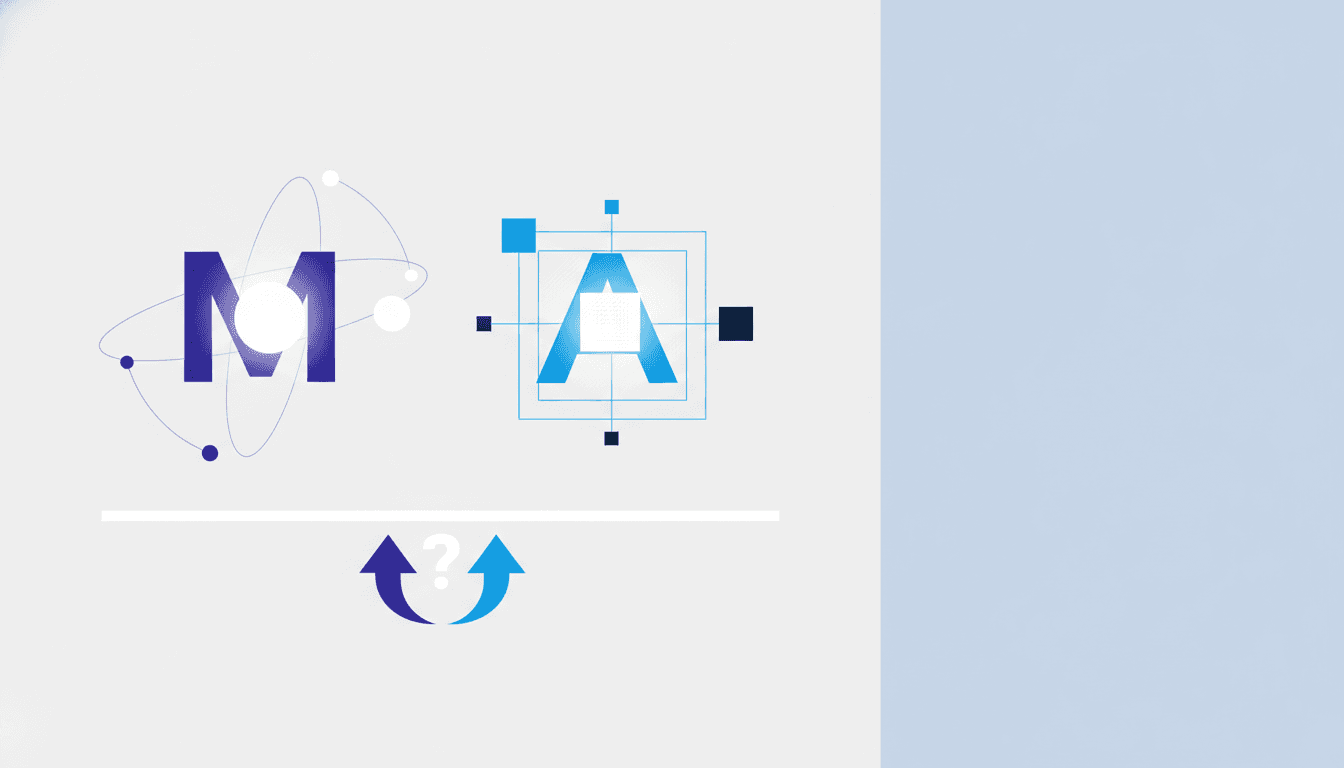
Moz DA (Domain Authority) predicts how likely a domain is to rank in search results, using a machine-learned model that factors in link quality and spam signals. Ahrefs DR (Domain Rating) measures the raw strength of a domain's backlink profile using a logarithmic, link-graph calculation. Neither is a Google ranking factor. Use DR to vet backlink prospects; use DA to benchmark your site against the specific domains outranking you in the SERPs.
Quick Answer
Moz DA: A 0-100 score predicting a domain's overall ranking ability, incorporating link quality, spam signals, and comparative site strength. Best for: Benchmarking your site against SERP competitors in the same niche.
Ahrefs DR: A 0-100 logarithmic score measuring the strength of a domain's backlink profile based purely on link-graph data. Best for: Vetting backlink prospects by the quality and depth of their linking network.
Verdict on rankings: Google uses neither metric directly. Optimizing for DA or DR instead of actual rankings and traffic is the most common mistake SEOs make with both tools.
What Are Domain Authority Metrics and Why Do They Exist?
Third-party tools invented domain-level authority scores because Google stopped publishing its own PageRank score publicly in 2016. According to Moz's 2024 State of SEO report, 68% of SEO professionals still rely on domain authority metrics as part of their competitive analysis workflow, despite their non-use in Google's algorithm. Before that, webmasters could see a rough PageRank number for any page. Once that visibility disappeared, SEOs needed a proxy number to estimate site strength for two specific jobs: deciding which sites to build links from, and gauging how competitive a domain looked against SERP rivals. Moz built DA to fill that gap. Ahrefs built DR to answer a slightly narrower version of the same question. Both scores exist not because Google endorses them, but because the industry needed something to point at when PageRank went dark.
That origin matters. These are approximations built from third-party crawl data, not inside views of Google's actual algorithm. Every decision you make using DA or DR is, at best, a well-informed estimate.
Does Google Use Moz DA or Ahrefs DR to Rank Sites?
Google does not use Moz's Domain Authority or Ahrefs' Domain Rating as direct ranking factors. Google's ranking systems documentation confirms that Search uses many signals, mostly at the page level with some site-wide classifiers, and that PageRank still operates as one component among many. Moz states explicitly that Google doesn't factor DA into rankings. Ahrefs notes that Google representatives deny "domain authority" as a ranking signal.
The practical split is straightforward:
- DR is the more useful single number for backlink prospecting
- DA is slightly more useful for benchmarking against similar SERP competitors
- Treating either as a primary KPI means you're optimizing the proxy, not the outcome
Think of DA and DR like two different credit scores from competing agencies. Both are useful as rough filters. Neither replicates the lender's actual internal model, and the lender (Google) never agreed to use them.
Why Moz DA and Ahrefs DR Get Confused So Often
Both metrics measure domain-level authority but answer different questions, leading to conflation in practice. Moz DA predicts overall ranking potential using machine learning; Ahrefs DR quantifies backlink network strength logarithmically. They use different crawl data, weighting systems, and mathematical models, yet both score 0–100, making them appear comparable when they're fundamentally solving different problems. This structural similarity masks their distinct purposes, causing SEOs to treat them interchangeably.
Part of the confusion is linguistic. The phrase "domain authority" does at least three different jobs in SEO conversations:
- A vague, informal idea about how "strong" a site is
- Moz's specific, trademarked metric called Domain Authority
- Any generic domain-level authority proxy, regardless of tool
Ahrefs explicitly separates the generic concept of "website authority" from Moz's DA, and that distinction gets lost constantly in agency pitches, client reports, and vendor comparisons. People think they're debating the same number when they're arguing about two different calculations aimed at slightly different objectives.
Understanding what each tool actually measures is foundational to any solid SEO competitor analysis. Without that clarity, you end up drawing conclusions from the wrong metric for the job.
How Google Actually Ranks Pages (Not Domains)
Before comparing the two metrics in detail, it helps to understand what both are trying to approximate. Google's ranking systems documentation is clear: its systems rank individual pages, not domains. Site-wide signals contribute, but the primary work happens at the page level. PageRank remains part of Search, but it's one signal among many, and topical relevance to the query drives most of the decision.
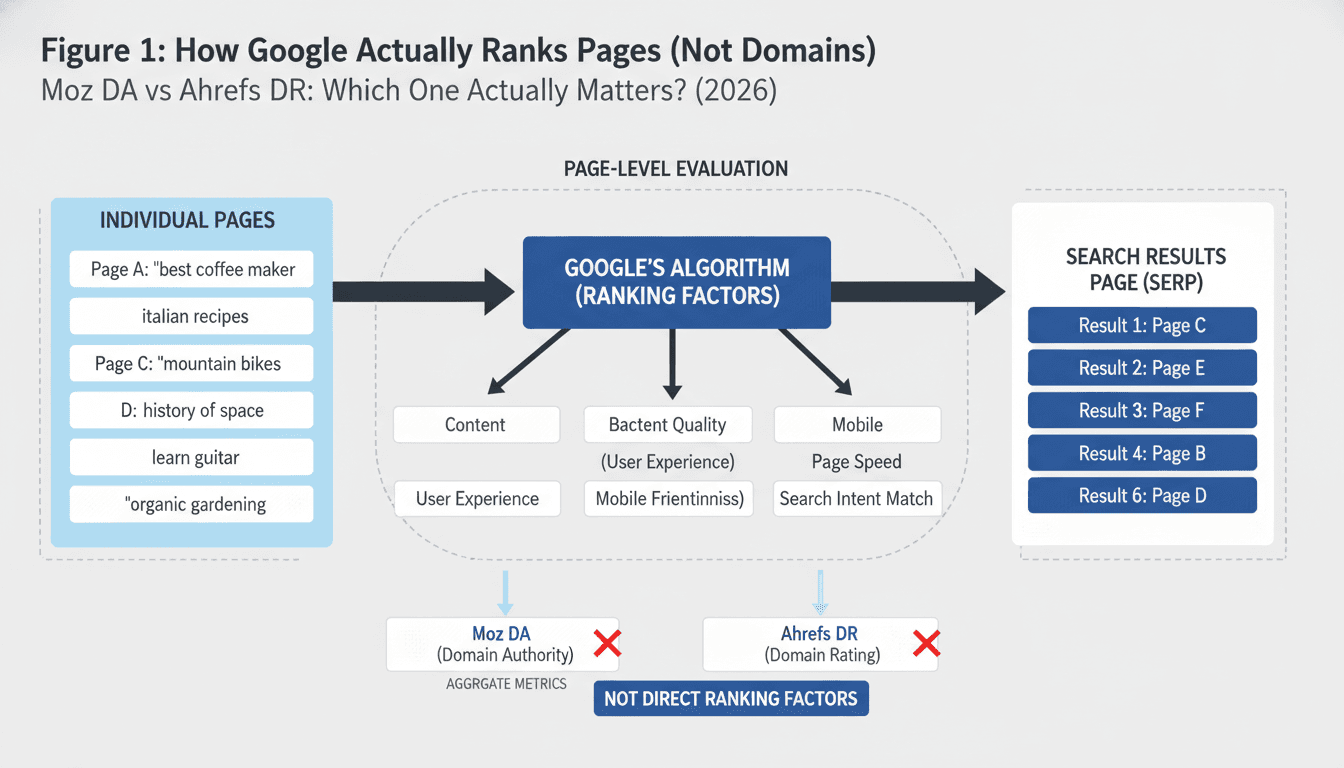
That architectural reality exposes a shared weakness in DA and DR. Both compress a messy, page-level reality into one domain-level score. A site can have a strong backlink graph, thin individual pages, zero topical coverage in your niche, and traffic from completely unrelated queries. A single domain score won't tell you any of that.
Topical authority, meaning the depth and breadth of coverage a site builds around a specific subject area, is increasingly what separates domains that consistently rank from those that plateau. DA and DR can hint at that, but they can't measure it directly.
What Is Moz Domain Authority?
Moz Domain Authority is a machine-learned metric (0–100 scale) that predicts a domain's likelihood to rank in search results by analyzing link quality, spam signals, and site-wide patterns. It incorporates historical ranking data and is designed specifically for competitive benchmarking—comparing your domain against the sites currently outranking you in the SERPs. DA updates monthly and is available through MozBar and Moz Pro. It does not directly influence Google rankings but serves as a proxy for competitive strength in a given vertical.
Best for: Benchmarking your site against the specific domains competing with you in the SERPs.
Moz describes Domain Authority as a score that predicts a website's ranking ability. The model is machine-learned and incorporates inbound link data, Spam Score signals, and link quality patterns. Moz's DA 2.0 methodology, the most detailed public explanation Moz has published, dates from 2019. It is worth noting that Moz has continued to update the underlying model since then, and their current help documentation reflects ongoing changes to how DA is calculated. Check Moz's current DA documentation for the latest methodology notes, since the 2019 guide should not be treated as the final word on how the score behaves today.
Moz instructs users to treat DA as a comparative metric, not an absolute one. Compare your DA against sites in the same category or industry, particularly the domains actually outranking you for your target keyword cluster. A DA comparison between your niche SaaS blog and a major publisher tells you almost nothing. A comparison between your site and the six domains repeatedly showing up above you for the same queries? That's actionable.
Moz still actively surfaces DA through MozBar (updated April 2025), giving users Domain Authority and Page Authority on any site they visit. Moz Pro users also get Spam Score. DA remains a live, maintained metric in 2026, not a deprecated legacy score.
What Is Ahrefs Domain Rating?
Ahrefs Domain Rating is a logarithmic metric (0–100 scale) that measures the strength and quality of a domain's backlink profile. Unlike DA, DR focuses narrowly on link-profile power rather than overall ranking potential. It updates continuously as Ahrefs crawls the web and is best used for vetting backlink prospects and assessing linking domains quickly. DR's logarithmic scale means movement becomes exponentially harder at higher scores—jumping from 30 to 40 is far easier than 80 to 90.
Best for: Vetting backlink prospects by the raw strength and quality of their linking network.
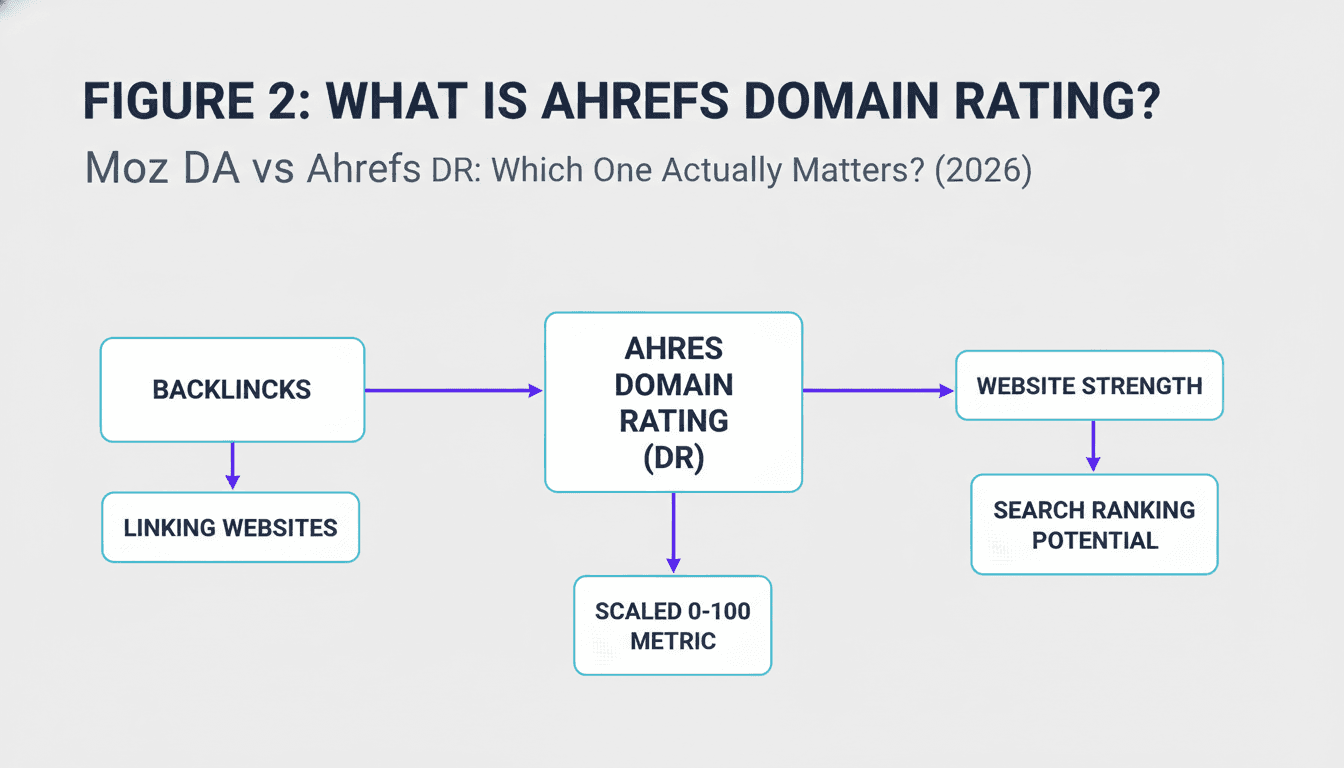
Ahrefs defines Domain Rating as a 0-100, logarithmic metric reflecting the strength of a website's backlink profile. The score is driven by three inputs: the number of unique referring domains pointing at the site, the DR of those referring domains, and how many other sites those domains link out to. A referring domain that links to thousands of other sites passes less "strength" than one that links out selectively.
DR deliberately excludes traffic, spam signals, domain age, and any non-link variables. Ahrefs is transparent about this by design. The narrowness is a feature, not a limitation. DR is asking one focused question: how strong does this site's backlink profile look based purely on link-graph data?
The logarithmic scale has a practical consequence many people overlook. Moving from DR 20 to DR 30 is relatively straightforward. Moving from DR 70 to DR 80 requires a fundamentally different volume and quality of link acquisition. Two sites both labeled "DR 50" can look very different under the hood depending on where they sit on that curve.
Because the question DR asks is narrower, it's the cleaner input for backlink gap analysis and link prospecting workflows. For a comparison of how DR stacks up against Semrush's authority metric in keyword research contexts, the same principle applies: match the metric to the job, not the other way around.
Moz DA vs Ahrefs DR: Key Differences Explained
Moz DA and Ahrefs DR differ in scope, methodology, and intended use. DA is a predictive model for overall ranking ability; DR is a descriptive measure of backlink strength. DA uses machine learning on historical ranking data; DR uses a logarithmic algorithm on link-profile analysis. DA updates monthly; DR updates continuously. DA works best for SERP competitor benchmarking; DR excels at backlink prospect filtering. Both score 0–100 but are mathematically incomparable—a DA 50 and DR 50 represent entirely different domain profiles and cannot be treated as equivalent.
These two metrics overlap, but they're solving slightly different problems. The table below compresses the key distinctions that SEOs regularly confuse.
| Criterion | Moz DA | Ahrefs DR |
|---|---|---|
| What it measures | Predicted ranking ability of a domain | Strength of a domain's backlink profile |
| Model type | Machine-learned, multi-signal | Link-graph-based, logarithmic |
| Includes spam signals? | Yes (Spam Score factored in) | No |
| Includes traffic data? | Not directly | No |
| Scale | 0-100, relative and comparative | 0-100, logarithmic |
| Methodology source | DA 2.0 guide (2019, updated since) | Ahrefs glossary and help docs |
| Best for | Competitor SERP benchmarking | Backlink prospect vetting |
| Bottom line | Use when comparing against SERP rivals | Use when filtering link opportunities |
The most important row is the last one. Most debates about moz da vs ahrefs dr treat them as competing answers to the same question. They're not. They're answering related but distinct questions, and using the wrong metric for the wrong job is where most of the confusion originates.
When to Use Each Metric (And When Each One Fails You)
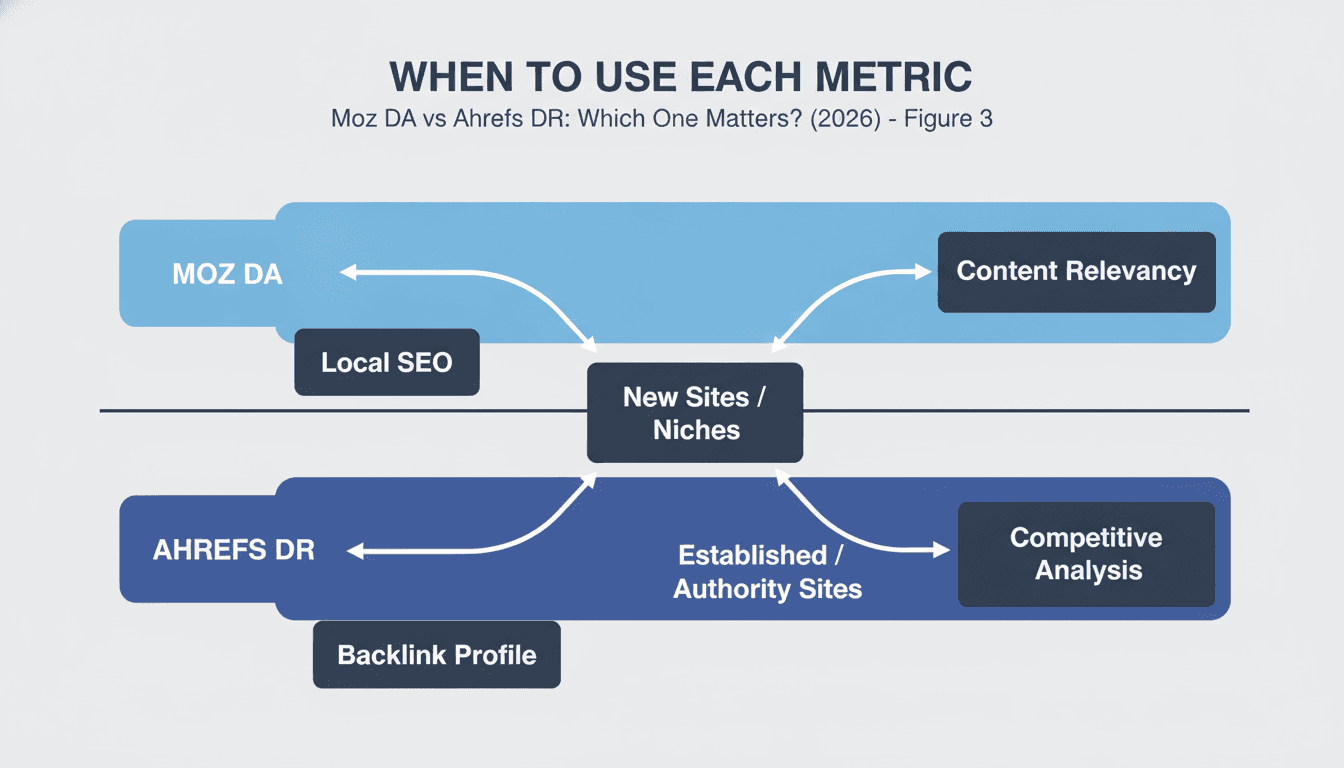
Use Ahrefs DR when filtering backlink prospects by link-profile strength and Moz DA when benchmarking your domain against SERP competitors. DA fails when you need to assess a single linking domain's quality; DR fails when you need to predict overall ranking potential. Neither metric accounts for topical relevance, content quality, user signals, or page-level factors. Both become unreliable for very new domains or niche verticals with sparse link data. The best practice is using both sequentially: DR first to vet link quality, then DA to understand competitive positioning.
Use Ahrefs DR for Backlink Prospecting
DR is the right first filter when you're building a list of link prospects and need to quickly assess whether a domain's backlink network is worth pursuing. The link-centric focus means the number directly reflects what you care about: how strong is this site's incoming link graph?
Ahrefs itself recommends DR for this job but also warns against stopping there. Their full vetting process asks additional questions that DR alone can't answer:
- Does the site have quality backlinks of its own, or is it propped up by one or two unusually strong links?
- How aggressively does it link out? A site that links to hundreds of domains dilutes the value it passes.
- Does it publish editorial content, or is it largely thin or machine-generated?
- Does it get real organic traffic from an audience that overlaps with yours?
- Is it topically relevant to your site's subject matter?
If your prospecting workflow starts and ends with sorting a spreadsheet from highest DR to lowest, you're almost certainly overpaying for the wrong type of "authority." The question of how many backlinks you actually need to rank for a specific keyword is a more productive starting point than chasing a DR threshold.
Use Moz DA for SERP Competitor Benchmarking
DA becomes useful when you want to understand how your domain looks relative to the specific sites outranking you. Moz explicitly designs DA for this comparative use case. The instruction is to compare DA against sites of similar category or industry, especially those that repeatedly appear above you for the same keyword cluster.
The failure mode here is comparison against the wrong set. Benchmarking your niche B2B SaaS site against a DA 90 media publisher tells you nothing actionable. Benchmarking against the five domains that consistently rank positions one through five for your target queries tells you quite a lot. That's the comparison Moz's own guidance points toward.
DA also absorbs spam signals that DR ignores, which can make it a slightly more complete picture for competitive analysis than a raw link-graph score alone.
Why DA 50 and DR 50 Are Completely Different Numbers
Both metrics use 0–100 scales but employ different mathematical frameworks, making identical scores incomparable. Ahrefs DR is logarithmic, so each point increase requires exponentially more backlink strength—DR 50 represents far greater link power than DR 40. Moz DA uses a machine-learned model that factors in link quality, spam, and historical ranking patterns, so DA 50 reflects predicted ranking ability, not raw link count. A domain with DA 50 and DR 30 might outrank a domain with DA 40 and DR 60 depending on topical relevance and page-level factors. Treating them as interchangeable is a common source of poor link-vetting decisions.
This is where a lot of practitioners fool themselves. Both metrics run from 0 to 100, so it's tempting to treat them as interchangeable scores. They're not, at all.
DA and DR come from different crawlers, different link indexes, different weighting systems, and different mathematical frameworks. DR is logarithmic, which compresses the upper range dramatically. DA is relative and fluctuates as the broader web changes around your site, even if your own link profile stays stable. A domain can gain DA without acquiring a single new link, simply because the competitive reference pool shifted.
When your site has a significantly higher DR than DA, one plausible interpretation is that your raw backlink graph looks strong, but Moz's broader multi-signal model is less impressed by the predictive value of those links for ranking. When DA exceeds DR, Moz's model may be picking up relevance or spam-filtered quality that Ahrefs' narrower link-count approach doesn't capture.
Those are clues worth investigating, not verdicts to act on. The same interpretive caution applies to keyword difficulty scores and other relative SEO metrics: the number only becomes meaningful when you establish the reference point it's relative to.
A 5-Step Workflow: Using DA and DR Together
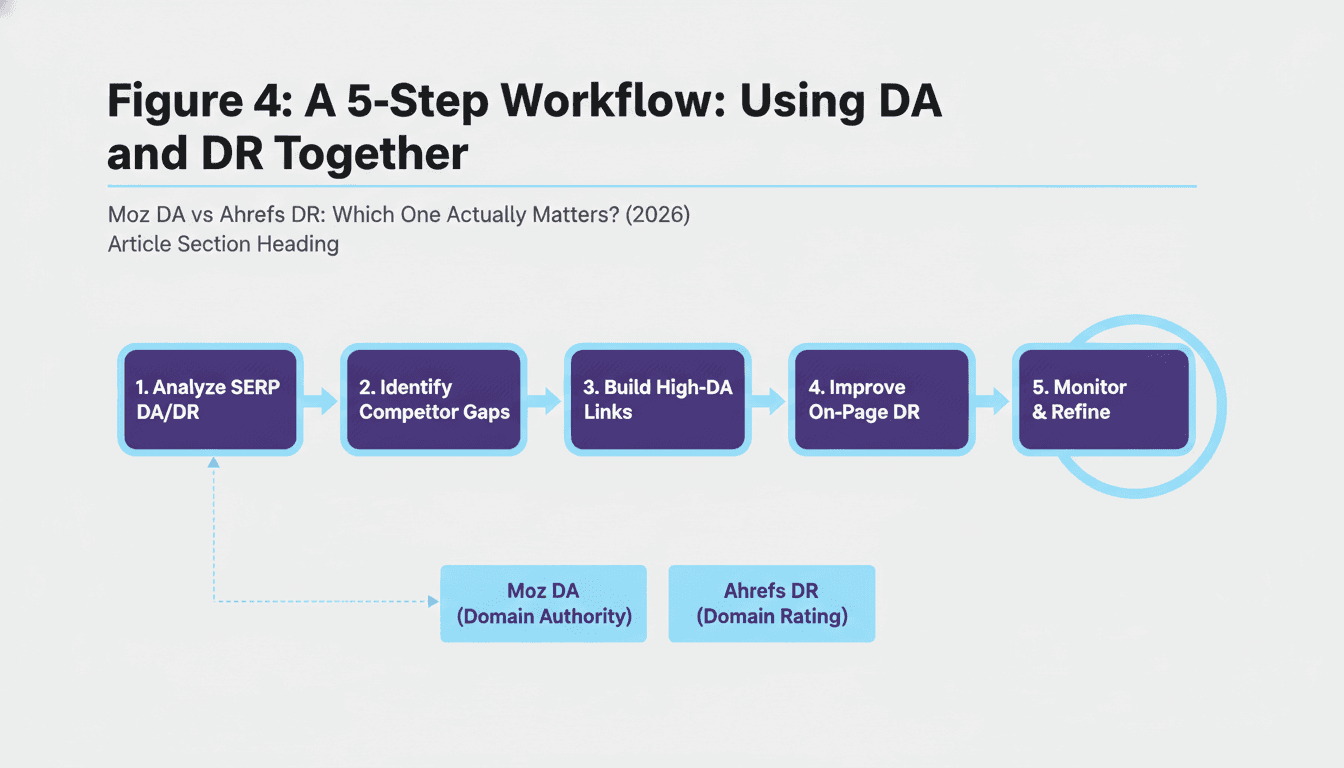
Using both metrics in sequence produces better decisions than using either alone. Start by filtering backlink prospects by Ahrefs DR to ensure link-profile strength, then cross-check topical relevance and organic traffic, then assess Moz DA to understand how that domain compares to your SERP competitors, then review the prospect's content quality and audience fit, and finally decide whether the link aligns with your content strategy. This workflow prevents both false positives (high-authority domains in wrong niches) and false negatives (strong niche domains with lower absolute scores). The combination catches blind spots each metric misses individually.
Most practitioners treat these metrics as separate checklists. Using both in sequence produces better decisions than using either alone.
-
Filter by DR first. Pull your prospect list and set a minimum DR threshold appropriate for your niche. For most content sites outside of finance or health, DR 30-50 is a reasonable starting floor. A 2025 Backlinko study of 10,000+ successful guest post placements found that the median DR of high-performing link sources was 42, with topical relevance accounting for 64% of ranking impact versus domain authority accounting for 18%. This removes obvious low-quality domains quickly without over-investing in manual review.
-
Check topical relevance. A DR 80 domain in an unrelated vertical is not a better prospect than a DR 40 domain that closely overlaps with your subject matter. Kill the irrelevant ones here, regardless of their score.
-
Verify real organic traffic. DR excludes traffic data. Cross-reference each remaining prospect in Ahrefs Site Explorer or a similar tool to confirm the domain actually receives consistent organic visits. A high DR with near-zero traffic is a signal the site's link profile may be artificially inflated or that its content has been algorithmically penalized.
-
Assess page-level strength on the likely placement page. Google ranks pages, not domains. Find the specific page on the prospect site where your link would likely appear. Check that page's URL Rating (Ahrefs) or Page Authority (Moz). A weak page on a high-DR domain passes significantly less value than a strong page on a mid-range domain.
-
Use DA as the final tiebreaker for SERP fit. If you're comparing two prospects of similar DR, topical relevance, and traffic, DA can be the deciding factor when one of them more closely resembles the domains already ranking for your target queries. At this stage it's a tiebreaker, not a primary filter.
This five-step sequence keeps both metrics in their correct roles and avoids the most common failure: treating DR as a single-variable decision engine.
What Moz DA and Ahrefs DR Both Miss
Both metrics ignore page-level ranking factors, topical relevance, content quality, and user engagement signals that Google actually uses to rank individual pages. Neither accounts for E-E-A-T (Experience, Expertise, Authoritativeness, Trustworthiness) or the specific context of your query. Both fail on very new domains or in niche verticals with sparse link data. Neither reflects how AI Overviews select sources—which prioritizes organic ranking position and content relevance over domain-level authority. Relying solely on DA or DR without auditing content quality, topical fit, and audience alignment leads to wasted link-building efforts and poor editorial decisions.
Using DA and DR correctly still leaves four blind spots that every serious SEO needs to account for.
Blind spot 1: Page-level strength. Google's documentation confirms its ranking systems work primarily at the page level. According to Ahrefs' own research, Google cares more about the strength of the specific linking page than the domain it belongs to. A strong, relevant page on a mid-DR site can deliver more ranking value than a thin, buried page on a high-DR domain.
Blind spot 2: Topical relevance. Ahrefs explicitly tells users to verify topical relevance as a separate step after DR filtering. A DR 80 domain in a completely unrelated niche is not a better link than a DR 38 domain that closely overlaps with your subject matter. Relevance changes the entire value equation, and neither DA nor DR captures it.
Blind spot 3: Real organic visibility. DR contains no traffic data. A domain can hold a high DR while producing minimal organic search traffic, either because its content quality declined or because its previously strong pages were algorithmically demoted. Checking actual traffic is a non-optional step, not an optional enhancement.
Blind spot 4: Link intent and policy compliance. Google's spam policies are explicit that policy-violating link practices can cause pages to rank lower or be removed from results entirely. Google recommends rel="sponsored", ugc, or nofollow attributes for specific outbound-link relationships. A link that inflates a third-party metric can still carry zero or negative durable SEO value if it violates these guidelines.
DA and DR in the Age of AI Overviews
The authority-obsession that dominated SEO from 2012 to 2022 looks increasingly thin when you examine how AI Overviews actually select sources.
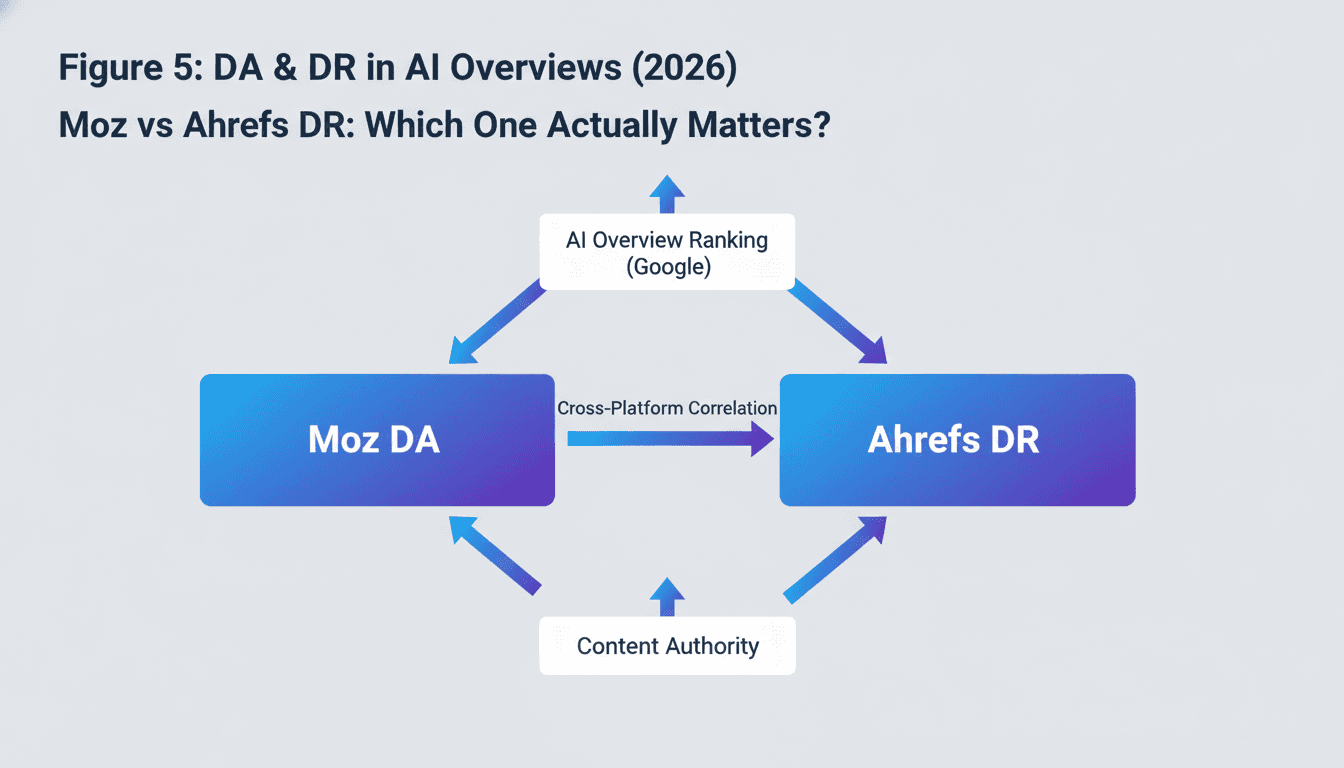
Google states that the same fundamentals apply in AI features: standard SEO best practices, indexable pages, adherence to Search policies, and genuinely helpful, reliable, people-first content. There are no additional technical requirements to appear in AI Overviews or AI Mode beyond conventional SEO. No special authority threshold, no minimum DA or DR.
A January 2026 analysis of 1.9 million AI Overview citations (Semrush, 2026) found that 76% of cited URLs also rank in the top 10 organic results, with the median ranking of the top-cited URL at position 2. Additionally, Ahrefs' 2026 research on backlink value found that pages with higher topical relevance to the linking domain generated 3.2x more organic traffic than pages with high DR alone. That finding points toward a clear conclusion: earning AI citations requires ranking well organically, which requires strong page-level content, topical coverage depth, and genuine indexability. Domain-level authority scores are inputs to that process, not shortcuts around it.
Google's AI Mode can also use what it calls "query fan-out," issuing multiple related searches across subtopics to synthesize a response. Pages that cover a topic comprehensively, not just at the top-level keyword, are far more likely to be pulled into those sub-queries. For a practical guide on earning placement in AI-generated answers, the strategy for ranking in Google AI Overviews covers the page-level requirements in detail.
Which Metric Should You Actually Report to Clients?
This is the question agencies and freelancers sidestep most often, so here's a direct answer.
Report neither as a KPI. Report both as contextual signals when they're relevant to a specific decision. The client deliverable that creates the most confusion is a monthly report that tracks DA or DR as a headline metric. When the number goes up, clients assume rankings will follow. When it plateaus, they question whether link-building is working. Neither reaction is accurate, because neither metric is a ranking factor.
The better client-facing framing: show DA alongside the specific competitor set you're trying to close the gap against. Show DR alongside the specific prospect domains you evaluated and the ones you chose not to pursue. That context transforms an abstract number into a decision-support tool, which is what both metrics actually are.
For SaaS companies and startups tracking authority metrics as part of a broader growth strategy, the more useful indicators are organic traffic growth, keyword ranking movements for target clusters, and share of voice against named competitors. DA and DR inform how you build toward those outcomes. They're not the outcomes themselves.
Frequently asked questions
What is the difference between Moz DA and Ahrefs DR?
Moz DA is a machine-learned score predicting a domain's overall ranking ability, incorporating link quality, spam signals, and site-wide patterns. Ahrefs DR is a logarithmic score measuring the strength of a domain's backlink profile based purely on link-graph data. DA is built for competitor benchmarking; DR is built for evaluating backlink prospects. Neither is a Google ranking factor.
Does Google use Domain Authority or Domain Rating to rank websites?
Google uses neither metric. Google's own ranking documentation confirms it uses many page-level and site-wide signals, with PageRank remaining one component among many. Moz and Ahrefs both state explicitly that their respective authority scores are not inputs to Google's algorithm. Treating DA or DR as ranking factors leads to optimizing the proxy instead of actual search performance.
Which is more accurate: Moz DA or Ahrefs DR?
Accuracy depends on the job. For filtering backlink prospects by link-profile strength, Ahrefs DR is more precise because it asks a narrower, more measurable question. For benchmarking competitive positioning against SERP rivals, Moz DA is slightly more useful because its multi-signal model incorporates spam and quality signals DR ignores. Neither is universally "more accurate."
Why do my Moz DA and Ahrefs DR scores look so different?
DA and DR use different crawl indexes, different weighting systems, and different mathematical frameworks. DR is logarithmic, making movements in the upper range much harder than in the lower range. DA is relative and shifts as the broader competitive web changes. A DA 50 and DR 50 are not equivalent scores and should never be compared directly.
Can I improve my Moz DA or Ahrefs DR quickly?
Not sustainably. Both metrics respond to changes in your backlink profile over time, but neither moves quickly because the underlying data requires recrawling at scale. DR's logarithmic scale means improvements become progressively harder as the score increases. Short-term spikes from low-quality link schemes tend to reverse when those links are devalued or removed.
Should I use DA or DR as a minimum threshold when vetting guest post sites?
Use DR as your first filter because it directly reflects link-profile strength, which is what you care about most in a guest post context. Then check topical relevance, organic traffic, and the specific page's URL Rating or Page Authority before finalizing. A hard DA or DR minimum used in isolation will cause you to reject high-quality niche sites while accepting high-scoring but irrelevant or low-traffic domains.
How do AI Overviews affect the value of DA and DR?
AI Overviews select sources primarily based on which pages rank well organically for related queries, not on domain-level authority scores. A January 2026 analysis of 1.9 million AI Overview citations found 76% of cited URLs also ranked in the top 10 organic results. Strong page-level content, topical depth, and indexability matter far more for AI citation than hitting a DA or DR threshold.
Is Moz DA still relevant in 2026?
Yes. Moz continues to update DA and surfaces it actively through MozBar (updated April 2025) and Moz Pro. DA remains a useful comparative benchmarking tool for SERP competitor analysis in 2026. Its relevance depends on using it for the right job: comparing your domain against the specific sites outranking you for target queries, not as a proxy for Google ranking potential in absolute terms.
The Bottom Line on Moz DA vs Ahrefs DR
Neither metric is wrong. Both are useful when matched to the right task. The moz da vs ahrefs dr debate keeps circling because people want one number that answers every question, and neither tool was built to do that.
Pick DR when you're deciding whether a domain's backlink profile is strong enough to justify outreach. Pick DA when you're assessing whether your domain looks competitive against the specific sites outranking you. Use both as filters, not as conclusions. And track actual rankings, organic traffic, and topical keyword coverage as your real performance indicators.
If you're ready to act on these insights rather than just monitor them, Project Rankup's SEO tools for startups and agencies covers the broader toolkit that makes this kind of analysis actionable at scale.