
Improving E-E-A-T for Indian websites means demonstrating real experience, verifiable expertise, genuine authority, and technical trustworthiness to both Google's quality raters and its ranking systems. Most Indian sites fail not because they lack knowledge, but because they bury their credentials, skip local trust signals, and treat content as a volume game instead of a credibility exercise. Fix those three things systematically, and rankings follow.
Quick Answer: E-E-A-T (Experience, Expertise, Authoritativeness, Trustworthiness) is not a single ranking factor but a framework Google uses to evaluate page quality. For Indian websites, improving it requires four concrete moves: building verifiable author profiles, earning links and mentions from credible Indian sources, adding India-specific content signals that prove first-hand experience, and locking down the technical trust layer that quality raters check first.
What E-E-A-T Actually Means for Indian Websites (and Why Most Sites Get It Wrong)
E-E-A-T is defined in Google's Search Quality Evaluator Guidelines, the document that trains the human raters who calibrate Google's algorithms. The four components are not weighted equally. Trustworthiness is the foundation. Experience and Expertise feed Authoritativeness. Pull any one leg out and the whole structure wobbles.
Here is where Indian sites specifically go wrong. A fintech startup in Bengaluru will publish technically accurate personal finance articles but attribute them to "Admin" or an anonymised pen name. A healthcare portal in Delhi will cover Ayurveda in genuine depth but carry no credentials for the practitioners writing the content. An e-commerce brand selling sarees from Varanasi will have no local content signals connecting the product to its geographic origin. Each of these is a trust gap, and Google's quality raters are trained to spot exactly them.
The "Experience" pillar added in December 2022 matters especially for Indian YMYL (Your Money or Your Life) categories: finance, health, legal, and news. A doctor writing about diabetes management needs a byline, a registration number, and ideally a link to a hospital profile. A SEBI-registered advisor writing about mutual funds needs that credential visible on the page, not buried in the footer. That specificity is what separates high E-E-A-T content from generic advice.
| E-E-A-T Component | What Google Checks | Common Indian Site Failure |
|---|---|---|
| Experience | First-hand account of the topic | Generic content with no personal or local context |
| Expertise | Credentials, qualifications, proven knowledge | Anonymous authors, no bio pages |
| Authoritativeness | External recognition, citations, backlinks | Links from low-quality Indian directories only |
| Trustworthiness | Accurate info, transparency, security | Missing About/Contact pages, no HTTPS |
Step 1: Build Author Profiles That Google Can Actually Verify
The single highest-leverage change most Indian websites can make is creating real, linkable author pages. Not a two-line bio at the bottom of a post. A full author page that connects the writer to an external identity Google can cross-reference.
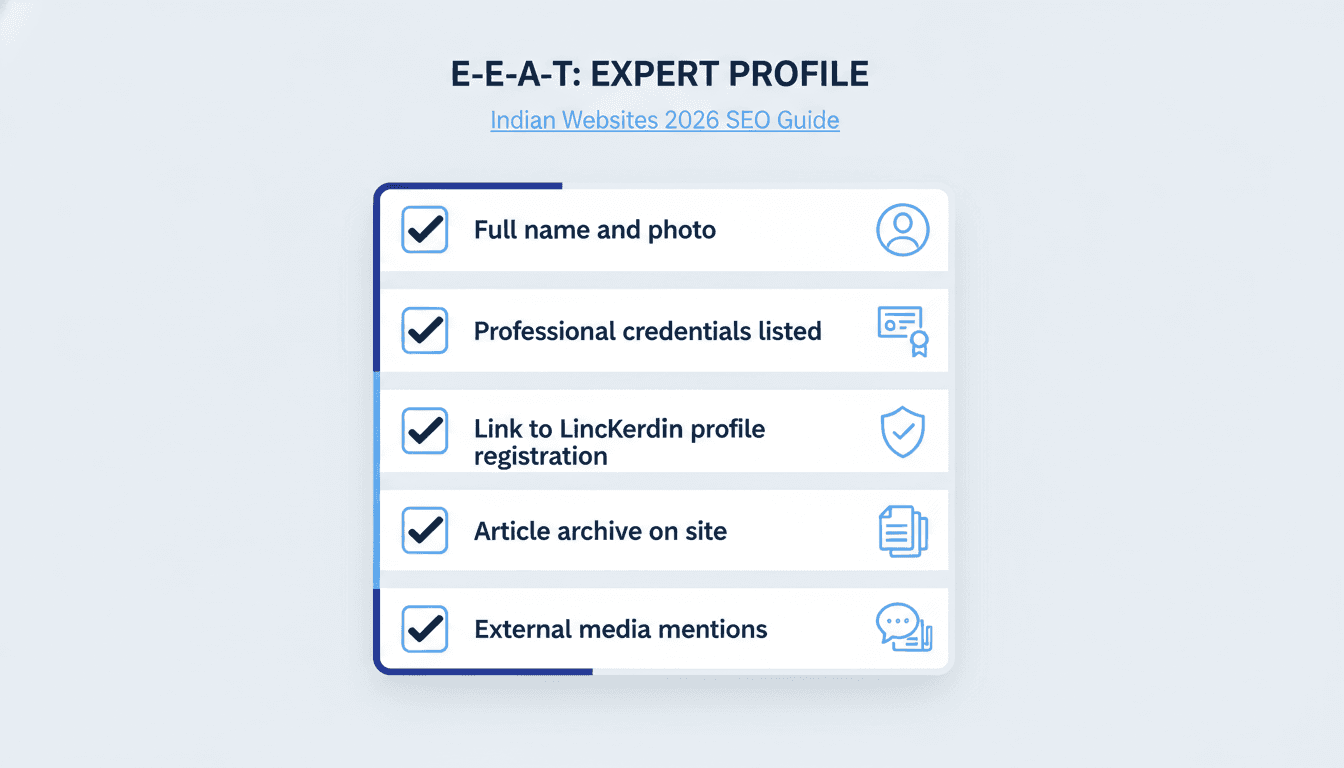
Here is the sequence that works:
- Create a dedicated author archive page for every contributor who writes more than three articles. The URL structure should be
/author/name/and the page should list their full byline, credentials, publication history on the site, and links to external profiles. - Link out to verifiable external profiles. LinkedIn is the minimum. For healthcare writers, link to NMC registration records or hospital profiles. For finance writers, link to SEBI or AMFI advisor listings. For legal authors, link to Bar Council registration pages. These external signals let Google triangulate who the person actually is.
- Add Schema markup to every article. The
Articleschema withauthor.name,author.url, andauthor.sameAsproperties pointing to LinkedIn or professional directories is the structured data signal that feeds directly into how Google understands authorship. Google's structured data documentation covers the exact implementation. - Get the author mentioned elsewhere. A quote in The Economic Times, a byline on a partner site, or a speaker credit at an industry event creates the off-site footprint that makes the author's authority credible. One solid external mention outweighs fifty self-published articles.
The mistake most agencies make here is treating author profiles as an SEO checkbox. They create the page, add a photo, and move on. What actually moves the needle is building the profile over time: more published pieces, updated credentials, genuine external citations. Think of it as building a resume for a person, because that is effectively what you are doing.
For Indian SaaS companies and startups, the founders are often the most credible authors on technical topics. A CTO writing about API security, a product manager writing about UX research, a co-founder writing about fundraising: these carry far more E-E-A-T weight than a generic "content team" byline. If your leadership team is not contributing to the blog, that is a gap worth fixing before you invest in 50 more SEO articles.
Step 2: Prove Local Experience Through India-Specific Content Signals
Knowing how to improve E-E-A-T for Indian websites means understanding that "local experience" is not just a local SEO play. It is an E-E-A-T play. Google's quality raters are instructed to evaluate whether a page demonstrates first-hand experience with its subject. For an Indian audience, that means content that reflects the realities of operating, shopping, investing, or seeking healthcare in India.

Specific signals that demonstrate local experience:
- Case studies with Indian market context. Not "a mid-sized e-commerce brand" but "a D2C apparel brand based in Tiruppur navigating GST reconciliation and COD return rates." The specificity is the signal.
- References to Indian regulations, platforms, and infrastructure. A personal finance article that mentions UPI, NACH mandates, Section 80C, and the EPFO portal is demonstrably written by someone with Indian market experience. One that mentions "tax-advantaged retirement accounts" generically is not.
- Original data from Indian sources. Survey responses from Indian users, screenshots of Indian SERPs, GST invoices in examples, screenshots of Razorpay or PayU dashboards. These primary evidence artifacts are things an AI tool or content farm cannot manufacture.
- Regional language signals where relevant. A food brand covering Tamil Nadu should include Tamil recipe names transliterated accurately. A real estate site covering Hyderabad should use the correct local area names (Gachibowli, Madhapur, Jubilee Hills) rather than generic neighbourhood descriptions.
Content teams often treat this as "localisation" and reduce it to swapping currency symbols and examples. That is not enough. The goal is content that could only have been written by someone embedded in the Indian market. That level of specificity builds trust with readers and, through engagement signals and quality rater evaluation, with Google.
For content audits, our guide on AI content audit tools covers the tools that help you identify which existing articles lack these local signals and need updating.
Step 3: Earn Authority Through Indian Digital PR and Targeted Link Building
Authority, in Google's framework, is essentially reputation. For Indian websites, that reputation needs to be built within the Indian web ecosystem. A backlink from a UK finance site carries less relevance for an Indian personal finance brand than a mention in Mint, The Hindu Business Line, or Moneycontrol.
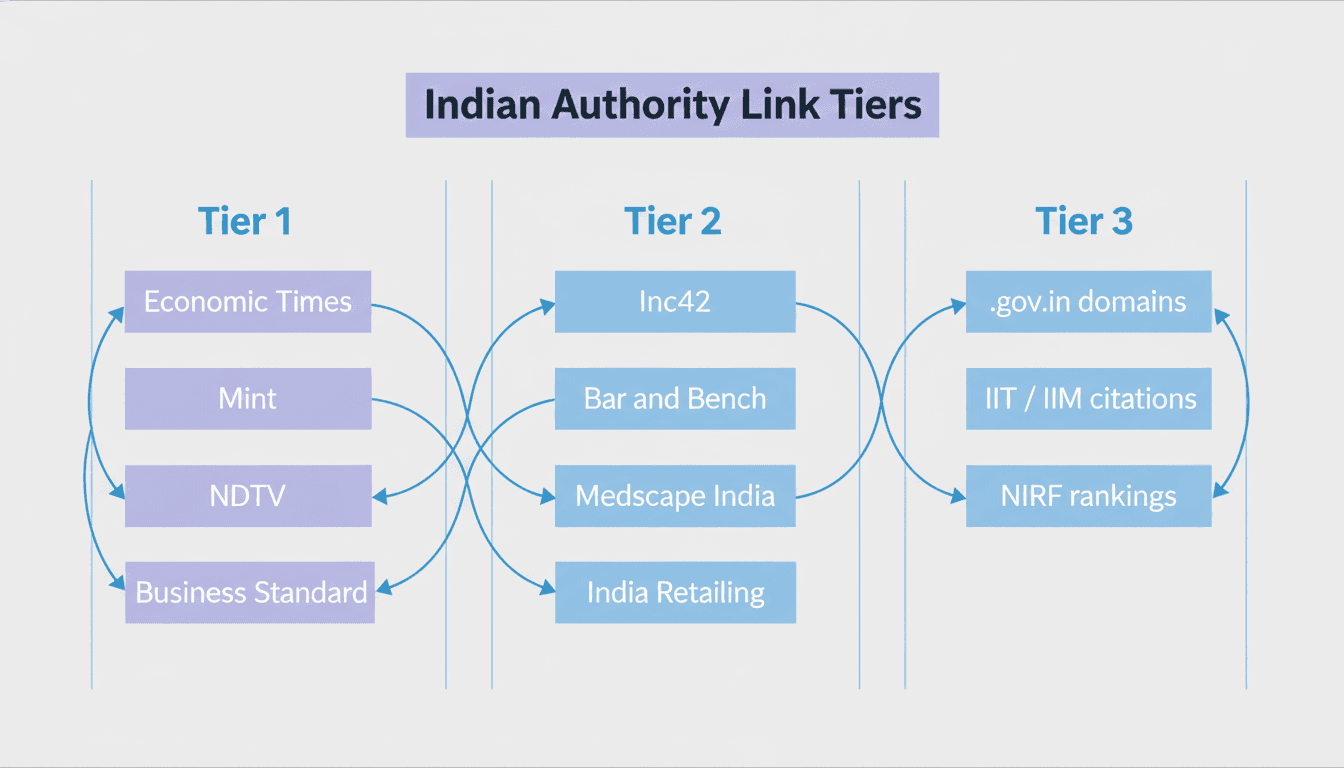
The link-building playbook for Indian authority looks like this:
Tier 1: National Indian media. The Economic Times, Mint, NDTV, Business Standard, The Hindu, Livemint. Getting cited here requires either a data asset (original research, a proprietary survey, a unique dataset) or a strong PR relationship. One link from ET carries more authority signal than 200 links from Indian blog networks.
Tier 2: Industry-specific Indian publications. For fintech: Inc42, Entrackr, VCCircle. For health: Medscape India, Practo Health Library. For legal: Bar and Bench, LiveLaw. For e-commerce: Retailer Association of India, India Retailing. These are harder to reach but highly relevant.
Tier 3: Government and educational institutions. A .gov.in or .ac.in backlink is rare and genuinely powerful. Think PIB mentions, IIT or IIM research citations, NASSCOM reports that reference your data. These take months to earn but anchor your authority credibly.
What does not work in 2026: Indian directory submissions, paid guest posts on private blog networks, links from generic "write for us" sites, and reciprocal link exchanges between sites in unrelated niches. Quality raters have access to the same tools you do. If a link profile looks engineered, it reads as low-trust.
A practical approach for most Indian brands is to start with a digital PR campaign anchored to original research. Commission a survey of 500 Indian consumers on a topic relevant to your industry, publish the findings, and pitch the data to Tier 1 and Tier 2 media. A single well-executed data study can generate 15-30 legitimate editorial links. That moves the authority needle more than a year of generic link building.
For agencies building authority for clients, the SEO services for small business framework we cover elsewhere applies directly here: authority building is a 6-12 month investment, not a monthly deliverable.
How Does Google Evaluate Trustworthiness for Indian E-Commerce and YMYL Sites?
Trustworthiness is the component of E-E-A-T that quality raters check first, because a site can have genuine expertise and still be untrustworthy if it has inaccurate information, hidden ownership, or missing contact transparency. For Indian e-commerce and YMYL sites specifically, the bar is higher and the failure modes are more consequential.
According to Google's helpful content guidance, pages on topics that affect health, financial stability, safety, and civic information receive the most scrutiny. An Indian health supplements brand making unverified claims about Ayurvedic cures, or a fintech app with no disclosed NBFC registration, will struggle regardless of how good its content is.
The trust checklist for Indian sites:
- About page with real ownership information. Company name, CIN (Company Identification Number) if incorporated, founding year, physical address. Not a PO box. A real address that can be verified on Google Maps and MCA21.
- Contact page with functional channels. An email that actually receives responses, a phone number, a chat option. Quality raters test these. If the contact form bounces or the phone goes unanswered, that is a trust failure.
- Privacy policy and terms of service that reflect Indian law. The IT Act 2000 and the Digital Personal Data Protection Act 2023 create specific disclosure requirements. Generic cookie-cutter policies from foreign templates are a red flag.
- Transparent editorial policy for content sites. Who writes the content, what is the review process, how are factual errors corrected. News and health sites especially need this.
- Accurate, up-to-date information. Outdated content on regulated topics (tax slabs, interest rates, drug approvals) signals low trust. A date-stamped last-reviewed notice and a process to update it are non-negotiable for YMYL categories.
For Indian e-commerce specifically, the trust signals that convert and rank overlap almost entirely: reviews with verified buyer badges, clear return policies linked from product pages, and visible registration under the Consumer Protection (E-Commerce) Rules 2020. Legal compliance is E-E-A-T compliance.
Step 4: Technical Trust Signals Indian Sites Consistently Underinvest In
These are the signals that take less than a week to fix and still appear on quality rater evaluations. Missing them costs trust points that content alone cannot recover.
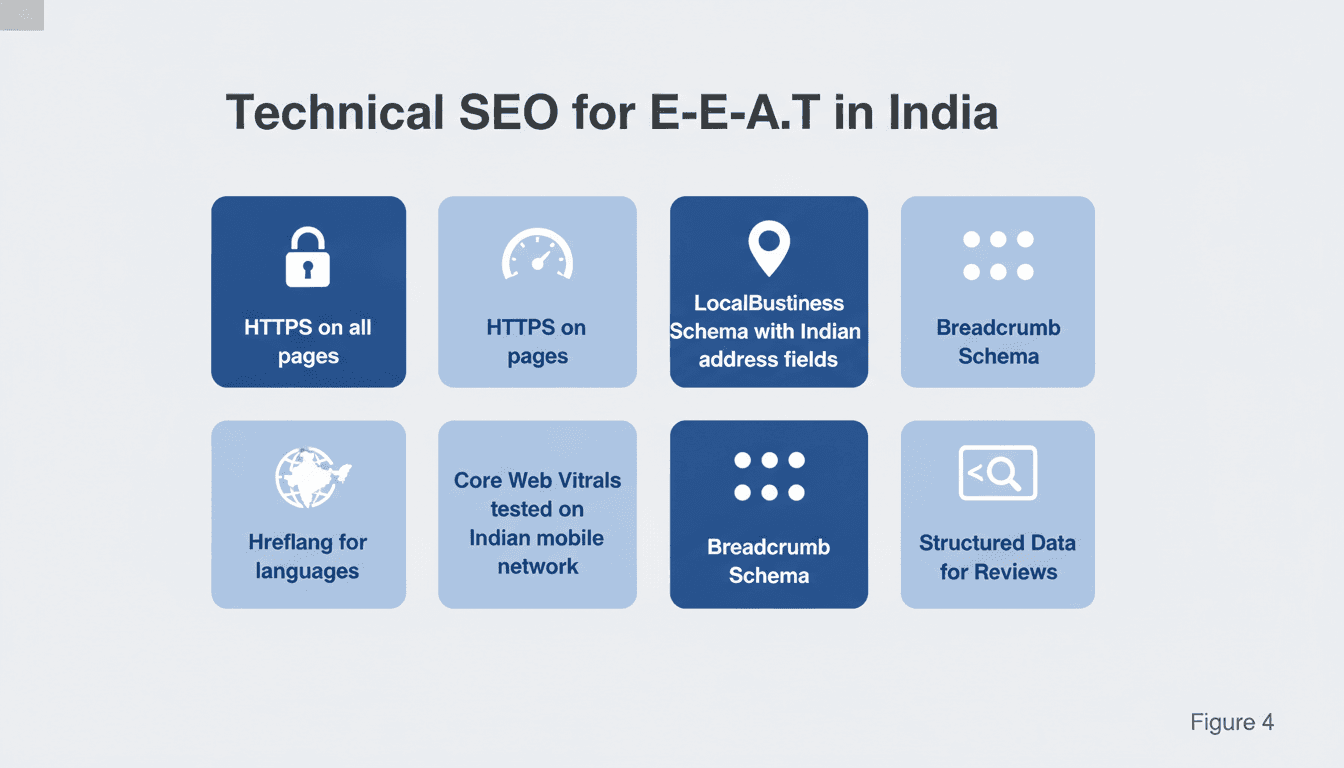
HTTPS everywhere. This is table stakes in 2026, yet a surprising number of Indian SME sites still serve HTTP on interior pages after an incomplete SSL migration. Run a crawl with any standard SEO tool and fix every mixed-content warning.
Structured data for LocalBusiness. If you serve a geographic area in India, the Schema.org LocalBusiness markup with addressRegion, addressLocality, geo, and openingHours properties tells Google's systems exactly what you are and where. This is especially critical for multi-city service businesses: a chartered accountancy firm with offices in Mumbai, Pune, and Ahmedabad should have separate LocalBusiness entities for each location.
Core Web Vitals tuned for Indian network conditions. The average Indian mobile user in 2025 connects on a 4G network with latency that would make a European developer wince. Google's own Chrome User Experience Report shows that LCP scores for Indian mobile users are consistently worse than desktop benchmarks. Optimise images with WebP, defer non-critical JavaScript, and test your Core Web Vitals from an Indian IP address using PageSpeed Insights, not just from a US server.
Breadcrumb schema and SiteLinks. These visual trust signals in the SERP tell users and Google that your site has clear, navigable structure. Breadcrumb markup is a 30-minute implementation that pays off in click-through rates and quality evaluation.
For a tool stack that covers these technical checks without overpaying, our guide to SEO tools for Indian startups covers the right options at each budget tier.
Step 5: User Experience Signals That Feed E-E-A-T Indirectly
Google does not use engagement metrics like bounce rate or time-on-page as direct ranking signals. That said, user experience optimization in India matters for E-E-A-T because poor UX causes users to abandon pages before the content can demonstrate its quality. A quality rater who lands on a page with interstitial pop-ups, auto-playing audio, and a 6-second load time will rate the page low before they read a word.
The UX improvements that matter most for Indian audiences in 2026:
Language and script choice. India has 22 scheduled languages and over 780 dialects. The decision to serve content in English, Hindi, or a regional language is a content strategy decision with direct E-E-A-T implications. A website that correctly serves Tamil speakers in Tamil Nadu with translated content written by native speakers demonstrates experience and expertise that a pure-English site cannot. If multilingual content is on your roadmap, prioritise depth over breadth: one excellent Hindi section outperforms ten poorly translated regional pages.
Mobile-first layout for low-literacy design patterns. A significant portion of first-time Indian internet users are mobile-native with limited experience navigating complex UIs. Navigation that relies on icon recognition rather than text labels, and CTAs placed above the fold, reduce friction for this segment without degrading the experience for sophisticated users.
Page experience for AI-generated overviews. As AI Overviews increasingly surface in Indian SERPs (they now appear for a growing share of English-language queries in India), content structure affects whether your page gets cited. Our guide on how to rank in Google AI Overviews covers the specific formatting signals that improve AI citation rates, which overlap significantly with E-E-A-T best practices.
Clear ad and affiliate disclosure. Indian users are increasingly sceptical of undisclosed commercial relationships after a wave of influencer controversies and fake review scandals. ASCI guidelines and the Advertising Standards Council of India require clear disclosure of paid promotions. Compliance here is both a legal requirement and a trust signal that quality raters specifically look for.
How to Measure E-E-A-T Progress Over Time
E-E-A-T improvement is not measured by a single metric. It is a composite of signals that manifest as ranking changes, traffic growth, and brand mention volume over 3-12 months. Here is a practical measurement framework:
Monthly tracking:
- Branded search volume (Google Search Console, query filter: brand name). Growing branded queries indicate growing recognition.
- Author page impressions and clicks. If author pages start ranking for the author's name, that is a Google confirmation that the entity is being recognised.
- Backlink acquisition from Tier 1 and Tier 2 Indian sources (Ahrefs or Semrush, filtered by referring domain authority and geography).
Quarterly tracking:
- Ranking movement for YMYL queries where E-E-A-T matters most. If your health or finance content climbs in quarters 2-4 after E-E-A-T improvements, the correlation is meaningful.
- Core Web Vitals pass rate in Search Console's Page Experience report, segmented by mobile.
- Number of articles with complete author profiles versus unattributed content.
What success looks like at 6 months: An Indian fintech blog that implements all five steps described here should see branded search volume increase by 20-40%, a measurable improvement in average position for informational YMYL queries, and at least 5-10 new editorial backlinks from credible Indian media. These are realistic, not guaranteed, but they are the signals that validate the work.
One thing most E-E-A-T guides miss: the correlation between E-E-A-T improvements and AI search citation rates. As Perplexity, ChatGPT, and Google's AI Overviews pull answers from trusted sources, websites with strong E-E-A-T signals are disproportionately cited. Understanding how AI search evaluates source credibility is now inseparable from understanding E-E-A-T. They are the same problem from two angles.
Frequently asked questions
What is E-E-A-T and why does it matter specifically for Indian websites?
E-E-A-T stands for Experience, Expertise, Authoritativeness, and Trustworthiness. It is the framework Google uses to assess page quality, particularly for YMYL topics. Indian websites face additional scrutiny because the Indian internet has a high volume of low-quality, duplicate, and unattributed content, making differentiation through genuine E-E-A-T signals more impactful than in many other markets.
How long does it take to improve E-E-A-T signals on an Indian website?
Technical trust fixes (HTTPS, schema, About and Contact pages) show impact within weeks. Author profile building and content quality improvements influence rankings over 3-6 months. Authority signals from earned media and editorial backlinks compound over 6-12 months. Treating E-E-A-T as a 90-day campaign rather than an ongoing programme is the most common strategic mistake.
Does writing content in Hindi or regional Indian languages affect E-E-A-T?
Yes, positively, when done correctly. Content written by native speakers in Hindi, Tamil, Telugu, or other Indian languages can demonstrate genuine local experience and expertise that English-only content cannot. The key condition is quality: a poorly translated Hindi article scores lower than a well-written English equivalent. Native-language content should be produced by qualified contributors with documented expertise in the relevant language.
Do government website backlinks (.gov.in) actually improve E-E-A-T for Indian sites?
Government-domain links are among the most authoritative backlinks available in the Indian web ecosystem. A .gov.in citation confirms that a credible public institution considers your content or data worth referencing. They are genuinely difficult to earn and cannot be manufactured, which is exactly what makes them valuable. PIB citations, NIC-linked resources, and Ministry-level references all carry significant authority weight.
Is E-E-A-T a direct ranking factor in Google's algorithm for Indian SERPs?
E-E-A-T is not a single algorithmic signal with a score Google directly reads. It is a quality framework that informs how Google's systems, trained partially using quality rater feedback, evaluate pages. Improving E-E-A-T improves the underlying signals (author entity recognition, link quality, content accuracy, technical trust) that the algorithm does measure directly. The distinction matters because there is no "E-E-A-T score" to optimise, but there are specific, measurable actions that move the underlying signals.
Which Indian websites are considered high E-E-A-T references by Google?
In the finance vertical: Moneycontrol, The Economic Times, Mint, and Cleartax are consistently cited in AI Overviews and quality rater training examples. In health: AIIMS official pages, Practo's clinical content, and Apollo Hospitals' health library. In legal: Bar and Bench, LiveLaw. These sites share three traits: named, credentialed authors; consistent editorial standards; and substantial editorial backlink profiles from other credible Indian sources.
How does E-E-A-T affect local SEO rankings in India for service businesses?
For local service businesses, E-E-A-T and local SEO overlap significantly. A chartered accountant in Chennai with a verified Google Business Profile, consistent NAP citations, client reviews on Google Maps, and a website with accurate LocalBusiness schema and a credentialed About page outranks a competitor with better content but weaker trust signals. Local E-E-A-T is about proving you are a real, verified, accountable business operating in a specific Indian geography.
Key Takeaways
- E-E-A-T improvement for Indian websites starts with author transparency: named, credentialed contributors with external-facing profiles are the highest-leverage first step.
- Local experience signals (Indian regulations, platforms, geographic specifics, original Indian market data) differentiate content that generic AI tools and content farms cannot replicate.
- Authority is built through Tier 1 Indian media citations and editorial backlinks, not directory submissions or paid placements.
- Technical trust (HTTPS, schema, transparent About/Contact pages, DPDPA-compliant policies) is the floor, not the ceiling. Quality raters check it first.
- E-E-A-T and AI search citation rates are now linked: pages that score high on E-E-A-T factors are disproportionately cited in AI Overviews and LLM answers.
- Measurement requires a 6-12 month horizon. Branded search volume, author entity recognition, and editorial backlink acquisition are the leading indicators.
- The Indian YMYL categories (finance, health, legal, news) face the highest quality rater scrutiny and return the highest ranking upside when E-E-A-T is genuinely improved.
Building a credible, authoritative presence in Indian search is not a one-time project. It is a compound investment that gets cheaper per result over time as your author entities, backlink profile, and content quality accumulate. If you want a clear-eyed assessment of where your site stands today and a prioritised roadmap to fix the gaps, book a consultation with the Project Rankup team. We work specifically with Indian and India-focused brands to build E-E-A-T strategies that earn rankings and AI citations, not just traffic spikes.