Helpful content, in Google's terms, is content made primarily to benefit people rather than to manipulate search rankings. It answers the reader's real question, adds something the other results do not, and makes clear who wrote it, how and why. Google ran a separate "helpful content system" from 2022, then folded it into its core ranking systems in March 2024, so the standard now applies on every core update.
Most guides still describe the helpful content update as a separate event that can "hit" a site. It no longer is. What survives is Google's list of self-assessment questions, so this guide spends most of its length on them: what they ask, what Google added in October 2026, and how to apply them to a sample page, line by line.
What does Google mean by helpful content?
Google's page on the subject is titled Creating helpful, reliable, people-first content, and its first sentence sets the frame: Google's ranking systems are designed to prioritize "helpful, reliable information that's created to benefit people, and not content that's created to manipulate search engine rankings."
Each of the three words in that title does a separate job.
- Helpful means the reader gets what they came for. Google's test is whether someone will "leave feeling they've learned enough about a topic to help achieve their goal".
- Reliable means the facts hold up and the reader can see why they should trust them: sourcing, an author with real knowledge, no easily checked errors.
- People-first is about intent. Google defines it as content "created primarily for people, and not to manipulate search engine rankings."
The opposite is search engine-first content. That does not mean any page that uses SEO, which Google says is fine when applied to people-first content. It means pages that exist mainly to attract search visits: a trending topic the site has no reason to cover, a thin rewrite of the top three results, a "2026 update" that changed nothing but the date.
A quick way to tell the two apart is to imagine the page with no search engine at all. If your existing customers would still want to read it when they came to your site directly, it passes the intent test. If the only reason it exists is a keyword tool, it probably does not.
What was the helpful content update?
The helpful content update was a ranking change Google announced on 18 August 2022 to reduce content "primarily created for ranking well in search engines rather than to help or inform people." It started with English searches, expanded to all languages that December, and was refined twice more before Google merged it into its core ranking systems in March 2024.
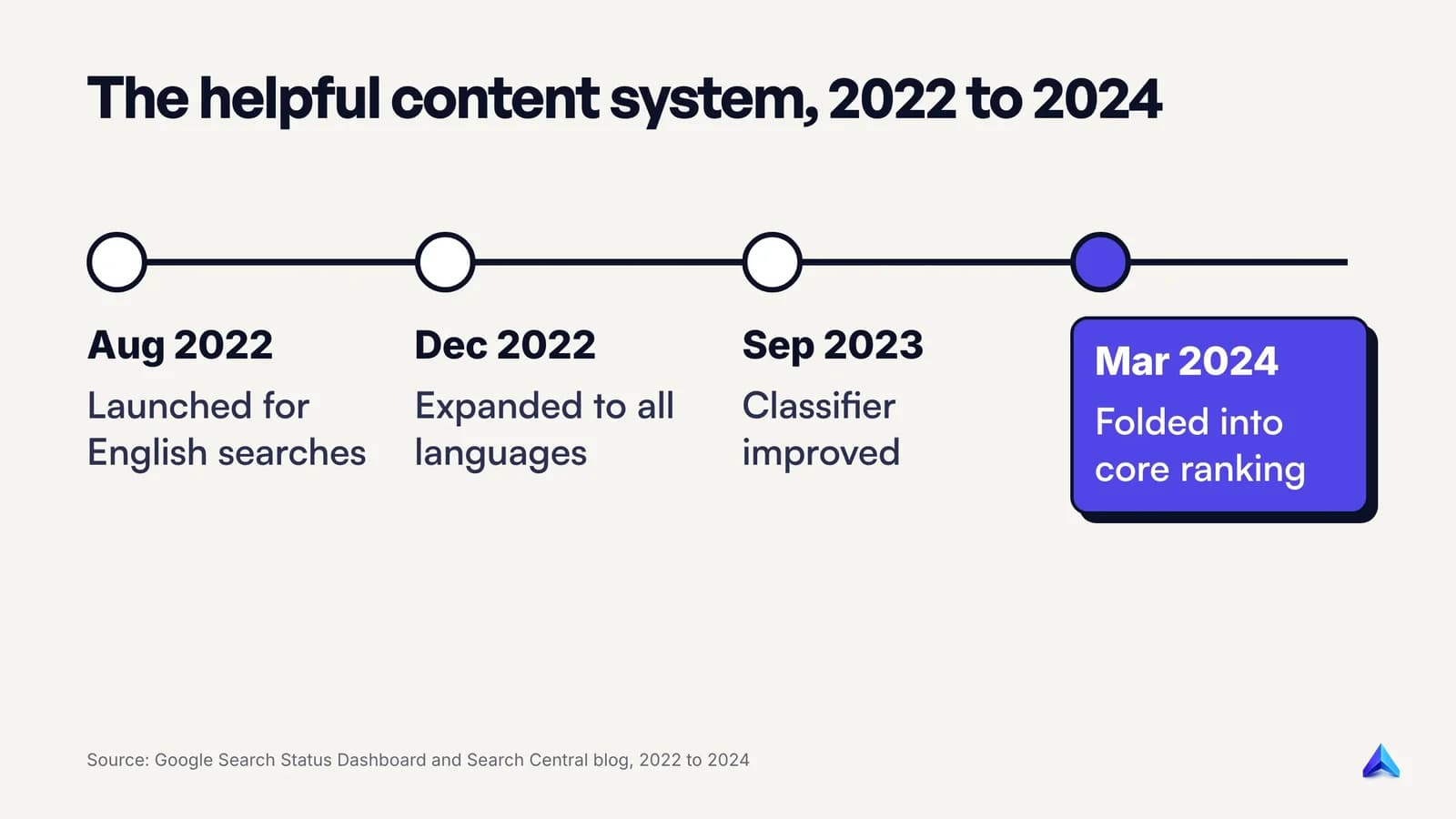
The dates come from Google's announcements and its Search Status Dashboard.
| Date | What happened | What Google said it did |
|---|---|---|
| 18 Aug 2022 | Announced | A new "helpful content update", English users first |
| 25 Aug to 9 Sep 2022 | First rollout | Introduced a site-wide signal from a machine-learning classifier |
| 5 Dec 2022 to 12 Jan 2023 | Second update | Improved the classifier; "works across content globally in all languages" |
| 14 to 28 Sep 2023 | Third update | "Improves our classifier" |
| 5 Mar to 19 Apr 2024 | March 2024 core update | Helpfulness assessment moved into core ranking; "no longer one signal or system" |
The 2022 version worked in a way that shaped how SEOs still talk about it. In its original announcement for creators, Google described "a new site-wide signal" and warned that "any content", not only the unhelpful pages, on a site with "relatively high amounts of unhelpful content overall is less likely to perform well." That is why the update felt like a penalty to many site owners: good pages fell alongside weak ones.
Google was careful to say it was not one. The classifier was "entirely automated, using a machine-learning model. It is not a manual action nor a spam action." There was no Search Console message and nothing to appeal.
What changed when it became part of core ranking?
Since March 2024 there has been no separate helpful content update to watch for. Google's ranking systems guide lists the helpful content system under "Retired systems" and says that in March 2024 "it evolved and became part of our core ranking systems." Even the old helpful content FAQ URL now redirects to that guide.
Three practical things follow.
Helpfulness is judged on every core update. Core updates happen several times a year. A site that would once have waited for the next helpful content refresh now gets reassessed whenever the core systems update, including smaller core updates Google does not announce.
It is no longer one signal. Google's March 2024 post for creators said: "There's no longer one signal or system used to do this." The ranking systems guide now describes the systems as working "on the page level", while adding that "site-wide signals and classifiers are also used." A large block of weak pages can still drag on a site, but there is no longer a single on/off label.
The effect was large. When Google announced the March 2024 core update, it expected the change, together with its earlier work, to cut low-quality, unoriginal content in results by 40%. After the rollout finished on 19 April, Google reported the final figure: "45% less low-quality, unoriginal content in search results versus the 40% improvement we expected."
The same day, Google introduced new spam policies, including scaled content abuse. That is a different mechanism: spam policies can lead to manual actions with a notice in Search Console, while helpfulness is judged by ranking systems with no notice at all. Spam updates also run on their own schedule, as the September 2026 spam update did.
Google's self-assessment questions, explained
Google publishes four sets of questions on its helpful content page, plus a "Who, How, and Why" framework. In three of the sets, a yes is good. In the fourth, a yes is a warning sign. Mixing those up is the most common way people misread the list.
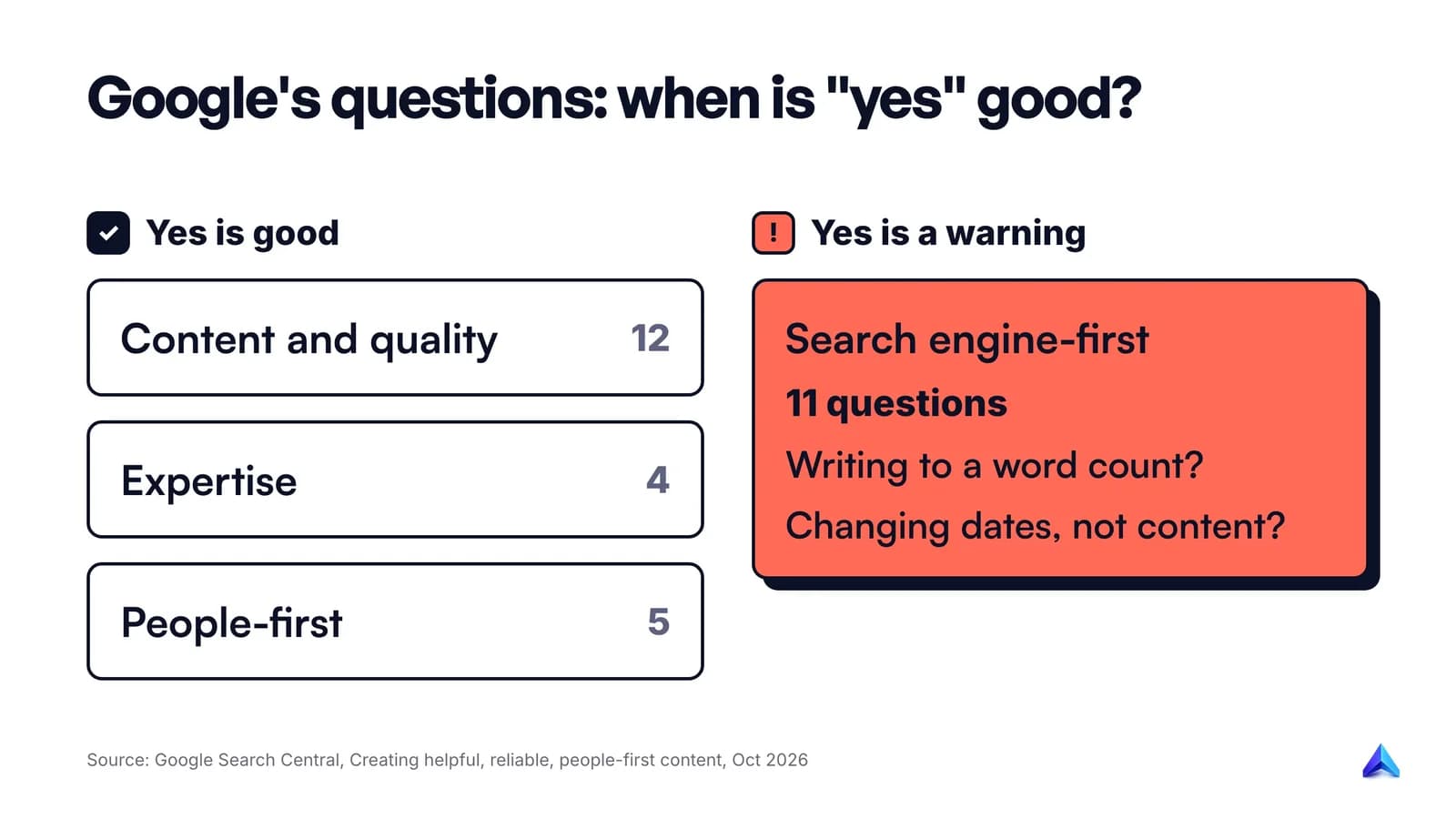
Content and quality (12 questions)
These ask whether the page is original and complete. The ones that do the most work in practice:
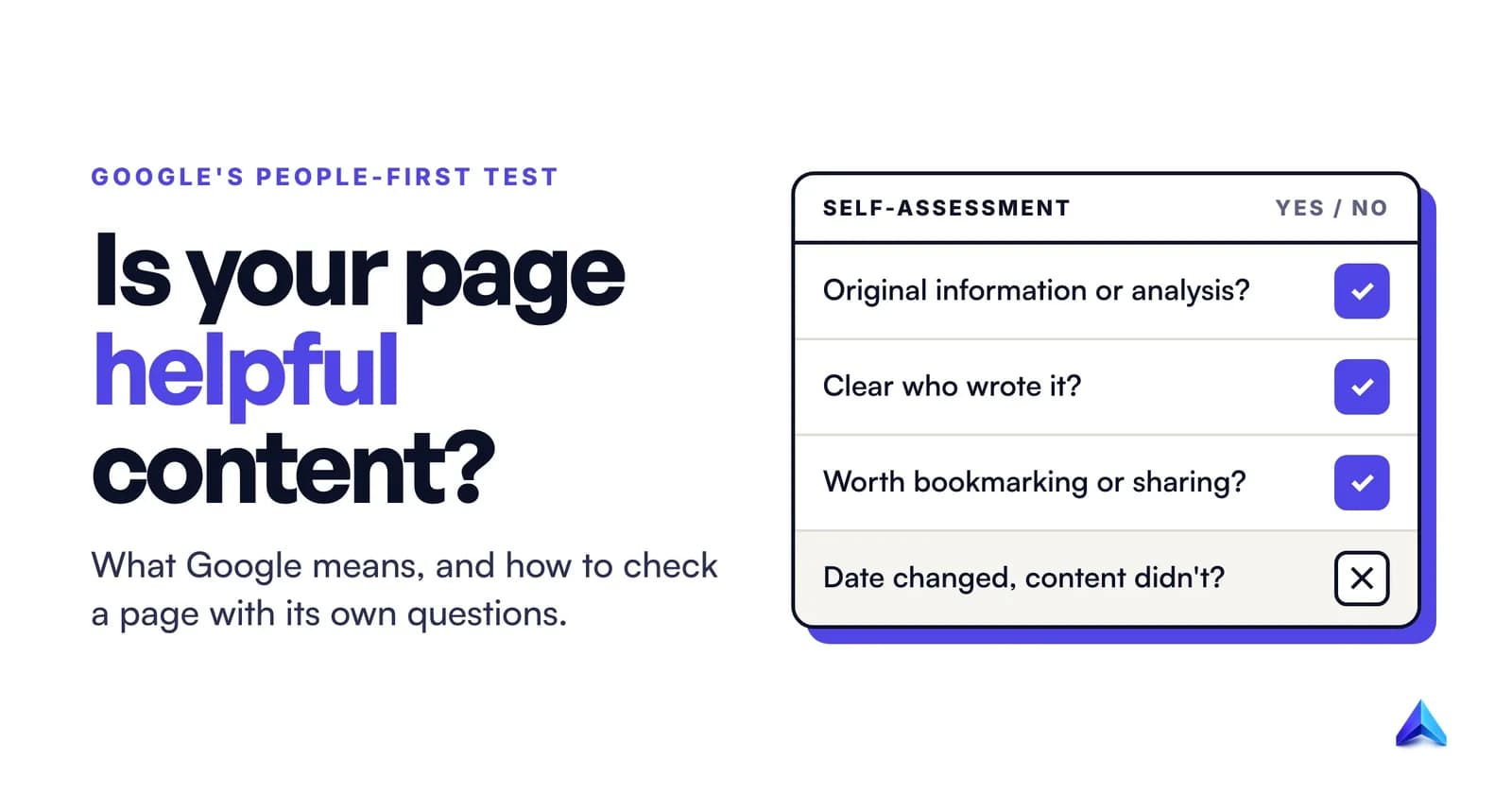
- "Does the content provide original information, reporting, research, or analysis?"
- "Does the content provide substantial value when compared to other pages in search results?"
- "Does the main heading or page title avoid exaggerating or being shocking in nature?"
- "Is this the sort of page you'd want to bookmark, share with a friend, or recommend?"
The comparison question matters most. A page can be accurate and well written and still add nothing to what already ranks. That gap has a name, information gain, and it is usually the reason a decent page sits on page two.
Expertise (4 questions)
These ask whether a reader has reason to trust the page: clear sourcing, an author or site with background in the topic, and no "easily-verified factual errors". They map onto E-E-A-T, which Google says is not a specific ranking factor; of its four parts, "trust is most important." Our guide to improving E-E-A-T for Indian websites covers the trust signals in detail.
People-first (5 questions)
These are about purpose. Do you have an audience that would find the page useful if they came to you directly? Does it show "first-hand expertise", such as having actually used the product or visited the place? Does the site have a primary focus? Will the reader leave satisfied?
Search engine-first (11 warning signs)
Google says that "answering yes to some or all of the questions below is a warning sign." The list includes:
- Producing lots of content on many different topics in the hope that some of it ranks.
- "Mainly summarizing what others have to say without adding much value".
- Writing about trending topics you would not otherwise cover for your audience.
- Leaving readers "feeling like they need to search again".
- Writing to a word count because you heard Google prefers one.
- Changing page dates to look fresh "when the content has not substantially changed".
Who, How and Why
Google closes with three questions about the page as a piece of work. Who wrote it: is authorship self-evident, is there a byline where readers would expect one, and does it lead to more about the author? How was it made: for a product review, how many products were tested and how; if automation was used substantially, is that disclosed and explained? Why does it exist? Google calls "Why" "perhaps the most important question to answer about your content."
What Google added in October 2026
Google revised the page on 5 October 2026. Comparing it with an archived copy from 1 October shows two additions worth knowing.
The first is a "Main content" section. It lists four attributes that Google's search quality raters are trained to evaluate: effort, originality, talent or skill, and accuracy. The effort definition is pointed. It names "using generative AI to produce large amounts of text without manual oversight or curation" as an example of "little to no effort", and adds that "attribution or giving credit to other sources doesn't replace the need for original effort."
The second is a warning about fake authors. "Fabricating creator profiles (such as by using AI-generated headshots, made-up names, or false credentials to make content appear as if it was written by human experts) is a form of deception," the page now says, and deception makes a page "untrustworthy to both users and our automated quality systems." If a vendor has given your blog an invented "expert" with a stock headshot, remove the profile.
A worked self-assessment of a sample page
Question lists are easy to agree with and hard to apply. So here they are applied to a page we made up for this exercise, a composite of patterns common on small-business blogs.
The page: "GST Registration: The ULTIMATE Guide (Updated October 2026)" on the blog of a fictional accounting-software company in Pune. It is 2,400 words, bylined "Admin", and the "Updated" date changes on the first of every month. It opens with three paragraphs on how GST changed Indian business before reaching the steps. The steps restate the government portal's help pages without screenshots. It ends with "Contact us for hassle-free GST registration". The same blog has 38 near-identical pages: "GST registration in Nagpur", "GST registration in Nashik" and so on.
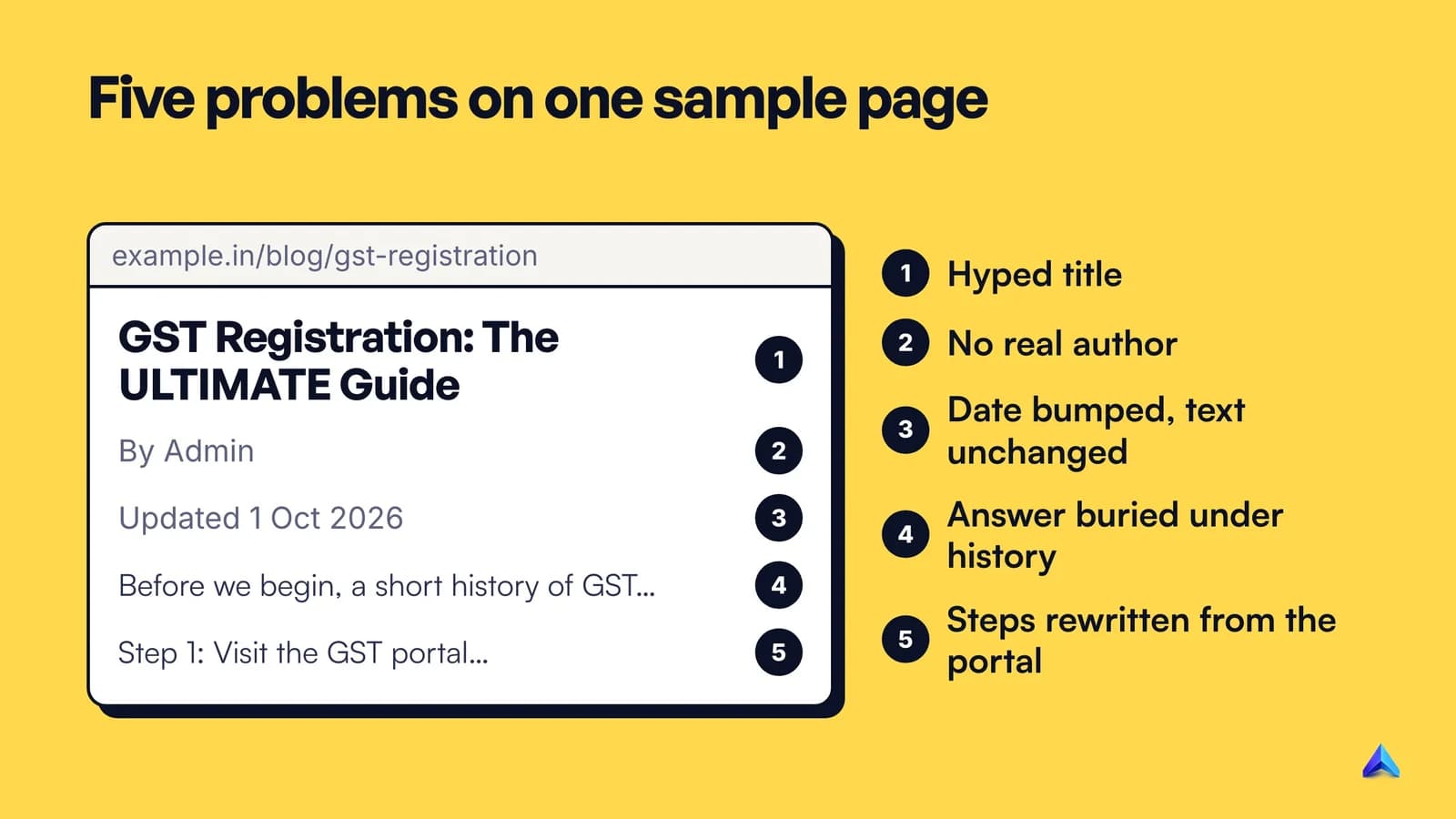
| Google's question | What the page does | Verdict | Fix |
|---|---|---|---|
| Does the title avoid exaggerating? | "ULTIMATE" in capitals, plus a date in the title | Fail | "How to Register for GST: Steps, Documents and Common Rejections" |
| Is it self-evident who authored the content? | "Admin" with no author page | Fail | Real name of the person who wrote or reviewed it, linked to a bio with their qualification |
| Changing dates without substantial change? | Date moves monthly, text has not changed since 2024 | Fail | Show the date of the last real edit and say what changed |
| Original information, research or analysis? | Steps paraphrased from the portal's help pages | Fail | Add what only a practitioner knows (see below) |
| Substantial value compared with other results? | Same steps as every other result, less clearly | Fail | Lead with the steps; add a document checklist and rejection reasons |
| Will readers need to search again? | No answer on what to do when an application is queried | Partial | Add a section on queries and how to reply to them |
| Lots of content on many topics hoping some ranks? | 38 city pages with only the city name changed | Fail | Merge into one page; keep a city page only if it has genuinely local content |
| Primary purpose or focus? | Accounting software for small firms; GST is on-topic | Pass | None |
| Existing audience who would find it useful? | Its customers do register for GST | Pass | None |
| Easily verified factual errors? | Not checked by anyone since 2024 | Unknown | Have a qualified accountant check it before republishing |
Two passes out of ten does not mean deleting the page. The two passes matter most for a rescue: the topic fits the business, and real customers need it. Everything that fails is fixable by people who know the subject.
What the rewrite needs
The table's fixes mostly remove things. The harder part is adding what no other result has, which means asking the people who do the work:
- What actually goes wrong. A support team that answers GST questions every week knows which documents get rejected and which portal steps confuse first-timers. The portal's help pages do not say that.
- Evidence of the "How". Screenshots of the real portal screens, taken by the author, sensitive fields blurred.
- An answer in the first paragraph. Who needs to register and what the process involves, before any history. Searchers already know what GST is.
- A proper byline. A named chartered accountant who reviewed the page and checked every figure, with a short bio.
- An honest ending. One line pointing to the product's GST invoicing feature is fine because it is related. "Hassle-free" adds nothing.
Nothing on the list adds words or keywords. The finished page will probably be shorter than 2,400 words, and better for it.
How to run the check across a whole site
After a sustained drop, Google's advice is to look at "your site overall (not just individual pages)". This is the order we would work in.
- Confirm the drop is real and dated. In Search Console, compare a week after the core update finished with the week before it started. Google's core updates documentation recommends waiting "at least a full week after a core update completes". Our Google Search Console guide covers the comparison view.
- Separate small drops from large ones. Google's examples: falling from position 2 to 4 needs no drastic action; falling from 4 to 29 calls for a deeper assessment.
- Review the most affected pages first, question by question, as in the example above.
- Look for patterns across pages. Twenty city pages, a tag archive, an old guest-post section, AI drafts published without review: the problem is usually one or two templates, not hundreds of separate pages.
- Get an outside reader. Google suggests asking people "you trust but who are unaffiliated with your site" for an honest assessment.
- Fix, merge, and only then delete. Google calls deletion "a last resort", though wanting to delete whole sections is itself a sign they were made for search engines.
- Give it months, not days. Recognition "could take several months", sometimes until the next core update.
Step 3 is slow on a large blog, so let a tool do the first pass. We compared options in our guide to AI content audit tools; Project Rankup's Content Audit, for one, scores a URL for content quality and lists issues in plain language, giving you a shortlist for a human review. Treat any score as a prompt to look, not a verdict: Google says third-party tools "don't have access to our internal ranking data."
Pages Google never indexed are a separate problem, though "crawled, currently not indexed" is often the same quality judgement arriving earlier.
What the helpful content guidance does not say
Much advice attributed to the helpful content update is folklore. Google's own pages contradict these four claims.
"AI content is not helpful content." Google's position since February 2023 has been that it rewards "high-quality content, however it is produced", and its guidance on AI-generated content says "appropriate use of AI or automation is not against our guidelines." What it objects to is automation used mainly to manipulate rankings, and large volumes of AI text published without oversight, which the October 2026 revision now names as low effort.
"Longer is more helpful." The search engine-first list includes writing to a word count, followed by Google's own aside: "No, we don't." Length should follow the question. Our guide to writing a blog post for SEO goes through how to decide what a post needs.
"Mass updates make a site look fresh." Adding or removing lots of content to make a site "seem fresh" is on the warning list too, with the answer: "No, it won't."
"You have been hit by the helpful content update." Not since March 2024. A drop after a core update can still be about helpfulness, but core systems weigh much else too. Check the timing against Google's list of ranking updates first.
Frequently asked questions
Is the helpful content update still running?
No, not as a separate update. Google's ranking systems guide lists the helpful content system as retired and says it became part of the core ranking systems in March 2024. Helpfulness is now assessed during core updates, which happen several times a year, and during smaller core updates that Google does not announce.
What makes content helpful?
Content is helpful when a reader leaves with enough to achieve the goal they searched for, without needing another search. In practice that means answering early, adding information or experience other results lack, getting facts right, and making clear who wrote it. Google's self-assessment questions are the most direct checklist for it.
How long does it take to recover from a helpful content drop?
Google says some improvements show within days, but it can take several months for its systems to confirm that a site as a whole now produces helpful content. If nothing changes after a few months, the effect may only arrive with the next core update. There is no reconsideration request, because it is not a manual action.
Does Google penalise AI-written content?
Not for being AI-written. Google says appropriate use of AI is not against its guidelines. It does act against automation used mainly to manipulate rankings, and its October 2026 guidance describes large amounts of AI text published without human oversight as showing little effort. Disclose AI use where a reader would expect to know.
Who should do a helpful content self-assessment?
Ideally someone who knows the subject but did not write the page. Google suggests asking people you trust who are unaffiliated with your site. An internal editor works if they read as a customer would, with the search results for the same query open beside the page.