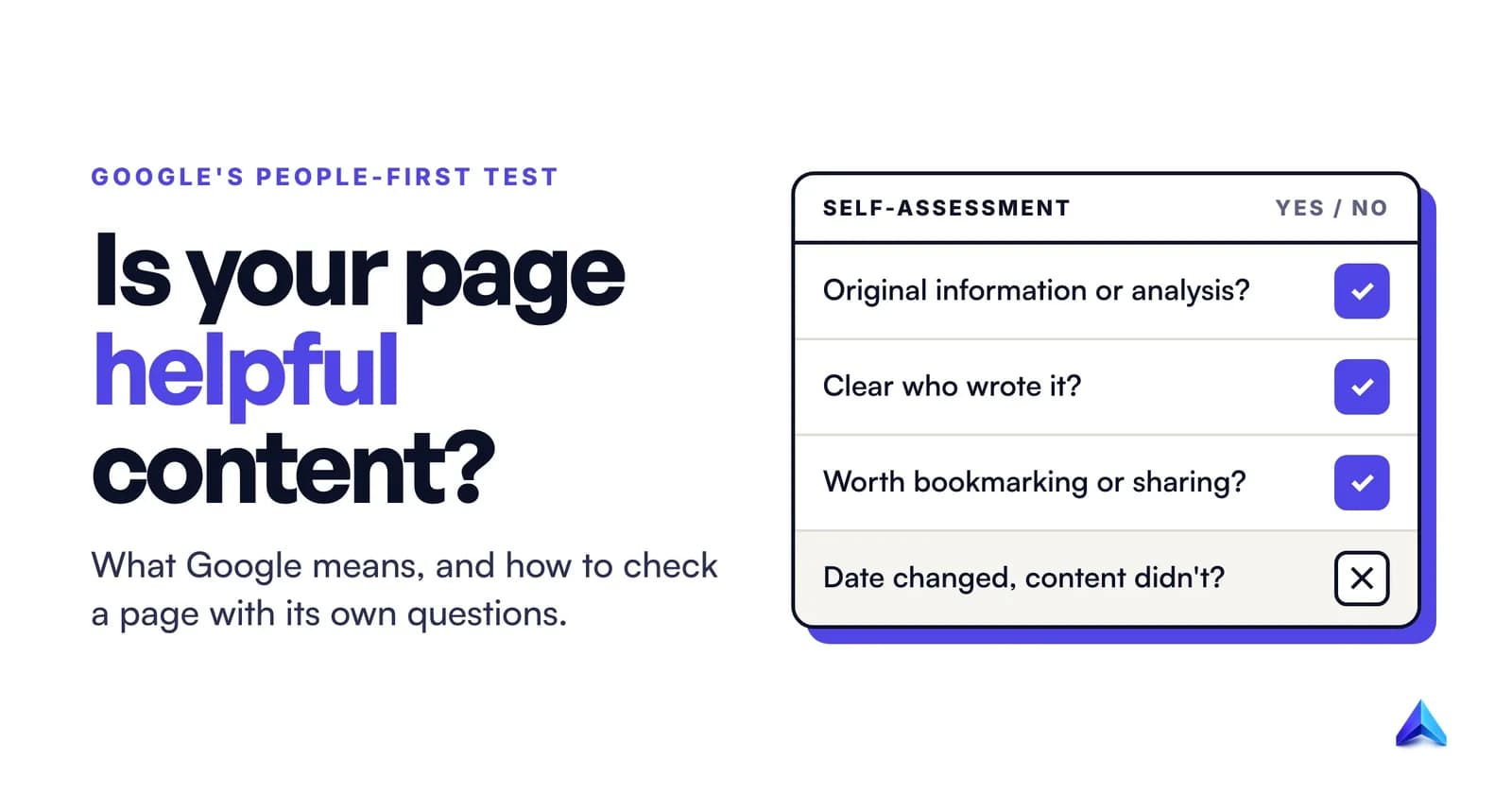
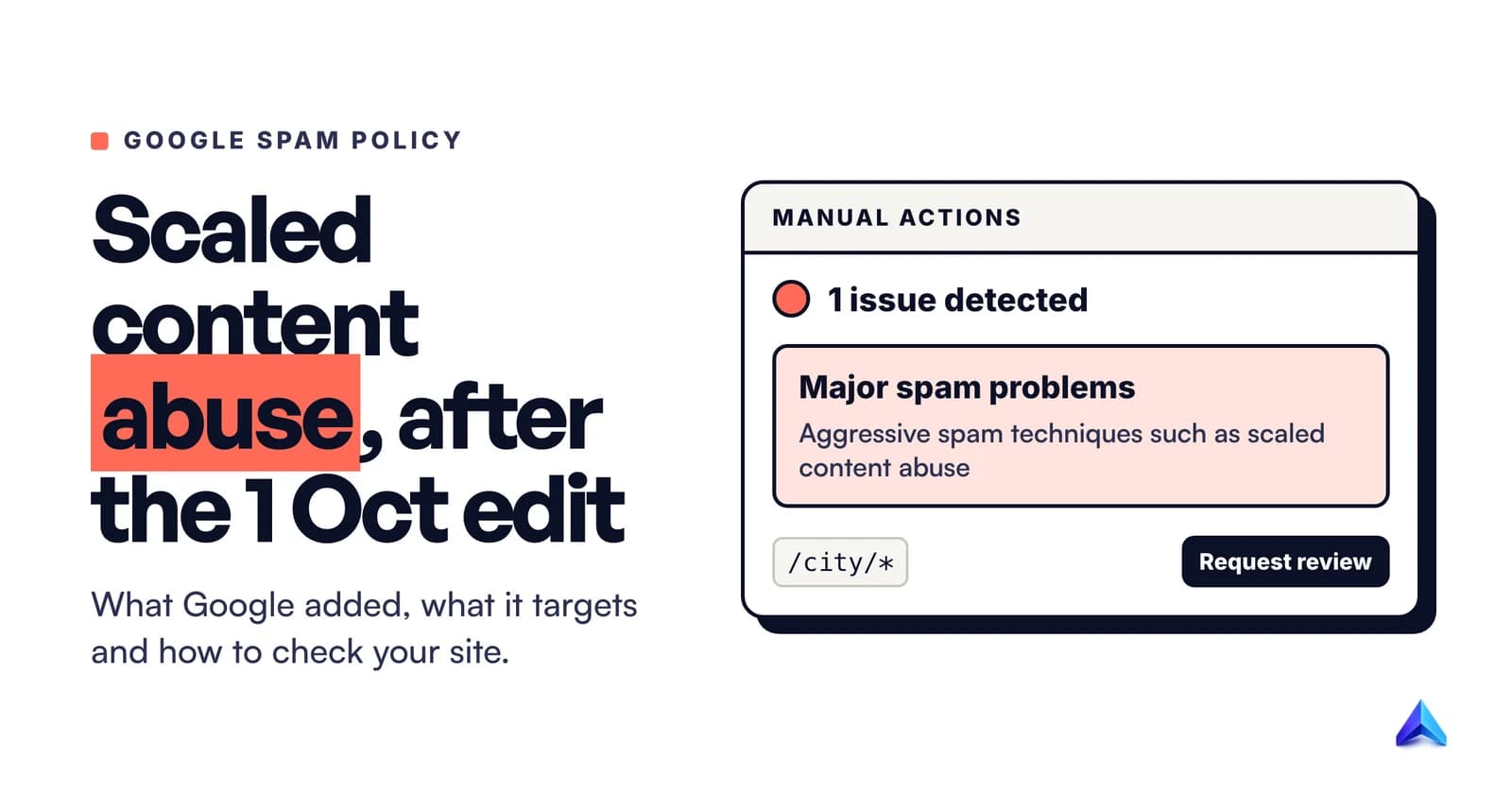
On 1 October 2026, Google updated its guidance on using generative AI content to say that AI output can hallucinate and that "it is critical to manually factcheck and review all AI-generated content" before publishing. The same page warns that generating many pages without adding value may violate Google's spam policy on scaled content abuse: mass-producing pages mainly to manipulate rankings, however they were made.
The edit is small, but it is the clearest statement yet of where Google draws the line for teams that publish with AI tools. Below: exactly what changed, what the policy covers in Google's words, how raters are told to spot it, how to check your own programme, and what to do if a site is already hit.
What changed on 1 October 2026
Google's documentation updates log has a 1 October entry headed "Updated guidance on using generative AI content". It says the guide was updated "with information from the Search Quality Raters guidelines", and gives the reason: "To get our documentation in sync with our presentations we use at our developer events."
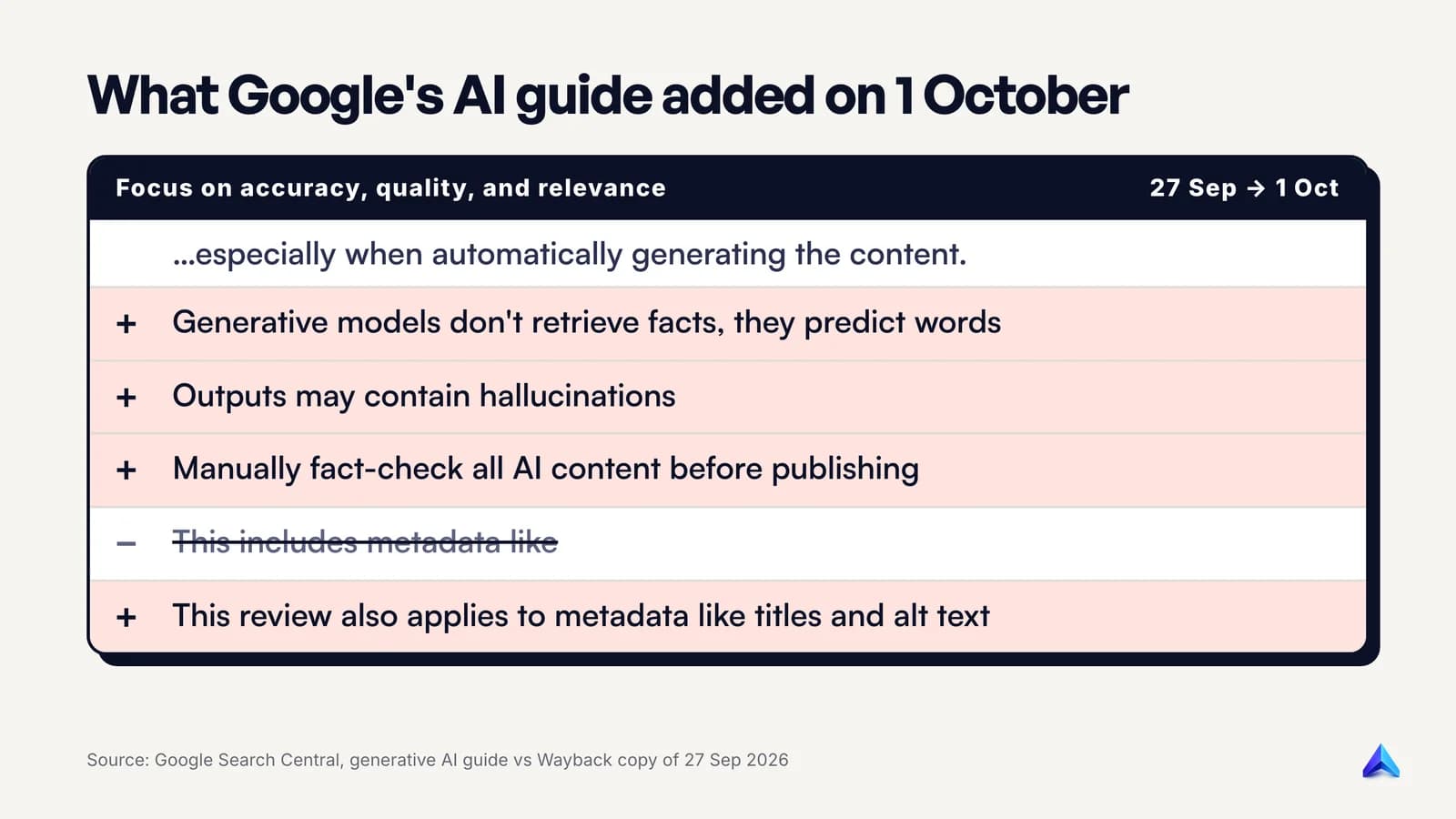
That description invites a bigger reading than the page supports. We compared the live guide to using generative AI content with a Wayback Machine copy captured on 27 September 2026, whose footer read "Last updated 2025-12-10". Two things changed, both in the section headed "Focus on accuracy, quality, and relevance".
Three sentences were added. They now read in full:
Keep in mind that generative models don't retrieve facts, but predict a likely sequence of words based on their training data. Because of this, generative AI outputs may contain inaccuracies (also known as hallucinations). It is critical to manually factcheck and review all AI-generated content for accuracy and trustworthiness before publishing.
One phrase was reworded. The old line said "This includes metadata like" title elements, meta descriptions, structured data and image alt text. It now says "This review also applies to metadata like" the same four items. The fact-check requirement therefore covers the text people see in search results, not only the article body.
Everything else is identical. In particular, the paragraph pointing readers to the Search Quality Raters guidelines, sections 4.6.5 (scaled content abuse) and 4.6.6 (content made with little effort or originality), was already on the September copy. The log entry's wording makes it sound new; the archived page shows it was there before.
No policy changed on 1 October, and Google did not tie the edit to any ranking update. What changed is the wording of Google's expectation: an unreviewed AI draft is now explicitly described as a risk to accuracy, and review is described as a manual job.
Four days later Google also revised its helpful content page, adding effort as a quality attribute and a warning against fabricated author profiles. Our guide to what Google means by helpful content covers that revision, so it is not repeated here.
What is scaled content abuse?
Google's spam policies define it in two sentences: "Scaled content abuse is when many pages are generated for the primary purpose of manipulating search rankings and not helping users. This abusive practice is typically focused on creating large amounts of unoriginal content that provides little to no value to users, no matter how it's created."
Three ideas sit inside that definition. There must be many pages. Their primary purpose must be ranking rather than helping. And the content is typically unoriginal and low in value. The last clause, "no matter how it's created", is the one most people skip.
Google lists five examples, and says the list is not exhaustive:
- Using generative AI tools or other similar tools to generate many pages without adding value for users.
- Scraping feeds, search results or other content to generate many pages, including through automated transformations such as synonymizing, translating or other obfuscation.
- Stitching or combining content from different web pages without adding value.
- Creating multiple sites with the intent of hiding the scaled nature of the content.
- Creating many pages where the content makes little or no sense to a reader but contains search keywords.
Only the first example mentions AI. The other four are older tricks: spinning, scraping, stitching and spreading a content farm across domains.
Where the policy came from
Google announced scaled content abuse on 5 March 2024, alongside expired domain abuse and site reputation abuse, in its post on the March 2024 core update and new spam policies. It replaced an older policy on "automatically-generated content". The reason for the rename is the useful part. Google said the new policy lets it act "no matter whether content is produced through automation, human efforts, or some combination of human and automated processes."
In other words, a farm of underpaid freelance writers producing 500 near-identical city pages is as much in scope as a script calling a language model.
Enforcement runs two ways. The spam policies page says Google detects violations "both through automated systems and, as needed, human review that can result in a manual action," and that violating sites "may rank lower in results or not appear in results at all." The automated side includes SpamBrain, which Google describes as its AI-based spam-prevention system and improves through periodic spam updates.
How Google's raters are told to judge it
The 1 October guide sends readers to the Search Quality Rater Guidelines, and that document is more concrete than the spam policy. The current edition is dated 11 September 2025. Section 4.6.5 opens with a sentence worth pinning above any content team's desk: "Creating an abundance of content with little effort or originality with no editing or manual curation is often the defining attribute of spammy websites."
Three details in the rater version differ from the public policy.
The motive is framed more broadly. Raters are told scaled content abuse occurs when pages are generated "for the purpose of primarily benefiting the website owner and not helping users." That is wider than manipulating rankings. A site built to harvest ad impressions fits it.
The AI example adds a comparison. The rater wording is "Using automated tools (generative AI or otherwise) as a low-effort way to produce many pages that add little-to-no value for website visitors as compared to other pages on the web on the same topic." Value is judged against what already exists, not in isolation.
Raters do not need to prove AI was used. "Even if you are unsure of the method of creation," the guidelines say, raters should use the Lowest rating "when you strongly suspect scaled content abuse after looking at several pages on the website." The judgement is made across a site, not one page.
Section 4.6.6 covers the page-level version. A page is rated Lowest if "all or almost all" of its main content is copied, paraphrased, embedded, "auto or AI generated", or reposted with little effort, originality or added value, "even if the page assigns credit for the content to another source." Licensed or syndicated content, such as wire stories, is explicitly not treated as copied.
The examples raters are shown
The worked examples in the guidelines show what Google's people picture when they say scaled content abuse.
- A medical article that opens with a model's disclaimer. It begins "As a language model, I don't have real-time data and my knowledge cutoff date is September 2021" and ends mid-sentence. Raters are told it is spam and a highly untrustworthy medical page.
- A rabbit enthusiasts' site whose articles wander into human health. Its hundreds of templated question-and-answer posts follow what the guidelines call "a common technique to create scaled content": collecting questions from sources such as Google's People Also Ask and answering them with unoriginal, paraphrased text, "often using generative AI tools."
- A site for seniors that hosts hundreds of articles on unrelated topics, including one titled "How Cold Can Chickens Tolerate".
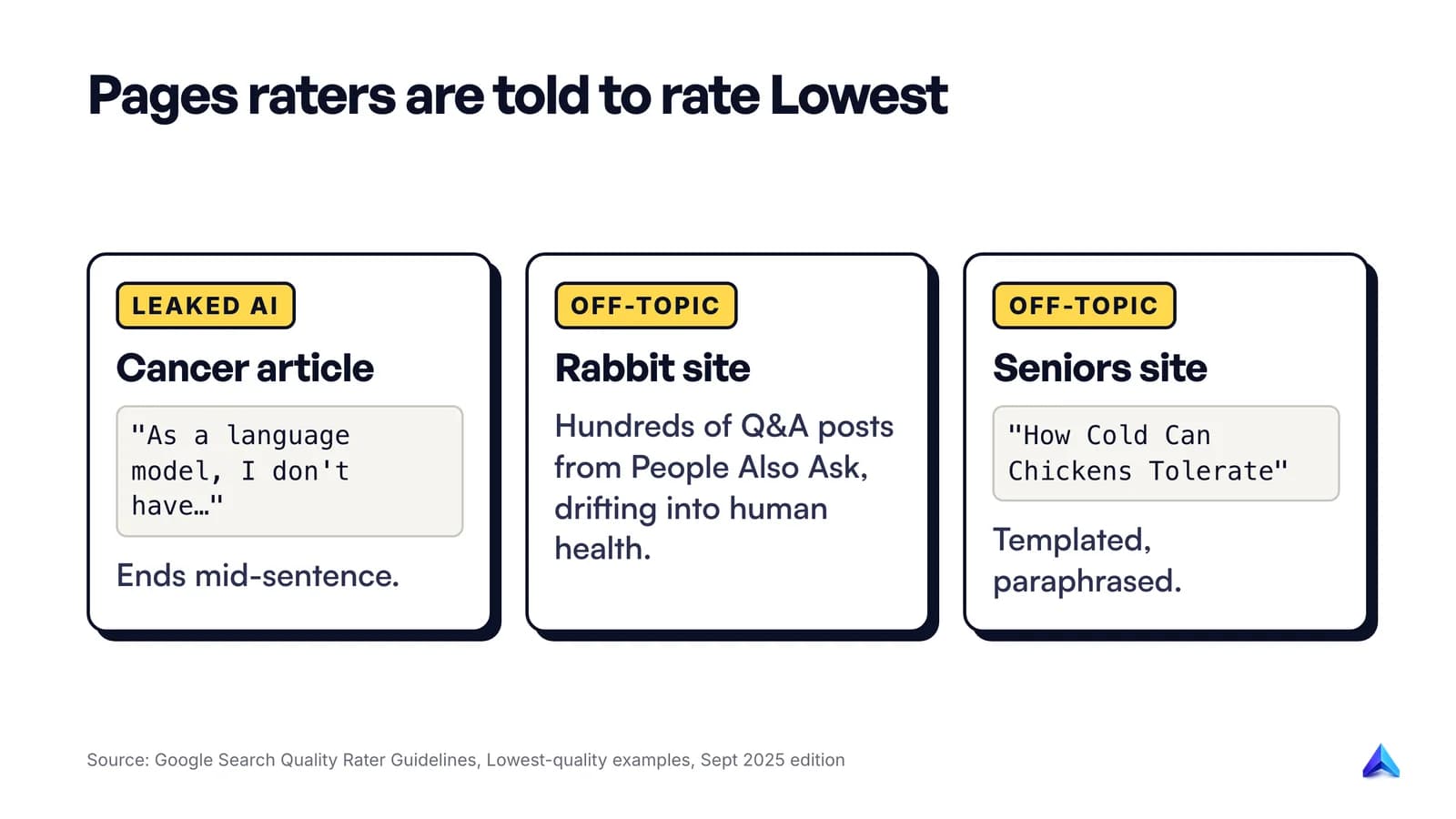
Two patterns repeat: no visible human pass, and topics unrelated to the site's stated purpose. Neither depends on the tool used.
One caveat matters. The guide itself says rater guidelines "are not a guide to ranking first in Google" and that raters' "ratings don't directly influence ranking." Raters evaluate whether Google's systems are working. Their guidelines are the best public description of what those systems are meant to catch, which is why Google points to them.
What scaled content abuse is not
The policy is often summarised as "Google penalises AI content". Google's own pages say otherwise, in several places.
Using AI is not the violation. The generative AI guide opens by saying the technology "can be particularly useful when researching a topic, and to add structure to original content." Google's 2023 guidance on AI-generated content is blunter: "Appropriate use of AI or automation is not against our guidelines." It adds that automation "has long been used to generate helpful content, such as sports scores, weather forecasts, and transcripts."
Volume is not the violation either. The definition turns on purpose and value. A large publisher, a marketplace with thousands of product pages or a documentation site with a page per API endpoint can be enormous without being abusive. Google has not published a page count or publishing rate that triggers the policy.
Human writing is no defence. Since March 2024 the policy has covered content made by people, machines or both. Five hundred hand-written pages that swap one city name are still five hundred pages with nothing new on them.
Citing the source is no defence. The rater guidelines say a page made of copied or paraphrased material is rated Lowest even when it credits the original.
A single weak post is not scaled content abuse. One thin article is a quality problem for your ranking, not a spam policy violation. The word "scaled" is doing real work in the name.
What the policy targets is a production line whose output never faces one question: does this page give a reader anything the pages already ranking do not? If the answer is no across many pages, the method stops mattering. The idea SEOs call information gain, adding something the other results lack, is the positive version of the same test.
How to self-check a content programme
If your team publishes with AI writing tools, or briefs freelancers at volume, run these checks before Google's systems run their own. They are ordered by how quickly they surface a real problem.
- Search your own site for model artefacts. Run
site:yourdomain.com "as an AI language model","knowledge cutoff","I cannot browse"and"Certainly! Here"in Google. Any hit is a page published with no human pass, which is exactly the first rater example. - Do the swap test on every template. Take two pages built from the same template, such as "GST registration in Pune" and "GST registration in Nagpur". Remove the place name. If what is left is the same page, the template is producing doorway-style duplicates. Merge them, or give each one genuinely local substance.
- Compare a sample with what already ranks. Pick ten recent pages across content types. For each, open the top three results for its target query and list one thing your page has that they do not. A blank line is the clearest warning sign in this list.
- Check topic fit. List your last 50 URLs by topic. Pages far outside what your business does, written because a keyword tool showed volume, are the rabbit-site pattern.
- Compare review capacity with publishing rate. If one editor signs off 40 posts a week, the "manual fact-check" the 1 October guide calls critical is not happening. Either slow down or add reviewers.
- Fact-check the metadata, not only the body. Since the 1 October edit, the review explicitly covers title tags, meta descriptions, structured data and image alt text. Auto-generated FAQ schema that answers a question the page never addresses is an easy miss.
- Check the endings. Truncated final paragraphs and stranded headings are the second tell in the first rater example. They are what a generation job leaves behind when it is cut off and nobody reads to the bottom.
- Make authorship and method honest. Use a real byline where readers would expect one. Google's generative AI guide suggests "adding information on how your content was created", and its 2023 post says giving AI an author byline "is probably not the best way" to do it.
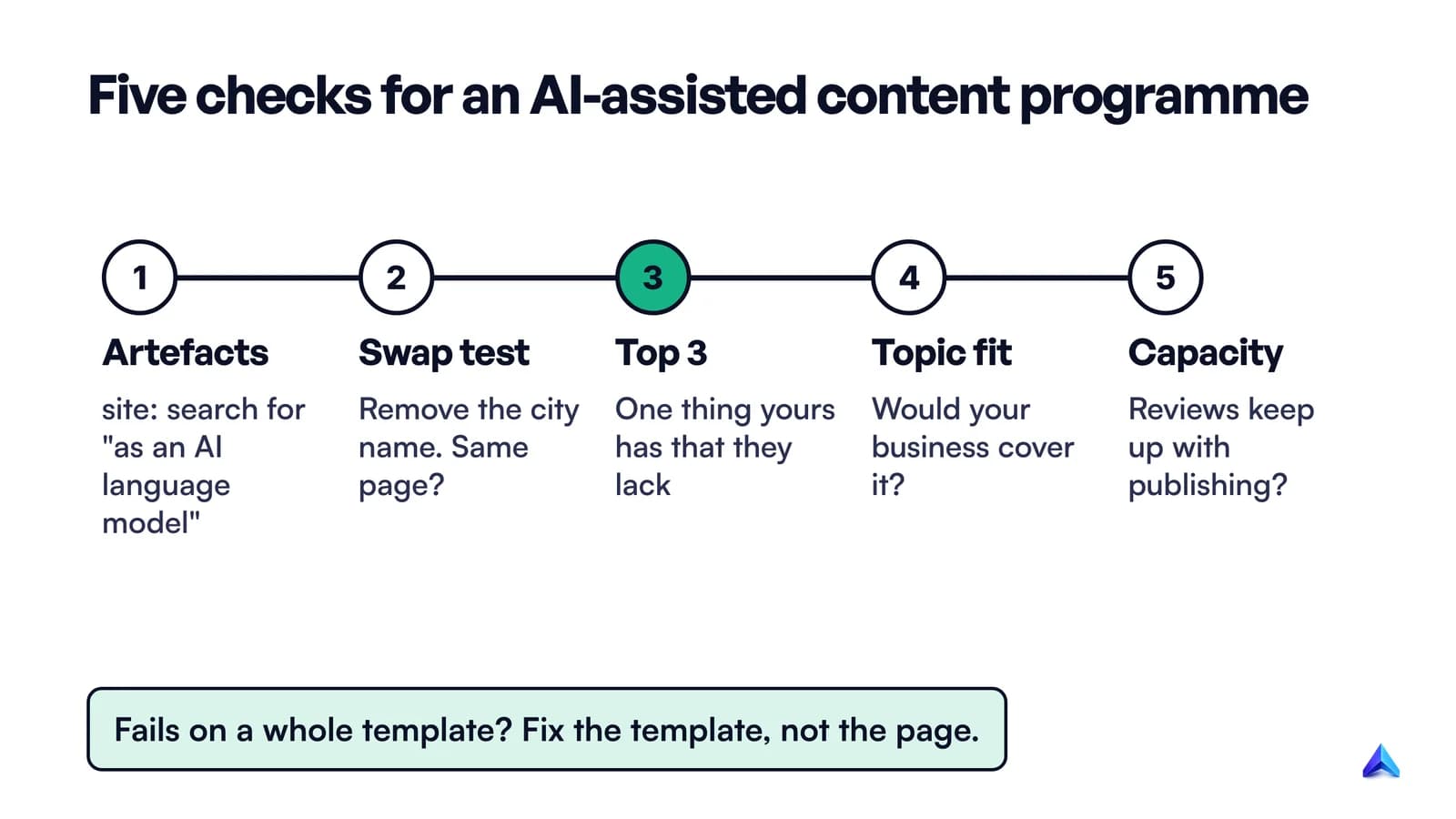
If a check fails on a few pages, fix those pages. If it fails on a whole template or folder, treat the template as the problem. That is also how Google's manual action reports describe affected pages: by URL pattern, such as a directory.
A wider content audit is the right tool when the failures are spread across years of posts rather than one recent batch.
Where this blog stands
It would be odd to write this post without saying so: projectrankup.com publishes researched posts at a steady pace, and AI tools are part of how they are made. We treat this policy as a constraint on how we publish rather than a box to tick. Every post starts from a ledger in which each number, date and quote is tied to a source someone opened, and claims that cannot be verified are cut. That is not a claim that we are "safe". Google does not certify anyone, and the test is applied to the output, not the process.
For teams using Project Rankup, the product's publish-readiness gate blocks two of the tells above, leaked prompt text and truncated endings, before a draft reaches a CMS. It does not replace the human fact-check the 1 October guide asks for.
What to do if your site is hit
First, work out which kind of hit it is, because the fixes differ.
A manual action comes with a notice. Open Search Console and go to Security & Manual Actions, then Manual actions. Google's manual actions help page lists the types. Scaled content abuse is named under "Major spam problems", described as "aggressive spam techniques such as scaled content abuse, cloaking, and/or other repeated or egregious violations." A related type, "Thin content with little or no added value", lists scraped content and low-quality guest blog posts among its examples. Expand the description to see which URL patterns are affected; it can be one folder or the whole site.
An algorithmic demotion comes with no notice. You see a drop that lines up with a spam update on Google's ranking updates list, and an empty Manual actions report. There is nothing to appeal.
Fixing a manual action
- Fix every affected page, not a sample. Google says fixing only some pages "will not earn you a partial return to search results."
- Remove, merge or improve. For pages with no salvageable value, the spam policy's own instruction is to exclude them from Search. Use
noindexor delete them. For pages worth keeping, rewrite them with original substance. - Make the fixed pages reachable. Google's reviewers must be able to see them: no login, paywall, robots.txt block or
noindexon the pages you want back. - Request review. In the Manual actions report, select Request Review. Google says a good request explains the exact quality issue, describes the steps you took and documents the outcome. Give examples of bad content you removed and good content you added.
- Wait, and do not resubmit. Google says most reviews take "several days or weeks" and asks you not to resubmit before a decision.
If you bought the site and the content predates you, Google asks you to say so in the request.
Recovering from an algorithmic hit
Make the same fixes, then be patient. Google's spam updates documentation says a site may improve "if our automated systems learn over a period of months that the site complies with our spam policies." There is no button to press.
Before rewriting half the site, rule out other causes. A drop can come from a core update, a technical fault or, more rarely, someone else's activity. Our guide to negative SEO covers how to tell a real attack from a coincidence, and the cloaking guide covers another manual action type and how to fix it.
What is still unknown
Whether the edit signals enforcement. The 1 October change landed in the middle of the September 2026 spam update, which ran from 24 September to 8 October according to Google's Search Status Dashboard. Google has not linked the two, and its log gives a documentation reason for the edit. Treat any claim that the update "targeted AI content" as speculation unless Google says so.
Where the threshold is. Google has never published a number of pages or a ratio of reviewed to unreviewed content. The rater guidelines describe judgement across "several pages", not a formula.
How "manual" a fact-check must be. The guide says "manually factcheck and review". It does not say whether an AI-assisted check with a human sign-off counts. The safe reading is that a person must be accountable for every claim on the page.
Frequently asked questions
Does Google penalise AI-generated content?
Not for being AI-generated. Google's position since 2023 is that appropriate use of AI is not against its guidelines. It acts when automation or people produce many pages mainly to manipulate rankings with little value added. Since 1 October 2026 its guide also says AI content should be manually fact-checked before publishing.
What are Google's AI-generated content guidelines?
They live on one Search Central page, "Google Search's guidance on using generative AI content on your website". It says AI can help with research and structure, warns that mass-generated pages without value may breach the scaled content abuse policy, asks for manual fact-checking including metadata, and suggests disclosing how automated content was made.
Is programmatic SEO scaled content abuse?
Not by definition. Pages generated from a real dataset, such as prices, schedules or specifications that differ on each page, can be useful at scale. It becomes abuse when the template produces pages that differ only by a keyword or place name and give the reader nothing the other results do not.
How do I know if I have a scaled content abuse penalty?
Check the Manual actions report in Search Console. A manual action appears there with its type, such as Major spam problems, and the affected URL patterns. If the report is clear but traffic fell during a spam update, the cause is more likely algorithmic, and there is no notice or appeal.
How long does a reconsideration request take?
Google says most reconsideration reviews take several days or weeks, with some types such as link-related requests taking longer. You receive an email when the request is received and another when the review is complete. Google asks site owners not to resubmit before getting a decision.