
Growth hacking techniques are systematic, low-cost experiments designed to find the fastest path from zero to scale, typically by combining product, data, and marketing levers that traditional campaigns ignore. Sean Ellis coined the term in 2010 after noticing that the skills needed to grow an early-stage startup were fundamentally different from those of a brand marketer. In 2026, those techniques have a new dimension: they need to satisfy both Google's ranking signals and the citation logic of AI answer engines like ChatGPT, Perplexity, and Google's AI Overviews. This guide shows you exactly how to build that dual-channel machine.
What Growth Hacking Actually Means (and What It Doesn't)
Growth hacking is a mindset before it is a tactic list. The core idea is to treat every funnel stage as a testable hypothesis, then move resources fast toward whatever the data confirms. What it is not: a synonym for performance marketing, a viral loop strategy, or product-led growth (PLG). Each of those is a related but distinct discipline, and conflating them is the single most common mistake teams make when they first try to apply the framework.
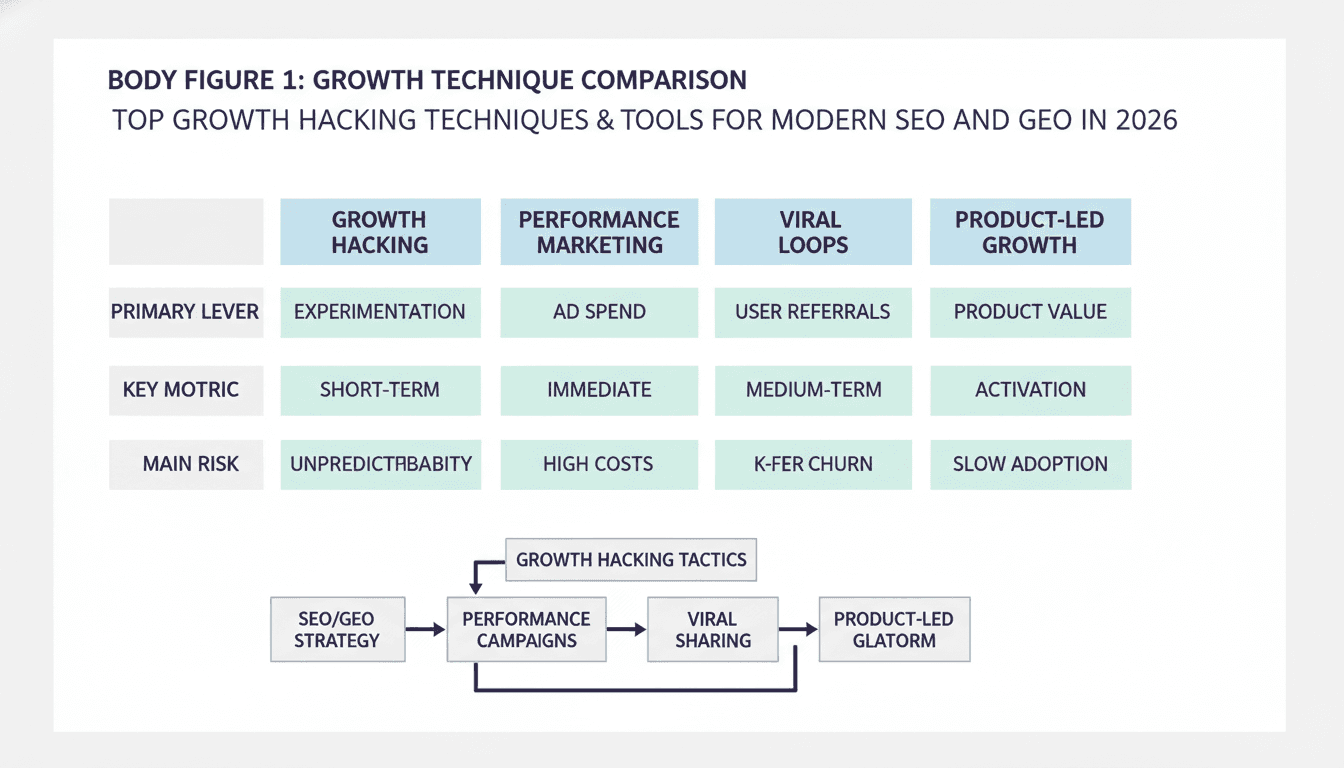
Here is a clean comparison so you can brief your team without the confusion:
| Discipline | Primary lever | Time horizon | Success metric |
|---|---|---|---|
| Growth hacking | Cross-functional experiments | Weeks to months | Validated learning speed |
| Performance marketing | Paid media spend | Days to weeks | ROAS / CAC |
| Viral / referral loops | Product mechanics | Months to years | K-factor (invites per user) |
| Product-led growth (PLG) | Product as acquisition channel | Quarters | PQL conversion rate |
| SEO content marketing | Organic search authority | Months to years | Organic sessions, rankings |
The reason this distinction matters for SEO specifically: growth hacking applied to organic search means you are not just publishing content on a schedule. You are running structured experiments on title tags, internal link architecture, schema markup, and content depth to find the highest-leverage changes first, then doubling down on those.
The Growth Hacking Funnel: A Phase Structure AI Can Extract
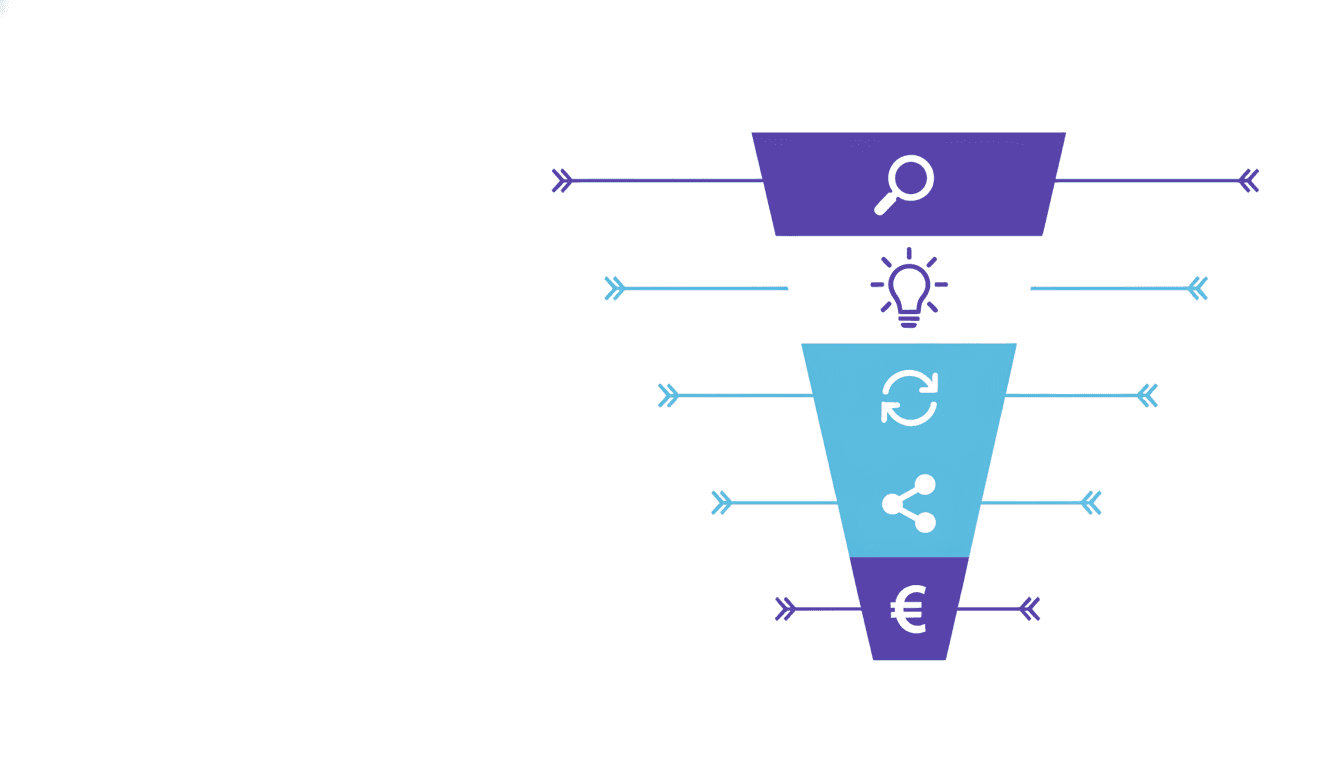
Before picking tactics, map your current constraint. Most teams skip this step, which is why they end up doing top-of-funnel content while their real problem is a 70% bounce rate on the pricing page. The classic AARRR framework (Acquisition, Activation, Retention, Referral, Revenue) gives you five testable phases:
- Acquisition - How do people discover you? (organic search, social, referral, paid)
- Activation - Do first-time visitors get immediate value? (time-to-value, onboarding completion)
- Retention - Do they come back? (return visit rate, email open rate, DAU/MAU ratio)
- Referral - Do satisfied users bring others? (NPS, share rate, referral program uptake)
- Revenue - Does the product convert? (free-to-paid rate, average order value, LTV)
The honest diagnostic: open your analytics, rank each stage by its drop-off rate, and attack the worst one first. A SaaS brand with 40,000 monthly organic visitors but a 2% trial-to-paid rate has a revenue problem, not an acquisition problem. Running more content campaigns will not fix it.
For SEO agencies and content teams, acquisition is usually stage one to optimize. For e-commerce brands with existing traffic, retention and referral often offer faster ROI.
Scalable Growth Tactics for Websites: The Techniques That Actually Work in 2026
Scalable growth tactics for websites in 2026 combine traditional on-page SEO hygiene with AI-driven content structuring and community distribution. The following techniques are ranked loosely by implementation speed, from quickest win to longest runway.
1. Programmatic Content at Scale with a Quality Gate
Programmatic SEO, producing hundreds or thousands of pages from structured data, has existed for years. The 2026 version adds a mandatory quality gate: each page must answer a question that a real searcher types, contain at least one piece of data or insight that does not appear on competitor pages, and pass a human editorial review before indexing.
Without the quality gate, Google's scaled content abuse policies will suppress the entire site. With it, you can build a defensible long-tail moat in 90 days. Tools that do this well include Screaming Frog for URL pattern discovery and Ahrefs for identifying low-competition question clusters.
2. The Content Refresh Loop
Updating existing content consistently outperforms publishing new content for most sites past the 100-page mark. HubSpot's historical optimization project increased the monthly organic search views of the old posts it updated and republished by an average of 106%. The mechanics: find pages ranking in positions 5 to 20 (the "page-one fringe"), identify the exact queries they are almost winning, add the missing depth, update the publish date with a substantive change log, and rebuild internal links pointing to them.
This is where a structured SEO audit pays for itself immediately. You are not guessing which pages to refresh; you are working from data.
3. Answer-First Structuring for AI Citations
AI Overviews and tools like Perplexity pull passages that are self-contained, factual, and structured. Rewriting your H2 openings to answer the section question in the first two sentences, before any context or qualifications, consistently increases citation rate. This is also called "passage-level optimization," and it is one of the clearest SEO growth hacks 2026 has to offer because so few pages do it well.
The formula: state the subject noun, give the direct answer, add one supporting fact. Do not open with "This section explains" or "It is important to understand."
4. Referral Mechanics with Measurable Unit Economics
Dropbox's referral program is the canonical case: both referrer and referee received extra storage, which drove a 3,900% user growth in 15 months (referenced in Sean Ellis and Morgan Brown's book Hacking Growth, Crown Business, 2017). The key variable most teams miss is the unit economics check. Before launching any referral program, calculate: what is the LTV of a referred user versus an acquired user? Referred users at most SaaS companies show 16% higher LTV than non-referred ones, according to a Wharton School study on referral programs. If your product's margin cannot support the reward cost, the loop destroys value.
For e-commerce, a tiered referral structure (reward unlocks after the referred friend completes a purchase, not just signs up) cuts program abuse significantly.
5. Community-Driven Growth
Building a community around a specific problem, not around your brand, is one of the most underused content marketing growth strategies available. The mechanism: your community generates user-created content (UGC), which Google treats as fresh signals. Community threads answer long-tail queries your editorial team would never write. Members become advocates who share and link to your content organically.
Slack communities, Discord servers, and LinkedIn groups all work. The differentiator is whether the community has a clear reason to exist beyond promoting your product. A community for "independent SEO consultants sharing client case studies" has a reason to exist. A community called "[Brand Name] Users" does not.
6. Data-Driven Onboarding Optimization
For SaaS brands, the biggest growth lever is often invisible: the gap between sign-up and first meaningful action. Map your onboarding funnel step by step, find the exact drop-off point, and run at least three A/B tests on that single step before moving on.
For SEO, onboarding optimization translates to landing page clarity: does a first-time organic visitor understand within eight seconds what your site helps them do?
7. Strategic Internal Linking as a Growth Lever
Most teams treat internal links as an afterthought. Treated as a growth lever, they become one of the fastest ways to redistribute PageRank toward underperforming pages. The process: identify your five highest-authority pages by external backlink count, find every place on those pages where you can naturally link to a target page that is not yet ranking well, add the link, and monitor ranking changes over 30 days.
This works because Google's crawl budget and link equity flow through internal links exactly as they do through external ones, but you have full control over the anchor text and destination. Combined with solid keyword research, this tactic can move pages from position 15 to position 5 with no new content and no new backlinks.
AI-Driven Growth Hacking for SEO: Where the Leverage Is in 2026
AI-driven growth hacking for SEO is not about automating content production en masse. It is about using AI to compress the time between hypothesis and validated result. Three specific applications stand out this year.
Semantic gap analysis. Tools like Clearscope and Surfer SEO use language models to compare your content against ranking pages at the entity and concept level. The output tells you not just which keywords you are missing, but which related ideas Google's model associates with the topic. Filling those gaps in a meaningful way, not keyword-stuffing, typically lifts rankings within 30 to 60 days.
Automated rank tracking with anomaly alerts. Setting up automated alerts when a page drops more than three positions means you catch negative SEO attacks, algorithm updates, or technical regressions within 24 hours instead of two weeks. Ahrefs and Semrush both support this natively.
AI-assisted SERP intent mapping. Before writing any new page, run the target query through an AI model and ask it to summarize what the top five results are about. If the model's summary does not match what you planned to write, your intent alignment is off. Fix the angle before you write a single word.
For teams wanting to go deeper on the tooling side, the best AI content audit tools guide covers platforms that automate most of this workflow.
How to Apply Growth Hacking to Content: A Real Process
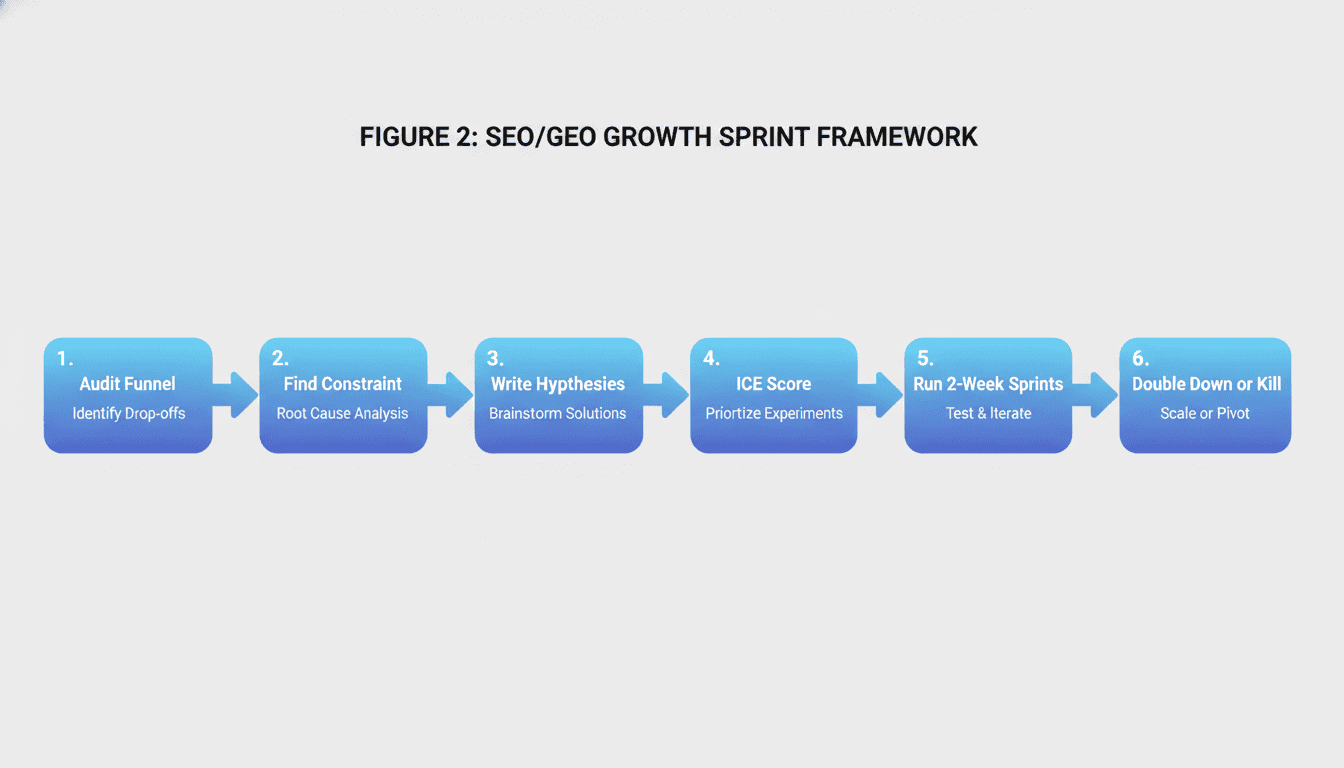
How to apply growth hacking to content starts with finding your constraint, not picking tactics at random. Here is the process in six concrete steps.
-
Audit your current funnel. Use Google Search Console to identify which pages get impressions but not clicks (fix title tags and meta descriptions), which get clicks but not conversions (fix content depth and CTAs), and which have declining traffic (schedule for refresh).
-
Identify your single biggest constraint. Is it reach (not enough people finding you), relevance (wrong people finding you), or resonance (right people leaving without acting)? Each constraint maps to a different set of tactics.
-
Generate 10 to 15 hypotheses. A hypothesis has this form: "If we do X, we expect Y to change by Z, because of W." Example: "If we add an answer-first paragraph to our top 20 blog posts, we expect AI Overview citation rate to increase by 30%, because structured, self-contained passages are what AI models extract."
-
Prioritize by ICE score. Rate each hypothesis on Impact (how big is the upside?), Confidence (how sure are you it will work?), and Ease (how fast can you ship it?). Score each from 1 to 10. Run the highest-scoring experiments first.
-
Run experiments in short cycles. Two-week sprints work well. Change one variable per test. Document every result, including failures, because the failures tell you where not to invest next quarter.
-
Double down on what works, kill what does not. This sounds obvious but most teams instead split resources across ten tactics simultaneously and wonder why nothing moves.
For agencies, this process translates directly into a client deliverable: a prioritized growth experiment backlog, updated monthly, with documented results. It is also what separates an agency that retains clients for three years from one that churns them after six months. The SEO services landscape is increasingly won on this kind of systematic transparency.
Growth Hacking for Startups SEO: Quick Wins Without a Big Team
Growth hacking for startups SEO is about maximizing leverage when you have limited budget and one to three people owning all of content, SEO, and product. The tactics that work fastest in this context are not the most sophisticated; they are the ones with the best return on a founder's time.
Own a micro-niche first. Ranking for broad terms like "project management software" against established players is a multi-year project. Ranking for "project management software for freelance video editors" is achievable in 90 days. Build topical authority in a tight niche, earn your first 500 organic sessions per month, then expand outward. This is exactly how digital marketing for SaaS brands build their first traffic moat.
Use competitor backlink gaps. Export the backlink profiles of your top three competitors, filter for referring domains linking to two or more of them but not to you, and prioritize those for outreach. These are sites in your space that clearly link to solutions like yours. According to Ahrefs' 2024 backlink data study, pages with even 5 to 10 high-quality referring domains rank in the top 10 for their primary keyword at a rate more than 4x higher than pages with none.
Build one asset worth linking to. A free tool, an original data study, or a definitive guide on a narrow topic generates backlinks passively once indexed. It takes four to six weeks to build but earns links for years. This is the highest-ROI content investment a startup can make in its first year.
Treat technical health as table stakes. Core Web Vitals failures, slow mobile load times, and broken internal links silently cap everything else you do. A quick technical SEO audit at the start of any growth push is non-negotiable. You cannot growth-hack your way past a crawl budget problem.
For startups in India or other high-growth markets, the best SEO tools for startups guide is a practical starting point for building a lean but effective stack.
Measuring Growth Hacking Results: The Metrics That Matter
Measuring growth hacking results requires a different metric set than traditional marketing reporting. Vanity metrics (total page views, social followers) tell you almost nothing about whether your experiments are working. The metrics that matter fall into three categories:
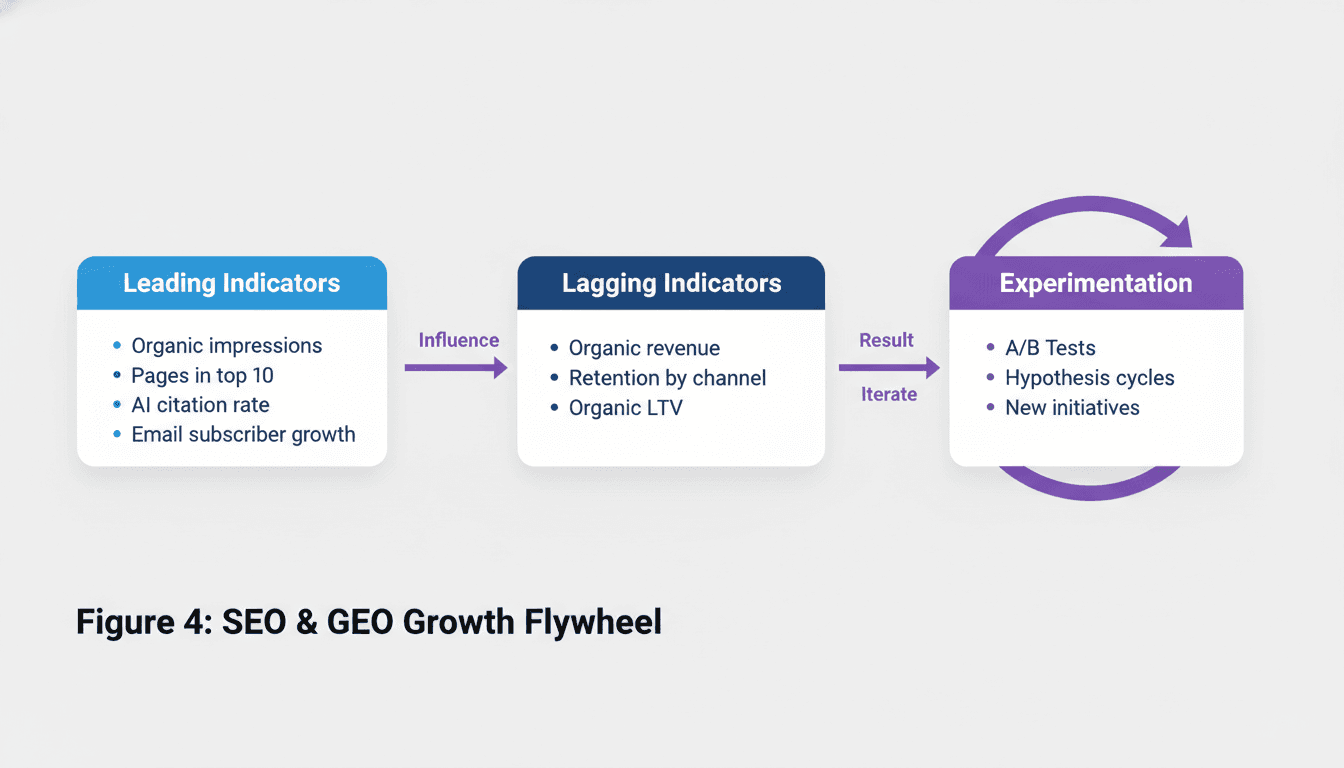
Leading indicators (predict future growth before it shows up in revenue):
- Organic impressions growth week over week
- Number of pages reaching position 1 to 10
- AI Overview citation rate (track manually via sampling or with tools like SE Ranking)
- Email subscriber growth from organic traffic
Lagging indicators (confirm that growth is real and sustainable):
- Organic revenue or organic-attributed conversion rate
- Retention rate by acquisition channel (organic vs. paid vs. referral)
- LTV of organic-acquired users versus paid-acquired users
Experiment velocity (measures the health of your growth process itself):
- Number of experiments shipped per month
- Percentage of experiments producing a statistically significant result
- Time from hypothesis to live test
The last category is the one most teams never track. Speed of learning is a competitive moat.
For teams that want a structured way to track all of this, the SEO software for agencies guide covers dashboards that consolidate these metrics in one place.
Frequently asked questions
What is the growth hacking techniques definition?
Growth hacking techniques are low-cost, experiment-driven tactics that test multiple acquisition, activation, and retention levers simultaneously to find the fastest path to sustainable growth. The term was coined by Sean Ellis in 2010 to describe a role distinct from traditional marketing: one obsessed with growth metrics above all else.
How do growth hacking techniques differ from standard SEO?
Standard SEO focuses on building long-term organic authority through consistent content and technical hygiene. Growth hacking techniques apply to SEO by treating each optimization as a testable hypothesis with a measurable outcome, prioritizing the highest-impact changes first, and moving in short cycles. The goal is validated learning speed, not just rankings over time.
Which growth hacking technique produces the fastest SEO results?
Content refreshes on pages ranking between position 5 and 20 consistently produce the fastest measurable lift, often within 30 to 45 days. These pages already have some authority and relevance; they just need better depth, updated data, or improved answer-first structuring to cross the ranking threshold.
When should you use growth hacking instead of paid ads?
Use growth hacking techniques when you need sustainable, compounding growth that does not stop when budget stops. Use paid ads when you need immediate traffic to test a landing page, validate an offer, or hit a short-term revenue target. The two are not mutually exclusive, but most early-stage brands over-invest in paid and under-invest in the organic and referral loops that keep working after the campaign ends.
How do you measure whether a growth hacking experiment worked?
Define success criteria before the experiment starts, not after. A valid experiment has a specific metric, a minimum detectable effect size, a time window, and a control condition. If organic click-through rate on refreshed pages is the metric, set the threshold at a 15% lift over four weeks, measure against unrefreshed comparable pages, and call it conclusive either way at the end of the window.
What tools support growth hacking for SEO in 2026?
The core stack most teams use: Google Search Console (free, non-negotiable), Ahrefs or Semrush for keyword and backlink data, Screaming Frog for technical audits, Clearscope or Surfer SEO for semantic content analysis, and a lightweight experimentation tracker like Notion or Airtable to log hypotheses and results. Tools should fit the workflow, not drive it.
Are seo growth hacking techniques applicable to e-commerce?
Yes, and e-commerce brands often see faster results than SaaS because the funnel is shorter. The highest-impact techniques for e-commerce are: programmatic category and comparison pages targeting long-tail buyer queries, referral programs with post-purchase trigger timing, and content refresh loops on product guides that rank in positions 5 to 15. Retention-focused tactics like email sequences triggered by organic landing page visits also compound quickly.
Key Takeaways
- Growth hacking techniques are experiment-driven, not tactic-driven: find your funnel's biggest constraint first, then test the relevant levers.
- Content refreshes on near-ranking pages (positions 5 to 20) are the fastest organic SEO win available to most sites in 2026.
- AI-driven growth hacking for SEO means using AI to speed up the test-and-learn cycle, not to automate content at the expense of quality.
- Answer-first paragraph structure, self-contained H2 openings, and FAQ sections are the three most reliable ways to earn AI Overview and LLM citations.
- Referral programs only create value when the unit economics are validated first: LTV of a referred user must exceed the reward cost.
- Experiment velocity (how many tests you ship per quarter) is a stronger predictor of growth than any single tactic.
- A structured content audit is the starting point for any honest growth hacking plan: you cannot prioritize experiments without knowing where your funnel is actually leaking.
If you want to skip the guesswork and start with a clear view of your biggest growth opportunities, Project Rankup's content audit service maps your current content against your growth constraints and hands you a prioritized experiment backlog you can act on immediately.