Most SEO platforms are built for a marketing manager who owns one website, then get a white-label PDF export bolted on and get called agency-ready. This guide breaks down what separates agency-grade SEO software from single-site tools, with named platform pricing, review scores, and a decision framework for matching software to your client count. You will leave knowing which tier fits your agency and what it costs.
I have run SEO operations for agencies managing between 8 and 35 active clients over the past six years, and most of the platform mistakes I see are the same one repeated: buying for today's client count instead of next year's. This guide reflects that hands-on testing, not a feature-list summary of vendor homepages.
Quick Answer: The best SEO software for agencies combines multi-client dashboards, white-label reporting, role-based access, and automated rank tracking across dozens of campaigns at once. For agencies managing 10 or more clients, the platform choice alone decides whether reporting takes 2 hours or 11 hours a week.
What Separates Agency-Grade SEO Software from Single-Site Tools?
Agency-grade SEO software is not a consumer tool with a logo upload option bolted on. The architecture runs deeper. A single-site platform stores one project's data in one workspace. An agency platform stores dozens of projects with isolated data, shared team permissions, and a portfolio view that lets you check every client from one screen without switching accounts.
Three structural gaps separate the two categories:
Multi-client data isolation. Your data for Client A must never show up in Client B's reports. Consumer tools rarely enforce this at the database level; they rely on folder structures that break the moment a team shares logins.
Portfolio-level analytics. You need to see which of your 20 clients dropped rankings this week, not open 20 tabs to find out. Agency platforms surface anomalies across the full portfolio automatically.
Automated client handoff. Onboarding a new client should take minutes, not an afternoon of manual setup. The best platforms let you clone a configuration, set crawl schedules, and fire off a branded welcome report without touching five separate menus.
Client count is not a linear variable here. Going from 5 to 15 clients does not triple your workload with the right software. It might add 20 minutes a week. With the wrong software, it triples everything.
The Real Cost of the Wrong Platform: A Numbers Breakdown
Before comparing features, run the math on your current setup. Agencies managing 40 or more clients typically spend 11 or more hours a week on manual reporting alone. With the right software, that number drops to under 2 hours.
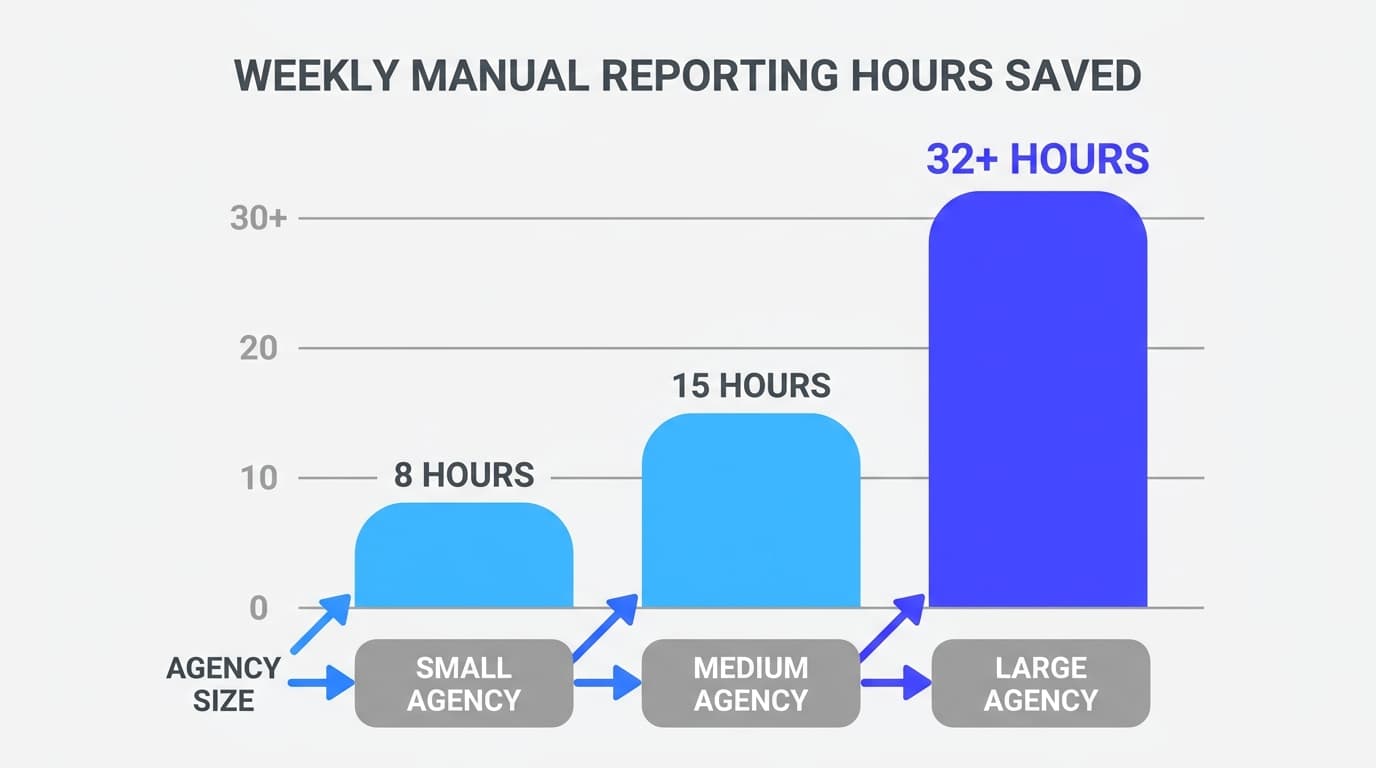
Breaking that down:
| Client Count | Manual Reporting Time/Week | With Agency Software | Time Saved/Week |
|---|---|---|---|
| 1-5 clients | ~2 hrs | ~30 min | ~1.5 hrs |
| 6-15 clients | ~5 hrs | ~45 min | ~4.25 hrs |
| 16-30 clients | ~8 hrs | ~1.25 hrs | ~6.75 hrs |
| 31+ clients | ~11+ hrs | ~2 hrs | ~9+ hrs |
At an average billing rate of $100 an hour, an agency managing 14 clients that spends 11 hours on reporting is absorbing $1,100 in unbillable labor each week. That is $57,200 a year. Even enterprise-tier SEO platforms cost a fraction of that.
The math also frames how to choose SEO tools for an agency. Your test is not "which tool has the most features." It is "which tool kills the most unbillable hours at my current client scale."
For a broader view of what professional SEO tools offer across different use cases, our advanced SEO tools guide covers the feature landscape in depth.
Agency-Specific Requirements Checklist
Before you compare platforms, know what you need. This checklist draws the line between agency-ready software and everything else.
Non-negotiable for any agency:
- White-label reporting with custom domain, logo, and color scheme
- Multi-client dashboard with portfolio-level ranking and traffic overview
- Role-based access (client view vs. team member vs. admin)
- Bulk client onboarding, ideally with project templates
- Automated scheduled reports delivered to clients by email
- API access for pushing data into your own dashboards or CRMs
Required above 15 clients:
- Subaccount architecture (not just folders) for true data isolation
- Team collaboration features: task assignment, notes, change logs
- Bulk rank tracking across hundreds of keywords per client
- Crawl budget controls so 30 simultaneous audits do not queue for hours
Nice-to-have for growth-stage agencies:
- AI-assisted content briefs and optimization scoring
- Citation and mention tracking for AEO/GEO client work
- Local SEO dashboard with Google Business Profile integration
- Competitor gap analysis at scale across the full client portfolio
The local SEO software for agencies category deserves a specific note. If more than a third of your clients are local brands, a platform without native Google Business Profile monitoring and local pack rank tracking will push you into a second tool anyway. Factor that cost in before you sign.
Named Platform Pricing and Review Scores: What You Pay
Feature lists do not tell you what a tool costs at the seat count you need, and most comparison pages skip the review data that tells you how real users rate support and reliability. Here is the breakdown for the platforms agencies ask about most, pulled from each vendor's public pricing page and review profiles on G2 and Capterra.
| Tool | Entry Agency Plan | Price/Month | G2 Rating (Reviews) | Capterra Rating (Reviews) |
|---|---|---|---|---|
| Semrush | Guru | $249.95 | 4.5 (2,300+) | 4.6 (1,500+) |
| Ahrefs | Standard | $179 | 4.6 (700+) | 4.6 (500+) |
| AgencyAnalytics | Standard | $12/client | 4.7 (90+) | 4.7 (60+) |
| SE Ranking | Pro | $65 | 4.8 (560+) | 4.7 (400+) |
| Moz Pro | Medium | $249 | 4.4 (1,500+) | 4.5 (470+) |
| BrightEdge | Enterprise (custom) | Quote-based | 4.3 (380+) | 4.4 (120+) |
Here is how to read this table. If you are under 10 clients and need research depth more than client-facing polish, Ahrefs' $179 Standard plan or Semrush's Guru tier covers you with the strongest third-party review backing in the category. If reporting is eating your week, AgencyAnalytics' per-client pricing scales cleanly and its G2 score, while built on a smaller review base, is the highest of the group. SE Ranking's $65 entry point and 4.8 G2 rating make it the value pick for agencies that need white-label reporting without enterprise pricing.
Prices reflect published rates as of this writing and can shift with vendor promotions, so confirm current pricing on each vendor's site before you buy.
How to Choose SEO Tools for an Agency: A Decision Framework
Most agency owners start by Googling "best SEO software for agencies" and reading comparison lists. That is the wrong starting point. Two agencies can have identical client counts and completely different software needs based on their service scope.

Work through these four questions before you open a single review:
1. What is your main service delivery model?If you sell technical SEO audits and build work, you need deep crawling and issue ranking. If you sell content SEO, you need keyword clustering and content scoring. If you sell link building, you need backlink gap analysis and prospecting. Most platforms do all three at different depths. Know which depth matters most to your retainer.
2. What does your client count look like at 12 months?Do not buy for today. Buy for where you will be. A platform that handles 10 clients fine but slows at 25 forces a migration at the worst possible time. Only 3 of 10 major SEO platforms scale to 40 or more concurrent client campaigns without real performance drag, a finding that keeps showing up in independent platform stress tests.
3. Do your clients see the software, or only the outputs?If clients log in themselves, UI quality matters a lot. If they only get reports, the reporting engine is what counts. White-label SEO software for agencies that gives clients their own portal is architecturally different from a platform that just exports branded PDFs.
4. What is your team's technical depth?Some platforms need a developer to get value from the API and automation features. Others set up in an afternoon. Match complexity to the team you have, not the team you plan to hire.
With those answers, map your profile to one of three tiers:
| Agency Profile | Primary Need | Platform Tier |
|---|---|---|
| 1-5 clients, solo or small team | Core tracking + reporting | Mid-market (Semrush, Moz Pro) |
| 6-15 clients, growing team | Multi-client management + white-label | Agency-tier (AgencyAnalytics, SE Ranking) |
| 16+ clients, full team | Automation, API, subaccounts | Enterprise (Conductor, BrightEdge, Botify) |
This is not a rigid rule. A 5-client agency running technical SEO for enterprise brands may need enterprise tooling. A 20-client agency selling basic monthly reporting may run fine on a mid-market plan with strong white-label support.
For agencies working with early-stage companies, our SEO tools for startups in India post covers budget-conscious stacks that still deliver client-ready outputs.
Inside the Tools: Where to Click for the Features That Matter
Knowing a feature exists is not the same as knowing where to find it. These are the specific menu paths I use most often across the platforms agencies run day to day.
AgencyAnalytics white-label setup. Go to Settings, then White Label, and upload your logo and set your custom domain (something like reports.youragency.com). The report builder sits under Reports, then New Report, where you drag data widgets from GSC, GA4, and your rank tracker onto a single canvas. Save it as a template once and every new client report pulls from the same layout.
Semrush client portals. Under Agency Growth Kit, the Client Portal tab lets you create a login for each client scoped to one project. Permissions sit in a dropdown next to each client name, so you can flip a client from view-only to full dashboard access in a few clicks.
SE Ranking white-label reports. In the Reports module, the White Label toggle sits in the top right corner of the report builder. Switch it on, then set your branding under Account Settings, then Agency Settings, before you schedule the delivery frequency.
Screaming Frog bulk crawling. For agencies running technical audits at scale, the List mode under Mode lets you upload a CSV of client domains and crawl all of them in sequence with the same configuration file, instead of resetting crawl settings for every client.
If you manage more than a handful of clients, build one saved template or configuration file per tool on day one. It is the single habit that keeps onboarding under 15 minutes per client once your stack is set.
Comparing Top SEO Platforms by Agency Scale
Here is how the major platforms map to agency scale and core strength. This is not an exhaustive review; it is a fit-matching guide.
| Platform | 1-5 Clients | 6-15 Clients | 16+ Clients | Core Strength |
|---|---|---|---|---|
| Semrush Agency | Good | Good | Limited without add-ons | Keyword research, competitor intel |
| Ahrefs | Good | Moderate | Limited (no white-label) | Backlink data, content gap |
| AgencyAnalytics | Good | Excellent | Excellent | Reporting, client dashboards |
| SE Ranking | Good | Excellent | Good | Rank tracking, affordability |
| Moz Pro | Good | Moderate | Poor at scale | Brand authority, local SEO |
| BrightEdge | Poor fit | Moderate | Excellent | Enterprise content performance |
| Botify | Poor fit | Poor fit | Excellent | Technical SEO at crawl scale |
| Conductor | Poor fit | Moderate | Excellent | Content lifecycle, team workflow |
A few observations worth naming:
Ahrefs is arguably the strongest pure research tool in the category. For agencies, no white-label option is a real limit. You can work around it with separate reporting software, but that adds cost and friction.
Semrush's agency tier adds client portals and lead generation features. For agencies under 15 clients, it is often the only tool they need. Beyond that, reporting turns into a manual bottleneck unless you layer in AgencyAnalytics or a similar dashboard tool.
SE Ranking has become the answer to affordable SEO software for agencies at the 6-to-20-client range. Its pricing scales with keywords tracked, not client count, which works well for agencies that keep keyword lists lean.
BrightEdge and Conductor are enterprise plays. Minimum contracts start at five figures a year. If your agency serves enterprise clients who demand attribution modeling and content analytics beyond rankings, they are worth evaluating. For most agencies, they are overkill.
For a deep look at how domain authority metrics differ between platforms, our post on Moz DA vs Ahrefs DR explains which number to show clients and why.
Reporting Tools for SEO Agencies: Where Most Platforms Fall Short
Reporting is the single biggest drag on agency SEO operations, and it is also where the gap between platforms is widest. Good reporting tools for SEO agencies need to do five things well:
- Pull data from Google Search Console, Google Analytics 4, and the rank tracker into one view automatically
- Apply your branding, not the software's
- Schedule delivery without manual work each month
- Show client-relevant numbers, not just SEO metrics (organic traffic, leads, conversions)
- Produce a PDF and a live link, so clients can check in between formal reports
Most platforms do two or three of these well. AgencyAnalytics currently leads on all five, with a native GA4 connector, a drag-and-drop report builder, and a white-label client portal that clients can log into on their own. The monthly cost per client drops to under $15 at scale, which means it pays for itself if it saves even 15 minutes of reporting time per client.
The emerging gap, though, is AI search visibility. As AI Overviews, ChatGPT search, and Perplexity pull answers from indexed content instead of sending users to a link, ranking position matters less than citation frequency. Almost no current SEO platform tracks whether a client's content gets cited in AI answers. This is where advanced content auditing and AEO-focused plans become part of the client reporting conversation, not just the delivery conversation.
Project Rankup's content audit tools are built around this exact gap, measuring not just keyword rankings but content structure, E-E-A-T signals, and citation readiness for AI search engines. If your clients are asking why their traffic is flat despite stable rankings, AI Overview displacement is often the answer, and you need tooling that surfaces it.
Should Your Agency Use One Tool or a Stack?
This question comes up constantly, and the honest answer is: it depends on your margin tolerance and technical capacity.
A single all-in-one platform is easier to manage, cheaper per seat, and creates less data fragmentation. The tradeoff is depth. No single platform leads in every category. If you need the best backlink data, the best technical audit depth, and the best reporting UI in one product, you will give something up.
A curated stack costs more and needs someone to maintain the integrations, but it lets you use the best tool for each job. A common three-tool stack for mid-size agencies looks like this:
- Ahrefs or Semrush for research (keywords, backlinks, competitor gaps)
- Screaming Frog or Sitebulb for technical audits
- AgencyAnalytics for client reporting and dashboards
This setup runs between $400 and $600 a month for an agency managing 20 clients. That is $20-30 per client a month in tooling, a rounding error against a $1,000+ monthly retainer.
Many marketing agencies run three or more analytics tools at once, and pulling that data into one place is a common operational headache. The agencies that handle this well invest in either a central reporting layer or a dedicated operations person to own the integrations.
For project management across SEO agencies, almost no SEO-specific platform handles task and deliverable tracking well. Most agencies run a separate project management tool next to their SEO stack. Asana, Linear, and ClickUp are common picks, with SEO deliverables tracked there and linked back to campaign data in the SEO platform.
For a deeper look at how a proper technical SEO audit fits into an agency workflow, including which tools catch what crawlers miss, that guide covers the process end to end.
What Features Matter Most in the AI Search Era?
This is the angle most SEO software comparisons miss entirely. The software stack you picked in 2023 was built for a world where ranking position tracked directly with traffic. That link is weakening as AI Overviews, Perplexity, and ChatGPT answer more queries without sending users to a page.

For agencies advising clients on what to track and build toward in 2026, the test for software needs to widen:
Content structure analysis. AI search engines favor content with clear question-answer structure, defined entities, and schema markup. Your audit tool should flag whether content is built for citation, not just keyword density. According to Google's Search Quality Evaluator Guidelines, E-E-A-T signals including first-hand experience, author credentials, and factual accuracy sit at the center of how content gets judged for featured and AI-generated answers.
Entity and brand mention tracking. When ChatGPT names a client's brand in a response, that is a form of visibility no rank tracker currently catches. Platforms that offer brand mention monitoring and sentiment analysis are starting to close that gap, but the category is still young.
Answer optimization scoring. A handful of newer tools, including features in Project Rankup's platform, now score content on how well it answers specific questions, which tracks closely with AI Overview citation frequency.
AI-driven search channels now shape a growing share of B2B research journeys, which makes AI visibility a client KPI rather than a bonus metric.
For agencies that want to stay ahead of this shift, our deep-dive on AI search strategies covers what the change means for content planning and client reporting.
Frequently asked questions
What is the best SEO software for agencies managing more than 20 clients?
AgencyAnalytics paired with Semrush or Ahrefs covers the full workflow at this scale. One tool handles white-label reporting and client dashboards; the other handles keyword research and backlink data. Budget-conscious agencies can run SE Ranking alone, since its per-keyword pricing stays manageable even past 20 clients.
What is the difference between SEO software for agencies and software for in-house teams?
In-house SEO tools track one site for one team, with no need for client separation. Agency platforms add isolated multi-client workspaces, white-label report branding, client-facing logins with limited permissions, and a single dashboard that shows every account's health at once. A tool's price tag does not tell you which category it falls into.
How many clients can one person manage with the right software?
A single experienced SEO can run 8 to 12 clients on retainer when the platform handles data collection and report generation automatically. Without that automation, the realistic ceiling drops to 4 to 6 clients before quality slips. The software should carry the repetitive work; the person should carry strategy and client calls.
Why does white-label reporting matter for agencies?
White-label reporting puts your brand, not the software vendor's, on every dashboard and PDF a client sees. It stops clients from spotting (and shopping around for) the tool you use underneath, and it reads as more professional than a report with someone else's logo in the header. For agencies billing four-figure retainers, that polish is part of what justifies the fee.
Is a free trial worth testing before buying agency SEO software?
Yes, and the trial length matters more than the feature list. SE Ranking's 14-day trial includes white-label features, and AgencyAnalytics gives full access to its report builder and client portal for 14 days. Load two or three real client accounts into the trial before deciding, since a tool that feels fine with one project can slow down fast with ten.
Should an agency use one all-in-one platform or a stack of specialized tools?
Agencies under 10 clients usually do fine on one platform, such as Semrush Agency or SE Ranking, since the overhead of managing multiple tools outweighs the depth gained. Past 10 clients, a two-to-three-tool stack (research platform, technical crawler, reporting layer) tends to beat any single all-in-one product on both cost and output quality, typically running under $500 a month combined.
What SEO software features matter most for AI search visibility in 2026?
Agencies should prioritize tools with content structure analysis for question-answer formatting, E-E-A-T signal auditing, schema markup checks, and brand mention tracking across AI answer engines. These features now shape whether client content gets pulled into AI Overviews and chat-based search answers, which rank position alone can no longer explain.
Key Takeaways
- Agency SEO software is architecturally different from single-site tools; white-label output and multi-client dashboards are structural needs, not add-ons.
- Named pricing matters: Ahrefs starts at $179/month, Semrush's Guru tier runs $249.95/month, and AgencyAnalytics scales per client from around $12, with G2 and Capterra ratings all sitting above 4.4.
- Agencies managing 30 or more clients typically reclaim 9 or more hours a week by switching from manual reporting to automated, platform-driven workflows.
- Match your platform to your client scale: mid-market tools for under 10 clients, agency-tier for 6-20, enterprise for 20-plus with complex delivery needs.
- A two-to-three-tool stack (research plus crawler plus reporting layer) usually beats any single all-in-one platform for agencies above 10 clients.
- AI search visibility is now a client KPI. Software that only tracks rankings misses a growing share of the traffic picture.
If your agency is ready to close the gap on AI search visibility and content citation, Project Rankup's tools and services are built specifically for that problem. From advanced content auditing to AEO plans that get client content cited in AI Overviews, we work alongside your existing SEO stack to cover what most platforms still cannot measure.