
SEO for startups means getting found by people who already have the problem you solve, before anyone knows your name. In practice: settle your domain and site structure before launch, publish bottom-of-funnel pages first (product use cases, comparisons, alternatives, integrations), earn a handful of real links, and skip big head terms until the site has authority. Expect the first year to be uneven, and judge progress by impressions and sign-ups, not traffic totals.
Most startup SEO advice is ordinary SEO advice with "startup" pasted into the title. This playbook is about the parts that are actually different when you are five people, the product changes every sprint, nobody searches for your brand yet, and the next funding conversation is nine months away.
What makes SEO different at a startup
A 40-person company with a ten-year-old domain and a startup with a three-month-old one are playing different games. Four constraints shape every decision below.
Nobody searches for you yet. Established companies get a steady stream of visits from people typing their name. You get none of that. Every visit has to come from a query about a problem, a category or a competitor.
The product moves under the pages. Features get renamed, pricing changes, and sometimes the whole positioning pivots. A page written in March can be wrong by May. Your SEO setup has to survive that churn without throwing away what it has earned.
The team is tiny. SEO usually lands on a founder or the first marketer, alongside five other jobs. Anything that needs a full-time person to maintain will rot.
Funding sets the clock. Investors ask about acquisition channels on a timeline that does not match how search works. Google's John Mueller has said a site that is "a couple of months old, maybe 8 months, maybe a year" is still very fresh, and that rankings settle down over the course of a year. Plan your reporting around that, so a dip in month four does not trigger a panic pivot away from the channel.
If you are deciding whether SEO deserves a slot at all versus paid or outbound, our guide to building an SEO plan covers how to weigh it against other work. This post assumes you have decided to do it and want the startup-specific order.
Before launch: five decisions that are expensive to undo
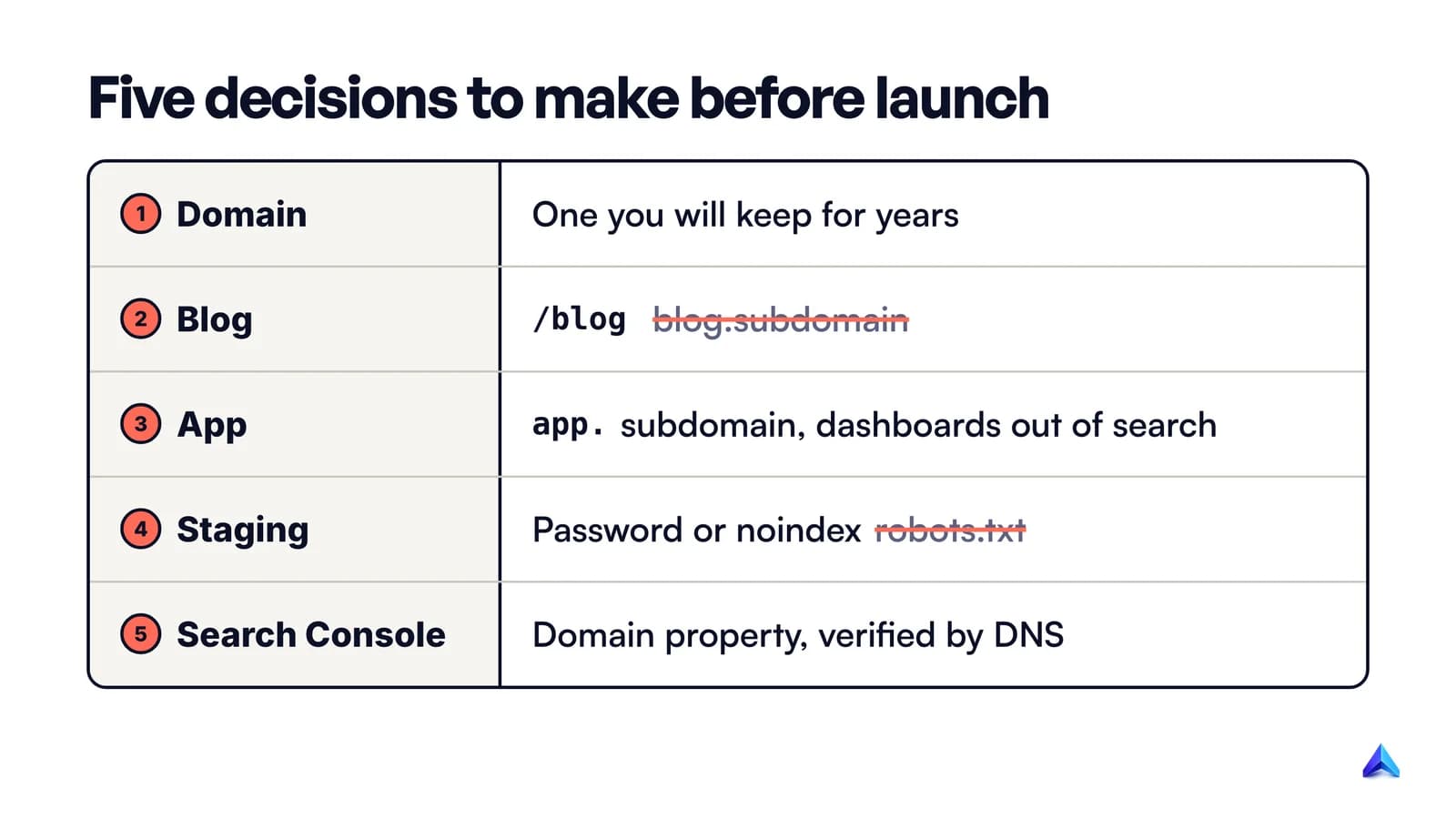
Most SEO work can be fixed later. These five cannot, or only at real cost, so make them before the marketing site goes live.
1. Pick the domain you will keep
Choose the domain you expect to have in three years, not the one that was free this week. Changing it later is a site move, and Google's site move documentation says a small to medium site can take a few weeks for most pages to move, with ranking fluctuations while Google recrawls. That is survivable, but it is a few weeks you would rather spend publishing.
The country question matters more for US, UK and Indian startups than most guides admit. Google's multi-regional guidance says a country-code domain such as .in or .co.uk sends a strong signal that the site is meant for that country, and lists its main drawback plainly: it can only target a single country. A Pune bakery chain should happily use .in. A Bengaluru SaaS company selling to the US and UK should not, because .in tells Google the site is for India.
Two details from the same page are useful. Google treats some country codes as generic, including .ai, .io and .co, so a startup on one of those is not geotargeted to Anguilla or the British Indian Ocean Territory. And if you later need country versions, subfolders such as /uk/ and /in/ on one generic domain are, in Google's words, easy to set up and low maintenance.
2. Put the blog in a subfolder
Use yourstartup.com/blog, not blog.yourstartup.com. Mueller's view is that content "meant to be tightly connected to the main site" belongs on the main site, and a subdomain suits content meant to stand on its own. A startup blog exists to support the product, so it belongs with it. He also lists the practical cost of subdomains: separate verification in Search Console, analytics tracking, DNS, hosting and security policies. A five-person team does not need that overhead.
Hosted blog platforms often default to a subdomain. If yours does, a reverse proxy can serve it under /blog. Do it before you publish post number one.
3. Keep the app and the marketing site apart
Your logged-in product should live on app.yourstartup.com or behind a login, and should not compete with your marketing pages in search. Sign-up and login pages can be indexed, but dashboards, settings screens and empty states should not be.
4. Lock down staging properly
Staging sites end up in Google when someone adds a robots.txt disallow and assumes that is enough. Google's robots.txt documentation is explicit that it "is not a mechanism for keeping a web page out of Google". Password-protect staging, or use noindex. Then check, on launch day, that the noindex did not ship to production with the rest of the build.
If the marketing site is a single-page app, render it on the server or pre-render it. Google's JavaScript guidance calls server-side or pre-rendering "still a great idea" because not all bots can run JavaScript.
5. Set up Search Console as a Domain property
Verify a Domain property through a DNS record on day one. It covers every protocol and subdomain, so http, https, www and app. all report in one place. Submit your sitemap, then use our guide on checking whether a page is indexed for the first few pages you care about.
The first pages to publish
With no authority and no brand demand, the pages that win first are the ones closest to a purchase decision. They have lower search volume, but the person searching already knows what they want, so a few visits can mean a demo booked.
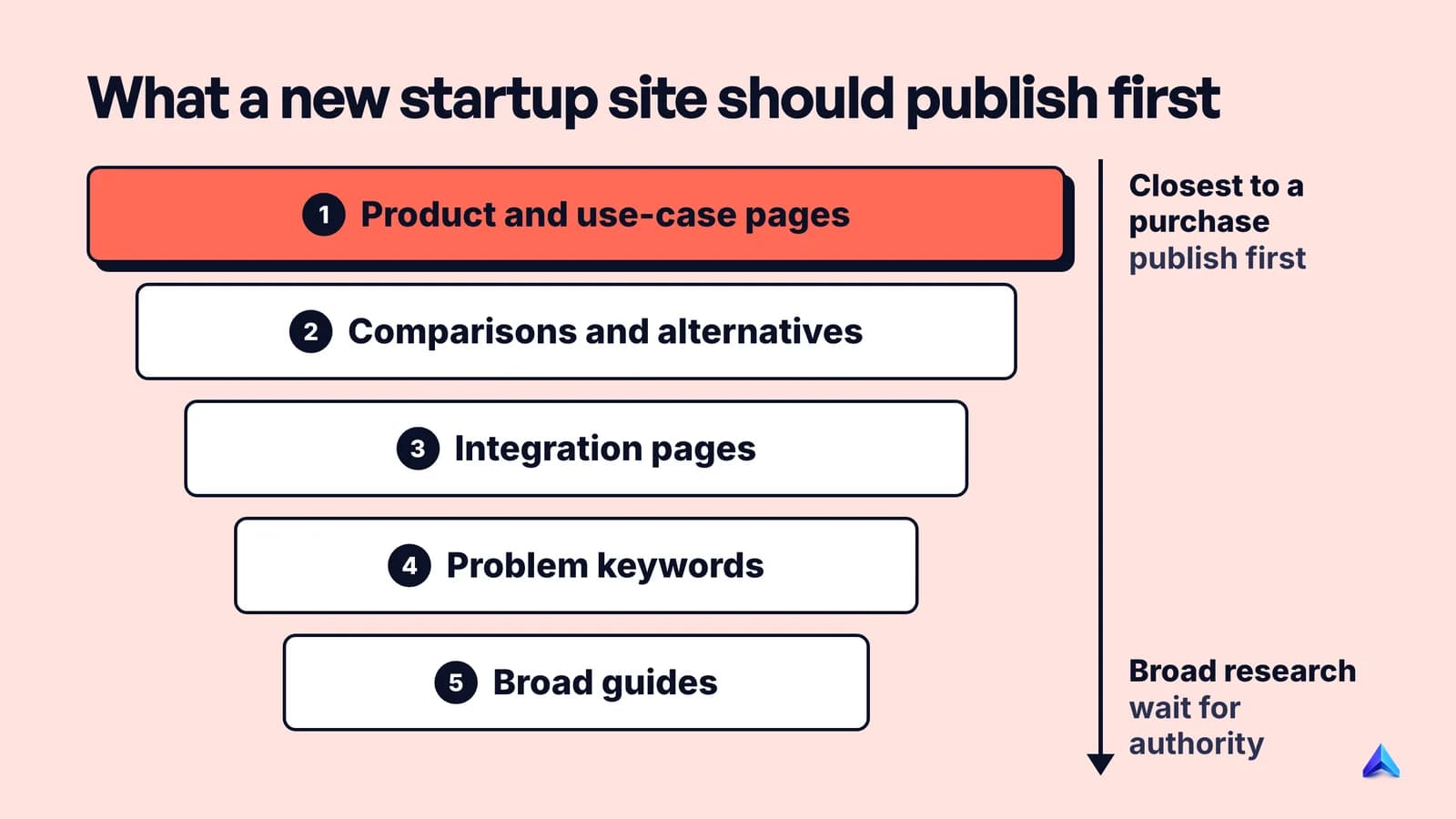
Publish in roughly this order:
- Product and use-case pages. One page per job your product does, in the words customers use. "Invoice software for freelancers in the UK" beats "Powerful billing platform". These pages often rank for long, specific queries that tools show as zero or near-zero volume.
- Comparison and alternatives pages. "YourProduct vs Incumbent" and "Incumbent alternatives". People searching these are mid-decision. Being absent means a competitor or an affiliate site tells the story for you.
- Integration pages. "Connect YourProduct to HubSpot", "Zoho Books integration". If you integrate with something popular, its users search for exactly this.
- Problem keywords. The specific, slightly technical questions your buyers ask before they know your category exists: "how to reconcile Stripe payouts in Tally", "why GST invoices get rejected". Low volume, low difficulty, high fit.
- Broad guides last. "What is a CRM" will not rank for a new domain, and an AI Overview can answer it on the results page anyway.
Pick targets by matching keyword difficulty against your site's authority rather than by volume. The SEO plan guide walks through that test in detail. Project Rankup's keyword view does this check for you, judging difficulty against your own domain's authority after reading your site, but a spreadsheet and any keyword tool can do the same job.
Your support inbox and sales calls are the best keyword research a startup has. Every question a prospect asks twice is a page.
How to write comparison and alternatives pages people trust
These pages fail when they read as sales copy, and readers can tell within a paragraph. Google's guidance on writing high-quality reviews is the best public standard for them, even though it is written for product reviews. It asks reviewers to show evidence of first-hand experience, to "explain which might be best for certain uses or circumstances", and to discuss "benefits and drawbacks ... based on your own original research".
Applied to a startup's own comparison pages, that means:
- Say who should pick the competitor. If the incumbent is better for 500-seat enterprises, write that. It costs you nothing with readers who were never your customer and earns trust with the ones who are.
- Show, don't claim. Screenshots of the same workflow in both products, real setup times, actual plan limits with the date you checked them.
- Date and maintain it. Competitor pricing changes. A comparison with last year's prices is worse than none.
- Lead with the difference, not the verdict "we're better". Readers decide "better" for themselves.
- Use the currency your buyer uses. If you sell in India and the UK, show ₹ and £ next to $, not dollars alone.
One alternatives page per major competitor is enough in year one.
SEO when the product changes every week
Startups break their own SEO more often than Google does. The usual cause is renaming things.
Keep URLs stable when names change. If "Smart Inbox" becomes "Triage", keep /features/smart-inbox and update the page, or 301 it to the new URL. Never just delete it. A slug that describes the job (/features/email-triage) survives a rename better than one that repeats the current marketing name.
Treat docs and the changelog as SEO assets. Public help docs answer exactly the specific, problem-shaped queries a new domain can rank for. A short, dated changelog page per meaningful release also gives Google a reason to recrawl.
Give every page an owner and a review date. A spreadsheet with URL, owner and "last checked" is enough. When the product team ships a pricing change, whoever owns /pricing and the comparison pages updates them that week.
After a pivot, redirect or retire deliberately. If you change audience, old pages targeting the old audience either get a 301 to the closest new page or a 410 if nothing fits. Leaving them live splits your site's topic.
Mueller has said small changes, such as a homepage and "maybe one or two other pages", probably show in Search within a week or two. Use that as your check interval after each release.
Getting your first links honestly
You need some links, but not many, and not yet in month one. Our on-page vs off-page SEO breakdown explains why a new site should fix its own pages before chasing links. Link building for startups gets its own post, so this is the short version.
Startups have link sources most businesses do not:
- Launch coverage. Product Hunt, a Hacker News Show HN, Indian startup media, UK tech newsletters. Some links will be nofollow; the referral traffic and brand searches still count.
- Integration partners. If you build on Shopify, Slack or Zoho, their app marketplaces and partner directories link to listed apps.
- Investors and accelerators. Portfolio pages link to their companies. Ask for the link to point at your real domain.
- Customers. A case study that your customer also publishes, or a "built with" mention, is a natural link.
- Something only you have. Anonymised data from your product, a free tool, or a benchmark. One useful data post tends to earn more links than a stack of guest posts.
Avoid buying links. Google's spam policies name exchanging money, goods or services for links, excessive link exchanges, and guest posts or press releases with optimized anchor text as link spam. The cheap "high-DA guest post" offers that land in a founder's inbox are exactly that.
What to skip in year one
Saying no is most of startup SEO. These are the common time sinks.
Programmatic pages at scale. Generating 2,000 "YourProduct for [city]" pages is tempting with AI tools. Google's spam policies describe scaled content abuse as many pages made mainly to manipulate rankings, "no matter how it's created", and list "using generative AI tools ... to generate many pages without adding value" as an example. If each page does not have something unique to say, do not make it.
Buying an expired domain for its links. The same policies call out expired domain abuse: buying an old domain and repurposing it to manipulate rankings. Start on your own domain.
A country site per market. Separate .co.uk and .in sites triple the maintenance for a team that can barely keep one site current. Use one domain and add subfolders when you have localised pricing or content to put in them.
Head terms. "Project management software" is not your keyword yet. Revisit it when your site has links and a body of pages ranking for related long-tail queries.
A big tool stack. Search Console, Bing Webmaster Tools and one keyword tool cover year one. Our older roundup of SEO tools for startups in India lists free and cheap options.
Chasing a perfect PageSpeed score. Fix anything that makes the site genuinely slow or broken on a phone, then go back to content. Fast enough beats perfect.
A 12-month timeline, and what "working" looks like
Mueller has said that a site with no prior SEO will probably see "a nice big jump in the beginning" as basics are fixed, and then progress becomes "slow and regular". That matches the shape of a realistic startup year.
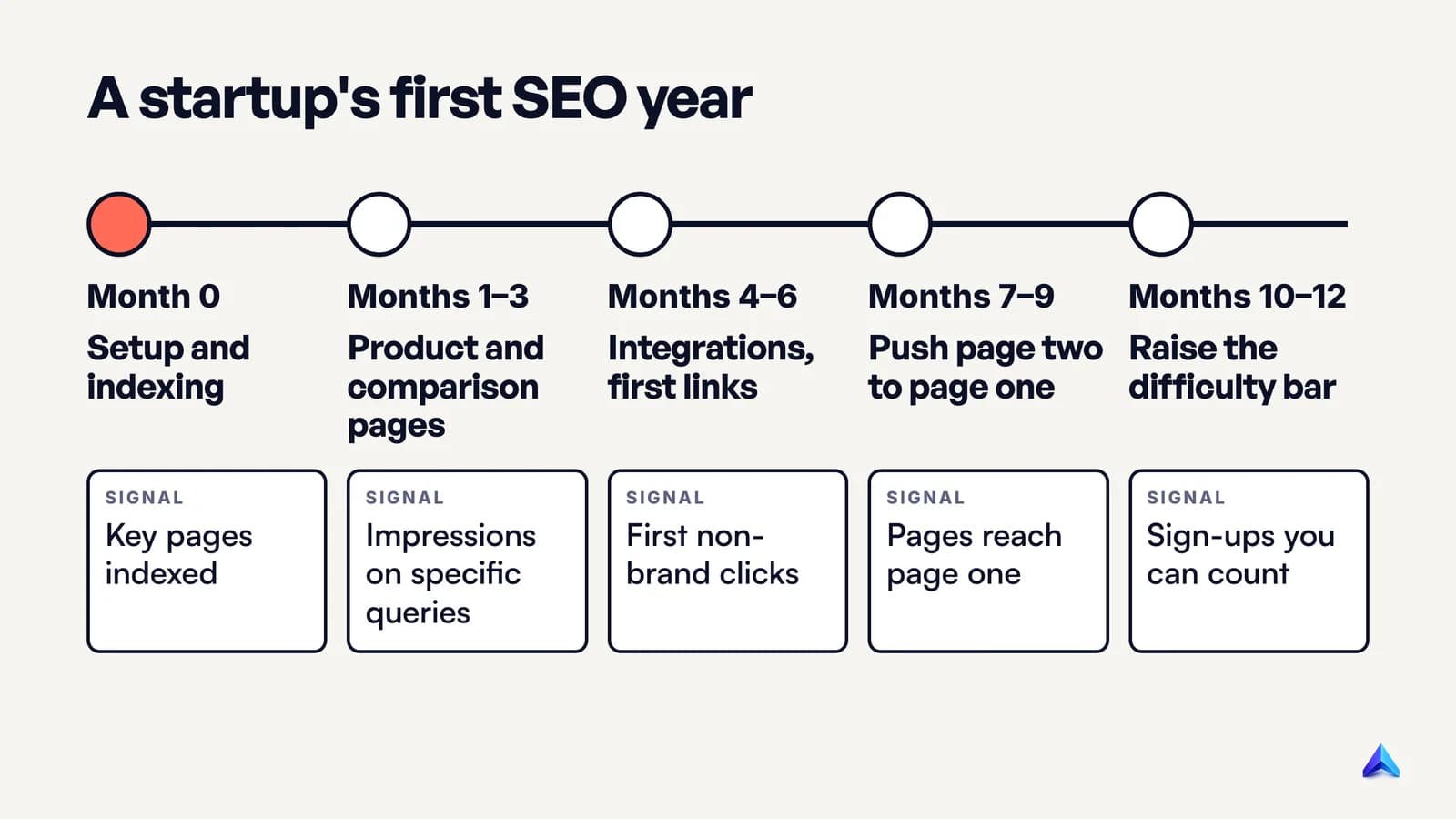
| Months | Do this | Signal it is working |
|---|---|---|
| 0 (pre-launch) | Domain, structure, staging, Search Console, sitemap | Key pages show as indexed |
| 1 to 3 | Product and use-case pages, 1 to 3 comparison pages | Impressions on long, specific queries |
| 4 to 6 | Alternatives and integration pages, first problem-keyword posts, launch and partner links | First clicks from non-brand queries; a few sign-ups attributed to organic |
| 7 to 9 | Update what is ranking on page two; add problem keywords from support tickets | Pages moving from page two to page one |
| 10 to 12 | Re-check authority, raise your difficulty ceiling, expand into adjacent topics | Organic sign-ups or demos you can count each month |
Three rules for reading the numbers:
- Impressions come before clicks. In months one to three, a page with impressions and no clicks is on track. A page with no impressions at all after six weeks usually has an indexing or targeting problem, not a patience problem.
- Separate brand from non-brand. As soon as you get press, brand searches will rise. They are welcome, but they are not SEO working. Filter them out in Search Console's query report.
- Count sign-ups, not sessions. Founders and investors care about pipeline. Our guide to SEO ROI covers how to attribute revenue to organic without inflating it.
If you are a founder doing this yourself and want to learn the craft in a sensible order, the SEO roadmap lays out what to learn first.
When to hire, and who
Google's own advice on hiring makes an interesting point for startups: a great time to hire is "when you're considering a site redesign (the earlier, the better), or planning to launch a new site". A few hours of expert review before launch can prevent the expensive mistakes in the pre-launch section above.
A sensible sequence:
- Pre-launch: a consultant for a one-off review. A few hours on domain, structure, rendering and indexing. Fixed scope, fixed fee.
- Months 1 to 6: the founder plus a freelance writer who knows the domain. The founder owns keyword choices and comparison pages, because nobody else knows the product and competitors as well. A writer with subject knowledge turns support questions into pages.
- After product-market fit: a dedicated in-house hire or a startup-focused agency. Hire when you can show that organic sign-ups exist and you want more of them. Before that, a full-time SEO hire spends half their time waiting for the product to settle.
When interviewing an agency or a startup SEO consultant, Google suggests asking "What kind of results do you expect to see, and in what timeframe? How do you measure your success?" It also advises granting read-only Search Console access during an audit, and warns that no one can guarantee a #1 ranking. Treat any proposal that promises page one by a date as a red flag. Our older guide to small business SEO covers more of the agency-versus-DIY trade-off for very small teams.
Frequently asked questions
Is SEO worth it for an early-stage startup?
Yes, but in proportion. Before product-market fit, do the pre-launch setup and a handful of bottom-of-funnel pages: product, use-case and comparison pages. Those cost little and protect you from competitors owning your category queries. Save heavy content investment until you know which audience and positioning will stick, so you are not rewriting everything after a pivot.
Is SEO dead now with AI?
No. Google says the best practices for SEO remain relevant for AI features such as AI Overviews and AI Mode, with no additional requirements or special optimizations. What has changed is that broad definitional queries are often answered on the results page, which is one more reason for startups to target specific, decision-stage queries first.
Can ChatGPT do SEO for a startup?
It can help with drafts, outlines and keyword brainstorming, but it cannot do the parts that make startup SEO work: knowing your product, your customers' real questions and your competitors' weaknesses. Google's spam policies also treat mass-produced AI pages without added value as scaled content abuse, so use AI as an assistant, not as a publishing machine.
How much should a startup spend on SEO?
Budget in time before money. In year one, most of the cost is a founder's hours and a freelance writer, plus a keyword tool subscription. Spend on a one-off expert review before launch. Commit to a retainer or a full-time hire only after organic search has produced sign-ups you can count, so you are scaling something proven.
Should a startup start with SEO or paid ads?
Both, for different jobs. Paid search gives you data in days: which keywords convert and what messaging works. SEO takes months but compounds. A sensible pattern is to run small paid campaigns first to learn which queries convert, then build organic pages for the winners so they stop paying for those clicks.