SEO for law firms means getting your practice-area pages, Google Business Profile and legal articles in front of people searching for the matters you take, in the places you are licensed to practise. The work is ordinary SEO with three extra constraints: Google holds legal content to its strictest quality bar, most enquiries are local, and your regulator decides what your website may say. Get the rules right first, then build pages, profiles and reviews inside them.
Most guides on SEO for lawyers never quote a single advertising rule. This one starts there, for the US, England and Wales, and India, then covers the five jobs that move a firm's organic traffic.
What makes law firm SEO different
Legal content is "Your Money or Your Life" content. Google's documentation says its systems "give even more weight to content that aligns with strong E-E-A-T" on topics that could affect people's health, finances or safety. A page on custody or deportation appeals sits squarely in that group.
Demand is local and jurisdictional. A tenant in Ohio cannot hire a landlord-tenant lawyer licensed only in Texas, however good the article.
The regulator reads your website too. A testimonial, a "specialist" badge or a review-request email is marketing to an agency and a regulated communication to a bar. The same tactic can be fine in London and misconduct in Mumbai.
The advertising rules that shape a law firm website
Nothing below is legal advice. We quote each regulator's own text; check your own bar or regulator before you publish, because local versions differ.
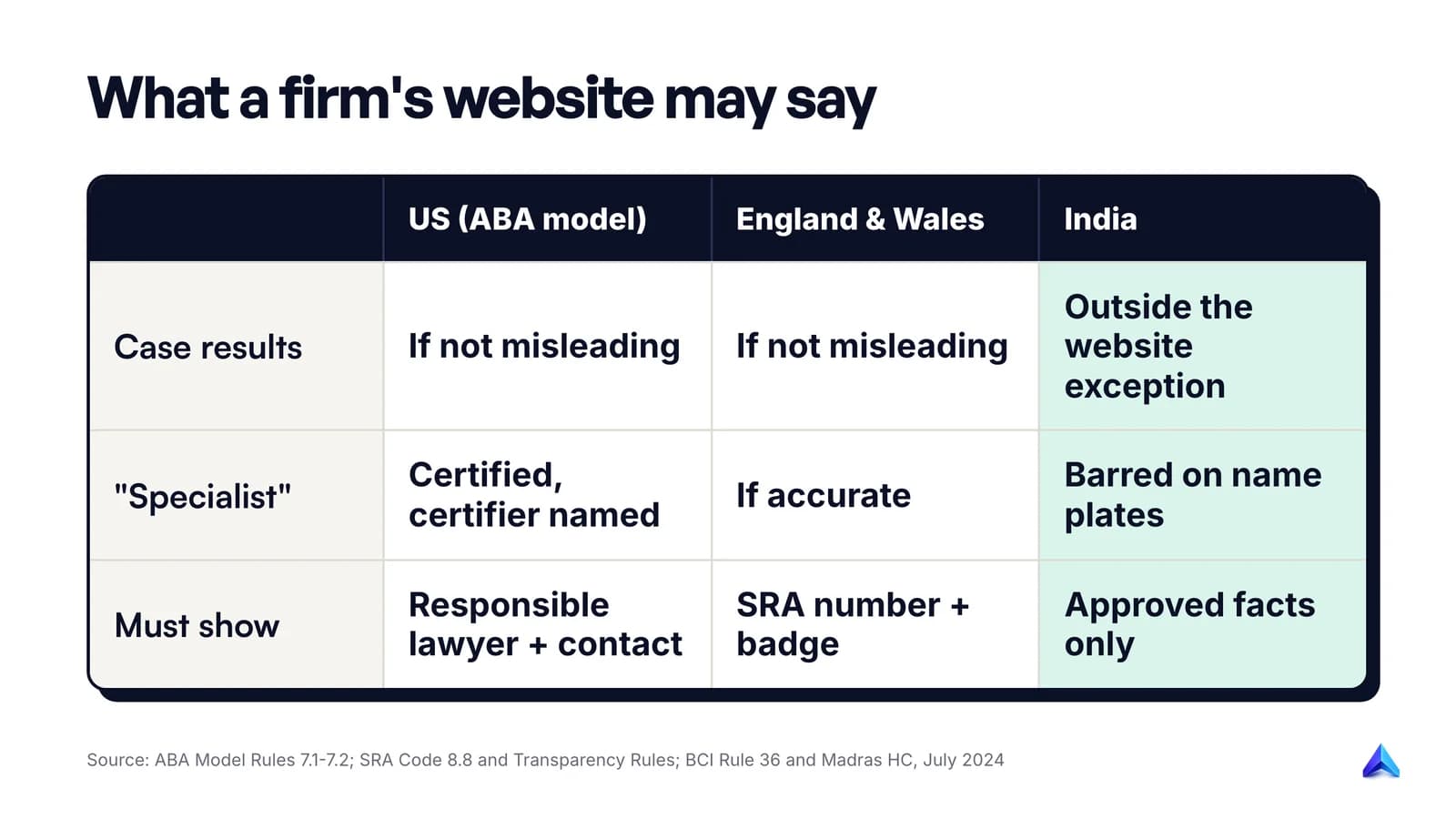
United States: ABA Model Rules 7.1 to 7.3, and your state's version
The anchor is ABA Model Rule 7.1: "A lawyer shall not make a false or misleading communication about the lawyer or the lawyer's services." A true statement still breaches it if it omits a fact needed to stop the whole message misleading. Every page on your site counts, blog posts and FAQ answers included.
The official comments turn that into website rules:
- Case results. Comment [3] says a truthful report of past wins can mislead if it leads a reader to expect the same result "without reference to the specific factual and legal circumstances" of their own case. A disclaimer may prevent that finding.
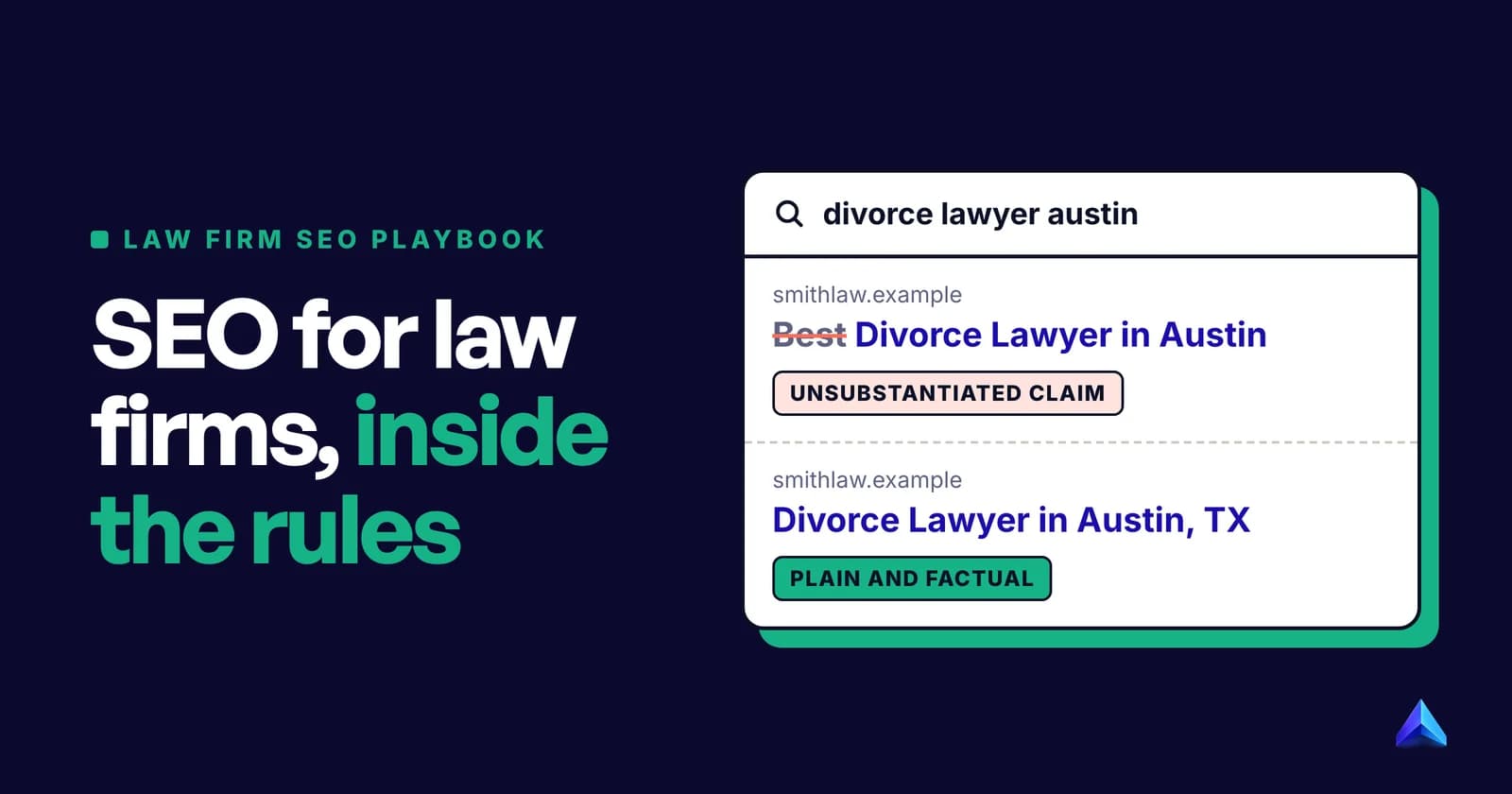
- Comparisons. An unsubstantiated comparison with other firms "may be misleading". "Best divorce lawyer in Austin" in a title tag is that kind of claim.
- Domain names. Comment [5] allows a distinctive website address or social handle only if it "is not misleading".
Rule 7.2 lets lawyers advertise "through any media" but bars giving "anything of value to a person for recommending the lawyer's services", apart from exceptions such as paying for advertising. You may not claim to be a certified specialist unless an approved body certified you and you name it, and every communication must name at least one responsible lawyer or firm with contact details. Rule 7.3 defines solicitation as a communication "directed to a specific person" known to need help in a particular matter. A practice-area page that anyone can find is not that.
These are model rules. Each state adopts its own version, and the ABA's adoption list notes that Puerto Rico has not adopted them at all. Versions also change: New York replaced its advertising rules on June 1, 2026. According to the New York State Bar Association's summary, the new rules "essentially adopt" the ABA's 2018 model text, and the old requirements to label ads "Attorney Advertising" and to add "Prior results do not guarantee a similar outcome" are gone.
England and Wales: the SRA Code and Transparency Rules
Paragraph 8.8 of the SRA Code of Conduct for Solicitors requires publicity that is "accurate and not misleading, including that relating to your charges". Paragraph 8.9 bans unsolicited approaches to the public, other than current or former clients, to advertise your services.
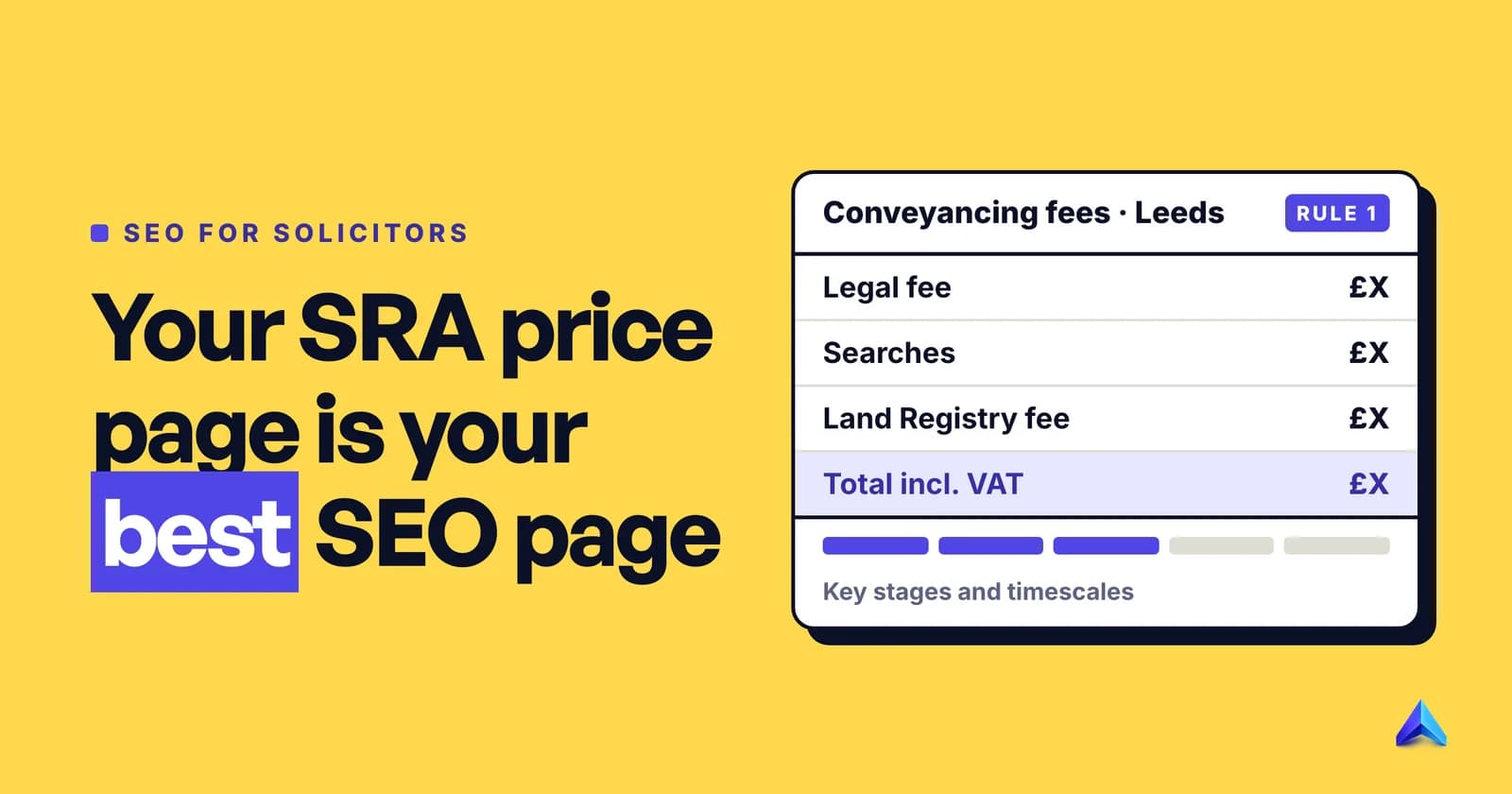
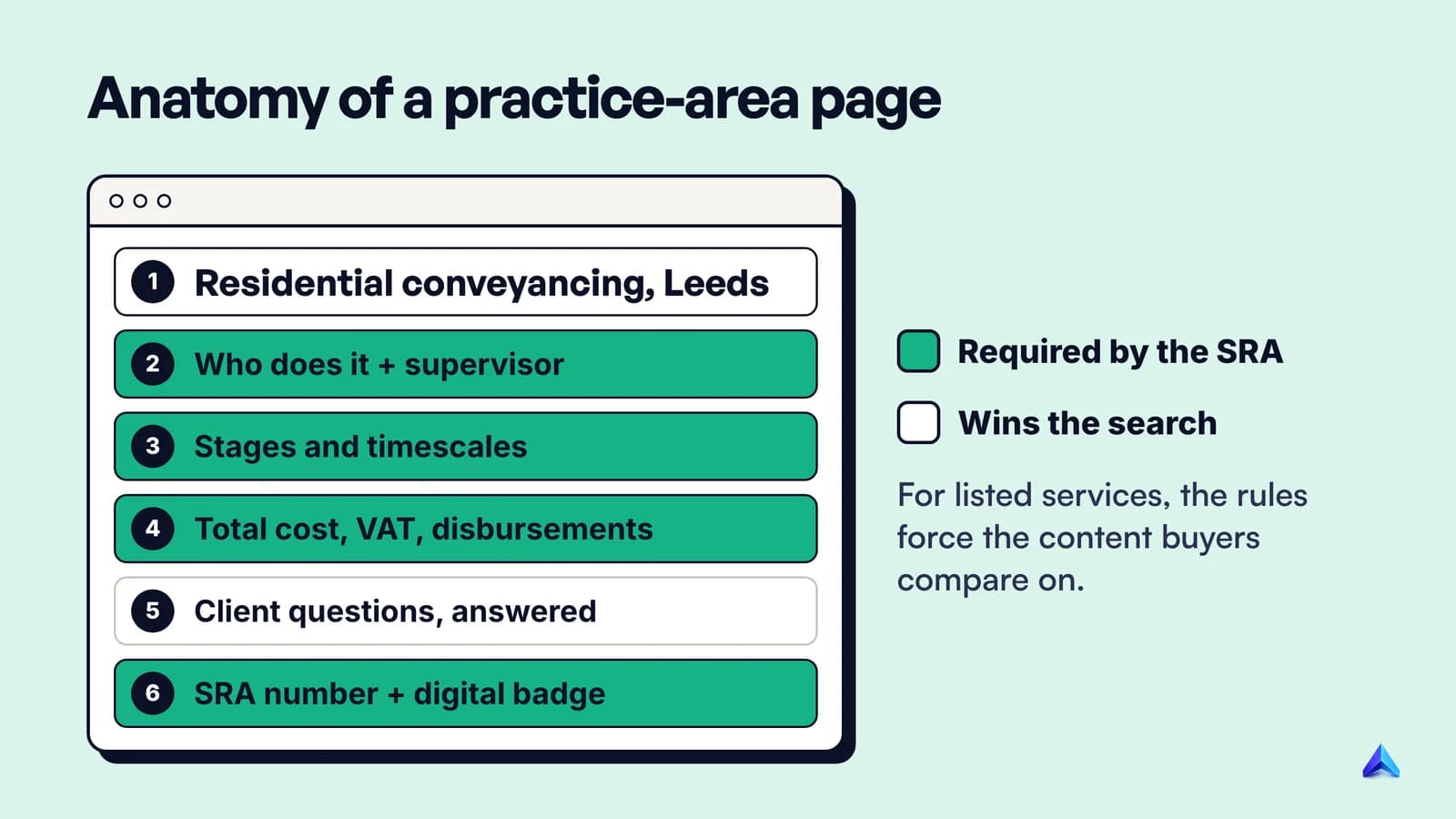
The SRA Transparency Rules go further, and they are an SEO asset in disguise. If you advertise residential conveyancing, uncontested probate, immigration applications or appeals (excluding asylum), summary-only motoring offences, unfair or wrongful dismissal claims, debt recovery up to £100,000 or business premises licensing, you must publish cost information on your website. It must cover the total cost or a range, the basis of charges, the experience of whoever does the work and their supervisor, disbursements, VAT, and the key stages and timescales, "in a prominent place". Firms must also publish their complaints procedure and display their SRA number and digital badge.
Every one of those items is something a person comparing conveyancing solicitors looks for. A pricing page with real stages, fees and named fee earners beats a PDF buried in the footer. Our guide to SEO for solicitors goes deeper on the UK rules, including Scotland and Northern Ireland, which have their own regulators.
India: Bar Council of India Rule 36
India is the strictest of the three. Rule 36 of the Bar Council of India Rules says an advocate "shall not solicit work or advertise, either directly or indirectly", whether through circulars, advertisements, touts, personal communications or press comment on their cases. It also bars name plates and stationery from indicating that an advocate specialises in any type of work.
Websites are allowed in a narrow form. In a July 2024 judgment, the Madras High Court described the one exception: advocates "can furnish website information as prescribed in the Schedule under intimation to and as approved by Bar Council of India". The court held that breaching Rule 36 invites action under section 35 of the Advocates Act, 1961, said that "ranking or providing customer ratings to lawyers is unheard of", and ordered Quikr, Sulekha and Justdial to remove violating content. The Bar Council of India then told State Bar Councils to act against advocates soliciting work through online portals.
We could not find the approved Schedule on an official source, so we do not list its items. Ask your State Bar Council before your site goes beyond basic facts. For Indian firms, SEO mostly means being found for your own name and firm name.
Step 1: Build practice-area pages before the blog
Start with the pages that convert. A person searching "contested will solicitor Leeds" or "DUI lawyer Phoenix" wants a page about that service, not an article on the history of probate.
Build one page per matter type, not one page for "Family Law". Divorce, child arrangements, financial settlements and prenuptial agreements are searched separately and need different facts. Each page should answer, in this order:
- What you handle, and where: the matter type, courts and the jurisdictions where you are admitted.
- Who does the work: their experience and qualifications, which the SRA requires for listed services. Names help too.
- How the matter runs: stages, timescales and what the client must provide.
- What it costs: fixed fees or ranges where you can. Mandatory for SRA-listed services, a trust signal everywhere else.
- Questions clients actually ask, answered briefly by a lawyer.
- One contact route, naming the responsible lawyer or firm, as ABA Rule 7.2(d) requires.
Then choose which pages to build first. Broad terms such as "personal injury lawyer" are dominated by established firms and directories, and a new site should not expect to rank for them in its first year. Our explainer on keyword difficulty shows how to match targets to your domain's authority, and our guide to building an SEO plan covers sequencing. A narrow matter type plus a town ("probate solicitor Harrogate") is where a small firm wins first.
The blog comes second. It answers questions people ask before they are ready to hire, such as how long uncontested probate takes, and links each answer to the matching practice-area page.
Step 2: Set up Google Business Profile for the firm and its lawyers
For "near me" searches and the map pack, your Business Profile matters more than your website, and lawyers have their own rules.
Google's Business Profile guidelines list lawyers as "individual practitioners". A lawyer qualifies for a profile only if they are public-facing and "can be contacted directly at the verified location during stated hours". Support staff should not have profiles, and a practitioner "shouldn't have multiple Business Profiles to cover all of their specializations".
| Your firm | What Google allows |
|---|---|
| Several public-facing lawyers at one office | A profile for the office, plus optional profiles for each lawyer, named with the lawyer's name only |
| One lawyer at a branded office | One shared profile, named "[Firm]: [Lawyer name]" |
| Solo lawyer | One profile in the name you trade under |
Titles such as "Esq." or "JD" are allowed in practitioner names. Extra words are not: "Smith Law Car Accident Lawyer Dallas" is the kind of name Google says "could result in the suspension" of the profile.
A virtual office, meaning a mailing address you do not operate from, is not eligible, and a profile showing its address needs permanent signage there. If you meet clients at their homes or by video across a region, use a service area instead.
For UK firms, our local SEO UK playbook covers verification, categories and the registered-office trap. Indian advocates should ask their State Bar Council how it views a public profile that displays star ratings, given the Madras High Court's view of ratings.
Step 3: Get reviews without breaching three sets of rules
Reviews feed local rankings, and three rulebooks apply to them at once.
Google's rules apply everywhere. Its review policy bans offering "payment, discounts, free goods and/or services" for a review, and bans the practice to "selectively solicit positive reviews". Reviews from current or former staff are a conflict of interest.
Consumer law adds penalties. In the US, the FTC's rule on fake reviews, announced on August 14, 2024, bans incentives "conditioned on the writing of consumer reviews expressing a particular sentiment" and bans "unfounded or groundless legal threats" to get a negative review removed. In the UK, fake reviews and concealed incentivised reviews have been banned practices under the Digital Markets, Competition and Consumers Act 2024 since April 2025.
Your regulator adds its own layer. ABA Rule 7.2(b) bars giving anything of value for a recommendation, so a discount for a five-star review fails twice. In India, do not run a review campaign without your State Bar Council's view.
What works: ask every client at the same point, such as when the file closes, with the same neutral message and a direct link. No incentive, no filtering by outcome.
Replying to a bad review
In ABA Formal Opinion 496, issued January 13, 2021, the ABA concluded that "a negative online review, alone" does not justify disclosing client information in self-defense. A reply that mentions the matter, the outcome or anything the client told you can breach confidentiality.
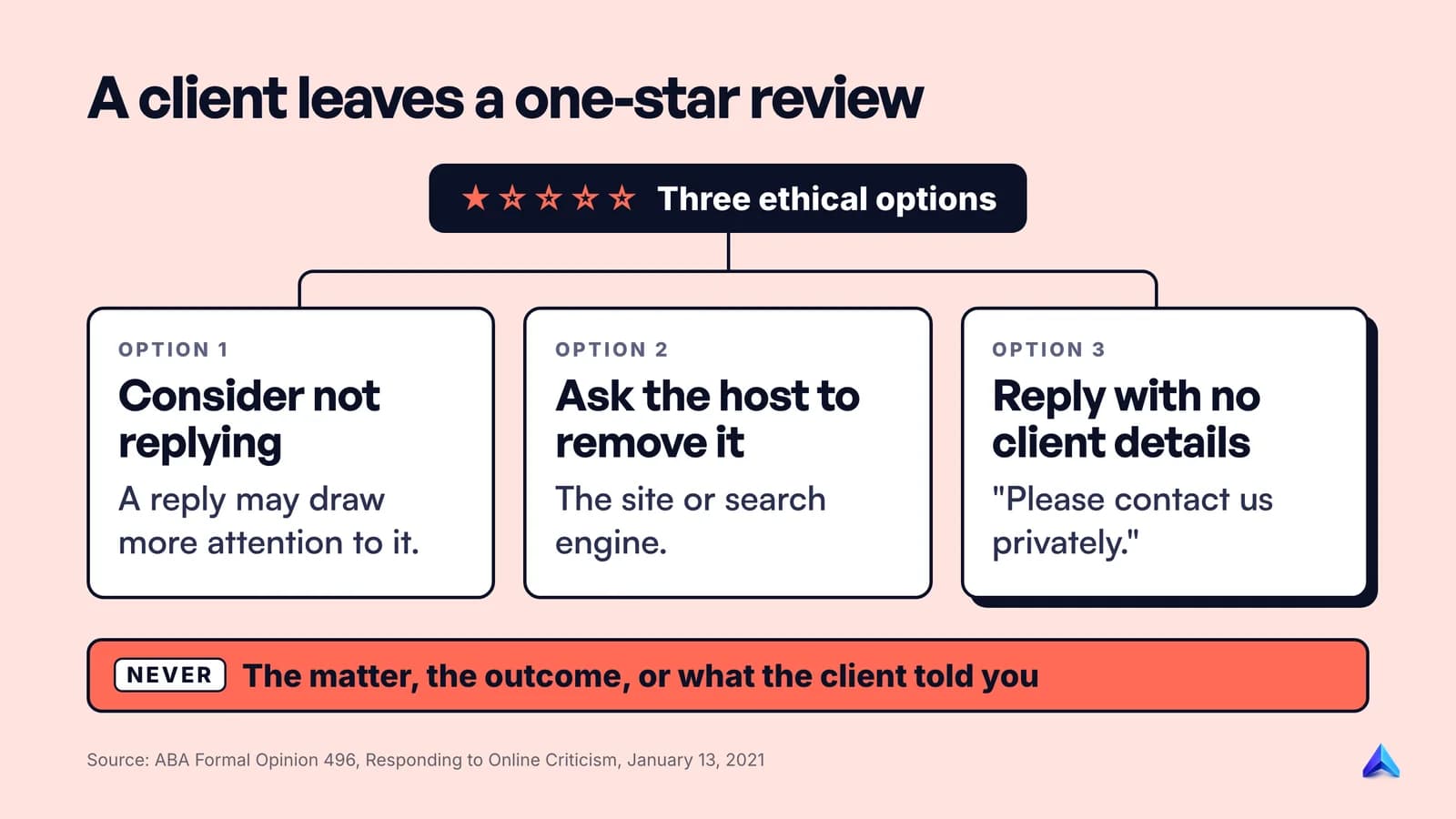
The opinion gives three options. Consider not responding, because a reply "may draw more attention" to the review. Ask the website or search engine host to remove it. Or reply without disclosing anything, by inviting the person to contact you privately or saying professional considerations prevent a response. "Please call our office so we can discuss this" is safe. "As we told you, your claim was time-barred" is not.
Step 4: Write legal content that meets the YMYL bar
Google's search quality raters do not rank pages; Google says their ratings help confirm its changes are working. Their guidelines are still the clearest public statement of what "good" means for legal pages. The September 2025 edition defines YMYL topics as those that "could significantly impact the health, financial stability, or safety of people, or the welfare or well-being of society". If a YMYL page gives advice, "a high level of expertise may be required for the page to be trustworthy", and trust is "the most important member of the E-E-A-T family". Raters are also told to expect reputation information for "professionals such as lawyers and doctors".
For a law firm, that translates into five habits:
- A named lawyer writes or reviews every article, with a byline linking to a profile that lists admissions and years in practice.
- State the jurisdiction in the first lines. "In England and Wales, a will must be signed in front of two witnesses" is useful; without the jurisdiction it is wrong for most readers.
- Cite the statute, rule or court page, and link to the official source.
- Show a "last reviewed" date. Law changes, as New York's June 2026 rules show.
- Explain without promising. Process, options and typical ranges, never predicted outcomes, which is the line Rule 7.1's comment draws.
Our guide to helpful content covers how Google judges usefulness, and how to write a blog post for SEO shows the answer-first structure that suits legal questions.
Step 5: Add office and service-area pages without making doorway pages
Firms with several offices need one page per real office: address, the lawyers based there, the courts it covers and the practice areas handled locally. Each office's Business Profile should link to it.
The mistake is a page for every town within 50 miles, each with the same text and the town name swapped. Google's spam policies list "pages targeted at specific regions or cities that funnel users to one page" as doorway abuse. It is also a Rule 7.1 problem: "Springfield Divorce Lawyer" implies a presence in Springfield that a firm without an office there does not have.
If you regularly appear at a nearby county court, a page about practising there, with its procedures, filing details and local timescales, gives readers something a swapped-name page never does.
Links, directories and lead generators
Link building advice for lawyers usually skips the rule that governs it. ABA Rule 7.2's comments let you pay for "on-line directory listings" and "Internet-based advertisements", and say directory listings by practice area "without more" are not recommendations. A paid listing in a legal directory is fine. Paying a blogger to call you "the best family lawyer in Denver" is paying for a recommendation, and a paid link Google does not want either.
You may pay a lead generator as long as it does not recommend you or imply it has "analyzed a person's legal problems" to choose you. The same comment points to Rule 5.3, which makes lawyers answerable for the non-lawyers they hire. That includes your SEO agency: if it buys links or writes fake reviews, the professional risk is yours.
Good links come from where firms already earn them: bar association directories, law school pages, local business groups, CLE or CPD talks, and journalists quoting your lawyers on a ruling.
How to tell if it is working
Rankings for "lawyer + city" are a weak measure alone. Track three things:
- Search Console clicks and impressions per practice-area page. Rising impressions with flat clicks means the title needs work; no impressions means the targeting does.
- Calls and form enquiries by source, separating organic search, the map pack and paid ads.
- Signed matters by source. Enquiries for work you do not take are not a win, however good the traffic chart looks.
Profile fixes tend to show first; practice-area pages take months, and a new domain longer. Our guide to SEO ROI shows how to value the results.
For a second read of a page before it goes live, Project Rankup's Content Audit Studio scores any URL or draft for SEO and AI-answer readiness and lists the issues in plain English. It does not check bar rules; that review stays with a lawyer.
Frequently asked questions
Does SEO work for law firms?
Yes, when it targets matters you take in places you are licensed. Most legal searches have local intent, so a correct Google Business Profile and specific practice-area pages usually bring enquiries sooner than broad articles. Firms that chase national head terms with a new domain often wait a long time for results.
How much does SEO cost for a law firm?
It depends on how many practice areas and offices you cover and how competitive your market is. Personal injury in a large US city takes far more work to rank for than probate in a market town. Whoever does the work, the firm stays answerable for it under its professional rules.
Can lawyers ask clients for Google reviews?
In the US and UK, generally yes, if you ask every client the same way, offer nothing in return and never filter out unhappy clients. Google bans incentives and selective requests, and ABA Rule 7.2(b) bars giving value for recommendations. Indian advocates should check with their State Bar Council first.
Can a law firm website say it specializes in an area of law?
Under ABA Model Rule 7.2(c), a lawyer may not claim to be a certified specialist unless an approved body certified them and the communication names it. States differ on uncertified "specialist" wording; New York's 2026 rules allow it if it is not misleading. In India, Rule 36 bars indicating specialisation on name plates and stationery.
Is website marketing allowed for advocates in India?
Only within narrow limits. Bar Council of India Rule 36 prohibits advertising and solicitation, with an exception for website information prescribed by the Bar Council of India. In 2024 the Madras High Court and the Bar Council of India acted against advocates soliciting work through online portals.