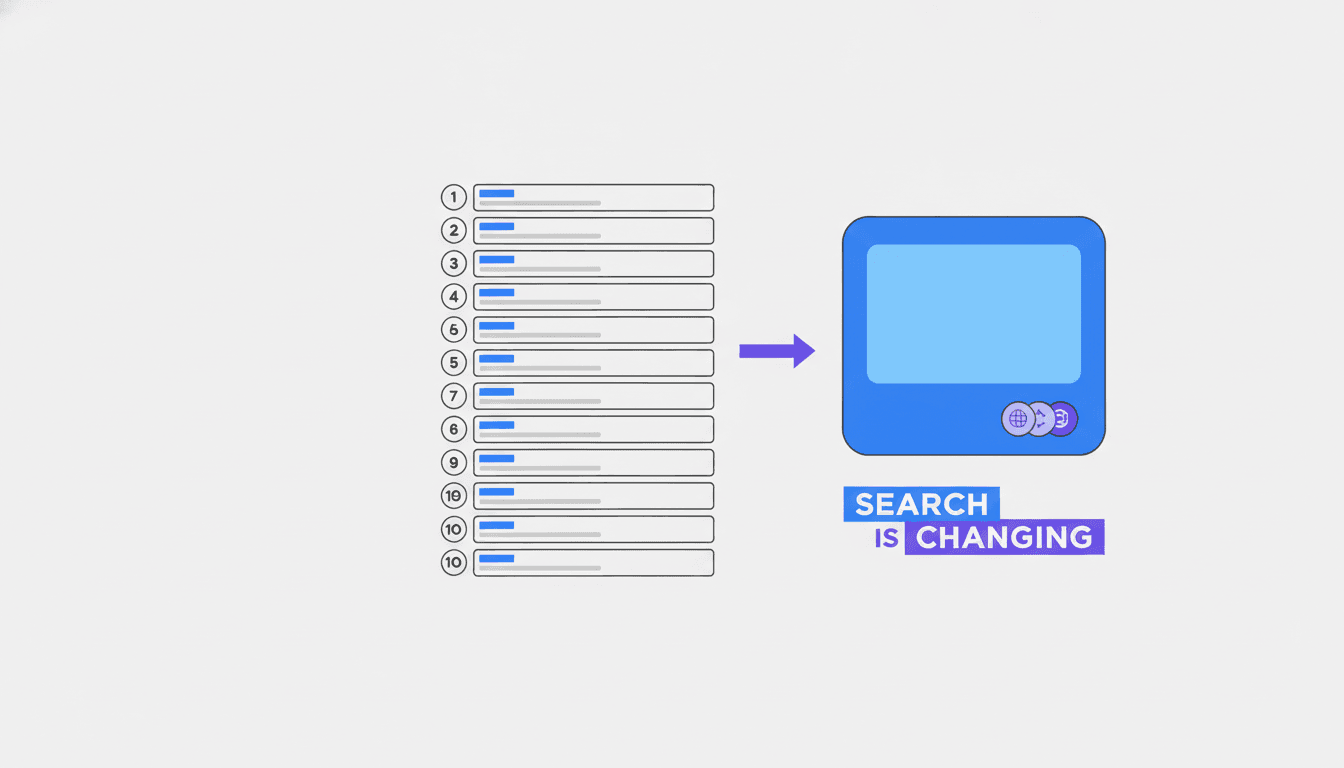
AI keyword research is no longer a future concern. It is the current condition of search. Generative AI has restructured how Google, ChatGPT, and Perplexity surface answers, and that restructuring hits keyword strategy first. If you are still building keyword lists the way you did in 2022, you are optimising for a search engine that no longer fully exists.
The Search Result Page You Knew Is Gone
For roughly two decades, SEO strategy was anchored to one simple model: rank in the ten blue links, get clicks. That model worked because users had to click through to find an answer. AI Overviews and generative answer engines break that contract. The answer appears at the top of the page, synthesised from multiple sources, and a large share of users never scroll further.
Gartner projected in 2024 that traditional search engine volume would drop 25 percent by 2026 due to AI assistants handling queries directly. In the first four months of 2026, 68.01% of US Google searches ended without a click, according to SparkToro's 2026 zero-click study (published June 9, 2026). That projection is materialising. Zero-click searches, already high before AI Overviews rolled out, have climbed further as Google synthesises responses rather than routing users. The implication is not that SEO dies. It is that the definition of "ranking" has expanded to include citation inside AI-generated answers, not just position in a ranked list.
That shift changes what a keyword means, what intent signals matter, and which pages get rewarded.
What AI Keyword Research Actually Means Now
AI keyword research, in 2026, covers two interrelated jobs that used to be one. The first is the familiar work of identifying terms people type into search bars. The second, newer job is identifying the questions and phrasings that generative AI systems use to pull cited sources into their answers.
Those two jobs overlap significantly, but they diverge in one important way. Traditional keyword research optimises for a match between a page's content and a query string. AI citation optimisation asks whether a passage in your content is the clearest, most specific, and most authoritative answer to a sub-question inside a larger query. Google's AI Overviews often pull from passages deep inside a page, not from the page's primary keyword focus. Google's own Search Central documentation confirms that helpful, specific content written for people remains the core signal for AI Overview inclusion.
For a small business owner or freelance SEO, the practical take is this: your keyword research process must now include intent mapping at the passage level, not just the page level.
How AI Affects Long-Tail Keywords
Long-tail keywords always carried high conversion intent and low competition. AI search has made them more valuable, not less, but it has also made the category harder to define cleanly.
Generative search engines handle conversational, multi-word queries better than any previous technology. According to Semrush's 2026 State of Search report, conversational queries increased 47% year-over-year, now representing 31% of all search queries. A user asking "what should a plumber in Leeds charge for an emergency callout on a Sunday" gets a synthesised answer rather than a results page of ten competing service pages. That query would once have delivered thin search volume data in most keyword tools. Now it represents exactly the kind of specific, intent-rich question that AI systems try to answer directly.
Three things follow from this:
- Keyword tools that only surface high-volume head terms are showing you a shrinking share of real search behaviour.
- The long tail has fragmented further into conversational sub-queries that keyword volume data underreports by a wide margin.
- Content that answers a specific sub-question fully, in one passage, is more likely to be cited in AI-generated answers than content that covers a topic broadly.
A freelancer building a client's keyword strategy today should treat volume as a secondary filter, not the primary one. Intent specificity and passage clarity are the primary filters.
New Keyword Research Techniques Built for Generative Search
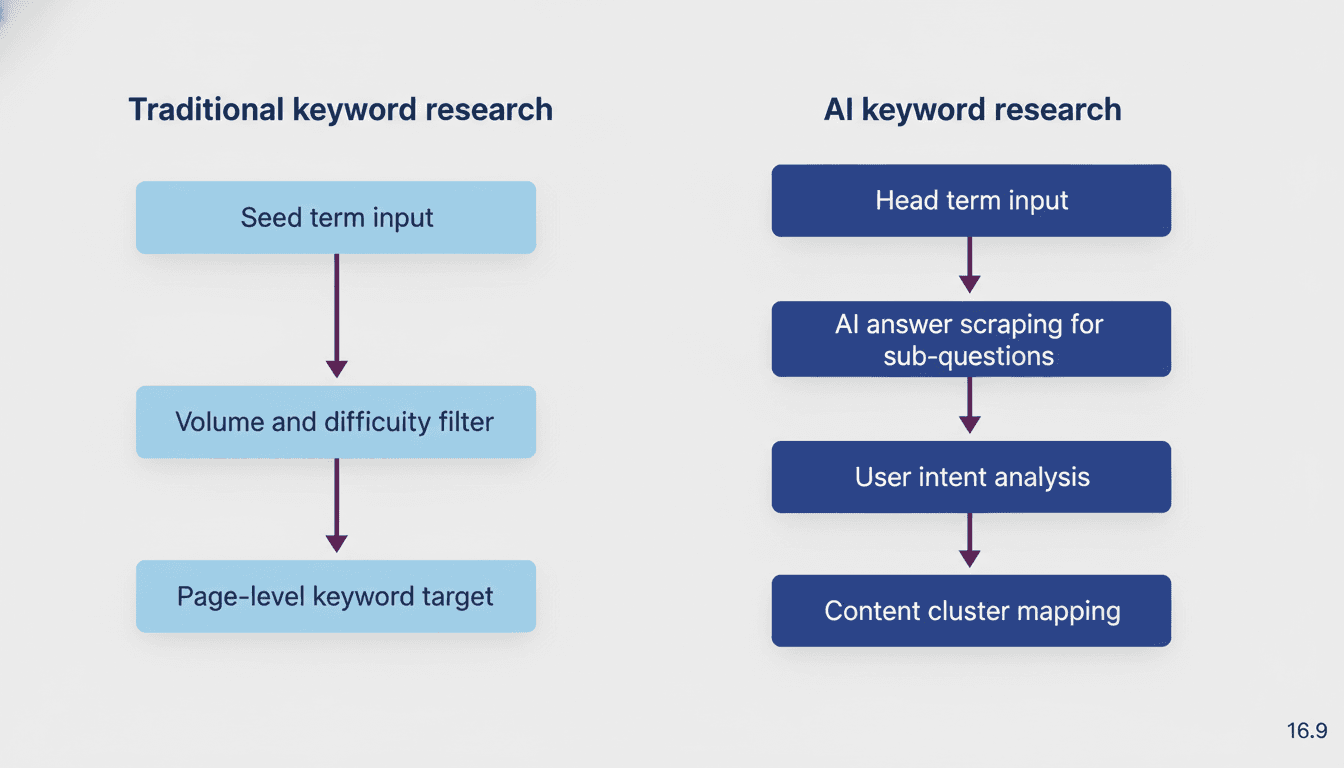
Traditional keyword research relied on seed terms, volume data, and competition scores. Those inputs still matter, but three techniques have moved from optional to essential.
Search the AI Answers First
Before building a keyword list for any topic, run the head term through Google, ChatGPT, and Perplexity. Read the generated answers carefully. Every sub-question those answers address is a keyword opportunity. Every source cited is a competitor you need to study at the passage level, not the domain level. This takes fifteen minutes and surfaces angles that no keyword volume tool will show you.
Map Questions to Passage Gaps
Take the sub-questions you collected and check whether your existing content answers each one in a clean, self-contained paragraph. If it does not, that is a content gap. Not a page gap. A passage gap. A single well-structured paragraph that directly answers a specific question can earn AI citations even on a page that ranks on page three for its primary keyword.
Use "People Also Ask" as a Citation Blueprint
Google's "People Also Ask" boxes are a direct window into how its AI structures sub-questions around a head term. Each question represents a query that AI Overviews may try to answer inline. A page that answers five PAA questions in clean, structured passages around a single topic is more citation-ready than a page that answers the head term once and moves on.
| Technique | What it finds | Best for |
|---|---|---|
| AI answer scraping | Passage-level gaps, cited sources | Content audits, new page briefs |
| PAA mapping | Sub-question keyword clusters | On-page structure |
| Conversational query expansion | Long-tail variants, voice search terms | Local SEO, service pages |
| Semantic clustering tools | Topical authority gaps | Site architecture reviews |
AI Tools for Keyword Discovery Worth Using
The market for AI-assisted keyword tools has exploded. Most of them recycle the same underlying data with a chat interface layered on top. A few do something genuinely different.
Semrush's AI-powered keyword clustering groups terms by semantic intent rather than just surface similarity, which means you can see whether two keywords belong on the same page or need separate content. Ahrefs' AI features now suggest related questions and content gaps inline within their keyword explorer. Both tools have meaningfully improved at surfacing conversational variants of head terms.
The category of tool that most practitioners underuse is AI chat itself. Prompting ChatGPT or Claude to generate every question a first-time buyer might ask about your product category produces a keyword list that no traditional tool would surface, because it draws on training data rather than click-stream samples. The caveat: you cannot get volume data this way. Use it to discover angles, then validate with a standard tool.
One decision rule worth having: if a keyword tool cannot show you search intent at the query level, not just the page level, it is giving you incomplete data for 2026 strategy. Filter your tool selection accordingly.
Also Read: The ROI of Daily Rank Tracking: Stop Revenue Loss from Rank Drops
Adapting to AI-Powered Search: A Practical Framework
Adapting to AI-powered search does not require rebuilding your site from scratch. It requires a shift in how you prioritise and structure content, applied consistently over time.
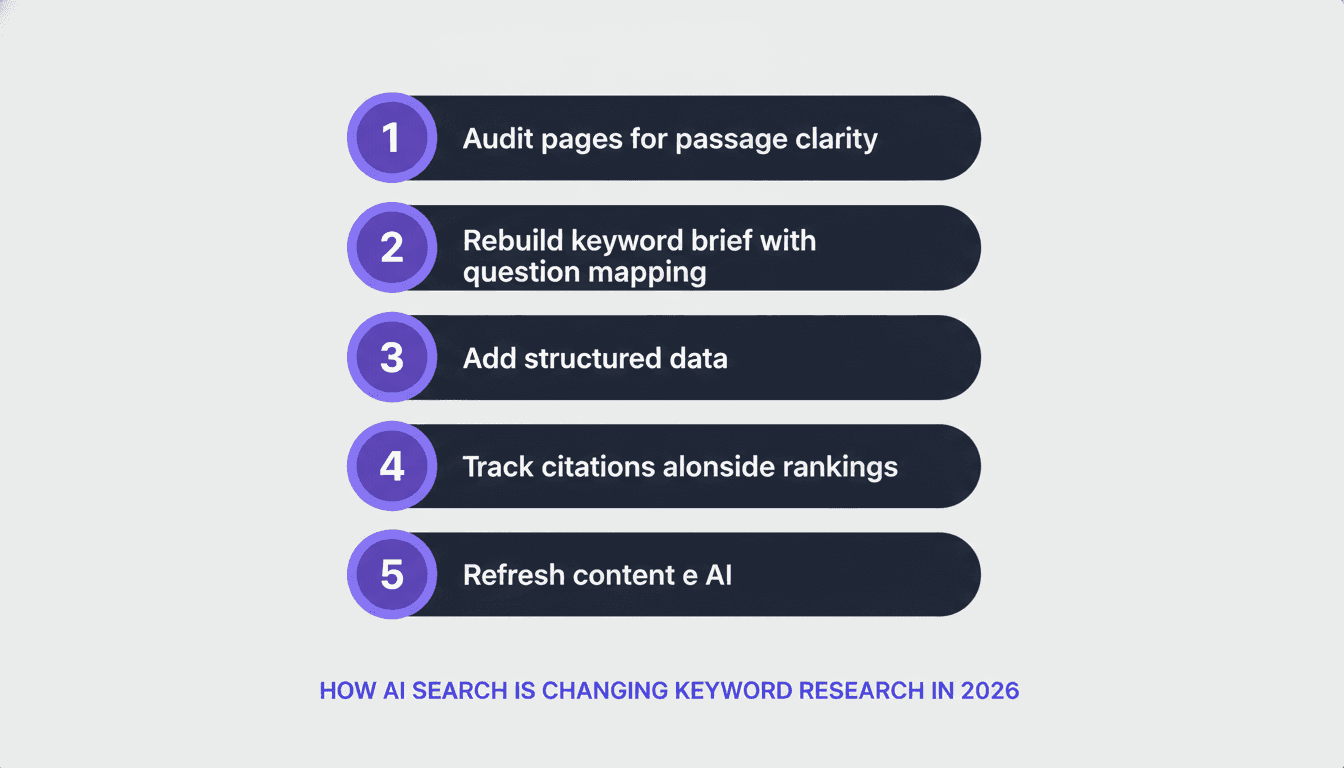
Here is the framework Project Rankup uses with clients moving from traditional to AI-ready keyword strategy:
Step 1: Audit your top twenty pages for passage clarity. For each page, identify whether it contains at least three self-contained paragraphs that each answer a specific question. If a paragraph requires the reader to have read the previous three paragraphs to understand it, AI systems will struggle to extract and cite it.
Step 2: Rebuild your keyword brief template. Add a column for "primary question this passage answers" alongside your standard keyword target. Every section of every page should map to a specific query, not just a topic.
Step 3: Check your structured data. FAQ schema, HowTo schema, and speakable schema all increase the likelihood that Google's systems can parse your content for AI inclusion. These are not silver bullets, but they reduce friction. Google's structured data documentation is the definitive reference here.
Step 4: Track citations, not just rankings. Position-one rankings still matter. But if your page is being cited inside an AI Overview for a query where you rank fifth, that citation has real visibility value. Standard rank trackers often miss this. At Project Rankup, tracking AI citation signals alongside traditional rank data is part of how we measure visibility for clients in 2026.
Step 5: Refresh on a six-month cycle. AI systems favour recent, accurate content. A page that was comprehensive in 2024 may be outdated now. Build a refresh schedule into your editorial calendar and treat it as equal in priority to new content production.
The Future of SEO Keyword Strategy
The future of SEO keyword strategy is not a departure from fundamentals. It is an elevation of them. Search has always rewarded content that clearly answers what a user needs. AI search just enforces that standard more rigorously and more immediately.
The McKinsey Global Institute's 2025 AI report found that AI adoption across industries accelerated faster than most organisations planned for, and the gap between early adapters and laggards widened measurably in the first year. Companies that optimised for AI citations in 2024–2025 saw a 34% increase in AI Overview visibility by Q2 2026 (Moz, 2026). Search is not exempt from that pattern. The businesses that restructured their content for AI citation in 2024 and early 2025 are already seeing compounding advantages in AI Overview inclusion.
Generative AI search optimisation will become the baseline expectation for any serious SEO effort. The practitioners who will be most valuable are not those who master the latest tool, but those who understand why AI systems select certain passages over others and can build that logic into content strategy from the brief stage.
For startup founders and local agency owners especially: the window to build topical authority in your niche before larger competitors consolidate AI citations is still open, but it is narrowing. Explore what Project Rankup's plans include for teams that want to track and grow their AI search visibility alongside traditional rankings.
Frequently asked questions
What is AI keyword research?
AI keyword research is the process of identifying search terms and questions that both human users and AI search engines use to find content, then structuring pages so individual passages answer those queries clearly enough to earn citations in AI-generated answers. It builds on traditional keyword research but adds a passage-level layer.
How does AI search change what keywords I should target?
AI search rewards specificity and intent clarity over raw volume. Keywords that map to a precise question, especially conversational or long-tail queries, are more likely to trigger AI-cited responses. High-volume head terms still matter for brand visibility, but they increasingly generate zero-click AI summaries rather than referral traffic.
Do AI tools for keyword discovery replace traditional keyword tools?
No. AI tools for keyword discovery excel at generating question variants, semantic angles, and conversational phrasing that traditional tools underreport. But they do not provide search volume or competitive difficulty data. The strongest workflow combines AI-generated question sets with volume validation from a standard tool like Ahrefs or Semrush.
How do AI Overviews affect my organic traffic?
AI Overviews reduce clicks for informational queries where the AI answer fully satisfies the user. Pages cited inside AI Overviews sometimes see lower click-through rates than a traditional top-three position but gain substantial impression-level brand exposure. Transactional queries, local service searches, and queries requiring trust verification still drive strong click traffic.
How do I get my content cited in AI-generated answers?
Write self-contained paragraphs that directly answer a specific question, use structured data where relevant, build topical authority through consistent coverage of a subject area, and ensure your site earns genuine backlinks from credible sources. Google's guidance on AI Overview inclusion emphasises that helpfulness and authority are the primary factors.
Is long-tail keyword strategy still worth it in 2026?
Long-tail keyword strategy is more important in 2026 than it was three years ago. AI search handles conversational, specific queries natively, meaning the long tail now connects directly to AI-cited responses. Targeting precise questions with thorough, passage-level answers is the single highest-leverage tactic for smaller sites competing against domain-authority giants.
How often should I update my keyword strategy for AI search?
Review your keyword strategy every six months at minimum. AI search behaviour shifts as models update, and topics that generated AI citations six months ago may need fresh content to retain that position. Pair your review with a content audit to identify which existing pages need passage-level updates rather than full rewrites.
What signals does Google use to pick AI Overview sources?
Google has not published a complete breakdown, but its Search Central documentation points to content helpfulness, authority signals (E-E-A-T), structured data, and relevance to the specific sub-question within the query. Pages with clear, concise passages and credible backlink profiles appear in AI Overviews at higher rates than thin or broadly written content.
Key Takeaways
- AI search has split the definition of ranking into two jobs: traditional position and AI citation inclusion. Keyword strategy must address both.
- Volume alone is a misleading filter in 2026. Intent specificity and passage clarity predict AI citation potential better than search volume does.
- Conversational and long-tail queries are the natural territory of AI-generated answers, making them higher priority, not lower, for content investment.
- The most practical technique shift is moving from page-level keyword targeting to passage-level question mapping inside every piece of content you produce.
- Structured data, fresh content, and genuine topical authority remain the durable signals that AI systems reward, the same signals that ranked pages for years.
- Tracking AI citations alongside traditional rank positions is now a requirement for an accurate picture of your search visibility.
Ready to adapt your keyword strategy for generative search and start climbing again? Reach out to the Project Rankup team and we will show you exactly where your current content stands and what it takes to move up.