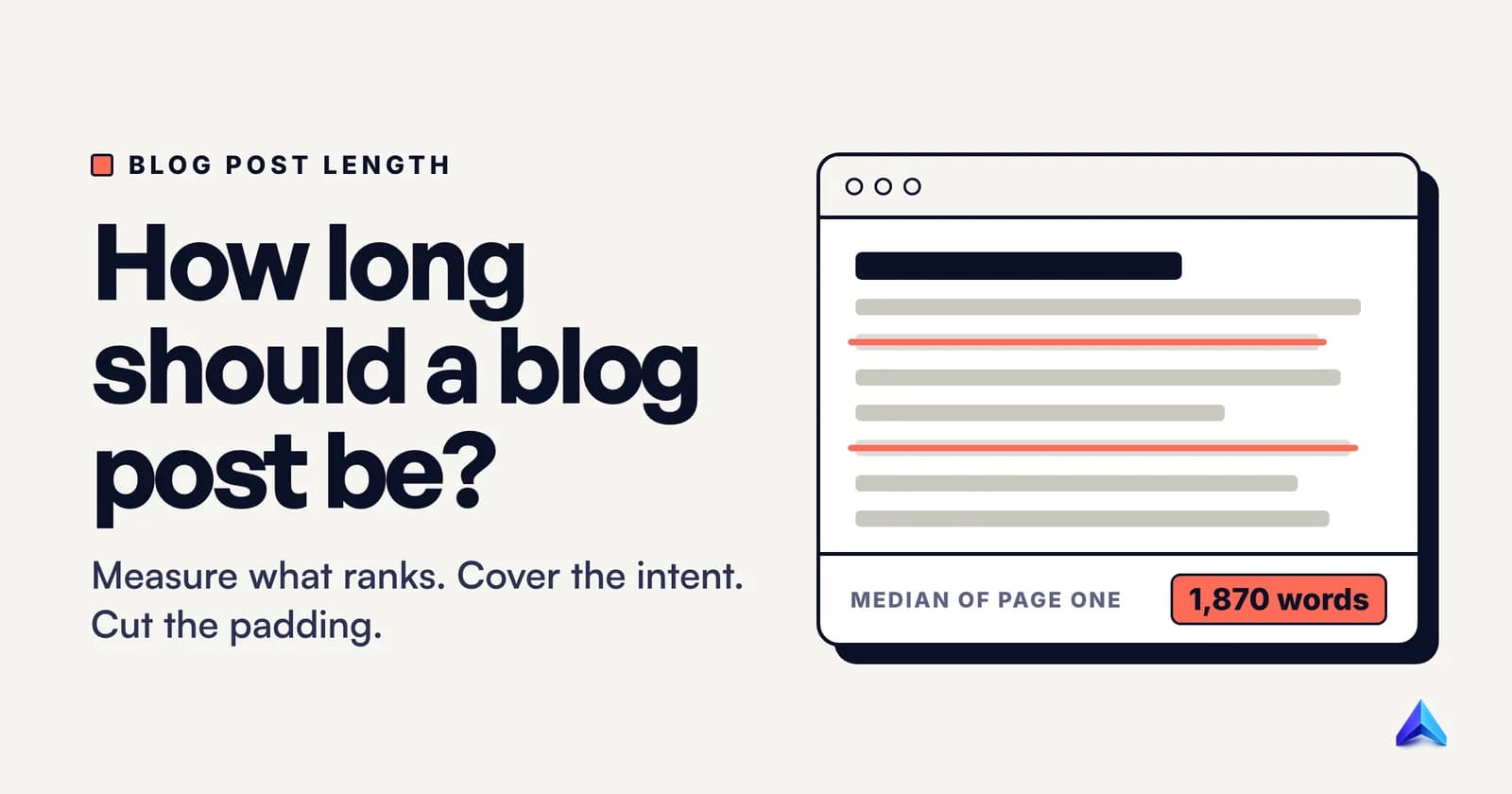
How long should a blog post be? As long as it takes to fully answer the query it targets, and no longer. Google says it has no preferred word count, so there is no number to hit. The practical way to size a post is to measure the articles already ranking for your keyword, use their median length as a guide, cover every question the searcher has, then cut anything that repeats or pads.
That answer frustrates people who want a number, so this guide gives you a method that produces one for your keyword. It also covers what Google has actually said about word count and SEO, why longer posts often look like they win, and how to turn a word count into reading time.
Does word count affect SEO?
No. Word count is not a ranking factor, and Google has said so in its own documentation more than once.
The clearest statement sits in Google's guidance on creating helpful content. In a list of warning signs that a page was made for search engines rather than people, it asks whether you are writing to a particular word count because you heard Google prefers one, and answers its own question: "(No, we don't.)"
Google's SEO Starter Guide repeats the point in its list of things that do not matter. It says the length of the content alone doesn't matter for ranking purposes, with no magical word count target, minimum or maximum. The same passage adds a useful nuance: when you write naturally and vary your wording, you have more chances to show up in Search simply because the page uses more of the words people search with.
Google's John Mueller has been just as direct in public. Asked in 2021 whether adding more relevant text would help a page rank, he said the number of words on a page "is not a quality factor, not a ranking factor", and that blindly adding text does not make a page better, as Search Engine Journal reported. He compared it to handing a client either a brochure or a thick book: some people want the book, and others want something short and sweet.
So what does matter? Whether the page satisfies the searcher. Google's helpful content questions ask whether a reader leaves having learned enough to achieve their goal, and whether they will need to search again somewhere else. Length is a side effect of meeting that standard, not a lever you pull.
Why longer posts look like they rank better
If word count is irrelevant, why do so many SEO threads swear long posts win? Because length travels with the things that do matter.
A post that covers a topic properly answers more sub-questions than a thin one, and gives other sites more reason to link to it. It also tends to be written by someone who spent more time on it. All of that pushes rankings up, and the word count rises alongside without causing anything.
Orbit Media's annual survey of bloggers shows the pattern from the writers' side. Its 2026 report on 1,042 content marketers puts the average blog post at 1,312 words, down from a peak of 1,427 in 2023, after posts grew from about 800 words to more than 1,200 between 2014 and 2019. Orbit says its past correlation charts showed that spending six or more hours writing 2,000-word posts roughly doubled the odds of reporting strong results.
Read that carefully. It is self-reported, it is a correlation, and the variable doing the work is effort as much as length. Orbit's own 2026 headline is that only 13.9% of respondents say their blog delivers strong results, an all-time low, so writing longer has clearly not rescued the average program.
The trap is treating length as the cause. Add 800 words of padding to a 1,200-word post and you get a 2,000-word post with the same information. It now takes longer to read and adds nothing new, which is the opposite of what information gain asks of a page.
How to work out the right length for your post
Mueller has also said it is fine to use word counts for yourself as a guideline, if they encourage better content from your writers, according to another Search Engine Journal write-up. That is the right role for a number: a planning target derived from the query, not a rule borrowed from a survey average.
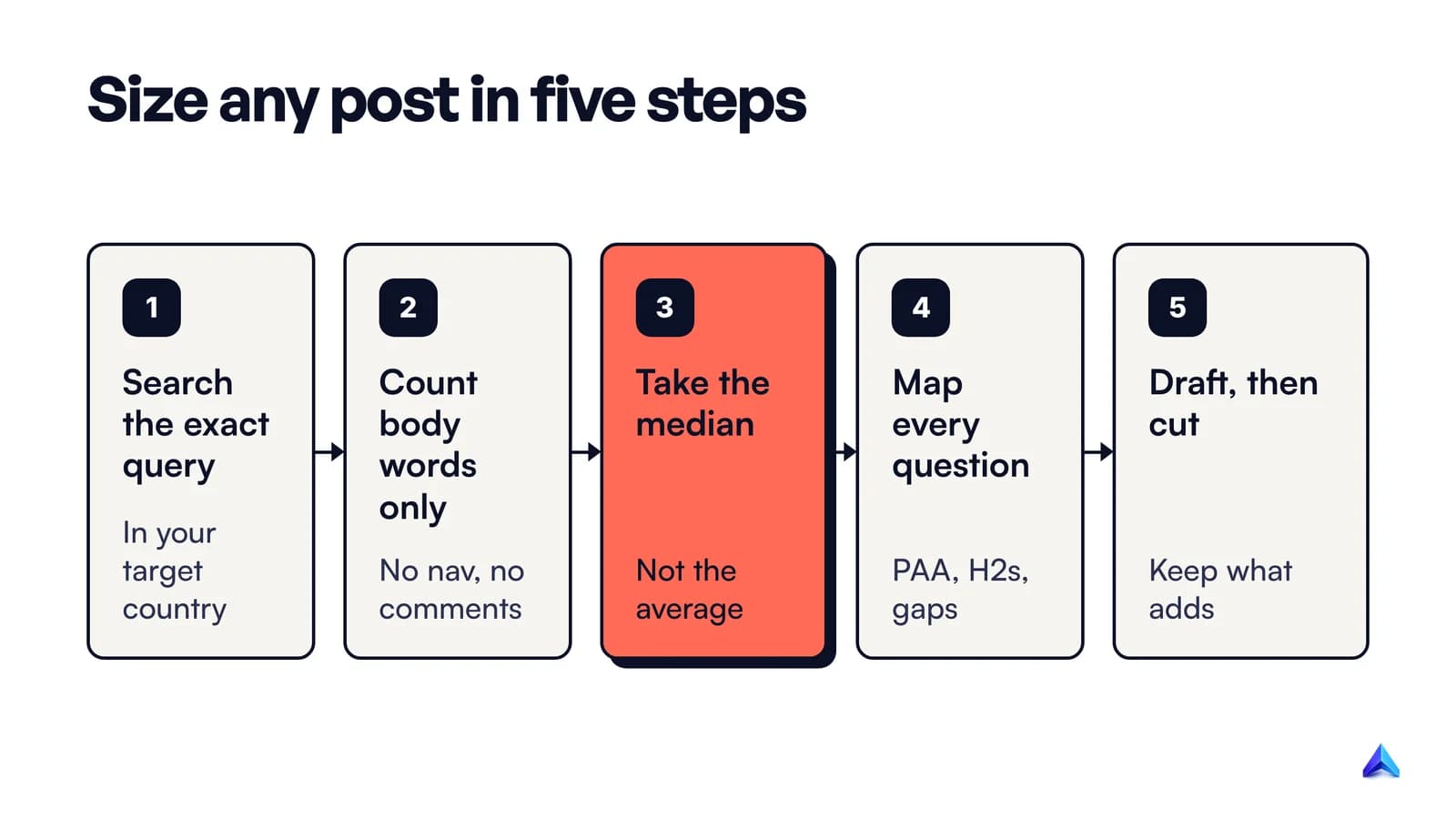
Step 1: Search the exact query in the country you target
Search your keyword in a private window, set to the country you want traffic from, or pull the results from an SEO tool. A query searched from Leeds and one from Pune can return different pages, so check the market that matters to you.
Before counting anything, look at what type of pages rank. If the top results are forum threads, videos, product pages or calculators, the problem is format, not length. A 3,000-word article will not displace a tool that answers the query in one click.
Step 2: Count body words only
Open five to ten articles that match the format you plan to write. For each one, count from the H1 to the last line of the article itself. Leave out navigation, cookie banners, author boxes, comments, related posts and footers.
This step matters more than it sounds. Paste a whole page into a word counter and you count the comments too, and on one page we measured for this article, 103 reader comments took the raw text from about 1,900 words of article to more than 9,000. Copy the article body only, or use a reader-view tool that strips the page chrome.
Step 3: Take the median, not the average
Line the counts up and take the middle value. The median ignores the one 8,000-word mega-guide that skews an average, and it tells you what a typical winning page looks like. Note the range as well, because a wide range means Google is rewarding different depths and you have room to choose.
Step 4: List every question the searcher needs answered
Now ignore the numbers for a moment. Collect the sub-questions: the H2s that recur across the ranking pages, the People Also Ask questions, and the things you know from experience that none of them covers. A content brief is the natural place to write these down, with a rough word estimate next to each section.
Add up the estimates. If your total lands near the median, good. If it lands far above, you have either found real gaps (worth keeping) or planned sections that belong in a different post (see the last section of this guide).
Step 5: Draft to cover, then cut
Write until every question on your list is answered. Then compare the draft with the median and treat any big gap as a prompt to check, never as an order. Far over the median? Look for padding. Far under? Look for a sub-question you skipped. If the draft is short because you answered everything quickly, publish it short. Our guide on how to write a blog post for SEO covers the drafting itself in more detail.
Worked example: sizing this article
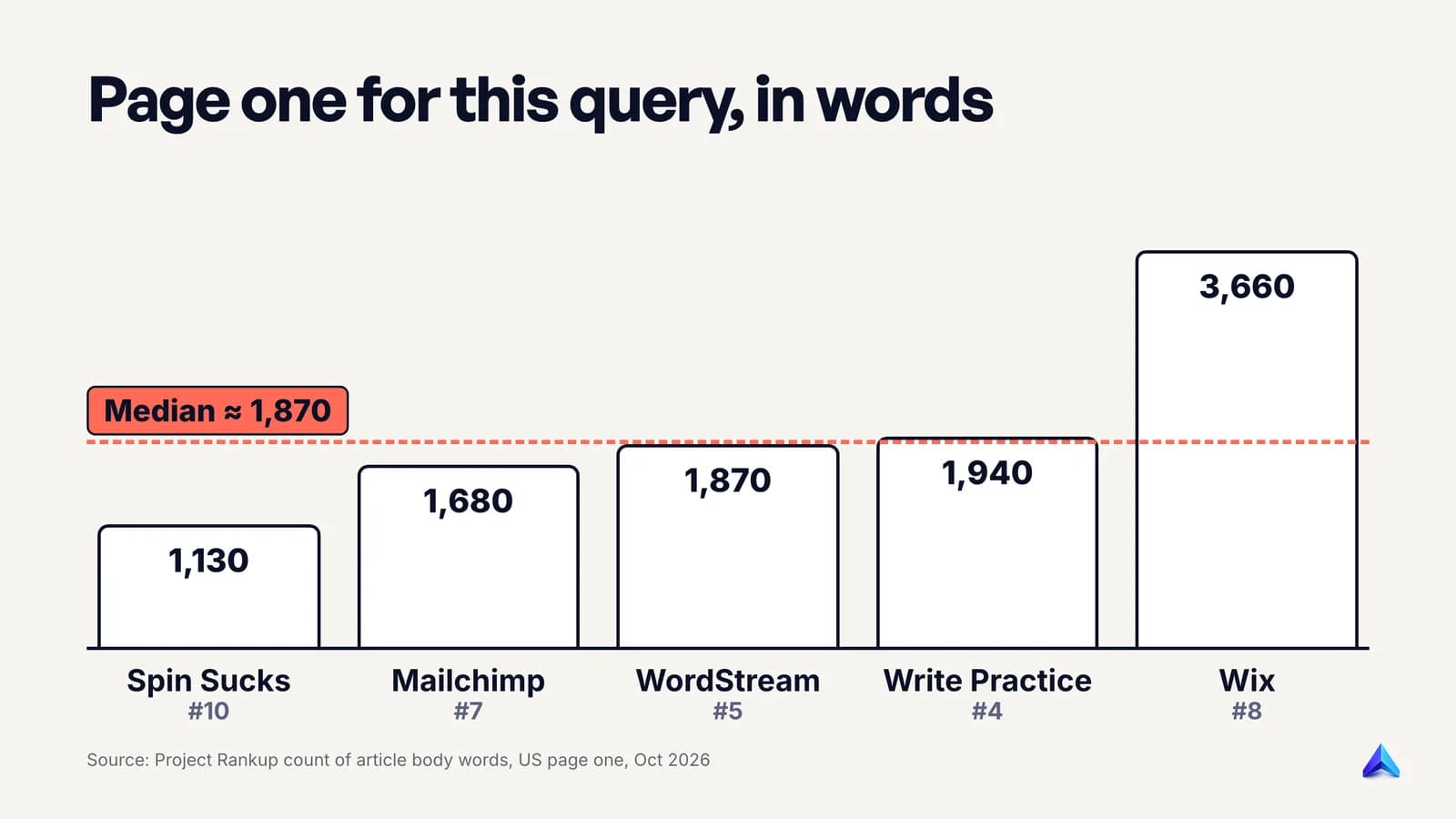
We ran the method on this exact keyword, "how long should a blog post be", in October 2026, using the US results.
The SERP itself says a lot before any counting. An AI Overview sits at the top, a Reddit thread from r/SEO ranks second, and a YouTube video and a paywalled Medium post also make page one. Searchers clearly want a quick answer first, with nuance after it.
We then measured the body text of the five open articles on page one:
| Ranking article | Position | Body words (approx.) |
|---|---|---|
| Spin Sucks | 10 | 1,130 |
| Mailchimp | 7 | 1,680 |
| WordStream | 5 | 1,870 |
| The Write Practice | 4 | 1,940 |
| Wix | 8 | 3,660 |
The median is about 1,870 words and the range runs from about 1,100 to 3,700. Notice that position does not follow length: the longest article ranks eighth, below three pages that are roughly half its length. That is what a non-factor looks like in the wild.
The median told us roughly 1,900 words would be competitive. This article runs longer, and every extra section has a reason in our research notes: none of the ranking pages quotes Google's own statements, gives a repeatable sizing method, converts words to reading time from real reading-rate data, or explains when to split a post. If a section had no reason, it was cut.
This is the method behind every post on this blog: each one is sized against the measured length of the pages ranking for its keyword. For our guide to llms.txt, for example, the ranking pages ran roughly 1,200 to 3,500 words, so the target sat inside that band rather than at a number from a survey.
How search intent changes the right length
Intent decides what a page must contain, and the contents decide the length. Use this as a check on your list of sub-questions before you start drafting.
| What the SERP shows | What your page must do | What that means for length |
|---|---|---|
| A quick fact or definition, often answered in an AI Overview | Answer in one or two sentences, then add the context people need next | Short pages compete; do not pad to match long guides |
| A process or "how to" | Give every step with the concrete how, the pitfalls and what success looks like | Length follows the number of steps |
| A comparison or "best" list | Lead with a verdict, then a table and honest trade-offs | Grows with the number of options compared |
| News or an opinion | Make one clear point with evidence | Keep it tight; every extra paragraph costs the reader time |
| A broad topic guide | Cover the whole topic and link out to detail pages | Longest, but split it when sections turn into separate queries |
Whatever the intent, put the direct answer at the top. A short, self-contained opening is the easiest part of a page for an AI Overview or a chatbot to quote, and our guide to optimizing content for ChatGPT answers explains how to write an opening that can be quoted cleanly. A long post with a buried answer loses to a short one with a clear answer.
How to cut padding without losing coverage
Padding is any sentence the reader could delete without losing information. It is easy to spot once you know its usual forms:
- Throat-clearing intros. Two paragraphs on why the topic matters before the answer arrives.
- Definitions the reader already has. Someone searching "how long should a blog post be" knows what a blog post is.
- Restating the heading. A section titled "Why length matters" that opens with "Length matters for several reasons".
- Lists without decisions. Ten tools with no word on which one to use and when.
- Summary paragraphs. A recap at the end of every section of what the section just said.
- FAQs that repeat the body. An FAQ answer should add something, not copy a paragraph from above.
Do one pass with a single question per paragraph: what does this add that the previous paragraph did not? If the answer is nothing, delete it or merge it. Then do a second pass for missing coverage, using Google's own test of whether a reader would need to search again to finish the job.
Cutting the wrong things is the other risk. Keep examples, numbers with their sources, steps and warnings, because those are what make a page useful and quotable. Our breakdown of Google's helpful content guidance covers the rest of what reviewers and ranking systems look for. Clear sentences matter too, though readability is a separate topic from length.
Turning word count into reading time
Readers feel length as time, not words, so it helps to know the conversion. The best figure comes from a 2019 meta-analysis by Marc Brysbaert in the Journal of Memory and Language. Based on 190 studies with 18,573 participants, it estimates that adults read English non-fiction silently at an average of 238 words per minute, and fiction at 260.
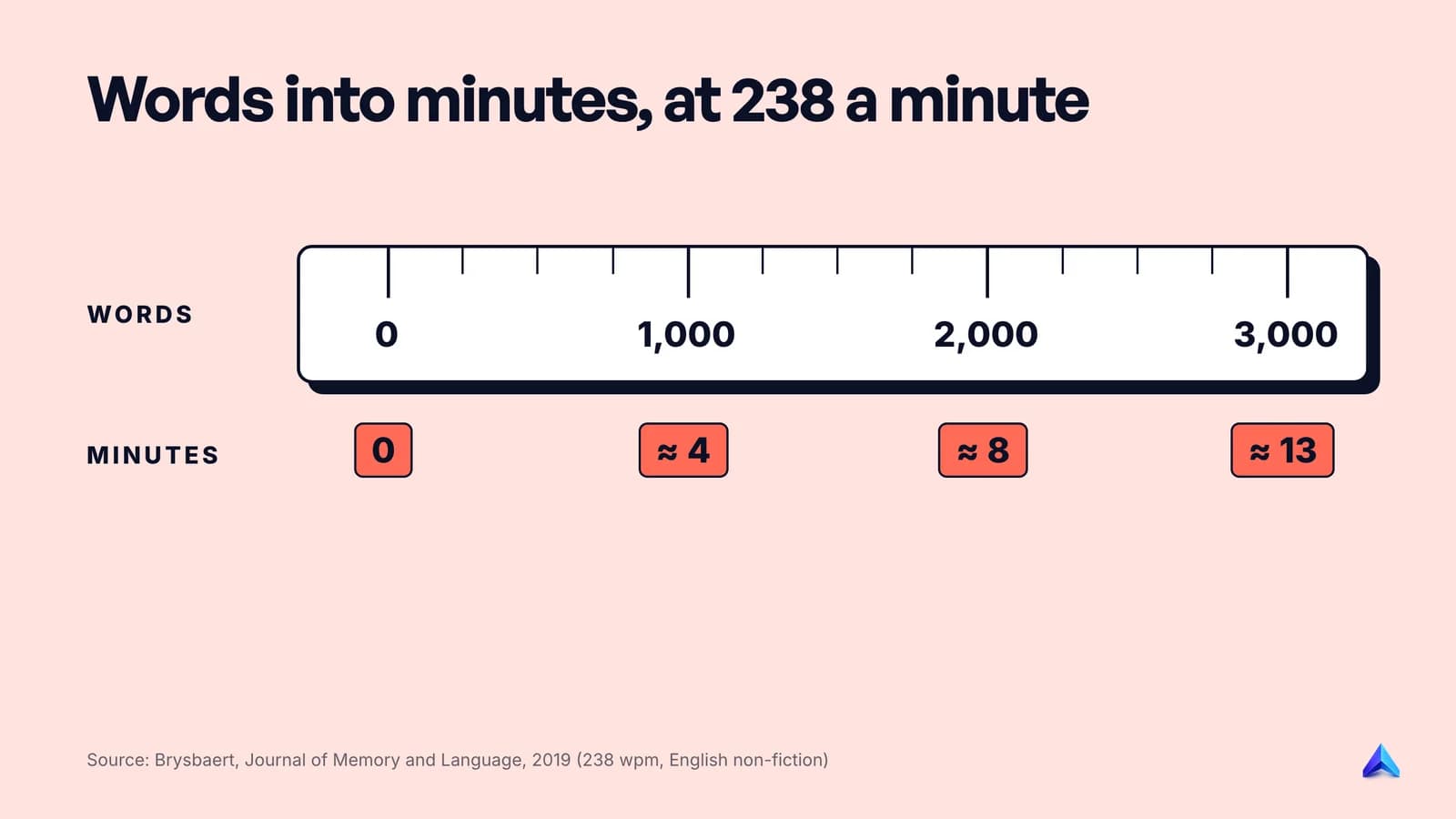
At 238 words per minute, the common lengths work out like this:
| Word count | Reading time (approx.) |
|---|---|
| 600 | 2.5 minutes |
| 1,000 | 4.2 minutes |
| 1,500 | 6.3 minutes |
| 2,000 | 8.4 minutes |
| 2,500 | 10.5 minutes |
| 3,000 | 12.6 minutes |
That is slower than many people assume, and the paper itself notes that its estimates are lower than the numbers often cited in scientific and popular writing. It also finds that reading rates are lower for people reading English as a second language, which matters if a good share of your audience in India or the UK reads that way. If you show a reading time on your posts, use 238 for non-fiction.
Two practical uses follow. First, a reading time tells you whether the length is honest: a 12-minute read for a question with a one-line answer is a warning sign. Second, it helps with structure. Once a post passes eight or nine minutes, plan for skimming: clear H2s, tables and a table of contents stop being nice touches and become the way people actually use the page.
When one long post should become two
Sometimes a draft runs long because it is trying to rank for two queries at once. The test is simple: search the heading of your biggest section as if it were a keyword. If Google returns a different set of pages from your main keyword's results, that section is its own topic and probably deserves its own post.
This article is a small example. How often you should publish is a question people ask alongside how long to write, but it returns different results and needs its own research, so it gets a sentence here and a separate post later.
The opposite mistake is splitting one query across several thin posts. Two pages chasing the same keyword compete with each other, and our guide to fixing keyword cannibalization shows how that splits rankings. One query, one page, as long as that query needs.
Frequently asked questions
How long should blog posts be in 2026?
There is no 2026 number. Google still says it has no preferred word count. Measure the articles ranking for your keyword and use their median as a guide. For reference, Orbit Media's 2026 survey of 1,042 bloggers found the average post was 1,312 words, but averages across all topics tell you little about one query.
Is a 3,000-word blog post too long?
Not if the query needs it. A complete guide to a broad topic can justify 3,000 words, while a simple question cannot. Check the ranking pages: if they sit around 1,500 words, find out what your extra 1,500 add. At 238 words per minute, 3,000 words is about a 13-minute read, so structure it for skimming.
Is 500 words enough for a blog post?
It can be. If the query has a short, factual answer and the ranking pages are brief, 500 well-chosen words can compete. Google's SEO Starter Guide says length alone does not matter for ranking. What fails is a 500-word post on a topic that needs steps, examples and caveats, because readers have to search again.
How many words is a 5-minute read?
About 1,200 words. A 2019 meta-analysis of 190 reading studies put the average adult silent reading rate for English non-fiction at 238 words per minute, so five minutes covers roughly 1,190 words. Slower readers, including many reading English as a second language, will need longer.
Is there a minimum word count for SEO?
No. Google's SEO Starter Guide says there is no magical word count target, minimum or maximum. Thin content is a problem of value, not length: a page that leaves the reader without an answer is thin at 300 words or 3,000. Write until the question is answered properly.
Should every post on my blog be the same length?
No. Length should vary with the query. A definition, a step-by-step guide and a comparison need very different amounts of text, and forcing them to a house word count either pads the short ones or cuts the long ones. Use one method for every post instead of one number.