To get cited in ChatGPT answers, your content needs to do one thing well: give a complete, unambiguous answer to a specific question in plain language, backed by structure that large language models can parse without guessing. That means clear headings, direct opening sentences, and factual claims tied to named sources. ChatGPT does not rank pages the way Google does, but it does favor content that is easy to extract, easy to attribute, and consistent across the web. This guide walks through each lever, in order.
How Does ChatGPT Actually Decide What to Cite?
ChatGPT pulls citations from two places: its training data and, in ChatGPT Search mode, live web retrieval via Bing. For training-data citations, the model learned to associate certain sources with authoritative answers during pre-training. For live retrieval, it fetches pages in real time and selects passages that directly answer the query.
What makes a passage get selected? Three factors dominate:
- Answer proximity: The answer to the implied question appears in the first 1-3 sentences of a section, not buried in the fifth paragraph.
- Passage coherence: The extracted chunk reads as a complete thought without needing surrounding context. A sentence like "This depends on your industry" means nothing alone. A sentence like "B2B SaaS brands typically see a 90-120 day lag between publishing and first AI citation" means something on its own.
- Source consistency: The same claim, phrased the same way, appears across multiple pages the model has indexed. Repetition across authoritative domains increases the probability of citation.
OpenAI's documentation on how ChatGPT Search retrieves and cites sources confirms that retrieval favors pages with clear structure and factual density. The practical implication: if your content is structured for extraction, it competes for citations the same way a well-structured page competes for a Google featured snippet.
Also Read: The Rise of AI Search Engines: What It Means for Your 2026 SEO Strategy
Step 1: Structure Each Section as a Self-Contained Answer
This is the highest-leverage change most content teams can make. The standard blog format buries the answer in the middle of a section after a paragraph of context-setting. LLM retrieval works the opposite way: it scores passages by how directly and completely they answer a question without needing adjacent text.
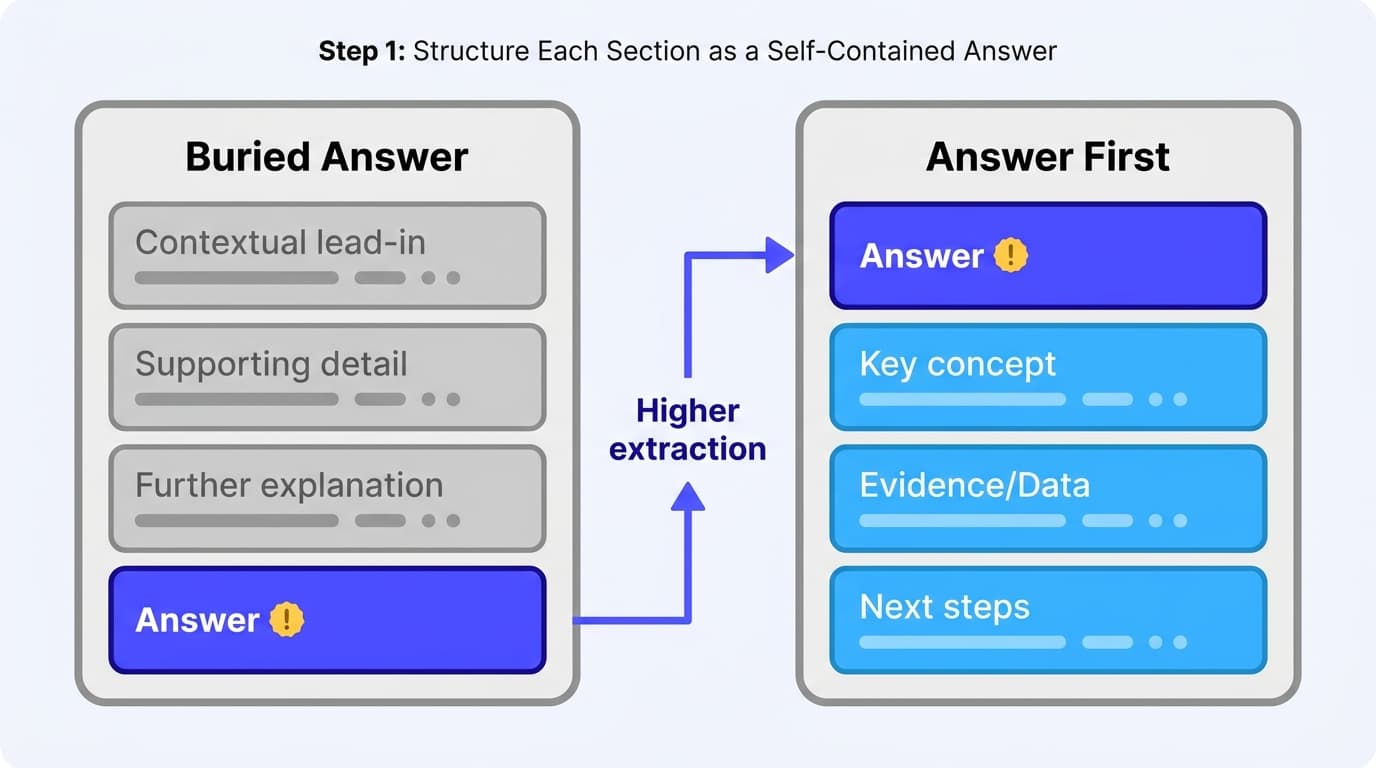
For each H2 section in your content, write the opening paragraph to satisfy this test: if a reader saw only that paragraph, would they have a complete, useful answer? If the answer is no, rewrite it.
A practical template for section openings:
- State the direct answer or conclusion in one sentence.
- Give the one most important supporting reason or qualifier.
- Name a concrete example, number, or scenario.
- Then expand as needed.
Here is the difference in practice:
Before (answer buried): "Schema markup has been discussed in SEO circles for years. Many brands have tried it with mixed results. The debate often centers on whether Google actually uses it. In terms of generative AI, the picture is becoming clearer."
After (answer first): "Schema markup helps ChatGPT and other LLMs identify what your page is about and how to attribute it. FAQ schema, HowTo schema, and Article schema each signal structured, extractable content. Pages using these types are indexed with cleaner entity associations, which raises the probability of citation."
The second version can be quoted directly. The first cannot.
Apply this pattern to every section. It takes longer to write but produces content that earns citations and ranks for featured snippets simultaneously. The two goals are not separate.
Step 2: Use the Right Structured Data for Generative Engines
Structured data for generative engines is not the same as structured data for Google rich results, though there is significant overlap. The distinction matters because many brands implement schema for visual enhancements (star ratings, breadcrumbs) without considering what signals it sends to LLM retrieval systems.
The schema types that most directly support AI citation are:
| Schema Type | What It Signals to LLMs | Best Used For |
|---|---|---|
Article with author and datePublished | Attributable, time-stamped factual claim | Blog posts, news, guides |
FAQPage | Discrete question-answer pairs ready for extraction | FAQ sections, support content |
HowTo | Ordered steps with named actions | Process guides, tutorials |
SpeakableSpecification | Passages optimized for audio and AI reading | Brand definitions, key facts |
Organization with sameAs | Connects your brand entity across the web | All brand pages |
The SpeakableSpecification type, documented in Google's structured data guidelines, marks specific passages as suitable for voice and AI synthesis. It is underused by most content teams and worth adding to any page where you want a specific passage extracted.
For Organization schema, the sameAs property is where you list your brand's profiles on Wikipedia, Wikidata, LinkedIn, Crunchbase, and other authoritative directories. This tells LLMs that all these references point to the same entity, which builds the knowledge graph association that underpins brand visibility in ChatGPT responses.
Implement schema using JSON-LD in the <head> of each page. Validate every implementation with Google's Rich Results Test before publishing.
Step 3: Build Citation Authority Through Consistent Digital PR
ChatGPT's training data skews heavily toward sources that appear frequently in its corpus: major publications, government domains, academic papers, and brands with consistent coverage across authoritative outlets. Optimizing digital PR for AI engines is not a metaphor. It is a direct input into whether your brand appears in generative answers.
The mechanism works like this: when many independent, high-authority pages reference your brand or cite your content in similar ways, the LLM builds a strong association between your entity and the topic. A single Forbes mention helps less than ten mid-tier publications all attributing the same statistic to you.
Practical steps for building this citation graph:
1. Create citable assets, not just articles. Original research, proprietary frameworks, named methodologies, and data sets get cited by other publications. A blog post summarizing what others have said does not. If your brand publishes a named framework (say, "The Rankup Content Readiness Model"), other writers will name it when referencing it, and that name becomes a searchable entity.
2. Pursue consistent attribution. When pitching journalists or contributing guest content, always use the same phrasing for your brand's core claims. LLMs learn entity associations partly through co-occurrence patterns. Consistent phrasing across many sources reinforces those patterns.
3. Get listed in structured directories. G2, Capterra, Crunchbase, ProductHunt, and industry-specific directories are indexed heavily and structured. Being listed with consistent name, address, and description data strengthens your entity in the knowledge graph that LLMs draw from.
4. Earn Wikipedia and Wikidata entries. This is a long game, but Wikipedia pages and Wikidata entries are among the highest-weighted sources in LLM training corpora. For SaaS brands and agencies with enough notability, contributing accurate, sourced entries (or working with a Wikipedia editor) is worth the effort.
For a deeper look at how answer engine optimization techniques differ from traditional SEO, the distinction between earning Google rankings and earning AI citations becomes clear at the entity-building stage.
Step 4: Optimize the Content Itself for LLM Extraction
Formatting and language choices directly affect whether a passage gets extracted. LLMs favor content that is unambiguous, factually dense, and free of rhetorical hedging.
Use plain, declarative language. Sentences beginning with "It is worth noting that" or "Many experts believe" give a model nothing to extract as a fact. Sentences beginning with "X does Y" or "The recommended approach is Z" are extractable.
Write descriptive headings. A heading like "More on This Topic" tells a model nothing. A heading like "How to Add FAQ Schema to a WordPress Post" tells it exactly what the section covers and makes the section more likely to surface when that query is asked.
Keep definitions explicit. Do not assume the reader knows what a term means. Define it in the same sentence or paragraph where you first use it. LLMs extract definitions frequently, and a clean definition with the term in the subject position ("Answer engine optimization is the practice of...") is a high-probability citation candidate.
Use numbered steps for processes. Ordered lists map directly to "how to" queries. A five-step process written as prose is harder to extract than a numbered list. This is not about formatting for its own sake; it is about matching the content structure to the query structure.
Limit paragraph length. Paragraphs longer than four sentences reduce extraction accuracy because the model has to decide which sentences belong together. Shorter paragraphs, each making one clear point, produce cleaner chunks.
These formatting choices also improve on-page SEO signals for Google, so the two optimization goals reinforce each other rather than competing.
Step 5: Distribute and Syndicate to Expand Your Footprint in LLM Training Data
Content that exists in one place has one chance to enter the training corpus or get retrieved. Content distributed across many authoritative channels has many chances. This is the distribution layer of how to optimize content for ChatGPT answers, and it is where most SEO plans stop too early.
Channels worth prioritizing:
- LinkedIn articles and newsletters: LinkedIn content is indexed by Bing and appears in ChatGPT Search results. Publishing long-form content there with consistent brand attribution builds another retrieval surface.
- Medium and Substack: Both platforms are indexed and appear in LLM training data. Syndicating key articles (with canonical tags pointing to your original) expands coverage without creating duplicate-content problems for Google.
- Podcast transcripts: Transcripts published on your site and on podcast directories add a text layer to audio content. They are indexed and can be retrieved by ChatGPT Search.
- YouTube descriptions and chapters: YouTube is owned by Google and its content feeds into AI Overviews. Detailed video descriptions with timestamps create extractable text content from video assets.
- Press releases on wire services: PRNewswire, BusinessWire, and GlobeNewswire content is indexed widely and appears in many LLM training sets. Use them for product launches, research releases, and major announcements.
The goal is not volume for its own sake. Each distribution channel should carry the same core claims, attributed to your brand, in consistent language. This trains the association between your entity and the topic across many independent sources.
For content teams managing this at scale, a structured content calendar tied to distribution workflows prevents the common failure mode: producing strong content and then publishing it in one place and moving on.
Also Read: Information Gain in SEO: Guide to Winning AI Search
What Does Success Look Like?
You can track AI citation progress even without direct API access to LLMs. Use these signals:
- Direct ChatGPT queries: Search for the questions your content answers in ChatGPT and note whether your brand or content is cited. Do this monthly and log the results.
- Perplexity citations: Perplexity shows its sources explicitly. Run the same queries there and track which domains appear. It is a useful proxy for retrieval behavior across LLMs.
- Branded query growth in Google Search Console: When AI answers cite your brand, users often follow up with branded searches. A rising trend in branded impressions after publishing optimized content is a real signal.
- Referring domains from high-authority outlets: Track whether your digital PR efforts are landing placements that other publications then reference. This second-order citation is what builds LLM entity authority.
Project Rankup's AI visibility audit maps your current footprint across ChatGPT, Perplexity, and Google AI Overviews, showing exactly which queries surface your brand and which go to competitors. If you want a clear baseline before investing in optimization, request a free AI visibility and content audit and we will show you where you stand.
Key Takeaways
- Structure each section so its opening paragraph answers the implied question completely, without needing surrounding context. This is the single most reliable way to get cited.
- Use
FAQPage,HowTo,Article, andSpeakableSpecificationschema to give LLMs clean, attributable signals about what each page covers. - Build citation authority through consistent digital PR: original research, named frameworks, and coverage across many independent authoritative sources matter more than any single high-profile placement.
- Write in plain, declarative language. Hedged, vague sentences are not extracted. Specific, falsifiable statements are.
- Distribute content across indexed channels (LinkedIn, Medium, podcast transcripts, press releases) using consistent brand attribution to multiply your footprint in LLM retrieval.
- Measure progress monthly by running direct ChatGPT and Perplexity queries for your target topics and tracking whether your brand appears in the answers.
Frequently asked questions
Does ChatGPT use structured data when generating answers?
ChatGPT does not process schema markup the way a search crawler does, but structured data improves how Bing and Google index your pages. Since ChatGPT Search retrieves content via Bing, pages with clean schema are indexed with stronger entity signals, which indirectly raises their retrieval probability.
How long does it take for content to start appearing in ChatGPT answers?
For live retrieval via ChatGPT Search, a newly published page can be retrieved within days of Bing indexing it. For training-data citations, the lag is much longer since those reflect a prior training cutoff. Focusing on retrieval optimization, not just training-data presence, produces faster results.
Should I write different content for ChatGPT and for Google?
No. The content qualities that earn AI citations (direct answers, clear structure, factual density, authoritative sourcing) are the same ones that earn Google featured snippets and AI Overviews. Optimizing for one optimizes for both. A separate "AI content strategy" that diverges from your SEO plan wastes resources.
Does brand mentions matter more than backlinks for AI visibility?
For traditional Google rankings, backlinks carry more weight. For LLM citation authority, brand mentions and co-citations across authoritative domains matter significantly. Being mentioned by name in a Reuters article without a link still builds entity association in the training corpus. Both matter, but the emphasis shifts toward mentions in an AI-first strategy.
What content formats get cited most often in ChatGPT answers?
Direct definitions, step-by-step processes, and comparison tables are extracted most frequently. Long narrative prose is rarely cited verbatim. If your content is mostly prose with few structural elements, adding numbered steps and definition-first section openings is the fastest formatting change you can make.