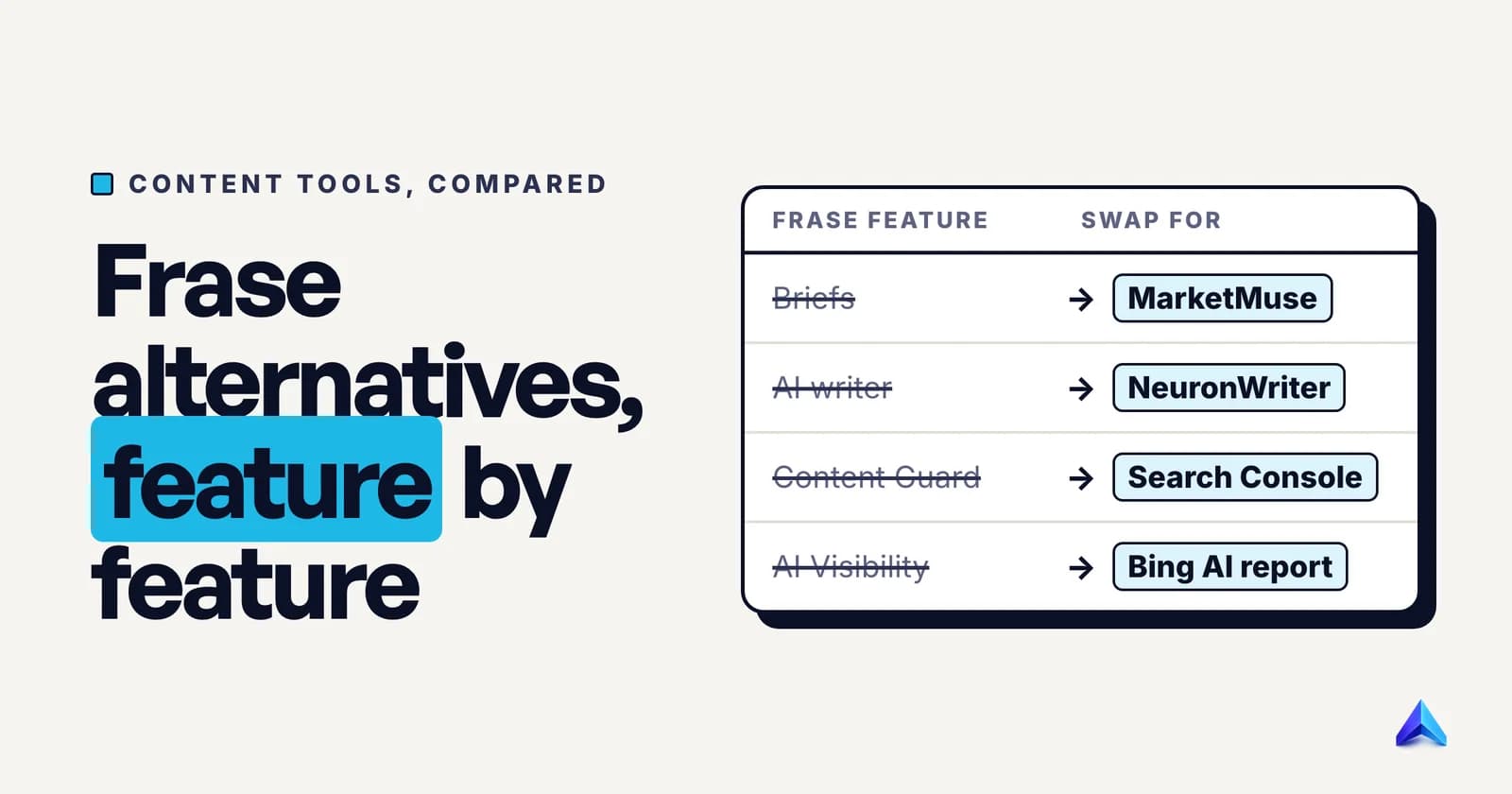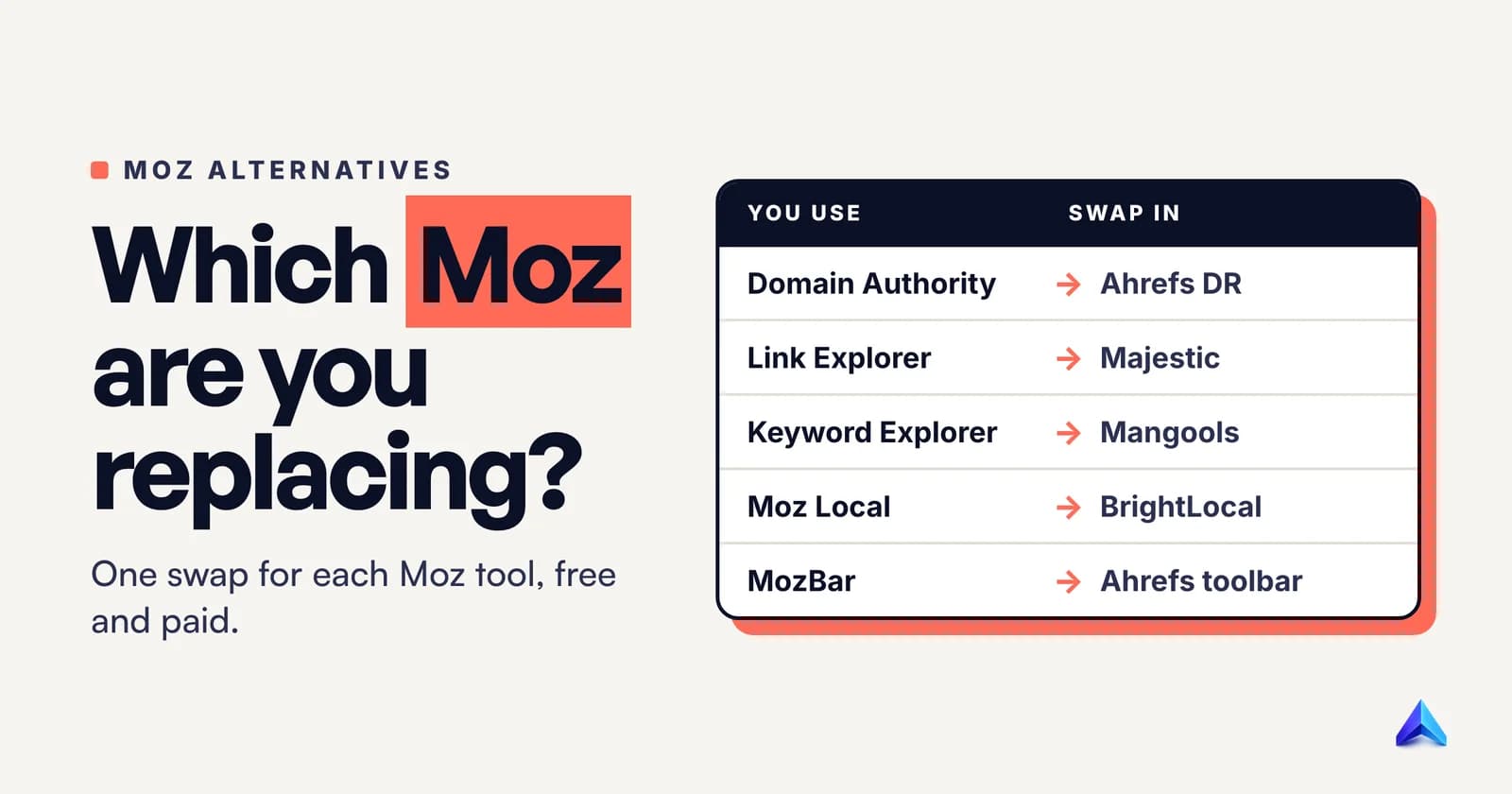

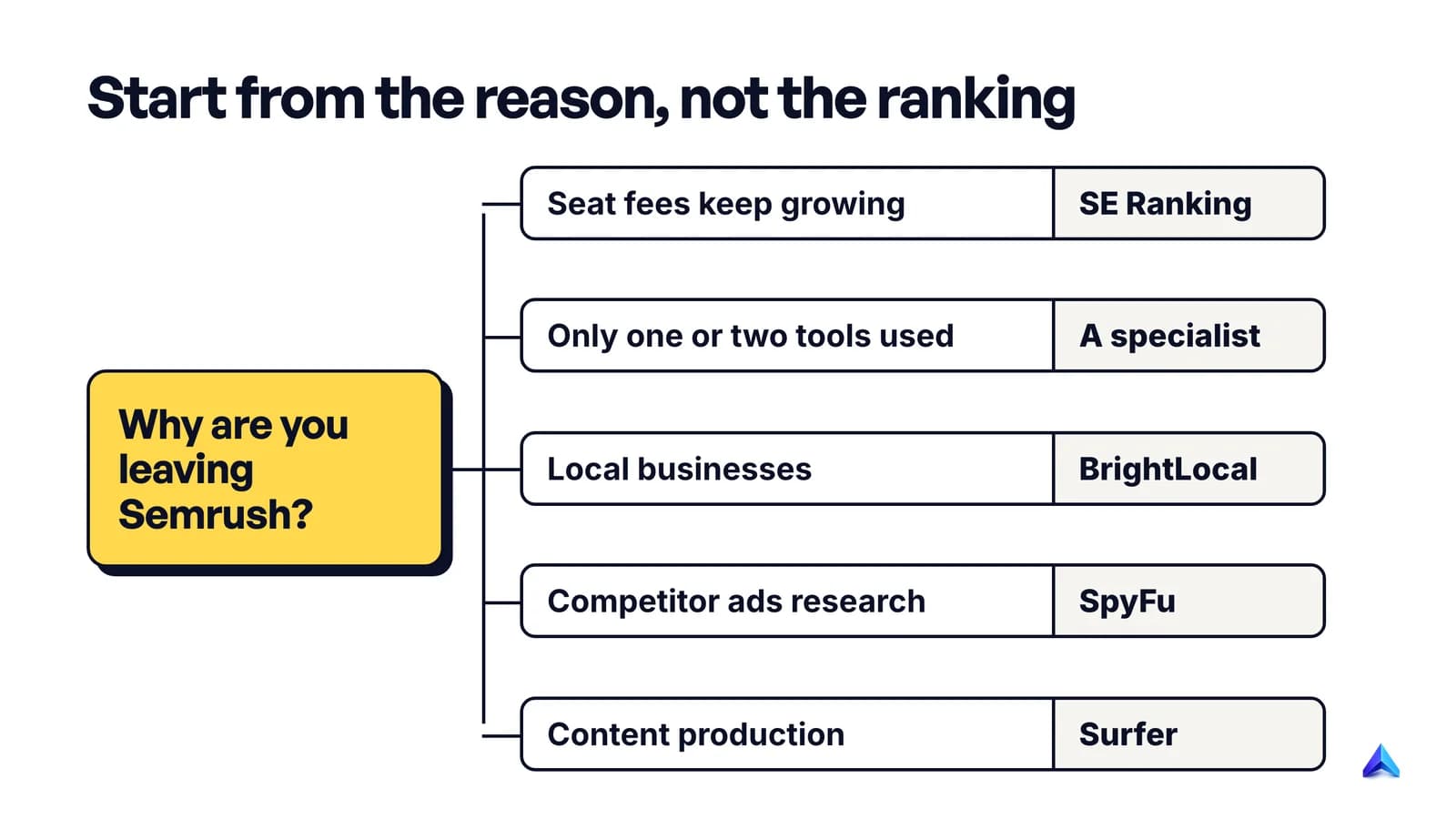
The right Semrush alternative depends on why you are leaving. If seat fees are the problem, SE Ranking includes three seats on its Growth plan. If you only use one or two tools, a specialist costs less. BrightLocal suits local businesses, SpyFu suits paid-search research, and Surfer suits content teams. Agencies get white-label reports from SE Ranking. All prices below are vendor list prices as of October 2026.
Most lists rank twelve tools from "best" to "worst" and leave you to work out which one fits. That order rarely matches the reason you opened your Semrush invoice and winced. So this guide starts from the reason, then names the tool that fixes it, and says plainly when the fix is to stay on Semrush and change plans instead.
Which Semrush alternative fits your team
Start with the kind of team you are. The pick changes more with team shape than with budget.
| Your team | Usual reason to leave | Best fit | Starting price (Oct 2026) | What it does better for you |
|---|---|---|---|---|
| Solo: freelancer, blogger or founder with one site | Paying for capacity you never touch | Moz Pro Starter | $49/mo | A plan built for a single website |
| In-house team of 2 to 5 | Every extra login costs $45 to $100 a month | SE Ranking Growth | $279/mo | 3 seats included, more from $16 |
| Agency with client sites | Client reporting and seats add up | SE Ranking + Agency Pack, or SpyFu Team/Agency | Core $129 + Agency Pack $69 (annual only), or $249/mo | White-label reports; SpyFu includes 5 users |
| Local business, one or a few locations | You need maps and reviews, not a keyword database | BrightLocal Track | $41/mo, or $31/mo billed yearly | Geo-grid rankings and citation checks per location |
| PPC-led marketing team | You mostly study competitors' ads | SpyFu Pro + AI | $119/mo after a $59 first month | 10+ years of competitor ad history |
| Content team | You need articles, not more reports | Surfer Standard | $99/mo billed yearly | 360 documents to write or optimize |
Every price in this post comes from the vendor's own pricing page, opened on 9 October 2026, and is the monthly list price in US dollars unless we say otherwise. We do not use affiliate links. Two caveats for readers outside the US: Semrush states that all its prices are in US dollars, and Majestic's prices exclude VAT, so a UK or Indian card will see a different total at checkout.
What Semrush costs as of October 2026
Before you compare, know exactly what you would be leaving. Semrush now sells four "SEO + AI Search" plans, with specialist toolkits priced separately on top.
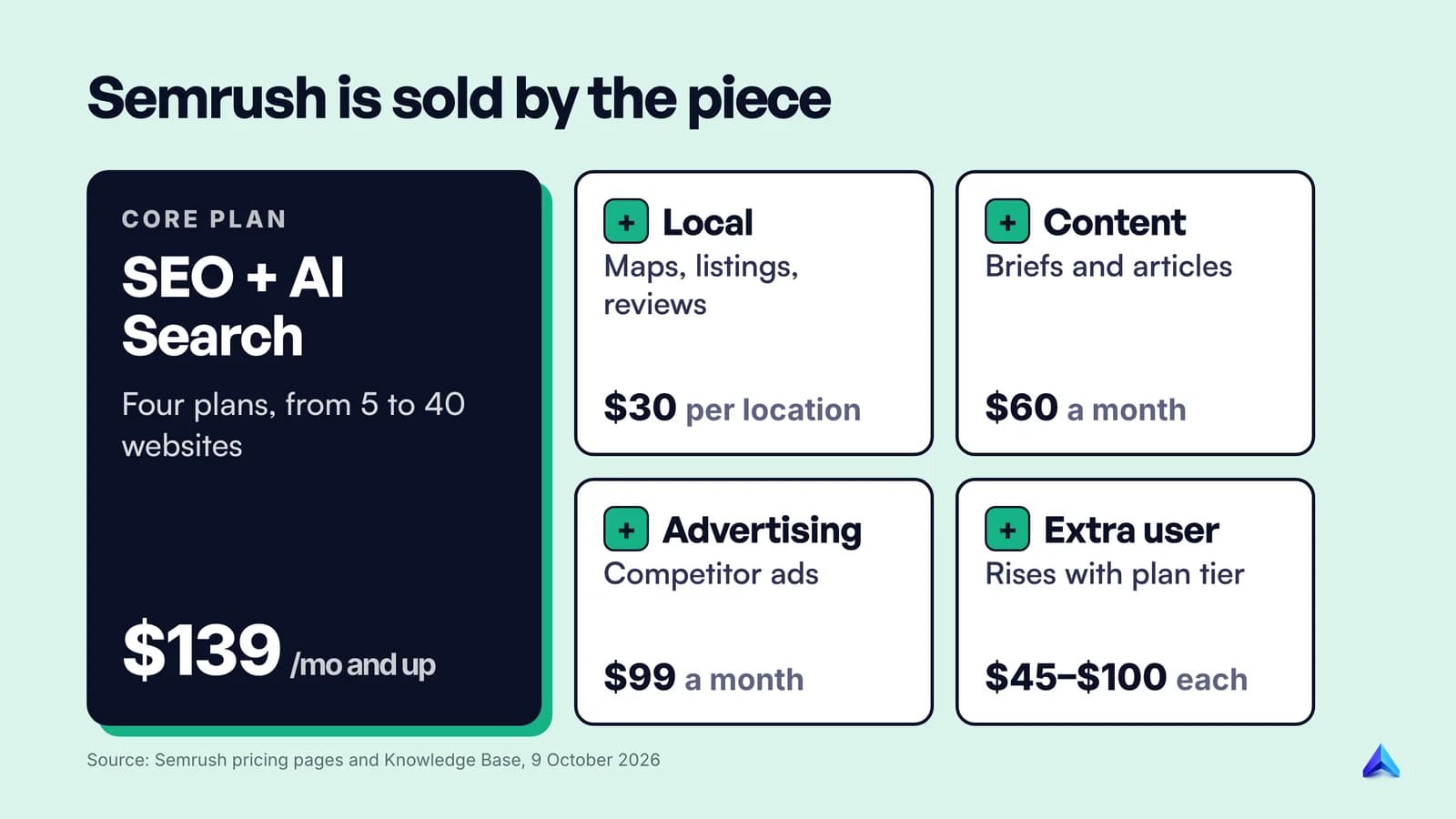
The four plans on Semrush's pricing page, as of October 2026:
| Plan | Monthly | Billed yearly | Websites | Keywords tracked daily |
|---|---|---|---|---|
| SEO | $139 | $117.33/mo | 5 | 500 |
| Starter | $199 | $165.17/mo | 5 | 500 |
| Pro+ | $299 | $248.17/mo | 15 | 1,500 |
| Advanced | $549 | $455.67/mo | 40 | 5,000 |
The SEO plan covers basic keyword research and competitor analysis, Position Tracking and Site Audit. Starter adds the fuller keyword and competitor tools and tracks 50 AI prompts a day. Pro+ is the first plan with historical data, content optimization and multi-location tracking. Advanced adds API access.
Three details shape most decisions to leave.
Extra people cost extra. Semrush's user management guide lists additional users at $45 a month on Starter, $80 on Pro+ and $100 on Advanced. A five-person team on Pro+ pays $320 a month in seats before anyone runs a report.
Toolkits are separate subscriptions. Local, Content, Advertising, Social, AI PR and Traffic & Market are each priced on their own. Local starts at $30 a month per location, Content at $60 a month, and Advertising at $99 a month. You can add or remove them at any time.
The free plan is real but small. It gives one demo project and 10 reports a day across the main tools, and Position Tracking for 10 keywords. Paid plans come with a 7-day free trial, though Semrush disables data exports during trials.
That structure means some people do not need to leave at all. If you only use rank tracking and site audits, the $139 SEO plan may cover you, and Semrush's own FAQ recommends it for freelancers, bloggers and in-house marketers on a limited budget. If you run one shop and care about Google Maps, the Local toolkit can be bought without any SEO plan. Downgrade first, then decide whether the gap is worth a new tool.
Reason 1: you pay for seats nobody fully uses
Seat fees grow faster than any other line on the bill as a team grows. Semrush counts every login, and a person who opens the tool twice a month costs the same as the one who lives in it.
SE Ranking prices seats very differently. SE Ranking's plans start with Core at $129 a month ($103.20 billed yearly), which gives 10 projects, one manager seat and 2,000 keywords tracked daily. Growth, at $279, includes 3 seats, 30 projects and 5,000 daily keywords. Extra manager seats start from $16 on both plans.
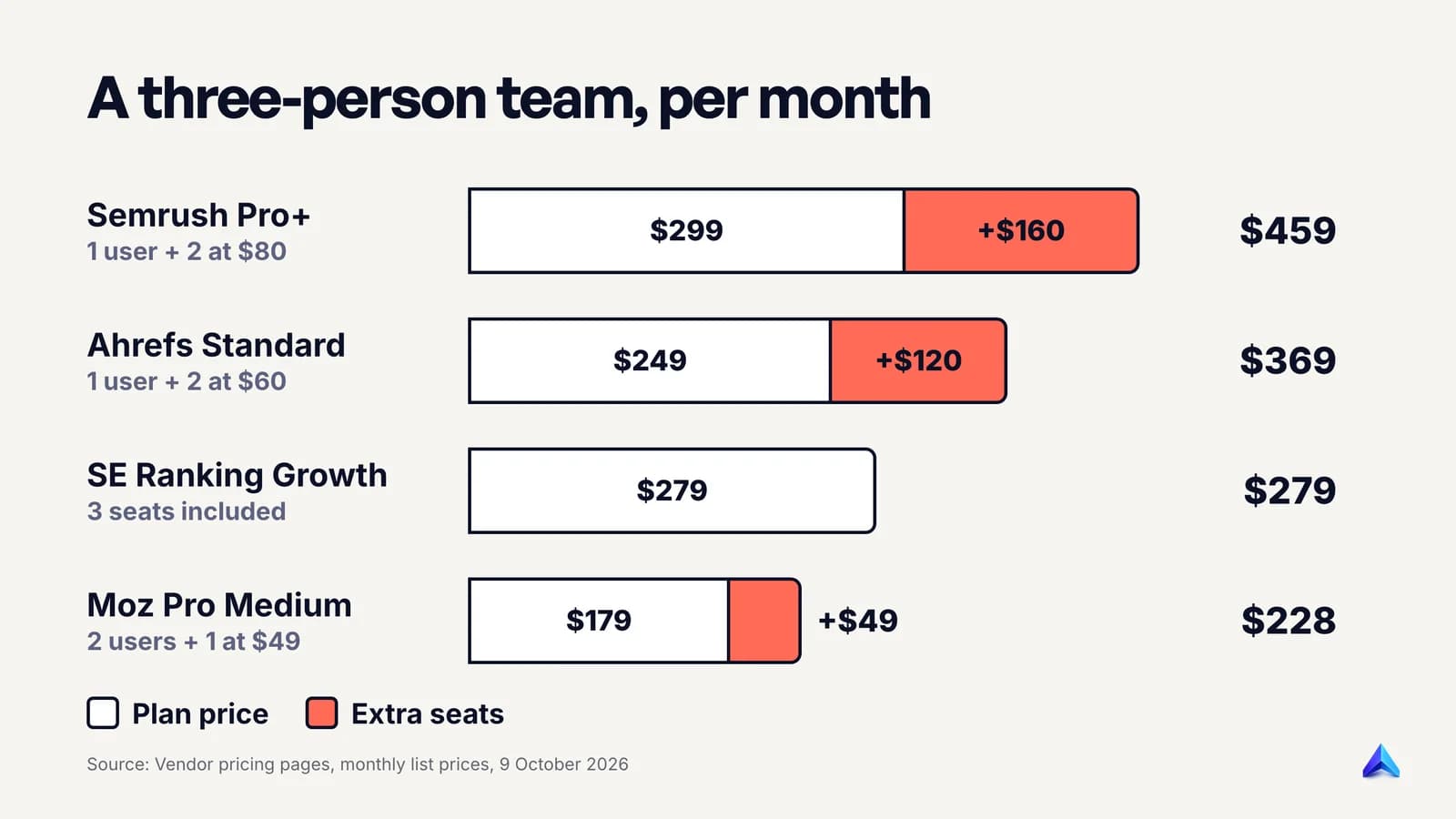
The chart prices one realistic case: three people on each vendor's mid-tier plan, paying monthly. Semrush Pro+ comes to $459 ($299 plus two users at $80). Ahrefs Standard comes to $369 ($249 plus two users at $60). SE Ranking Growth stays at $279 because three seats are included. Moz Pro Medium includes two users, and a third costs $49, so the total is $228.
The plans are not identical, so treat the chart as a starting point. Semrush Pro+ tracks 1,500 keywords and 15 websites. SE Ranking Growth tracks 5,000 keywords across 30 projects. Moz Medium tracks 1,500 keywords across 10 sites. Run your own numbers with your real seat count before you sign.
Choose SE Ranking if you have three or more people who all need logins and you want daily rank tracking. One warning: SE Ranking allows only one active session per login, so sharing a single seat across a team will not work.
Choose Moz Pro if the team is two people managing a handful of sites. Moz's pricing page lists Standard at $99 with one user, Medium at $179 with two, and Large at $299 with three. Additional seats are $49 a month on any plan. There is a free trial.
Ahrefs is the third all-in-one option, and the one most people consider first. We compared it in depth, plan by plan, in our guide to Ahrefs alternatives. For seat costs alone, Ahrefs charges $40 to $60 per extra user on Lite and Standard, below Semrush's $80 on Pro+. A direct Semrush versus Ahrefs comparison is a separate decision, and we are covering it in its own post.
Reason 2: you only use one or two tools
Open your Semrush history and count the tools you actually used last month. Many small teams find it is two: keyword research and rank tracking, or site audit and backlinks. Paying for a suite to use two tools is the clearest case for leaving.
The specialists are cheaper for a single job:
- Keyword research: Mangools Basic costs $37.70 a month, billed yearly ($452.40 a year).
- Backlinks: Majestic Lite costs $49.99 a month, excluding VAT.
- Technical audits: Screaming Frog's SEO Spider is free for up to 500 URLs. A licence costs £199 or $279 a year, per user.
- Your own site's data: Google Search Console and Bing Webmaster Tools are free.
We wrote these up in detail, with each tool's limits, in the Ahrefs alternatives guide, and the same picks apply when you leave Semrush. The jobs are the same. Only the tool you are replacing differs.
A practical test before you split one suite into three tools: list what you checked last month and which report answered it. If the list is short and stable, specialists save money. If it changes every week, a suite saves you the logins.
Wherever you do keyword research, read difficulty against your own site, not against the market. A new domain and an established one see the same KD score very differently, and our explainer on what keyword difficulty measures covers how to judge which scores are realistic for you.
Reason 3: you look after local businesses
Local SEO runs on different data from national SEO. A dental practice in Leeds or a bakery in Pune cares about the map pack, the Google Business Profile, citations and reviews. A huge keyword database does little for it.
BrightLocal's pricing page lists three plans, priced per number of locations. For one location:
- Track costs $41 a month, or $369 a year ($31 a month). It monitors local rankings for up to 100 keywords against four competitors, shows a geo-grid map for up to five keywords, checks citation accuracy and audits your Google Business Profile against competitors. It also includes a local AI visibility tracker.
- Manage costs $54 a month, or $40 a month billed yearly. It adds listing sync across key sites and scheduled Google Business Profile posts.
- Grow costs $65 a month, or $49 a month billed yearly. It adds review monitoring and review requests by email, SMS and in store.
Pricing climbs with locations. Track for two to five locations costs $62 a month, which matters for a small chain or an agency with a few local clients.
Compare that with staying on Semrush. Its Local toolkit costs $30 a month per location for Base, which includes an AI agent for Google Business Profile posts and review replies, and $60 per location for Pro, which adds Listing Management and review generation. It can be bought without any SEO plan. SE Ranking takes a third approach: both Core and Growth include 3 locations, with Listing Management across 100+ directories, and extra locations from $18.40.
Choose BrightLocal if local is the whole job and you want rank tracking, citations and reviews from a company that only does local. Stay on Semrush Local if you like its interface and only need the local piece. Choose SE Ranking if you need local and national SEO in one login. For UK businesses, our guide to local SEO in the UK covers what to fix before any of these tools will show progress.
Reason 4: you report to clients
Agencies leave Semrush for a different reason. The tools are fine, but every client adds projects, seats and reporting time.
Semrush does offer white-label reporting through its Pro Report add-on, at $20 a month per report. The two strongest alternatives build client work into the plan.
SE Ranking's Agency Pack adds white-label reporting and client-facing tools for $69 a month, on annual billing only. Paired with Growth's 30 projects and 3 seats, it covers a small agency with one tool. SE Ranking also offers free migration with an annual subscription.
SpyFu's Team/Agency plan costs $249 a month and includes 5 users, unlimited tracking projects, white-labeled reports and API access. Extra users are $30 each. SpyFu tracks rankings weekly, not daily, which suits monthly client reporting better than daily monitoring.
If you run an agency and are rebuilding your stack from scratch, our older roundup of SEO software for agencies lists the other categories you will need, such as reporting and project management.
Reason 5: you mostly research paid search
Some teams opened Semrush for SEO and ended up using it mainly to study competitors' Google Ads. Semrush now sells that as its Advertising toolkit, at $99 a month for Base and $220 for Pro, which adds AdClarity coverage of display, video and social ads.
SpyFu's pricing starts lower. Basic is $39 a month, or $29 billed yearly, with one user and 5,000 weekly tracked keyword rankings. Pro + AI costs $59 for the first month and $119 after that, and it is the first plan with 10+ years of competitor ad history, unlimited search results and exports, and pre-built Google Ads campaigns. SpyFu also offers a 30-day money-back guarantee.
Choose SpyFu if your core question is "what have competitors been bidding on, and for how long?" Stay with Semrush's Advertising toolkit if you want AdClarity's coverage of display, video and social ads alongside search.
Reason 6: you need content written, not just researched
Semrush is very good at telling you what to write. Many teams leave because they never find the time to write it.
Semrush has an answer of its own: the Content toolkit at $60 a month, with topic ideas, brief generation, article generation and 5 SEO content boosts a month. Pro+ also includes content optimization. If you already pay for Semrush, try that first.
Surfer is the established content-optimization tool. Surfer's pricing starts with Discovery at $49 a month billed yearly for 120 documents. Standard costs $99 a month billed yearly, with 360 documents and team collaboration. Pro, at $182 billed yearly, includes 5 team seats. Surfer suits a team that writes in-house and wants a score and guidelines while it writes.
Project Rankup (our product) fits a narrower job, so weigh what follows accordingly. It takes you from keyword research to articles that are written and ready to publish. It reads your own site and a few competitor homepages once, pulls volume and difficulty for keyword ideas, tags each by funnel stage and judges difficulty against your own domain's authority. Then it plans a content calendar and writes articles with the answer up front, FAQ and Article schema, cited sources and internal links. It can also audit and repair existing posts, and it tracks pages through a Search Console connection.
What it does not do matters just as much. It has no backlink index and does no link building. It does not track AI visibility or share of voice, which Semrush's paid plans now include. It covers 10 target countries, including the US, UK and India. So it replaces the content part of Semrush, not the research suite. Plans are on our pricing page; we do not quote prices here while billing is being finalised.
Whichever route you take, the writing still has to be good. Our guide to SEO content writing covers what separates a page that ranks from one that only matches a keyword.
How to switch without paying twice
Switching tools costs more than the subscription. You lose rank history, saved projects and the habits your team built. A clean switch takes about a month.
- Write down what you actually use. List the reports you opened in the last 30 days and the decisions they fed. Ignore the rest.
- Run trials side by side on the same domains. SE Ranking's 14-day trial includes up to 10 projects and 750 tracked keywords a day. Moz and BrightLocal also offer free trials. Use the same three competitor domains in each so you compare like for like.
- Check refund terms before you pay. SpyFu offers 30 days. SE Ranking says payments are non-refundable except when the service was not delivered as promised. Semrush refers to its official refund policy and lets you cancel or downgrade at any time.
- Export your history while you still have access. Do not assume your rank history will move to the new tool, so save the reports you will want for year-on-year comparisons. Remember that Semrush trials disable exports, so this only works on a paid account.
- Cancel at the end of the billing period, once the new tool has run for at least two weeks alongside the old one.
Finally, judge the switch on results, not on the invoice alone. A cheaper tool that your team stops opening costs more than an expensive one that drives decisions. Our guide to measuring SEO ROI shows how to tie tool spend to the traffic and leads it produces.
常見問題
Which is better, SE Ranking or Semrush?
It depends on team size and needs. As of October 2026, SE Ranking Growth costs $279 a month with 3 seats and 5,000 daily tracked keywords, while Semrush Pro+ costs $299 for 1,500, plus $80 for each extra user. Semrush offers a broader set of toolkits, including advertising and social. SE Ranking is better value for teams that mainly need tracking, audits and client reports.
Who does Semrush compete with?
Its main all-in-one competitors are Ahrefs, SE Ranking and Moz Pro. In specific areas it also competes with specialists: SpyFu for paid-search research, BrightLocal for local SEO, Surfer for content optimization, Majestic for backlinks, Mangools for keyword research and Screaming Frog for technical audits.
Is there a free version of Semrush?
Yes. Semrush's free plan costs $0, needs no credit card and allows one demo project and 10 reports a day across its main tools, with 10 keywords in Position Tracking. Paid plans also come with a 7-day free trial, but data exports are disabled during trials.
Is Semrush worth it for a small business?
Often not at full price. A single-site business rarely uses enough of the suite to justify $139 or more a month. Moz Pro Starter at $49 is built for one website, and free Google Search Console covers your own site's search data. If you mainly need Google Maps visibility, Semrush's Local toolkit or BrightLocal costs less.
What are the top 3 SEO tools?
For most teams, Google Search Console for real search data on your own site, one all-in-one suite such as Semrush, Ahrefs or SE Ranking for competitor research, and Screaming Frog for technical crawls. Which suite is best depends on the job and team size, which is why this guide is organised by reason.
Can I cancel Semrush at any time?
Yes. Semrush's pricing FAQ says you can cancel, downgrade or upgrade at any time, unless you signed custom terms. Refunds follow its official refund policy, so check that before you cancel mid-cycle, and export any rank history you want to keep first.