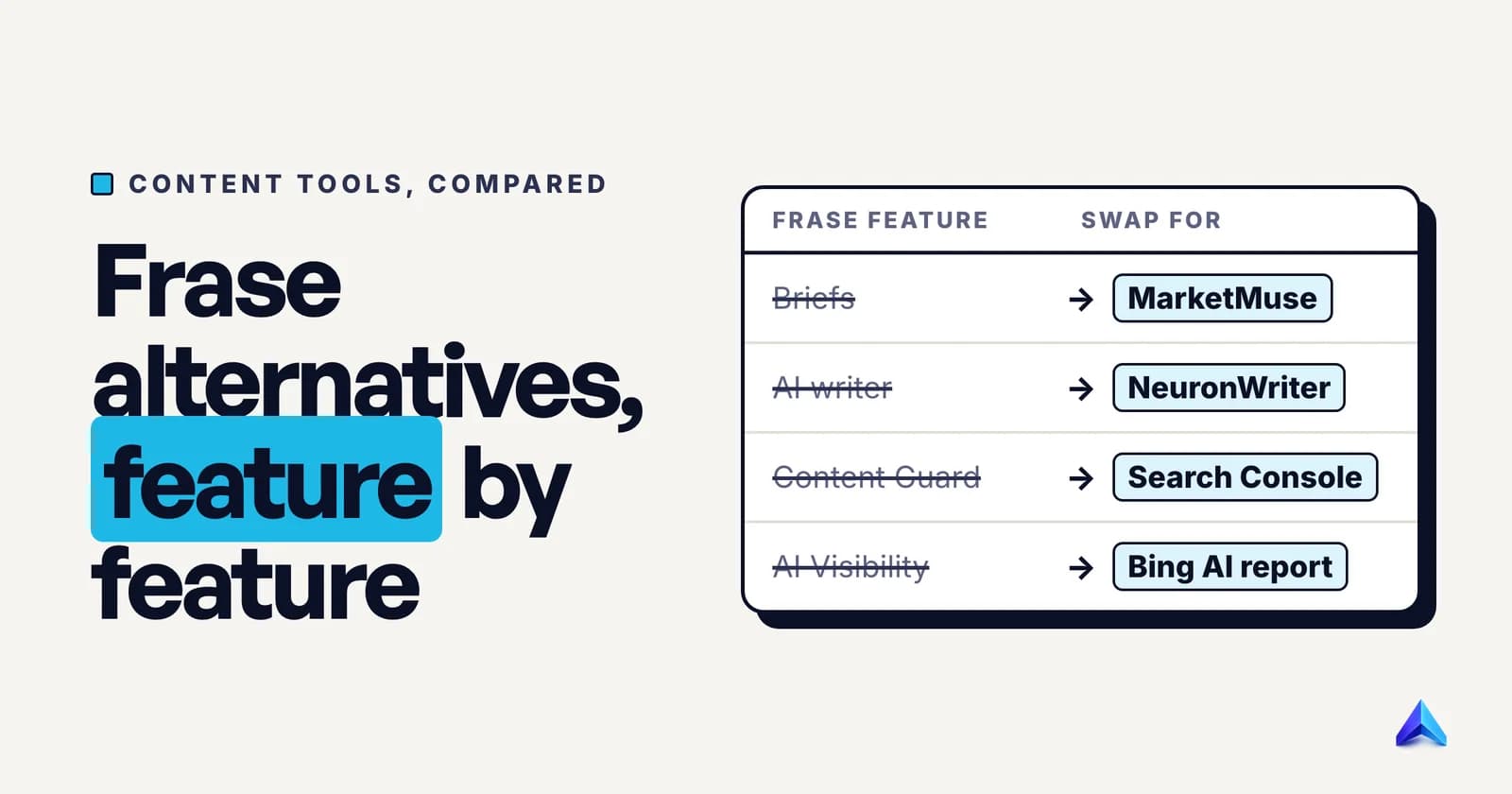
The best Writesonic alternative depends on which Writesonic you are replacing. If you came for the AI writer, pick Jasper for brand teams, Frase for SEO articles, or Rytr if price decides. If you came for AI-visibility tracking, pick Otterly.ai for the cheapest entry, Semrush's AI Visibility Toolkit or Ahrefs Brand Radar if you already pay for that suite, and Profound for enterprise budgets. Every price below was checked on the vendor's own page on 9 October 2026.
Most lists for this search pick one of those two jobs and ignore the other. Writesonic's own list of Writesonic alternatives contains only AI-visibility trackers. The next result down contains only writing tools. Both are right for half their readers, so this guide keeps the two jobs apart and tells you which half you are in.
Which Writesonic are you replacing?
Writesonic started as an AI writer, and many people still know it that way. Its homepage now calls it "The AI Search Growth Engine", and its pricing page title reads "Writesonic AI Search Visibility Platform". The pitch is to find where ChatGPT, Gemini and Google's AI answers ignore your brand, then fix that with content, citations and technical work.
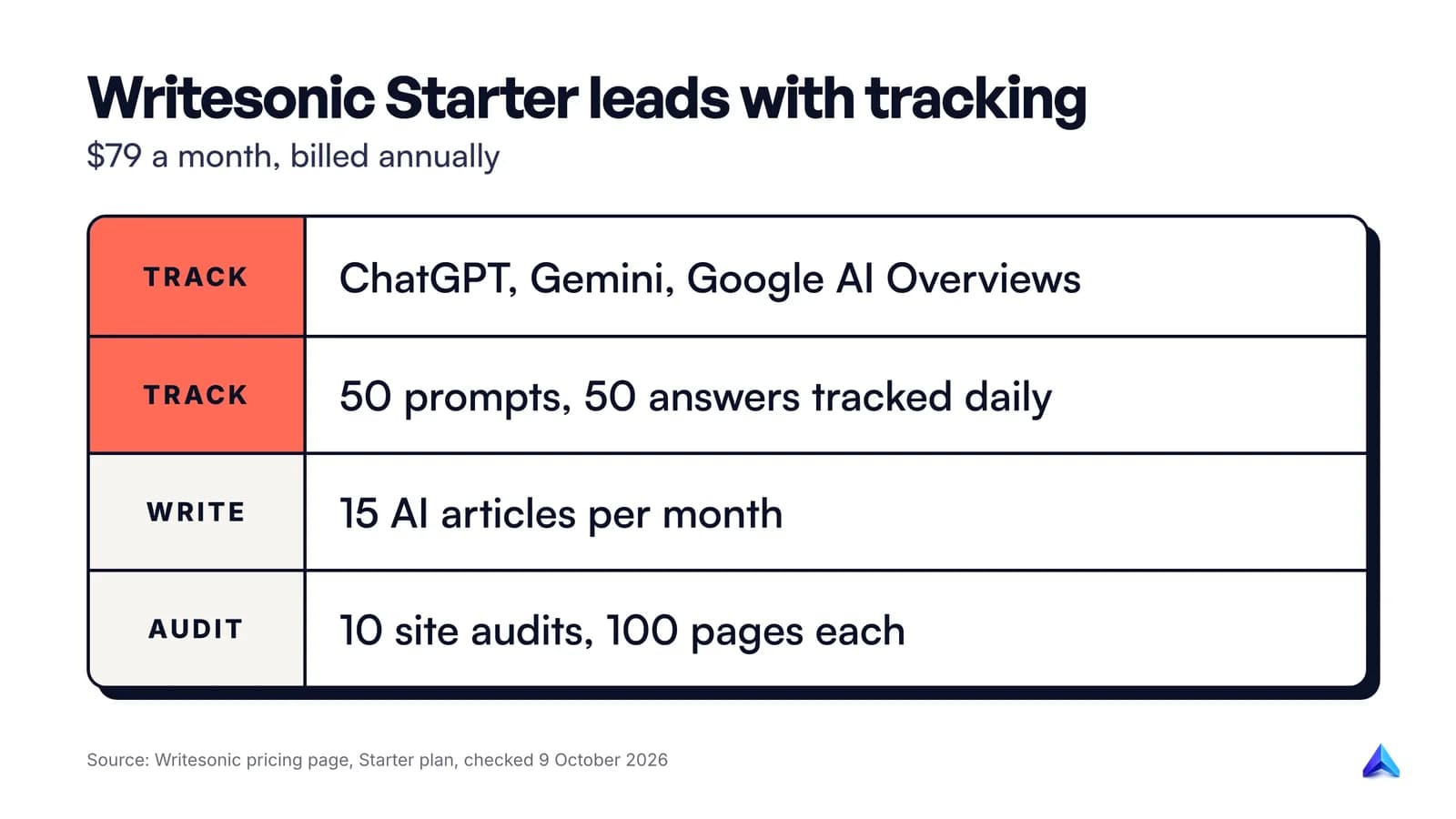
The plans read the same way. As of October 2026, Writesonic's pricing page lists three self-serve plans, all quoted per month and billed annually:
| Writesonic plan | Price (billed annually) | Prompts tracked | AI articles a month | Users |
|---|---|---|---|---|
| Starter | $79/mo | 50 prompts, 50 answers a day | 15 | 1 |
| Basic | $199/mo | 100 prompts, 300 answers a day | 25 | 2 |
| Growth | $399/mo | 200 prompts, 600 answers a day | 50 | 3 |
All three track ChatGPT, Gemini and Google AI Overviews. Tracking all eight AI platforms Writesonic covers, including Perplexity, Claude, Copilot, Grok and Google AI Mode, needs the custom-priced Enterprise plan. The annual toggle advertises a 20% saving, and you can start free without a card.
So the question matters. If you judge the tool by drafts, brand voice and how fast a post goes live, you need job A, an AI writer, and you are paying for a dashboard you never open. If you report on how often AI answers mention your brand against competitors, you need job B, a tracker, and a specialist may give you more prompts, engines or countries for the money. Teams that need both get their own section further down.
Writesonic alternatives at a glance
One row per tool, grouped by job. "Entry price" is the cheapest paid plan on the vendor's own page on 9 October 2026, in US dollars.
| Tool | Job | Entry price (Oct 2026) | Best for | What it does better than Writesonic for that job |
|---|---|---|---|---|
| Jasper | A: writer | $59/seat/mo billed yearly | Brand and campaign teams | Brand voices, audiences and a marketing workspace for many channels |
| Copy.ai | A: writer | $24/mo billed yearly (Chat, 5 seats) | Small teams who want a shared chat workspace | Five seats on the entry plan, with models from OpenAI, Anthropic and Google |
| Rytr | A: writer | Free; paid from $7.50/mo | Solo writers on a tight budget | A free-forever plan and the lowest paid price here |
| Frase | A + some B | $39/mo billed yearly | One person running SEO content for one site | Research, writing, audits and CMS publishing in one loop |
| Surfer | A + some B | $49/mo billed yearly | Writers who optimise against the ranking pages | A content editor with 120 documents on the entry plan |
| Project Rankup (our product) | A only | See pricing | Founders and small teams publishing to their own site | Checks every draft before it can publish |
| Otterly.ai | B: tracker | $29/mo | Solo marketers and small brands | Four engines and daily tracking for under $30 |
| Peec AI | B: tracker | Check its pricing page | Teams that want unlimited users | Choose the 3 AI models you track |
| Profound | B: tracker | Free 7-day trial, then Enterprise | Large brands | Up to 9 answer engines on Enterprise |
| Semrush AI Visibility Toolkit | B: tracker | $99/mo add-on | Teams already on Semrush | AI visibility next to the SEO data you already pay for |
| Ahrefs Brand Radar | B: tracker | Custom prompts from $50/mo | Teams already on Ahrefs | A 462M-prompt index that needs no setup |
Several entry prices are annual prices charged upfront, and all are in dollars, so buyers in India and the UK should check the final rupee or pound amount at checkout.
If you need an AI writer
Writing tools differ less in the quality of a paragraph than in what surrounds it: brand voice, research, and what happens after the draft exists. Judge them on a real brief from your own backlog, not the demo prompt.
Jasper: for brand teams writing across channels
Jasper is a marketing workspace first. Jasper's pricing page lists Pro at $59 per seat a month billed yearly, or $69 month to month, with 2 brand voices, 5 knowledge assets and 3 audiences per seat. Business is custom-priced and adds agents for "complex marketing workflows, including GEO, translations, and deep research", plus API access. Jasper also says it writes in more than 30 languages.
It suits a team producing ads, emails, landing pages and blog posts that must sound like one company. A founder who only wants SEO blog posts pays per seat for channels they will not use. A full Jasper comparison is coming in its own guide.
Copy.ai: for a small team that wants one shared chat
Copy.ai now sells itself on workflows for sales and marketing teams. Its entry Chat plan costs $29 a month, or $24 a month billed $288 yearly, and that covers 5 seats with unlimited words in chat and access to OpenAI, Anthropic and Gemini models. The jump after that is steep: Growth is $1,000 a month for 75 seats and 20,000 workflow credits.
Pick the Chat plan if three to five people want a shared AI workspace for drafting at a low price per person. It is not an SEO writer: there is no keyword research or content scoring on the entry plan's feature list, so pair it with your own research.
Rytr: for the smallest budget
Rytr is the cheapest serious option. Its free plan is "Free forever, no CC required" and generates 10,000 characters a month, about 1,500 words of English. Unlimited lists at $7.50 a month and Premium at $24.16, and Premium adds 5 custom tones of voice and writing in 40-plus languages. Rytr says its annual plans save 20% and carry a 12-month commitment.
It is a good fit for a freelancer in Pune or Leeds writing product descriptions, emails and social posts. For long SEO articles you will do the research and structure yourself, which is where the guide to SEO content writing earns its keep.
Frase: for one person running SEO content end to end
Frase is the closest like-for-like replacement for the old Writesonic workflow, and it also does a light version of job B. As of October 2026, Frase's pricing page lists Starter at $39 a month billed yearly ($49 month to month) for 10 articles and 50 audit pages a month, with SEO and GEO scores and AI visibility on ChatGPT and Google AI. Professional ($103 yearly, $129 monthly) adds Perplexity. It publishes to WordPress, Webflow, Sanity or Wix, or hosts posts on its own FraseCMS.
Pick Frase if you want research, drafting, auditing and publishing for a single site in one login, with some AI tracking on the side.
Surfer: for writers who optimise against what ranks
Surfer's Discovery plan is $49 a month billed yearly for 120 documents; Standard, at $99, gives 360 documents and 25 AI prompts refreshed weekly. Its strength is the content editor, which scores your draft against the pages already ranking. Our Surfer SEO alternatives guide covers what that score does and does not predict.
A general AI assistant
People Also Ask keeps raising which AI beats ChatGPT for writing. For a single article, ChatGPT or Claude with a good brief is often enough. Dedicated tools add the scaffolding: saved brand voices, keyword data, scoring and publishing. Start with an assistant and pay for a writer when you miss that scaffolding.
Project Rankup (our product)
Project Rankup does job A for one kind of buyer: a business publishing research-backed blog posts to its own site. It reads your site and two or three competitor homepages once, pulls real volume and difficulty for keyword ideas, and flags keywords your domain is unlikely to win yet. Each draft opens with a direct answer, carries FAQ and Article schema, cites dated sources and links to your own pages. A publish-readiness gate blocks drafts with leaked prompt text, cut-off endings or scores below its threshold, and WordPress publishing is supported.
Be clear about what it is not. Project Rankup has no AI-visibility or share-of-voice tracking, so it is not an alternative for job B, and it does no link building. It targets 10 countries, including the US, UK and India, and writes in English or Chinese only. Plans are on the pricing page.
If you need to track AI visibility
Every tool in this group does the same basic thing. You give it prompts, the questions your buyers ask an AI, and it runs them on a schedule, records each answer, and reports how often your brand is mentioned or cited next to competitors. The differences are in which engines, how many prompts, how often, and in how many countries. If the vocabulary is new, our explainer on generative engine optimization covers what these tools are trying to measure.
Otterly.ai: the cheapest way to start
As of October 2026, Otterly's pricing page lists Lite at $29 a month for 15 search prompts tracked daily on four engines: ChatGPT, Google AI Overviews, Perplexity and Microsoft Copilot. Claude, Gemini and Google AI Mode are paid add-ons. Every plan includes unlimited team members, and the page lists support for 50-plus countries. Standard is $189 for 100 prompts, and Premium is $489 for 400.
Fifteen prompts covers one product line in one market, which makes Lite a cheap month-long trial before you commit anywhere larger.
Peec AI: for teams that want to pick their models
Peec prices by prompts. Its Starter, Pro and Advanced plans track 50, 150 and 350 prompts daily, each with a choice of 3 AI models and unlimited users, and Advanced adds multiple countries and a Looker Studio integration. The page explains that usage is "calculated by multiplying tracked prompts by active models and tracking frequency". We could not read a price from Peec's pricing page on 9 October because it loads in an interactive widget, so check the live figure before you budget.
Profound: for large brands
Profound now presents itself as an "AI Marketer" that researches, writes and reports, with visibility tracking underneath. Its public pricing has two tiers: a free trial that runs 50 prompts daily for 7 days on ChatGPT, Gemini and Google AI Overviews, and a custom-priced Enterprise plan that tracks up to 9 answer engines with SSO and SOC 2 compliance. There is no self-serve paid plan, so expect a sales process.
Semrush AI Visibility Toolkit: if you already pay for Semrush
Semrush sells AI visibility as a separate toolkit. Its knowledge base lists the price as $99 a month with no free trial, including 25 prompts for daily Prompt Tracking on platforms such as Google AI Mode and ChatGPT, plus brand-performance reports, prompt research and an AI crawler check in Site Audit. Extra prompts cost $60 a month per 50. Regional data covers the US, UK and India among more than 40 countries.
On its own, $99 for 25 prompts is not cheap. Inside an existing Semrush subscription, it puts AI visibility next to rankings and backlinks in one place. Our Semrush alternatives guide covers the wider suite.
Ahrefs Brand Radar: if you already pay for Ahrefs
Ahrefs Brand Radar works two ways. Custom Prompts tracks the exact questions you choose and starts at $50 a month, with some prompts included free on every paid Ahrefs plan from Lite up. The AI Visibility Index starts at $199 a month and shows any brand's visibility across a database of more than 462 million prompts on AI Overviews, AI Mode, ChatGPT, Perplexity, Gemini and Copilot, with no setup.
The index lets you check a competitor's AI visibility before you write a single prompt, though Ahrefs says it works best once a brand already appears in AI search.
How to compare AI visibility trackers fairly
"50 prompts" means different things on different pricing pages. The number that matters is how many AI answers the tool actually records, and that is prompts multiplied by engines multiplied by how often each runs. Peec says so in its own pricing note, and Ahrefs spells it out: "5 prompts on 1 platform = 150 checks/mo."
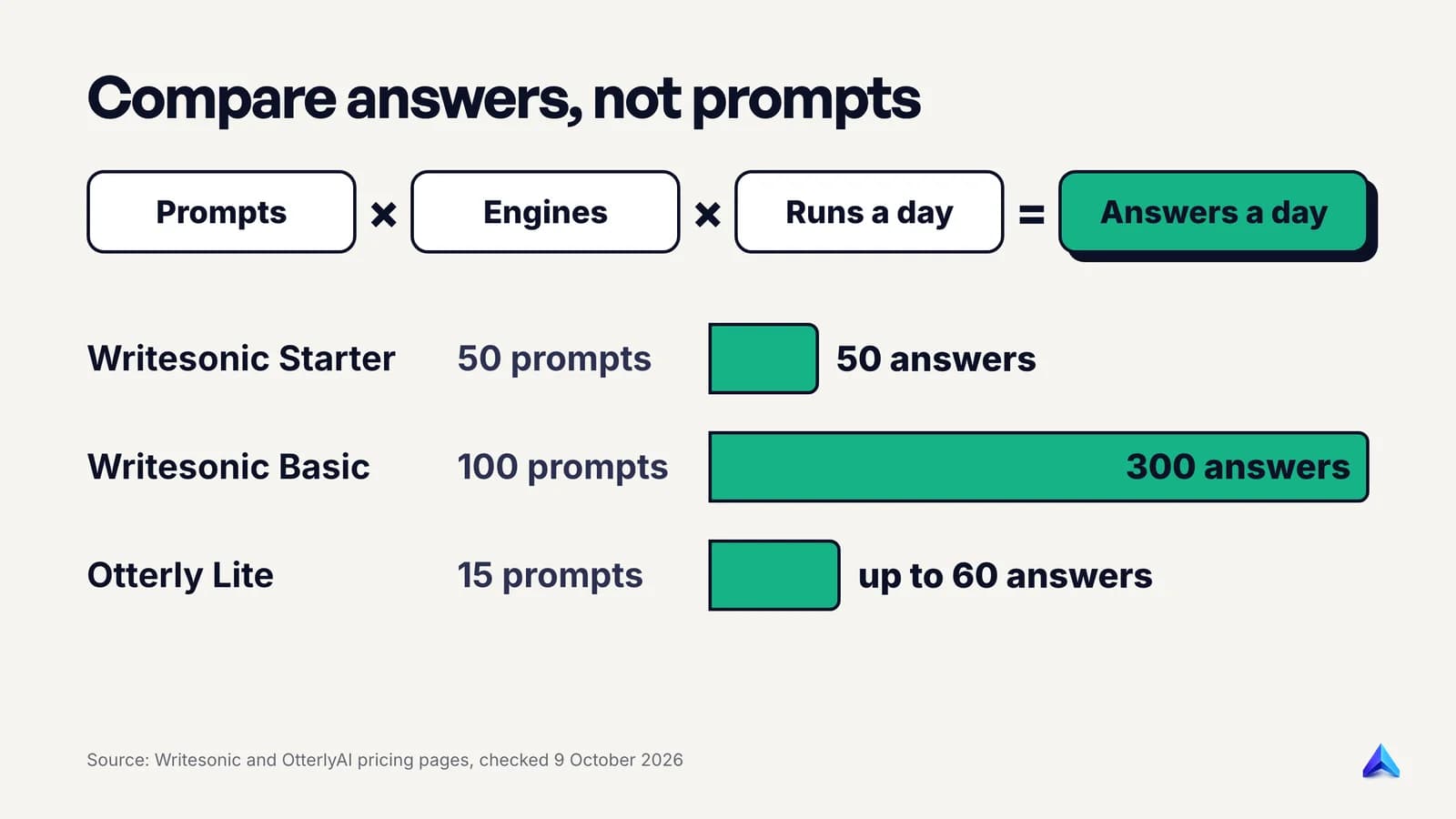
Writesonic's own plans show why. Starter lists "50 prompts, 50 answers tracked daily" across three engines, which works out to one answer per prompt per day. Basic lists 100 prompts and 300 answers a day, which is every prompt on every engine, daily. Basic has twice the prompts and six times the answers. Otterly's Lite plan, by the same arithmetic, can record up to 60 answers a day from 15 prompts on four engines.
When you shortlist trackers, ask each vendor four questions:
- How many answers a day does my plan record? Not prompts. Answers.
- Which engines are included, and which are add-ons? Otterly sells Claude, Gemini and Google AI Mode as add-ons, and Writesonic keeps Perplexity, Claude and AI Mode for Enterprise.
- Which country and language are the prompts run in? An answer in the US can differ from the same prompt asked from India or the UK.
- Can I export the raw answers? A visibility score you cannot audit is hard to defend in a report.
Then set a free baseline before you pay anyone. Google's documentation on AI features says that sites appearing in AI Overviews and AI Mode "are included in the overall search traffic" in Search Console's Performance report. That will not tell you how often you were mentioned, but it does tell you whether Google's AI features are sending you clicks. Our guides to what AI Overviews are and Google AI Mode explain where those answers appear.
The same page says there are "no additional requirements to appear in AI Overviews or AI Mode, nor other special optimizations necessary". A tracker measures; it does not change what Google rewards. The work that moves the number is still useful, well-structured, indexable content.
One tool for both jobs, or two cheaper ones?
Writesonic's case is the bundle: tracking and writing in one login, with the articles meant to close the gaps the tracker finds. That has real value if one person does both jobs and wants a single workflow.
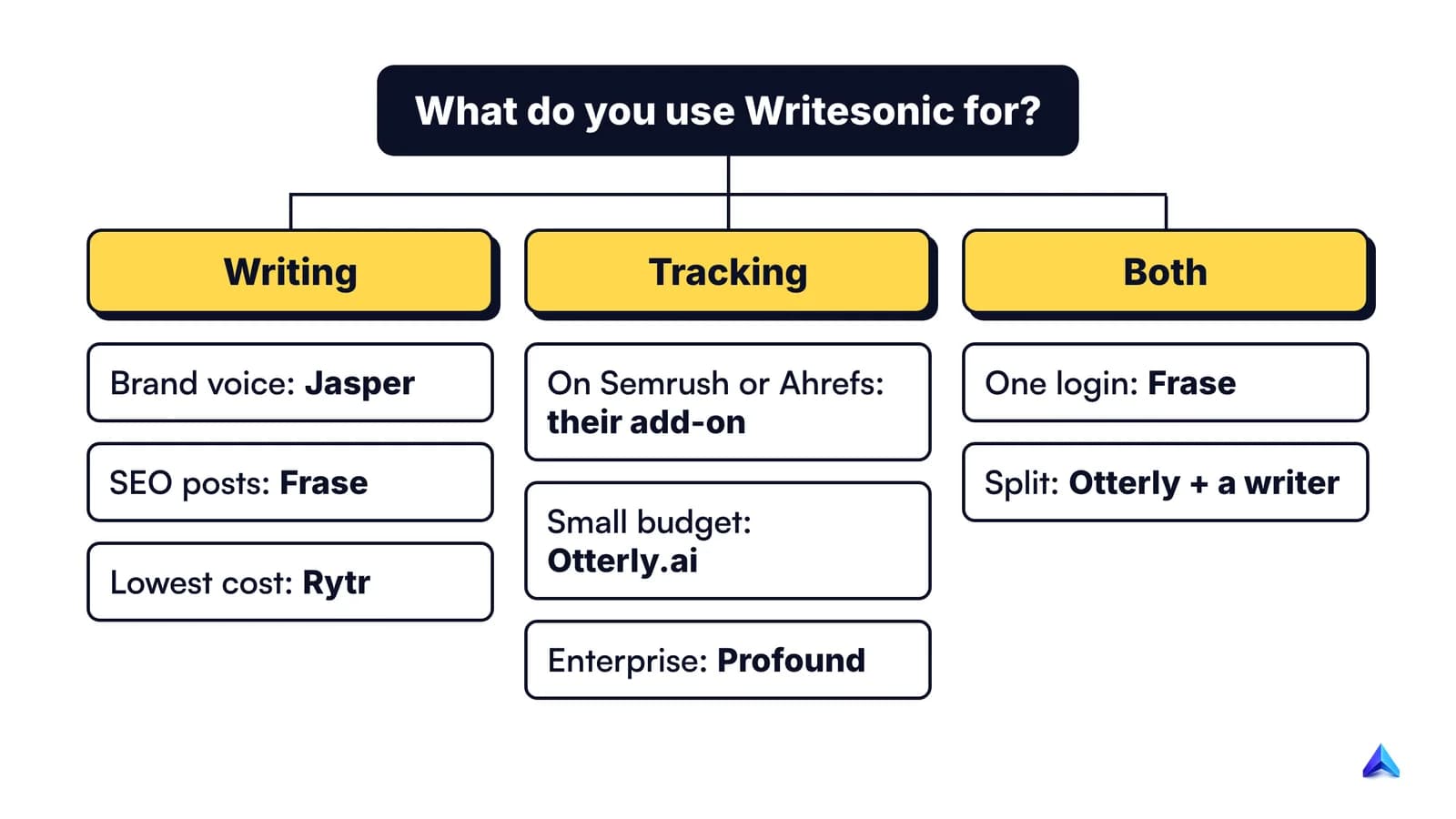
Splitting the jobs can cost less, though, and it lets you pick a stronger tool for each:
| Setup | Monthly cost (Oct 2026) | Tracking | Writing |
|---|---|---|---|
| Writesonic Starter | $79, billed annually | 50 prompts, 50 answers a day, 3 engines | 15 AI articles |
| Otterly Lite + Rytr Unlimited | $36.50 | 15 prompts, 4 engines, daily | Unlimited Rytr generations |
| Frase Starter | $39, billed yearly | ChatGPT and Google AI | 10 articles, plus publishing |
| Ahrefs or Semrush add-on + Jasper Pro | $50 or $99, plus $59 a seat | Inside your SEO suite | Brand-voice writing |
Our recommendation: if your tracking needs fit in fewer than 20 prompts, split the jobs and spend the difference on better content. If you already pay for Ahrefs or Semrush, add their AI module before buying a separate tracker. Keep an all-in-one tool like Writesonic or Frase when the same person writes, tracks and reports, and the time saved by one login is worth more than the price gap.
Before you cancel Writesonic
- Copy out your prompt list and competitor set. These took the most thought to build, and you will paste them straight into the next tracker.
- Screenshot or export your current visibility numbers. Different trackers measure differently, so you need a before figure, and you should not expect the new tool's first numbers to line up with the old ones.
- Save the articles you published from Writesonic with their target keywords, so you can track them in Search Console after you leave.
- Run the same 10 prompts in two trackers for a week. Compare the answers they record, not just the scores.
- Time it to your renewal. Annual plans are paid upfront, so use the remaining article and audit credits on posts you plan to refresh first.
常見問題
Is Writesonic still an AI writer?
Partly. As of October 2026 it markets itself as an AI search visibility platform, and its plans lead with prompt tracking on ChatGPT, Gemini and Google AI Overviews. Each plan still includes AI articles, from 15 a month on Starter to 50 on Growth, plus site audits.
How good is Writesonic?
It is a capable all-in-one tool if you want AI-visibility tracking and article writing in one login. The entry plan records only 50 answers a day, and all eight AI platforms need Enterprise, so price it against a dedicated tracker plus a dedicated writer.
Which AI writing tool is best for writers?
For brand and marketing teams, Jasper, because of its brand voices and audiences. For SEO blog writers, Frase or Surfer, because they research and score against the pages that rank. For freelancers on a budget, Rytr, which has a free plan and paid plans from $7.50 a month.
Is Copy.ai better than Jasper?
They suit different buyers. Copy.ai's Chat plan gives 5 seats for $24 to $29 a month, which is cheap for a small team that wants a shared AI workspace. Jasper costs $59 to $69 per seat but adds brand voices, audiences and marketing agents. Pick Copy.ai for price per person, Jasper for brand control.
Is there a free Writesonic alternative?
Rytr has a free-forever plan with 10,000 characters a month for writing. For tracking, Profound offers a free 7-day trial, and Ahrefs includes some Brand Radar prompts in its paid plans. Search Console is free and reports clicks from AI Overviews and AI Mode as part of your search traffic.
Which Writesonic alternative is cheapest for AI visibility tracking?
Otterly.ai's Lite plan, at $29 a month for 15 prompts tracked daily on ChatGPT, Google AI Overviews, Perplexity and Copilot, was the lowest self-serve price we found on 9 October 2026. Ahrefs Brand Radar's custom prompts start at $50 a month.