SEO for dentists means getting your practice into the map results and the treatment searches that nearby patients run, then turning those visits into booked appointments. In practice that comes down to four assets: a correctly set up Google Business Profile, one page per treatment, honest reviews, and a website whose claims your regulator would sign off. The last part is where most dental SEO advice goes wrong, so this playbook covers the rules alongside the tactics.
Examples cover the US, the UK and India, because the advertising rules differ more than the search tactics do.
What patients search, and which page should answer it
Google treats "dentist" as a place you go to, not a topic you read about. Its own Search Quality Rater Guidelines list [dentists] among the queries that "clearly 'ask' for nearby information or nearby results", next to pizza and car repair. So the first battle is the map pack, and the map pack is fed by your Business Profile, not your blog.
The second battle is treatment searches. Someone researching implants, aligners or a root canal is rarely ready to book today; they are comparing costs and reading about recovery. Pages on your site win those searches.
| What the patient types | What they want | The page that should win it |
|---|---|---|
| dentist near me, emergency dentist Leeds | A practice open now, close by | Google Business Profile |
| dental implants cost Austin, Invisalign price Pune | A price range and whether you do it | Treatment page with fees |
| is a root canal painful, dry socket symptoms | Reassurance before booking | Treatment page or a short guide, clinically reviewed |
| Dr Priya Shah dentist | That one dentist's details | The dentist's own profile and bio page |
| dentist accepting new NHS patients | Eligibility, not marketing | A plain, current "new patients" page |
Two keyword rules follow from that table. Treatment plus place beats generic terms, because "dental implants in Cedar Park" has a patient behind it and "best dental tips" does not. And the difficulty score matters more than the volume, because a new practice site cannot outrank dental chains and directories on head terms. If KD scores are new to you, our guide to keyword difficulty explains how to read them against your own site's authority.
Google Business Profile: the practice and each dentist
Most practices get the profile basics right. Fewer read the part of Google's guidelines for representing your business that names dentists outright: "Doctors, dentists, lawyers, financial planners, and insurance or real estate agents are all individual practitioners."
That status gives each dentist the right to a separate profile, under two conditions. They must work in a public-facing role, and they must be reachable at the verified location during stated hours. Google says support staff should not create their own profiles, so reception, treatment coordinators and practice managers do not get listings.
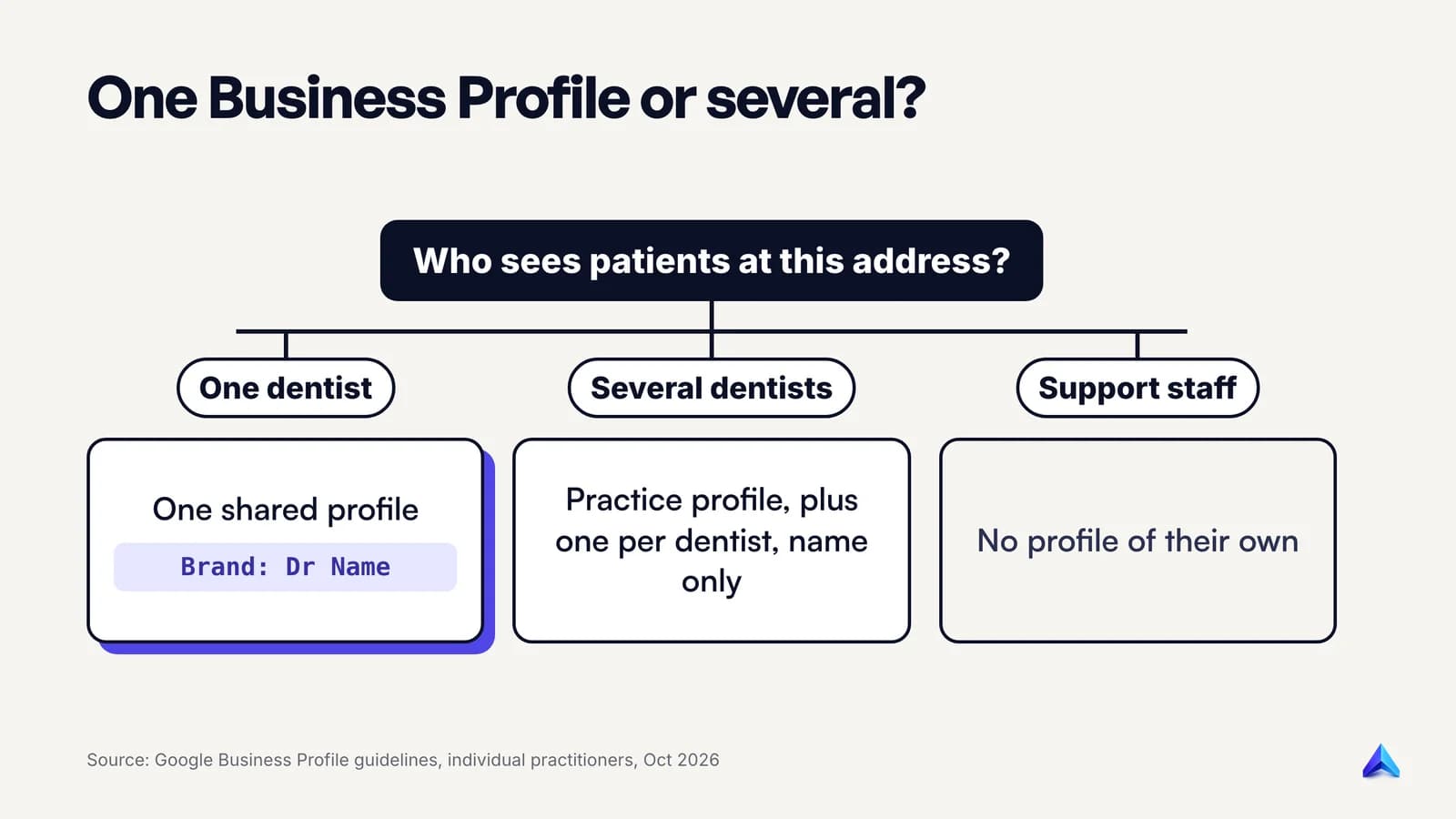
How you set it up depends on how many dentists see patients at the location:
- Several dentists at one practice. The practice gets its own profile. Each dentist gets a profile titled with their name only, such as "Dr Priya Shah, DDS". Google says the practitioner's title "shouldn't include the name of the organization."
- One dentist under a practice brand. Google says it is best to share a single profile, named "[brand/company]: [practitioner name]", for example "Harbour Dental: Dr Tom Ellis".
- One dentist, many skills. Still one profile. Google states that a practitioner "shouldn't have multiple Business Profiles to cover all of their specializations." A separate "implant dentist" listing for the same person breaks the guidelines, and Google reserves the right to suspend profiles that do.
Practitioner profiles may include "Dr." or a degree such as DDS or BDS. Keep the practice profile's name exactly as it appears on your sign, with no "best" or city keywords bolted on. And remember that each dentist profile collects its own reviews: with frequent associate turnover, we think one strong practice profile is the better trade.
Treatment pages that pass the YMYL bar
Every treatment you want patients to find needs its own URL. A "Services" page that gives twelve treatments a sentence each cannot rank for any of them.
Dental content is what Google calls "Your Money or Your Life" material, and its raters are told to hold it to a higher standard. The rater guidelines even use a dental page as a worked example of the lowest rating: a page about dry socket with "literally no information about who is responsible for the content or the website." The guidelines' reasoning is that medical information about a dental condition "could significantly impact how people seek dental treatment", and that medical pages need a high level of trust.
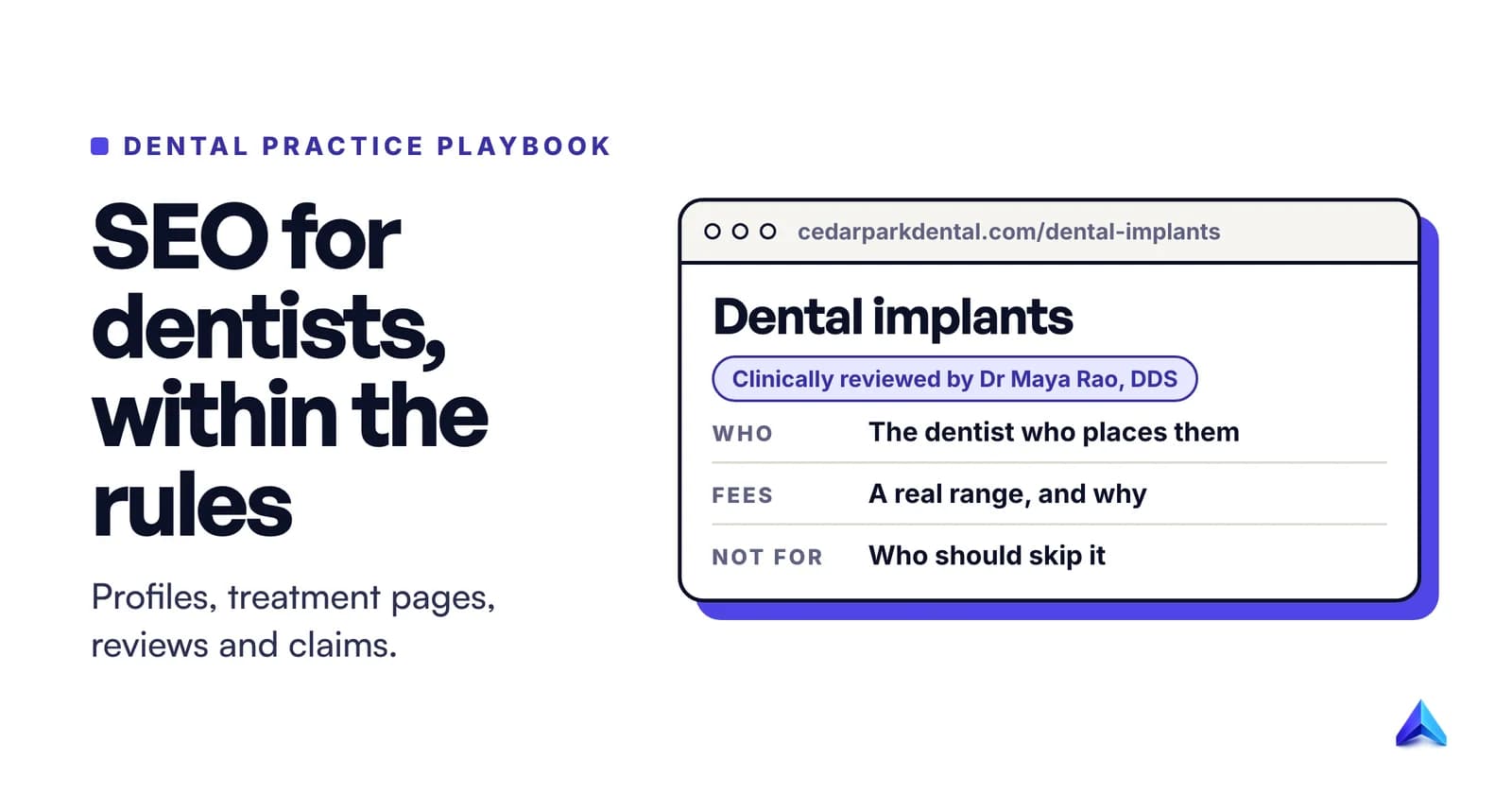
That example tells you what a treatment page has to show. Build each one with:
- Who does it. The treating dentist's name, qualification and registration number, with a link to their bio.
- Who checked the page. A "clinically reviewed by" line and a review date. The ADA's code treats a health article published under a dentist's byline without "truthful disclosure of the source and authorship" as misleading, so the byline must be true.
- What it costs. A real range, and what changes it. Indian practices are explicitly allowed to publish fees, as the India section below explains.
- What happens. Consultation, stages, appointments, recovery time, in the order a patient lives through it.
- Who it is not for. Contraindications and alternatives. This is the content competitors skip and nervous patients look for.
- Questions you hear in the chair. Answer them in plain words, consistent with mainstream clinical guidance. The rater guidelines ask raters to check YMYL pages for consistency "with well-established expert consensus."
Write each page for a frightened adult. If it answers "will it hurt, how long, how much" in the first screen, it also answers the query Google is matching. Our breakdown of what Google means by helpful content goes deeper on how its systems and raters judge that.
Word the page so your regulator would sign it
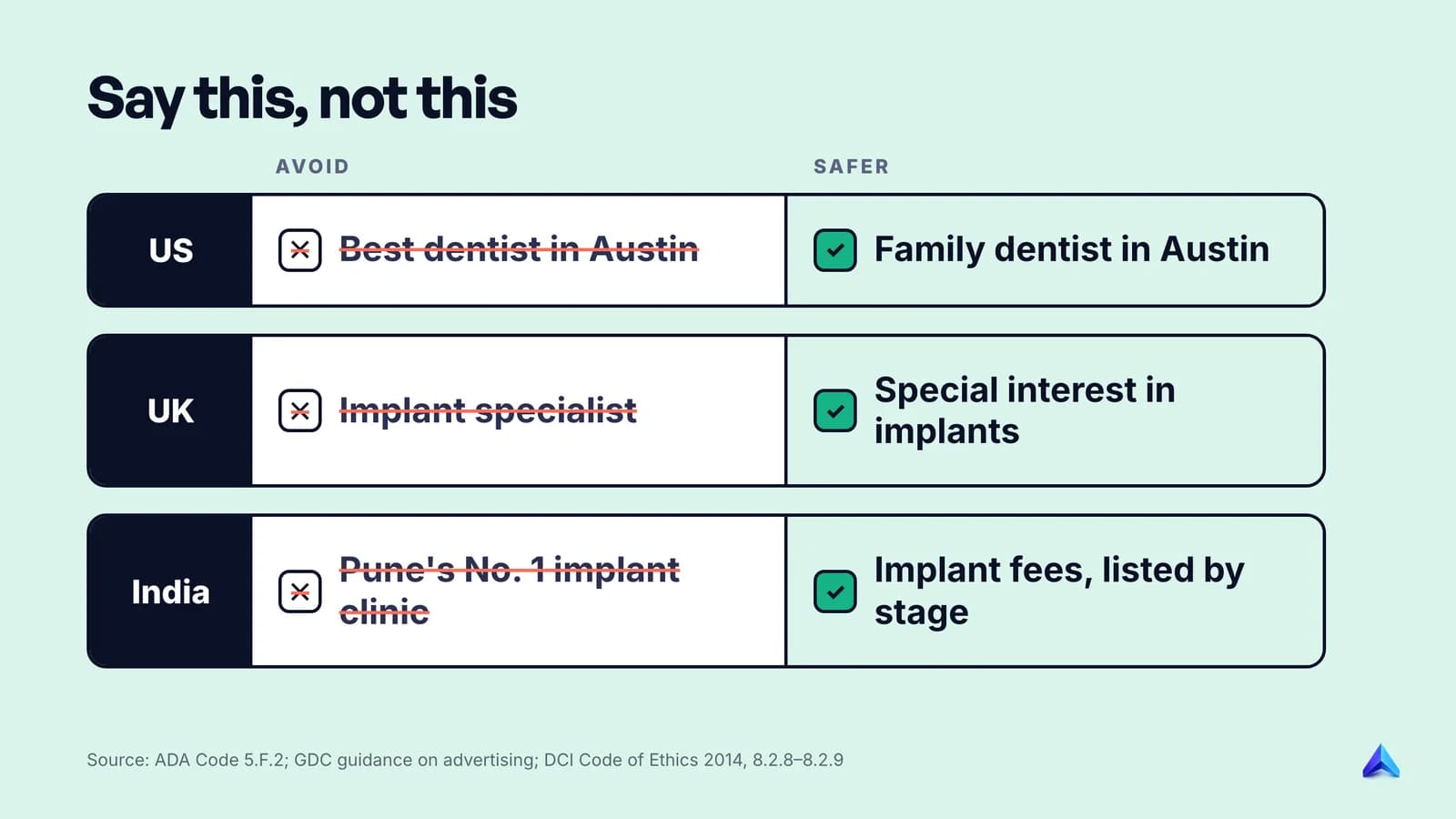
Treatment pages are advertising, and the title you give yourself is regulated. In the UK, the GDC says a dentist who is not on a specialist list "must not describe yourself as 'specialising in…'" and may instead say "special interest in", "experienced in" or "practice limited to". In the US, the ADA code limits announcing yourself as a specialist to the specialties recognised by the National Commission on Recognition of Dental Specialties and Certifying Boards. A heading such as "Implant Specialist" on a general dentist's page fails both.
Location pages without doorway pages
Multi-site groups need one page per real practice address: its own team, hours, parking, accessibility, NHS or private status, and directions. That page is what the Business Profile for that site should link to.
What fails is the page for every suburb you would like patients from. Google's spam policies define doorway abuse to include "pages targeted at specific regions or cities that funnel users to one page" and "substantially similar pages that are closer to search results than a clearly defined, browseable hierarchy." Twenty near-identical "Dentist in [suburb]" pages pointing at one surgery are exactly that. If you have one building, mention the areas you serve on your contact page and let the Business Profile do the local work.
Reviews: what Google, the FTC and HIPAA each allow
Reviews are what patients read before they call, and they are where a practice can break three sets of rules in one email. The rules do not match. Google is stricter than US law on how you ask, and HIPAA is stricter than both on how you reply.
How you ask. The FTC's Consumer Reviews and Testimonials rule took effect on October 21, 2024, and allows courts to impose civil penalties for knowing violations. It does not ban incentives outright: they are allowed "as long as there isn't an express or implied requirement that the reviews have to express a particular sentiment." The FTC's own example of an implied requirement is "Tell us how much you loved your visit... and get a $5 coupon." Google's Maps policy goes further and bans any incentive "in exchange for posting any review," along with "selectively solicit[ing] positive reviews." A $10 gift card for an honest review can pass the FTC rule and still get the review removed from Google.
Who you ask. The FTC answers yes to family members reviewing your business, provided they "clearly and conspicuously disclose their relationship." Google lists family and employment as conflicts of interest. So staff, spouses and the associate down the hall should not review the practice on Google at all.
How you reply. This is where dental practices have actually been penalised. The HHS Office for Civil Rights settled with New Vision Dental in California over patient information disclosed in replies to online reviews; the practice paid $23,000. In a separate North Carolina case, HHS imposed a $50,000 civil money penalty on a dental practice that disclosed a patient's information on a webpage responding to a negative review.
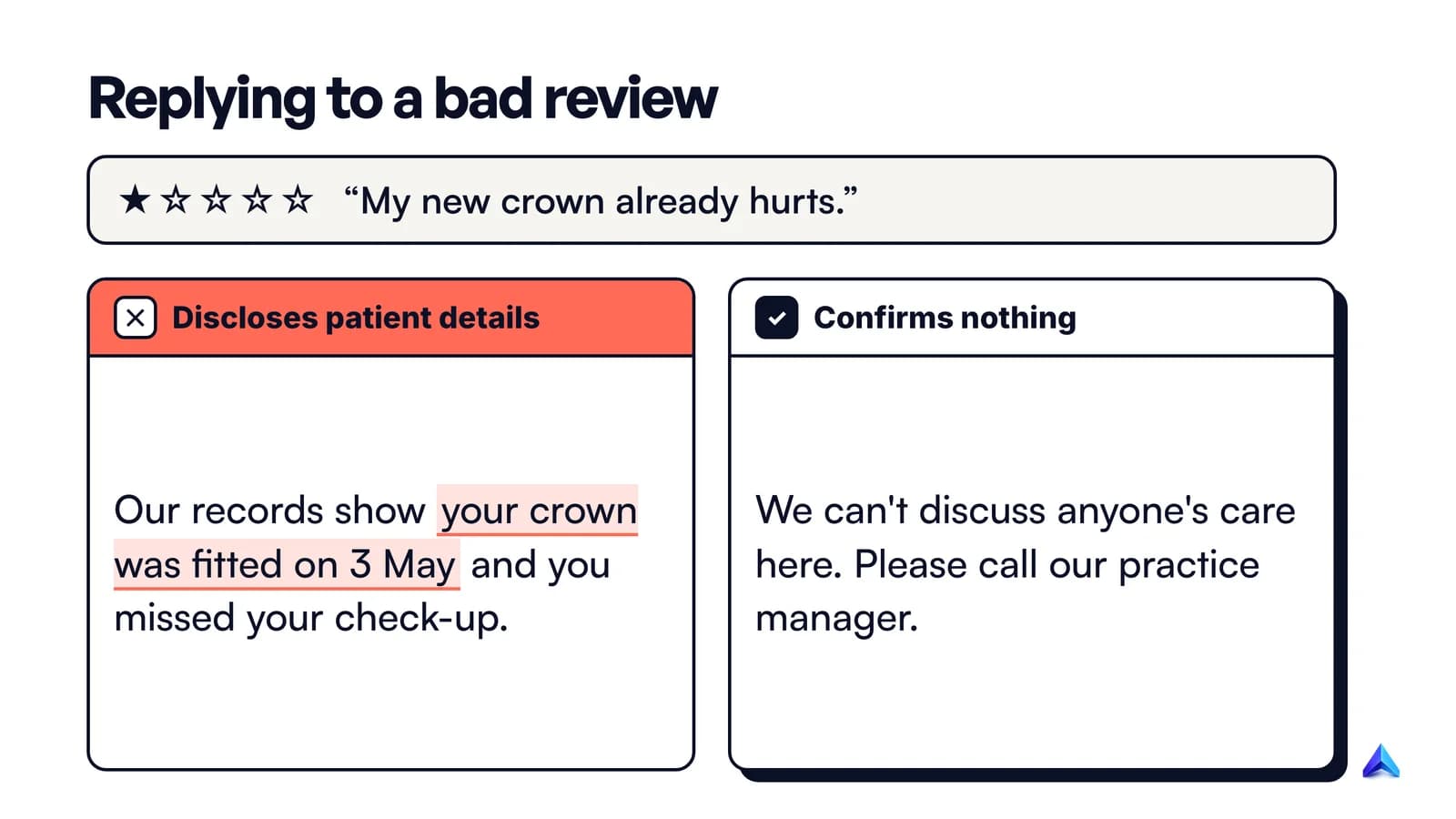
A safe reply never confirms that the reviewer is a patient, never mentions treatment, dates or records, and moves the conversation offline. Something like: "We take every comment seriously and can't discuss anyone's care in a public forum. Please call our practice manager on the number on our website so we can look into this." The FTC adds its own limits: no false accusations against the reviewer, no intimidation and no "unfounded or groundless legal threat."
The same privacy logic covers your website. If a case study, testimonial or before-and-after photo identifies a patient, treat it as marketing. HHS guidance says that "with limited exceptions, the Rule requires an individual's written authorization" before health information is used for marketing. Get the signature before the photo goes on the page.
UK practices have their own review law: since April 2025, fake reviews and undisclosed paid-for reviews are banned practices under the Digital Markets, Competition and Consumers Act. Our local SEO guide for UK businesses walks through what that means for asking customers, so it is not repeated here.
What your website may claim in the US, UK and India
Dental marketing rules are written by regulators who assume patients cannot judge clinical quality for themselves. Each country expresses that differently, and the differences decide what goes in your page titles. This is a summary, not legal advice: check your own state board, the GDC or your State Dental Council before you publish.
United States: the ADA code and your state board
The ADA code is unusually direct about search. Advisory opinion 5.F.6 says dentists "may use services to increase the visibility of their web sites," calls this SEO by name, and requires that the website be truthful like any other professional announcement. The ADA's veracity section then lists what counts as misleading. Two items catch most dental SEO copy:
- statements "likely to create an unjustified expectation about results the dentist can achieve", such as "pain-free implants" or "perfect smile guaranteed";
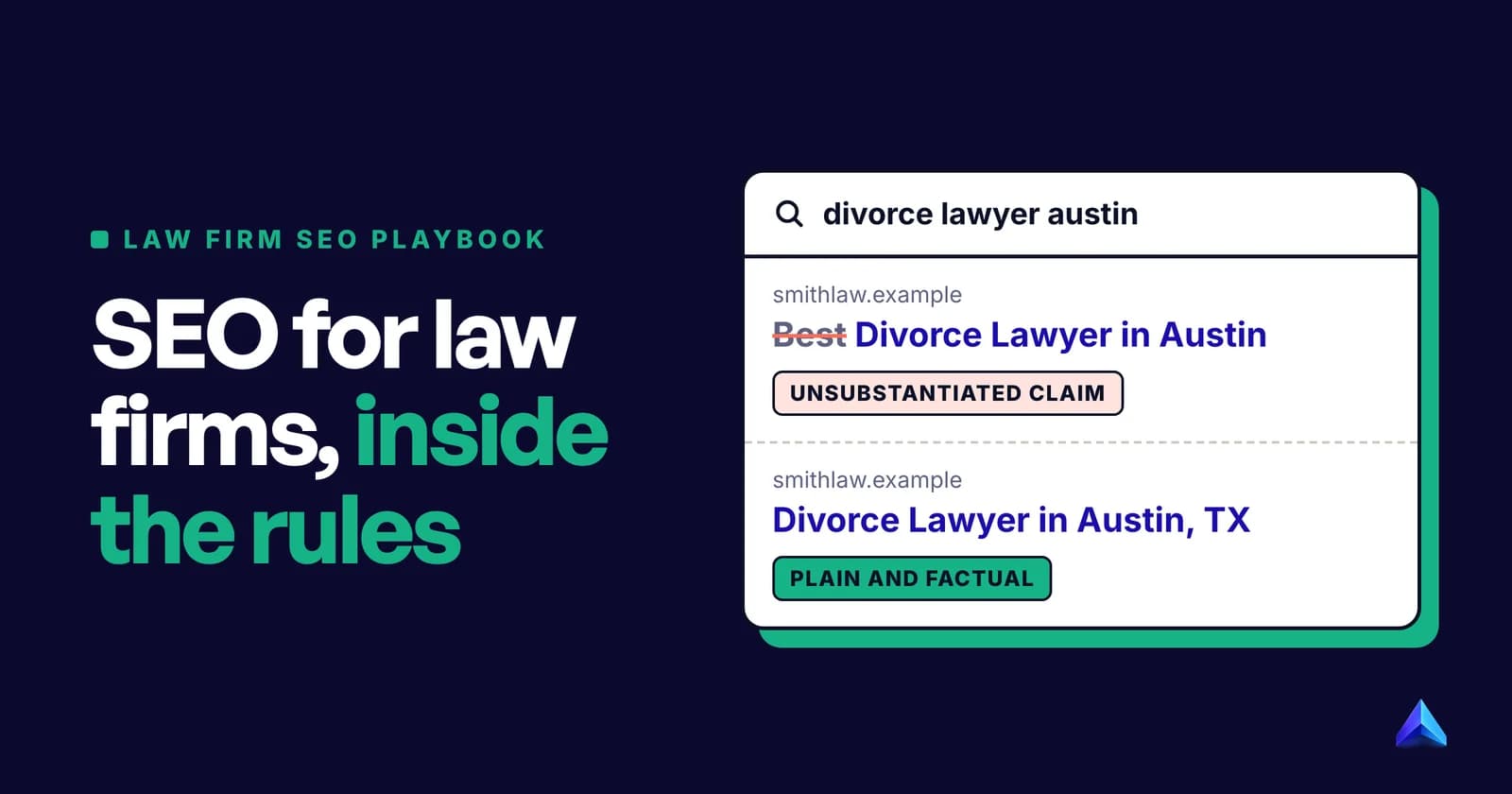
- a claim "that the advertised services are superior in quality to those of other dentists, if that representation is not subject to reasonable substantiation", which is what "Best Dentist in Austin" is.
That second point puts the ADA at odds with common agency advice to put "best" in a homepage title. The code is the profession's ethics standard, not state law, and the ADA itself says that "in all instances, state law should be consulted."
United Kingdom: the GDC, then the CAP Code
The GDC's guidance on advertising is the most specific of the three, and parts of it read like a website checklist. A practice website must show:
- the practice name and the geographic address where care is provided;
- contact details, including an email address and phone number;
- the GDC's contact details or a link to the GDC website;
- the complaints procedure, and who patients can go to if they are not satisfied;
- the date the website was last updated.
Every dentist named on the site needs their qualification, the country it came from and their GDC number shown. The practice must make clear whether it is NHS, mixed or wholly private. The site must not compare one professional's skills with another's, and treatment offers on social media must say the treatment "may not be appropriate for every patient" and depends on an assessment.
On top of that sits the CAP Code's health section, which the ASA enforces. Rule 12.1 says "objective claims must be backed by evidence, if relevant consisting of trials conducted on people," and rule 12.9 requires proof before claiming a treatment is "guaranteed to work, absolutely safe or without side-effects."
India: the 2014 code of ethics
India's rules are the strictest on self-promotion and the most generous on prices. The Revised Dentists (Code of Ethics) Regulations, 2014, issued by the Dental Council of India, allow a dentist to advertise "provided that they maintain decorum." Internet listings are permitted, but "any claim to superiority or special skills over others will be construed as unethical practice."
Websites get their own clause. A site where "all information is factual" is acceptable, and it may carry "details of treatment facilities available and the fees for the same." So an Indian practice can publish a fee table for implants or aligners, which is one of the most useful things a treatment page can show. What it cannot do is "boast of cases, operations, cures," call a new service the "best" or "first," or name a clinic a "dental hospital" unless it meets the code's in-patient conditions. The registration number from the State Dental Council must be displayed too.
One caveat. Parliament passed the National Dental Commission Act in 2023, which repeals the Dentists Act, 1948 under which this code was made. Ask your State Dental Council whether newer regulations apply before you rely on the 2014 text.
Structured data: what helps and what Google ignores
Mark up each practice location with schema.org's Dentist type, which inherits from LocalBusiness. Google's local business documentation asks for "the most specific LocalBusiness sub-type possible," and Dentist is it. Include the name, address, phone, opening hours and the URL of that location's page, matching the Business Profile exactly.
Do not expect review stars in your own search results, whatever other dental SEO guides promise. Google's review snippet documentation is clear: when a business controls the reviews about itself, its pages using LocalBusiness or Organization markup "are ineligible for star review feature," and that includes reviews pulled in "through an embedded third-party widget (for example, Google Business reviews...)." Show reviews to visitors by all means, but marking them up for stars is wasted effort. Spend that time on FAQ sections inside the main content, where patients, and the systems that build AI Overviews, can read them.
If you hire a dental SEO agency
Plenty of practices should hire help; a dentist's hour is better spent in the chair. A one-page written brief with your treatments, locations, fees policy and regulator does more than any sales call, and our guide to writing a content brief shows what fields to include.
Ask every agency these questions, and treat a vague answer as a no:
- Who owns the Google Business Profile? It should be the practice, with the agency added as a manager. An agency that owns the profile owns your reviews.
- How do you get reviews? Any mention of incentives, review "filtering" or only emailing happy patients breaks Google's policy.
- Who writes and checks the clinical content? A named dentist should approve every treatment page before it goes live.
- Will you create pages for areas where we have no surgery? If yes, that is the doorway pattern Google's spam policy describes.
- How will you word specialist services? The answer should come from your regulator's rules, not from what competitors write.
- What will you report? Calls, booking requests and direction requests from the profile, and clicks by treatment page from Search Console, not "keyword rankings" alone.
Walk away from any promise of the number one position.
How to tell it is working
Dental SEO pays off in calls and booking requests, so measure those first: the Business Profile's performance view for calls, website clicks and direction requests, and Search Console for which treatment pages earn clicks from which searches. Compare the two monthly.
Give a new treatment page a few months before you judge it, and check early that Google has indexed it at all; how to check if a page is indexed covers the quickest ways. If a page gets impressions but few clicks, rewrite its title around the price or the recovery question patients actually ask. If it gets clicks but no bookings, the page is answering the wrong question, or the booking route is too hard to find on a phone.
常见问题
What is SEO for dentists?
It is the work of making a dental practice appear when nearby people search for a dentist or a treatment. It covers the Google Business Profile, treatment and location pages, reviews and technical basics, all within the advertising rules that apply to dentists in each country.
What are the best SEO keywords for dentists?
Treatment plus place, such as "dental implants Austin" or "Invisalign cost Pune", and urgent local searches like "emergency dentist near me". They carry clearer booking intent than general dental tips and are usually less competitive than broad terms like "dentist".
How long does dental SEO take to work?
Profile fixes, such as the right category or a corrected address, tend to show first because Google reads them directly. Treatment pages take longer to settle, often months, and longer in competitive cities. A new website starts slower than one with years of genuine reviews and links.
How much does SEO cost for a dental practice?
It ranges from your own time to a monthly agency retainer, and prices vary widely by city and scope. The fair comparison is cost per new patient, so ask any agency how they will report calls and bookings, not only rankings.
Can a dentist respond to a negative Google review?
Yes, but the reply should not confirm the person is a patient or mention their care. In the US, HHS has penalised dental practices for disclosing patient information in review replies. A short reply that invites the reviewer to call the practice is the safe pattern everywhere.
Are dentists in India allowed to have a website?
Yes. India's 2014 dental code of ethics says a factual website is not unethical and may list treatments and their fees. It must avoid superiority claims, boasting about cases and calling a clinic a hospital without meeting the code's conditions.