B2B SEO is the work of getting your pages found by people who research purchases on behalf of a company: engineers, procurement managers, operations heads, finance teams. It differs from consumer SEO because the searches are few, each one can be worth a contract, several people judge the same page, and the sale usually closes with a person, not a checkout. So the job is to find the exact phrases buyers use, give each buying question its own page, and measure pipeline instead of traffic.
Most guides to B2B SEO quietly assume you sell software. This one works through three other businesses: an industrial valve manufacturer in Coimbatore selling to refineries and EPC contractors, a fire-safety consultancy in Leeds selling risk assessments to landlords and care homes, and a managed IT provider in Columbus, Ohio. SaaS teams can follow the same steps.
What makes B2B SEO different
Google ranks a valve maker's pages by the same rules as a sock shop's. What changes is the economics and the reader, and those change almost every decision you make.
| Consumer SEO | B2B SEO | |
|---|---|---|
| Search volume | Big head terms are worth chasing | A good keyword may get a few dozen searches a month |
| Value of one visitor | One basket | Possibly a year-long contract |
| Who reads the page | The person buying | Several people, each with a different worry |
| Buying cycle | Minutes to days | Weeks to many months |
| Where it converts | Checkout | A quote request, a call, a site visit, a trial |
| Vocabulary | Everyday words | Trade terms, standards, part numbers |
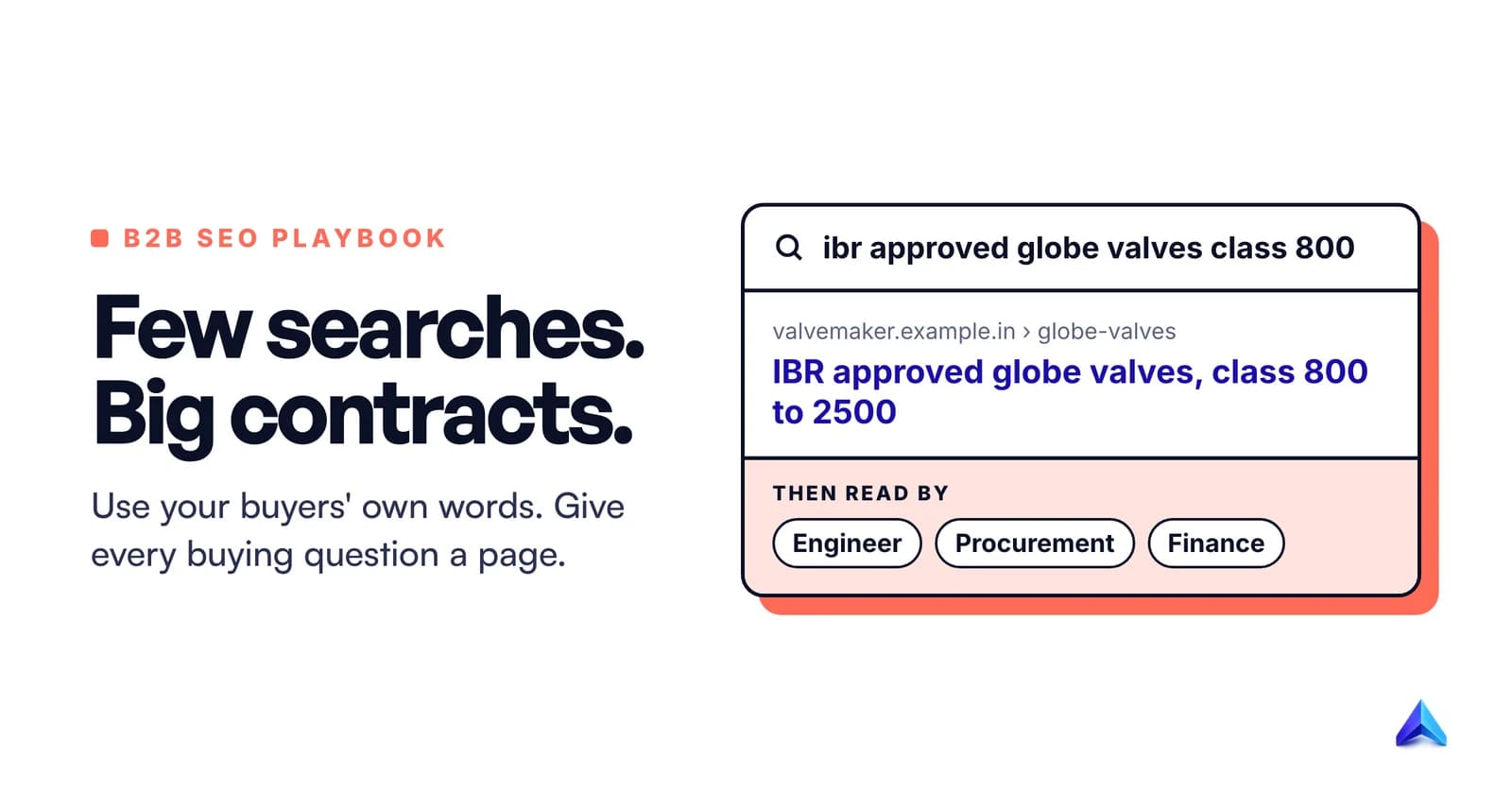
Small volumes are the point, not the problem. Suppose the Coimbatore valve maker finds a phrase that a keyword tool estimates at 30 searches a month. A consumer brand would skip it. But if one of those searchers a month sends a request for quotation, and one in four quotes becomes an order worth ₹18 lakh, that one page brings in about three orders a year. The numbers are illustrative. The shape holds for almost every B2B business: few searches, high stakes.
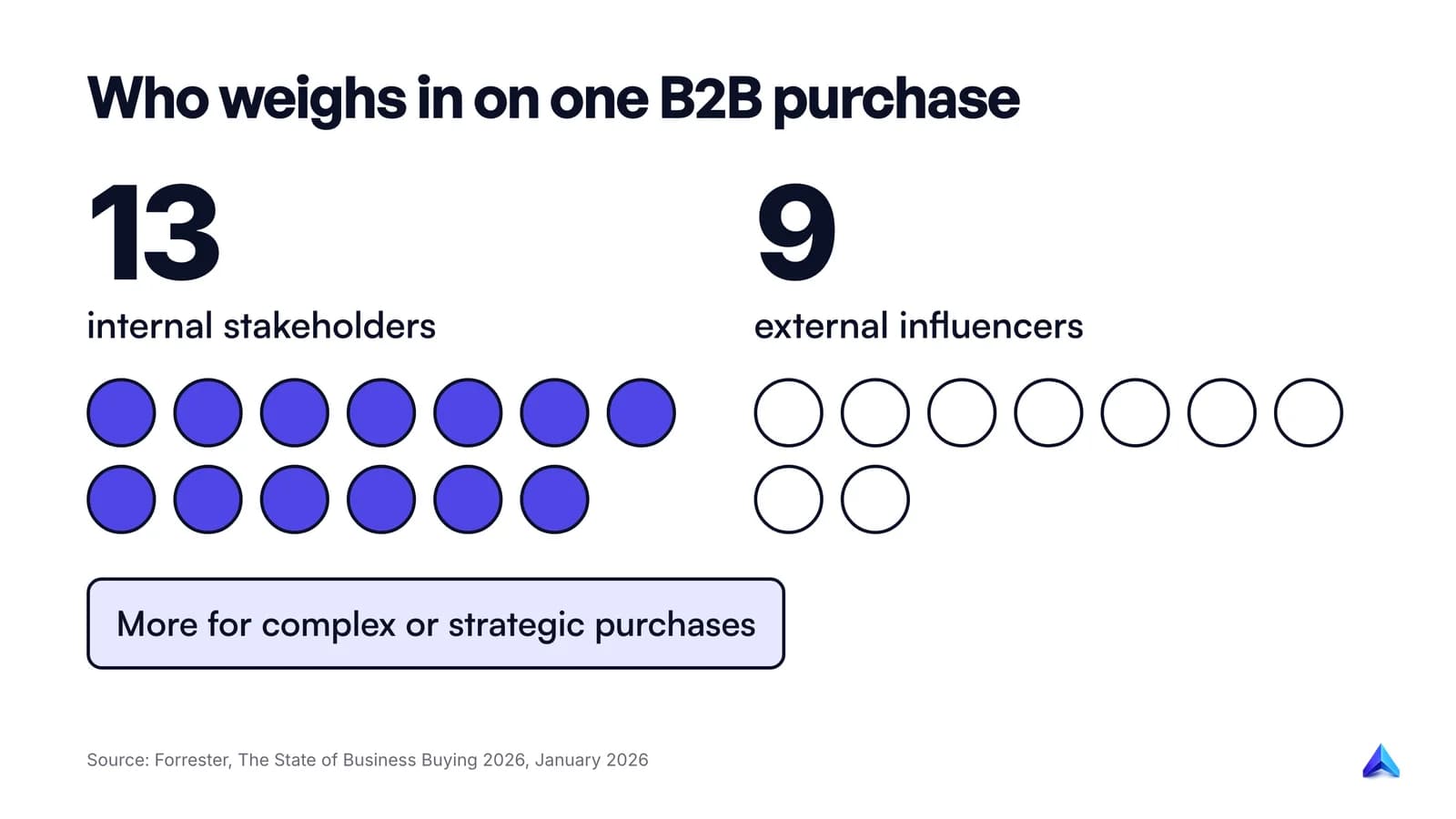
The reader is a committee. Forrester's State of Business Buying 2026 found that the typical buying decision now includes 13 internal stakeholders and nine external influencers, and that number rises for complex or strategic purchases. The same report says procurement professionals are decision-makers in 53% of business buying cycles, and they are involved from the start.
That changes what a page has to do. The plant engineer who found your page is not the person who signs. Your page will be forwarded, pasted into a comparison sheet and read again by someone who never searched for anything.
Cycles are long, and the sale finishes with a human. Nobody adds 40 gate valves to a cart. A fire risk assessment for a 60-bed care home starts with a scoping call. A managed IT contract starts with an audit. Organic search does its work weeks or months before revenue appears, which is why traffic reports undersell B2B SEO and why measurement gets its own step below.
Searchers are experts. Google's SEO starter guide makes the point with food: people who know a topic well use different words from people new to it, so one person searches "charcuterie" and another "cheese board". In B2B the gap is wider. A refinery buyer searches "API 6D trunnion ball valve", not "big valve for oil pipe". If your site uses the second kind of language, the first kind of buyer never finds it.
Step 1: Find the keywords buyers actually type
Keyword tools are built from aggregate demand, and B2B demand is thin and specialized. Start from your own records, then use a tool to check and expand.
Five kinds of B2B query
Almost every useful B2B keyword falls into one of five types. Each signals a different stage of a purchase.
| Query type | What it signals | Valve maker (India) | Fire-safety firm (UK) | Managed IT (US) |
|---|---|---|---|---|
| Problem | Something is broken or risky | gate valve passing after closing | fire door gaps too big | outlook keeps asking for password |
| Category | Looking for a supplier | forged steel valve manufacturer india | fire risk assessment company leeds | managed it services columbus |
| Comparison | Choosing between options | ball valve vs gate valve for steam | fire risk assessment vs fire safety audit | co-managed it vs fully managed |
| Standard or compatibility | Checking a hard requirement | IBR approved valves | BS 5839 fire alarm compliance | microsoft 365 backup for hipaa |
| Job title or role | Someone doing their own job well | valve inspection checklist for maintenance engineers | responsible person fire safety duties | it checklist for office managers |
Two rows matter most for revenue. Category queries come from people already looking for a supplier. Standard and compatibility queries come from people with a specification in hand, checking whether you meet it. Both are low volume and convert well, because the searcher has already decided to buy something.
Problem and job-title queries do a different job. They reach the engineer or office manager early, before a supplier list exists, and they are where an unknown company can earn its first visits. For SaaS companies, the integration row becomes "does X integrate with Y" pages, which our guide to SaaS content marketing covers in detail.
Mine your sales calls, RFQs and support tickets
The best B2B keyword list is already sitting in your inbox. Work through these sources and copy the buyer's exact words, not your summary of them.
- Requests for quotation and enquiry emails. Export the last 12 months. The subject lines and first sentences are search queries in disguise: "Need IBR approved globe valves 2 inch class 800 for boiler feed line".
- Notes from sales and scoping calls. Ask whoever takes the calls for the five questions they answer every week. For the Leeds consultancy that might be "Do I need a new assessment after a refurbishment?" and "Is a landlord responsible for fire doors in an HMO?"
- Support tickets and helpdesk tags. The managed IT provider's ticket categories are a ready-made list of problem queries, with real frequency attached.
- Free-text fields on your forms. "What do you need help with?" answers show the vocabulary prospects use before anyone from your team has taught them yours.
- Tender documents and specifications. Public tenders list the standards and part descriptions buyers will search for later.
Then put the phrases into a keyword tool. Some will show a volume. Many will show zero, or "0 to 10".
Do not throw out zero-volume keywords
A zero in a keyword tool means the tool's data did not catch the query. It does not mean nobody searches it. Google says as much about its own reporting: in a Search Central post on performance data, it explains that queries not issued by more than a few dozen users over a two-to-three month period are anonymized and left out of Search Console's query tables, though they still count in the chart totals.
Much of B2B search lives in exactly that band. So treat a phrase that came from three separate RFQs as real demand, whatever the tool says. Write the page, then watch impressions for it in Search Console over the following months.
Difficulty works the other way round. A new or low-authority site should start with the keywords it can win, and our explainer on keyword difficulty shows how to read that score against your own domain rather than in the abstract.
Step 2: Give each buying stage its own page
A B2B buyer moves through roughly four questions: what is wrong, what are my options, who can do it, and can I trust them. Each question needs a different page. Trying to answer all four on one service page is a common reason B2B sites rank for nothing.
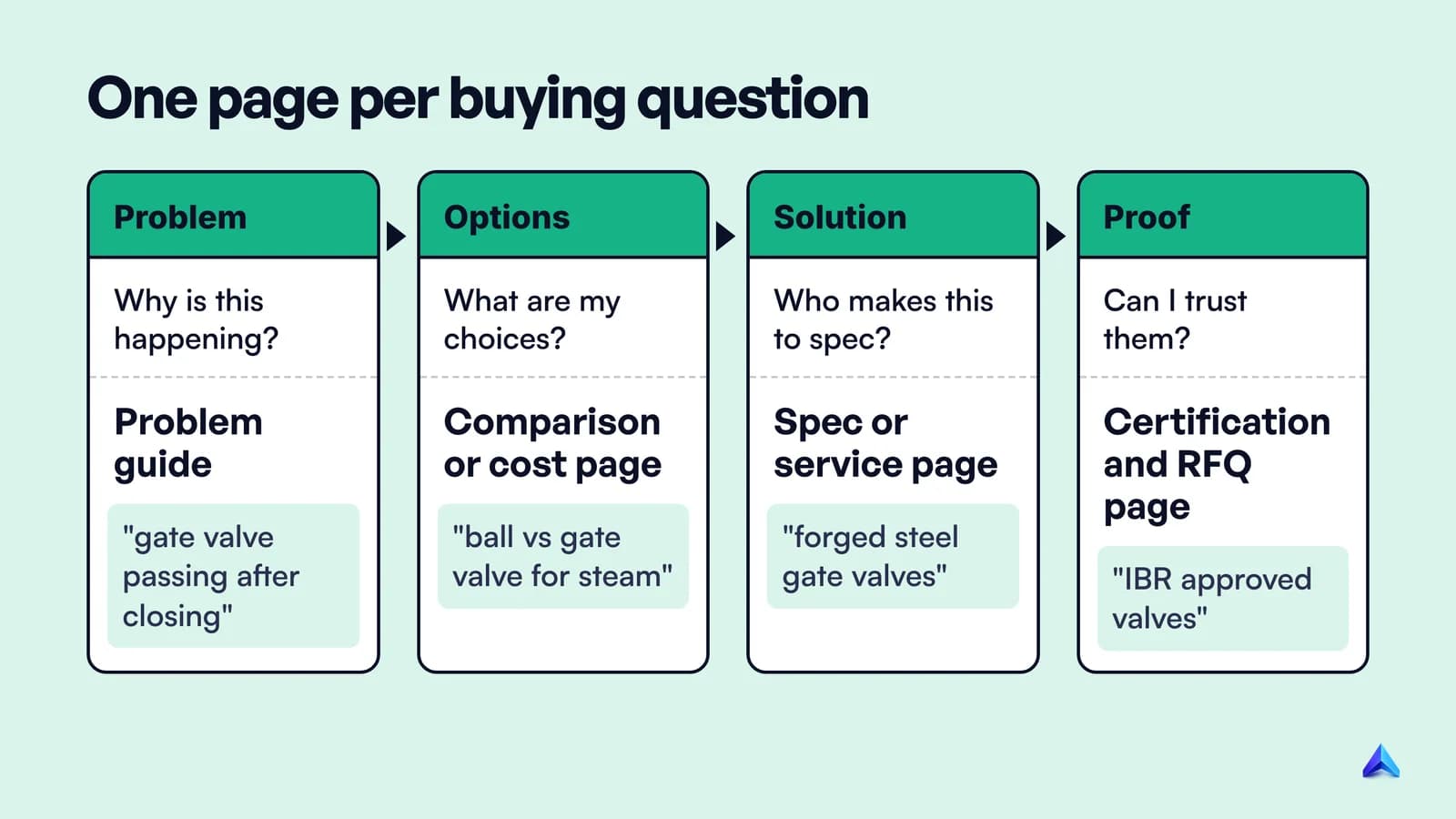
| Stage | What the buyer asks | Page type | Example (valve maker) | Example (fire-safety firm) |
|---|---|---|---|---|
| Problem | Why is this happening? | Problem guide | Why a gate valve passes after closing | Do I need a new fire risk assessment after a refurbishment? |
| Options | What are my choices, and what do they cost? | Comparison or cost-factor page | Ball vs gate valves for steam service | What affects the cost of a fire risk assessment |
| Solution | Who makes or does this, to my spec? | Product-family, spec or service page | Forged steel gate valves, class 800 to 2500 | Fire risk assessments for HMOs |
| Proof | Can they deliver, and are they approved? | Certification, application, case study and RFQ pages | IBR approval and test certificates; refinery case study | PAS 79 method; care-home case study |
A few page types do more work in B2B than anywhere else:
- Spec and product-family pages with the numbers in HTML text: sizes, pressure classes, materials, end connections, standards. A datasheet PDF on its own is not enough, because the buyer's search needs to match words on the page.
- Application or industry pages such as "valves for water treatment plants" or "managed IT for law firms". Each one uses that industry's vocabulary and names its standards, which a single generic page cannot do.
- Cost-factor pages. B2B companies avoid publishing prices, and that is often reasonable. You can still explain what drives the price: property size and occupancy for a fire risk assessment, material and pressure class for a valve, user count and compliance needs for IT support. Procurement teams search for this early.
- Standards and certification pages. "IBR approved", "API 6D monogrammed", "BS 5839 compliant". These are pass/fail checks in a buyer's head, and a clear page answers them before the call.
SaaS companies have their own set, including alternatives, integration and template pages. We cover those in the SaaS content marketing guide rather than repeat them here.
Step 3: Write for every person on the buying committee
Once a page ranks, it gets passed around. Write it so each person who opens it finds their answer in under a minute. For a page on forged steel gate valves, that means three blocks:
- For the engineer: dimensions, pressure-temperature ratings, materials, testing standards, a drawing.
- For procurement: lead times, minimum order quantities, certifications, inspection options, where you have supplied before.
- For finance or the project owner: what drives cost over the life of the part, warranty terms, and what failure costs in downtime.
Procurement's block deserves more attention than it usually gets. With procurement making decisions in 53% of buying cycles, according to the same Forrester report, the person comparing three suppliers in a spreadsheet is often your real reader. Make the facts they need easy to copy into that spreadsheet.
Expertise has to be visible, not claimed. Google's guidance on creating helpful content asks whether content is written or reviewed by an expert who demonstrably knows the topic well. In B2B that is straightforward to show: name the engineer, assessor or systems lead who reviewed the page, state their qualification, and include the kind of detail only practitioners know. A Leeds assessor can explain which fire door defects they find most often in converted Victorian houses. No generic writer can.
The same Forrester research says AI answer engines often give buyers incomplete or unreliable information, so buyers look for validation from trusted sources. A page with named reviewers, real specifications and dated test standards is that trusted source. It is also the kind of page an AI system can quote accurately.
Thought leadership and search content do different jobs
B2B marketers often lump these together. They work on different people at different times, so plan them separately.
Search content meets demand that already exists. Someone types "fire risk assessment for HMO" because they need one. The page has to match the query, answer it fast and make the next step easy.
Thought leadership creates demand among people who are not looking yet. It is the Leeds consultancy's director publishing a view on what the Building Safety Act means for small landlords, or the valve maker's quality head explaining why cheap castings fail early in sour service. Nobody searched for that opinion. It reaches them through LinkedIn, newsletters, events and trade press.
Both matter. The 2024 Edelman-LinkedIn B2B thought leadership study, which surveyed 3,500 B2B decision-makers, found that 73% of buyers consider thought leadership a more trustworthy basis for judging a company's competence than its marketing materials. 86% said they would be moderately or very likely to invite an organization that produces it into an RFP. Yet only 29% of producers could link leads or wins back to it, and 42% still measured it by website and social traffic.
That last number is the warning for SEO teams. If thought leadership is judged by organic traffic, it will look like a failure, because opinion pieces rarely match a search query. If search pages are judged by social shares, they will look dull. Give each its own measure.
The two still feed each other: thought leadership earns mentions and links that help search pages rank, and search pages give a curious LinkedIn reader somewhere useful to land. For how the two split ownership and budget, see SEO vs content marketing.
Step 4: Measure pipeline, not traffic
A B2B page that gets 40 visits a month and starts two serious conversations a quarter is a success. A traffic report will not show you that. You need to follow the visit into your CRM.
The aim is a simple report: which open and won opportunities touched an organic page, and which page. Most B2B companies can build it with tools they already have.
- Capture the landing page on every form. Store the first page the visitor landed on and the referrer in hidden fields on your enquiry and RFQ forms, and pass them into the CRM contact record.
- Carry it onto the opportunity. When a lead becomes a deal, copy the first organic landing page onto the opportunity record. Now you can filter pipeline by page.
- Ask the buyer, and log the answer. Sales should ask how the prospect found you and record it on the deal. Software companies can use a free-text field on the sign-up form instead.
- Report two numbers each quarter: pipeline sourced by organic search (the first touch was organic) and pipeline influenced by it (any contact on the deal visited a key page before the deal closed).
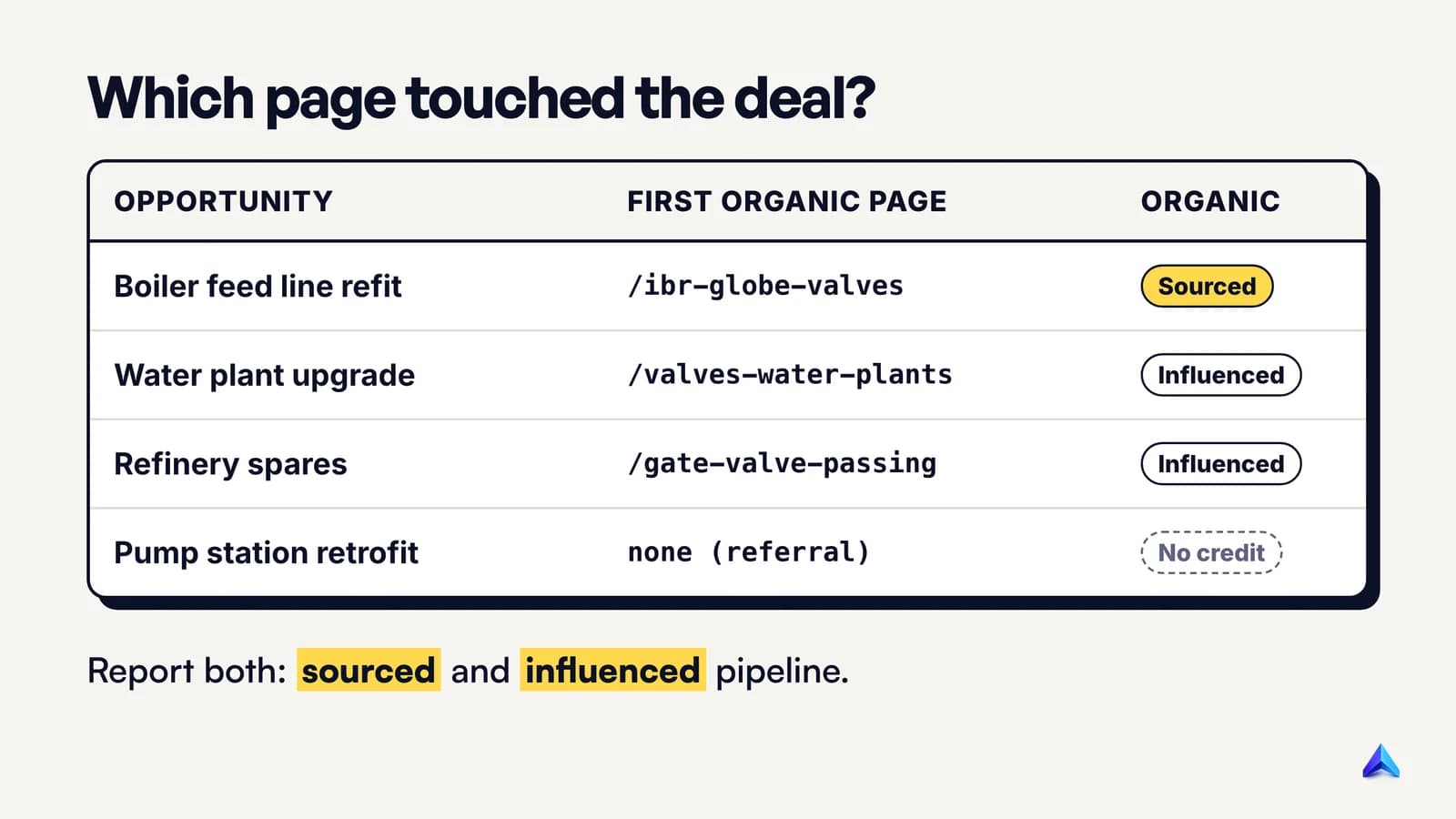
Influenced pipeline matters more in B2B than in most businesses, because of the committee. The engineer who found your spec page may never fill in a form. The procurement manager who later sends the RFQ arrives by typing your name into Google. Without the influence view, that deal looks like a branded search, and the page that started it gets no credit.
Two leading indicators help while deals are still open. Impressions and clicks for your category and standards pages in Search Console tell you buyers are finding the right pages. Rising searches for your brand name, also visible in Search Console, tell you the earlier work is building awareness. To turn pipeline into a return figure, with costs, time windows and a worked example in rupees, pounds and dollars, use our guide to SEO ROI.
With buying cycles measured in months, a page published in January can show up in a deal won in September, so judge the program on pipeline over a long window, not the first quarter's traffic.
Mistakes that waste a B2B SEO budget
- Chasing head terms. "Industrial valves" or "IT services" are dominated by marketplaces, directories and large brands. A specific product-family or application page wins sooner and sells better.
- One service page for every industry. A care home, an HMO landlord and an office manager search differently and worry about different rules. Separate pages, each in that reader's language.
- Gating everything. A form in front of a useful guide hides it from Google and from the colleague it gets forwarded to.
- Writing in marketing language. "End-to-end solutions" matches no search. "Class 1500 forged gate valve, socket weld" does.
- Starting without a plan. If the list of pages is long and the team is small, decide order by revenue potential and winnability first. Our SEO plan post shows one way to make that call.
If you want help turning your own site and competitors into a list of keywords you can realistically win, sorted by funnel stage, that is the job Project Rankup's keyword discovery does.
常见问题
What is B2B in SEO?
B2B in SEO means search optimization for businesses that sell to other businesses rather than to consumers. The techniques are the same, but the targets differ: low-volume, high-value keywords, pages written for several decision-makers at once, and success measured in qualified enquiries and pipeline rather than raw traffic or online sales.
Is SEO dead now with AI?
No. Forrester's 2026 buying research says AI search is now a starting point for B2B buyers, but that answer engines often give incomplete information, so buyers check trusted sources before deciding. Pages with clear specifications, named experts and real proof are those sources. They also give AI systems accurate material to quote when summarizing your category.
How long does B2B SEO take to show results?
Early signs come first: impressions for the right queries in Search Console. Enquiries and pipeline arrive later, because rankings take time and B2B buying cycles run for months. We recommend judging a program on six to twelve months of pipeline data. New domains with little authority sit at the slower end.
Should B2B content be gated?
Mostly no. Content meant to rank must be readable by Google and by colleagues who receive a forwarded link, so keep guides, comparisons and specification pages open. Gate only assets that are clearly worth an email address, such as a detailed calculator, a benchmark report or a design template, and promote those from your open pages.
What are the four types of SEO?
The usual split is on-page SEO (the content and HTML of each page), off-page SEO (links and mentions from other sites), technical SEO (crawling, indexing and site speed) and local SEO (map and location results). B2B companies need all four, though local SEO matters most for service firms that sell within a region.
Does SEO work for manufacturers and industrial suppliers?
Yes, and often better than for consumer brands, because competition for specific product and standards queries is thin. The work is mostly making technical information searchable: specification pages in HTML, one page per product family and application, and certification pages that answer procurement questions before the first call.