The best blog post ideas are questions your readers already type into Google. The richest free sources are the queries in your Search Console report, Google's autocomplete, the People Also Ask box, and the questions customers ask your sales and support staff. Then pick a post type that fits the reader's stage. Below are six ways to find ideas and 24 types of post, each with example titles for three different businesses.
Most lists of blog ideas give you 100 prompts like "share your morning routine". Those suit a personal blog. A business blog has a narrower job: bring in people who might one day buy, and answer what they ask on the way.
How we chose these ideas
Every idea type below passes two tests. A business can write it from its own knowledge, without hiring a journalist. And it matches something people search for, at a stage of buying that we can name.
To keep the examples concrete, we use three made-up businesses that need very different blogs:
- A sourdough bakery in Manchester that sells in its shop and ships loaves and starter kits across the UK.
- A payroll SaaS in Bengaluru for Indian startups with 10 to 200 staff.
- A CPA firm in Columbus, Ohio, whose clients are mostly freelancers and one-person businesses.
Each idea type gets a funnel stage. Top of funnel (TOFU) posts answer someone who is not shopping yet, middle of funnel (MOFU) posts help them compare, and bottom of funnel (BOFU) posts serve someone close to buying. Most blogs are almost all TOFU, which is why they get read and do not sell.
Six free places to find blog ideas people already search for
Start with demand, then pick a format. Start with the format ("we should do a listicle") and you write posts nobody asked for. The first source is the strongest because the data is about your own site.
1. Queries you already get impressions for
Search Console shows the searches your site appears for, even when nobody clicks. Google's Performance report documentation says the report helps you see "what search queries are most likely to show your site". It counts an impression each time your site appears in results, and the default view covers the past three months.
The ideas hide in the gap between impressions and clicks. Open Performance > Search results, switch to the Queries tab, and sort by impressions. Look for queries with plenty of impressions, an average position below 10, and no page on your site that answers them directly. Google is already testing you for that search. A post written for it has a head start.
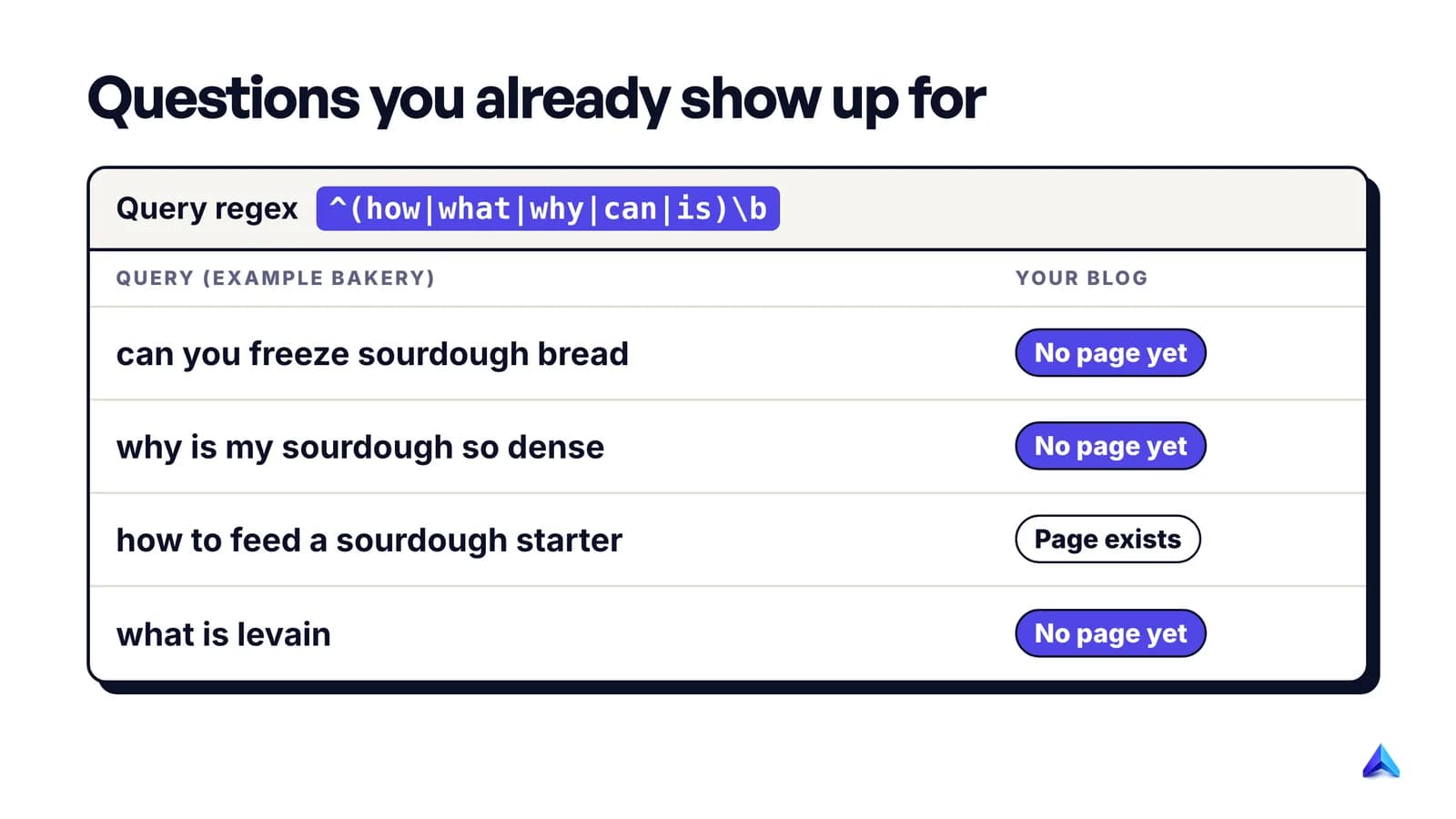
To pull out the questions, add a query filter, choose Custom (regex), and paste:
^(how|what|why|when|can|should|is|does|do)\b
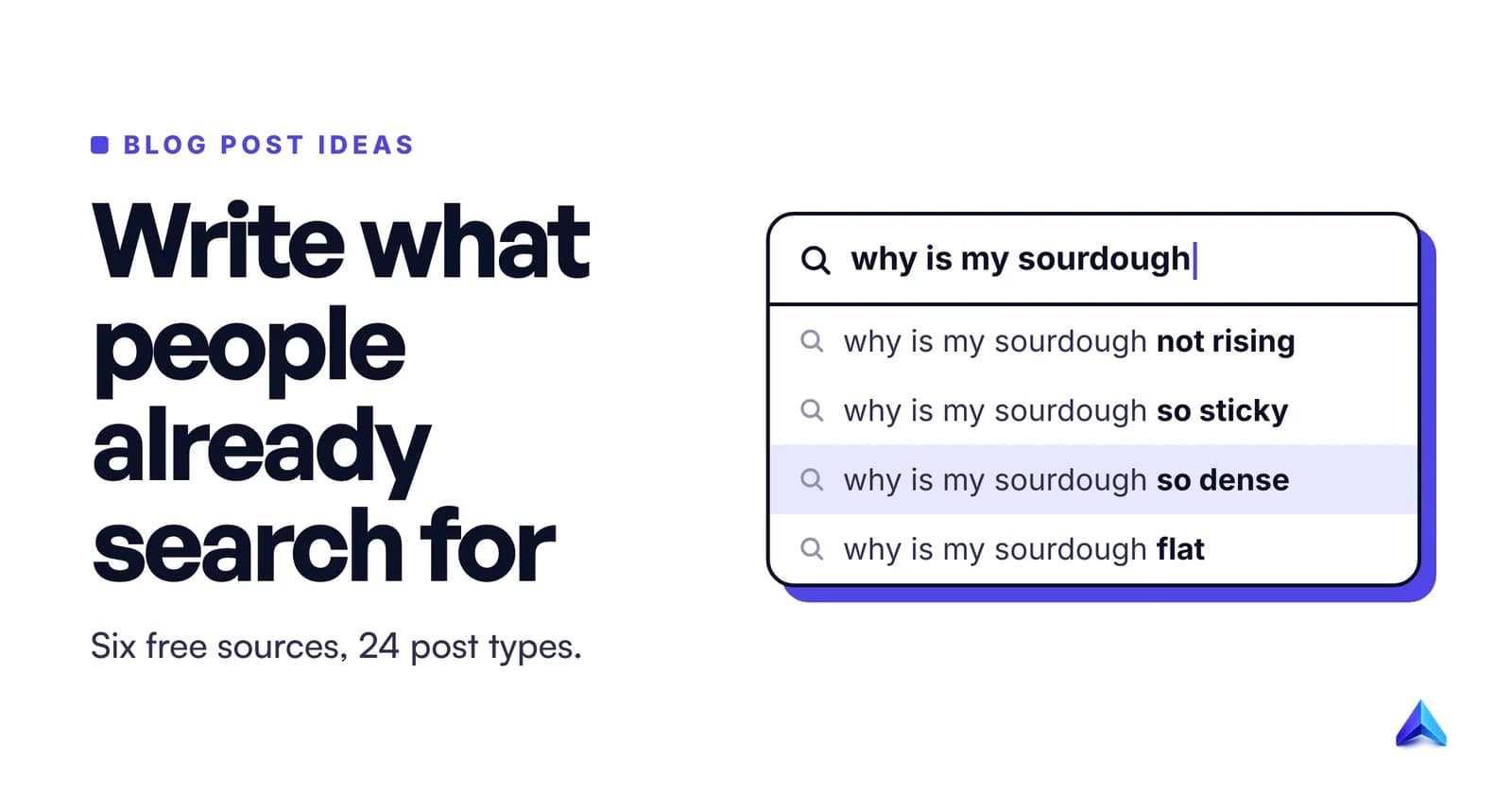
Search Console uses RE2 regex syntax and ignores case by default, according to Google's guide to filtering the report. For the Manchester bakery, a filter like this might surface "can you freeze sourdough bread" or "why is my sourdough so dense". Each is a post, and the second one is also a reason to sell a starter kit.
A new site with almost no impressions will see little here. Use the next five sources first, and come back after three months.
2. Google autocomplete
Type the start of a search and stop. Google's own explanation of autocomplete says the predictions "reflect real searches that have been done on Google", adjusted for the searcher's location and trending interest. That makes autocomplete a free list of real phrasings.
Two tricks get more out of it. Add a letter after your topic ("payroll software a", "payroll software b") to walk the alphabet. And try question starters before the topic: "how to calculate", "what is", "is it legal to". For the Bengaluru payroll tool, "how to calculate PF" and "how to calculate gratuity" both come straight out of this.
Google also says autocomplete is not a popularity ranking and should not be compared with Google Trends. Treat a prediction as proof that people search the phrase, not as proof of how many do.
3. People Also Ask
The People Also Ask box under many results lists questions related to your search. Click one and more appear. Five minutes of clicking on a single seed query gives you a tree of related questions, already in the reader's words.
A few PAA questions deserve their own post. Most work better as H2s or FAQ entries inside a larger post, because they share an answer with the main query.
4. Reddit, Quora and forums
Search site:reddit.com plus your topic, or browse the subreddit your customers read. r/smallbusiness, r/Sourdough and r/tax all have questions phrased in ways no keyword tool would invent. Threads also show which answers people argued with.
Forum questions do not come with search volumes. Check them against autocomplete or a keyword tool before you commit a week to one.
5. Your sales and support inbox
Most teams ignore this source, yet it produces the posts most likely to sell. Ask whoever answers customer email or sales calls for the ten questions they hear every week. The CPA firm's list will include "do I need to pay quarterly taxes in my first year?" The payroll tool will hear "can we run payroll for contractors?" A question asked by people already talking to you is, by definition, asked by people close to buying.
Experts and newcomers also search in different words. Google's SEO Starter Guide gives the example of one person searching for "charcuterie" while another types "cheese board". Your support inbox tells you which words your customers use, not the ones your team uses internally.
6. Gaps in what competitors rank for
Search site:competitor.com plus a topic word and skim the titles their blogs cover that yours does not. Paid tools such as Ahrefs or Semrush show the exact keywords each page ranks for.
Do not copy their list. Look for topics they cover badly, or where you have something they lack: a process, data, a local angle. A competitor's thin post on "sourdough starter not rising" is an invitation to write the troubleshooting guide a baker would bookmark.
Is the idea worth writing? Three checks
A list of 200 questions is not a plan. Run each idea through three checks before it goes on the calendar.
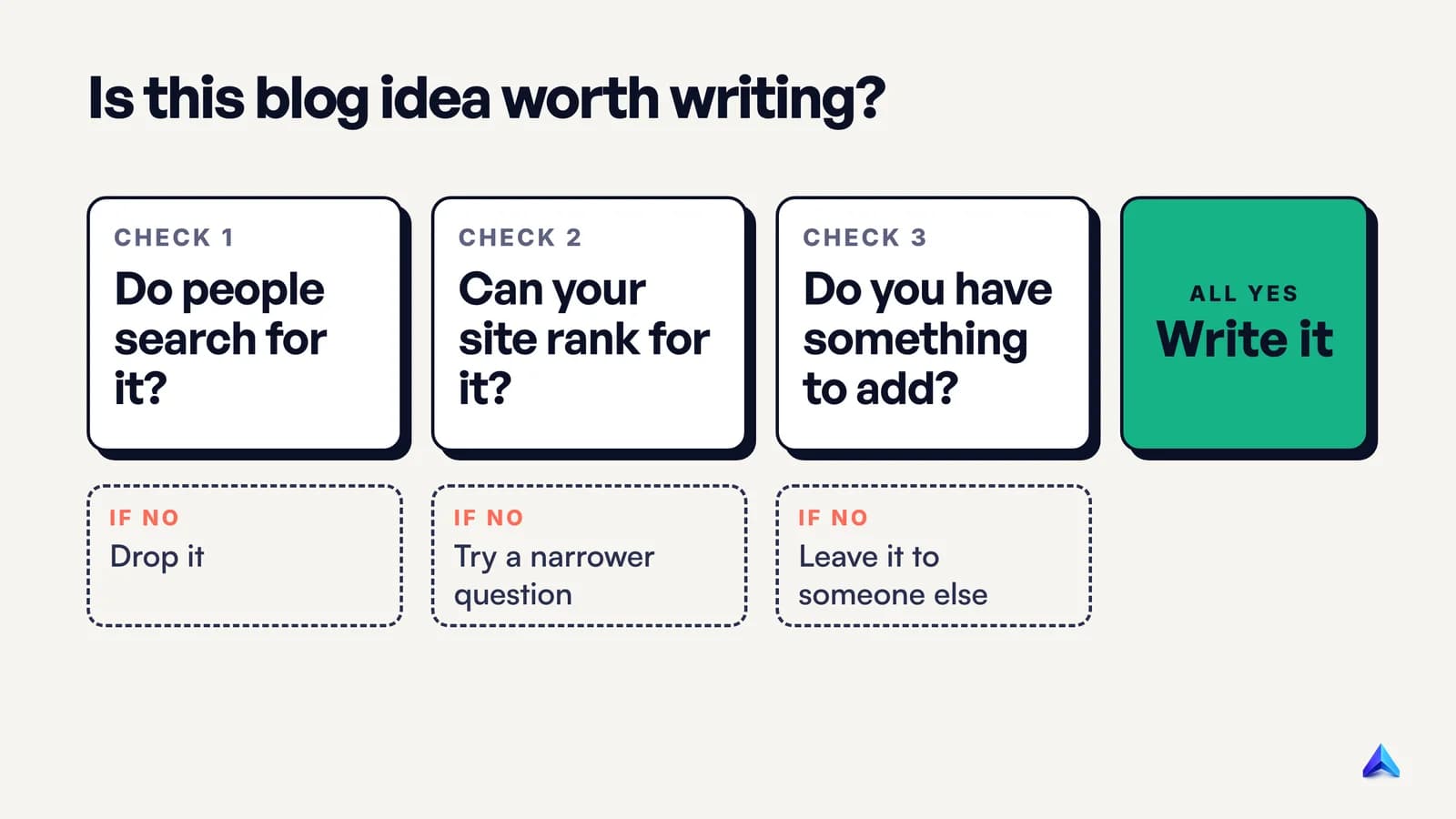
Is there demand? A Search Console impression, an autocomplete prediction or a keyword tool volume is enough proof. "Our CEO finds this interesting" is not.
Can your site rank for it? A new site will not outrank established publishers on a head term. Our guide to keyword difficulty explains how to read KD scores against your own site's authority. For a young blog, the long, specific question usually beats the broad one.
Do you have something to add? Google's guidance on helpful, people-first content asks whether you have "an existing or intended audience for your business or site that would find the content useful if they came directly to you". If the honest answer is no, the idea belongs to someone else.
Ideas that pass all three get a short content brief before anyone writes a word. Project Rankup helps with the first two checks: it tags each keyword idea as TOFU, MOFU or BOFU and judges its difficulty against your own domain's authority.
24 blog post idea types, by funnel stage
The 24 types below are grouped by the reader's stage. Under each group is a table with an example title for each of the three businesses, so you can see how one type changes shape across industries.
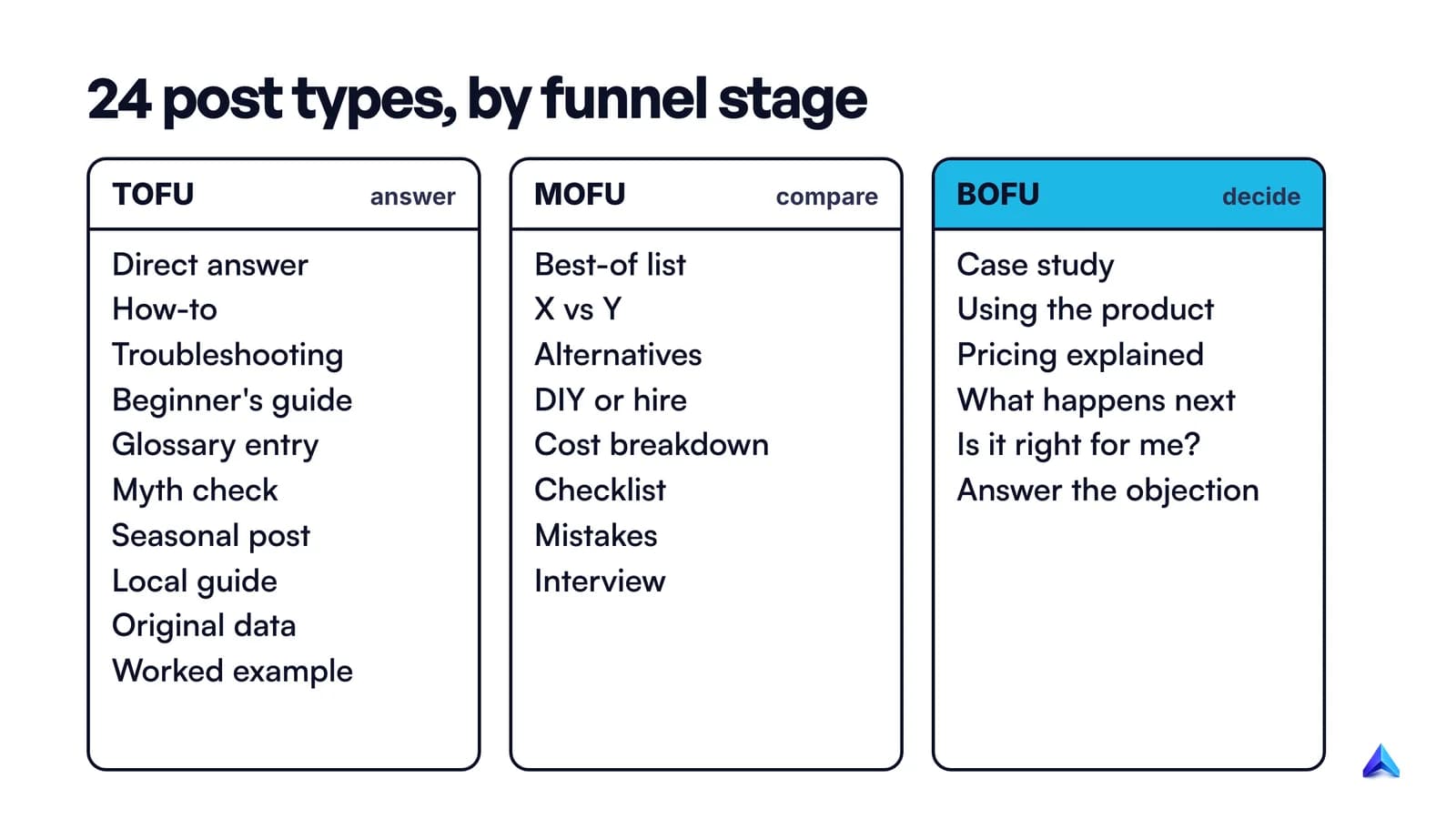
Top of funnel: posts that answer a question
These bring the most readers and the fewest buyers. They earn their place by meeting future customers early and building topical depth.
- The direct answer. One question, answered in the first two sentences, then explained.
- The step-by-step how-to. A process with numbered steps and the mistakes at each one. Best when your team does the process daily.
- The troubleshooting guide. Starts from a symptom ("dense crumb", "PF mismatch") and works back to causes. These get bookmarked.
- The beginner's guide. What a newcomer needs, in the order they need it. Keep it to one topic.
- The glossary entry. One term, defined well, with an example. Useful in jargon-heavy fields like payroll and tax.
- The myth check. A common belief, tested against evidence. Works only if you can source the evidence.
- The seasonal or deadline post. Written for a date your readers care about: a tax deadline, a festival, a filing season. Publish it a few weeks early so Google has time to find it.
- The local guide. For businesses with a place. It helps local visibility and gives people a reason to link to you; our local SEO playbook for UK businesses covers the rest of that job.
- Original data. A number nobody else has, from your own sales, survey or records. Orbit Media's 2026 survey of 1,042 content marketers found that publishing original research "improves the likelihood of performance by 50%", even though fewer marketers now do it.
- The worked example. One real-looking case, calculated in full. Readers trust numbers they can follow.
| Type | Manchester bakery | Bengaluru payroll SaaS | Columbus CPA |
|---|---|---|---|
| Direct answer | Can you freeze sourdough bread? | What is CTC in salary? | Do freelancers pay quarterly taxes? |
| How-to | How to feed a sourdough starter | How to calculate gratuity in India | How to file Schedule C as a freelancer |
| Troubleshooting | Why is my sourdough so dense? | Why your PF challan was rejected | IRS notice CP14: what it means |
| Beginner's guide | Sourdough for complete beginners | Payroll basics for first-time founders | Taxes for your first freelance year |
| Glossary | What is levain? | What is LOP in payroll? | What is a 1099-NEC? |
| Myth check | Does sourdough really have less gluten? | Do startups have to pay ESI? | Is an LLC always better for taxes? |
| Seasonal | Christmas bake order dates for the UK | Form 16 deadlines for employers | Q3 estimated tax deadline checklist |
| Local guide | Where to buy real sourdough in Manchester | Bengaluru startup hiring costs | Ohio municipal income tax explained |
| Original data | What 1,000 orders taught us about loaf sizes | Average salary hikes in our customer base | What our freelance clients deducted |
| Worked example | Baker's percentages for one 900g loaf | Full payslip for a ₹12 lakh CTC | Estimated tax for a $90,000 freelancer |
Only publish original data if the numbers are real and yours to share. The CPA firm would need client consent and aggregated figures before writing about deductions.
Middle of funnel: posts for people comparing options
Readers here are weighing ways to solve a problem. Fewer people search these, but each reader is worth more.
- Best-of list. A curated list with a stated method. Include competitors honestly.
- X vs Y. Two named options compared on the points that decide. Lead with the verdict.
- Alternatives post. Written for people leaving a specific product. Say who should switch and who should stay.
- Do it yourself or hire someone. The honest maths of doing the job in-house. It attracts exactly the readers a service business wants.
- Cost breakdown. What the thing costs and why prices vary. People search for this long before they request a quote.
- Checklist. A list a reader uses while choosing.
- Mistakes post. What goes wrong when people choose badly. Speaks to readers who have been burned once.
- Interview with a practitioner. Your head baker, your payroll lead, your senior CPA. First-hand expertise is the one thing an AI summary cannot copy from someone else.
| Type | Manchester bakery | Bengaluru payroll SaaS | Columbus CPA |
|---|---|---|---|
| Best-of | Best flour for sourdough in the UK | Best payroll software for Indian startups | Best accounting apps for freelancers |
| X vs Y | Sourdough vs yeasted bread | Payroll software vs a CA firm | LLC vs S corp for freelancers |
| Alternatives | Alternatives to supermarket bread delivery | Alternatives to spreadsheets for payroll | Alternatives to TurboTax for the self-employed |
| DIY or hire | Bake at home or buy: the real cost | In-house payroll or outsource? | Do your own taxes or hire a CPA? |
| Cost breakdown | Why real sourdough costs more than supermarket bread | What payroll software costs per employee | How much a CPA costs for a freelancer |
| Checklist | Starter kit checklist | Payroll compliance checklist | Freelancer tax document checklist |
| Mistakes | Eight starter mistakes we see | Payroll mistakes that trigger notices | Tax mistakes in your first freelance year |
| Interview | Our head baker on hydration | Our compliance lead on PF and ESI audits | A CPA on audit red flags |
Bottom of funnel: posts for people ready to buy
These get the least traffic and the most enquiries. Most blogs skip them because they feel salesy. Written well, they read as plain help.
- Case study. One customer, their problem, what changed. Ask permission and use real figures, or skip it.
- How to use the product for a job. A tutorial that solves a real task with your product. Strong for SaaS, where content that turns into trials usually starts with the product as the worked example.
- Pricing explained. What each option includes and who it suits. Link your pricing page; do not repeat numbers that will change.
- What happens when you sign up. The first week, step by step. Removes the fear that stops people booking.
- Is it right for me? Who your product suits and who it does not. Turning some readers away earns the trust of the rest.
- Answer the objection. One common reason people do not buy, answered honestly. Your sales team knows the list.
| Type | Manchester bakery | Bengaluru payroll SaaS | Columbus CPA |
|---|---|---|---|
| Case study | How a Didsbury café switched to our loaves | How a 60-person startup cut payroll time | How a designer fixed three years of late filings |
| Using the product | How to revive your starter kit after posting | How to run your first payroll in our app | How to use our client portal at tax time |
| Pricing explained | Wholesale bread pricing explained | Which payroll plan fits a 25-person team? | What our flat-fee freelancer package covers |
| What happens next | What happens after you order a bread subscription | Your first week after switching payroll | What happens in your first CPA meeting |
| Is it right for me? | Is a weekly bread box worth it? | Is payroll software overkill for 10 people? | Do you need a CPA if you earn under $50,000? |
| Objection | Does sourdough survive UK post? | Is your salary data safe with a payroll app? | Is a CPA worth it if software is cheaper? |
Blog ideas to skip
Generic lists pad themselves with inspirational quotes, a day in my life and your favourite apps. For a bakery or a payroll tool, those have no search demand and bring readers with no reason to buy.
Two more categories deserve caution. The first is trend-chasing. Google's helpful-content guidance lists "writing about things simply because they seem trending" as a warning sign, when you would not otherwise write about them for your audience. The second is drifting off topic. The same guidance warns against "producing lots of content on many different topics in hopes that some of it might perform well". A payroll tool writing about travel hacks is doing exactly that.
A quieter trap: Orbit Media's survey found that "the most effective formats are also the least common", and it names a common failure as an "endless series of text heavy, how-to articles". How-tos are useful. A blog made only of them is easy to ignore.
Keep an idea list that refills itself
Ideas run out when they live in someone's head. Keep a single sheet with one row per idea and these columns:
| Column | What to put in it |
|---|---|
| Query | The search, in the reader's words |
| Source | GSC, autocomplete, PAA, forum, sales, support, competitor |
| Funnel stage | TOFU, MOFU or BOFU |
| Post type | One of the 24 above |
| Demand proof | Impressions, volume or "asked 5 times this month" |
| Difficulty | KD, or a note on who ranks today |
| Our angle | What we know that the top results do not |
| Status | Idea, briefed, drafted, live, updated |
Refill it on a schedule. Check Search Console once a month for new questions, ask the sales and support team once a quarter, and add every question a customer asks twice. Balance the stages as you plan: a month of only TOFU posts brings readers and no enquiries, and a month of only BOFU posts reads like a brochure.
When an idea is ready to write, our guide on how to write a blog post for SEO covers the drafting step by step, and how long a blog post should be explains how to size each one from the results that already rank. If you write for clients, the skills behind all of this are covered in SEO content writing.
常见问题
What are examples of blog posts?
Common examples include how-to guides, answers to a single question, troubleshooting guides, comparisons, best-of lists, case studies, interviews, checklists and posts built on original data. For a business, the best mix covers every funnel stage: posts that answer questions, posts that help readers compare, and posts that help them decide.
Are blogs still a thing in 2026?
Yes, but the easy version works less well. Orbit Media's 2026 survey of 1,042 content marketers found fewer of them reporting strong results than in any earlier year, and that publishing original research still improves the likelihood of performance by 50%. Blogs that publish first-hand knowledge and data people search for still earn traffic.
What should my first blog post be?
Write the answer to the question your customers ask most often. It has proven demand, you know the answer better than anyone, and it gives your sales team a link to send. Avoid a "welcome to our blog" post; nobody searches for it, and it says nothing a reader needs.
Can I use AI to come up with blog ideas?
Yes, as a brainstorming partner, but check every idea against real demand. An AI model can suggest plausible topics nobody searches for. Feed it real inputs instead: your Search Console questions, support tickets and competitor titles, then ask it to group them by funnel stage and spot gaps.
Which blog posts get the most traffic?
Broad top-of-funnel posts usually get the most visits: how-tos, beginner guides and direct answers to common questions. They rarely bring the most customers. Comparison, cost and "is it right for me" posts get fewer readers, but those readers are much closer to buying.