Hiring an SEO agency is one of the highest-leverage decisions a brand can make, and also one of the easiest to get wrong. An SEO agency is a firm that improves a website's visibility in search results through technical optimization, content strategy, link building, and, increasingly, answer engine optimization (AEO) and generative search visibility. Done right, agency-led SEO compresses the path to measurable results from 6-12 months (typical DIY timeline) down to 3-4 months. Done wrong, it burns budget, triggers penalties, and leaves you further behind than when you started.
This guide cuts through the noise. It maps the decision from first principles: when an agency is the right call, how to evaluate one honestly, what AI and AEO expertise actually look like in practice, and which red flags should end a conversation before it begins.
What Does an SEO Agency Actually Do?
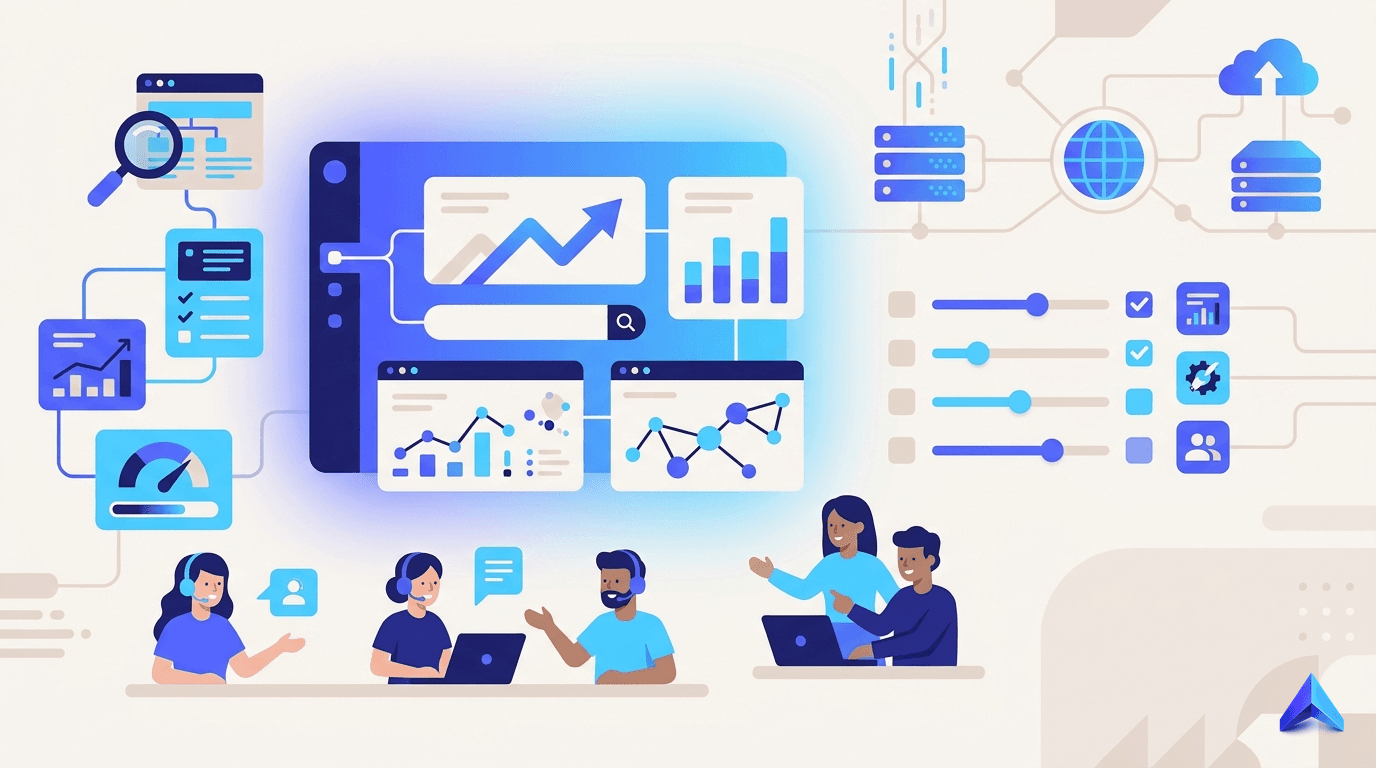
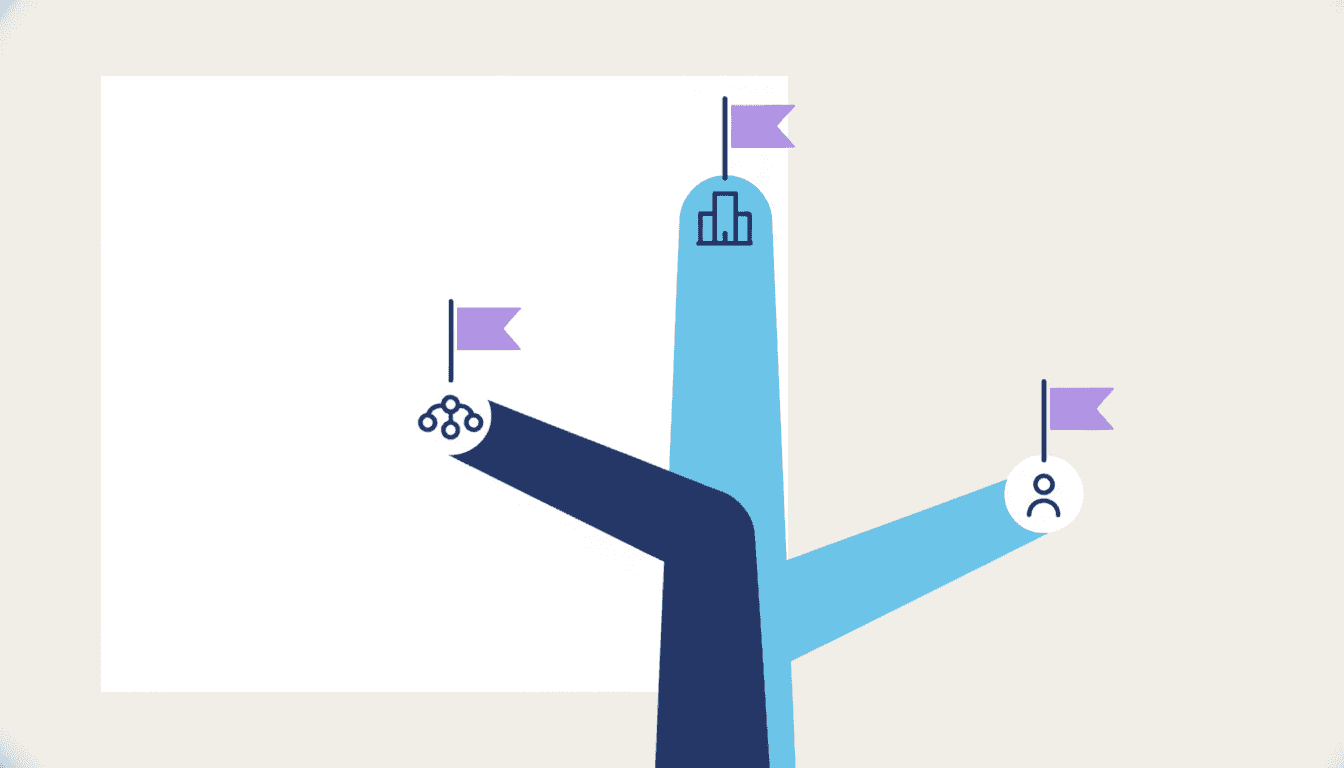
An SEO agency plans and runs the full range of activities that move a site up in organic search and, now, into AI-generated answers. That means a lot more than writing blog posts or building backlinks. A well-run agency covers four interconnected disciplines.
Technical SEO is the optimization of server-side performance, crawlability, and site architecture. It differs from on-page SEO (content, keywords, meta tags) and off-page SEO (backlinks, brand signals). Google's Core Web Vitals sit here, as does structured data, canonical tags, and crawl budget. Most sites have technical debt that quietly kills rankings; a good agency finds it in week one.
Content strategy goes beyond volume. In 2026, content teams at leading agencies are building what Search Engine Journal calls "topical authority clusters" rather than one-off posts, mapping every piece to a stage in the buyer journey and a position in the E-E-A-T framework.
Link acquisition has matured. The agencies still chasing directory links and paid guest posts are the ones to avoid. Durable link building today means digital PR, original research, and earning citations from publications that AI models treat as authoritative sources.
AEO and GEO are the genuinely new disciplines. Answer Engine Optimization is the practice of structuring content so it gets cited in AI Overviews, ChatGPT answers, and Perplexity results. Generative Engine Optimization (GEO) is the broader practice of making content quotable by large language models. An agency that cannot explain both terms clearly, with specific tactics, is already behind.
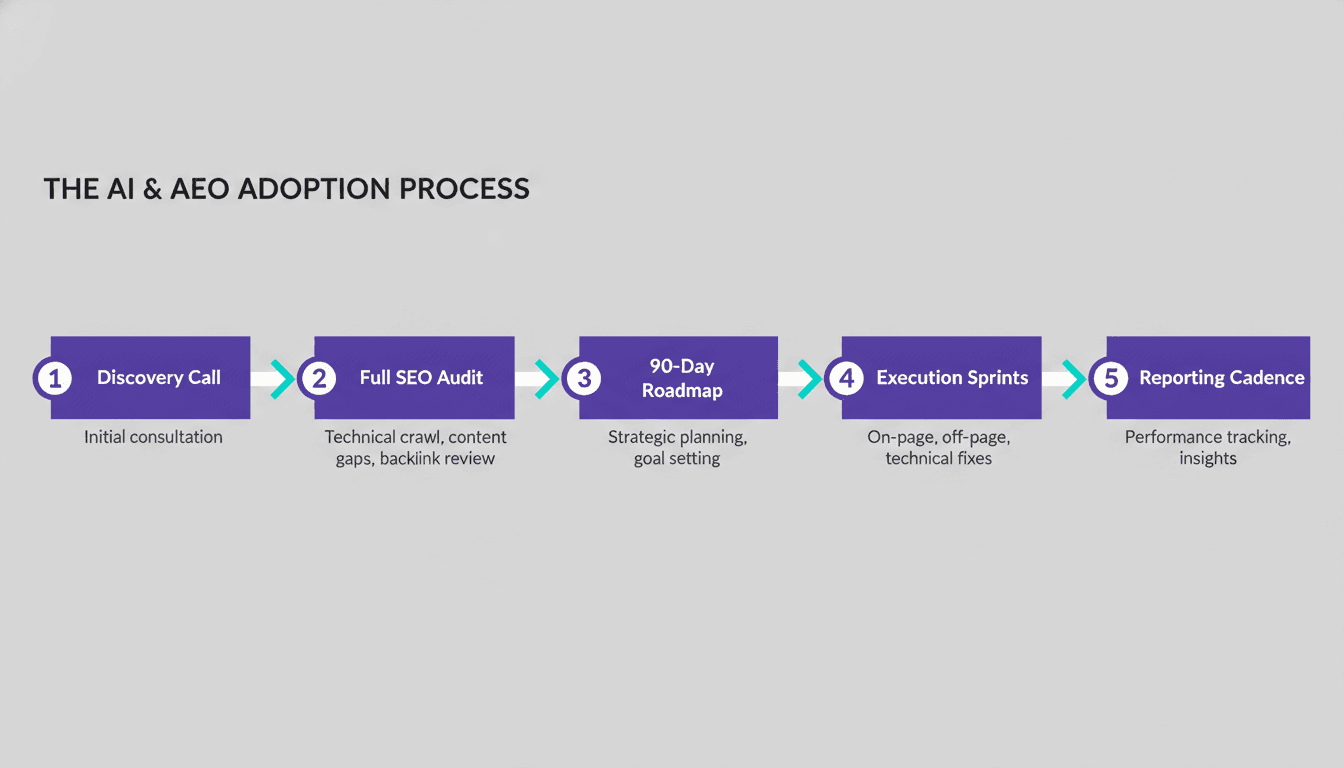
The workflow from first contact to ongoing reporting typically runs like this:
- Discovery call - The agency maps your goals, current baseline, competitors, and budget.
- Full SEO audit - Technical crawl, content gap analysis, backlink profile review, and keyword opportunity mapping. A good audit surfaces the three to five highest-impact fixes within the first two weeks.
- 90-day roadmap - Prioritized list of actions with expected timelines and owners.
- Execution sprints - Monthly or bi-weekly cycles of technical fixes, content publishing, and link outreach.
- Reporting cadence - Monthly reports tied to KPIs you agreed on at the start, not vanity metrics the agency controls.
For a deeper look at what a proper site review covers, the SEO audit guide on Project Rankup walks through each layer in detail.
Agency vs. In-House vs. Freelancer: The Real Decision
Most businesses frame this as a budget question. It is actually a capability and speed question. Budget is a constraint, not the deciding factor.
Use this table to map your situation to the right model before you talk to anyone.
| Dimension | SEO Agency | In-House Team | Freelancer |
|---|---|---|---|
| Cost range (monthly) | $1,500-$15,000+ | $6,000-$20,000+ (fully loaded) | $500-$5,000 |
| Ramp-up time | 2-4 weeks | 3-6 months (hiring + onboarding) | 1-2 weeks |
| Strategic depth | High (team of specialists) | High (if well-resourced) | Varies sharply by person |
| Technical SEO capacity | Strong | Strong if you hire a tech SEO | Often limited |
| AEO/GEO expertise | Leading agencies offer it | Rare unless you hire for it | Very rare |
| Accountability | Contract + SLA | Internal management | Relationship-dependent |
| Scalability | Flexible scope | Slow to scale up or down | Limited bandwidth |
| Best for | Fast results, multi-discipline needs, lean internal teams | Large brands with complex sites and stable budgets | Single-discipline projects, startups with tight budgets |
Pick an agency if you need results within a quarter, lack a dedicated SEO hire, or want AI and AEO capabilities built in from day one. Pick an in-house team if SEO is a core competitive advantage for your brand and you have the budget for a three to five person specialist team. Pick a freelancer for a defined project: a technical audit, a content sprint, or a link outreach campaign, not ongoing strategy.
A word that gets overlooked: the "agency vs. freelancer" framing assumes a binary choice. Many fast-growing SaaS brands run a hybrid model, keeping a strategist in-house and contracting an agency for execution at scale. That is often the sharpest use of budget.
How to Evaluate an SEO Agency Before You Sign Anything
The pitch deck tells you nothing. Here is what to actually look at.
Their own site
An agency that cannot rank for its own target keywords has a credibility problem. Search "SEO agency in [city]" or "[niche] SEO agency" and see where they appear. Check if their blog content is genuinely useful or thin, keyword-stuffed filler. Check whether their technical SEO is clean using any free crawler. If they skip their own homework, they will skip yours.
Case studies with real numbers
Not logos. Numbers. "Grew organic traffic 214% in six months for a B2B SaaS client from 4,200 to 13,100 monthly sessions" is a case study. "We helped brands reach their goals" is a logo wall. Ask for the specific industry, the starting baseline, the timeline, and the tactics used. If they cannot share client names, ask for anonymized versions with verifiable data points.
How they talk about AI and AEO
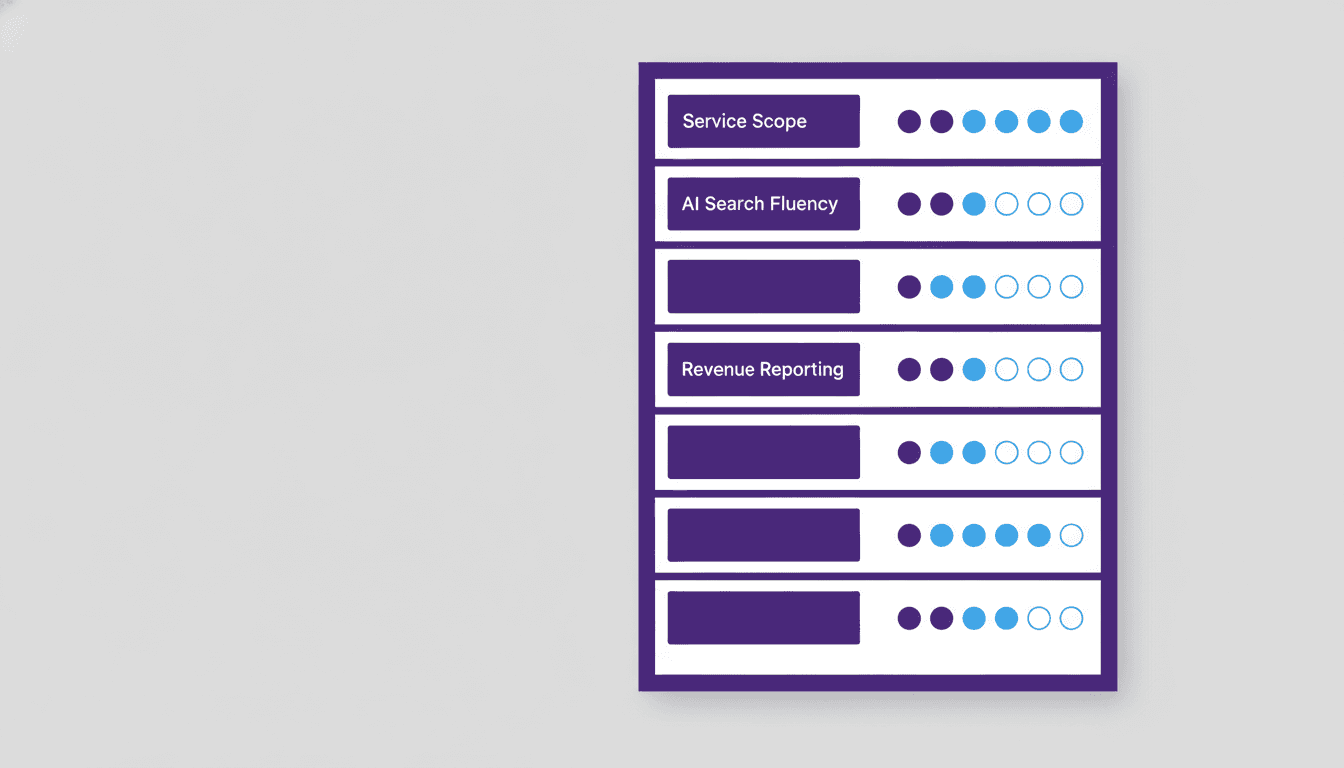
This is the fastest filter in 2026. Ask them: "How do you optimize content for AI Overviews?" and "What is your process for GEO?" A strong agency will name specific tactics: schema markup for FAQ and HowTo, structured answers at the top of each page section, building topical authority clusters, earning citations from sources LLMs trust. A weak agency will say "we stay on top of algorithm updates" and change the subject.
For a benchmark on what good AI-era SEO tooling looks like, the SEO software for agencies breakdown covers the stack leading agencies are using right now.
Contract terms
Four things to check before signing:
- Minimum contract length. Three months is reasonable; 12 months with no exit clause is a warning sign.
- Who owns the work. Content, links, and strategy docs should belong to you, not the agency.
- Reporting transparency. You should get raw access to analytics and Search Console, not filtered screenshots.
- Guarantees. No legitimate agency guarantees a specific ranking. Google's own guidelines say this. Any guarantee of "#1 on Google" is a red flag, not a selling point.
Red Flags When Hiring: What Disqualifies an Agency Fast
The SEO industry still has a long tail of bad actors. Here are the patterns that should end a conversation.
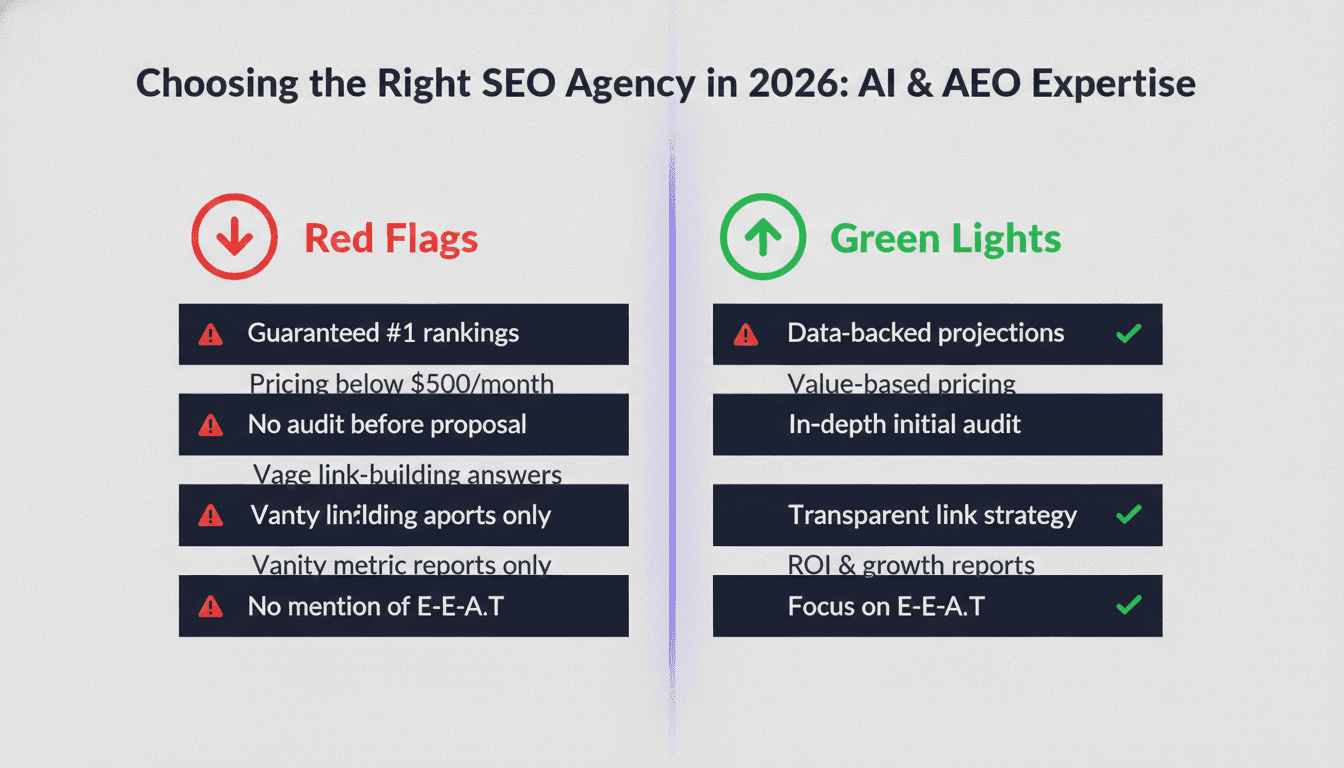
- Guaranteed rankings. No one controls Google's algorithm. An agency that promises specific positions is either uninformed or dishonest.
- Unusually low pricing. A $199/month "full SEO package" means either fully automated, low-quality link schemes or offshore content farms producing content that will get your site penalized. The floor for credible ongoing work is around $1,000-$1,500/month for a small brand.
- No audit before a proposal. A legitimate agency cannot quote a realistic scope without looking at your site first. If they send a proposal after a 15-minute intro call with no access to your data, the scope is fictional.
- Black-hat link schemes. Private blog networks (PBNs), link buying, and keyword stuffing are still sold by bad actors. Ask directly: "What link building tactics do you use?" If you hear "we have strong relationships with publishers" without specifics, push harder.
- Vanity metric reporting. An agency that reports on rankings and traffic but never touches conversions, leads, or revenue is optimizing for their own retention, not your growth. Rankings are a leading indicator. Revenue is the point.
- No mention of content quality or E-E-A-T. Google's quality rater guidelines center on Experience, Expertise, Authoritativeness, and Trustworthiness. An agency that does not build content around demonstrated expertise is producing content that Google is actively trying to demote.
Agency Specializations: Which One Fits Your Business?
Not all SEO agencies serve all markets equally. Specialization matters, and the right fit depends on your site type, industry, and growth stage.
Ecommerce SEO agency
An ecommerce SEO agency handles the scale challenges that general agencies often underestimate: faceted navigation creating crawl traps, thousands of thin product pages, duplicate content from product variants, and category page optimization. If you run a Shopify, Magento, or WooCommerce store, ask specifically about their approach to crawl budget, canonical tags across variants, and structured data for products. Good ecommerce SEO directly lifts Google Shopping visibility alongside organic results.
Local SEO agency
A local SEO agency focuses on the map pack, Google Business Profile optimization, local citations, and proximity-based ranking factors. If your revenue depends on foot traffic or service-area leads, local SEO is a different discipline from national organic SEO. The ranking factors, the reporting metrics, and the content formats are all different. A generalist agency that also does local SEO is not the same as a local SEO agency.
White label SEO agency
A white label SEO agency delivers SEO work under another brand's name, primarily serving marketing agencies that want to offer SEO without building an in-house team. If you run a web design or PPC agency and want to add SEO to your service line, white-label fulfillment lets you do it without hiring specialists. The key due-diligence question is quality control: what does the production process look like, and who owns the client relationship if you part ways?
SaaS and startup SEO
SaaS SEO is content-heavy, conversion-funnel-focused, and built around long-tail informational keywords that bring in users at the research phase. The best SaaS-focused agencies understand product-led growth, trial-to-paid conversion, and the difference between content that drives signups and content that drives rankings. For brands at an early stage, SEO tools built for startups can complement agency work without duplicating cost.
Enterprise SEO
Enterprise SEO agencies work with large-scale sites: hundreds of thousands of pages, complex CMS architectures, multi-region and multi-language setups, and internal stakeholder management. The work is more about governance and technical infrastructure than content volume. The agencies that do this well have dedicated technical architects, not just content writers.
SEO Agency India: Regional Context and What It Means for Buyers
The Indian SEO market is one of the most competitive in the world, with a high concentration of agencies in Mumbai, Bangalore, and Delhi. A search for SEO agency in Mumbai or SEO agency in Bangalore returns hundreds of results, making due diligence harder, not easier.
Quality varies sharply. The top-tier agencies in India run sophisticated AI-era SEO programs, build genuine topical authority, and compete globally. A significant second tier still relies on tactics that were already declining five years ago. The price range is enormous: from $200/month operations running automated link schemes to $8,000/month boutique firms doing genuine strategy work.
For global brands considering an SEO agency India partner for cost efficiency, the evaluation criteria are identical to anywhere else. The questions about case studies, technical depth, AEO capabilities, and contract terms apply the same way. Timezone overlap and communication cadence are worth checking explicitly.
For a focused view on what small brands specifically need, SEO services for small business maps the right service scope by business size.
Pricing, Timelines, and Realistic Expectations
This is where most buying conversations go wrong. Agencies over-promise on timeline to close deals; clients under-budget based on quotes from bottom-tier providers. Here is what the numbers actually look like.
Pricing models
| Model | Structure | Best for |
|---|---|---|
| Monthly retainer | Fixed fee for ongoing work | Most brands; ongoing optimization |
| Project-based | Fixed fee for a defined deliverable | Audits, site migrations, one-time content builds |
| Hourly consulting | Per-hour rate ($100-$300+) | Specific advice, training, second opinions |
| Performance-based | Base fee + bonus tied to traffic or leads | Brands with clear conversion tracking; rare |
Retainers are the most common model. For a small to mid-size brand, a credible retainer starts at $1,500-$3,000/month in India and $2,500-$6,000/month in the US or UK. Enterprise scopes start above $10,000/month. These are floors for work that produces results. Anything below signals either narrow scope (one deliverable, not full-service) or a quality problem.
Timelines
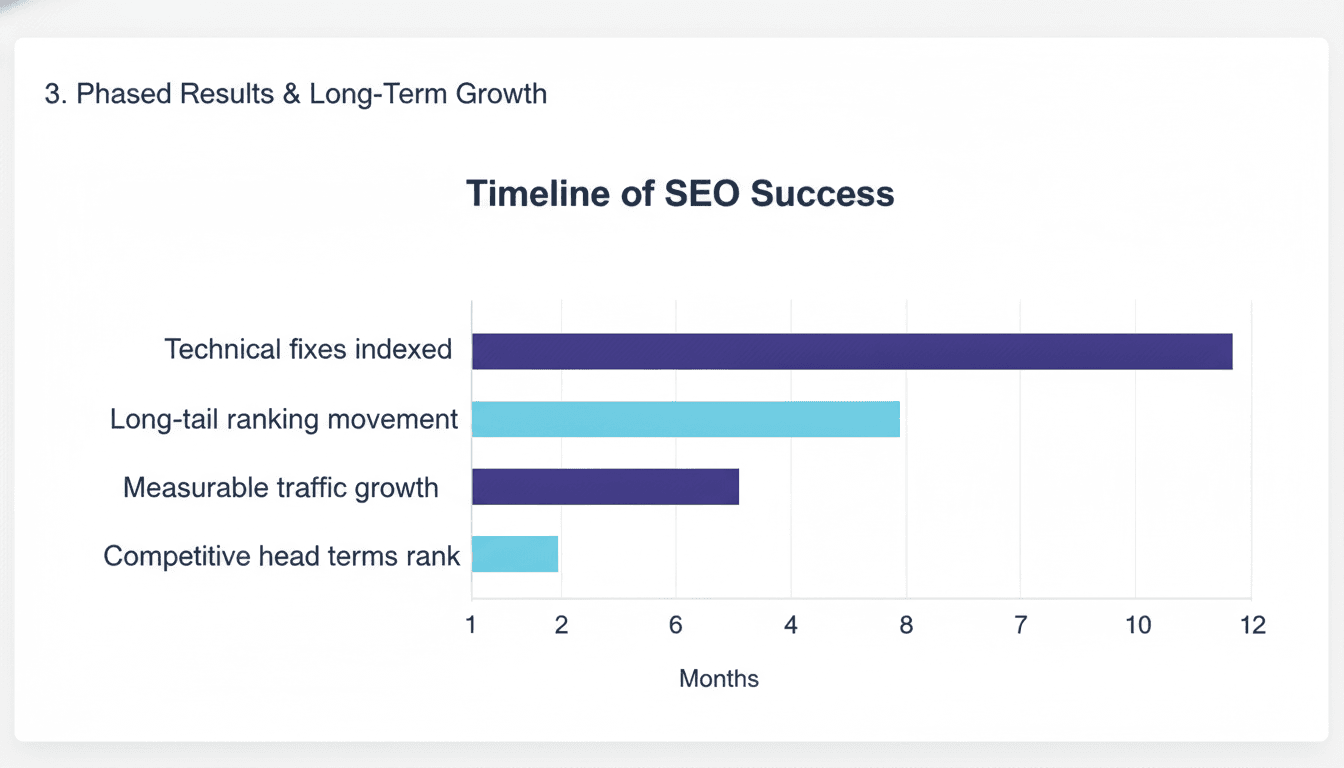
SEO takes time. That is not a hedge; it is physics. Google's crawl and indexing cycle, the time needed to build topical authority, and the lag between a link going live and PageRank flowing through it all compound. A realistic view:
- Month 1-2: Audit complete, technical fixes deployed, first content live.
- Month 3-4: Early ranking movement on long-tail terms, crawl improvements indexed.
- Month 4-6: Measurable traffic growth on targeted pages.
- Month 6-12: Compounding effect on authority, ranking on competitive head terms.
Any agency that promises page-one rankings in 30 days is either targeting zero-volume terms or planning tactics that will eventually hurt you. According to Ahrefs' study of newly published pages, only 1.74% of newly published pages reach the top 10 within a year (down from 5.7% in 2017), and those that do typically have strong backlink profiles and topical authority behind them.
KPIs that actually matter
Rankings are a signal, not the goal. The metrics to track:
- Organic sessions from Search Console and GA4, segmented by landing page
- Keyword visibility score across your target cluster (not just one term)
- Conversion rate from organic traffic (leads, signups, purchases)
- Share of voice against named competitors on target keyword sets
- AI citation frequency in tools like Perplexity, ChatGPT, and AI Overviews for your target queries
The last one is new. As AI-generated answers absorb more of the click volume that used to go to position one results, an agency that does not track and optimize for AI citations is leaving a growing share of your potential traffic unmeasured and unmanaged. AI Overviews appeared on 39.4% of Google desktop searches in June 2026, according to Comscore's Q2 2026 AI Intelligence Report (published September 22, 2026). Citation share is becoming as important as ranking position for many informational queries.
How AI and AEO Are Reshaping What SEO Agencies Offer
The agencies that will lead the market over the next three years are not the ones with the most backlinks in their case studies. They are the ones that have rebuilt their service model around how search actually works in 2026.
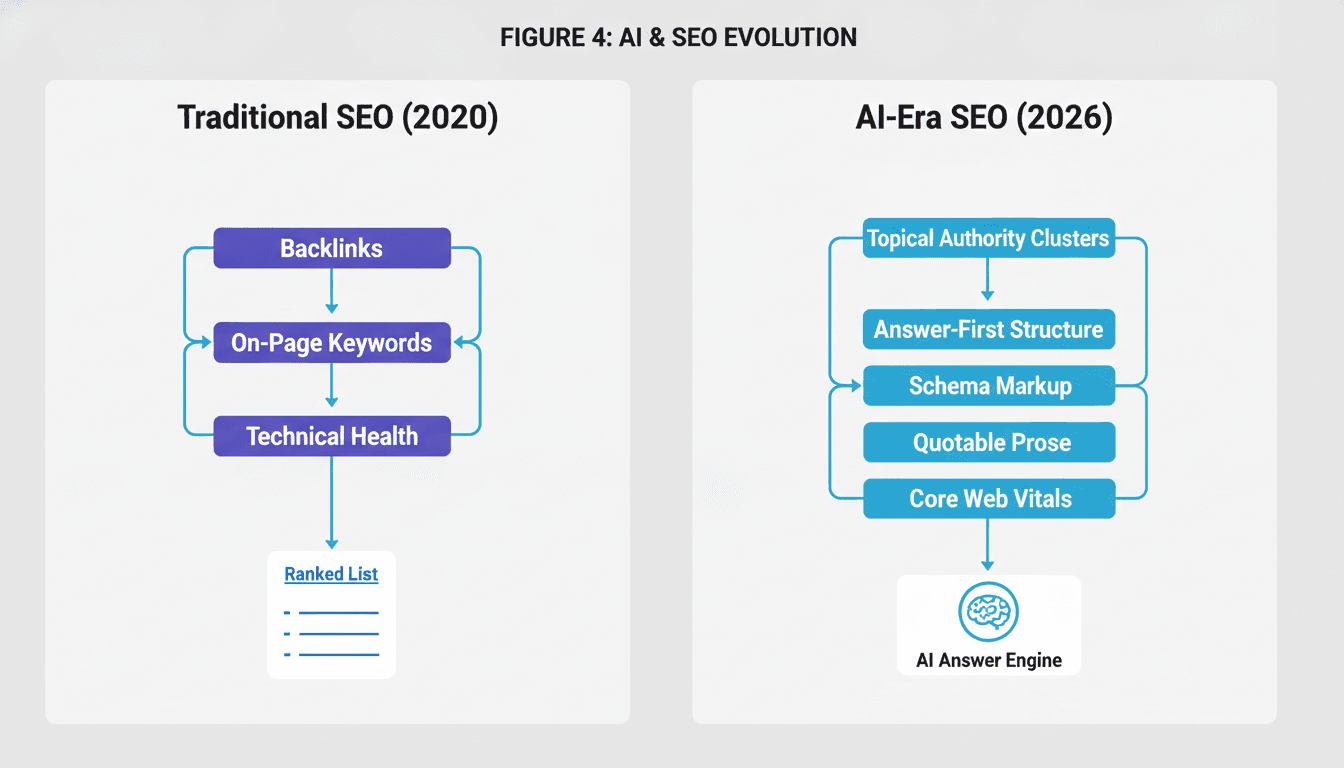
AI Overviews, introduced broadly by Google in 2024, pull structured answers from pages that demonstrate topical authority and clear, quotable prose. ChatGPT and Perplexity route research queries to pages that AI training data already treats as credible. Both behaviors reward the same underlying quality signals: deep expertise, clear structure, named sources, and content that answers a specific question in the first paragraph.
For agencies, this means three structural changes to how good work gets done.
Content architecture shifts from posts to entities. A single well-optimized article is less durable than a cluster of pages that together cover a topic at depth, link to each other logically, and signal to both Google and LLMs that this domain is an authoritative source. Keyword research in 2026 now includes mapping query intent to the right cluster position, not just matching a phrase to a page.
Schema markup becomes standard practice, not an advanced tactic. FAQ schema, HowTo schema, and Article schema give AI crawlers structured hooks to pull from. An agency that is not deploying schema on every new content build is already behind the default.
Off-page signals expand to include AI model training sources. The publications and research institutions that LLMs are trained on are now a form of link equity. Agencies that build digital PR programs targeting those publications are building the kind of authority that works in both traditional search and generative search.
According to SparkToro's 2026 zero-click study (published June 9, 2026), 68.01% of Google searches in the US ended without a click in the first four months of 2026, which makes AI citation share a critical metric for brands that have historically depended on click-through traffic. The agencies that understand this are building content explicitly designed to be quoted, not just to rank.
For a ground-level view of what AI-native content auditing looks like, AI content audit tools covers the platforms leading agencies are using to identify which content is being cited in generative answers and which is invisible to them.
Frequently asked questions
What does an SEO agency do?
An SEO agency optimizes a website's visibility in search results through technical audits, content strategy, link building, and, in 2026, answer engine optimization (AEO) for AI-generated search results. Most full-service agencies also provide keyword research, competitive analysis, and monthly reporting tied to agreed KPIs like organic traffic, conversions, and AI citation frequency.
How much does an SEO agency cost?
Monthly retainers for credible ongoing work start at around $1,500-$3,000 for small brands in India and $2,500-$6,000 in Western markets. Enterprise scopes typically run above $10,000/month. Project-based work (audits, migrations) is priced separately. Anything below these floors usually signals limited scope or quality shortcuts.
How long does SEO take to work?
SEO typically takes 3-6 months to show measurable results when an agency leads the work, compared to 6-12 months with a DIY approach. Early wins on long-tail keywords often appear in months two to three; competitive head terms usually move in months six through twelve, depending on domain authority and the level of competition in the niche.
How do I choose an SEO agency for AEO visibility?
Ask directly how they optimize for AI Overviews and LLM citation. A capable agency will name specific tactics: answer-first content structure, FAQ and HowTo schema, building topical authority clusters, and targeting publications that AI training data treats as authoritative. If they cannot explain the difference between AEO and traditional SEO optimization, they are not built for where search is heading.
What is the best tool for seo agency work in 2026?
No single tool wins every use case. Most strong agencies use a combination: Screaming Frog or Sitebulb for technical crawls, Ahrefs or Semrush for keyword and backlink research, Surfer SEO or Clearscope for content optimization, and emerging platforms for AI citation tracking. The full breakdown by use case is in the SEO software for agencies guide.
What are red flags when hiring an SEO agency?
The main ones: guaranteed ranking promises (no one controls Google's algorithm), pricing that is far below market rate, no audit before a proposal, vague answers about link-building tactics, and reporting that covers rankings but never touches revenue or conversions. Any agency still selling links from private blog networks is using tactics that carry penalty risk.
What is the difference between an SEO agency and a freelancer?
An agency brings a team of specialists covering technical SEO, content, link building, and strategy, with structured processes and contract accountability. A freelancer is typically one person strong in one or two disciplines. Agencies cost more and scale more easily; freelancers are leaner and better for defined, single-discipline projects. Neither is universally better: the right choice depends on scope, budget, and how fast you need to move.
Key Takeaways
- An SEO agency covers technical SEO, content, links, and increasingly AEO and GEO, and it compresses the path to results compared to DIY.
- Choose between agency, in-house, and freelancer based on scope and speed requirements, not just budget.
- Evaluate agencies on their own site performance, real case studies with numbers, and their ability to explain AI and AEO tactics clearly.
- Red flags include guaranteed rankings, pricing far below market, no audit before proposals, and reporting that ignores revenue.
- Pricing floors for credible work start at $1,500/month; timelines to measurable results run 3-6 months under agency management.
- AI Overviews appeared on 39.4% of Google desktop searches in June 2026 (Comscore), making AEO and AI citation tracking essential services, not add-ons.
- The agencies winning in 2026 build topical authority clusters, deploy schema as standard, and optimize explicitly for generative search citation.
If your brand needs to close the gap between where it ranks today and where it needs to be in an AI-driven search environment, the place to start is a clear-eyed audit and a partner who understands both the technical and generative sides of modern search. Reach out to Project Rankup to see how our AI-powered SEO and AEO solutions can build the kind of authority that earns rankings and citations across every search surface.