
Organic search drives roughly 53% of all website traffic, making it the single largest acquisition channel available to businesses of any size. This guide covers every component of a modern small business SEO strategy: what to buy, what to pay, when to DIY, and how to choose between a consultant, an agency, or an AI-powered tool.
Quick Answer
- What it is: SEO services help small businesses rank higher in Google search results without paying for ads.
- Cost in 2026: Typically $300-$5,000+/month depending on scope, or $75-$200/hour for consultants.
- Three main paths: DIY (cheapest, slowest), SEO consultant (flexible, mid-cost), or SEO agency (fastest scale, highest cost).
- Time to results: Expect meaningful ranking movement in 3-6 months; strong ROI often appears at the 6-12 month mark.
- Local shortcut: Optimizing your Google Business Profile is the single fastest win for any location-based business.
Why Small Businesses Need SEO Services
SEO services for small business solve a specific problem: you are competing for attention in a search environment where the top three organic results on Google capture more than 68% of all clicks, according to Sistrix's click-through rate study. If your business is not in that window, you are effectively invisible to the majority of people searching for what you sell.
Organic Traffic Outperforms Paid in the Long Run
Pay-per-click advertising stops the moment your budget runs out. Organic rankings, once earned, continue delivering traffic without additional spend per click. The BrightEdge 2024 Channel Performance Report found that organic search accounts for 53.3% of all trackable web traffic across industries, compared to 15% from paid search. That gap widens for service-based businesses and local retailers, where high-intent searchers use Google specifically to find vendors in their area.
The math is straightforward: a plumber who ranks on page one for "emergency plumber in Austin" earns that click every time someone searches it, whether that is 10 times a day or 10,000. A plumber running Google Ads for the same term pays $40-$120 per click (realistic for a high-competition local service keyword) every single time.
SEO Levels the Playing Field Against Bigger Competitors
Large brands dominate paid channels through sheer budget. They cannot always dominate local or niche organic results, because Google's algorithm rewards relevance and authority for a specific query rather than brand size. A boutique accounting firm that publishes a thorough guide to "small business tax deductions in Illinois" can outrank a national chain that has a generic services page and nothing else.
This is the most important structural advantage SEO gives small businesses. Niche targeting, local signals, and content depth are things a 10-person company can execute as well as a 10,000-person one.
The Opportunity Gap Is Closing Fast
More small businesses report actively investing in SEO than five years ago. That closing gap means the competitive advantage of being an early SEO adopter is shrinking. Businesses that start now still have a meaningful head start; businesses that wait another two years may face a fully saturated landscape.
Of the small businesses already investing in SEO, 71% report satisfaction with their results. The risk of doing SEO is low. The risk of not doing it is losing search-visible market share permanently.
Local Search Converts at a Rate That Surprises Most Owners
Many Google searches carry local intent, meaning the user is looking for something near them.
For a brick-and-mortar business, a restaurant, a dental practice, or any service business with a defined territory, local SEO services are not optional. They are the most direct path from a Google search to a paying customer.
Key SEO Services for Small Businesses: What You Actually Get
Most providers offering SEO services for small business bundle several disciplines together. Understanding what each one does prevents you from paying for things you do not need and missing the ones you do.
Keyword Research and Strategy
Best for: Any business starting SEO from scratch or unsure which terms to target.
Keyword research identifies the exact phrases your potential customers type into Google. The common mistake small businesses make is targeting terms that are too broad ("marketing" or "accounting") rather than terms with specific intent ("small business accountant in Denver" or "QuickBooks setup for freelancers").
A professional AI keyword research process goes beyond search volume. It evaluates:
- Search intent: Is the user researching, comparing, or ready to buy?
- Competition density: Can a newer or smaller site realistically rank?
- Local modifiers: Are people adding a city, neighborhood, or "near me"?
- Long-tail value: Lower-volume, higher-specificity phrases often convert at 3-5x the rate of broad terms.
A realistic output from a keyword research engagement is a prioritized list of 30-100 target phrases, mapped to existing pages or planned content, with a clear rationale for why each was chosen.
On-Page SEO Optimization
On-page SEO covers everything visible and invisible on individual pages of your site. It is also the area where most small business websites have the most immediate, fixable problems.
The checklist a competent SEO service works through includes:
- Title tags: Each page needs a unique title under 60 characters that includes the primary keyword. "Home" or "Services" as a page title is wasted SEO real estate.
- Meta descriptions: 150-160 characters, written to drive clicks, not stuffed with keywords.
- Heading structure: One H1 per page stating the page's core topic. H2s and H3s organize supporting content. This guide follows that structure deliberately.
- Keyword placement: Primary keyword in the first 100 words, in at least one H2, and naturally throughout the body. Never in every sentence.
- Image alt text: Descriptive text for every image, primarily for accessibility, secondarily for image search.
- Internal links: Connecting related pages passes authority around the site and helps Google understand content relationships. A 10-page site with no internal links is effectively 10 disconnected islands.
- Content depth: Thin pages with 100-200 words rarely rank for competitive terms. Pages that comprehensively answer a searcher's question typically do.
Technical SEO Foundations
Technical SEO is the infrastructure layer. It does not generate traffic directly; it removes the barriers preventing Google from crawling, indexing, and ranking your pages correctly.
For small businesses, the most common technical problems are:
- Slow page speed: Google's Core Web Vitals are ranking signals. A page that loads in 6 seconds on mobile loses rankings and visitors simultaneously.
- Mobile usability: Google indexes the mobile version of your site first. If it does not display cleanly on a phone, rankings suffer.
- Crawl errors: Broken links, redirect chains, and blocked pages prevent Google from seeing your content.
- Duplicate content: Multiple URLs serving identical content confuse search engines about which version to rank.
- Missing or malformed structured data: Schema markup helps Google understand your business type, reviews, hours, and products without having to guess.
A technical SEO audit typically surfaces 20-40 issues on a site that has never had one. Fixing the most critical ones alone can produce ranking improvements within 4-8 weeks.
Local SEO Services for Small Businesses
Best for: Any business serving customers in a specific geographic area.
Local SEO is a distinct discipline within the broader SEO services for small business category. Its primary focus is making your business visible in Google's "local pack" (the map and three listings that appear above organic results for location-based searches) and in Google Maps.
The core components are:
Google Business Profile Optimization
Your Google Business Profile (GBP) is the most important local SEO asset you control. An unoptimized or incomplete GBP profile is the single most common reason local businesses fail to appear in local pack results.
Optimization includes:
- Verifying and fully completing every field (hours, services, description, category)
- Uploading recent, genuine photos (businesses with photos receive 42% more direction requests, per Google's own GBP documentation)
- Selecting the most accurate primary and secondary categories
- Publishing Google Posts weekly to signal activity
- Actively requesting and responding to reviews
Reviews deserve specific attention. The volume, recency, and sentiment of your Google reviews directly affect your local pack ranking. A business with 12 reviews at 4.8 stars will typically outperform one with 3 reviews at 5.0 stars for competitive local terms.
Local Citations and NAP Consistency
Citations are mentions of your business name, address, and phone number (NAP) on directories like Yelp, Yellow Pages, Apple Maps, and industry-specific listings. Inconsistent NAP data (different phone numbers, abbreviated vs. spelled-out addresses) erodes local ranking trust. An SEO service will audit existing citations and either correct or build new ones on high-authority directories.
Location-Specific Content
Pages targeting "[Service] in [City]" are not keyword stuffing; they are the appropriate way to signal local relevance to Google. A pest control company serving five counties should have a page for each county, each with genuinely useful information about local considerations, not just the same paragraph with the city name swapped.
Link Building and Authority Development
Google's algorithm still weights external links from other reputable websites as a primary ranking signal. For small businesses, the most realistic link-building strategies are:
- Local press coverage: A story in the local newspaper or business journal earns a genuine, high-value link.
- Chamber of commerce and trade association directories: Legitimate, low-cost, and often overlooked.
- Supplier and partner pages: If you sell a brand's products or are a certified installer, ask to be listed on their dealer/partner page.
- Content-driven links: A genuinely useful resource (a neighborhood guide, a local event calendar, an industry FAQ) earns links organically as other sites reference it.
What small businesses should avoid: paid link schemes, low-quality directory spam, and "press release distribution" services that publish to hundreds of sites no one reads. Google penalizes manipulative link acquisition, and the penalties are difficult to recover from.
Content Marketing and Blog Strategy
Content marketing is the long game. It means creating articles, guides, and resources that answer questions your potential customers are asking, ranking for informational keywords that introduce your business to people earlier in their buying process.
A plumber who publishes "How to know when your water heater needs replacing" will attract homeowners who eventually need a new water heater installed. A financial advisor who writes "How to set up a SEP-IRA for self-employed people" attracts exactly the audience she serves.
The SEO value compounds over time. A well-structured content calendar that consistently targets relevant keywords builds domain authority month by month, making it easier to rank for more competitive terms as time passes.
How Much Do Small Business SEO Services Cost in 2026?
Cost is the question every small business owner asks first. The honest answer is: it varies enormously, and the cheapest option is rarely the best value. Here is a practical breakdown of what you actually get at each price point.
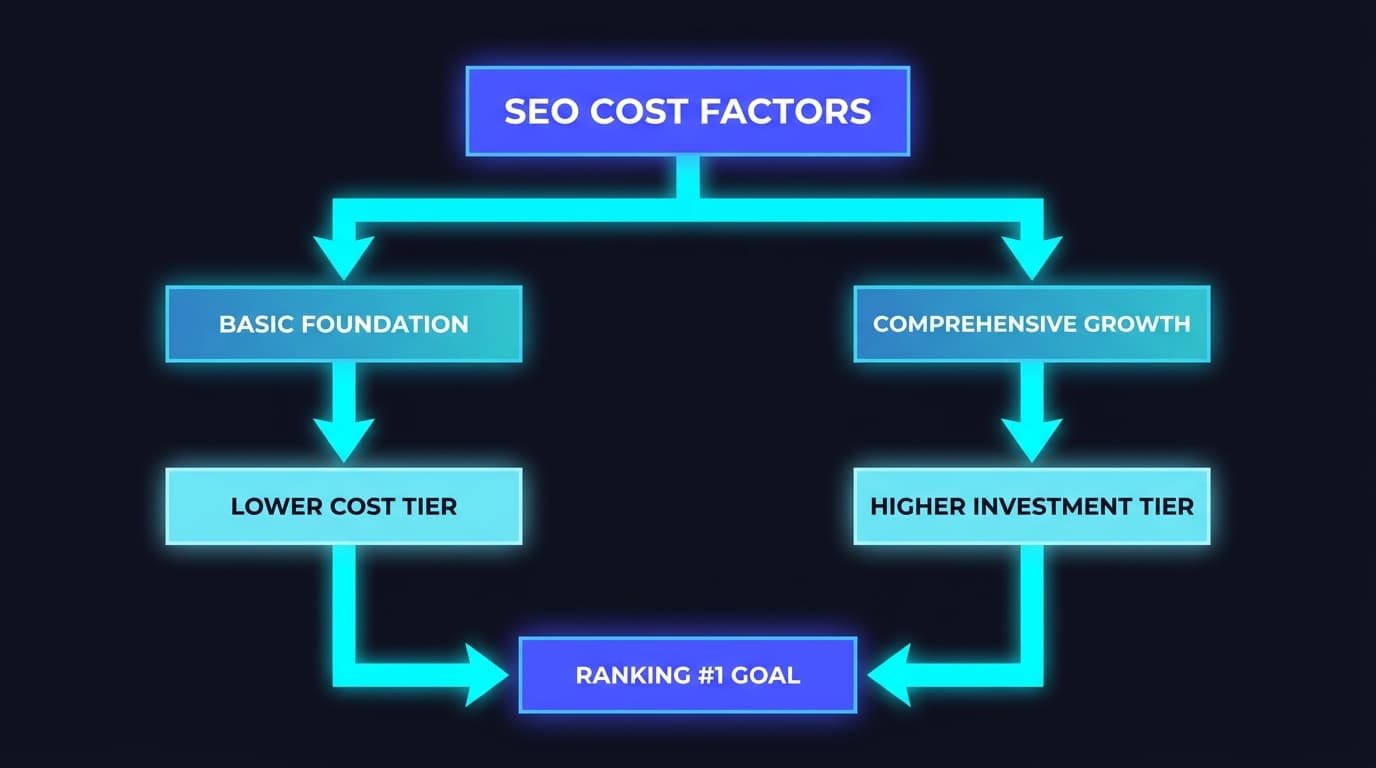
SEO Pricing Table: What to Expect in 2026
| Tier | Monthly Cost | What Is Typically Included | Best For | Expected Timeline |
|---|---|---|---|---|
| Starter / DIY Tools | $50-$300 | Keyword tools, rank trackers, basic audit software | Solopreneurs, very early-stage businesses | 6-18 months with consistent effort |
| Freelance Consultant | $500-$2,000 | Strategy, on-page audits, monthly reporting, some content | Businesses wanting guidance without full agency overhead | 4-9 months for initial traction |
| Small Agency / Boutique | $1,500-$4,000 | Full on-page, technical SEO, link building, content, local | Growing businesses ready to invest seriously | 3-6 months for measurable movement |
| Full-Service Agency | $4,000-$10,000+ | Everything above plus PR outreach, paid/organic integration, CRO | Established businesses scaling aggressively | 2-4 months (faster due to team bandwidth) |
| One-Time Audits | $300-$2,500 (flat) | Detailed technical and on-page audit with prioritized fix list | Businesses that want a roadmap to DIY from | Immediate deliverable; results depend on execution |
A few things the pricing table does not show: the $500/month option from an offshore provider who builds 200 spam links a month costs far more in the long run because the penalty recovery process can take 12-18 months. Budget for quality, not just quantity.
What "Cheap SEO" Usually Means
SEO services priced below $300/month for a full-service package are almost always one of three things: link farms, automated content mills, or junior freelancers using recycled strategies. The tactics that worked in 2018 (exact-match anchor text, article spinning, private blog networks) are actively penalized in 2026. The risk of hiring cheap providers is not just wasted money; it is active damage to your site's standing in Google's index.
The minimum realistic budget for a small business that wants genuine, sustained results from a professional is around $800-$1,000/month. Below that, a structured DIY approach with good tools is genuinely a better option.
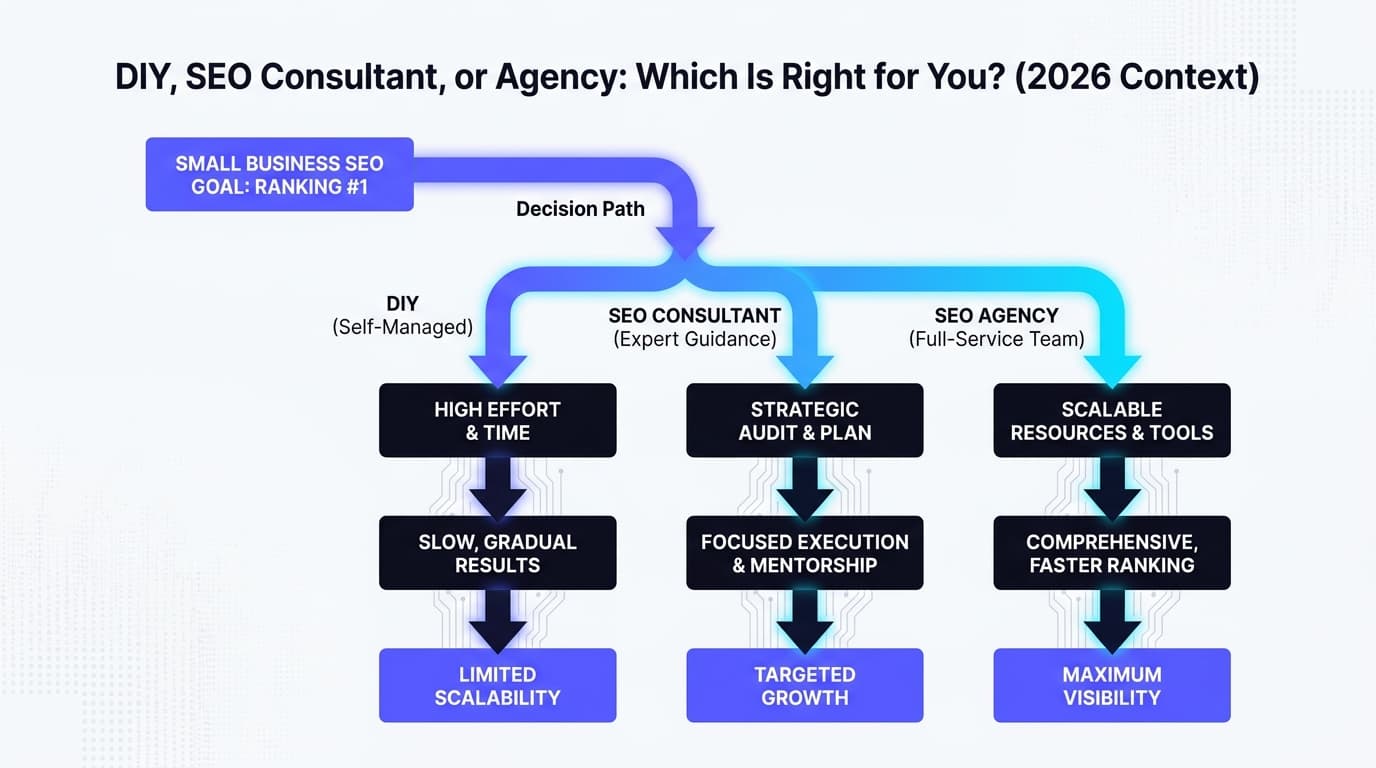
DIY, SEO Consultant, or Agency: Which Is Right for You?
This is the fork in the road that every small business owner reaches. The right answer depends on your budget, your time, and how quickly you need results. There is no universally correct choice.
DIY SEO
Best for: Business owners with 5-10 hours per week to dedicate to learning and executing SEO, and a very tight marketing budget (under $300/month for tools).
DIY SEO is viable. Many small businesses have built strong organic presence without ever hiring an agency. The prerequisites are time and willingness to learn. Google's own Search Essentials documentation is a legitimate starting point, as is the Google Search Console interface for identifying technical issues.
Realistic DIY capabilities for a non-specialist:
- Setting up and optimizing Google Business Profile (high ROI, fully accessible)
- Writing and publishing keyword-targeted blog content
- Basic on-page optimization (title tags, meta descriptions, headings)
- Building local citations manually
What is genuinely difficult without expertise: technical SEO audits (you can run a crawler but interpreting and prioritizing the output is a skill), link building at scale, and diagnosing ranking drops after algorithm updates.
The hidden cost of DIY is opportunity cost. Ten hours per week spent learning and executing SEO is ten hours not spent on your core business. For many owners, the honest answer is that their time is worth more than the cost of hiring help.
SEO Consultant
Best for: Businesses wanting expert strategy and prioritized guidance without the overhead cost of a full agency retainer. Works well for businesses with an internal team member who can handle execution.
A good SEO consultant for small business typically charges $75-$200/hour or a flat monthly retainer of $500-$2,000. What you get is a senior-level strategist who diagnoses your specific situation, builds a prioritized action plan, and either executes some tasks themselves or trains your team to handle them.
The consultant model works especially well when you have a content writer, a web developer, or a marketing coordinator on staff who can implement recommendations. The consultant provides the expertise; your team provides the capacity. This hybrid keeps costs manageable while ensuring the strategy is sound.
What to check before hiring a consultant: Ask for examples of ranking improvements they have driven for businesses similar to yours. Ask which tools they use and how they measure progress. Anyone who guarantees a specific ranking within a fixed timeframe is either lying or planning to use tactics that will hurt you long-term. Google does not offer guaranteed placements in organic results to anyone.
SEO Agency
Best for: Businesses ready to invest $1,500+/month, that want a full team handling strategy, content, technical work, and link building simultaneously, and that are focused on scaling organic traffic as a primary growth channel.
Agencies bring bandwidth and specialization that individual consultants cannot match. A mid-sized agency has a technical SEO specialist, a content team, a link-building outreach team, and an account manager coordinating them. For a business targeting 20 city-level keyword clusters or competing in a tough national market, that team structure is not a luxury; it is a necessity.
The risk with agencies is accountability. Large agencies sometimes serve small business clients with junior staff while their senior people focus on enterprise accounts. Before signing, ask specifically who will work on your account, what their experience is, and how often you will meet with them. A well-run agency relationship produces monthly reporting with clear metrics: organic sessions, keyword rankings, leads attributed to organic, and progress against agreed goals.
AI-Powered SEO Tools for Small Businesses in 2026
AI-powered tools have fundamentally changed what a small business can accomplish without a full agency team. They do not replace strategy, but they compress the time required to execute it significantly.
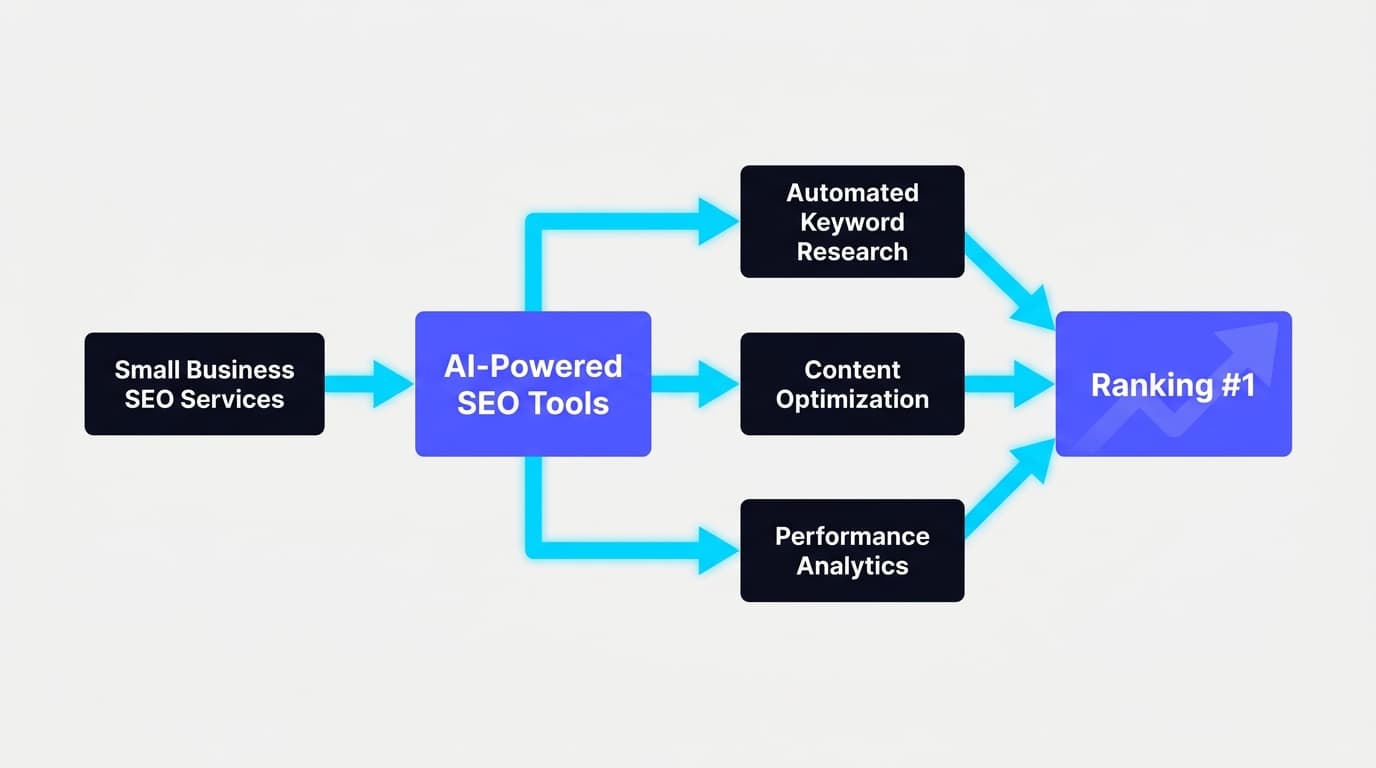
What AI SEO Tools Actually Do
AI SEO tools in 2026 are not just chatbots that write content. The category breaks into four distinct capabilities:
1. Content Generation and OptimizationBest for: Businesses that need to publish keyword-targeted content consistently but lack dedicated writers.
Tools in this category analyze top-ranking pages for a target keyword, extract the topics and questions they cover, and help you create content that is structured to compete. The key differentiator from simple AI writing is the SEO-specific layer: heading structure, keyword placement, internal link suggestions, and readability scoring applied automatically.
The limitation: AI-generated content that is published without substantive editing and fact-checking is detectable in quality and often lacks the specific, experience-driven detail that earns both reader trust and editorial links. Use AI for structure and drafts; add genuine insight before publishing.
2. Keyword Clustering and Intent AnalysisBest for: Businesses mapping out a content strategy across dozens of related topics.
Traditional keyword research produces lists. Clustering tools group related keywords by semantic meaning and search intent, revealing which topics a single page can address and which require separate content. A small business that would previously spend three days building a keyword map can now complete that work in a few hours.
For a practical walkthrough of AI-driven keyword approaches, AI keyword research methods and tools covers the process in depth.
3. Automated Technical AuditsBest for: Businesses without a developer who need to identify and prioritize technical SEO issues.
AI-assisted audit tools do not just list problems; they explain them in plain language and prioritize them by likely ranking impact. A small business owner who does not know what a canonical tag is can still understand "this page is competing with itself in Google's index and should be fixed first."
Reviewing the best SEO tools for different use cases helps narrow down which audit tool fits your budget and technical comfort level.
4. Rank Tracking and Competitive IntelligenceBest for: Any business that wants to monitor progress and understand what competitors are doing differently.
Modern rank trackers go beyond position monitoring. They flag when competitors publish new content targeting your keywords, identify gaps in your coverage, and surface opportunities where your site is ranking on page two (positions 11-20), where a focused optimization push has the highest probability of moving you to page one.
AI SEO Tools and Google's Guidelines
A legitimate concern for small businesses: does using AI for SEO content violate Google's guidelines? The answer as of 2026 is no, provided the content is helpful, accurate, and written for people rather than search engines. Google's Helpful Content guidance focuses on quality and user intent, not the production method. Content that is factually accurate, specific, and genuinely useful ranks. Content that is thin, repetitive, or obviously generated without editorial oversight does not.
The practical rule: AI tools should accelerate your expertise, not replace it. If you know your industry and customers well, AI tools help you produce more of that knowledge, faster. If you use AI to generate content about topics you know nothing about, the output will reflect that gap.
How to Choose an SEO Provider: A Practical Framework
Choosing the wrong SEO provider is an expensive mistake that can take 12-18 months to undo. The following framework applies whether you are evaluating an agency, a consultant, or a freelancer offering SEO services for small business.
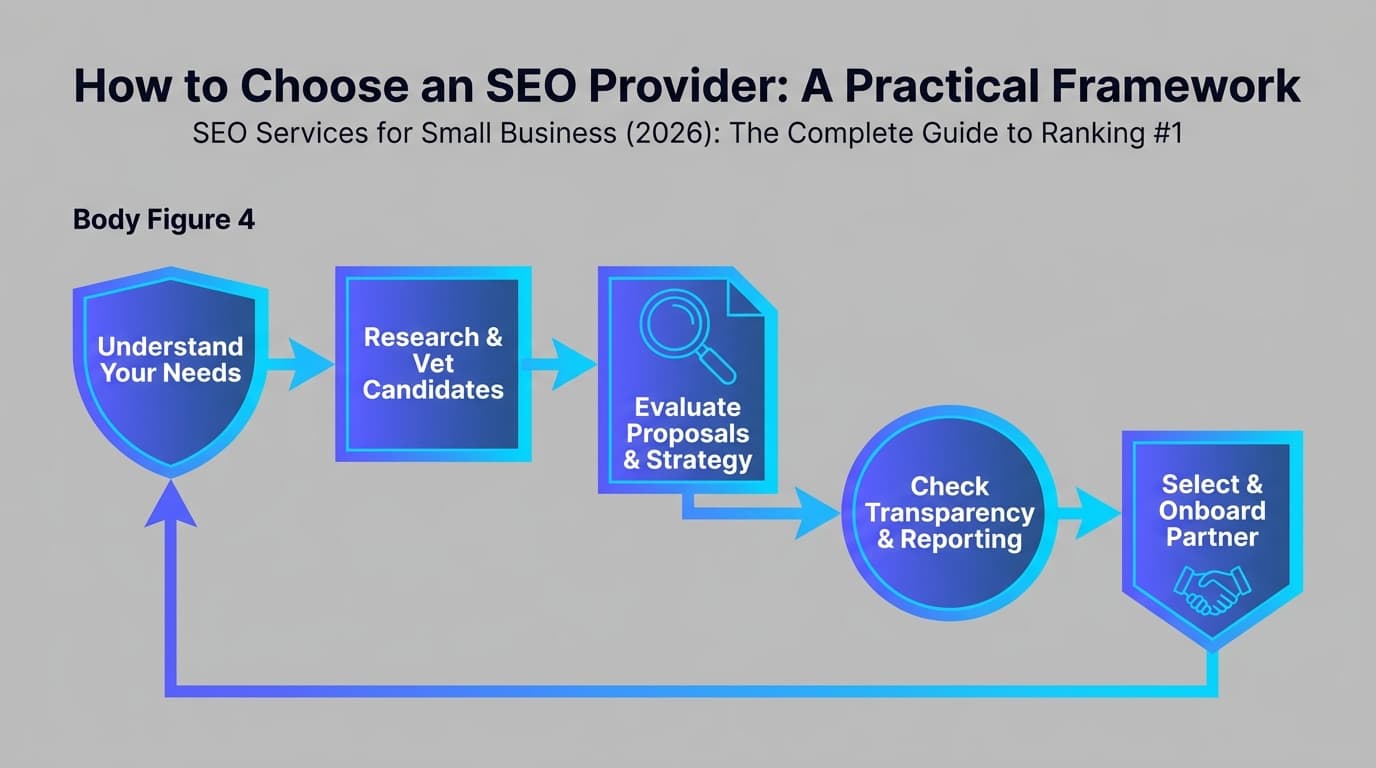
Step 1: Define Your Goals and Metrics Before the First Call
Before you talk to any provider, write down:
- What does success look like in 6 months? 12 months? (Traffic? Phone calls? Form submissions? Revenue?)
- What is your realistic monthly budget, including a buffer for content production?
- Do you want local visibility, national visibility, or both?
- What is your timeline pressure? (A business opening in 60 days needs a different approach than one planning 12 months out.)
Providers who ask these questions during the first conversation are thinking correctly. Providers who lead with a package pitch before asking any questions about your business are not.
Step 2: Evaluate the Proposal Against These Criteria
A trustworthy SEO proposal for a small business should include:
- A site audit showing current baseline status and specific identified problems
- Keyword targets with rationale (not just a list)
- A clear timeline and what deliverables you receive each month
- Metrics they will track and how they will report
- Their link-building approach (specifically ask this)
- Contractual flexibility (be very cautious of 12-month locked contracts with no performance benchmarks)
Anything that sounds like "our proprietary algorithm" or "secret techniques" is a red flag. Good SEO is not secret. The methods are well-documented and the results are measurable.
Step 3: Check References and Past Results
Ask for three client references in a similar industry or size, and actually call them. Ask:
- Did rankings improve, and on what timeline?
- Did traffic lead to actual business outcomes?
- Was communication consistent and honest when things were not going well?
- Would you hire them again?
Rankings screenshots are easy to fake. A client willing to talk about their experience is not.
Step 4: Start with a Time-Limited Engagement
If you are uncertain, start with a one-time audit (typically $300-$2,500) or a three-month engagement before committing to a longer retainer. A legitimate provider will have enough confidence in their work to not require a 12-month lock-in before demonstrating value.
Step 5: Understand the Reporting Structure
You should receive a monthly report that shows, at minimum:
- Organic traffic trend (Google Analytics / Search Console data, not third-party estimates)
- Keyword ranking movements for your priority terms
- Technical issues identified and resolved that month
- Content published or updated
- Links acquired
If a provider cannot clearly explain where your rankings stand and what moved them, they cannot manage the campaign effectively.
Small Business SEO Strategy: A 90-Day Starting Roadmap
Most small businesses benefit from a phased approach. The following roadmap applies whether you are DIYing or directing a provider.
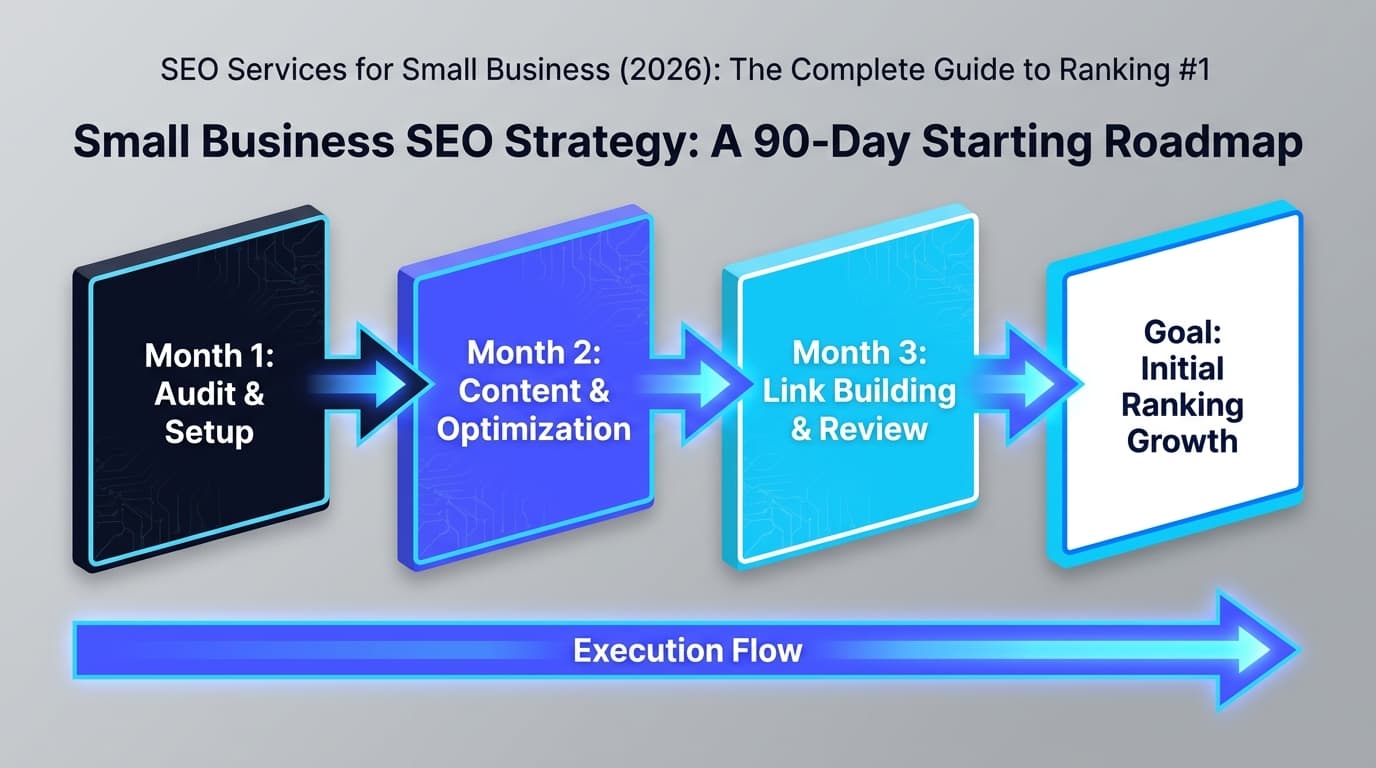
Month 1: Foundations
- Set up Google Search Console and Google Analytics 4 if not already configured.
- Run a technical audit and fix crawl errors, speed issues, and mobile usability problems.
- Claim and fully optimize your Google Business Profile.
- Complete keyword research and map target keywords to existing pages.
- Fix title tags and meta descriptions on your 10 highest-traffic pages.
Month 2: Content and On-Page
- Rewrite or expand the three to five most important service or product pages using the keyword map.
- Publish two to three new keyword-targeted blog posts targeting informational queries.
- Build or correct local citations on 20-30 priority directories.
- Begin a review generation process (email follow-ups, QR code at point of sale, or direct ask).
Month 3: Authority and Momentum
- Launch an outreach effort for two to three high-quality local or industry links.
- Publish two to three more content pieces, this time targeting commercial-intent keywords.
- Analyze Search Console for pages ranking positions 11-20 and run a targeted optimization push on those pages.
- Review GBP Insights for search query data and add new content or posts based on what you see.
Results from this roadmap: By month three, you should see measurable movement in Search Console's performance report. Significant traffic increases typically come at month four through six as Google indexes and evaluates your updated content.
The businesses that abandon SEO at month two because they "haven't seen results yet" are the ones who funded their competitor's ranking improvement. The compound nature of SEO means the early months build the foundation that later months monetize.
Frequently asked questions
How long does it take for SEO services to show results for a small business?
Most small businesses see initial ranking movement within 60-90 days of sustained optimization. Meaningful organic traffic increases typically appear at the 4-6 month mark. Competitive markets may take 9-12 months for significant page-one visibility. The timeline shortens when a site has no existing technical problems and targets lower-competition local or niche keywords.
What is the difference between local SEO and regular SEO services for small businesses?
Local SEO focuses specifically on ranking for searches with geographic intent, appearing in Google Maps and the local pack of results. It centers on Google Business Profile optimization, local citations, and reviews. Regular (organic) SEO targets broader search results across any geography. Most small businesses need both: local SEO for immediate, high-converting local traffic, and organic SEO for longer-term content-driven growth.
How much should a small business spend on SEO services per month?
A realistic minimum for professional SEO services is $800-$1,000/month for a freelance consultant or small agency. Established agencies with full teams typically charge $2,000-$5,000/month. Businesses under $300/month are usually better served by a structured DIY approach using tools like Google Search Console, Ahrefs Webmaster Tools (free tier), or similar platforms rather than a provider who cannot deliver meaningful work at that rate.
Can a small business do SEO without hiring anyone?
Yes, especially for local businesses with low-to-moderate keyword competition. The highest-ROI DIY tasks are: fully optimizing your Google Business Profile, writing keyword-targeted service and location pages, and consistently requesting reviews from customers. These three activities alone produce substantial local visibility improvements for most service businesses without any paid tools.
What should I look for in an affordable SEO package for a small business?
A legitimate affordable package should include, at minimum: an initial technical audit, on-page optimization for your core pages, monthly keyword rank tracking, and Google Search Console review. Avoid packages that lead with "500 backlinks per month" or "guaranteed page 1 rankings." Transparency about the specific tasks performed each month is the clearest indicator that a provider is legitimate.
Do AI tools replace traditional SEO services for small businesses?
AI tools compress the time and cost required to execute SEO tasks like keyword research, content drafting, and technical audits. They do not replace strategic judgment, link-building relationships, or the experience needed to diagnose why a site is underperforming. The best 2026 approach combines AI tool efficiency with human strategy: use AI to accelerate execution, use expertise to direct it.
How does Google Business Profile affect SEO for small businesses?
Google Business Profile is the most direct lever for local search visibility. A complete, verified, regularly updated profile with genuine reviews and accurate category selection directly determines whether a business appears in the local pack. Google has confirmed that proximity, relevance, and prominence are the three core local ranking factors, and GBP signals affect all three. It is also free, making it the single highest-ROI SEO action available to any local business.
What is a realistic ROI expectation for small business SEO services?
The widely cited industry figure is 5x average return on SEO investment over a 12-24 month horizon, meaning $1,000/month in SEO spend generates $5,000+ in attributable revenue. This varies significantly by industry, competitive intensity, and execution quality. Service businesses with high customer lifetime value (legal, medical, financial, home services) tend to see the strongest ROI because a single converted client can be worth thousands of dollars.
Should a small business choose an SEO agency or an SEO consultant?
Choose an agency if you need a full team executing multiple workstreams simultaneously and have a budget above $2,000/month. Choose a consultant if you have some internal capacity for execution, want senior-level strategy without paying for account management overhead, and have a budget of $500-$2,000/month. The consultant model often delivers better value for small businesses that are organized and can act on recommendations without hand-holding. Choosing the right SEO services for small business is a decision that compounds over years. Start with the foundation: a complete Google Business Profile, technically sound website, and a small set of well-researched target keywords. Build from there. The businesses ranking at the top of Google for your most valuable search terms got there through consistent, methodical work, not a single campaign. If you want to accelerate that process with AI-driven research and content tools built specifically for competitive SEO, explore Project Rankup's pricing and plans to see which tier fits your current stage.