SEO for roofers works when three things are in place before the phone starts ringing: pages built for the jobs homeowners search after storms and at the change of season, proof that you are a local, licensed firm rather than a crew passing through, and a steady record of real jobs with photos. Roofing demand arrives in waves. The roofer whose pages are already indexed when the hail comes through gets the calls.
This guide is for owners of small roofing firms, mainly in the US, with notes for the UK, and it sticks to what is different about roofing.
Roofing demand comes in waves, so build pages before the wave
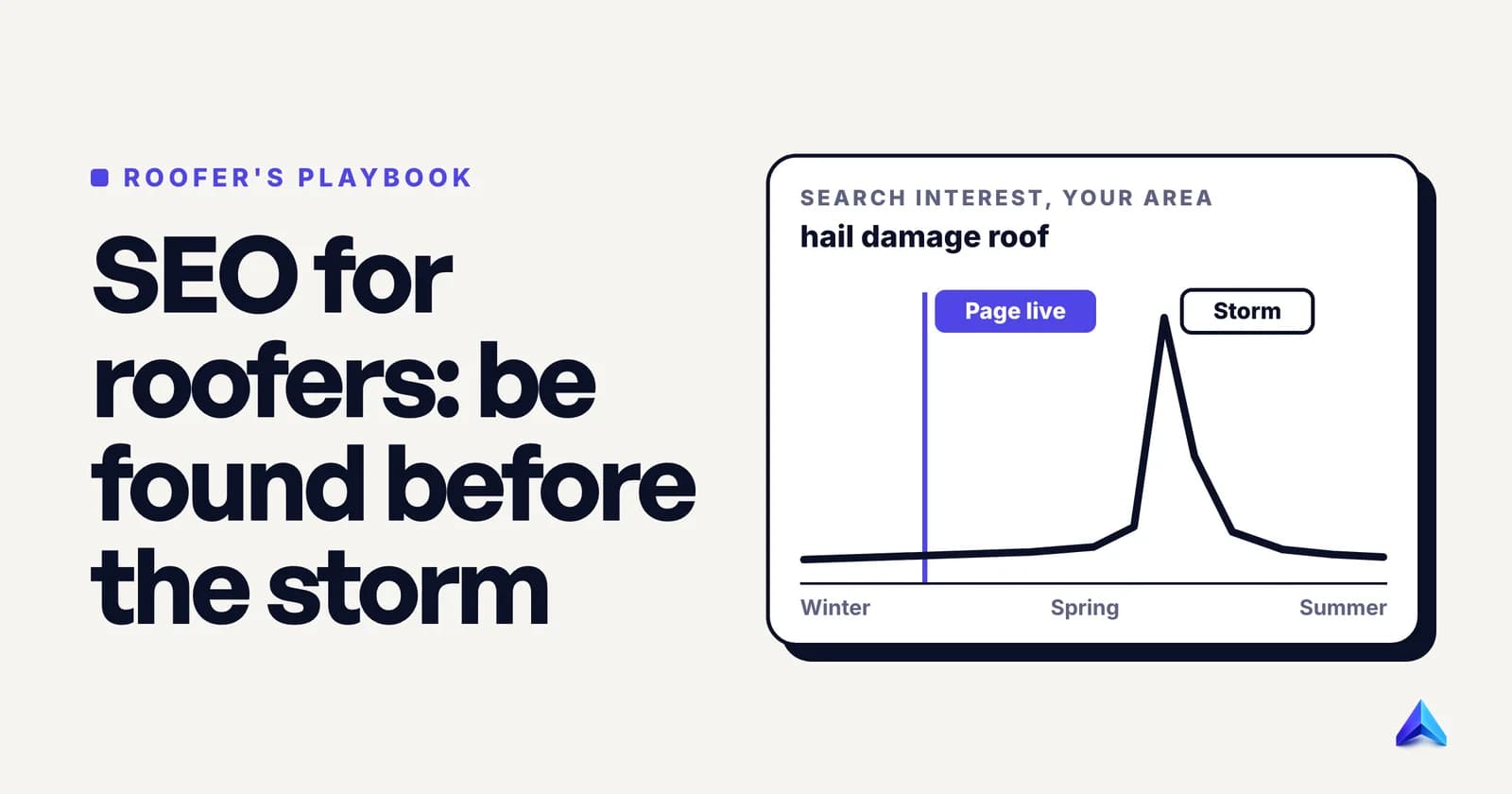
Searches for hail damage, storm damage and emergency tarping can jump overnight after a bad storm, and replacement searches follow the weather and the building season. A page published the morning after a storm will not be indexed and ranking in time for that storm.
Google Trends shows the pattern for your own area, free:
- Open Google Trends, choose Explore and set the location to your state or metro area, not the whole country.
- Set the time range to the past five years, so one unusual season does not mislead you.
- Compare phrases that match your work, such as "roof repair", "roof replacement", "hail damage roof" and "roof leak", and note the months each one rises.
Read the chart correctly. Google's explanation of Trends data says each data point is divided by total searches for that place and time and then scaled from 0 to 100. That makes it a measure of relative interest, not a search count. Terms with low volume show as 0, and Google adds statistical noise, so a one-off spike on a small phrase in a small town can be noise rather than real demand. Google itself calls Trends one data point among others.
Use what you learn to set a lead time. If replacement interest in your area climbs in spring, publish or refresh the replacement page and its job examples in late winter. If hail interest jumps in early summer, have the storm damage page live and indexed months before. Then pick the phrases a new site can realistically rank for; our guide to what keyword difficulty measures explains why a young roofing site should start with the specific, low-difficulty phrases rather than "roofer near me".
The pages a roofing site actually needs
A homeowner with water coming through the ceiling and a homeowner planning a new roof in two years search differently and want different answers. One page called "Services" serves neither. Build a page for each job type you want more of, and make each one answer the questions people ask before they call.
| Page | What the homeowner wants to know |
|---|---|
| Emergency roof repair and tarping | Can you come today, what happens on the first visit, and what a temporary repair costs compared with the permanent one |
| Roof repair | Which problems you fix (leaks, missing shingles, flashing, valleys), and how you decide between repair and replacement |
| Roof replacement | Materials you install, how long a typical job takes, what happens to the old roof, and the warranty |
| Storm and hail damage | How you inspect, what the report includes, and how you work with the homeowner's insurer |
| Flat roof repair and replacement | Membrane types you install (EPDM, TPO, modified bitumen, GRP in the UK), and drainage problems you fix |
| Material pages | One page per material you are known for, such as asphalt shingle, metal, tile or slate |
Repair versus replacement deserves the most care, because it is the decision every homeowner is trying to make. An honest page on how you judge it (age of the roof, extent of the damage, layers already on, the state of the decking) earns trust before a visit. If it always ends in replacement, people can tell.
Flat and pitched roofs are different trades for many firms, and the searches differ too. If you do both, give them separate pages. If you only do pitched, say so plainly on the flat-roof question in your FAQ rather than ranking for work you will turn down.
UK roofers should split pages the way British homeowners search: slate and tile roofs, flat roofs (felt, EPDM, GRP fibreglass), leadwork, chimney repairs, and fascias, soffits and guttering. Heritage slate work in conservation areas is a page of its own if you do it.
Your Google Business Profile sits alongside these pages. Set it up as a service-area business with your real name, real hours and the towns you actually cover; the setup is the same for every trade that travels to customers, and our plumbers' guide walks through the service-area rules. UK firms should also read our UK local SEO playbook for the address and review rules that differ there.
How to out-trust the storm chaser
Roofing has a reputation problem that most trades do not. After a big storm, out-of-area crews arrive, knock on doors and push homeowners to sign on the spot. The Federal Trade Commission's warning on home repair scams describes the pattern almost word for word: someone knocks or calls, offers to fix a leaky roof, finds people after a windstorm or flood, pressures them to act quickly and asks for cash or offers financing.
That warning is useful to you. The same FTC page tells homeowners what to check before hiring: that the company has licences and insurance, that they get three written estimates, that no work starts before a written contract is signed, and that they do not pay by cash or wire transfer. Its 2025 alert on weather-related scams adds that people should confirm a contractor's licence with their state or county and pay in full only after the work is done.
So publish the answers before anyone asks. A page called "How to check us out" or a block on every service page should carry:
- Your licence number and the issuing authority, so the homeowner can look you up with the state or county themselves.
- Proof of insurance, with the insurer's name and how a homeowner can request a certificate.
- A physical address with a history. The year you started, how long you have been at that address, and a photo of the yard or office. A storm chaser cannot show years in your town.
- How you take payment, in writing: deposit terms, stage payments, card and check accepted, and the plain statement that you do not take cash up front.
- A sample contract or estimate, with personal details removed, so people can see what they will sign.
Then match it in the field. The homeowner who gets a written estimate, a named project manager and no pressure to sign today writes the review that tells the next homeowner you are not a storm chaser. Ask every customer for that review in the same way, and never offer a discount for one.
Turn every job into a page: project photos and before and after galleries
A finished roof is the best advert a roofer has, and most roofing sites waste it. The photos sit in a gallery called "Our Work" with filenames like IMG_4471.jpg, no captions and no text, so search engines have nothing to connect them to a place or a service.
Google's image SEO guidance gives you the rules. It says Google learns what an image shows from the page around it, including captions, and that images should sit near relevant text on a page about the same subject. It calls alt text the most important attribute for describing an image, and it gives a plain example of filenames: a short descriptive name beats IMG00023.JPG. It also warns that stuffing keywords into alt text can make a site look like spam.
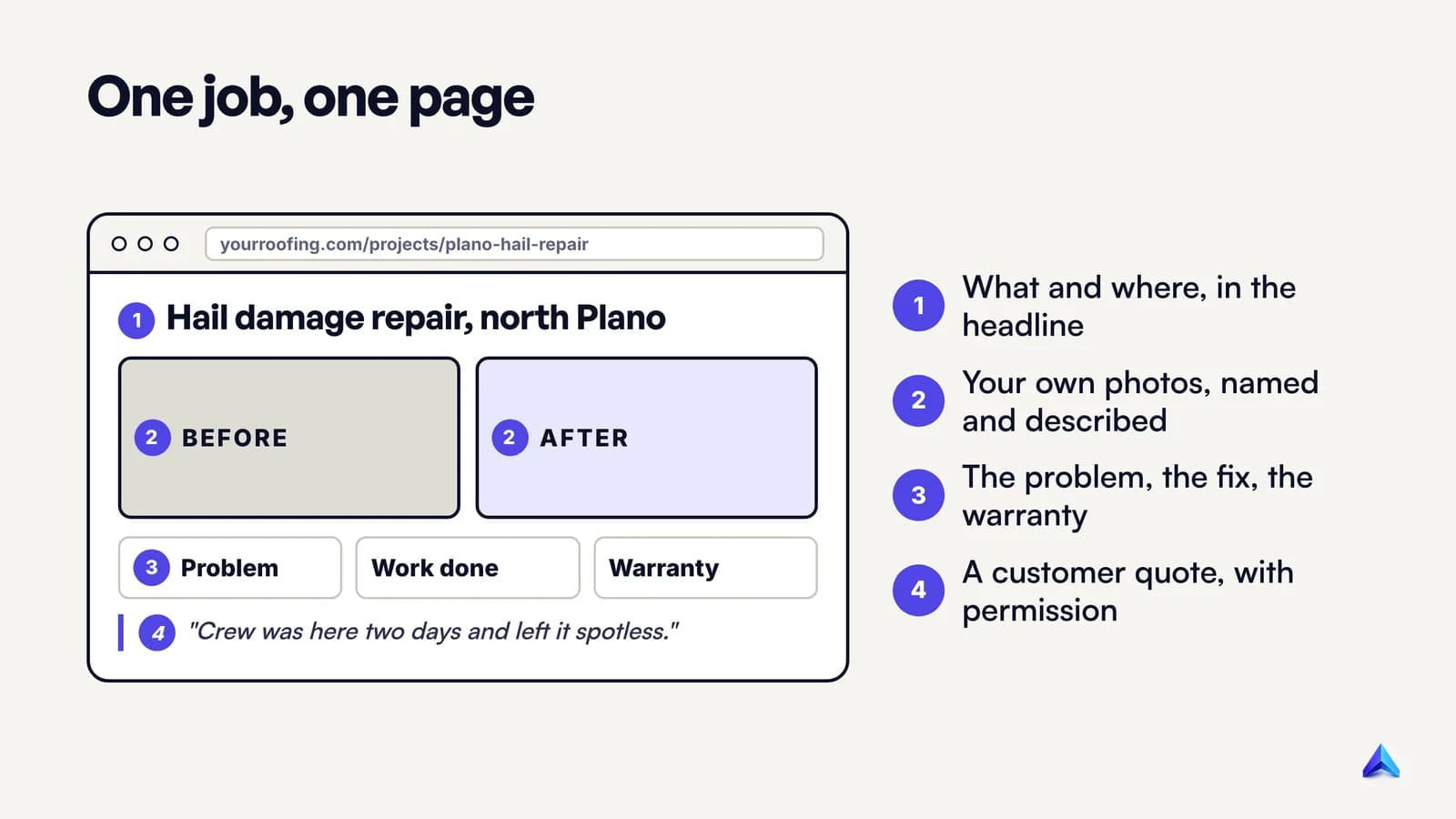
For a roofer, that means a short job page for every project worth showing, linked from the relevant service page and from the town it was in. Each one needs:
- A headline that says what and where. "Hail damage repair and full replacement, architectural shingles, north Plano" tells a reader and Google more than "Project 47".
- Before, during and after photos. The during shots matter: decking replaced, ice and water shield going down, new flashing. They show the work a homeowner never sees and a rival cannot fake.
- Three or four sentences on the problem and the fix. What the homeowner noticed, what you found, what you did, how long it took.
- Materials and warranty. Brand, product line, colour, and which warranty was registered.
- Location at neighbourhood level. Never the house number. Ask the homeowner's permission before publishing photos of their house, and keep street signs and number plates out of frame.
- A quote from the customer, if they are happy to give one.
Name the files for what they show, such as plano-hail-damage-shingle-roof-before.jpg, and write alt text a person could picture: "Storm-damaged asphalt shingle roof with missing tabs above a two-car garage". Resize and compress before upload; photos straight from a phone are far heavier than a page needs. Our guide to optimising images for SEO covers formats, sizes and lazy loading step by step.
Ten real job pages in a town beat one thin "Roofing in Plano" page with the town name swapped in. They are also dated, local, photographed proof that you were working here last year and will be here next year.
Answer the insurance and financing questions homeowners search
After a storm, the first thing many homeowners wonder is whether their policy will pay. They search the questions before they call anyone: will insurance cover my roof, what is a deductible, should I call the roofer or the insurer first. Pages that answer these clearly earn visits that competitors' sales pages do not.
Write them as a roofer, not as an insurance expert:
- What to document after a storm. Photos of the roof from the ground, interior water stains, the date of the storm, and any temporary repairs with receipts.
- What your inspection report includes, and that the homeowner gets a copy whatever they decide.
- How you work with the adjuster. If you attend the insurer's inspection, say so, and say what it costs. If you do not, say that too.
- What you will not do. Do not promise to "get your roof paid for" or to deal with the claim on the homeowner's behalf. The insurer decides coverage under the policy, and a page that implies otherwise sets up an angry customer.
One topic needs particular care. The National Association of Insurance Commissioners warns homeowners about assignment of benefits agreements, which let a third party such as a contractor stand in the policyholder's shoes and seek payment from the insurer directly. The NAIC tells consumers they are not required to sign one to get repairs done. If you use these agreements, explain them in plain terms on the page. If you do not, say so. Either way, homeowners who have read the NAIC's warning will trust the roofer who mentions it first.
Financing pages follow the same logic. The FTC lists "offer to get you financing" as part of the door-knock pattern, so a financing page that hides the lender, the rate or the terms looks exactly like what homeowners have been warned about. Name the finance partner, link their terms, and tell people they are free to compare loans elsewhere.
Trust signals that are real, and how to show them
Homeowners skim past a row of badges. The signals that still work are specific, current and checkable on the issuing body's own site.
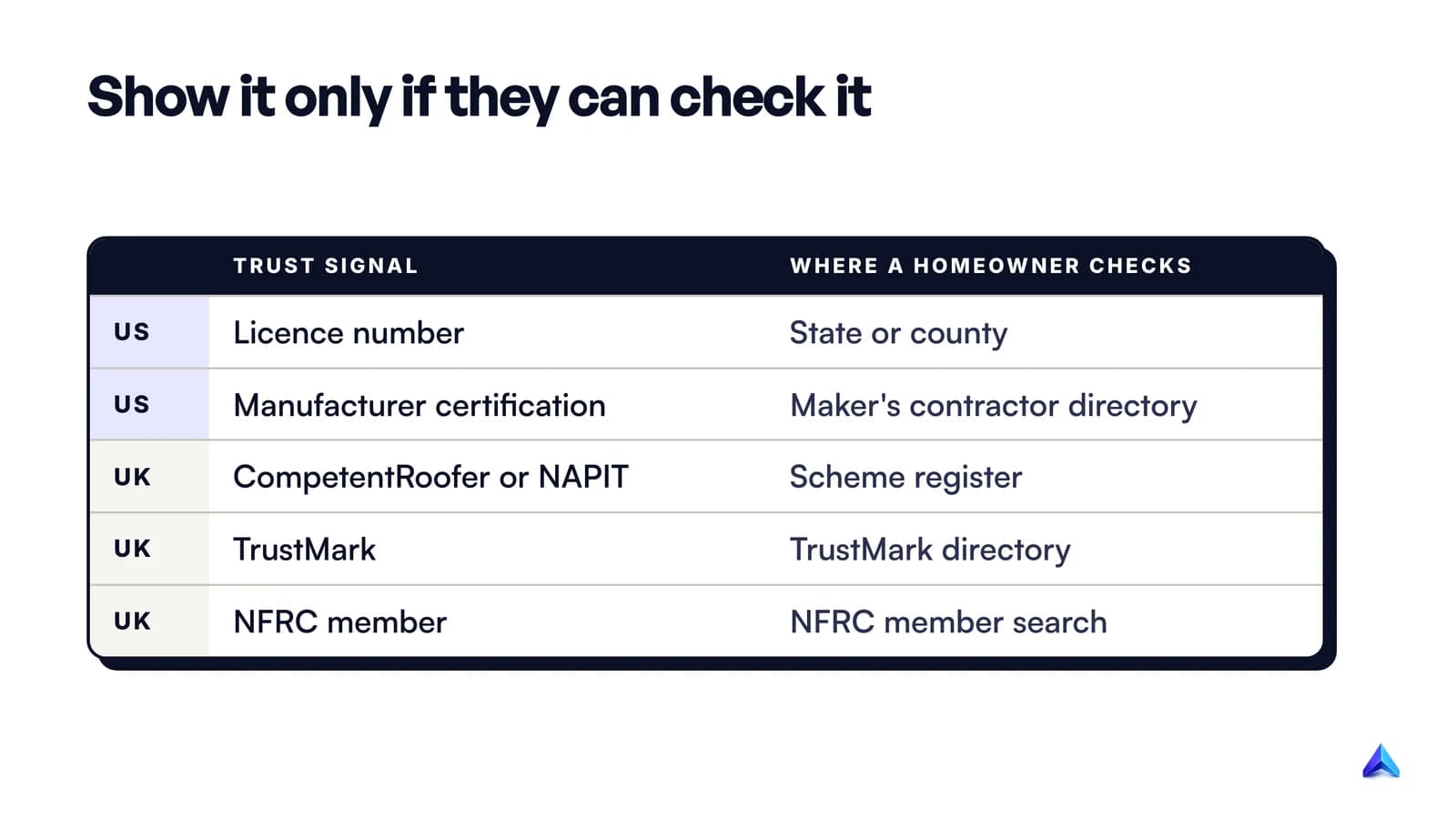
US: state and local licensing. The FTC tells homeowners to confirm a contractor's licence with their state or county government, so that is where your number has to stand up. Do not claim "licensed" without the number beside it. Where your state or county licenses roofing work, show the number and the issuing body in every page footer; where it does not, say plainly what you do hold, such as a business licence and insurance, rather than implying a licence that does not exist.
US: manufacturer certification programmes. Shingle makers run contractor programmes that let certified roofers offer extended warranties. GAF's residential programme guidelines are a good example of what the badge does and does not mean. All three of its tiers (Certified, Certified Plus and Master Elite) require a state licence where one is needed, $1 million in liability insurance and workers' compensation insurance. GAF says it may also weigh years of experience and customer reviews. Master Elite contractors must meet yearly renewal minimums of 1,000 rewards squares, 500 warranty squares and 10 learning credits to be considered for renewal. GAF's approved wording says only 2% of roofers in North America are invited to Master Elite.
The same document sets the rules for talking about it. Claims about a certification must be truthful and not misleading, and contractors must include GAF's statement that certified contractors are not GAF employees or agents. So if you hold a certification, show the exact tier, link to your listing in the manufacturer's contractor directory, and keep it current. A lapsed badge on a website is a liability, not a trust signal. Other manufacturers run their own programmes with their own rules; read each one's own terms before you describe it.
UK: Competent Person Schemes. Gov.uk's list of Competent Person Schemes explains that installers who join a scheme can self-certify certain types of building work instead of getting building regulations approval. For replacement of roof coverings on pitched and flat roofs, the authorised schemes are NAPIT and CompetentRoofer, which is run by the National Federation of Roofing Contractors. If you are registered, say which scheme and that you can self-certify re-roofing work, because homeowners otherwise worry about building control.
UK: TrustMark and NFRC. TrustMark describes itself as the UK's only Government Endorsed Quality Scheme, lists around 18,000 registered businesses, and says registered businesses give a minimum two-year guarantee on work in and around the home. NFRC says its members must pass an inspection before joining and are inspected every three years after that, on technical competence and commercial capability. Each has a public directory, so link your listing rather than just displaying the logo.
Put the same facts into structured data. schema.org has a RoofingContractor type, which sits under LocalBusiness by way of HomeAndConstructionBusiness, so your name, address or service area, phone number and opening hours can be marked up with the most specific type available.
A roofing year: what to work on, season by season
Plumbers can run the same monthly routine all year. Roofers get better results by matching the work to the weather they watched in Trends.
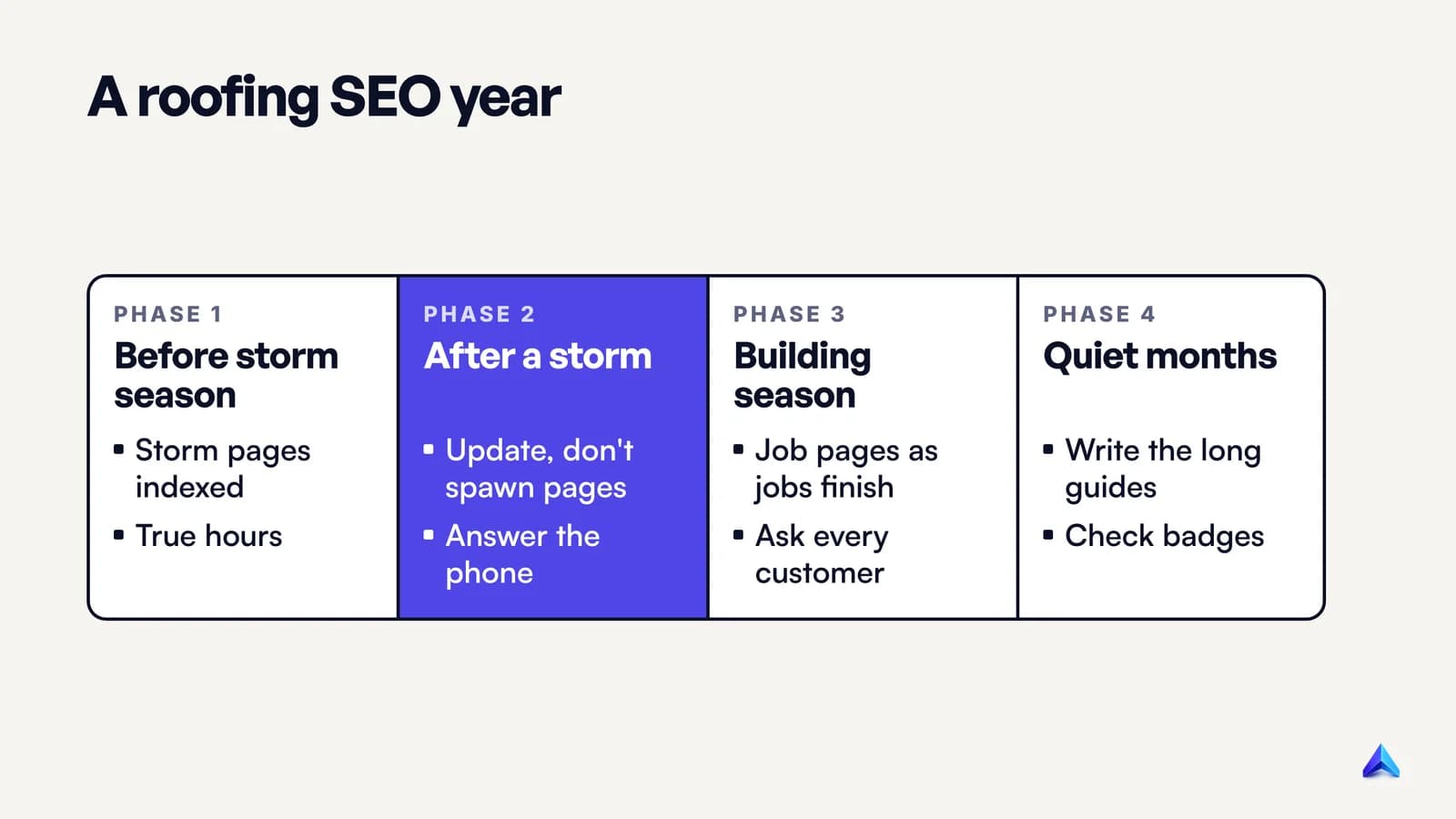
Before storm season. Check that the storm damage, emergency repair and insurance pages are live, indexed and fast on a phone. Inspect each one in Search Console; if any is missing, our guide to checking whether a page is indexed shows how. Make sure your hours and emergency number on the profile are true, and that someone will answer.
In the week after a storm. Do not rush out ten new pages with the storm's name in them. Update the existing storm page with the date and the areas you are covering, post an update on your Business Profile, and answer the phone. Take photos on every inspection, with permission, because they become next year's job pages.
In the building season. Publish job pages as jobs finish, while the photos and the details are fresh. Ask every customer for a review in the same way. Add a material or service page only where you see real enquiries you have no page for.
In the quiet months. Write the long pages: repair versus replacement, the material comparison, what a roof inspection includes. Refresh last year's storm page, and check that certifications and directory listings are current.
If you want help choosing which questions to write about, our own tool, Project Rankup, judges keyword difficulty against your domain's authority, so a new roofing site sees which topics it can rank for this year instead of chasing "roofing company" in a big metro.
Judge results over a full year. Compare this spring with last spring in Search Console and your Business Profile performance, not this month with last month.
Frequently asked questions
What is the best way to advertise for roofing?
Use paid ads to fill the diary quickly and SEO to lower what each job costs over time. Ads stop the day you stop paying. Service pages, job pages with photos and a well-run Business Profile keep bringing enquiries, including in the seasons when you are too busy to manage ad campaigns.
What is SEO in construction?
It is the work of making a construction or trade business show up in search when people look for the services it offers in the places it works. For roofers, that means the map results and local organic results for searches such as "roof repair" plus a town, and the questions homeowners ask before hiring.
What keywords should roofers target?
Start with each service you want more of combined with the towns you cover, such as "roof replacement" or "flat roof repair" plus a town name. Add storm and insurance questions people ask in your area. A new site should favour specific, low-difficulty phrases over broad ones like "roofer near me" in a large city.
How long does SEO take for a roofing company?
Business Profile changes and new reviews can move map results within weeks. New service and job pages usually take a few months to rank, longer on a brand-new domain. Because roofing demand is seasonal, publish storm and replacement pages well before the season you want them to rank in.
Do roofers need a blog?
Not a news blog. Roofers need job pages with photos and a handful of genuinely useful guides, such as repair versus replacement, what an inspection includes and how storm claims work. Those answer real homeowner questions. Weekly filler posts about "the importance of your roof" rarely rank and do not win jobs.
Should I hire a roofing SEO company?
Hire one if you cannot find the time to do the work above, but ask what they will deliver each month, in writing. Be wary of guaranteed rankings, hundreds of near-identical town pages, or plans that do not include your own job photos. Those are signs of templated work that is unlikely to last.