

SEO for plumbers comes down to three jobs: a Google Business Profile set up correctly as a service-area business, one solid website page for each service you want more of, and a steady flow of honest reviews. Get those right and you can compete in the map results for "plumber near me" without paying an agency. This guide gives you a one-week setup plan and a monthly routine that fits into an afternoon.
It is written for the owner who does the work, a sole trader or a firm with a few vans, mainly in the US, with notes for the UK and India where the rules differ.
The searches that bring plumbing jobs, and where each one lands
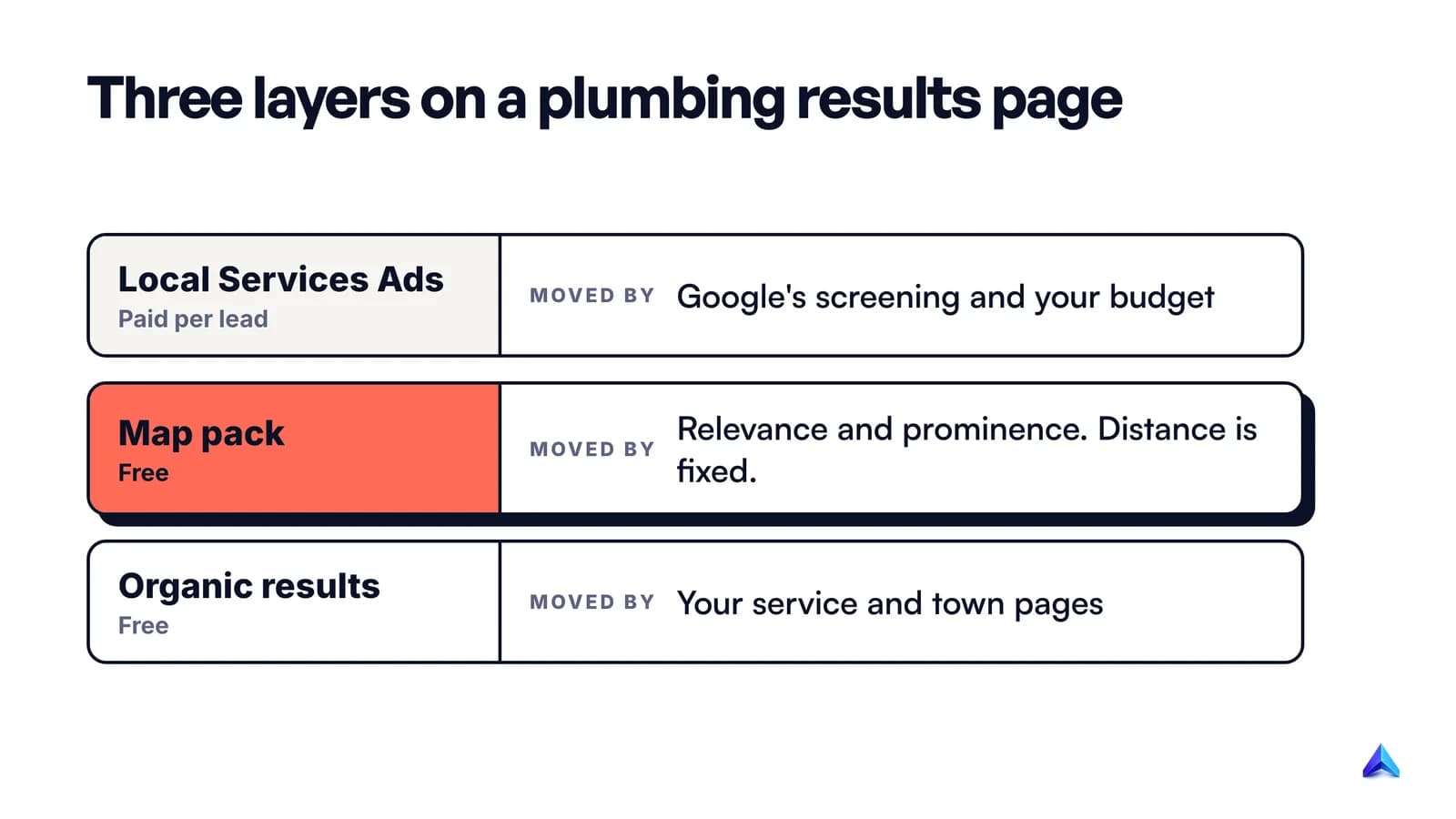
A plumber's searches fall into four groups, and each is won in a different part of the results page.
- Emergency searches. "Emergency plumber near me", "burst pipe", "no hot water". The person is on a phone, often standing in water. These are decided in the map pack and, where available, in Local Services Ads above it.
- Service plus place. "Water heater installation Columbus", "drain cleaning Dublin Ohio". The map pack still shows, but your service page can rank in the organic results below it.
- Trust checks. Someone has your name from a neighbour or a van and searches it, often with "reviews". Your profile, your reviews and your site answer this one.
- Research questions. "Why is my water heater making a popping noise", "how much does it cost to replace a sump pump". Informational, organic only, and the slowest to pay off.
Most plumbers should spend their first month on groups one to three. Research articles come later, because a new site with no authority struggles to rank for them; our explainer on what keyword difficulty measures shows why.
Set up your Business Profile as a service-area business
You go to the customer, so Google treats you as a service-area business. Its service area guidance sets the rules.
Hide your home address. If customers do not come to you, remove the address from the profile. You still use it to verify, and Google keeps it private. A P.O. box or an unstaffed virtual office is not allowed as your address at all.
List the areas you actually cover. You can set up to 20 service areas, defined by cities, ZIP codes or similar areas. Google does not accept a radius around your base, and it says the whole area should sit within about two hours' driving of where you are based. Pick the towns you want more work from.
One profile, whole area. Google allows a service-area business one profile for everything it serves. A second listing for the next county, with a different phone number, breaks that rule.
Use your real name. The business name field must match the name on your van, invoices and website. "Rivera Plumbing" is fine. "Rivera Plumbing | 24/7 Emergency Plumber Columbus" is a keyword-stuffed name, and Google's guidelines list hours and service descriptions as things you may not add to the name.
Choose categories narrowly. Pick "Plumber" as the primary category. Google asks for as few categories as possible, chosen by finishing the sentence "this business IS a". Add a secondary category only when it is genuinely a second business line you can be called for, such as drainage or water heater installation if that category exists in your country's list.
Fill in the services list and description. Add each job you do as a service, with a short plain description. Write the description for a homeowner: what you do, where, and whether you take emergency calls.
UK readers have extra traps, such as Companies House addresses; our UK local SEO playbook covers them.
Emergency and "near me" searches: what you can change
Google ranks local results on three things, and its page on how local ranking works names them: relevance, distance and prominence. Distance means how far your business is from the person searching. You cannot change it, so stop worrying about it: a plumber based on the north side of a city will rarely show for a "near me" search on the south side.
The other two you can move.
Relevance is how well your profile matches the search. Your category, your services list, and the words in your reviews all feed it. A review that says "came out at 11pm for a burst pipe under the kitchen sink" tells Google more than "great service".
Prominence is how well known you are. Google says it draws on how many websites link to you and how many reviews you have, and that more reviews and positive ratings can help your local ranking.
Two things matter specifically for emergencies:
- Hours must be true. If you set "Open 24 hours", answer the phone at 3am. A customer who reaches voicemail at midnight after Google said you were open writes the review you least want. If you take night calls only sometimes, set your real hours and say "emergency call-outs by arrangement" in the description.
- Answer the phone, or call back fast. Customers remember the plumber who picked up, and what they write in reviews feeds prominence.
What does not work: paying someone for a "guaranteed top 3" in the map pack. Google states plainly that there is no way to request or pay for a better local ranking.
Service pages and town pages that aren't doorway pages
Your website ranks for service-plus-place searches the profile cannot reach, and gives the profile somewhere convincing to send people. Start with service pages, one per job you want more of:
- Water heater repair and replacement
- Drain cleaning and blocked drains
- Leak detection and burst pipes
- Sewer line repair
- Bathroom and kitchen plumbing installation
- Emergency call-outs
Each page should answer what the customer actually wants to know before calling: what you do, whether you can do it today, roughly what affects the price, how long it takes, and what happens on the visit. Photos of your own jobs beat stock images. A short FAQ at the bottom, with real questions customers ask on the phone, helps both the reader and search engines.
Town pages are where plumbers get into trouble. Several agency guides tell you to create a page for every town you serve. Done badly, that is exactly what Google's spam policy calls doorway abuse: pages "targeted at specific regions or cities that funnel users to one page", or "substantially similar pages that are closer to search results than a clearly defined, browseable hierarchy". Swapping the town name in the same 400 words, 30 times, is the textbook case.
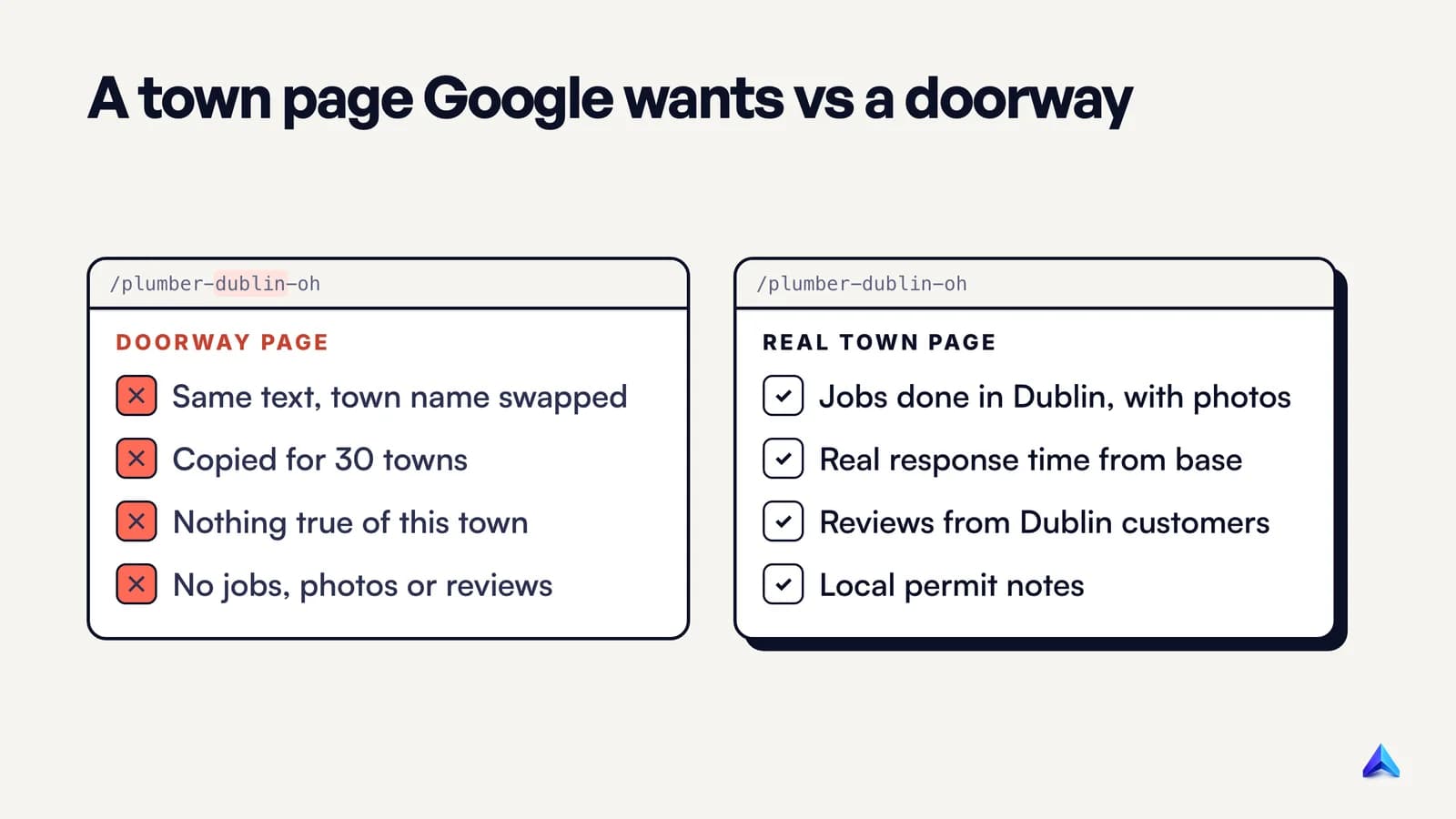
A town page earns its place when it carries things that are only true of that town:
- Jobs you have done there, with photos and the type of property.
- Your real response time to that area from where your vans are based.
- Reviews from customers in that town.
- Local specifics a customer would recognise, such as the common housing stock or the city's permit process for water heater replacement.
If you cannot write that for a town, do not build the page. List the town on your service-area page and in your profile instead. Ten real town pages beat fifty thin ones, and a site that is mostly thin pages risks the pages that were good. The same trap catches other local businesses; our law firm SEO guide shows how it plays out with office pages.
Make every page load fast on a phone, with a tap-to-call number at the top. If a new service page does not show up in Google within a few weeks, work through why a website is not showing on Google before rewriting anything.
Licences and accreditations that actually count
Homeowners let you into their house, so proof of competence weighs heavily when they choose between three map results. Show the proof that is real in your country, with something a customer can check.
United States. Plumbing licences are set by states, and in some places by cities or counties too, with levels such as journeyman and master. Put your licence number in the website footer and on every service page, and name the issuing board, so a customer can look you up. Add proof of insurance and bonding if your state requires them. Never claim "licensed" without the number next to it.
United Kingdom. Plumbing in general is not a licensed trade, but gas work is. The Health and Safety Executive's gas safety guidance says anyone employed to work on gas appliances in domestic premises must be a Gas Safe registered engineer. If you fit or service boilers, show your Gas Safe number and say which work your ID card covers, because the card lists the appliances each engineer is qualified for. For water work, WaterSafe is the national register of approved plumbers; approved contractors can issue Certificates of Compliance showing work meets the Water Fittings Regulations.
India. We could not find a national plumbing licence comparable to the US or UK schemes. The Indian Plumbing Skills Council is the plumbing sector skill council under the National Skill Development Corporation and certifies plumbers against national occupational standards. If you or your team hold that certification, say so with the certificate details. If you do not, do not invent a badge; show years in business, the brands you are trained to install, and reviews.
Put the same facts in your structured data
Mark up your site with the schema.org Plumber type, which sits under LocalBusiness. Google's LocalBusiness structured data documentation asks for the most specific subtype possible and lists name and address as required. As a service-area business, give the city, state and ZIP code rather than a street address you have hidden on your profile.
{
  "@context": "https://schema.org",
  "@type": "Plumber",
  "name": "Rivera Plumbing",
  "url": "https://riveraplumbing.example",
  "telephone": "+1-614-555-0142",
  "address": {
    "@type": "PostalAddress",
    "addressLocality": "Columbus",
    "addressRegion": "OH",
    "postalCode": "43215",
    "addressCountry": "US"
  },
  "areaServed": ["Columbus", "Dublin", "Westerville", "Grove City"]
}
One common mistake: do not add aggregateRating with your Google star rating. Google says that property is only for sites that collect reviews about other local businesses, so marking up your own rating earns you nothing and puts markup on the page that Google says is not meant for it.
Reviews: what US law and Google's policy allow
Reviews feed prominence, and in the US they are now regulated by a federal rule. The Federal Trade Commission announced its final rule on fake reviews on August 14, 2024, and it went into effect on October 21, 2024. The FTC can seek civil penalties against knowing violators. For a plumbing business, the parts that bite are:
- No fake or bought reviews, including reviews written by AI or by anyone who never used you.
- No paying for a sentiment. Offering anything in return for a positive review is banned.
- Insider reviews must be disclosed. Reviews from staff or family need the connection made clear.
- No review suppression. Threatening legal action without grounds, or intimidating a customer, to get a bad review taken down is banned.
The FTC rule allows more than Google does. The FTC's guidance says an incentive is acceptable if there is no requirement that the review be positive. Google's review policy treats any incentive, including a discount, in exchange for a review as fake engagement. It also bans asking only the customers you think are happy. Your reviews live on Google, so follow Google's rule: no discounts, no prize draws, and the same request to every customer.
The method that stays inside both:
- Get your review link or QR code from the Business Profile.
- Text it to every customer the evening of the job, with one line: "Thanks for having us out today. If you have a minute, a review helps a small business like ours."
- Do not ask for five stars, and do not suggest what to write.
- Reply to negative reviews once, politely, with your name, and take the details offline.
UK businesses face a different law, the Digital Markets, Competition and Consumers Act; the review section of our UK local SEO guide covers what it bans.
Local Services Ads or organic: where each fits
Local Services Ads are the boxes above the map pack for many plumbing searches. Google's Local Services Ads page lists plumbers as an eligible category, and you pay only for leads related to your business, rather than per click. Businesses that pass Google's screening carry a Google Verified badge. Many guides still talk about the Google Guaranteed badge, but Google's own page now names only Google Verified.
Google lists 11 countries: Austria, Belgium, Canada, France, Germany, Ireland, Italy, Spain, Switzerland, the United Kingdom and the United States. India is not among them, and Google's ads policy blocks plumber ads entirely in the Netherlands. Even inside those countries, the categories available vary by area, so check eligibility for your ZIP code or postcode.
| Local Services Ads | Map pack and organic | |
|---|---|---|
| How you pay | Per lead | Your time, or an agency |
| Speed | As soon as screening is done | Weeks for the profile, months for pages |
| Stops when you stop paying | Yes | No |
| Countries | 11 listed by Google, not India | Everywhere |
| Best for | Filling the diary now | Lowering cost per job over time |
Our view: if you are in the US or UK and the diary has gaps, run Local Services Ads while the organic work builds, and set a weekly budget you can afford to lose. The two help each other, because the same reviews and verified details that make your profile strong also make the ad more convincing. In India, put the whole effort into the profile, the site and reviews.
Your first week, day by day
This is the setup, done once. Each day is roughly two hours.
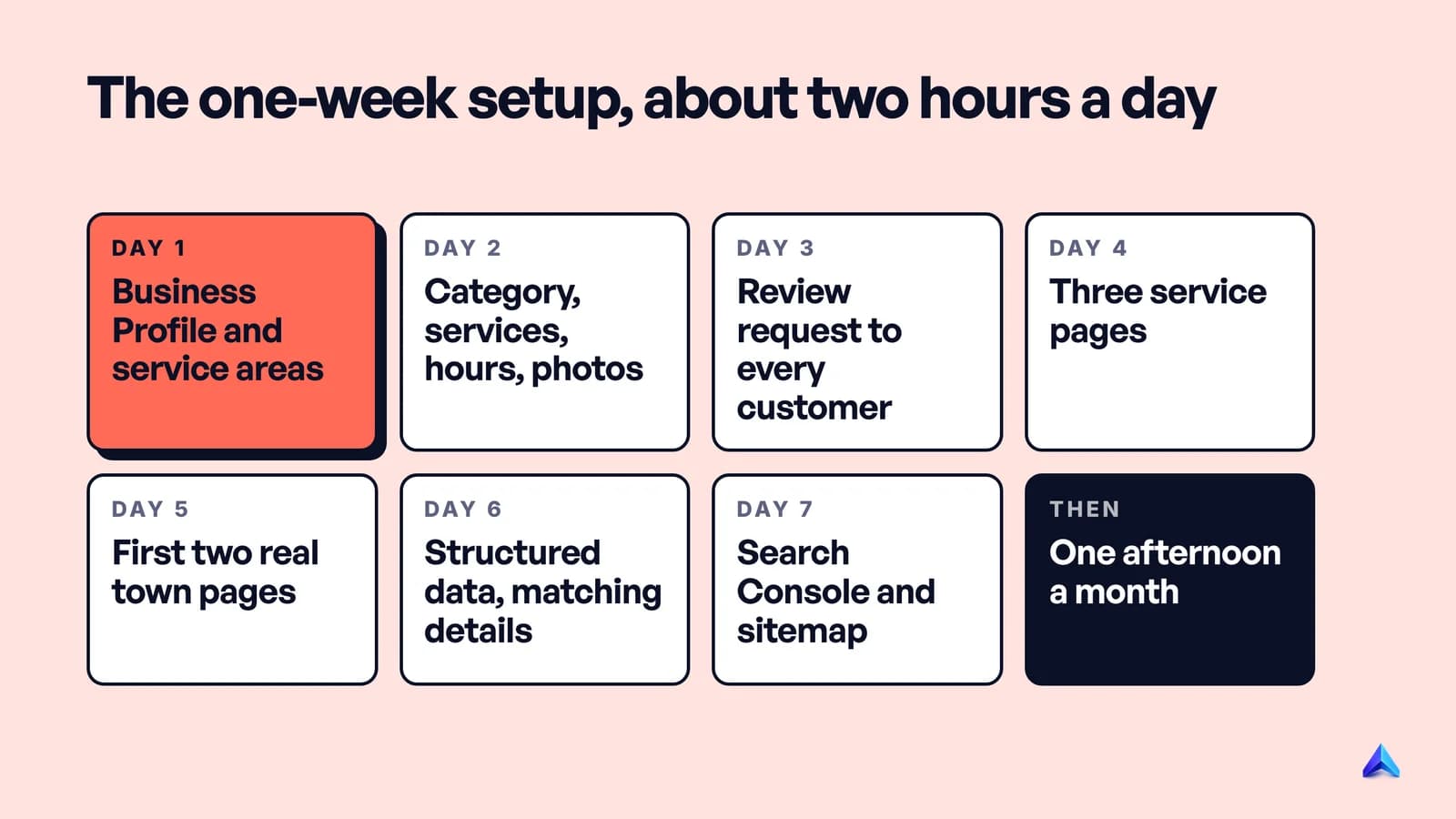
| Day | Job | Done when |
|---|---|---|
| 1 | Claim or create the Business Profile; hide your address; set up to 20 service areas | Verification is started |
| 2 | Primary category "Plumber"; services list; description; true hours; 10 photos of your own work, vans and team | Every field that applies is filled |
| 3 | Send a review request to every customer from the last three months | One message per customer, the same wording to all |
| 4 | Write or rewrite your three most valuable service pages, with licence number and a tap-to-call button | Each answers price factors, timing and the visit |
| 5 | Decide which towns deserve a page; write the first two with real local jobs | Pages contain things only true of that town |
| 6 | Add Plumber structured data; make name, phone and service areas match the profile everywhere | Same details on the site, profile and Bing Places |
| 7 | Verify the site in Google Search Console and submit the sitemap | Service pages show as indexed |
On day 7, check each new page individually with the URL inspection method.
A monthly routine that takes an afternoon
After the setup, SEO for a plumber is a habit, not a project. Block out one afternoon a month.
Read the numbers first. The Performance section of your Business Profile shows calls from the profile, website clicks and the search terms people used to find you; the search terms update at the start of each month. In Search Console, look at which pages get impressions and for which queries. Watch the direction across three months, not one.
Then do the upkeep:
- Add five new job photos to the profile.
- Check that every customer from the month got the review request, and reply to any review that needs it.
- Update hours for public holidays ahead of time.
- Answer any new questions on the profile.
- Add one real case to a town page, or one new service page if the search terms show demand you have not covered.
Every three months, write one useful article. Take a question customers keep asking on the phone, such as how long a tank water heater lasts or what to do while you wait for an emergency plumber, and answer it properly. Choose questions with low difficulty; a new site wins those first. Tools such as our own product, Project Rankup, judge difficulty against your domain's authority so you skip topics you cannot rank for yet.
Expect the profile changes to show within weeks and the service pages within a few months. If calls from search have not moved after three months of this routine, the problem is usually distance, reviews or a page Google has not indexed, in that order.
Frequently asked questions
How much does SEO cost for a plumber?
The setup in this guide costs your time and nothing else: Business Profile, Search Console and Bing Places are free. Agencies charge a monthly retainer that varies widely by city and scope. Before paying one, ask exactly which of the jobs above they will do each month, and never pay for "guaranteed" map rankings, which Google says cannot be bought.
Can I do plumbing SEO myself?
Yes. A sole trader or small firm can do all of the setup and the monthly routine without a developer. The work that needs most care is the Business Profile rules and the town pages, because mistakes there can lead to suspension or a spam problem. Hire help for a website rebuild or when you cover several cities.
How long does SEO take to work for plumbers?
Profile changes, new photos and reviews can affect map results within a few weeks. New service pages on an established site usually take a few months to rank, longer on a brand-new domain. Research articles take longest. Judge progress on calls and form enquiries over three months, not on a single week's rankings.
What keywords should a plumber target?
Start with the services you want more of, combined with the towns you cover: "water heater replacement" plus your city, "emergency plumber" plus your city. Then add the questions customers ask on the phone. Use the search terms report in your Business Profile to see what people already find you for.
Do I need a website if I have a Google Business Profile?
A profile alone can bring calls from the map pack, but a website ranks for service-plus-town searches the profile cannot, carries your licence details and gives Google more evidence of what you do. For most plumbers, a fast, simple site with a page per main service is enough.