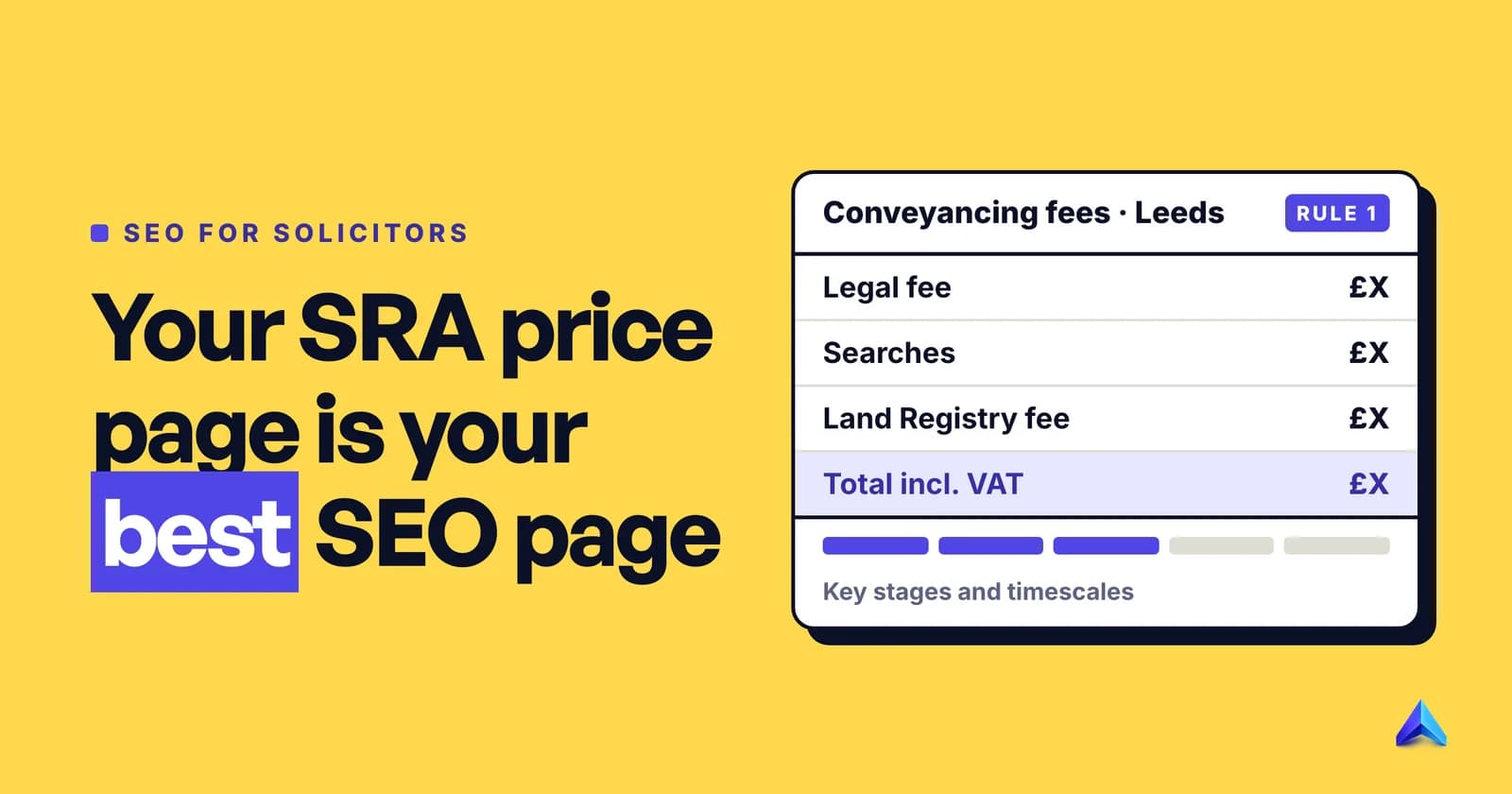
SEO for solicitors means getting your service, price and office pages in front of people searching for legal help in the towns you serve. In England and Wales the SRA already makes many firms publish what those searchers want: prices, stages, timescales and who does the work. Build those mandatory pages as proper search pages, give each real office one Google Business Profile, and back both with trust signals a client can check.
This is the UK-only version. For how US, English and Indian advertising rules compare, read our SEO for law firms guide. Nothing here is legal advice; check the SRA's current guidance, or your own regulator's, before you publish.
How clients find a solicitor now
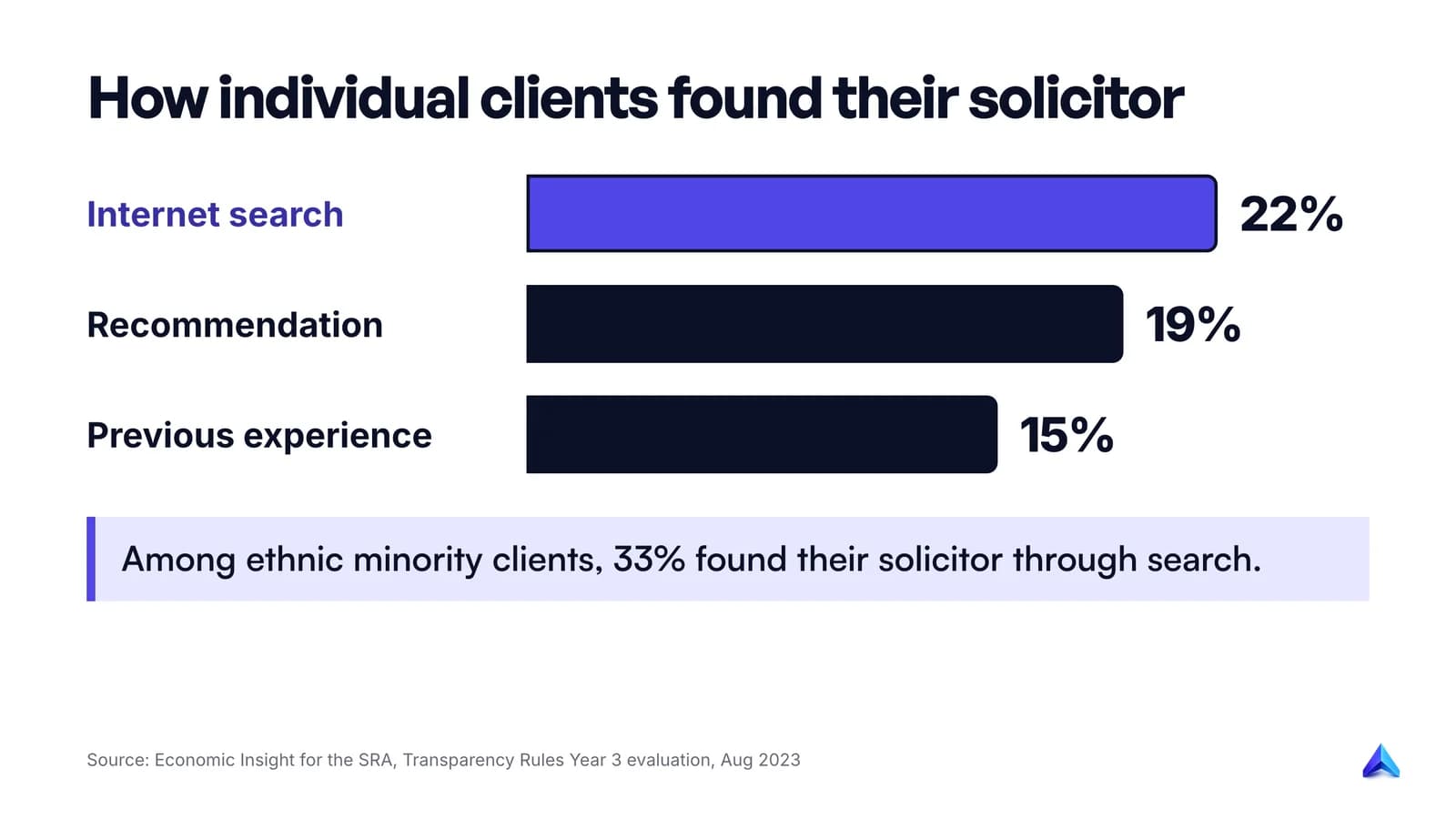
Search now edges out word of mouth. The SRA commissioned Economic Insight to evaluate its Transparency Rules, and the Year 3 evaluation (August 2023) found that 22% of individual clients used an internet search to find their solicitor, ahead of recommendations (19%) and previous experience (15%). Among ethnic minority clients the internet share was 33%, against 20% for everyone else.
People also compare more than they used to. The same report found 55% of individual clients compared the prices and services of different providers before instructing one, up from 46% at Year 1. The most common complaint from those who struggled: prices are presented differently from firm to firm.
Then comes the number that should interest any small firm. Only 38% of firms offering the mandated services said they published everything the rules require online. Most of your competitors are leaving the pages that comparison shoppers look for half-built.
Which services must publish prices, and which you should anyway
Rule 1 of the SRA Transparency Rules applies when a firm "publishes as part of its usual business the availability of" certain services. Publicly funded work is excluded. The list is narrower than many marketing guides suggest, so check it against your practice areas:
| Practice area | Covered by Rule 1? | Exactly what is covered | Page to build first |
|---|---|---|---|
| Conveyancing | Yes | Residential freehold or leasehold sales and purchases, mortgages and remortgages | "Conveyancing fees [town]" price page |
| Wills and probate | Partly | Uncontested estate administration with UK assets. Will drafting is not on the list | Probate price page, then a voluntary wills page |
| Family | No | Not on the list | Voluntary fixed-fee pages, such as an uncontested divorce |
| Employment | Partly | Unfair or wrongful dismissal claims at the Employment Tribunal, for employees and for employers defending them | Tribunal claim price page, split by employee and employer |
| Immigration | Partly | Applications and First-tier Tribunal appeals, excluding asylum | One price page per visa route you handle |
| Other | Yes | Summary-only motoring offences at a single hearing, debt recovery up to £100,000, business premises licensing | One price page each |
For each covered service, Rule 1.5 lists what the cost information must include:
- The total cost, or where that is not practicable, the average cost or a range.
- The basis for your charges, including hourly rates or fixed fees.
- The experience and qualifications of anyone doing the work, and of their supervisors.
- Likely disbursements and their cost.
- Whether fees or disbursements attract VAT, and how much.
- What is included, the key stages and likely timescales, and anything a client might expect to be included that is not.
- If you use conditional fee or damages-based agreements, when clients may have to pay themselves.
Rule 1.6 adds that the information "must be clear and accessible and in a prominent place on your website."
Family and wills sit outside the rule, and that is an opening. The Year 3 evaluation found that clients whose legal issue was not covered "also wanted price and services information to help them make their decision." A family firm in Bristol that publishes a clear fixed fee for an uncontested divorce is answering a question its competitors are not required to answer, and mostly do not.
Turn the mandatory price page into a page that ranks
Most firms treat transparency as a compliance chore: a PDF linked from the footer, or one "Our fees" page covering six services. Both waste the most commercially useful page a firm can publish. The SRA's guidance on price and service transparency says the information must be "in a prominent location on your website, which is accessible, clearly signposted and easy for visitors to find." A crawlable HTML page per service meets that test and is something Google can rank.
Build one page per service, in this order
Take a residential conveyancing page for a firm in Leeds as the worked example.
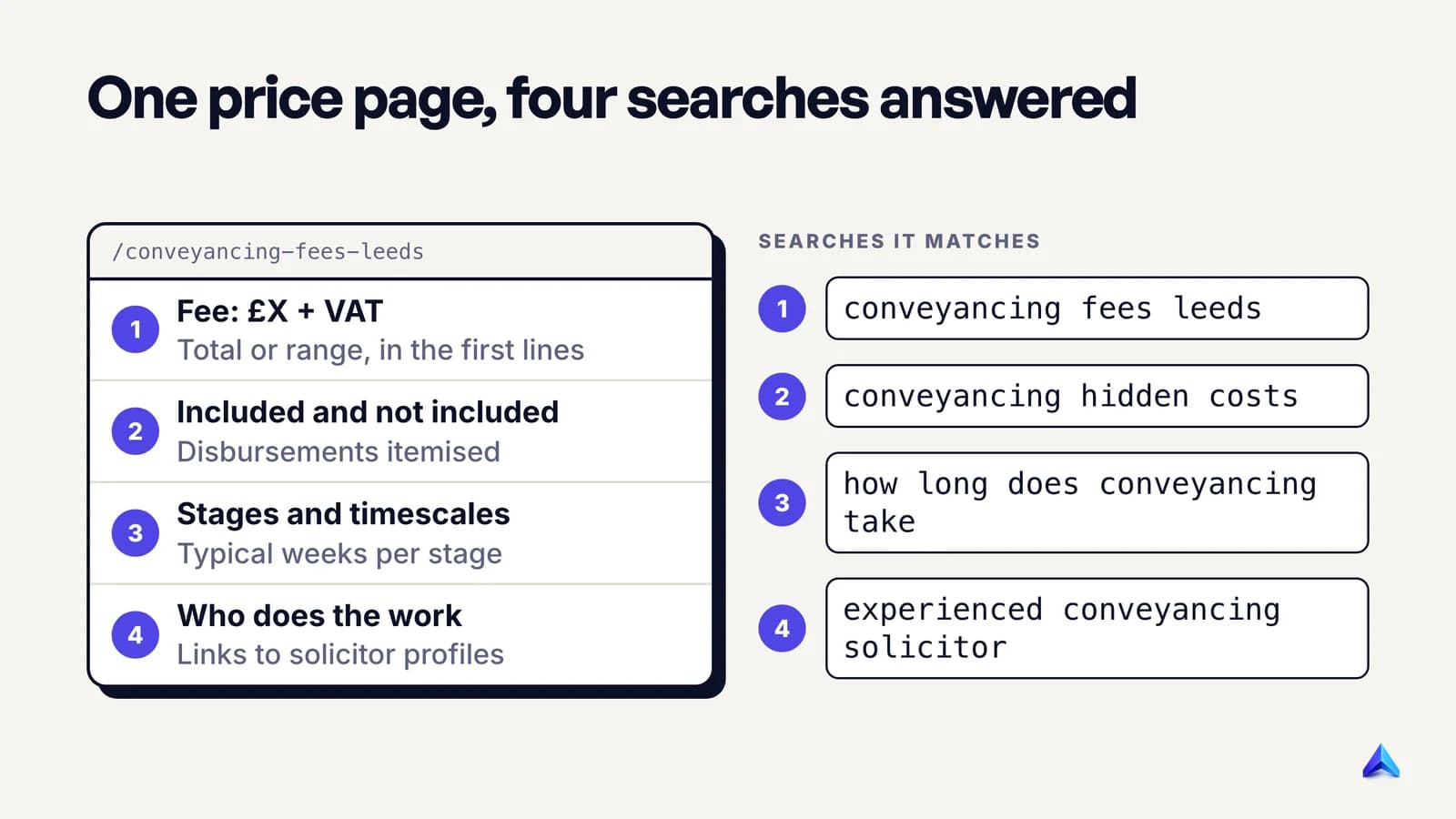
- Answer first. Open with the price: "Our fee for a freehold purchase up to £300,000 is £X plus VAT, with disbursements of about £Y." That sentence matches "conveyancing fees Leeds" and gives an AI Overview something to quote.
- A fee table by property value. The SRA's guidance accepts an indicative fee table based on property value, and lets you publish the typical cost of the service rather than a mathematical mean.
- Included and not included. Leasehold supplements, new-build work and shared ownership are where clients get surprised. List them. The SRA notes that unclear costs are among the most common complaints the Legal Ombudsman handles.
- Disbursements and VAT, itemised: searches, Land Registry fee, bank transfer fee.
- Stamp Duty without guessing. The guidance says to avoid estimating the tax and to link to a calculator you trust, such as HMRC's, or the Welsh Revenue Authority's for property in Wales.
- Stages and timescales. "How long does conveyancing take" is a question in its own right. Answer it on the price page with your real typical range, stage by stage.
- Who does the work. The guidance says team information "does not need to be on the same page as the price information." Link to profile pages for each solicitor and conveyancer instead: admission year, years in residential property, who supervises. Those pages are where your experience becomes visible to Google, which our guide to helpful content explains.
Do not gate the quote
If you offer an online quote calculator, the guidance is blunt: it "must produce a quote without requiring any additional contact at that stage." It also notes that people "do not like being forced to provide personal information such as email addresses or phone numbers." A calculator that demands a phone number before showing a figure breaks the guidance and loses the visitor. Keep the published fee table in plain text beside it, so search engines can read prices that a JavaScript widget hides.
Pick terms a new site can win
"Conveyancing solicitor" nationally is owned by large online conveyancers and directories. "Conveyancing fees Leeds", "probate costs Harrogate" or "settlement agreement solicitor Sheffield" are smaller and closer to an instruction. Our explainer on keyword difficulty shows how to match targets to the authority your domain has today.
What the SRA Code lets your pages say
The publicity rules for solicitors in England and Wales are short. Paragraph 8.8 of the SRA Code of Conduct for Solicitors, RELs and RFLs says: "You ensure that any publicity in relation to your practice is accurate and not misleading, including that relating to your charges". Firms carry the same duty under paragraph 7.1 of the Code for Firms.
For SEO, three habits follow.
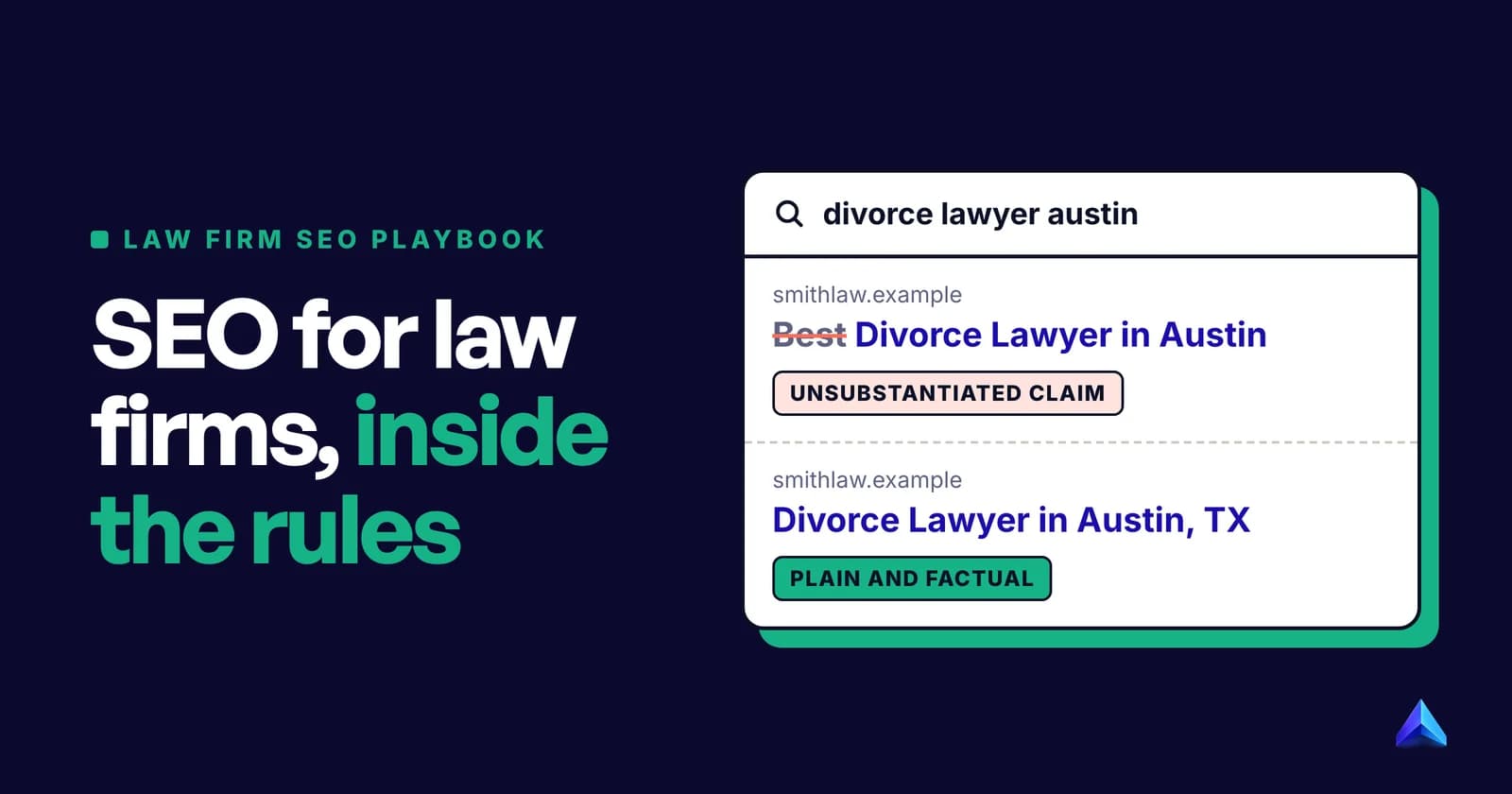
- Titles and meta descriptions are publicity. "Leeds's best divorce solicitors" in a title tag is a claim you would need to stand behind. "Divorce solicitors in Leeds | Fixed-fee options" is accurate and still matches the search.
- Price claims must match the price page. A meta description promising "conveyancing from £499" when the table starts at £499 plus VAT and £300 of disbursements is the misleading-charges problem 8.8 names.
- Unregulated arms need clear labels. Paragraph 8.10 requires that you do not present a separate business that the SRA does not authorise "as being regulated by the SRA". If your group runs an unregulated will-writing company, its pages should not carry the firm's SRA wording.
Paragraph 8.9 bans "unsolicited approaches to members of the public" to advertise your services, current and former clients excepted. Organic search is the opposite of that: the client comes to you. It is one more reason SEO suits a regulated profession better than cold outreach does.
The SRA clickable logo and your regulatory footer
Rule 4.1 of the Transparency Rules requires every SRA-authorised firm to display its SRA number and the SRA's digital badge "in a prominent place" on its website. The SRA calls the badge its clickable logo, and it has been mandatory since 25 November 2019.
How it works, from the SRA's Q&A:
- The technology comes from the SRA's partner, Yoshki. You choose one of three colour versions, in English or Welsh, and receive a piece of code for whoever manages your site.
- The logo only displays on domains registered in your mySRA account. If you launch a new domain or a microsite for one practice area, add it to mySRA first.
- A visitor who clicks it lands on an SRA page that confirms your firm, by name, is regulated.
- It may only appear on your website, not in print or emails.
Put it in the site-wide footer with your SRA number and a link to your complaints procedure, which Rule 2 also requires, including how and when to complain to the Legal Ombudsman and the SRA. Your letterhead and emails need the words "authorised and regulated by the Solicitors Regulation Authority" under Rule 4.2. The SRA tells consumers that "only law firms we regulate can put it on their website", which makes the badge one of the few trust signals a stranger can verify in one click.
Scotland and Northern Ireland have their own regulators
Scotland. The SRA Transparency Rules do not apply to Scottish solicitors, who are regulated by the Law Society of Scotland. Its Practice Rules, rule B3, say solicitors may "advertise and promote your services in any way you think fit", subject to limits. Promotional material must be decent and must not contain "any inaccuracy or misleading statement" or identify a client "without the prior written consent of the client". A claim to be a specialist is allowed, but "the onus of proof that any such claim is justified" sits with whoever makes it. Case studies on a Scottish firm's site need that written consent.
Northern Ireland. Solicitors there are regulated by the Law Society of Northern Ireland, under powers conferred mainly by the Solicitors (Northern Ireland) Order 1976. Its list of regulations includes the Solicitors' (Advertising and Public Relations and Marketing) Practice Regulations 1997, as amended in 2006, with guidance notes. Read the current version on the Society's site before publishing marketing content in Northern Ireland.
A firm with offices in more than one jurisdiction should keep separate service pages for each. Conveyancing in Glasgow and conveyancing in Leeds follow different law and different regulators, and a single "UK conveyancing" page serves neither searcher well.
Trust signals: Find a Solicitor, accreditations, Legal 500 and Chambers
These four get lumped together as "legal directories". They are different things, and they matter to different clients.
| Signal | What it is | Who it matters to |
|---|---|---|
| Law Society Find a Solicitor | A free Law Society service listing organisations and people in England and Wales regulated by the SRA | Consumers checking a firm, and Google reading consistent firm details |
| Law Society accreditations | Voluntary quality marks, including the Conveyancing Quality Scheme, the Wills and Inheritance Quality Scheme, Lexcel, and family and immigration accreditations | Consumer clients comparing high-street firms |
| The Legal 500 | A research-based guide to law firms, founded in 1987, built from firm submissions, partner interviews and client data | Commercial and in-house clients |
| Chambers | Rankings built from research interviews and surveys, mostly of in-house counsel, plus firm submissions | Commercial and in-house clients |
For a high-street firm, a correct Find a Solicitor entry and a relevant accreditation shown on the matching service page do more than a Chambers ranking ever will. Name accreditations exactly as the Law Society does, and only where the firm or the named person holds them. For a commercial firm, a Legal 500 or Chambers ranking quoted on the practice page is strong third-party evidence. Quote the ranking accurately, with its year.
Keep your firm name, address and phone number identical across all of these and your Business Profile. Our local SEO UK playbook covers why that consistency matters and which other UK citations are worth the time.
Google Business Profile for firms with more than one office
Most firm-level local SEO comes down to getting profiles right. Google's Business Profile guidelines give multi-office firms four rules that matter.
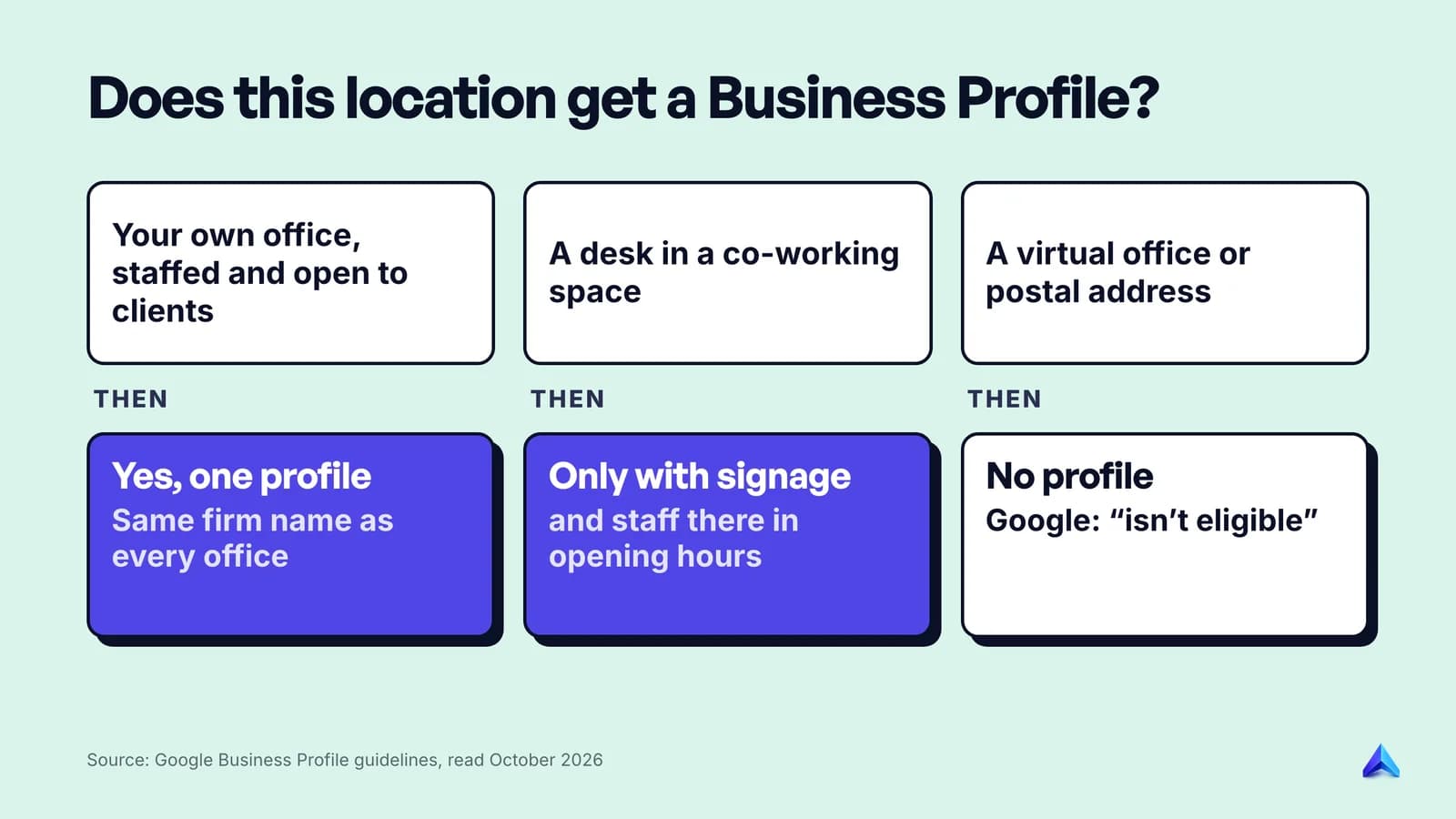
One profile per real office. Google says "Do not create more than one page for each location of your business". An office where clients are seen during opening hours gets one profile, linked to that office's page on your site.
The same name everywhere. "All business locations within the same country must have the same name for all locations." That means "Smith Jones Solicitors" in Leeds and in York, not "Smith Jones Solicitors York Conveyancing". Keyword-stuffed names risk suspension.
No virtual offices. A rented postal address you do not operate from "isn't eligible". A desk in a co-working space only qualifies if it "maintains clear signage, receives customers at the location during opening hours, and is staffed during opening hours by your business staff." A Tuesday-only meeting room in Harrogate does not make a Harrogate profile.
Departments rarely qualify. Google allows separate profiles for public-facing departments that "operate as distinct entities", with different names and typically "a separate customer entrance". Your family team on the second floor is not one. Individual solicitors can sometimes have their own profiles; our law firms guide sets out Google's practitioner rules, including that a practitioner "shouldn't have multiple Business Profiles to cover all of their specialisations".
Town pages that are not doorway pages
Firms want to rank in towns where they have no office. The usual tactic, thirty pages with the town name swapped, is what Google's spam policies call doorway abuse: "pages targeted at specific regions or cities that funnel users to one page". It is also an 8.8 risk, because "Wakefield Conveyancing Solicitors" implies a presence the firm may not have.
A town page earns its place when it has facts a reader in that town can use:
- A real office: address, the solicitors based there, parking, hours, and the services handled locally. Mark it up with the schema.org LegalService type, which sits under LocalBusiness.
- Real local work without an office: the county court or tribunal hearing centre you attend, how hearings there run, and remote meetings explained honestly. Fine for litigation and employment work.
- Nothing local to say: no page. Let the service page, with its clear service area, rank instead.
Reviews: the CMA rules plus the SRA's own guidance
Google reviews feed local rankings, and the consumer law that governs them is the same for solicitors as for any UK business. The CMA's guidance says the Digital Markets, Competition and Consumers Act 2024 makes fake reviews and concealed incentivised reviews a banned practice that is "automatically unfair and illegal"; our local SEO UK guide explains what the CMA allows and why Google's own policy is stricter. Ask every client the same way, when the file closes, with no incentive and no filtering by outcome.
The SRA adds the professional layer. Its guidance on engaging with online reviews says "It is okay for you to respond to, and comment on, an online review left by a current or former client provided that you do not disclose confidential or privileged information." If the client has revealed details themselves, you may reply on that site but must not disclose "any further details beyond that which the client has disclosed." The SRA also says it would not expect you to pressure a client, or the website, to remove a negative review.
A safe reply to a bad probate review reads: "We're sorry to hear this. Please contact our client care partner on the number below so we can look into it." An unsafe one mentions the estate, the family dispute or the delay's cause. For a review you suspect is fake, the SRA suggests a neutral line such as "we have not been able to verify this review is from a genuine client", then a report to the site.
When you are ready to measure the results, track Search Console clicks to each price page, enquiries by source, and instructions by source. Our guide to SEO ROI shows how to value them.
Frequently asked questions
How much does SEO cost for solicitors in the UK?
It depends on how many practice areas and offices you cover and how competitive your towns are. A single-office probate practice needs far less work than a multi-office personal injury firm in Manchester. Much of the highest-value work, such as price pages and Business Profiles, can be done in-house by someone who knows the firm's services.
Is SEO being replaced by AI search?
No. AI answers in Google and chatbots draw on pages they can find and read, so the same crawlable, specific pages still matter. A price page that opens with the fee, lists stages and names the people doing the work is easy for an AI answer to quote. Vague "contact us for a quote" pages give it nothing.
Can a solicitor call themselves a specialist?
In England and Wales the test is paragraph 8.8 of the SRA Code: the claim must be accurate and not misleading, so be ready to back it with experience or a named accreditation. In Scotland, rule B3.4 allows specialist claims but puts the burden of proving them on the solicitor making them.
Do solicitors have to display the SRA logo on every page?
The Transparency Rules require it "in a prominent place" on the website, not on every page. Most firms satisfy this with the site-wide footer, which puts it on every page anyway. The logo only works on domains registered in the firm's mySRA account, so new domains must be added first.
Can I use client testimonials on a solicitor's website?
Yes, if they are genuine, accurate and do not mislead about likely outcomes, and they reveal nothing confidential without the client's agreement. In Scotland, rule B3.5 bars identifying a client in promotional material without their prior written consent, so get it in writing.