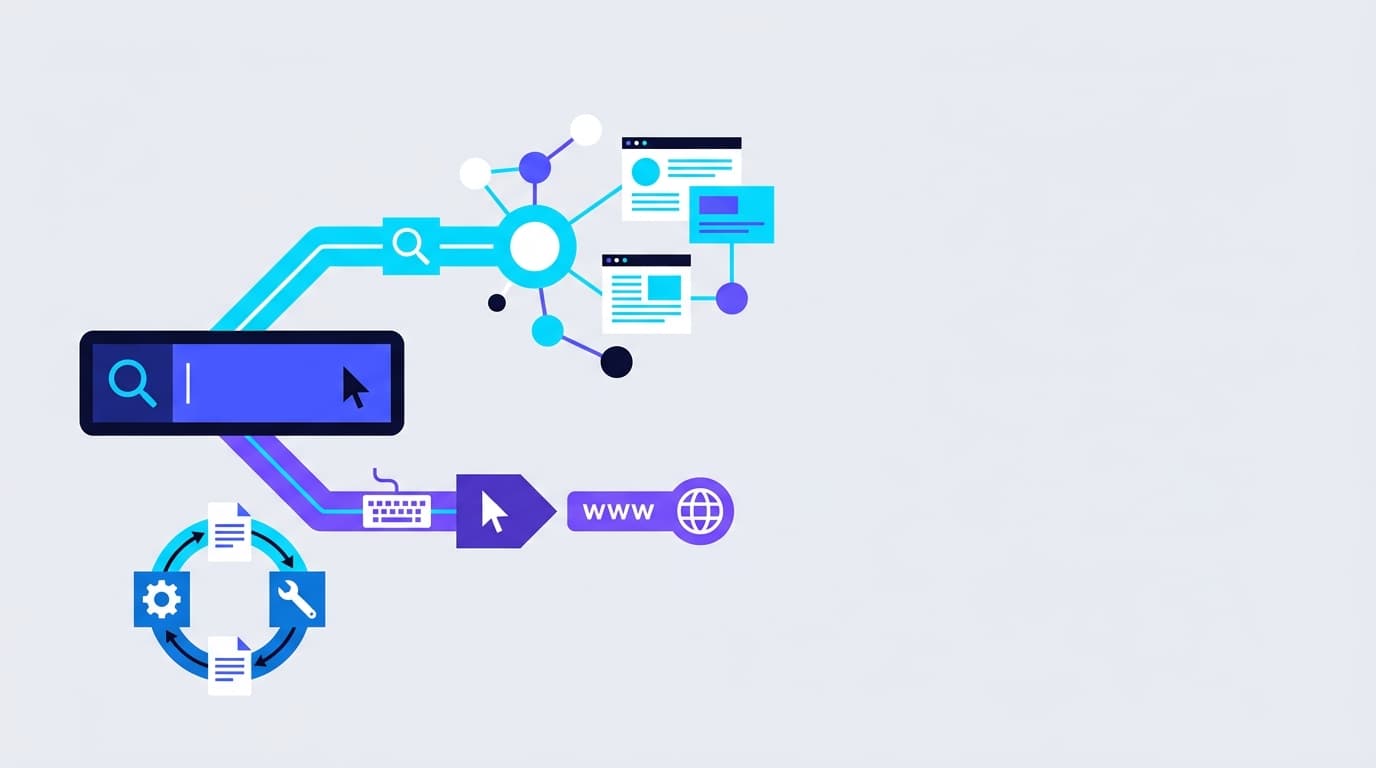

When a user opens Chrome and faces the choice to search or type a URL, that split-second decision reveals more about their relationship with a brand than most analytics dashboards will show you. Search signals discovery intent; typing a URL signals direct recall. In 2026, with AI Overviews reshaping organic results and generative search engines entering the navigation layer, understanding which behavior drives your traffic is one of the clearest competitive edges left in SEO.
Quick Answer: The phrase "search or type URL" refers to the two distinct behaviors users take in a browser's address bar: entering a search query or navigating directly to a known web address. For SEO, these represent discovery intent versus brand recall intent. Organic search wins you new audiences; direct navigation measures how deeply your brand has lodged in returning users' memory. Optimizing for both requires different tactics, different content, and different measurement frameworks.
What Does the Browser Omnibar Tell You About Your Audience?
The omnibar, Chrome's unified address bar introduced in 2010, collapsed what were once two separate browser fields into one interface. That single design decision created a persistent SEO measurement challenge that most teams still have not fully solved. StatCounter's 2025 global browser data shows Chrome commanding roughly 65% of the desktop browser market, which means the majority of your users are making the search-or-type-URL decision inside Chrome's omnibar every single time they open a new tab.
When a user types something into that bar, Google receives either a search query or a URL request. Browsers log both behaviors, but analytics platforms have historically blurred the line between them. Branded navigational queries (typing "projectrankup.com" versus typing "project rankup") are processed as either direct traffic or branded organic search depending on whether the user types a full URL or submits a partial brand name as a search query. That distinction changes what channel the session gets attributed to in Google Analytics 4, and most teams never notice.
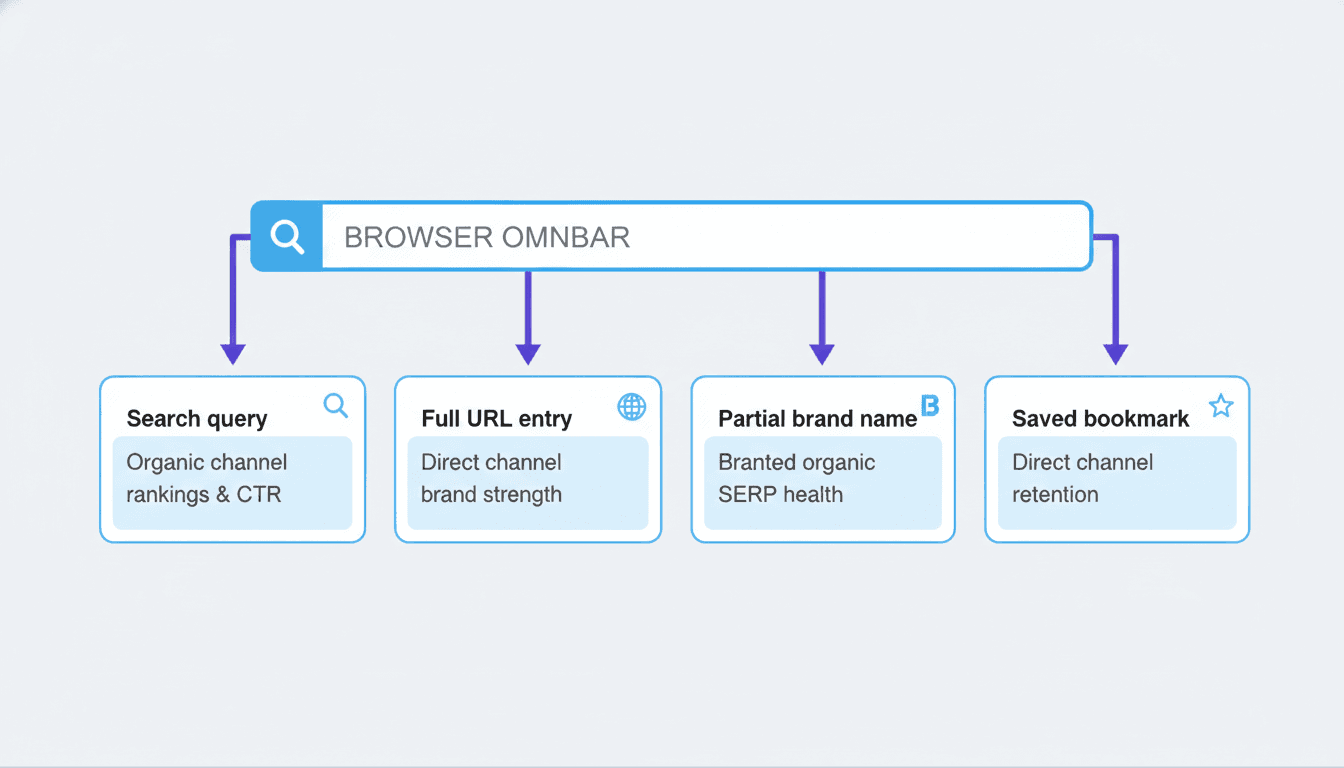
| Behavior | User Signal | Analytics Channel | SEO Implication |
|---|---|---|---|
| Types a search query | Discovery or active research | Organic search | Keyword rankings, CTR, impressions |
| Types a full URL | Strong brand recall | Direct traffic | Brand strength, repeat engagement |
| Types a partial brand name | Navigational intent | Branded organic search | Brand SERP health, autocomplete SEO |
| Uses a saved bookmark | Passive return behavior | Direct traffic | Retention, not acquisition |
That table is a diagnostic tool, not just taxonomy. If your direct traffic is flat while branded organic search grows, users know your brand but are not remembering your URL. If both metrics are declining together, you have a discovery problem at the top of the funnel. The two signals need to be read together, not separately. For a breakdown of what the browser prompt itself means before the strategy layer kicks in, our guide on "Search Google or Type a URL" covers the interface mechanics in detail.
Does Typing a URL Directly Affect Your Google Rankings?
Direct URL navigation does not improve your Google rankings directly. Google's documentation on how Search works confirms the ranking system evaluates signals like backlinks, content quality, Core Web Vitals, and query relevance rather than raw direct-session volume. But the indirect relationship is real enough to care about.
The behaviors that produce consistent direct traffic (strong brand recognition, high content quality, earned media, word-of-mouth) correlate tightly with the signals Google does measure. Sites that attract consistent direct navigation tend to show better engagement metrics across the board: lower bounce rates, longer session durations, and higher pages per session. Those behavioral patterns reinforce the quality signals tied to E-E-A-T, which Google's ranking systems guide confirms carry increasing weight in the evaluation process.
Here is the practical diagnostic that most SEO audits skip: if your direct traffic ratio sits below 10% of total sessions for an established brand, that signals a brand-building deficit. No amount of keyword optimization repairs weak brand recall. The ranking problem you see in organic search may actually be a brand awareness problem expressing itself through your traffic mix.
The flip side is also true. A brand with strong direct traffic and weak organic performance has an audience that knows it exists but is not finding it for new queries. That is an SEO content gap problem, and it is solvable with the right strategy.
The SEO Implications of Search Query vs. URL Input
Search query vs URL input maps directly onto two different stages in a user's relationship with your brand, and conflating them is one of the most expensive misdiagnoses in SEO reporting.
A user who finds you through an organic search query is in discovery mode. They had a question; Google matched them to your answer. Your content strategy job in that moment is to convert a stranger into someone who will remember your URL the next time they need you. That is the entire content marketing loop condensed into a single visit.
A user who types your URL directly has already completed that loop at least once. They remember you. They may be a customer, a subscriber, a prospect deep in evaluation, or a repeat reader. The content waiting for them should serve entirely different goals: depth over breadth, retention over acquisition, specific actions over general orientation. The mistake most SaaS startups and e-commerce brands make is treating all traffic as interchangeable. They optimize every page for the search or type a URL entry point (getting found), when a significant share of high-value returning users arrive via direct navigation and bounce because the landing experience assumes they are first-time visitors.
Segmenting new versus returning users by channel is the fastest way to expose this gap. A page with a 70% bounce rate for direct traffic is almost always a personalization failure, not a content quality failure. Running a structured SEO audit with channel-level segmentation surfaces this pattern quickly and points you toward which pages need differentiated experiences rather than keyword rewrites.
Optimizing for Known-Item Search: When Users Already Know Your Name
Known-item search occurs when a user already knows the brand, product, or page they want and types it into the address bar or search field to reach it quickly. It differs from exploratory search, where the user is browsing options they have not yet identified. Brand search is the most common form of known-item search, and this is where your brand SERP health becomes critical.
For AI search platforms like Google with AI Overviews, ChatGPT, and Perplexity, known-item queries increasingly trigger entity panels, direct answer boxes, or sourced citations rather than traditional ranked lists. If a user types "Project Rankup pricing" into Perplexity, the AI will pull structured information about your pricing page and surface it directly in the answer. That only works if your site architecture clearly signals the entity relationship between your brand name and each page's content.
Three things to prioritize for known-item search in 2026:
- Brand entity markup: Use structured data (Organization, Product, FAQPage schema) to help search engines and AI systems understand what your brand is and what each page offers. Schema markup increases the probability your pages surface in AI-generated summaries rather than a competitor's.
- Consistent brand name usage: Use your exact brand name, not variants or abbreviations, across all pages, social profiles, and external mentions. Inconsistency fragments your entity signal in knowledge graphs and reduces the coherence of your brand SERP.
- Direct-navigation-optimized landing pages: Pages that frequently receive direct traffic should load fast, require no re-introduction of who you are, and push users immediately toward the next logical action, whether that is logging in, viewing a product, or reading a related article.
The brands that win known-item search are not necessarily the ones with the best general SEO. They are the ones that have made it structurally easy for AI systems and search engines to answer "what is this brand and what do they offer" with confidence.
Brand Search vs. Discovery Search: Your Funnel Is Not a Straight Line
Brand search vs discovery search is often taught as a linear funnel: users discover you through content, develop brand recall over time, and eventually navigate directly. That model is outdated and causes real measurement mistakes.

In 2026, users frequently encounter a brand name through an AI answer, a podcast mention, a newsletter recommendation, or a social post, and their very first intentional interaction is a direct URL type or a branded search query rather than a discovery click. The funnel has multiple entry points, and many of them are invisible to organic search analytics.
This has a concrete implication for how you measure SEO success. Tracking only organic traffic growth misses users who discover you entirely outside of search and then navigate directly. According to Statista's 2025 data on global search engine market share, Google accounts for approximately 90% of global search queries. That still leaves billions of navigational sessions happening via direct URL entry, bookmarks, and in-app browsers, all counted as direct traffic and invisible to standard keyword ranking reports.
Brand discovery through AI Overviews adds another layer of invisible attribution. When Google surfaces your brand in an AI-generated answer, the user does not necessarily click through immediately. They absorb the information, finish their research, and if interested, return later by typing your URL directly or searching your brand name. That delayed conversion from AI impression to direct visit sits entirely outside current attribution models.
For a SaaS startup, a steady month-over-month increase in branded search volume is a strong signal that AEO and GEO efforts are working, even before organic clicks spike. That leading indicator is worth tracking aggressively.
How Does AI-Powered Search Change the Way People Navigate?
Generative search engine navigation is restructuring where in the user journey the search engine stops being involved. Traditional search required users to return to Google for every new question in a research session. AI Overviews and chat-based search engines answer follow-up questions within the same session, reducing the number of times users ping the SERP per research task. The result is fewer discovery search events per session, but each one carries substantially more weight in shaping the user's understanding of a topic and the brands associated with it.
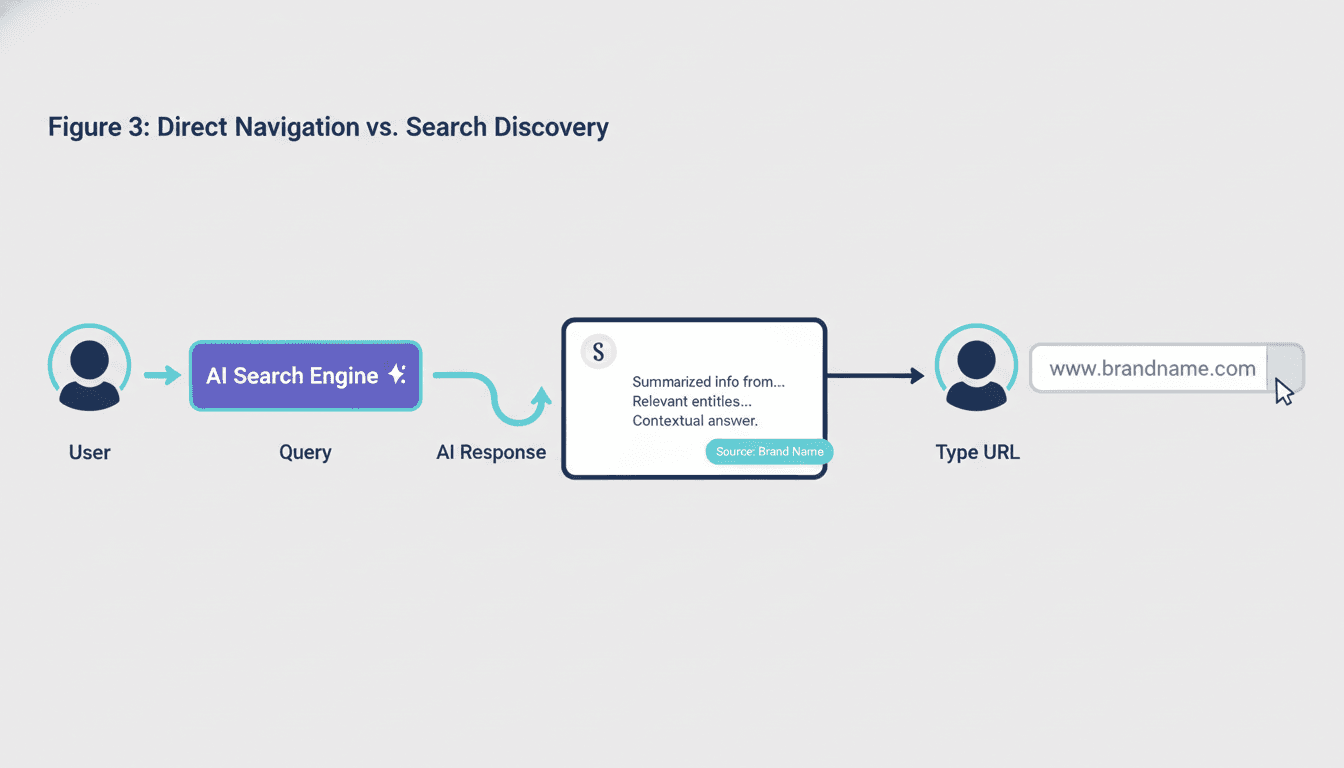
For SEO and AEO content strategy, this creates what is best described as a citation-or-invisible dynamic. If your content is cited in an AI Overview or a Perplexity answer, you become a known entity for that user. They may type your URL directly in their next session, or search your brand name to find a specific page. If you are not cited, you effectively do not exist in that research session regardless of where you rank on page one of the traditional SERP.
The AEO implications of URL typing flow directly from this mechanism. A brand that earns consistent AI citations builds a direct traffic base organically, without paid acquisition. Every citation is a micro-impression that incrementally raises the probability a future user will bypass the SERP entirely and type your URL. That is a compounding return on content investment that keyword rankings alone cannot capture, and it does not show up in rank trackers.
Practical steps to position for this in 2026:
- Write answer-first content structured for extraction: short, self-contained paragraphs, clear entity definitions, and cited statistics that AI systems can quote confidently.
- Build topical authority clusters so AI systems recognize your domain as a reliable source across a subject area, not just a single high-ranking query.
- Monitor brand search volume in Google Search Console monthly as a proxy for AI-driven brand awareness, even in periods when direct citation clicks do not follow immediately.
- Use deep search AI tools to audit which of your pages are being cited in AI-generated answers, and prioritize those pages for content freshness updates to maintain citation eligibility.
Brands that treat direct traffic as a vanity metric while competitors earn AI citations are falling behind on a compounding return they may not see in their dashboards for months.
Frequently asked questions
What does "search or type URL" mean in a browser?
"Search or type URL" describes the two actions available in a browser's address bar: entering a keyword query that gets routed to a search engine, or typing a complete web address to navigate directly to a site. Chrome's unified omnibar handles both inputs from the same field, which is why the phrase appears as placeholder text in many modern browser interfaces.
Does direct URL traffic help my website's Google rankings?
Direct URL traffic does not improve rankings directly, since Google's algorithms evaluate signals like backlinks, content relevance, and page experience rather than raw direct-session volume. However, high direct traffic correlates with strong brand recall and repeat engagement, both of which support the E-E-A-T signals that inform Google's quality assessments and connect to long-term ranking stability.
What is known-item search and why does it matter for SEO?
Known-item search happens when a user already knows the brand or page they want and types it into the search field to reach it quickly. For SEO, it matters because your brand SERP health (autocomplete suggestions, Knowledge Panel accuracy, branded query rankings) determines whether users reach you cleanly or land on a competitor's brand-bidding ad first.
How does omnibar behavior affect how I read my analytics?
Omnibar behavior creates a measurement overlap in Google Analytics 4: partial branded queries register as organic branded search, while full URL entries register as direct traffic. Segmenting sessions by new versus returning users and cross-referencing branded search volume in Google Search Console gives the clearest picture of both discovery and direct-navigation intent for your domain.
How do AI Overviews change the search or type URL decision for users?
AI Overviews answer questions inside the SERP, reducing the immediate need to click through to a source page. When users absorb information from an AI-generated summary, they often return later by typing the cited brand's URL directly rather than re-running the search. This compresses the discovery-to-direct-navigation timeline and makes AI citation optimization a measurable driver of brand traffic.
What is the difference between brand search and discovery search?
Brand search occurs when a user types a specific company or product name with intent to navigate to that entity. Discovery search happens when a user types a question or topic with no specific destination in mind. Brand search reflects existing awareness; discovery search represents acquisition opportunity. A complete SEO strategy requires content optimized for both, since users enter the funnel from multiple touchpoints at different stages.
How do I measure whether my content is driving direct traffic growth?
Track direct sessions month over month in GA4, segmented by landing page. Pages showing rising direct traffic over a 90-day window are building brand recall effectively. Cross-reference with branded keyword growth in Search Console to separate URL-type direct sessions from branded-search sessions. A comprehensive SEO audit surfaces which content types most strongly correlate with returning direct visitors.
Key Takeaways
- The choice to search or type a URL maps onto discovery intent versus brand recall intent, two different SEO problems that require different content strategies and different success metrics.
- Direct traffic does not boost rankings directly, but the brand strength that produces it correlates with every E-E-A-T signal Google measures.
- Chrome's omnibar creates a measurement gap between branded organic sessions and direct URL sessions that most GA4 setups conflate without deliberate segmentation.
- Known-item search optimization (structured data, consistent brand naming, fast direct-navigation pages) is a distinct discipline from standard keyword SEO and is increasingly driven by AI entity recognition.
- AI citations in Google AI Overviews and generative search answers are building direct traffic pipelines for brands that earn them, through a compounding mechanism most rank trackers do not capture.
- Brand search volume in Google Search Console is currently the best proxy for AI-driven brand awareness even when citation clicks do not immediately follow.
- Your funnel is not linear: users now discover brands through AI answers, podcasts, and social content before their first intentional search query or URL entry, which means organic-only attribution models undercount the return on your content investment.
Ready to understand exactly how your users split between search and direct navigation, and build a strategy optimized for both? Explore Project Rankup's analytics and content strategy services to get a data-driven picture of your full discovery-to-retention loop.