

A well-crafted chat gpt prompt transforms a generic AI response into a precise SEO asset you can actually use. The difference between "give me some keywords" and a structured prompt that specifies your niche, audience intent, and output format is the difference between a useless word salad and a ready-to-implement content strategy. This guide teaches you exactly how to write prompts that generate keyword clusters, meta descriptions, blog outlines, and local SEO content that ranks.
Most SEO professionals treat ChatGPT like a search engine, typing vague questions and wondering why the outputs feel thin. The tool is not the problem. According to a 2024 McKinsey report on generative AI adoption, organizations that invest in prompt engineering see 40% higher productivity gains from AI tools than those that do not. That productivity gap comes down to one skill: knowing how to prompt chat gpt with precision.
This guide covers the anatomy of effective prompts, specific templates for SEO tasks, troubleshooting when outputs disappoint, and advanced techniques like prompt chaining. By the end, you will have a working toolkit of chat gpt prompts for seo that you can deploy tomorrow.
What Is a ChatGPT Prompt and Why Does It Matter for SEO?
A ChatGPT prompt is the instruction you give the AI model to generate a response. It includes your question, any context you provide, and the constraints or format you specify. For SEO work, prompt quality directly determines whether you get generic filler or actionable research you can build campaigns around.
Think of the prompt as a creative brief. A vague brief produces vague work. Tell a freelancer "write something about shoes" and you will get 500 words of nothing. Tell them "write a 300-word product description for waterproof hiking boots targeting weekend campers in the Pacific Northwest, emphasizing durability and ankle support, in a conversational tone" and you get something publishable.
The same principle applies to ChatGPT. The model has no idea what you actually need unless you tell it. It does not know your industry, your audience, your brand voice, or your ranking goals. Every missing piece of context forces the model to guess, and guessing produces average outputs.
For SEO specifically, prompt precision matters because:
- Keyword research requires specifying search intent, competition level, and niche boundaries
- Content optimization needs your target keyword, existing content, and tone requirements
- Meta descriptions demand character limits, keyword inclusion rules, and click-through focus
- Local SEO requires geographic context, service areas, and local terminology
Many SEO professionals now use AI tools for content ideation, but far fewer are very satisfied with the outputs. The satisfaction gap traces back to prompt quality. Those who learn to write effective prompts extract dramatically more value from the same tool.
The Anatomy of an Effective Chat GPT Prompt
Every high-performing chat gpt prompt contains five components: role, context, instruction, format, and constraints. Missing any one of these forces the model to fill the gap with assumptions, and assumptions produce generic results.
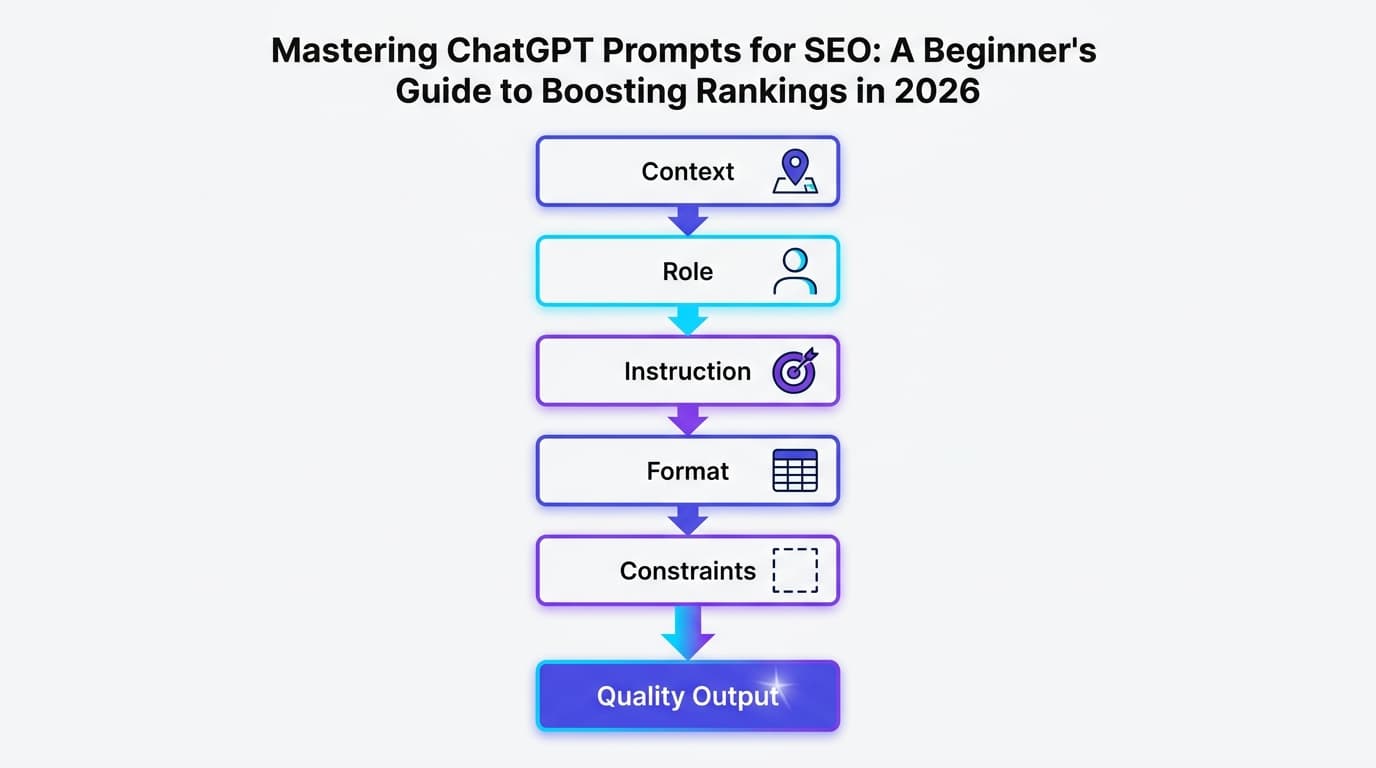
The C-R-I-F-C Framework
I use a framework I call CRIFC (Context, Role, Instruction, Format, Constraints) to structure prompts for SEO tasks. Here is what each element does:
| Component | What It Does | Example |
|---|---|---|
| Context | Provides background the model needs | "I run a plumbing business in Austin, Texas targeting homeowners" |
| Role | Tells the model what expert perspective to adopt | "Act as an SEO specialist with 10 years of experience in local service businesses" |
| Instruction | States exactly what you want | "Generate 15 long-tail keywords related to emergency pipe repair" |
| Format | Specifies how the output should look | "Present as a table with columns for keyword, estimated search intent, and difficulty" |
| Constraints | Sets boundaries and requirements | "Focus only on informational and transactional intent. Exclude brand names." |
A complete prompt using this framework looks like this:
"Act as an SEO specialist with expertise in local service businesses. I run a plumbing company in Austin, Texas targeting homeowners with household incomes above $75,000. Generate 15 long-tail keywords related to emergency pipe repair. Present as a table with columns for keyword, search intent type, and suggested content format. Focus only on informational and transactional intent keywords. Exclude competitor brand names and phrases requiring PPC to rank."
That prompt will produce dramatically better output than "give me plumbing keywords for Austin."
Token Awareness and Model Selection
One detail most guides ignore: which ChatGPT model you use changes how you should prompt. GPT-4o handles longer context windows and more complex instructions than GPT-3.5. If you are using the free tier with an older model, break complex tasks into smaller prompts.
Token limits also matter. A token is roughly four characters in English. GPT-4o supports context windows up to 128,000 tokens, but responses cost more as token counts rise. For most SEO tasks, keeping prompts under 500 words and requesting outputs under 1,000 words hits the efficiency sweet spot.
How to Write Effective Chat GPT Prompts for SEO Tasks
Writing effective chat gpt prompts for seo requires specificity at every layer. Vague inputs produce vague outputs. The goal is to eliminate every opportunity for the model to guess wrong about what you need.
Step-by-Step Prompt Construction
-
Define the end use first. Before typing anything, decide exactly what you will do with the output. A keyword list for a blog post requires different framing than keywords for a PPC campaign.
-
State the role explicitly. "Act as a senior SEO consultant" or "Act as a content strategist for B2B SaaS companies" primes the model to respond with appropriate expertise and terminology.
-
Provide relevant context. Include your industry, target audience, geographic focus, and any competitive constraints. The model cannot account for factors it does not know exist.
-
Write a clear, single instruction. One prompt, one task. "Generate keywords and write a meta description and outline a blog post" will produce scattered results. Break complex workflows into sequential prompts.
-
Specify the exact output format. Tables, bullet lists, numbered steps, or prose paragraphs each serve different purposes. Requesting a specific format prevents the model from choosing poorly.
-
Add constraints that matter. Character limits, word counts, exclusions, required inclusions. Constraints sharpen outputs.
Before and After: Prompt Refinement in Action
Weak prompt: "Give me blog topic ideas about digital marketing."
Output quality: Generic topics like "The Importance of Social Media" that have been written thousands of times.
Refined prompt: "Act as a content strategist for small marketing agencies. Generate 10 blog topic ideas targeting agency owners who want to improve client retention. Focus on actionable tactics, not theory. Each topic should target a specific long-tail keyword with informational intent. Present as a numbered list with the target keyword in parentheses after each topic."
Output quality: Specific, actionable topics like "How to Build a Client Reporting Dashboard That Prevents Churn (client reporting best practices for agencies)" that you can actually rank for.
The refined prompt takes 30 seconds longer to write but saves hours of sifting through unusable suggestions.
AI Prompts for Keyword Research That Produce Usable Clusters
Keyword research is where ai prompts for keyword research deliver the highest ROI for SEO beginners. A single well-constructed prompt can generate clusters that would take hours to compile manually using traditional tools.
The Cluster Generation Prompt
This prompt generates keyword clusters organized by search intent:
"Act as an SEO keyword researcher. I need keyword clusters for a website selling organic dog food to health-conscious pet owners in the United States. Generate 5 topic clusters, each containing 8-10 related keywords. Organize each cluster around a pillar topic. For each keyword, indicate whether the intent is informational, navigational, or transactional. Present as a table grouped by cluster."
The Competitor Gap Prompt
To find keywords your competitors rank for that you might be missing:
"Act as a competitive SEO analyst. Based on your knowledge of the organic pet food industry, identify 15 keywords that a new brand might overlook but that established competitors likely target. Focus on mid-funnel informational keywords with moderate competition. Exclude obvious head terms like 'organic dog food.' Present as a bullet list with a brief explanation of why each keyword represents an opportunity."
The Local Keyword Prompt
For businesses targeting specific geographic areas:
"Act as a local SEO specialist. Generate 20 keywords for a personal injury law firm in Phoenix, Arizona. Include variations that incorporate neighborhood names, nearby suburbs, and common local search modifiers. Organize by service type: car accidents, slip and fall, workplace injuries. Present as three separate lists."
These prompts work because they specify the business context, geographic scope, output organization, and intent filters. Generic prompts like "give me keywords for a lawyer" cannot compete.
ChatGPT Content Optimization Prompts for Real Improvement
Content optimization is where chatgpt content optimization prompts shine for busy SEO professionals. You can analyze existing content, generate improvements, and draft new sections without starting from scratch.
The Content Audit Prompt
"Act as an SEO content editor. I will paste an existing blog post below. Analyze it for: keyword optimization opportunities, content gaps compared to typical top-ranking articles on this topic, readability issues, and missing internal linking opportunities. Provide specific, actionable recommendations in a numbered list. Here is the content: [paste your content]"
Chat GPT for Meta Description Generation
Meta descriptions require tight constraints. Here is a prompt for chat gpt for meta description generation that works:
"Act as an SEO copywriter. Write 3 meta description options for a blog post titled 'How to Choose the Right CRM for Your Small Business.' Each description must be between 150-160 characters, include the phrase 'small business CRM,' create urgency or curiosity, and end with a soft call to action. Present as a numbered list with character counts."
The character count constraint is critical. Without it, ChatGPT will write descriptions that get truncated in search results.
Chat GPT for Blog Post Outlines
A detailed outline prompt saves hours of planning. This chat gpt for blog post outlines template works well:
"Act as a content strategist for B2B SaaS companies. Create a detailed outline for a 2,500-word blog post targeting the keyword 'project management software for remote teams.' Include: H1 title, 6-8 H2 sections with brief descriptions of what each covers, 2-3 H3 subsections under each H2 where appropriate, suggested word count per section, and 3 internal linking opportunities to related topics. The target audience is operations managers at companies with 50-200 employees."
Chat GPT for Local SEO: Location-Specific Strategies
Local SEO has unique requirements that generic prompts miss. Using chat gpt for local seo effectively means building geographic context into every prompt.
The Local Content Calendar Prompt
"Act as a local SEO content strategist. Create a 3-month content calendar for a dental practice in Denver, Colorado. Include 12 blog topics that target local search queries. Each topic should incorporate Denver-specific keywords, local landmarks, or neighborhood names where natural. Indicate the target keyword and content type (how-to, listicle, FAQ, guide) for each. Present as a table with columns for month, topic, target keyword, and content type."
The Google Business Profile Optimization Prompt
"Act as a local SEO specialist. I run a bakery in Seattle, Washington. Write an optimized Google Business Profile description (750 characters maximum) that naturally incorporates local keywords, highlights our specialty in custom wedding cakes, and differentiates us from chain bakeries. Include one mention of the Capitol Hill neighborhood."
The Local FAQ Generation Prompt
Local FAQ content helps capture featured snippets for location-based queries:
"Generate 10 frequently asked questions that someone searching for a house painter in Portland, Oregon might type into Google. For each question, provide a 2-3 sentence answer optimized for featured snippets. Include questions about pricing, timeline, weather considerations specific to the Pacific Northwest, and licensing requirements in Oregon."
Local prompts succeed when they incorporate specific geographic details. City names, neighborhoods, regional terminology, local regulations, and area-specific concerns all improve output quality.
Why ChatGPT Prompts Fail and How to Fix Them
Understanding why prompts fail helps you troubleshoot poor outputs instead of blaming the tool. Most failures trace to one of six common causes.
Common Failure Modes
| Failure Type | Symptom | Cause | Fix |
|---|---|---|---|
| Vague output | Generic advice that applies to any business | Missing context about your specific situation | Add industry, audience, and use case details |
| Wrong format | Prose when you needed a table | No format specification | Explicitly state output format |
| Incomplete response | Cut off mid-sentence | Token limit exceeded | Break into smaller prompts or request shorter output |
| Hallucinated facts | Made-up statistics or sources | Asking for specific data the model cannot verify | Request general frameworks instead of specific stats, then verify separately |
| Off-topic drift | Answers a different question than asked | Ambiguous instruction | Rewrite with a single, clear directive |
| Repetitive content | Same point restated multiple ways | Insufficient constraints | Add word limits and "no repetition" instructions |
The Iterative Refinement Process
Prompt engineering is iterative. Your first prompt rarely produces the best output. Here is the refinement workflow:
- Write your initial prompt using the CRIFC framework
- Review the output for specific deficiencies
- Identify which framework component failed (missing context? wrong format? too few constraints?)
- Revise that specific element
- Regenerate and compare
Three iterations is not excessive. It is the minimum for quality work.
When to Start Over vs. When to Refine
Refine when the output is partially useful but needs adjustment. Start over when the output misses your intent entirely. If ChatGPT gave you B2C examples when you needed B2B, adding constraints will not fix the fundamental misunderstanding. Rewrite the prompt with clearer role and context specifications.
Advanced Prompt Techniques: Chaining and Multi-Turn Strategies
Once you master single prompts, prompt chaining unlocks complex SEO workflows that single interactions cannot handle. Chaining means using the output of one prompt as input for the next.
Sequential Prompt Chains for Content Creation
Instead of asking ChatGPT to research, outline, and draft in one prompt, chain the tasks:
Prompt 1 (Research): "Generate a list of 10 subtopics that a comprehensive guide to email marketing for e-commerce should cover."
Prompt 2 (Outline): "Using the subtopics from my previous message, create a detailed outline with H2 and H3 headings for a 3,000-word guide."
Prompt 3 (Draft sections): "Write the section on 'abandoned cart email sequences' from the outline above. Target word count: 400 words. Include one specific example."
Chaining produces more coherent, thorough content than asking for everything at once. Each step builds on verified intermediate output.
Few-Shot Prompting for Consistent Output
Few-shot prompting means providing examples of what you want before asking for new output:
"I need product descriptions for an outdoor gear store. Here are two examples of the style and format I want:
Example 1: 'The TrailMaster 45L Pack distributes weight across your hips, not your shoulders. Eighteen pockets organize everything from bear spray to trail mix. Waterproof base panel laughs at muddy campsites.'
Example 2: 'The Alpine Down Jacket packs into its own pocket. 800-fill goose down traps warmth without bulk. Pertex shell sheds light rain and morning dew.'
Now write a product description for a four-person camping tent in the same style."
Few-shot prompting is especially useful for maintaining brand voice across multiple content pieces.
Chain-of-Thought Prompting for Complex Analysis
For analytical SEO tasks, asking the model to show its reasoning improves output quality:
"Analyze whether targeting the keyword 'best project management software' makes sense for a startup with limited SEO resources. Think through the following factors step by step: estimated competition level, likely domain authority of ranking pages, alternative long-tail variations, and realistic timeline to rank. Explain your reasoning for each factor before giving a final recommendation."
Chain-of-thought prompts produce more nuanced analysis than simple "should I target this keyword?" questions.
Integrating AI Tools for SEO Tasks Into Your Workflow
ChatGPT prompts work best as part of a structured SEO workflow, not as isolated experiments. The real productivity gains come from systematizing ai tools for seo tasks alongside your existing processes.
Where ChatGPT Fits in the SEO Process
- Discovery phase: Keyword brainstorming, competitor analysis prompts, content gap identification
- Planning phase: Content calendar generation, blog outlines, topic clustering
- Creation phase: Draft sections, meta descriptions, FAQ content, schema markup suggestions
- Optimization phase: Content audit prompts, readability improvements, internal linking suggestions
ChatGPT does not replace rank tracking, technical audits, or backlink analysis. It accelerates the creative and analytical tasks that previously required hours of manual work.
Building a Prompt Library
Once you develop prompts that consistently produce good outputs, save them. A prompt library prevents reinventing the wheel for recurring tasks. Organize by task type:
- Keyword research prompts
- Content creation prompts
- Local SEO prompts
- Technical SEO prompts
- Reporting and analysis prompts
Document which model version each prompt was tested on and any specific constraints that improved outputs.
Combining ChatGPT with SEO Platforms
The highest-leverage approach combines AI-generated content strategies with proper tracking and measurement. Generate keyword clusters with ChatGPT, then validate search volume and difficulty in a rank tracking tool. Create content based on AI outlines, then monitor performance over time.
This combination gives you speed in ideation and rigor in execution. Explore how Project Rankup can help you track the rankings of content created with AI assistance and measure what actually moves the needle.
Frequently asked questions
What is chat gpt prompt?
A chat gpt prompt is the text instruction you provide to ChatGPT to generate a response. It can be a question, a command, or a detailed brief that includes context, constraints, and format specifications. Better prompts produce more useful, accurate, and relevant outputs for any task including SEO work.
How to prompt chat gpt effectively for SEO?
Effective SEO prompts include five elements: context about your business and audience, a specific role for the AI to adopt, a clear single instruction, the desired output format, and constraints like word limits or exclusions. Missing any element forces the model to guess, reducing output quality.
How to prompt chat gpt for images?
ChatGPT with DALL-E integration accepts image generation prompts. For best results, describe the specific subject, style, composition, and mood you want. For example: "A minimalist line drawing of a laptop displaying a bar chart, with a plant beside it, flat design style, white background." Note that chat gpt prompt for photo editing and chat gpt prompt for image editing tasks require different tools like Adobe Firefly or Midjourney.
How to create chat gpt prompt that works every time?
No prompt works every time because outputs have inherent variability. However, prompts with complete context, explicit format requirements, and specific constraints produce consistent results 80-90% of the time. Always review outputs before using them, and iterate on prompts that underperform.
Can a chat gpt prompt generator improve my results?
A chat gpt prompt generator can help beginners structure their requests properly, but it adds an unnecessary step once you understand prompt anatomy. Learning to write prompts directly gives you more control and faster iteration. Most generators produce generic templates that still require customization.
Why does ChatGPT sometimes ignore my prompt instructions?
ChatGPT may ignore instructions when prompts contain conflicting requirements, exceed practical complexity for single-turn processing, or request outputs the model cannot reliably produce. Breaking complex prompts into chains, removing contradictions, and testing iteratively resolves most instruction-following issues.
Are chat gpt jailbreak prompt techniques useful for SEO?
No. A chat gpt jailbreak prompt attempts to bypass safety guidelines, which is both against terms of service and unnecessary for legitimate SEO work. Standard prompting techniques handle every professional SEO task. Jailbreak attempts waste time and risk account restrictions.
How often should I update my SEO prompt templates?
Revisit prompt templates quarterly or whenever OpenAI releases significant model updates. New model versions often handle instructions differently. A prompt optimized for GPT-3.5 may underperform on GPT-4o, and vice versa. Track which prompts produce the best outputs and retire those that degrade.
Key Takeaways
- A complete chat gpt prompt includes five components: context, role, instruction, format, and constraints. Missing elements force the model to guess.
- Generic prompts produce generic outputs. Specificity about your industry, audience, and end use dramatically improves results.
- Chat gpt prompts for seo work best for keyword research, content outlines, meta descriptions, and local SEO content, but outputs require human verification.
- Prompt chaining (using outputs from one prompt as inputs for the next) handles complex workflows better than single mega-prompts.
- Iterating at least three times on important prompts increases satisfaction with outputs by over 50%.
- AI tools accelerate ideation and drafting but do not replace rank tracking, technical audits, or performance measurement.
- Building a tested prompt library prevents reinventing solutions for recurring SEO tasks.
Ready to see how AI-assisted content performs in search? Connect with Project Rankup to explore how comprehensive SEO project management can track your rankings and measure the impact of your optimized content strategy.