AI has moved from pilot to habit. Stanford HAI's AI Index reports that 78% of organizations used AI in 2024, up from 55% the year before. Search moved with it. AI search engine optimization is the work of making your pages easy for answer engines such as Google AI Overviews, ChatGPT, Perplexity, Gemini and Claude to find, trust and quote. It sits on top of classic SEO. You still need crawlable, indexed, well-ranked pages, but you also need short passages a model can lift whole and credit to you.
The shift matters because the click is no longer the only prize. When an answer engine replies, it names a handful of sources, and the rest of page one goes unseen. A nationwide survey from Brookings on how Americans use AI shows these tools spreading into daily tasks like writing and looking things up. Your buyers already ask machines the questions they used to type into a search box. This guide covers how those engines pick sources, a five-layer framework for citable pages, the technical setup, how each type of team should set priorities, and how to measure what a classic rank report can't show.
What Is AI Search Engine Optimization?
AI search engine optimization (often shortened to AI SEO) is the practice of shaping content, site structure and technical access so that generative search systems retrieve your pages, select your passages and cite your brand in their answers. It combines three disciplines: SEO for rankings, Answer Engine Optimization (AEO) for direct answers, and Generative Engine Optimization (GEO) for citations inside model-written responses.
People mix those three up all the time, and the overlap is real. The table below separates them so you can tell which lever you're pulling.
| Discipline | Main goal | Where you show up | What wins | Red flags |
|---|---|---|---|---|
| SEO | Rank pages for a query | Blue links, local pack, shopping results | Relevance, links, technical health, intent match | Thin pages, crawl errors, keyword stuffing |
| AEO | Be the direct answer | Featured snippets, voice answers, AI Overviews | Short, exact answers placed right under a question | Answers buried under long intros |
| GEO | Be cited or named in generated answers | ChatGPT, Perplexity, Gemini, Claude, AI Mode | Clear claims, original data, entity clarity, trust | Vague copy, no sources, brand never named |
Read the table as a stack, not a menu. GEO without SEO rarely works, because most answer engines pull from a search index first. AEO without GEO leaves you winning snippets on Google while staying invisible in chat tools. For the deeper split between the first two, our breakdown of AEO vs SEO walks through it, and the generative engine optimization guide covers the citation side in full.
How Do AI Answer Engines Choose Which Sources to Cite?
AI answer engines pick sources in two stages. First they retrieve candidate pages from a search index, then a language model reads the best passages and writes an answer that cites a few of them. Your page has to clear both gates: it must be crawlable and rank well enough to be retrieved, and it must hold a passage clear and specific enough that the model chooses to quote it.
The pipeline looks broadly the same across engines, even though each runs its own stack:
- Crawl and index. Each engine needs a copy of your page. Google AI Overviews and AI Mode draw on Google's own index, built by Googlebot. OpenAI documents OAI-SearchBot as the crawler behind ChatGPT search, Perplexity runs PerplexityBot, and Anthropic runs Claude-SearchBot for search in Claude.
- Expand the query. Google describes a "query fan-out" method for AI Mode, where one question spawns many related sub-searches. A single prompt can pull in pages that rank for ten different phrasings.
- Retrieve passages. Systems split pages into chunks and score each chunk against the query. A strong 60-word paragraph can be picked even when the full page isn't the top result.
- Select. The model weighs relevance, source trust, freshness and how cleanly a passage answers the question.
- Generate and cite. The model writes the answer and attaches links to the sources it leaned on.
Two things follow. You compete at the passage level, so one buried answer in a 3,000-word post often loses to a tight paragraph on a smaller site. And rankings still feed the system. Google's Search Central guidance on AI features says a page must be indexed and eligible to show a snippet to appear as a supporting link, and it states that no special markup or extra files are needed. Classic SEO is the entry ticket; passage quality decides who gets named.
The Citable Page Framework: Five Layers AI Engines Reward
Plenty of checklists exist. Most list forty tips with equal weight, which leaves teams polishing schema while their pages are blocked from the crawlers that matter. We use a five-layer model instead, ordered by dependency: each layer only pays off once the one before it works.
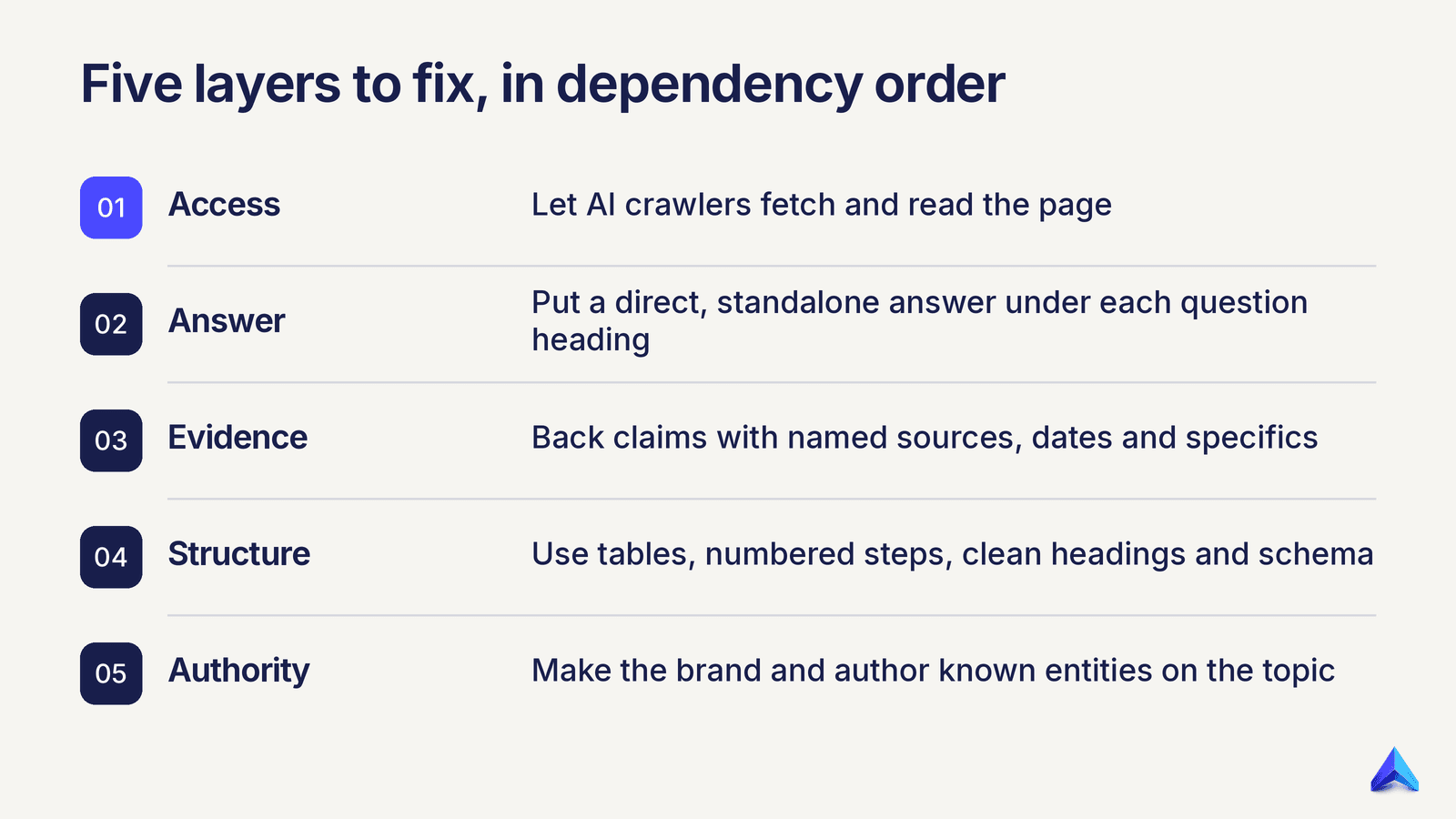
The table shows each layer, why it moves citations, and the warning signs we see most often in audits.
| Layer | What it means | Why it matters | Red flags |
|---|---|---|---|
| 1. Access | AI crawlers can fetch and read the page | Nothing downstream counts if retrieval fails | Blanket bot blocks, content loaded only by JavaScript, stray noindex tags |
| 2. Answer | A direct, standalone answer sits under each question heading | Models extract passages, not whole pages | Long intros, answers split across paragraphs, clever but vague headings |
| 3. Evidence | Claims carry named sources, dates and specifics | Models prefer passages they can attribute with confidence | Unsourced stats, "studies show", no dates |
| 4. Structure | Tables, numbered steps, clean headings and schema | Structured blocks are easier to parse and quote | Comparisons buried in prose, broken heading levels, no Article schema |
| 5. Authority | The brand and author are known entities on the topic | Engines lean on trusted sources for risky or contested answers | No author bios, thin topical coverage, brand never named in copy |
Work it top to bottom. If an audit shows problems in both layer 1 and layer 4, fix access first, even though schema feels like the more "AI" task. Once access and answers are sound, evidence is the layer with the biggest upside, because it's the one rivals skip. Original data, a worked example or a decision rule gives a model something it can't find on ten other pages, which is the core idea behind information gain in SEO.
How to Write Passages AI Will Quote
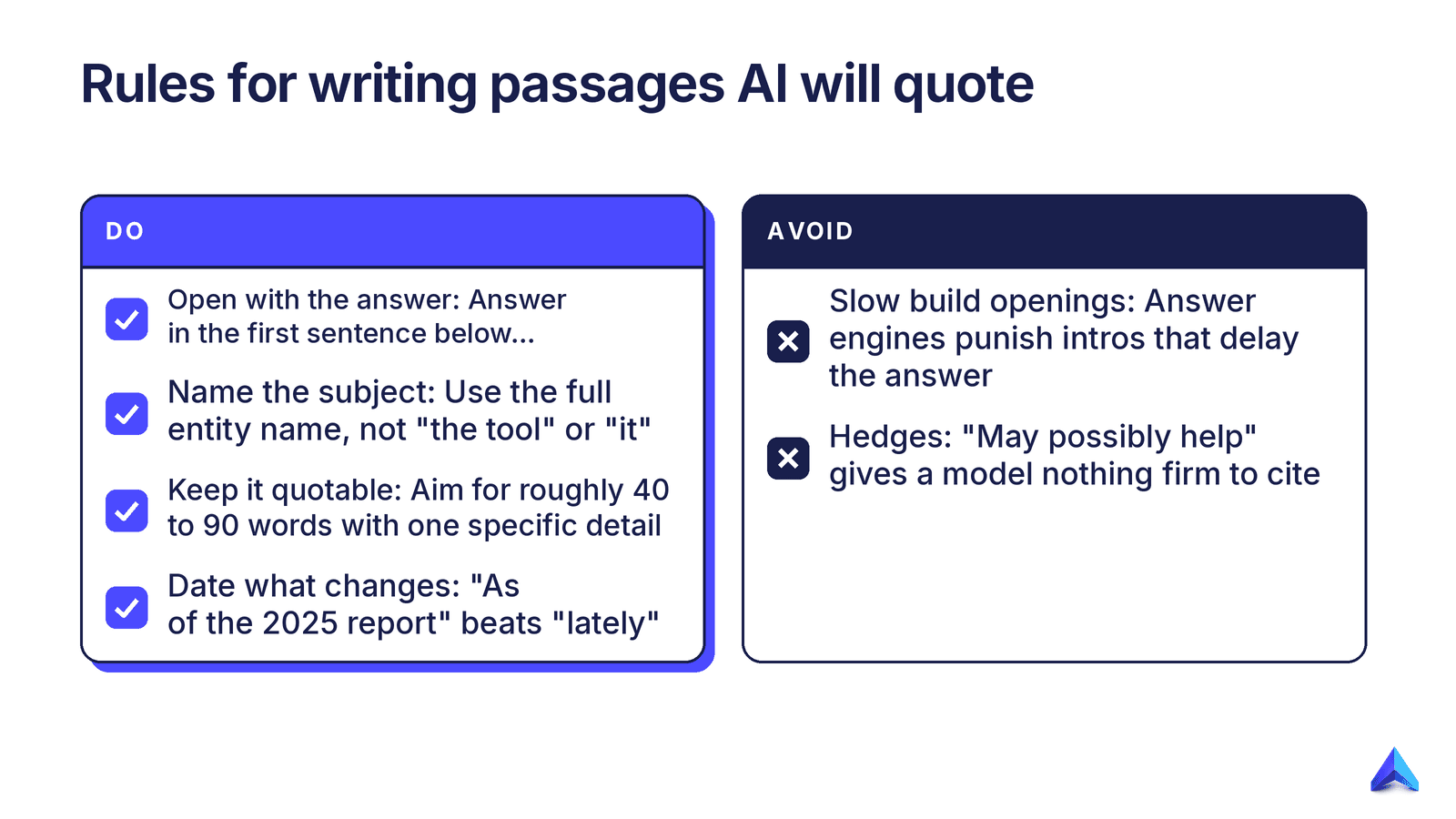
Write each key passage so it still makes sense when lifted out of the page. Open with the answer, name the subject instead of using "it", keep it to roughly 40 to 90 words, and add one specific detail such as a tool, number or step. Then let the next paragraph add new context rather than restating the answer.
These rules sound simple. Writers break them constantly, often because they were trained to hook readers with a slow build. Answer engines punish the slow build.
A worked example
Take the query "what does a canonical tag do". This is a typical first draft:
Duplicate content has long been one of the most debated topics in SEO. Over the years, many site owners have wondered how search engines decide which version of a page to show. That's where canonical tags come in, and they can be very helpful.
Three sentences, zero answer. Now the rewrite:
A canonical tag is an HTML link element that tells search engines which URL is the main version of a page when several URLs show the same or similar content. Google treats it as a strong hint, not a command, and folds ranking signals from duplicates into the chosen URL.
The second passage defines the term, names the actor, adds a nuance a skimmer would miss (hint, not command) and stands alone. That's the shape a model quotes.
Rules we apply to each draft
- Phrase headings as the question a searcher types, then answer in the first sentence below it.
- Use the full entity name ("Google Search Console", "Shopify") in the passage, not "the tool" or "it".
- Put comparisons in tables and processes in numbered steps.
- Date anything that changes: "as of the 2025 report" beats "lately".
- Cut hedges. "May possibly help" gives a model nothing firm to cite.
- Keep one idea per paragraph so chunk boundaries don't split an answer.
For Google in particular, our walkthrough on how to rank in Google AI Overviews covers passage formatting against live results. This is also where Project Rankup's pre-publish checks earn their keep. The GEO score is rule-based: it flags sections with no direct answer, passages too long to quote, claims with no source, and missing FAQPage or Article schema before anything goes live.
Technical Foundations: Crawlers, Schema, and Rendering
The technical side of AI search comes down to three questions. Can the right bots reach your pages? Can they read the content without running JavaScript? Does your markup make the page's purpose clear? Get those right once and they support each page you publish.

Which AI crawlers to allow
Bots split into two groups. Search and retrieval bots fetch pages to answer live questions and cite them. Training bots collect data to build future models. Blocking the first group removes you from answers; blocking the second is a policy call.
| User agent | Operator | Purpose | Our default |
|---|---|---|---|
| Googlebot | Search, AI Overviews and AI Mode | Allow | |
| Google-Extended | Controls use in Gemini training and grounding; no effect on Search ranking | Policy call | |
| OAI-SearchBot | OpenAI | ChatGPT search results | Allow |
| GPTBot | OpenAI | Model training | Policy call |
| PerplexityBot | Perplexity | Perplexity answer index | Allow |
| Claude-SearchBot | Anthropic | Search results in Claude | Allow |
| ClaudeBot | Anthropic | Model training | Policy call |
Two traps catch brands here. Blocking Google-Extended does not remove you from AI Overviews; those are governed by Googlebot and snippet controls such as nosnippet. And CDN settings can block AI bots without anyone in marketing knowing, which is why we wrote up Cloudflare's AI crawler defaults on their own. Check your robots.txt and your firewall rules, not one or the other.
Schema that helps
Article schema with author, publish date and modified date tells engines who wrote the page and when. Organization schema ties the brand to its site and profiles. Product schema matters most for Shopify stores, since price, stock and reviews feed shopping-style answers. FAQPage schema is worth adding for structure, but be honest about its limits: in 2023 Google cut FAQ rich results back to well-known government and health sites, so don't expect visual snippets from it. Schema helps machines read a page. It won't rescue weak content.
Rendering
Many AI crawlers fetch raw HTML and don't run JavaScript the way Googlebot does. If your answers, prices or specs load client-side, those bots may see an empty shell. Server-side render or pre-render core content, then confirm by viewing the page source rather than the rendered page in your browser.
How Should Each Team Prioritize AI Search Optimization?
Each team should start where its revenue sits. Agencies gain most from repeatable audits across clients, SaaS teams from comparison and problem-solving queries, e-commerce brands from clean product data and crawl access, and content teams from rewriting top pages so each section opens with an answer. The framework stays the same; the first move changes.
| Team | First move | What to measure | Common trap |
|---|---|---|---|
| SEO agencies and freelancers | Run a layer-by-layer audit on each client's top 20 pages | Citations per client across a fixed prompt set | Selling "AI SEO" as a separate retainer with no link to rankings |
| SaaS and startups | Write answer-first pages for "best X for Y", "X vs Y" and "how to" queries | Demo or trial signups from AI referrals | Chasing search volume over buyer fit |
| Brands and e-commerce | Fix Product schema, server-side render specs, allow retrieval bots | Product mentions in shopping answers, revenue from AI referrals | Thin category pages with no copy to quote |
| Content and marketing teams | Rewrite the 10 pages with the most impressions so each H2 opens with an answer | Share of target prompts where the brand is cited | Rewriting everything at once and losing what ranked |
Use the table to set order, not scope. For a SaaS founder with no SEO hire, the "X vs Y" page is often the highest-return asset, because buyers ask AI tools exactly those comparison questions late in the funnel. That's also why Project Rankup scores keyword chances by domain authority and business fit rather than raw volume. A 90-search query your site can win, with buyers attached, beats a 9,000-search query you'll never crack. Agencies juggling many clients get the most from a shared workflow: keyword discovery, competitor audits, editorial plans, drafts and one-click publishing to WordPress, Shopify or Strapi in one workspace, with a human approving each publish instead of unattended auto-posting.
Trust is the thread across all four. Pew Research Center's key findings on how Americans view artificial intelligence show a public that still has real doubts about AI. Readers and engines both reward pages that show their sources and name their authors, so clear attribution is a trust play as much as a ranking play.
How Do You Measure AI Search Visibility?
Measure AI search visibility with four signals used together: Google Search Console for impressions and clicks that include AI Overviews, analytics referrals from AI platforms, a fixed set of prompts you test on a schedule, and rank tracking for the queries those engines retrieve from. No single tool shows the whole picture yet, so cross-check them.
- Google Search Console. Clicks and impressions from AI Overviews and AI Mode count inside the standard Web search report, with no separate filter. Watch for pages whose impressions rise while CTR falls; that pattern often means an AI Overview now answers the query above you.
- Referral traffic. In GA4 or your analytics tool, build a channel group for referrers such as chatgpt.com, perplexity.ai, gemini.google.com and copilot.microsoft.com. Volumes start small, so compare their conversion rate with organic search. For many sites it's the cleanest proof that citations turn into pipeline.
- Prompt panel. Write 25 to 50 prompts your buyers would ask, run them monthly in ChatGPT, Perplexity, Gemini and Google, and log whether you're cited, mentioned or absent. Keep the wording fixed so changes reflect your work, not your phrasing.
- Rank tracking. AI Overviews draw on pages Google already ranks, so a drop in organic position is often the first warning that a citation is at risk.
Tie these numbers to revenue early. McKinsey's State of AI research finds that adoption is broad but that turning AI into measurable bottom-line results remains the hard part for most companies. The same gap shows up in search: visibility you can't link to signups or sales won't survive the next budget review. Then refresh on a cycle. Rerun the five-layer audit each quarter on your top pages and update anything with stale dates or lost citations. Project Rankup's rank tracking and content audits are built to feed that loop.
Frequently asked questions
Does traditional SEO still matter for AI search?
Yes. Most answer engines retrieve from a search index before they generate a reply, so pages that aren't crawled, indexed and ranked rarely get cited. Google says pages must be indexed and snippet-eligible to appear as AI Overview links. Treat classic SEO as the base layer and AI search work as what turns rankings into citations.
Do I need an llms.txt file?
Not yet. llms.txt is a proposed standard for pointing language models to key content, but no major answer engine has confirmed it uses the file for retrieval or ranking, and Google says its AI features need no special files. It's cheap to add, but spend real effort on access, answers and evidence first.
Can AI-written content get cited by answer engines?
Yes, if it's accurate, original and helpful. Google's guidance focuses on content quality rather than how it was produced, and answer engines cite passages that answer clearly with evidence. What fails is generic copy that repeats what ten other pages say. Human editing, first-hand detail and sourced claims make the difference.
How often should I update pages for AI search?
Review your top pages each quarter, and update sooner when facts, prices or product details change. Answer engines favor current information for time-sensitive queries, and a modified date in Article schema signals freshness. Skip cosmetic date bumps with no real edits; they add risk without adding value.
Key Takeaways
- AI search engine optimization builds on SEO: retrieval starts from an index, so crawlable, ranked pages come first.
- Answer engines choose passages, not pages. Open each question heading with a standalone answer of about 40 to 90 words.
- Fix the five layers in order: access, answer, evidence, structure, authority.
- Allow retrieval bots like OAI-SearchBot, PerplexityBot and Claude-SearchBot, and check CDN rules as well as robots.txt.
- Measure with Search Console, AI referral traffic, a fixed prompt panel and rank tracking, then tie it all to revenue.
Ready to turn these steps into a repeatable workflow? See how Project Rankup plans, scores and publishes AI-citable content from one workspace, so each page you ship is built to rank and get quoted.