Quick note before we start: "AEO" means two different things online. In customs and trade, it stands for Authorized Economic Operator, a certification tied to import/export compliance. This article is about the other AEO: Answer Engine Optimization, the practice of making content easy for ChatGPT, Perplexity, Google AI Overviews, and Gemini to find, understand, and cite. If you landed here looking for customs audits, the WCO's AEO Implementation and Validation Guidance is the right document. Everyone else, keep reading.
An aeo compliance content audit process is a structured review of your content that scores whether each page can be understood, extracted, and cited by AI answer engines, not just ranked by Google. The output is a page-by-page scorecard with fixes ranked by effort and impact. You can run a working version of this audit on 20 pages in a single day if you follow the four stages below in order.
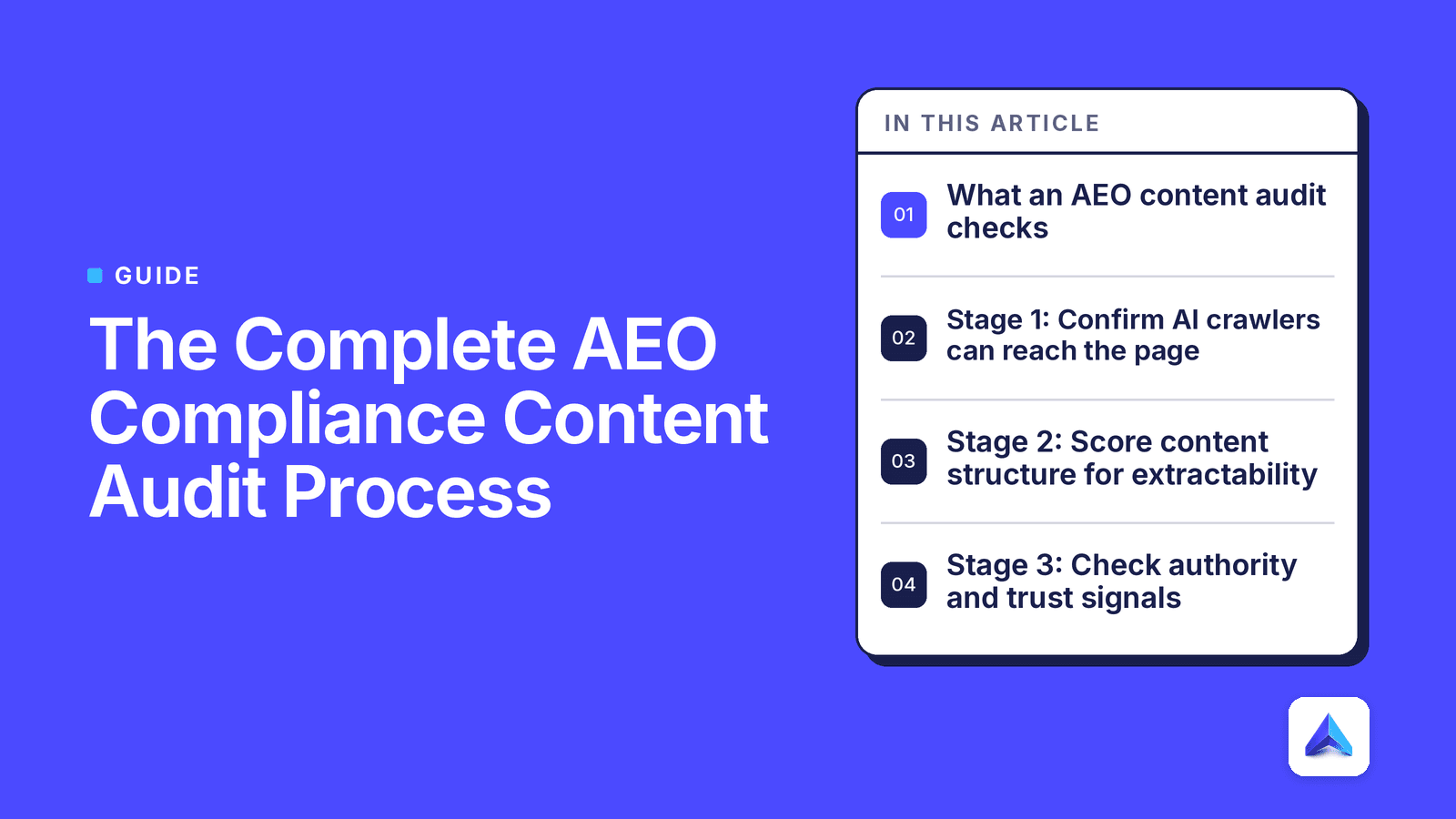
What an AEO content audit checks
An AEO content audit checks four things in sequence: whether AI crawlers can reach your page, whether the content is structured so a model can lift an answer out of it cleanly, whether the page carries enough authority signal to be trusted as a source, and whether anyone can measure if it's working. Skip a stage and you'll fix the wrong problem first.
This is a different exercise from a standard SEO audit, even though the two share tools and some of the same pages. An SEO audit asks whether a page can rank in the ten blue links. An AEO audit asks whether a sentence inside that page can be lifted whole, with no editing, and dropped into an AI answer with your brand named as the source. Those are related questions, but they're not the same question, and treating them as identical is the single most common mistake teams make when they bolt "AEO" onto an existing SEO checklist.
| Dimension | Traditional SEO audit | AEO content audit | Why it matters | Red flag |
|---|---|---|---|---|
| Primary unit scored | Whole page | Individual passage/paragraph | AI engines cite sentences, not pages | Scoring only at page level misses citation-blocking paragraphs |
| Crawler check | Googlebot access | GPTBot, PerplexityBot, ClaudeBot, Google-Extended access | Blocking one AI crawler silently removes you from that engine entirely | robots.txt blocks AI bots but team didn't notice |
| Structure signal | Keyword placement, internal links | Answer-first paragraphs, lists, tables, Q&A format | Extractable structure is what gets lifted into an answer | Dense prose paragraphs with no scannable structure |
| Authority signal | Backlinks, domain authority | Author bios, schema markup, named citations, freshness date | Models weight trust signals differently than link equity | No author attribution, no dates, no sourcing |
| Success metric | Rankings, organic traffic | Citation rate, share of AI answer, referral clicks from AI engines | You can rank #1 and still get zero AI citations | Tracking only Google Search Console, nothing from AI referral traffic |
If you've already run a standard technical pass, our technical SEO audit guide covers the crawlability and indexation side in more depth than we will here. This piece picks up where that one stops: once Google can see the page, can an AI engine use it?
Stage 1: Confirm AI crawlers can reach the page
Start here because nothing else in the audit matters if the content is invisible to the engines you're optimizing for. Pull your robots.txt file and check it against GPTBot (OpenAI), PerplexityBot, ClaudeBot (Anthropic), and Google-Extended (Gemini and AI Overviews). A surprising number of sites block one or more of these without realizing it, often because a developer copied a restrictive robots.txt template years ago and nobody revisited it.
Run this checklist on every domain and major subdomain you own:
- Pull the live robots.txt and search for each crawler's user-agent string by name, not by assumption.
- Check server logs or a bot-verification tool to confirm crawlers are hitting pages, not just permitted to.
- Test whether key pages render without JavaScript. Many AI crawlers do not execute client-side JS the way Googlebot increasingly does.
- Check canonical tags point to the version you want cited, especially on pages with parameters or syndicated duplicates.
- Confirm your sitemap is current and submitted, since several AI engines use it as a discovery path alongside crawling.
If you serve content through a heavy JavaScript framework and haven't checked server-side rendering, this is where most teams find their first real problem. A page can rank fine in Google, which has gotten better at rendering JS, while remaining functionally invisible to an AI crawler that gives up after the initial HTML response. Siteimprove's research on content auditing for answer engine discoverability found that crawlability gaps like this are one of the most overlooked causes of AI citation failure, precisely because the page looks fine to a human and even to Google.
One more thing worth building now: an llms.txt file. It works like robots.txt but speaks directly to language models, listing your most important pages and a short description of what each one covers, so a model building context about your site has a clean map instead of guessing from crawled fragments. Keep it short, prioritized, and in plain markdown at your root domain. It won't force a citation, but it removes friction for engines that check for it.
Stage 2: Score content structure for extractability
A page passes Stage 2 when an AI model can lift a complete, accurate answer from it without rewriting or guessing at missing context. That means answer-first paragraphs near the top of each section, clear heading hierarchy that mirrors how someone would ask the question, and lists or tables wherever you're comparing options or walking through steps.
Score each page against this rubric. It's a simple 0 to 2 scale per criterion, which keeps it fast enough to finish an audit instead of abandoning it halfway through 40 pages.
| Criterion | 0 points | 1 point | 2 points |
|---|---|---|---|
| Opening answer | Buried past 200+ words or absent | Present but vague or hedged | Standalone, specific answer in first 2-3 sentences |
| Heading phrasing | Generic ("Overview," "Benefits") | Topic-relevant but not question-shaped | Phrased as a real search query |
| Structure (lists/tables) | Dense prose throughout | Some bullets, no tables | Tables or numbered steps where comparison/process exists |
| Sentence length in key passages | Mostly 25+ words | Mixed, some long | Average under 20 words in citation-target paragraphs |
| Named sourcing | No attribution for claims | Links without named source | Named source plus linked primary document |
Add the points, divide by 10, and you get a percentage score per page. Bands we use: below 50% means rebuild the page's structure before touching anything else; 50 to 70% means targeted rewrites of specific sections; 70 to 85% is quick wins, usually just tightening openings and adding a table; above 85% means the page is already doing its job and your time is better spent elsewhere.
This is the stage where a before/after example earns its keep more than any amount of explanation. Here's a weak paragraph pulled from the kind of page we see constantly in SaaS documentation audits:
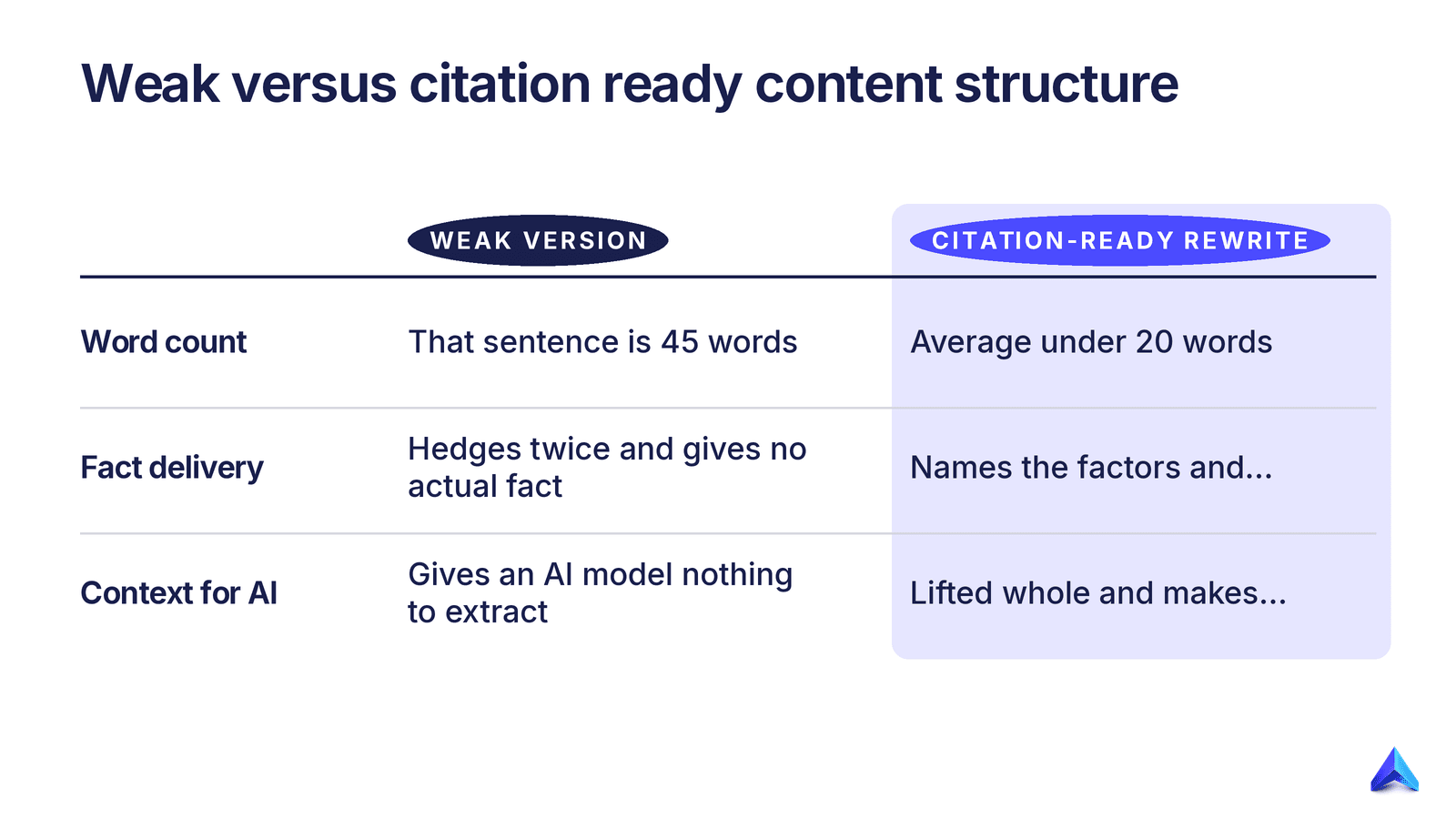
Weak version: "When it comes to pricing, there are a number of factors that can influence the overall cost of implementation, and businesses should take the time to carefully consider their options before making a decision, as this can have a significant impact on long-term value."
That sentence says nothing. It's 45 words, hedges twice, and gives an AI model nothing to extract because there's no actual fact in it.
Citation-ready rewrite: "Implementation pricing depends on three factors: seat count, integration complexity, and support tier. A 10-seat team on the standard tier typically pays setup costs that are recovered within the first two billing cycles through reduced onboarding time."
That version names the factors, gives a concrete number, and states a specific outcome. A model can lift either sentence whole and it still makes sense out of context, which is the actual test for whether a passage is citation-ready.
If you want a structured starting point before running this stage on your own content, our guide on how to do a content audit walks through the inventory and categorization groundwork that feeds directly into this scoring pass.
Stage 3: Check authority and trust signals
A page with perfect structure still won't get cited reliably if it reads as anonymous or unsourced. AI engines, like careful editors, weight content more heavily when they can tell who wrote it and verify the claims inside it. This stage checks for the signals that build that trust, separate from whether the prose itself is well structured.
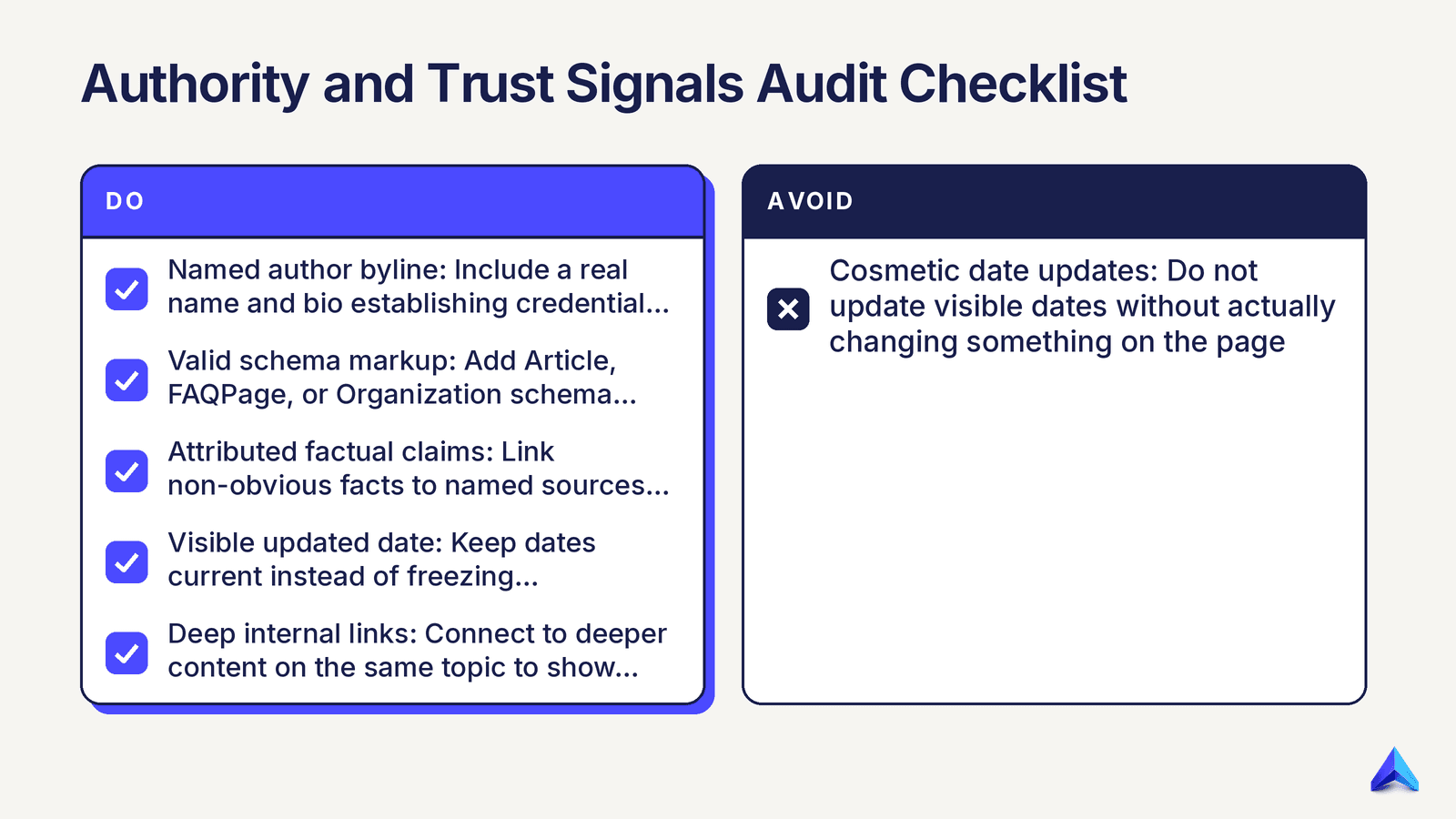
Walk each page through these checks:
- Author byline with a real name and a bio that establishes relevant credentials, not a generic "Marketing Team" tag.
- Schema markup present and valid: Article, FAQPage, or Organization schema depending on page type, validated through a structured data testing tool rather than assumed correct.
- Every non-obvious factual claim attributed to a named, linked source, not left as a bare assertion.
- A visible last-updated or published date, kept current rather than frozen at the original publish date.
- Internal links to related, deeper content on the same topic, showing topical depth rather than an isolated page.
Freshness deserves specific attention here because it's cheap to fix and teams underestimate how much it matters. A page updated eighteen months ago on a topic that moves quarterly signals staleness to both readers and models, even if the underlying facts haven't changed. Set a recurring calendar reminder to revisit your highest-traffic pages at minimum twice a year, and update the visible date only when you've changed something, not as a cosmetic trick.
For regulated industries, legal, finance, healthcare, this stage carries extra weight. Misrepresentation risk is real: an AI engine summarizing your content incorrectly, or citing an outdated figure as current, can create compliance exposure that a simple ranking drop never would. If you operate in one of these spaces, add a sixth check specific to your audit: every page stating a regulatory figure, rate, or legal threshold needs a visible "accurate as of" date and a direct link to the primary regulatory source, not a secondary summary. Review these pages on a shorter cycle than the rest of your content, and flag any page where a claim could be misread as current advice if the underlying rule has since changed.
How does an AEO audit differ across ChatGPT, Perplexity, and Google AI Overviews?
Each engine retrieves and cites content differently, so a page optimized purely for one may underperform in another. Perplexity leans heavily on real-time web retrieval and favors recent, clearly sourced pages. ChatGPT's browsing mode and Google AI Overviews both draw more on pages with strong existing search visibility and structured data, while Gemini weights Google's own index signals more directly since it shares infrastructure with core Search.
| Engine | Retrieval style | What it favors | Practical audit implication |
|---|---|---|---|
| ChatGPT (browsing) | Live web search plus training data | Established pages, clear structure, strong existing rankings | Don't neglect core SEO fundamentals assuming AEO replaces them |
| Perplexity | Real-time retrieval, heavy on citations shown to user | Freshness, named sources, direct answer passages | Prioritize update cadence and visible dates on fast-moving topics |
| Google AI Overviews | Pulls from indexed, ranked pages | Schema, E-E-A-T signals, pages already ranking well organically | Fix core ranking factors first; AI Overviews rarely surface unranked pages |
| Gemini | Shares signals with Google Search index | Structured data, topical authority across a domain | Build topic clusters, not isolated pages |
The practical takeaway: don't audit for one engine in isolation. A page that only chases Perplexity-style freshness while ignoring Google AI Overviews' reliance on organic rank will win citations in one place and stay invisible in another. Run the full four-stage audit regardless of which engine you're prioritizing, since the underlying fixes (crawlability, structure, authority) serve all four.
Stage 4: Measure citation rate and close the loop
A page audit is only useful if you can tell whether the fixes worked. This stage sets up the measurement that turns a one-time audit into an ongoing aeo compliance content audit process rather than a report that sits in a shared drive.
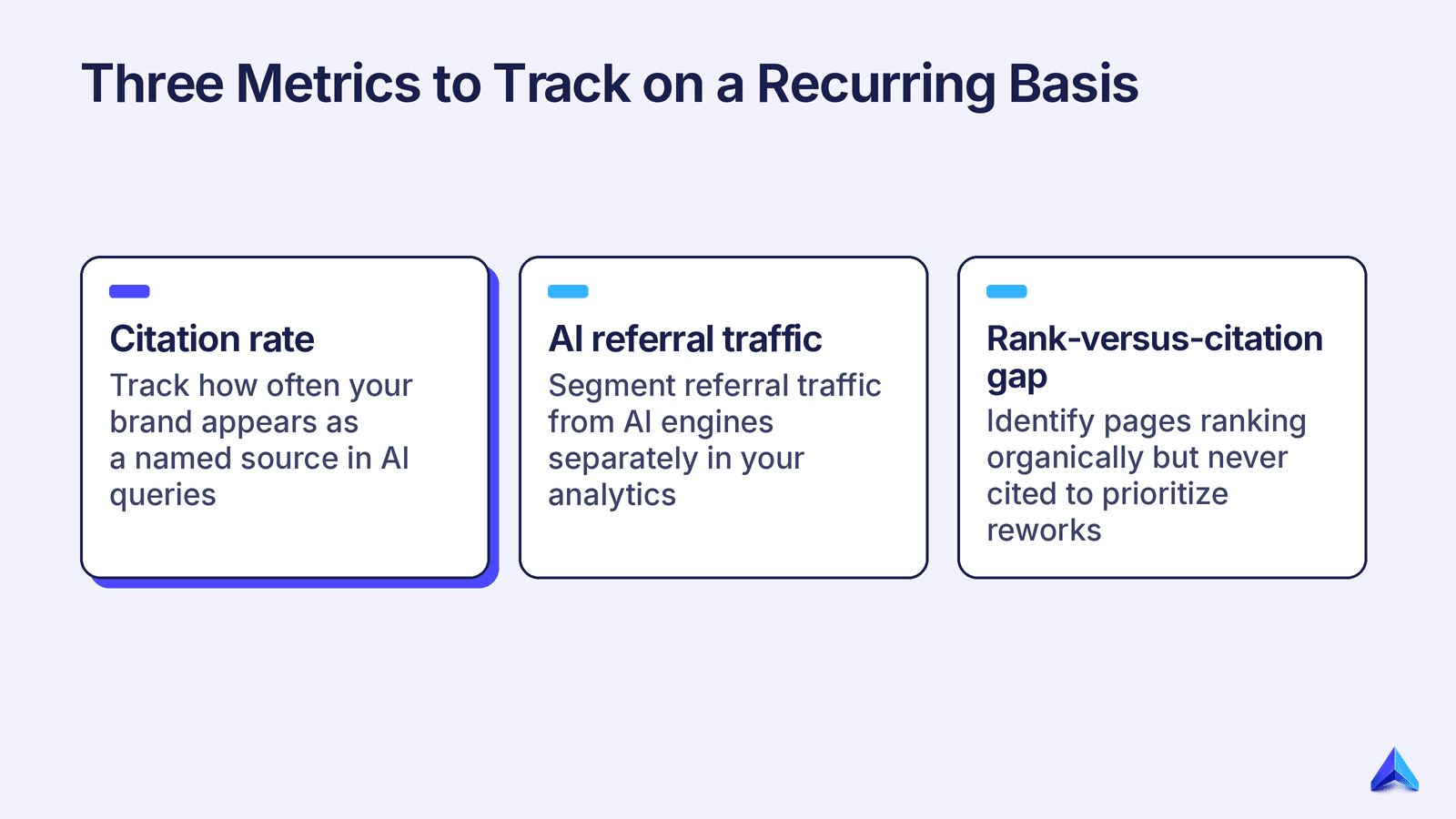
Track three things on a recurring basis, ideally monthly for your top 20 to 30 pages by traffic or strategic importance:
-
Citation rate: how often your brand or domain appears as a named source when you manually query ChatGPT, Perplexity, and Google AI Overviews with your target questions.
-
Referral traffic from AI engines: segment this separately in your analytics rather than lumping it into generic referral traffic, since the behavior and intent of this traffic differs from a typical organic click.
-
Rank-versus-citation gap: pages ranking well organically but never cited by AI engines are your highest-priority Stage 2 and 3 rework candidates, because the demand and relevance are already proven.
Re-run the full scoring rubric on your priority pages every quarter. Content decays, competitors update their own pages, and an engine's retrieval behavior shifts as models get retrained. An audit from eight months ago describing a page as "already optimized" is a guess, not a fact, if nothing has been rechecked since.
This cyclical structure mirrors something worth borrowing from customs compliance audits, even though the subject matter is unrelated. In that world, the European Court of Auditors found in its 2023 special report that certified operators still required recurring internal review to maintain compliance status, since certification at a single point in time doesn't guarantee ongoing conformity. Content works the same way. Passing an AEO audit today doesn't mean the page still passes in six months, and treating the audit as a one-time project rather than a recurring process is where most of the value gets lost.
Prioritizing fixes: quick wins versus full rebuilds
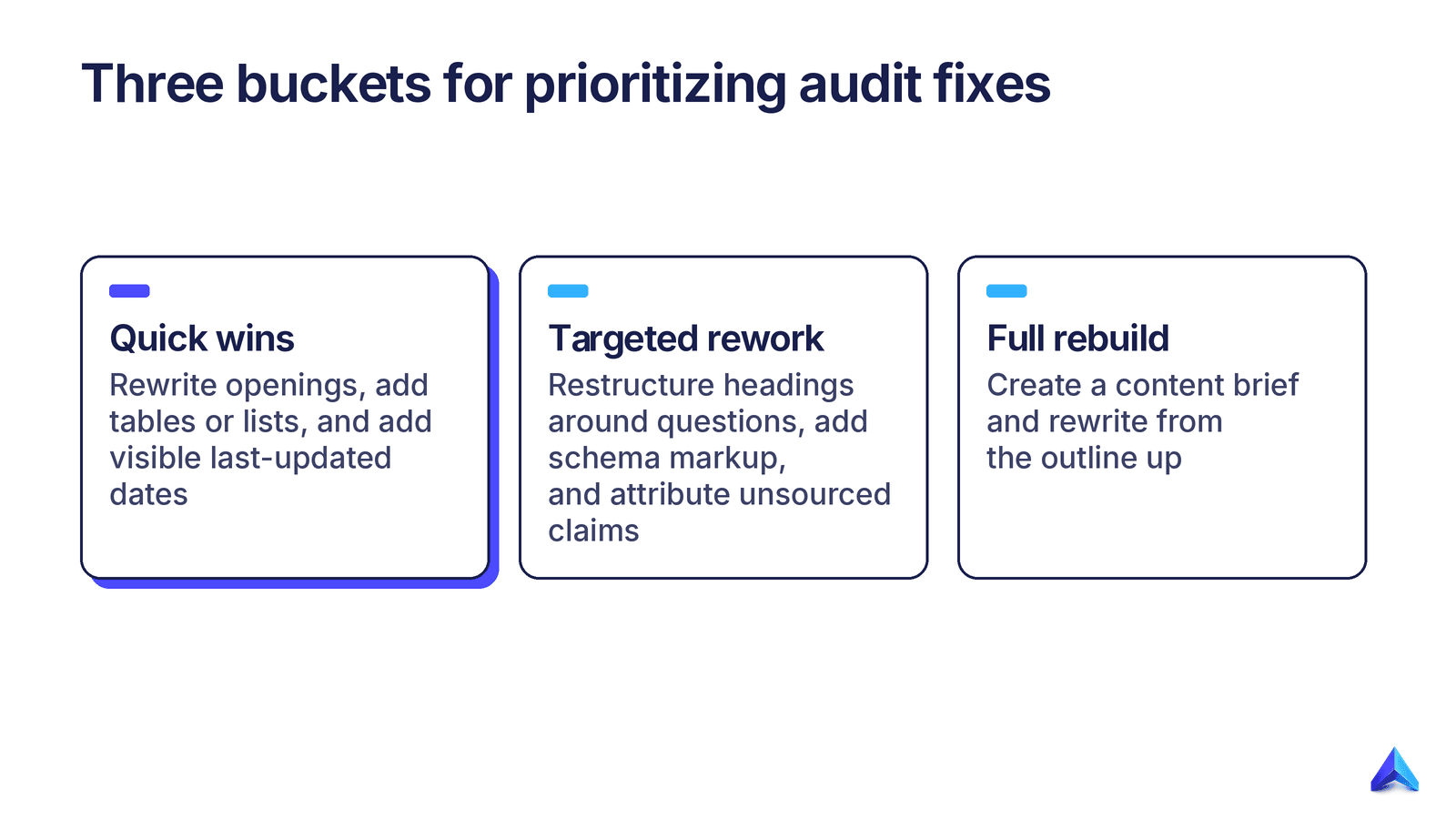
Once every page in your audit has a score, sort fixes into three buckets rather than working through pages in whatever order they happen to sit in your spreadsheet. This single step is what separates an audit that improves citation rate from one that generates a long document nobody acts on.
-
Quick wins (Stage 2 score 70 to 85%): rewrite the opening paragraph to lead with a direct answer, add one table or numbered list where a comparison already exists in prose, add a visible last-updated date. These take under an hour per page and should be done first, this week, not scheduled for next quarter.
-
Targeted rework (Stage 2 score 50 to 70%, or any page failing Stage 1 crawlability): restructure headings around real questions, add schema markup, attribute unsourced claims to named references. Budget a day or two per page depending on length.
-
Full rebuild (below 50%, or any page with no author attribution and no sourcing at all): these pages need a content brief and a rewrite from the outline up, not a patch. Treat them as new content projects. Our content brief framework is built for exactly this kind of ground-up rework, and it's worth using even on existing pages rather than improvising structure as you go.
Work through quick wins across your entire priority page set before starting a single full rebuild. The math favors it: fixing twenty pages' opening paragraphs in a day will move your citation rate faster than spending that same day rebuilding one page from zero. Save the rebuilds for pages where the topic itself justifies the investment, measured by search volume, strategic importance, or how often sales or support teams reference it with prospects.
If your team is running this audit across dozens or hundreds of pages, manual scoring stops scaling fast. Our breakdown of AI content audit tools covers which platforms can automate parts of the Stage 2 structure scoring, though we'd still recommend manually checking Stage 3 authority signals since tools miss nuance around sourcing quality that a human reviewer catches immediately.
What the audit looks like for different page types
A blog post, a pricing page, and a support doc don't fail the same checks, and scoring them identically wastes the audit's usefulness. Pricing pages rarely need a long answer-first intro; they need the actual numbers stated plainly, without the vague hedging language common in sales copy. Support and documentation pages benefit most from Q&A formatting that mirrors the exact phrasing a user would type into a search bar or ask a chatbot. Product pages need named specifications and comparison tables more than narrative prose.
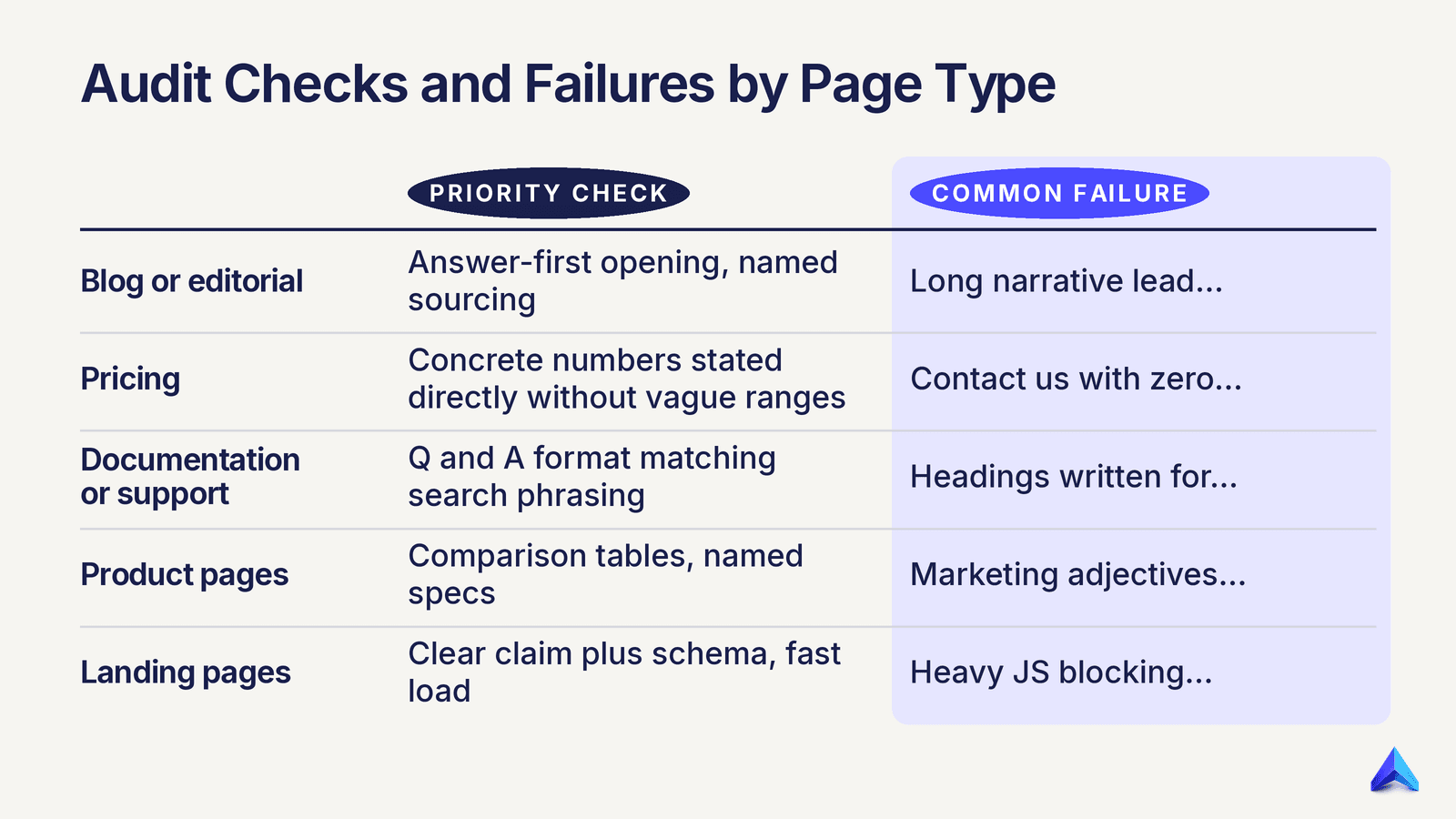
| Page type | Priority check | Common failure |
|---|---|---|
| Blog / editorial | Answer-first opening, named sourcing | Long narrative lead before the actual point |
| Pricing | Concrete numbers stated directly, no vague ranges | "Contact us for a custom quote" with zero anchor figures |
| Documentation / support | Q&A heading format matching real search phrasing | Headings written for internal navigation, not user questions |
| Product pages | Comparison tables, named specs | Marketing adjectives substituted for actual specifications |
| Landing pages | Clear claim plus schema, fast load | Heavy JS rendering blocking crawler access entirely |
If you manage e-commerce or SaaS content across all five of these types, run Stage 1 and Stage 4 universally, but let Stage 2's rubric flex slightly by type. A product page scoring low on "named sourcing" isn't a problem if its specifications are stated plainly; that criterion matters far more for editorial content making factual claims that need backing.
For teams building out a broader content plan around this, our guides on SaaS content marketing and SEO content writing both cover planning frameworks that pair well with this audit once you know which pages need rebuilding from scratch rather than patching.
How much does an AEO audit cost, and how often should you run one
Cost depends entirely on scale and whether you run it in-house or bring in outside help, but the real driver is page count, not hourly rate. A 20-page audit done by one experienced person following this four-stage process typically runs one to two days of focused work. A 200-page site audit, especially one spanning multiple page types like the table above, is realistically a one to two week engagement, longer if a meaningful share of pages land in the full-rebuild bucket.
Run the complete four-stage audit quarterly on your top-priority pages, the ones driving the most traffic or revenue. Run a lighter version, Stage 1 crawlability and Stage 4 measurement only, monthly across your full site, since crawler access and citation rates can shift between quarterly cycles without any content changes on your end. An annual deep audit across your entire content library catches the slow drift that monthly spot-checks miss: freshness dates nobody updated, schema that broke silently after a CMS migration, authority signals that degraded as bylines changed or pages got merged.
Teams that treat this as a one-time project rather than a recurring cycle tend to see citation rates climb for a quarter and then flatten or decline, because competitors keep auditing while they stop. If you'd rather have a team run this process end to end, including the quarterly re-scoring and the measurement layer, get in touch with Project Rankup and we'll walk through what a full audit looks like for your specific page count and industry.
Frequently asked questions
What is an AEO content audit?
An AEO content audit is a structured review scoring whether existing content can be found by AI crawlers, extracted as a clean answer, and trusted enough to be cited by name in tools like ChatGPT, Perplexity, and Google AI Overviews.
What's the difference between an AEO audit and an SEO audit?
An SEO audit scores whether a page can rank in search results. An AEO audit scores whether a specific passage inside that page can be lifted whole and cited as an answer, which depends more on structure and sourcing than on backlinks.
How often should you run an AEO compliance content audit process?
Run the full four-stage audit quarterly on priority pages. Run a lighter crawlability and citation-rate check monthly across the rest of the site, and do one deep annual pass across your entire content library.
What tools can audit AEO compliance?
Several platforms automate parts of Stage 2's structure scoring, but authority and sourcing checks in Stage 3 still need a human reviewer. Treat tools as a first pass, not a replacement for manual review.
What is a citation-ready paragraph?
A citation-ready paragraph states a specific fact or figure in a short, standalone sentence that still makes complete sense if lifted out of the page and quoted alone, with no vague hedging or missing context.