What is content marketing? It means attracting and keeping an audience by publishing material they genuinely want, rather than interrupting them with ads. You earn attention by answering questions and solving problems, and the sale follows once trust is built. Done well, it is one of the few marketing channels that compounds: a guide published two years ago can still bring in leads today.
That compounding effect is the whole case for the discipline. A paid ad stops working the day you stop paying for it. A ranking blog post, a cited guide, or a newsletter with a loyal list keeps earning long after the work is done. This guide covers what content marketing is, how it works stage by stage, the formats worth your time, what it costs, and how it differs from SEO and copywriting, two terms people mix up constantly.
What Is Content Marketing, Really?
Content marketing is the practice of publishing material your audience seeks out, not material you push at them. A software brand that sends a weekly newsletter on growth metrics is doing content marketing. A SaaS tool that maintains a free keyword research guide ranking on page one is doing content marketing too. The commercial intent is real in both cases, but it takes a back seat to being useful.
The Content Marketing Institute defines it as a strategic marketing approach focused on creating and distributing valuable, relevant, and consistent content to attract and retain a clearly defined audience. The word consistent does a lot of work in that sentence. One blog post is not a content marketing programme. A publishing rhythm you can sustain for a year is.
Three related terms get tangled up constantly, and mixing them up is why some brands publish a lot of content that converts nobody.
| Term | What It Covers | What It Does Not Cover | Why It Matters |
|---|---|---|---|
| Content marketing | The plan to attract and convert an audience through content | Production schedules, CMS workflows | Confusing this with content management is why teams measure output (posts per month) instead of outcomes (leads per month) |
| Content strategy | The governance layer: audience, voice, formats, channels, success metrics | Distribution or promotion tactics | Skipping this step is the single biggest reason content programmes stall after six months |
| Content management | The operational work: publishing, updating, archiving, version control | Why you are producing content at all | A great CMS workflow cannot fix a plan with no clear audience or goal |
You need all three working together. Red flag: if your team can tell you exactly how many posts went live last month but not which ones brought in a lead, you have a content management habit, not a content marketing plan.
Within digital marketing, content is the foundation layer that makes every other channel work harder. Paid ads convert better when the landing page they point to is clear and credible. Email click rates climb once a newsletter has trained readers to expect something useful in every send. Content marketing in digital marketing spans owned channels (your blog, your list, your YouTube channel) and earned ones (guest posts, podcast invites, citations inside AI answers). Paid amplification can boost reach, but the content itself remains the asset, which is why it survives algorithm changes that wipe out purely paid strategies overnight.
For SEO specifically, content is the mechanism that earns keyword rankings and topical authority. No page can rank for a search term that nothing on your site addresses. Building content around a deliberate keyword map is still the clearest route to organic growth, and it is the one lever competitors cannot buy their way around.
How Content Marketing Works: The Funnel You Need
Content marketing works by meeting buyers at every stage of their decision, not just the moment they are ready to buy. Most brands over-invest in bottom-funnel content (product pages, comparison posts) and under-invest in the top-funnel material that builds the audience in the first place. Fix that imbalance before you touch anything else.
Here is how content type maps to a buyer's actual mindset at each stage:
| Funnel Stage | Searcher's Mindset | Best Content Formats | Goal |
|---|---|---|---|
| Awareness | "I have a problem" | Blog posts, short videos, social carousels, podcasts | Drive discovery, earn the first visit |
| Consideration | "What are my options?" | Comparison guides, webinars, long-form articles, email sequences | Build trust, capture an email address |
| Decision | "Should I choose you?" | Case studies, demos, testimonials, free trials | Convert to customer |
| Retention | "How do I get more value?" | Onboarding docs, tutorials, community content | Cut churn, raise lifetime value |
The mistake most SaaS and e-commerce teams make is treating content as a top-of-funnel-only job. Post-purchase content, onboarding guides, feature walkthroughs, can lift retention as much as any paid win-back campaign. A customer who keeps learning from your content tends to stick around longer than one who never hears from you again after checkout.
Personas drive the whole system, and skipping this step is where most format decisions go wrong. Before picking between a podcast and a LinkedIn carousel, you need a real answer to three questions: who is this for, what do they already know, and what objection are they sitting with right now. Choosing a format without that answer is guesswork wearing a strategy's clothes.
Types of Content Marketing
The types of content marketing worth using depend on where your audience spends time and which format they already trust, not on what is trending. There is no universal ranking here. A B2B SaaS brand selling to engineers gets more mileage from detailed technical docs than from Reels. A D2C skincare brand usually has the opposite problem.
| Format | Best For | Effort Level | ROI Timeline |
|---|---|---|---|
| Long-form blog or guide | SEO traffic, E-E-A-T, lead capture | Medium | 3 to 9 months |
| Short-form video (Reels, Shorts) | Awareness, social reach | Medium-high | 1 to 4 weeks |
| Podcast | Thought leadership, loyalty | High | 6 to 18 months |
| Email newsletter | Retention, direct conversion | Low-medium | Immediate to 4 weeks |
| Infographic or data visual | Backlink earning, shareability | Medium | 1 to 6 months |
| Case study | Decision-stage conversion | Medium | 1 to 8 weeks |
| Interactive tool or calculator | Lead generation, time on site | High | 3 to 12 months |
| Social carousel | Repurposed reach, community building | Low | 1 to 2 weeks |
Named examples make this concrete. HubSpot built much of its early growth on free blog content and templates that ranked for the exact questions its buyers were already typing into Google, long before it had a sales team large enough to outbound its way to that audience. Patagonia's long-running environmental storytelling (films, essays, campaign pages) functions as content marketing that sells almost nothing directly, yet keeps the brand top of mind for people who later buy a jacket. Semrush publishes dense, data-backed guides that rank for thousands of SEO terms and double as top-of-funnel lead capture for its own tool. None of these programmes started with every format at once; each picked two or three formats that matched their audience and did them consistently.
Repurposing is the scaling lever most teams ignore. One well-researched 2,000-word guide can become a LinkedIn carousel, a short video script, three email sends, and a podcast episode. The research is the asset; the format is just the delivery vector. Teams that repurpose deliberately publish far more without burning out their writers.
Content Marketing vs. SEO vs. Content Strategy
Content marketing vs SEO is one of the most common false choices in digital marketing. They are two different disciplines that work best stacked together, not two paths to the same place.
SEO is the technical and structural work that makes content findable: crawlability, site speed, schema markup, link authority, canonical tags. A thorough SEO audit surfaces the gaps that stop even excellent content from ranking at all. Content marketing is the editorial work that gives a searcher a reason to click through and come back.
| Dimension | SEO | Content Marketing | Red Flag |
|---|---|---|---|
| Primary goal | Visibility in search results | Audience building and conversion | Treating a ranking as the finish line instead of the start of the relationship |
| Main inputs | Technical fixes, backlinks, keyword targeting | Writing, video, research, distribution | Hiring an SEO fix without anyone owning the writing is a common budget trap |
| Time to results | 3 to 6 months for technical fixes, longer for authority | 3 to 12 months for organic; faster for email and social | Expecting SEO-style quick wins from a content programme leads to teams quitting at month four |
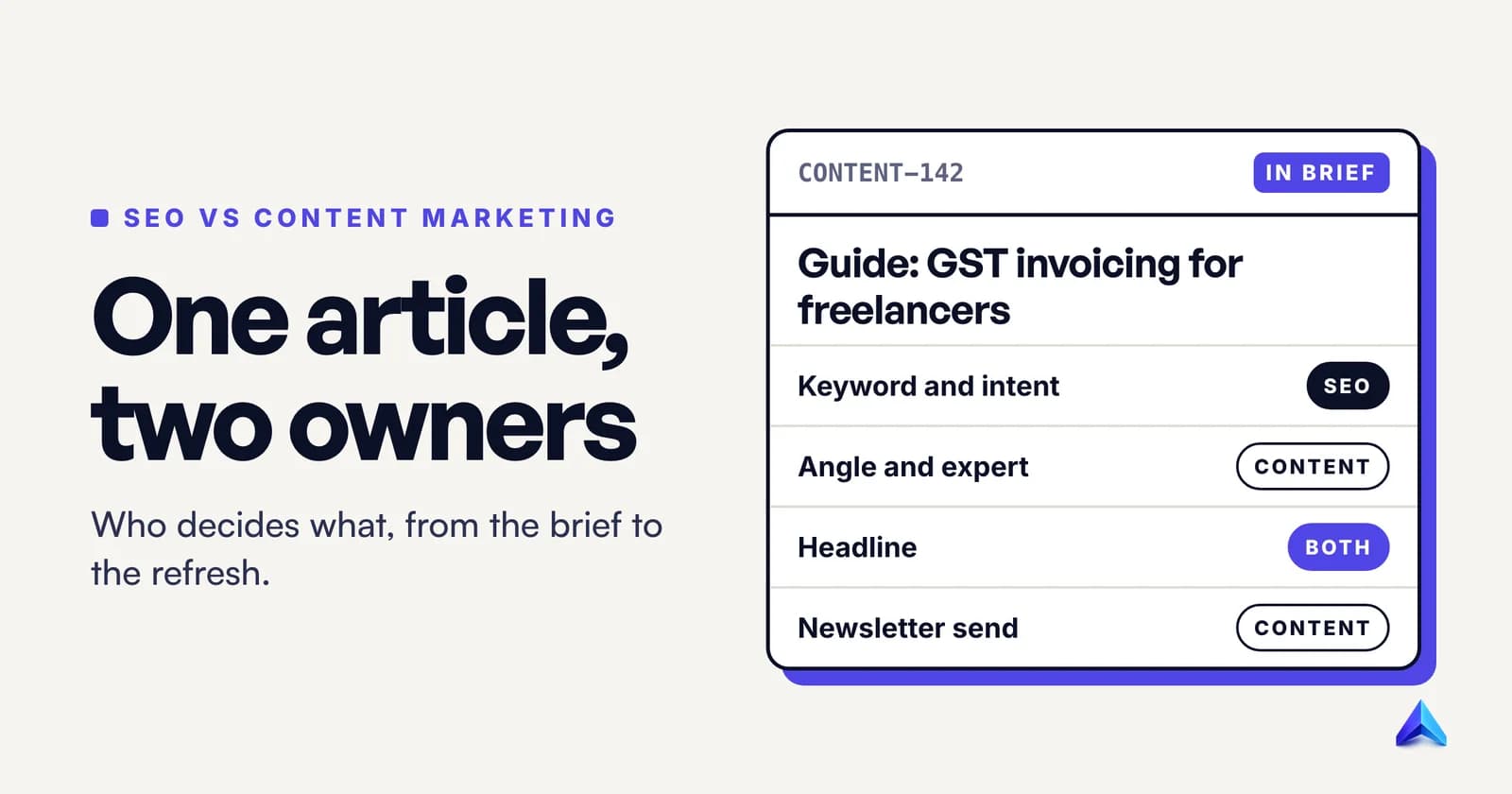
| Who owns it | SEO specialist, dev team | Content team, marketing | Splitting these across teams with no shared KPI is why content and SEO blame each other for flat traffic |
| Overlap zone | On-page optimization, topical authority, E-E-A-T | Both need keyword research and quality signals | Skipping keyword research on either side wastes the other team's work |
The practical takeaway: you can run SEO without a content marketing plan, fixing technical issues and building links to pages you already have. But you cannot scale organic traffic without content marketing, full stop. Most brands that plateau at a fixed traffic ceiling have simply run out of technical fixes to make and need new pages to rank at all.
For agencies and freelancers running client content programmes, pairing LSI keyword mapping with the content plan is the fastest way to close a topical authority gap against competitors who have been publishing longer.
Benefits of Content Marketing (With Sourced Data)
The benefits of content marketing are not theoretical anymore. Enough large studies agree closely enough that these can be stated as findings, not hopes.
Demand Metric's 2023 content marketing benchmark report found content marketing generates roughly three times more leads than outbound marketing while costing about 62% less per lead. That ratio held across both B2B and B2C respondents once a content programme had been running for at least 12 months, which matters: the ratio is a payoff for sustained publishing, not a result you get from a single campaign.
Businesses running a documented content strategy report positive ROI far more often than those publishing content with no written plan, according to the Content Marketing Institute's annual B2B research. The document itself is not bureaucracy. It is the variable that separates programmes that compound from ones that stall out after a few months.
HubSpot's 2025 State of Marketing report found blogs, short-form video, and podcasts remain the top three formats for reported ROI across industries, with video showing the largest year-over-year gain in reported effectiveness. That tracks with Google's continued push to surface video inside AI Overviews.
At Project Rankup, our own content audits of client blogs follow a simple rule before we recommend new publishing volume: we check whether existing pages are being updated and interlinked before we greenlight new ones. Clients who clean up and relink their existing library before adding new posts consistently see faster movement in rankings than those who only add new content on top of a neglected archive. New content without maintenance is building on sand.
Specific benefits worth planning around:
- Compounding organic traffic. A blog post that ranks keeps pulling visitors every month with no extra spend. Paid ads stop the day the budget runs out.
- E-E-A-T signals. Google's quality guidance rewards demonstrated expertise, and a deep, well-maintained content library is the clearest signal of subject-matter authority a site can build.
- AI answer citations. LLMs and AI Overviews pull from content that answers questions directly and names its sources. Getting cited inside an AI Overview is quickly becoming 2026's version of ranking in position one.
- Sales cycle compression. Buyers who arrive having already read your content show up with fewer objections. Inbound leads at SaaS companies routinely close faster than outbound ones for exactly this reason.
- Owned list and community. Every subscriber you earn through content is an asset you control, unlike a social following that lives on a platform you do not own and that can change its algorithm tomorrow.
How much should a business budget for content marketing?
A workable starting budget runs 25 to 30% of total marketing spend for brands building an organic engine from scratch, based on the range reported across recent Content Marketing Institute benchmark surveys. Smaller teams can start leaner: one dedicated writer or a part-time freelancer plus a modest research and promotion budget is enough to sustain monthly publishing while a bigger plan takes shape.
Building a Content Marketing Strategy
A content marketing strategy is the document that connects audience research to a publishing plan, formats to goals, and distribution channels to metrics. Skip it, and content production becomes activity mistaken for progress, busy without being effective.
Six components make up a working plan for 2026:
-
Audience definition. Named personas with specific pain points, not demographic buckets. "SaaS founder, 30 to 45, Series A, can't attribute MQLs to content" is a persona. "Marketing professionals" is not.
-
Goal and metric alignment. Each content type gets its own KPI: blog posts get organic traffic and time on page, email gets open rate and click-to-lead, case studies get sales cycle length. ROI without stage-level metrics cannot be measured.
-
Keyword and topic map. Built from search volume data and competitor gap analysis. Keyword research is the raw input; the topic map is the output. Publish in clusters around a topic, not at random.
-
Format and channel selection. Driven by audience preference and team capacity, not whatever platform is trending this quarter. Three formats done well beat eight done poorly.
-
Content calendar. A publishing calendar turns the strategy into an actual schedule. Cadence beats volume: a steady monthly rhythm outperforms sporadic bursts of ten posts followed by three months of silence.
-
Distribution and amplification plan. Every piece needs a promotion plan: an email send, a social adaptation, internal links from older posts, outreach for backlinks. Publishing with no distribution plan is stocking a shelf in a store with no customers.
Measurement sits at the end of each cycle and feeds straight back into step one. The signs of a healthy programme at the 12 month mark: organic sessions growing month over month, email list growth above 5% monthly, and demo or trial requests tied to content touchpoints taking up a growing share of total pipeline.
Content Marketing in AI Search (2026)
The rise of AI Overviews, ChatGPT search, and Perplexity has changed where content shows up, but not what makes it worth showing. These systems pull from sources that answer questions directly, cite real evidence, and show genuine expertise, which is just a description of good content marketing, not some new bar to clear.
What has changed is how little patience these systems have for anything vague or derivative. AI systems are blunt about whether a page adds new information or just rearranges what already exists elsewhere. A 500-word post that rephrases a Wikipedia summary will not earn citations anymore. A 2,000-word guide with a real framework, named sources, and answers to follow-up questions gets pulled into AI answers routinely.
Three shifts worth building into any 2026 content plan:
-
Answer-first structure. Open every page with a full, standalone answer to the main question. AI systems extract the first coherent passage that answers the query. Three paragraphs of scene-setting before the real answer just hands the citation to a competitor who answers immediately.
-
Named, dated citations. "Studies show" is invisible to an AI system. "According to Semrush's 2024 State of Content Marketing report" is quotable. Every factual claim needs a named source and a year attached to it, the same standard this guide is held to.
-
Structured content blocks. Tables, numbered steps, and FAQ sections get pulled into AI answers at a far higher rate than the same information buried in paragraphs. Format information the way an answer engine would want to reuse it.
A regular content audit matters more here than most teams realize. AI search surfaces the best-performing content across your site and your competitors' sites at the same time. Old pages that contradict your current thinking will surface right alongside the new ones and muddy the signal you are trying to send.
常見問題
What are some examples of content marketing done well?
HubSpot built an early audience through free blog content and templates that ranked for its buyers' exact search terms. Patagonia uses long-form storytelling and environmental campaigns that sell almost nothing directly but keep the brand top of mind. Semrush publishes dense, data-led guides that double as lead capture. Each picked a few formats that matched its audience rather than chasing every channel at once.
How much should a business budget for content marketing?
A reasonable starting point is 25 to 30% of total marketing spend for a brand building an organic engine from scratch, based on recent Content Marketing Institute benchmark data. Smaller teams can get moving with one dedicated writer and a modest promotion budget while a larger plan takes shape.
Is content marketing the same as copywriting?
No. Copywriting pushes for an immediate action: a purchase, a click, a signup. Content marketing is a longer editorial programme built to earn an audience and trust over months and years. Strong content marketing uses good copywriting inside it, but the two have different timelines and different success metrics.
What is the difference between owned and earned content?
Owned content lives on channels you control, like your blog, your email list, or your YouTube channel, where you decide what publishes and when. Earned content is coverage you did not pay for: a journalist citing your research, a podcast invite, or an AI Overview linking to your guide. Content marketing builds the owned layer first; earned placements tend to follow once that owned content is credible enough to cite.
Key Takeaways
-
Content marketing is a plan to earn an audience through useful content, not interrupt them with ads. The commercial intent is real, but value comes first.
-
Content marketing, content strategy, and content management are three separate disciplines. Mixing them up is the most common reason programmes stall.
-
Content maps to funnel stage: awareness content drives discovery, consideration content builds trust, decision content converts, and retention content keeps customers around.
-
Content marketing and SEO are not alternatives. Technical SEO makes content findable; content marketing gives searchers a reason to visit and stay.
-
AI search rewards the same qualities as good journalism: direct answers, named sources, structured formats, and real expertise.
-
A content marketing strategy for 2026 needs six parts: defined personas, stage-level KPIs, a keyword map, format selection, a publishing calendar, and a distribution plan.
If you want these principles turned into a programme that moves rankings and pipeline, see how Project Rankup approaches content strategy and optimization.