
Picking the right seo course in 2026 is harder than it looks. Most programs still teach the 2019 version of the discipline, and the gap between what they cover and what Google, ChatGPT, and Perplexity now reward is wide enough to stall a career or a brand's growth. The best training today blends classic ranking skills with answer engine optimization (AEO), generative engine optimization (GEO), and the structural work that earns citations inside AI-generated results.
What Is an SEO Course, and Who Actually Needs One?
An SEO course is a structured program that teaches you how to make web pages rank higher in search results and, now, how to get cited inside AI-generated answers. According to Google's Search Essentials, this includes understanding how search engines crawl, index, and rank content. It covers keyword research, on-page signals, technical health, link authority, and the content structures that search engines prefer. In 2026, a course worth your time also covers how large language models select and cite sources.
The honest answer to who needs one: almost every team touching digital content. SEO agencies need staff who can audit, report, and execute without hand-holding. Freelancers need a credential that signals they are current. SaaS brands and e-commerce teams need in-house skills so they stop depending on agencies for basic wins. Content and marketing teams need to understand why some posts rank and others stagnate, even when the writing is strong.
A word on self-taught SEO: it works, but it is slow and full of outdated advice recycled across forums. A focused program compresses years of trial and error into a logical order. The risk is choosing a program built on that same recycled advice, which is exactly what the evaluation framework below is designed to catch.
The 2026 SEO Landscape Has Shifted the Curriculum
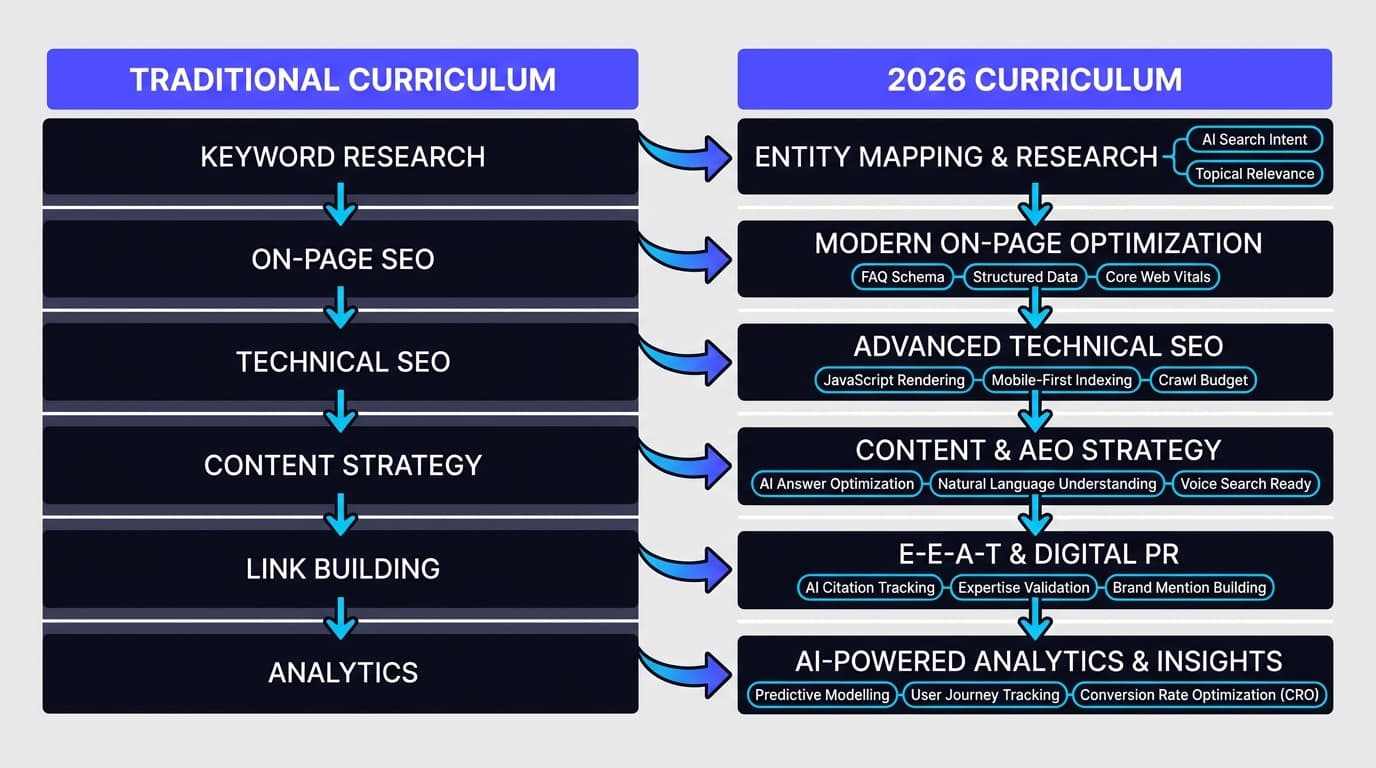
Traditional SEO training focused on three pillars: on-page, off-page, and technical. Those still matter. But AI search engines have added a fourth layer that most courses have not caught up with.
Google AI Overviews, Perplexity, and ChatGPT Search do not rank ten blue links. They synthesize a single answer and cite a handful of sources. Getting cited requires different signals than getting ranked. Research from Pew Research Center studies on AI adoption shows that as AI systems synthesize answers from multiple sources, citation authority becomes a measurable ranking factor. Specifically, it rewards:
- Structured, self-contained answers that a language model can lift without losing meaning
- Schema markup and entity clarity so a crawler knows exactly what an entity is
- E-E-A-T signals baked into the page, not just the domain
- Topical authority across a cluster of related content, not a single optimized post
This is the territory that generative engine optimization training covers. GEO is not a replacement for SEO. It is a layer on top, and any course that frames them as competing disciplines is already behind.
The table below maps the old curriculum against what a current program needs to include.
| Curriculum Area | Traditional Focus | 2026 Addition |
|---|---|---|
| Keyword Research | Search volume, difficulty | Intent modeling, entity mapping, AI query patterns |
| On-Page SEO | Title tags, meta, headings | Answer-first structure, FAQ schema, passage optimization |
| Technical SEO | Crawl budget, speed, mobile | Structured data depth, LLM crawl accessibility, Core Web Vitals |
| Content Strategy | Long-form, keyword density | Topical clusters, citation-worthy prose, E-E-A-T evidence |
| Link Building | DA, anchor text | Brand mentions, unlinked citations, source authority for AI |
| Analytics | Google Analytics, rank tracking | AI visibility tracking, citation monitoring, SEO tracking dashboards |
If a course you are evaluating covers only the left column, keep looking.
How to Choose an SEO Course: A Decision Framework
Before you compare providers, get clear on your own constraints. The right course for a solo freelancer who needs a verifiable credential differs from the right course for a content team that needs practical workflows they can run next Monday.
Start with three questions:
- What outcome do I need? A certification for client credibility, hands-on skills for a specific channel, or a full-team upskill?
- What is my current level? A beginner spending money on an advanced technical seo course will waste half the material. An experienced practitioner paying for a beginner course will learn nothing new.
- How current is the content? Check the syllabus for mentions of AI Overviews, structured data beyond basic schema, or GEO. Their absence is a red flag.
Once you have answers, use this checklist when comparing programs.
SEO Course Syllabus Checklist
- Keyword research with intent and entity mapping
- On-page optimization including passage and FAQ structure
- Core Web Vitals and technical health (technical SEO audit skills)
- Structured data and schema implementation
- Link building and brand authority
- Content cluster strategy and topical authority
- AEO and AI answer optimization
- GEO and generative engine visibility
- Analytics, rank tracking, and AI citation monitoring
- A practical project or real-site audit
Any program missing more than two of these items is teaching a partial discipline. That is fine if you know the gaps and plan to fill them elsewhere. It is a problem if you are buying it as a complete education.
Free vs. Paid: What Each Level Actually Covers
There is a real case for free online seo training, particularly at the start. Google's own Search Central documentation is the closest thing to a primary source in SEO. Bing Webmaster Guidelines and the Google Search Essentials page together give you the rules directly from the engines that matter most. For beginners, reading these before paying for a course saves money and calibrates your expectations.
Beyond documentation, several platforms offer structured free training. The gap between free and paid usually shows up in three places: live feedback on your work, a credential that carries weight with clients or employers, and coverage of emerging topics like GEO that the free tiers have not yet absorbed.
Paid programs justify their cost when they offer:
- Updated curriculum with a clear last-revised date (look for 2025 or later)
- Hands-on projects on real or sandboxed sites, not just video walkthroughs
- Community and mentorship where you can ask why something worked or broke
- A certificate recognized by clients or hiring managers in your market
A google seo course free with certificate exists via Google's own Digital Garage. It is a solid grounding in fundamentals. It does not cover GEO, advanced schema, or AI citation strategy, so treat it as a foundation, not a finish line.
What a Strong SEO Course Syllabus Looks Like in Practice
The best programs are not organized by topic. They are organized by workflow, because that is how SEO actually happens. A practitioner does not do "all the keyword research" and then "all the technical work." They audit a site, find the highest-leverage gap, fix it, and measure the result.
A workflow-first seo full course looks like this:
- Audit - crawl the site, find technical blockers, benchmark current rankings and AI visibility
- Research - map keywords to intent, build a content cluster plan, identify entity gaps
- Optimize - fix on-page issues, structure content for passage extraction, add schema
- Build authority - earn links and brand mentions that signal source credibility to both algorithms and LLMs
- Measure - track rankings, organic traffic, and citations in AI answers
- Iterate - use data to find the next highest-leverage action
This loop, not a list of topics, is what search engine optimization looks like at a working level. A course that teaches the loop is worth more than one that covers every topic in isolation.
For teams using Google Search Console for SEO, the audit and measure steps are where that tool earns its keep. A good course will spend real time on it, not just show screenshots.
Red Flags That Tell You a Course Is Out of Date
The SEO training market is full of programs that were excellent in 2020 and have not been meaningfully updated since. Here are the signals that a program has gone stale.
| Red Flag | Why It Matters |
|---|---|
| No mention of AI Overviews or AI Search | Ignores the biggest shift in how results are served |
| "Keyword density" still presented as a metric | Google has not used raw density as a signal for years |
| Link building section focuses only on volume | Quality and relevance have outweighed volume since at least 2012 |
| No structured data module | Schema is now foundational, not advanced |
| Analytics section covers only Google Analytics basics | Missing rank tracking, Search Console depth, and AI visibility |
| No live project or audit exercise | Passive video learning does not build real skills |
| Last updated date missing or older than 2024 | The discipline changes fast; stale content misleads |
One more red flag worth naming: courses that promise specific ranking outcomes. No one can guarantee a rank. A course that claims otherwise is selling something other than education.
Regional Training and the India Market
Searches for an seo course in india and seo course in delhi reflect a large and growing market of practitioners looking for structured, affordable training. Several strong programs are delivered from Indian institutions, and a growing number of global platforms have added India-specific pricing. The curriculum evaluation criteria above apply equally regardless of where a course is based.
What matters more than geography is whether the course reflects the current global search environment. Google runs the same algorithms worldwide. AI Overviews appear in India. A program that teaches local SEO tactics without covering the underlying technical and content principles will not prepare students for the full scope of the work.
For practitioners in this market looking to differentiate, building fluency in technical SEO and structured data alongside the fundamentals is the fastest path to premium clients and projects. McKinsey research on digital transformation confirms that organizations investing in technical expertise and data infrastructure see 20–30% higher conversion rates from organic search traffic.
常见问题
What is seo course?
An SEO course is a structured training program that teaches you how to increase a website's visibility in search engine results. It covers keyword research, on-page optimization, technical health, link building, and content strategy. In 2026, strong programs also cover answer engine optimization and how to earn citations in AI-generated results.
Which course is best for seo?
The best SEO course is the one that matches your current level and covers the full modern curriculum: traditional ranking signals plus AEO, GEO, and structured data. For beginners, Google's Digital Garage provides a free foundation. For practitioners who need AI search skills, look for programs with a 2025 or later revision date and a hands-on project component.
Why seo course is important?
Search is the primary way people find products, services, and information. An SEO course gives you a systematic way to capture that traffic rather than guessing. As AI-generated answers replace traditional ranked lists for many queries, formal training also covers how to earn visibility in those new formats, where the stakes for getting cited are even higher.
How do I know if an SEO course covers modern AI search?
Check the syllabus for these terms: AI Overviews, answer engine optimization, generative engine optimization, structured data, schema markup, and E-E-A-T. If none appear, the course predates the shift to AI-generated results and will leave a significant gap in your skills. Also check the last-updated date; anything older than 2024 is likely missing these topics.
Is free online SEO training worth it for beginners?
Yes, as a starting point. Google's Search Essentials and Search Central documentation are authoritative and free. They cover the fundamentals directly from the source. The gap is that free resources rarely include structured data depth, GEO, or hands-on feedback. Use free training to build a foundation, then move to a paid program when you need those layers.
What is the difference between SEO and GEO training?
SEO training focuses on ranking in traditional search results: keyword signals, technical health, links, and on-page structure. GEO, or generative engine optimization training, teaches you how to get cited inside AI-generated answers from tools like Google AI Overviews, Perplexity, and ChatGPT. The two skill sets overlap heavily, but GEO adds answer-first content structure, entity clarity, and citation-worthy prose as distinct competencies.
Do I need an advanced technical SEO course or a general one?
Start with a general course if you are new to the field. Move to an advanced technical seo course once you understand the fundamentals and want to go deeper on crawl architecture, log file analysis, structured data implementation, and JavaScript rendering. Most practitioners benefit more from getting the fundamentals right than from jumping to advanced topics before the basics are solid.
Key Takeaways
- A strong seo course in 2026 covers both traditional ranking signals and AI search optimization, including AEO and GEO.
- Use the syllabus checklist above to evaluate any program before you pay: missing more than two items means incomplete coverage.
- Free online SEO training is a solid foundation but rarely covers structured data depth or generative engine visibility.
- Red flags like missing update dates, keyword density advice, and no live project work signal a stale curriculum.
- Workflow-based learning beats topic-based learning because it mirrors how SEO actually gets done.
- Regional programs in markets like India can be excellent; what matters is whether the curriculum reflects the current global search environment.
Want a structured way to put your new skills into practice? Download Project Rankup's free modern SEO and GEO implementation checklist, built to complement any training program and help you apply what you learn to a real site from day one. Get in touch with the Project Rankup team to grab your copy and start climbing.