
On page seo is the practice of optimizing individual web pages so both search engines and people can understand, trust, and rank them. According to HubSpot's 2024 State of SEO report, on-page optimization accounts for approximately 40% of SEO success factors, making it the single largest controllable lever most teams have. It covers everything directly on the page: the title tag, headings, body content, images, internal links, and structured data. Get these elements right and you give every other part of your SEO plan a solid foundation to build on.
What Is On Page SEO and Why Does It Still Matter?
On page seo is the set of optimizations you control directly within a page. Unlike link building or technical infrastructure, you can audit and fix it today without waiting on third parties. In 2026 that control matters more than ever because AI-driven results like Google's AI Overviews and Perplexity pull passages directly from pages, and those passages need to be self-contained, clearly written, and matched to what the searcher actually wants. Google reports that over 10% of searches now trigger AI Overviews (as of 2024), with that figure growing across new query types, meaning passage-level optimization has moved from optional to essential. A page that satisfies search intent well earns both a traditional ranking and a citation in AI-generated answers.
The mistake most teams make is treating on-page work as a one-time setup. It is not. Content drifts out of alignment with intent, competitors update their pages, and Google refines what signals it weights. Treating on-page optimization as a recurring audit rather than a launch checklist is what separates pages that hold rankings from pages that slowly slide.
On Page SEO vs Off Page SEO: Where Each One Lives
On-page SEO encompasses all optimization elements within your control on a single page—title tags, headings, content, meta descriptions, internal links, and schema markup. Off-page SEO covers external signals like backlinks and brand mentions from other websites. On-page work is faster to execute and shows results within weeks, while off-page authority takes longer to build. Both are essential: on-page optimization clarifies what your page is about, while off-page signals establish trustworthiness and competitive strength.
On page and off page seo work together, but they are not the same discipline. Understanding the boundary helps you allocate effort correctly.
| Factor | On Page SEO | Off Page SEO |
|---|---|---|
| What it covers | Content, tags, structure, schema, internal links | Backlinks, brand mentions, social signals, PR |
| Who controls it | You, immediately | Earned through outreach and trust over time |
| Speed of impact | Days to weeks after indexing | Weeks to months after links are acquired |
| AI answer relevance | High: AI models cite passage-level content | Moderate: authority signals influence selection |
| Red flag | Keyword stuffing, thin content, duplicate tags | Paid links, link farms, unnatural anchor patterns |
On page SEO is the prerequisite. A page with weak content and missing signals will not hold a ranking even if it earns strong backlinks. Fix on-page first, then build authority on top of it.
The On Page SEO Audit Checklist for 2026
A systematic on-page audit identifies gaps across your entire site by evaluating search intent alignment, title tag effectiveness, meta descriptions, header structure, image optimization, internal linking patterns, and schema markup. This checklist prioritizes fixes by impact—starting with intent match, then title tags and content depth, then amplifiers like schema and metadata. Running audits quarterly keeps pages aligned with evolving search behavior and algorithm changes, ensuring both traditional rankings and AI Overview visibility.
This is the working framework Project Rankup uses when auditing client pages. Run through it in order; each layer depends on the one before it.
1. Search Intent Optimization
Search intent optimization is the first item on the checklist because every other element serves it. Before you write a word, confirm whether the page needs to be an informational guide, a comparison, a product page, or a how-to. Look at the top five ranking pages for your target keyword. If they are all listicles and yours is a long essay, the format mismatch will cost you the ranking regardless of how well everything else is done.
A SaaS team targeting "project management software" needs a feature-comparison page, not a thought-leadership post. An agency targeting "how to do a technical SEO audit" needs step-by-step instructions, not a product pitch. Match the format, depth, and angle of the dominant result type, then out-execute it on substance.
2. Title Tag Optimization
Title tag optimization remains one of the highest-leverage on-page signals. The Google Search Central documentation on titles confirms that Google uses the title link as a primary indicator of what a page is about. Backlinko's 2024 analysis of over 14 million search results found that optimized title tags correlate with an average CTR lift of 5–10% in SERPs, underscoring their direct impact on both visibility and user interaction. Keep titles between 50 and 60 characters to avoid truncation in SERPs. Put the primary keyword near the front. Brand names go at the end, separated by a pipe or colon.
The common failure mode: writing the title for click-through rate and ignoring the keyword entirely. A title like "We Tried 12 SEO Tools So You Don't Have To" may get clicks from an email newsletter but it gives Google almost nothing to work with on the query you care about.
3. Meta Descriptions Best Practices
Meta descriptions do not directly influence rankings, but they do affect click-through rate, and a higher CTR sends a usage signal that can lift rankings over time. Follow these meta descriptions best practices:
- Keep them between 150 and 160 characters.
- Include the primary keyword naturally in the first half of the sentence.
- Write one clear value proposition: what will the reader know or be able to do after reading?
- Never duplicate a meta description across pages. Each page needs its own.
- Treat it as a two-line ad, not a summary.
For AI Overviews, the meta description matters less than the opening paragraph of the page, which is what AI models extract. Write both.
4. Header Tags Structure
Header tags structure the content hierarchy for both crawlers and readers. The H1 appears once and matches the page's primary topic closely. H2s carry the main sections. H3s break down sub-topics within a section. This is not decorative; it is how Googlebot parses the page and how AI models identify the most relevant passage for a given query.
The mistake to avoid: writing headings as creative chapter titles rather than descriptive topic labels. "The Secret Sauce" tells a crawler nothing. "How to Write Title Tags That Rank in 2026" tells it everything.
For AI answer eligibility, phrase at least some H2s as questions. AI Overviews and ChatGPT are far more likely to extract a passage when the heading matches a natural-language query and the paragraph beneath it opens with a direct answer.
5. Image Alt Text Best Practices
Image alt text best practices serve two goals: accessibility for screen readers and keyword context for crawlers that cannot see images. Write alt text that describes the image accurately in plain language, then include the relevant keyword only when it genuinely fits the description. Do not stuff keywords into alt attributes; Google treats that as a spam signal.
A good rule: if you removed the image and read only the alt text, would you know what the image showed? If yes, the alt text is doing its job. Aim for under 125 characters. For purely decorative images, use an empty alt attribute (alt="") so screen readers skip them.
6. Internal Linking Strategy
A strong internal linking strategy does two things: it passes authority across your site and it tells Google which pages are topically related. Both matter. An orphan page with no internal links pointing to it will index slowly and rarely rank, even if the content is strong.
For each new page, ask: which three to five existing pages on my site are most relevant to this topic? Link to them with descriptive anchor text that reflects what those pages are actually about. Avoid generic anchors like "learn more" or "click here."
Also build links inward. Whenever you publish a new post, go back to two or three older posts on related topics and add a contextual link pointing to the new page. This practice alone accelerates indexing and strengthens topical authority faster than most teams expect. Our guide on SEO tracking covers how to monitor how internal link equity flows across your site over time.
7. Schema Markup for On Page SEO
Schema markup for on page seo is still underused, even by teams that get everything else right. Structured data in JSON-LD format tells Google explicitly what type of content a page contains: an article, a FAQ, a product, a how-to, a review. It does not directly boost rankings, but it unlocks rich results in SERPs and significantly increases the chance of being cited in AI Overviews.
For blog content, implement Article schema. Add FAQPage schema to pages with question-and-answer sections. Use HowTo schema on step-by-step guides. The schema.org vocabulary is the authoritative reference for every type. Test your markup with Google's Rich Results Test before publishing.
One thing most guides skip: keep your schema data consistent with your visible content. If the FAQ schema includes a question that does not appear in the page body, Google may ignore it or penalize the inconsistency.
How AI Search Changes On Page Optimization
AI Overviews, Perplexity, and similar systems extract and synthesize passages directly from pages rather than simply ranking and linking them. This means each section must open with a standalone, self-contained answer that reads correctly in isolation. Pages with clear header tags, direct lead paragraphs, and structured data earn citations far more often than pages optimized only for traditional rankings. Strong on-page optimization now serves dual purposes: capturing traditional search visibility and securing passages in AI-generated results.
AI Overviews, Perplexity, and ChatGPT with web access do not simply reproduce ranked pages; they extract and synthesize passages. This changes the game for on-page optimization in three ways.
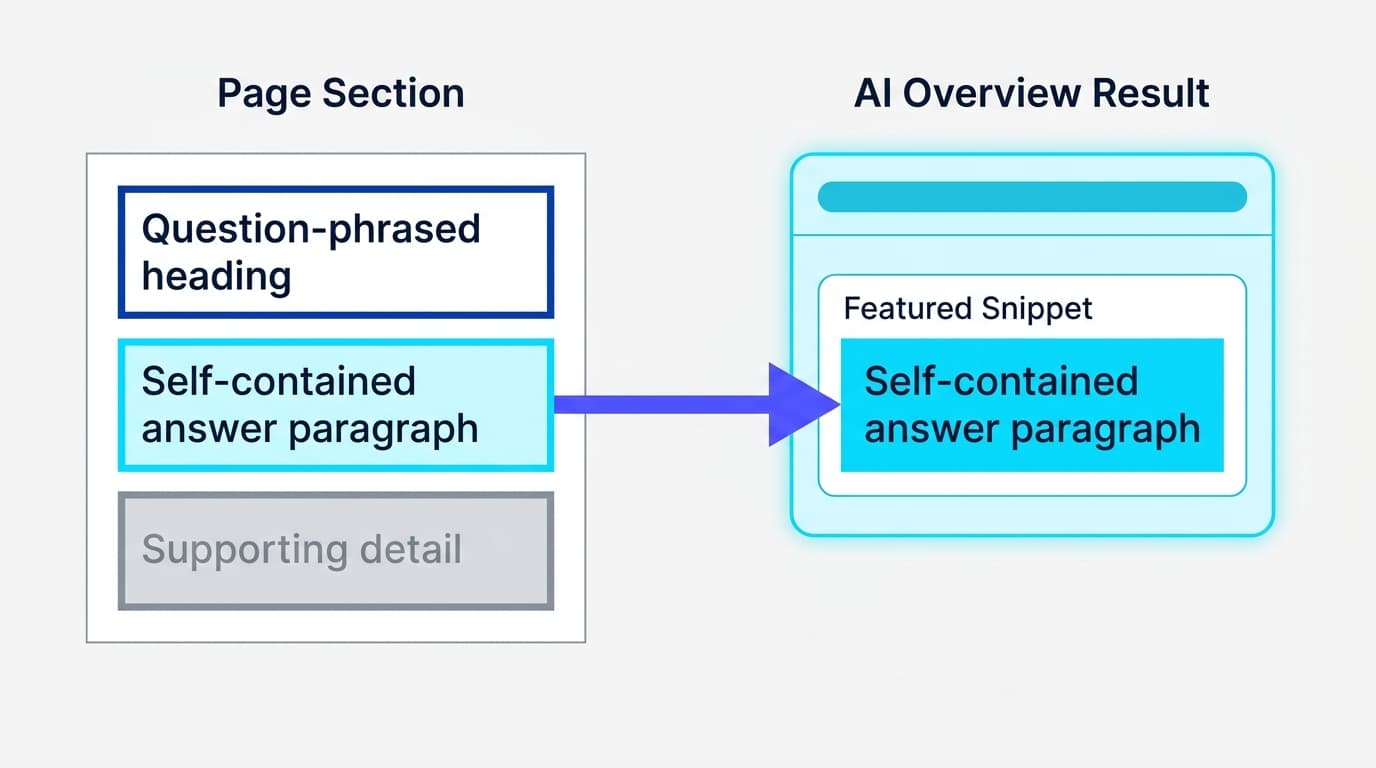
First, answer density matters more than keyword density. Each section should open with a direct, self-contained answer to its implied question. If a reader can screenshot the first two sentences of a section and share them as a useful answer, you have written for AI extraction correctly.
Second, factual precision earns citations. AI models prefer pages that make specific, attributable claims over pages that make general observations. Name the tool, the specific step, the concrete outcome.
Third, E-E-A-T signals now carry weight in AI selection, not just Google's standard ranking algorithm. Pages that show genuine first-hand experience, link to authoritative sources, and are written by credible authors are cited more often. Google's guidance on helpful content frames this as writing for people first, which turns out to be exactly what AI models reward too.
For a broader look at how this shift is playing out across search, see our post on the rise of AI search engines.
Which On Page Elements Carry the Most Weight?
Search intent alignment ranks first—a format or content mismatch will prevent ranking regardless of technical perfection. Title tags and content depth follow as the next strongest signals, directly influencing both ranking and click-through rates. Schema markup, meta descriptions, and header structure act as amplifiers, unlocking rich results and improving passage extraction for AI systems. Internal linking and image optimization support crawlability and topical authority. Allocate effort in this order to maximize ROI on your on-page work.
Not all on-page signals are equal. Here is a practical ranking of where to spend your time, based on the elements that move the needle most consistently.
- Search intent match - If the page format and content type do not match what the searcher expects, nothing else compensates.
- Content quality and depth - Thin content that skims the surface loses to thorough content that answers follow-up questions before they are asked.
- Title tag - The single strongest on-page signal for keyword relevance.
- H1 and H2 structure - Shapes how both crawlers and AI models parse the page's topic hierarchy.
- Internal links - Distributes authority and builds topical clusters.
- Schema markup - Unlocks rich results and AI citations.
- Meta description - Affects CTR, which feeds back into rankings indirectly.
- Image alt text - Lower individual impact but cumulative across a large site.
The teams that consistently rank well spend most of their time on the top three and treat the rest as a clean-up pass during a structured audit.
Running a Full On Page SEO Audit
A structured on page seo audit checklist gives you a repeatable way to find gaps across an entire site, not just the pages you happen to remember. Here is the process we recommend.
Step 1: Crawl the site. Use a crawler to collect every URL, title tag, meta description, H1, word count, and canonical tag. This surfaces duplicates, missing tags, and thin pages in one pass.
Step 2: Map pages to keywords. Check that each page has one clear target keyword and that the title, H1, and opening paragraph all reflect it. Pages targeting multiple unrelated keywords rarely rank well for any of them.
Step 3: Audit search intent alignment. Compare your page format to the top-ranking pages for each target keyword. Flag any page where your format is a significant mismatch.
Step 4: Review content depth. Are there obvious follow-up questions the page does not answer? Could a competitor easily publish a more thorough version? Thin pages get consolidated or expanded.
Step 5: Check internal links. Find orphan pages and pages with no outbound internal links. Build the connections that are missing.
Step 6: Validate schema. Test every page that should have structured data. Fix any markup errors flagged by Google's tools.
Step 7: Prioritize fixes. Score pages by traffic potential and fix difficulty. High-traffic pages with easy wins go first.
For a deeper look at the technical layer that sits beneath all of this, our technical SEO audit guide covers crawlability, Core Web Vitals, and indexation issues that can undermine even well-optimized content. You can also use Google Search Console to identify which pages are losing impressions or clicks before and after your audit work.
If you want the audit handled automatically, Project Rankup's platform runs this full analysis across your site and flags prioritized issues without requiring you to stitch together a half-dozen tools. Run your on-page content audit here.
常见问题
What is on page seo?
On page seo is the practice of optimizing elements within a web page so search engines can understand its topic and users find it genuinely useful. It covers title tags, headings, body content, meta descriptions, image alt text, internal links, and structured data. These are all factors you control directly, making on-page work the fastest lever in the SEO toolkit.
What is on page and off page seo?
On page seo covers everything within a page itself: content quality, tags, structure, and schema. Off page seo covers signals that come from outside the page, primarily backlinks and brand mentions earned from other sites. Both matter. On-page optimization shapes what a page is about; off-page signals tell Google how much to trust it.
Which on page element carries the most weight for seo?
Search intent match carries the most weight. A page that gives searchers the wrong format or wrong content type will not rank regardless of how well the tags are written. After intent alignment, the title tag and content depth are the next strongest signals. Schema and meta descriptions matter, but they are amplifiers, not foundations.
How often should I run an on page seo audit?
For most brands, a full site audit every quarter is enough to catch content drift, new intent shifts, and technical tag issues. High-traffic or high-revenue pages deserve a monthly check, especially after algorithm updates. An audit is not a one-time event; it is a recurring process that keeps pages aligned with how search engines and AI models evaluate content.
Does on page seo help with AI Overviews and AI search?
Yes, and significantly. AI Overviews extract passages from pages rather than just citing URLs. Pages that open each section with a direct, self-contained answer, use clear header tags, and include structured data are cited far more often. Strong on-page optimization is the single best investment you can make to earn visibility in both traditional and AI-driven search results.
How long does it take to see results from on page seo changes?
For pages Google already crawls regularly, changes to title tags and headings often reflect in search data within one to three weeks. Content depth improvements take longer, typically four to eight weeks, because Google needs time to re-evaluate the page against competing results. Schema changes that unlock rich snippets can appear as quickly as the next crawl, sometimes within days.
What is the difference between on-page seo and technical SEO?
On-page seo focuses on the content and metadata within a page: what the page says, how it is structured, and what it signals about its topic. Technical SEO covers the infrastructure that lets pages be crawled and indexed: site speed, mobile usability, canonicalization, and Core Web Vitals. A well-optimized page on a slow, poorly structured site will underperform. Both layers need to work together.
Key Takeaways
- On page seo covers every element you control directly on a page, from title tags to schema, and it is the fastest lever available to any SEO team.
- Search intent optimization is the highest-priority step; format mismatch cancels out every other improvement.
- Title tag optimization, content depth, and H2 structure are the three elements that consistently drive the biggest ranking gains.
- Schema markup for on page seo unlocks rich results and meaningfully increases the chance of being cited in AI Overviews.
- A strong internal linking strategy accelerates indexing and builds topical authority across the whole site.
- Treat on-page optimization as a recurring audit, not a one-time setup; content drifts, intent shifts, and the checklist keeps you ahead of both.
- AI search rewards the same things good on-page SEO has always rewarded: clear answers, genuine depth, and content that earns trust.