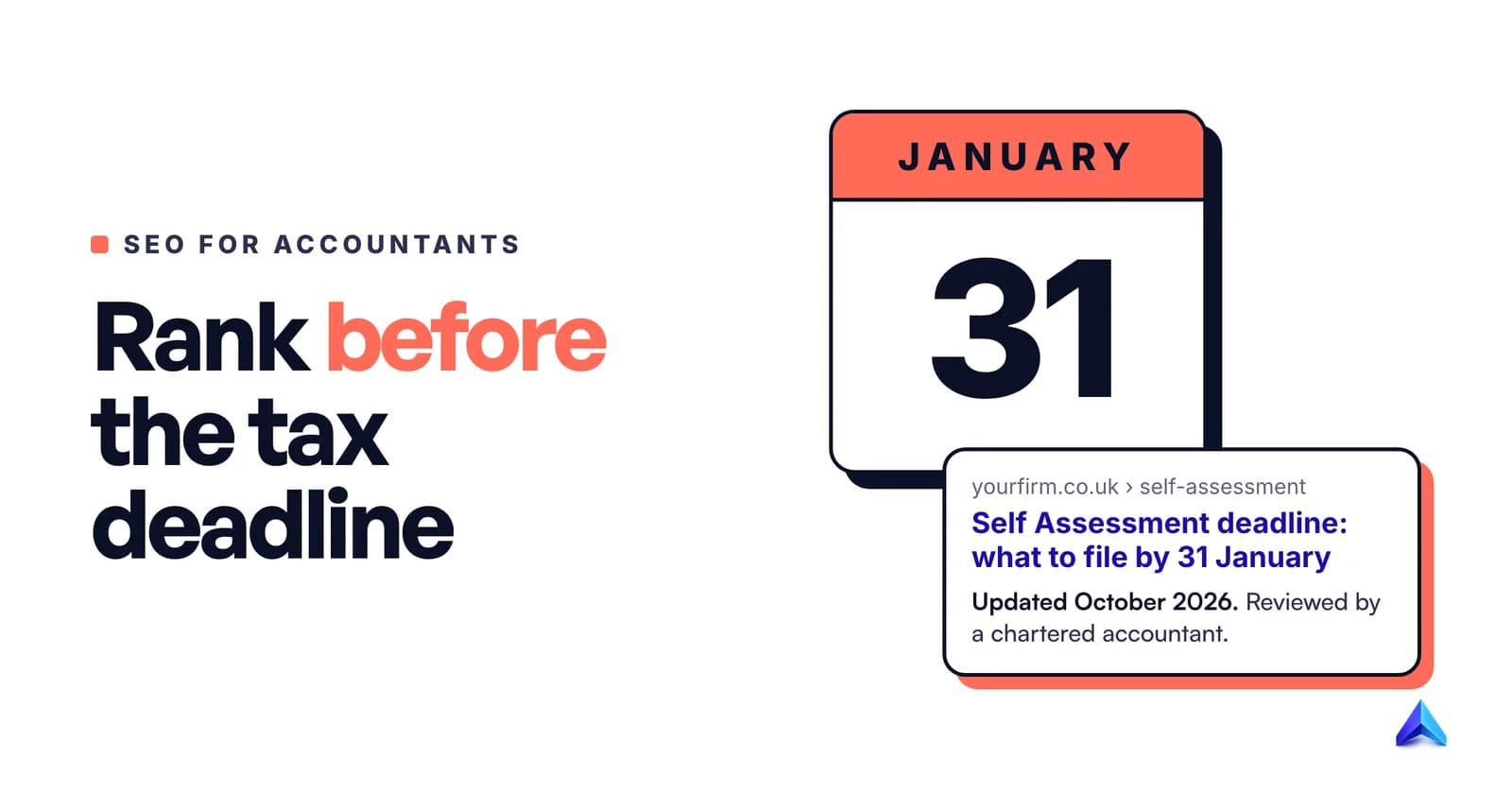
SEO for accountants is the work of getting your firm found by people who need a specific accounting service, at the moment they need it. That moment is set mostly by tax authorities: searches build in the weeks before IRS, HMRC and Income Tax Department deadlines. So the plan is simple to state. Publish deadline pages well ahead of each due date, give every service and client type its own page, put a qualified name on every page about money, and stay inside your professional body's advertising rules.
This guide covers the US, the UK and India, including the rules on what a CPA, chartered accountant or CA firm may say online. It is marketing guidance, not tax or legal advice; dates come from each tax authority's site as of October 2026, so check them before you publish.
Why accounting searches follow the tax calendar
A plumber's demand follows burst pipes. An accountant's follows a calendar the government publishes months in advance.
That predictability helps only if you act early. A page published three days before a deadline has to be crawled, indexed and trusted before the searches stop, which rarely happens on a small firm's site. A page that has sat at the same URL for two seasons is already in position when the rush starts.
Two habits follow from this:
- One URL per deadline, updated every year. A page called
/self-assessment-deadline/that you refresh each autumn keeps its history. A new/self-assessment-deadline-2027/page competes with last year's version, which is how firms end up with keyword cannibalization across five near-identical pages. Keep the year in the title and the body, never in the slug; our guide to URL slugs explains why. - Treat extensions as news. On 28 September 2026 India's Central Board of Direct Taxes issued Circular 07/2026, moving the return deadline for audit cases from 31 October to 21 November 2026. A firm with a live, dated "ITR due dates" page could update one paragraph that day and catch the searches that followed.
Open Google Trends, set the country, and look at five years of data for terms like "self assessment" or "ITR filing". Plan backwards from the peaks.
Turn each market's tax calendar into a publishing calendar
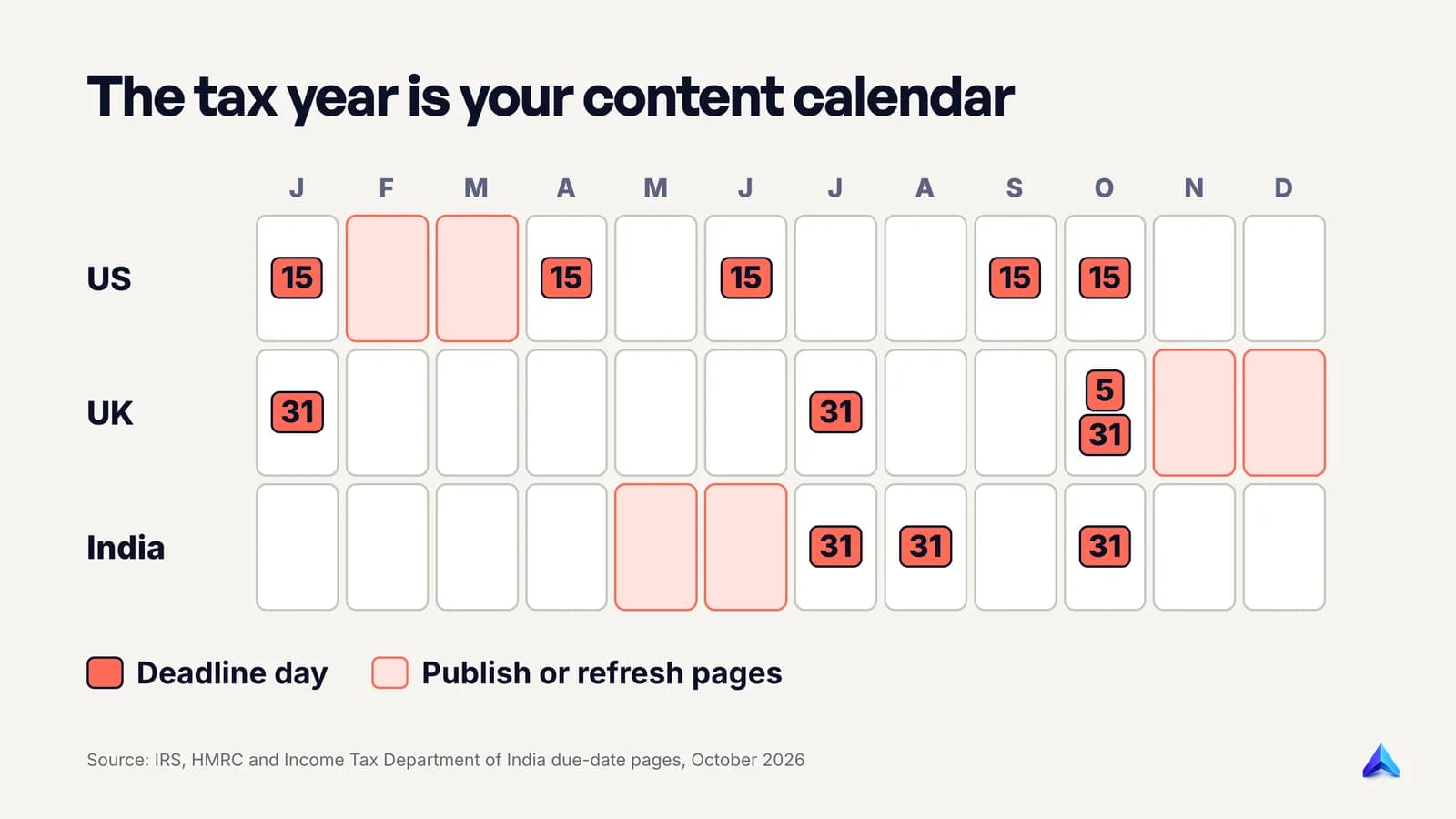
The table lists the deadlines behind most small-firm demand, with the page each one calls for. Publish or refresh each page six to eight weeks before the date. That is our recommendation, not a Google rule: it leaves time for indexing and for the page to pick up a few internal links.
| Market | Deadline | Who it hits | Page to have live |
|---|---|---|---|
| US | April 15: individual returns (calendar-year filers) | Every individual filer | "When is the tax deadline" + individual tax prep service page |
| US | Six months after April 15: extended returns | Anyone who filed Form 4868 | "Filed an extension? What happens next" |
| US | April 15, June 15, Sept 15, Jan 15: estimated tax | Freelancers, landlords, owners | "Quarterly estimated taxes" guide |
| UK | 5 October: register for Self Assessment | First-time filers | "Do I need to file a tax return?" |
| UK | 31 January: online return and payment | Self-employed, landlords | Self Assessment service page |
| UK | One month and 7 days after each VAT period | VAT-registered businesses | VAT returns service page |
| UK | 6 April 2026, 2027, 2028: Making Tax Digital phases | Sole traders and landlords | MTD for Income Tax guide |
| India | 31 July / 31 August: ITR (non-audit) | Salaried / non-audit business | ITR filing service page |
| India | 31 October (21 Nov in 2026): audit cases | Audited businesses and partners | Tax audit service page |
| India | 11th and 20th of each month: GSTR-1, GSTR-3B | GST-registered businesses | GST return filing service page |
United States
The IRS's own when to file page gives April 15 for calendar-year filers, moved to the next business day when the 15th lands on a weekend or holiday. It also states the line clients most often get wrong: an extension of time to file is not an extension of time to pay. Give that sentence its own section on your extension page.
Estimated tax is quieter but steadier. The IRS sets four payment due dates, April 15, June 15, September 15 and January 15, and each one sends freelancers and landlords searching.
United Kingdom
HMRC's Self Assessment deadlines page sets the UK's biggest spike: online returns and payment by 11:59pm on 31 January 2027 for the 2025 to 2026 tax year. Paper returns are due by 31 October 2026, and anyone filing for the first time had to tell HMRC by 5 October. A second payment on account falls on 31 July.
Making Tax Digital for Income Tax is the UK's newest content opportunity. HMRC says sole traders and landlords with qualifying income over £50,000 in 2024 to 2025 should have started from 6 April 2026. The threshold drops to £30,000 from April 2027 and £20,000 from April 2028. Each step brings a new group of searchers, and a landlord-focused MTD page can rank for all three waves if you update it rather than replace it.
VAT runs on its own rhythm: HMRC puts the deadline at one calendar month and 7 days after each accounting period ends.
India
India has two calendars, and firms usually write for only one. The Income Tax Department's due dates table gives 31 July for salaried and other non-business taxpayers, 31 August for business and professional taxpayers whose accounts need no audit, and 31 October for audit cases. In 2026 the CBDT circular pushed that last date to 21 November.
GST is the second calendar, and it repeats every month. The GST portal's own FAQs put monthly GSTR-1 on the 11th and monthly GSTR-3B on the 20th of the following month, with quarterly filers on different dates by state. That is twelve small peaks a year for a firm that sells GST compliance. If you want more topics beyond the deadlines, our list of blog post ideas your readers already search for shows how to find them in your own Search Console data.
Service pages built around the client, not the service list
Deadline pages attract searchers; service pages convert them. A single "Services" page listing tax, bookkeeping and payroll in a grid ranks for nothing because it is about everything.
Build one page per service, and then one page per type of client where the work genuinely differs. A landlord, a contractor and a funded startup all need "tax returns", but they search differently and worry about different things:
| Page | What the searcher types | What the page must answer |
|---|---|---|
| Accountant for landlords | "accountant for landlords", "MTD for landlords" | Which MTD phase applies to them, what you handle, how fees are set |
| Contractor accountant (UK) | "contractor accountant", "IR35 accountant" | Inside or outside IR35, limited company vs umbrella |
| Startup accounting | "accountant for startups", "startup bookkeeping" | Entity setup, payroll, investor-ready books |
| GST registration and returns (India) | "GST registration consultant", "GSTR-3B filing" | Documents needed, timelines, monthly vs quarterly filing |
| Self-employed tax returns | "self assessment accountant", "freelancer tax return" | Deadlines, payments on account, what records to send |
IR35 shows why the client-type page wins. HMRC describes the off-payroll rules as making sure a contractor working through their own company pays broadly the same Income Tax and National Insurance as an employee would. That contractor is worried about one decision, and a generic "tax services" page never speaks to it.
Pick the terms you can actually win. A new firm site will not outrank national directories for "accountant", but "accountant for Airbnb hosts in Leeds" or "GST return filing Pune" is often wide open. Our guide to keyword difficulty explains how to read a KD score against your own site's authority. And resist cloning the same page for twenty towns with only the place name changed. One strong page per real service beats twenty thin copies.
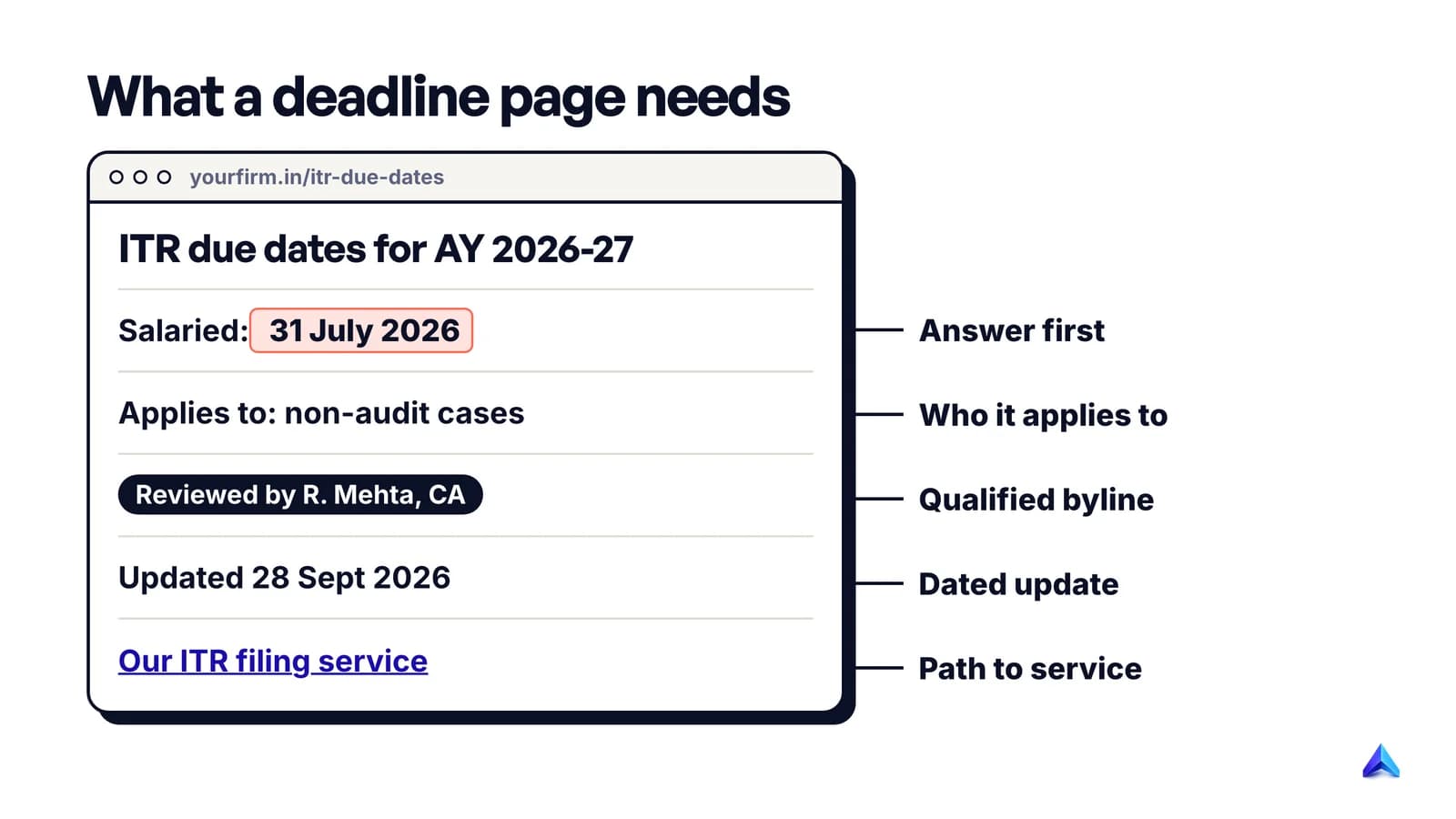
Give every deadline and service page the same parts: the answer in the first lines, who it applies to, what happens if they miss it, who checked it, a "last updated" date, and a link to the matching service.
Put a qualified name on every page about money
Tax content is what Google calls a "Your Money or Your Life" topic. Its guidance on helpful content says its systems give even more weight to strong experience, expertise, authoritativeness and trust on topics that could significantly affect people's financial stability. For those pages, it says the content must be highly accurate and consistent with established expert consensus.
Accountants have a regulated designation that a reader can verify. Use it on every page.
- CPA (US). A certified public accountant is licensed by a state board of accountancy, after meeting education requirements, passing the CPA exam and completing a set amount of experience, according to NASBA.
- ICAEW Chartered Accountant (UK). The ACA is the Institute of Chartered Accountants in England and Wales's own qualification, and ICAEW also regulates its members.
- ACCA. The Association of Chartered Certified Accountants describes itself as a global body with over 266,100 members in 179 countries.
- CA (India). The Institute of Chartered Accountants of India is a statutory body set up by the Chartered Accountants Act, 1949, under the Ministry of Corporate Affairs.
Put the byline at the top of each article, linked to an author page with the person's designation, membership number where your body allows it, the areas they work in, and the date they last reviewed the page. Our explainer on helpful content covers how Google's "who, how and why" questions apply to bylines in more detail.
One US caution: the AICPA Code says a member who breaks a state's rules on using the CPA title is treated as using it in a false, misleading or deceptive way. If your firm has staff who are not yet licensed, their author pages must not imply they are. The same code allows a firm to use an AICPA designation such as the PFS in marketing only if every partner holds it.
What your professional body lets your website say
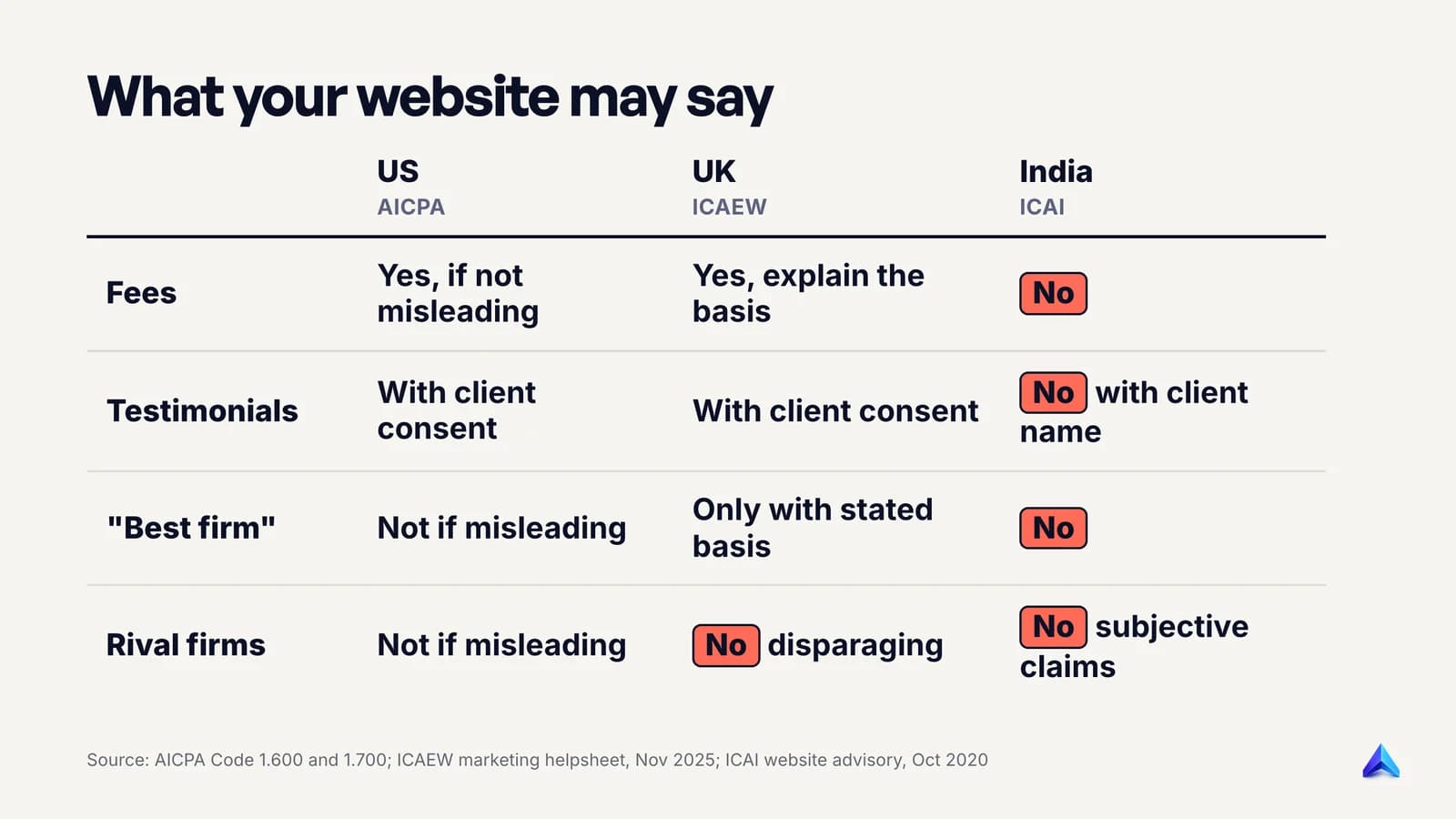
The ranking guides skip this, yet it changes what good SEO copy means in each market. The rules cover everything your site publishes, including pages an agency writes.
United States: the AICPA Code
The AICPA Code of Professional Conduct is short on this point. Rule 1.600.001 says a member in public practice shall not seek clients through advertising that is false, misleading or deceptive, and bans solicitation by coercion or harassment. Its interpretation lists what counts as misleading, including anything that creates "false or unjustified expectations of favorable results" or implies an ability to influence a court or regulatory agency.
For SEO copy, that rules out "guaranteed maximum refund", "we get IRS penalties waived" and "audit-proof returns". It also says members must not do through others what they cannot do themselves, so an agency's ad copy is your responsibility. Testimonials and case studies need care for a second reason: the confidential client information rule bars disclosing client information without specific consent.
United Kingdom: ICAEW and ACCA
ICAEW's marketing helpsheet, updated in November 2025, is the most practical guide of the three. It says firms must not disparage others even when a claim is true: "we provide a better service than X firm in Manchester" is out, even if you can prove it. A claim to be the leading practice in an area must state the basis for it on the page. Testimonials need the client's consent. And if you outsource marketing, the firm remains responsible for what is published.
ACCA's factsheet on obtaining professional work starts from a more permissive place: members may advertise "in any way they think fit", subject to its rules. Those rules are close to ICAEW's in practice: any factual statement must be one you can justify, adverts must be recognisable as adverts, and no unflattering comparisons with other firms.
India: ICAI
ICAI's rules are the strictest, and they reshape the whole strategy. Its October 2020 advisory on website guidelines explains that Clauses (6) and (7) of Part I of the First Schedule to the Chartered Accountants Act bar solicitation and advertising, and that the website guidelines exist so members can have a site without breaching them. Breaching the guidelines is itself professional misconduct.
The advisory then lists what a CA firm's website must not contain. The items that collide with standard SEO advice:
- client names or logos, and testimonials with a client's name;
- professional fees, or the fact that a service is free;
- "Leading Firm", "Best Firm" or "Top Firm", and subjective claims such as "best quality services";
- awards, rankings, media coverage and certifications;
- a "why choose us" section;
- services pushed to visitors (the guidelines call it "push mode");
- updates that are not professional updates.
The list ends by saying it is not exhaustive. So for an Indian CA firm, the playbook narrows to what is clearly allowed: plain service pages, professional updates, and deadline guides like the ones in the calendar above. Those happen to be the pages that rank anyway. We found no ICAI guidance on asking clients for Google reviews; ask the Ethical Standards Board before you run a review campaign.
Google Business Profile and reviews for a practice
Searches such as "accountant near me" show a map pack, and the map pack runs on your Business Profile. Google's Business Profile guidelines have three rules that catch accounting firms out.
- Practitioners can have their own profile. Google lists financial planners among individual practitioners and allows titles such as CFA in the profile name. A partner who is public-facing and can be contacted at the verified address may have a profile separate from the firm's. Support staff may not. A sole practitioner trading under a brand shares one profile, named "Brand: Practitioner Name".
- No virtual offices. Google says a rented mailing address that you do not operate from is not eligible. If you work from home and visit clients, set up a service-area profile with your address hidden instead.
- Seasonal hours belong on the profile. If you open evenings in January or July, Google allows seasonal hours and special hours for particular days.
Pick the primary category that matches your main work, and do not create extra profiles for each specialism. Google states that a practitioner should not have multiple profiles to cover specializations. If you are a UK firm, our local SEO UK playbook covers citations, NAP consistency and service areas in more depth.
Reviews
Google's Maps content policy lets you ask clients to review you, as long as you offer nothing in return. It bans incentives such as discounts, and it bans asking only the happy clients while steering unhappy ones away. Ask everyone, at the same point in the engagement: when the return is filed or the year-end accounts are signed off is a natural moment.
Replies are where accountants get into trouble. A bad review often invites a defensive answer with details of the client's affairs. The AICPA's confidentiality rule bars disclosing client information without specific consent, and ICAEW's helpsheet reminds UK firms that the client relationship is confidential. Do not confirm the reviewer was a client, let alone discuss their tax position. Reply in general terms, invite them to call, and take it offline.
Measure each season against the last one
A US tax firm's traffic falls in May whatever you do, because the April 15 searches are over. Comparing May with April tells you nothing.
Compare each season with the same season last year instead. In Google Search Console, open the Performance report, choose Compare in the date filter, and set the same weeks a year apart: the six weeks before 31 January, or before April 15, or before 31 July. Then filter to your deadline pages and service pages. What you want to see:
- Impressions up year on year on the deadline pages, which means Google is showing them for more searches;
- Average position rising on the service pages those deadline pages link to;
- Clicks from local searches on your Business Profile in the same window, which Business Profile performance reports show separately from Search Console.
If a deadline page lost impressions, check that its date was updated and that it is still indexed. Project Rankup's Rank Tracker connects to Search Console and labels each slipping page by its likely cause, such as losing clicks but not rank, which is useful when twenty seasonal pages move at once.
常見問題
Is SEO worth it for accountants?
Yes, because accounting demand is predictable and tied to dates set by the IRS, HMRC and India's tax department. Pages built months before each deadline keep working every year. Paid ads stop the day you stop paying, while a well-maintained deadline page can rank for several seasons.
How long does SEO take for an accounting firm?
Expect a full tax season before a new page ranks well, and longer for competitive terms in big cities. That is why the timing matters: a page for the 31 January Self Assessment deadline should go live in the autumn, not in January.
What keywords should accountants target?
Target a service plus a client type or place, such as "contractor accountant Manchester", "accountant for landlords" or "GST return filing Pune", and the deadline questions your clients ask, such as "when is the tax deadline". Avoid single words like "accountant": national directories own them, and a new firm site will not outrank them.
Can chartered accountants in India advertise on Google?
ICAI's guidelines let members and firms run a website, but Clauses (6) and (7) of the Chartered Accountants Act's First Schedule bar solicitation and advertising. Its 2020 advisory prohibits fees, client names, testimonials with names, "best firm" claims and "why choose us" sections. Check with ICAI's Ethical Standards Board before any paid or promotional campaign.
Can CPAs ask clients for Google reviews?
Yes. Google's policy allows businesses to ask for reviews if they offer no incentive and do not ask only satisfied clients. The AICPA Code bans misleading advertising, so never write or edit reviews yourself. When you reply, do not confirm the reviewer was a client or mention any detail of their affairs.
Should an accounting firm use Google Ads or SEO?
Use both for different jobs. Ads put a new firm on the first page during a deadline rush while your pages build trust; SEO keeps working the following year. For most small firms, run ads only in the weeks before major deadlines and spend the rest of the year on pages.