SEO for doctors is the work of making sure that when a patient searches your name, your specialty in your town, or a condition you treat, they find accurate pages that you control or have checked. In practice: a small website of your own, claimed directory profiles, condition pages you write or review, and claims your regulator would accept. Below are the steps, with the rules for India, the UK and the US.
It is written for GPs, consultants and small private clinics; hospitals and groups should read our guide to SEO for healthcare organisations. This is not medical or legal advice; check anything regulatory with your own council or board.
What patients type before they book you
Doctors get found through three kinds of search, and most SEO advice only talks about one of them.
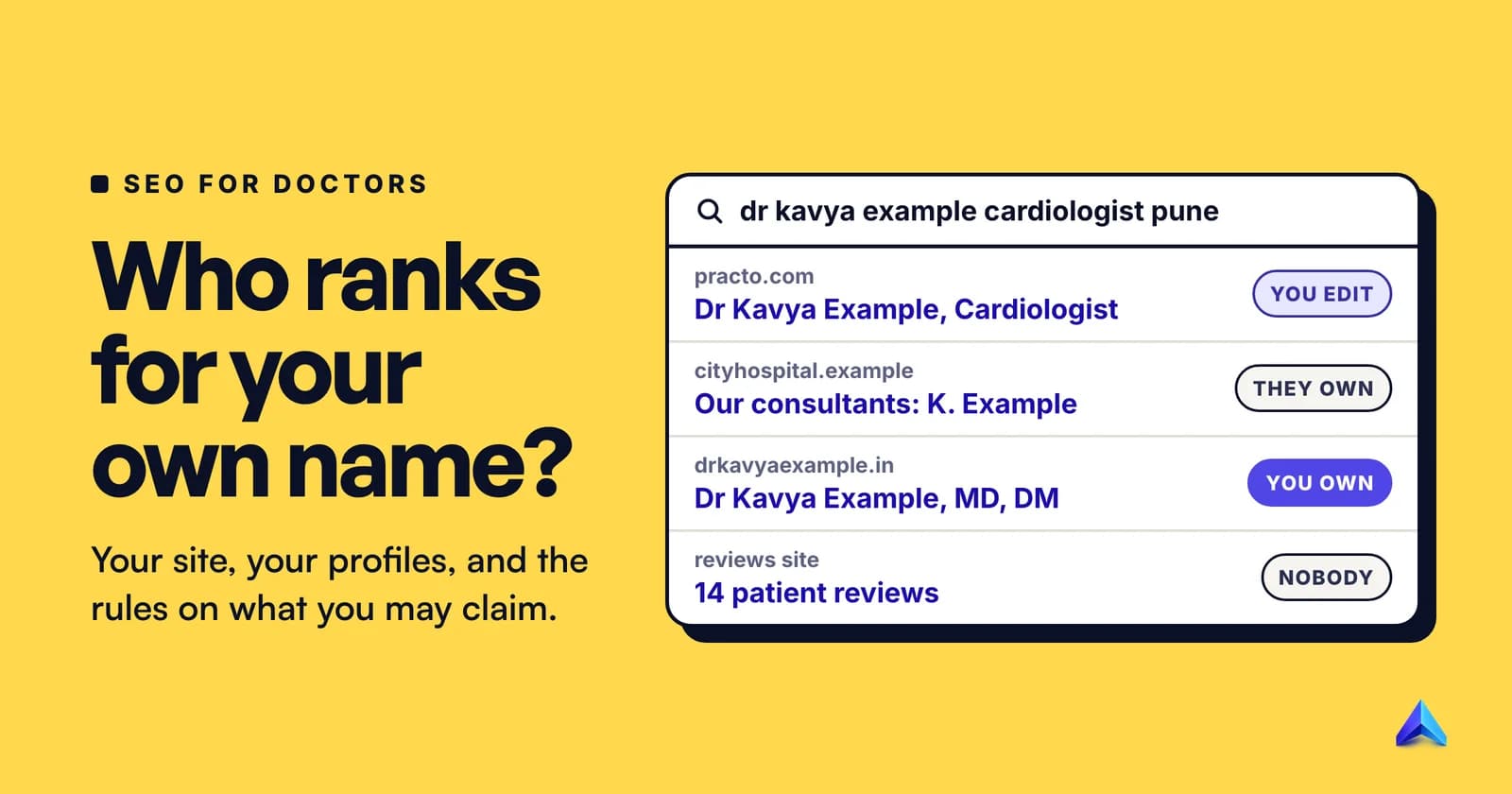
- Your name. A GP refers a patient to "Dr Kavya Example, cardiologist". The patient types the name into Google before calling. It is the search you are most likely to win and to neglect.
- Specialty plus place. "Endocrinologist in Pune", "private GP Leeds", "dermatologist Austin". These lead to the map results and to directories, and they are where competition sits.
- A condition or a symptom. "Thyroid nodule biopsy recovery", "is a resting heart rate of 50 normal". The searcher is not choosing a doctor yet. A clear page written by one can be what makes them choose you later.
A specialist who takes referrals lives on the first kind; a GP or private clinic depends more on the second. AI summaries now sit above many results too; the US results for "seo for doctors" itself opened with one when we checked in October 2026. Our explainer on how AI Overviews work covers how pages get cited inside them.
Search your own name first
Before you build anything, find out what a patient sees. Open a private browser window, sign out of Google, and search three variants: your name alone, your name with "Dr", and your name with your specialty and city. Repeat it on a phone.
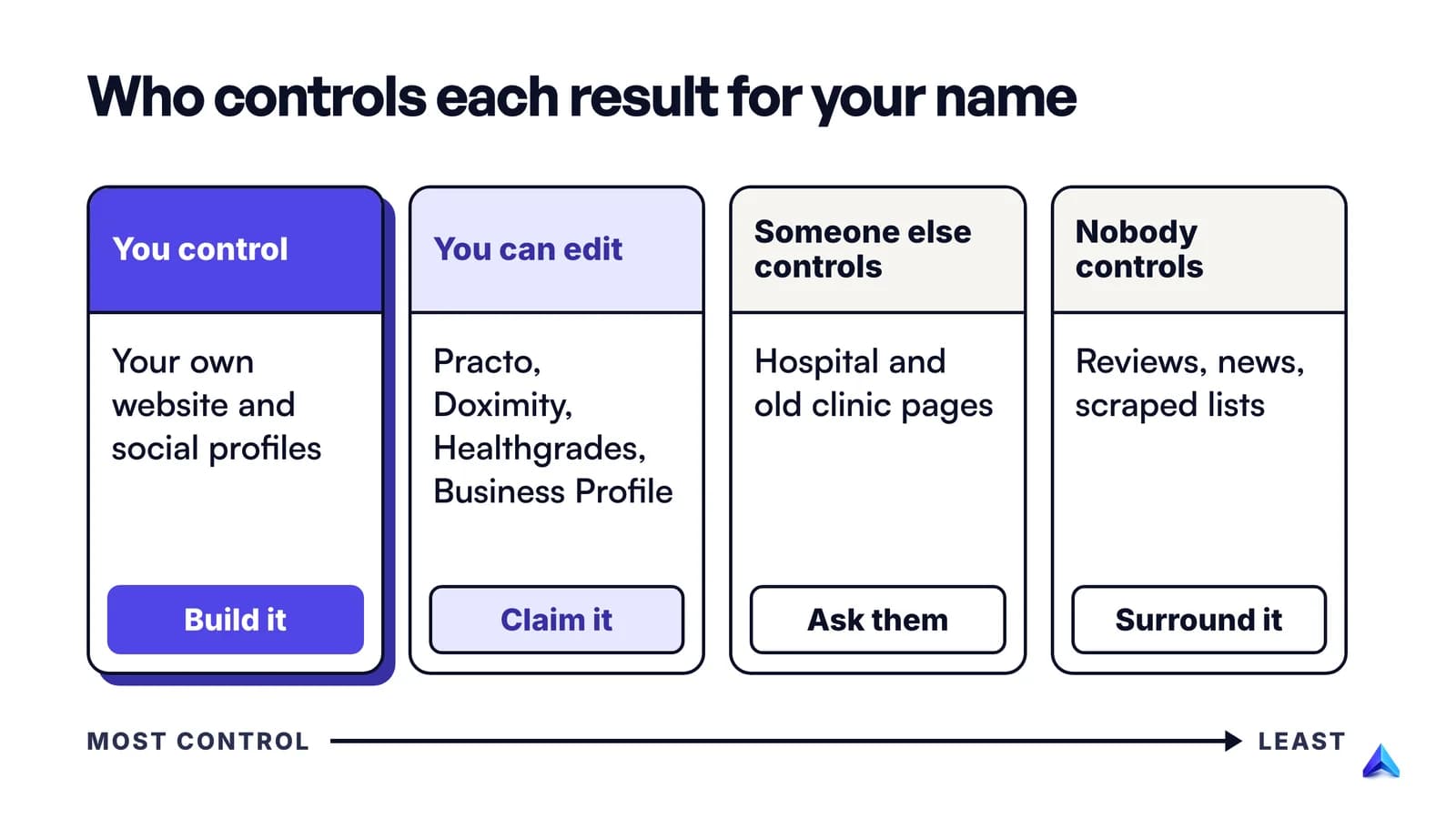
Write down every result on the first page and sort them into four groups:
- Pages you control: your own website, your social profiles.
- Profiles you can edit: Practo, Doximity, Healthgrades, your Google Business Profile.
- Pages someone else controls: your hospital's consultant page, an old clinic's "our team" page, a university staff page.
- Pages nobody controls: reviews, news stories, forum threads, scraped directories.
The usual findings are dull and damaging: a hospital profile listing a clinic you left, a directory phone number that rings a former receptionist, two spellings of your name. None is a ranking problem; each is a lost appointment. Fix the top three results first.
Your own website or the hospital's profile page
Many consultants rely on the profile page their hospital publishes. It ranks well and costs nothing, but it belongs to the hospital. When you change employer, it disappears. If you work at two hospitals and a private clinic, a patient finds three partial profiles with three phone numbers.
A small website of your own fixes that. Five to ten pages carry most doctors:
| Page | What it must say |
|---|---|
| Home | Who you are, what you treat, where you see patients, how to book |
| About | Qualifications, registration number, hospital affiliations, languages |
| Where I practise | Each location with its days, address, phone and booking route |
| Conditions and procedures | One page per thing you are known for, not one list |
| Fees and insurance | What you charge or how fees are set, insurers or panels you accept |
| Online consultations | Only if you offer them; see below |
Then connect the pieces. Ask each hospital to link its profile of you to your site, link back from "Where I practise", and use the exact same name, qualifications and registration details everywhere.
Pick a domain built on your name, such as drkavyaexample.in or drjamesexample.co.uk, not on a specialty keyword. You may switch hospitals or cities. Your name will not change, and it is what referrers say out loud.
Directory profiles: Practo, Doximity, Healthgrades
Directories already hold a page about most doctors, seen or not. Claiming those pages is the cheapest SEO you will do, because they already rank.
Practo (India). Practo's provider page invites doctors to "create your free Practo profile in 3 simple steps", adding details "including your medical registration, fees, timings and more." It verifies registration and qualifications before listing, and lets doctors reply to patient feedback. Practo is an established domain and a brand-new personal site is not, so for an Indian consultant the Practo profile is likely to be the first result for your name for a while. Treat it as your second homepage, not an afterthought.
Doximity (US). Doximity calls itself "the largest verified network of healthcare professionals in the U.S." What matters for search is in its help article on public profiles: every physician profile "has a public version that is visible in web search results," whether or not you have signed up. Unclaimed profiles carry only basic default information. Once claimed, you choose which sections show publicly, and the same data "powers the U.S. News Doctor Finder." So one profile edit corrects two places patients look.
Healthgrades (US). The Healthgrades provider portal says that "when you update your Healthgrades profile, your data syncs across all of our partner brands." That makes it worth checking even if you never read your own Healthgrades page: a wrong address there can travel.
UK doctors have no single equivalent. Patients can check any doctor's registration status on the GMC's online register. You cannot edit that entry, but you can make sure the name on your website matches it exactly, so a patient comparing the two sees the same doctor.
On every directory, keep the name, qualifications, address and phone identical to your own site, and do not pay for "featured" placement until the free profile is correct.
A Business Profile for one doctor
Google treats doctors as individual practitioners. Its guidelines say plainly that "doctors, dentists, lawyers, financial planners, and insurance or real estate agents are all individual practitioners," which means you can have a Business Profile in your own name, separate from the clinic's. The conditions: you see patients in a public-facing role, and you "can be contacted directly at the verified location during stated hours." One doctor gets one profile, however many specialties they have.
The setup itself, including naming formats for solo doctors inside a branded clinic, is the same for dentists and doctors, so we will not repeat it here; our dental practice playbook walks through each case.
What is specific to doctors is the visiting consultant and the online-only doctor. Google's eligibility rules for Business Profiles say a business "must make in-person contact with customers during its stated hours," and list "online-only businesses" as ineligible. A doctor who only consults by video does not qualify. A consultant who holds a Tuesday clinic at one hospital and a Friday clinic at another should set hours that match reality at each verified location, or let the hospital's own listing carry those sessions. A UK reader can find the general local steps in our local SEO guide for UK businesses.
Condition pages you write or review yourself
Condition and procedure pages are where a single doctor can beat large health websites. They can explain knee replacement; they cannot say how your patients are assessed or what your recovery advice is.
Google holds these pages to a higher bar. Health is a "Your Money or Your Life" topic, and Google's guidance says that for these subjects "the content must be highly accurate and consistent with established expert consensus." One of the questions it asks of every page is direct: "Is this content written or reviewed by an expert or enthusiast who demonstrably knows the topic well?" A doctor's own site starts with an answer to that question that most content farms do not have. Our guide to Google's helpful content questions goes through the rest of the list.
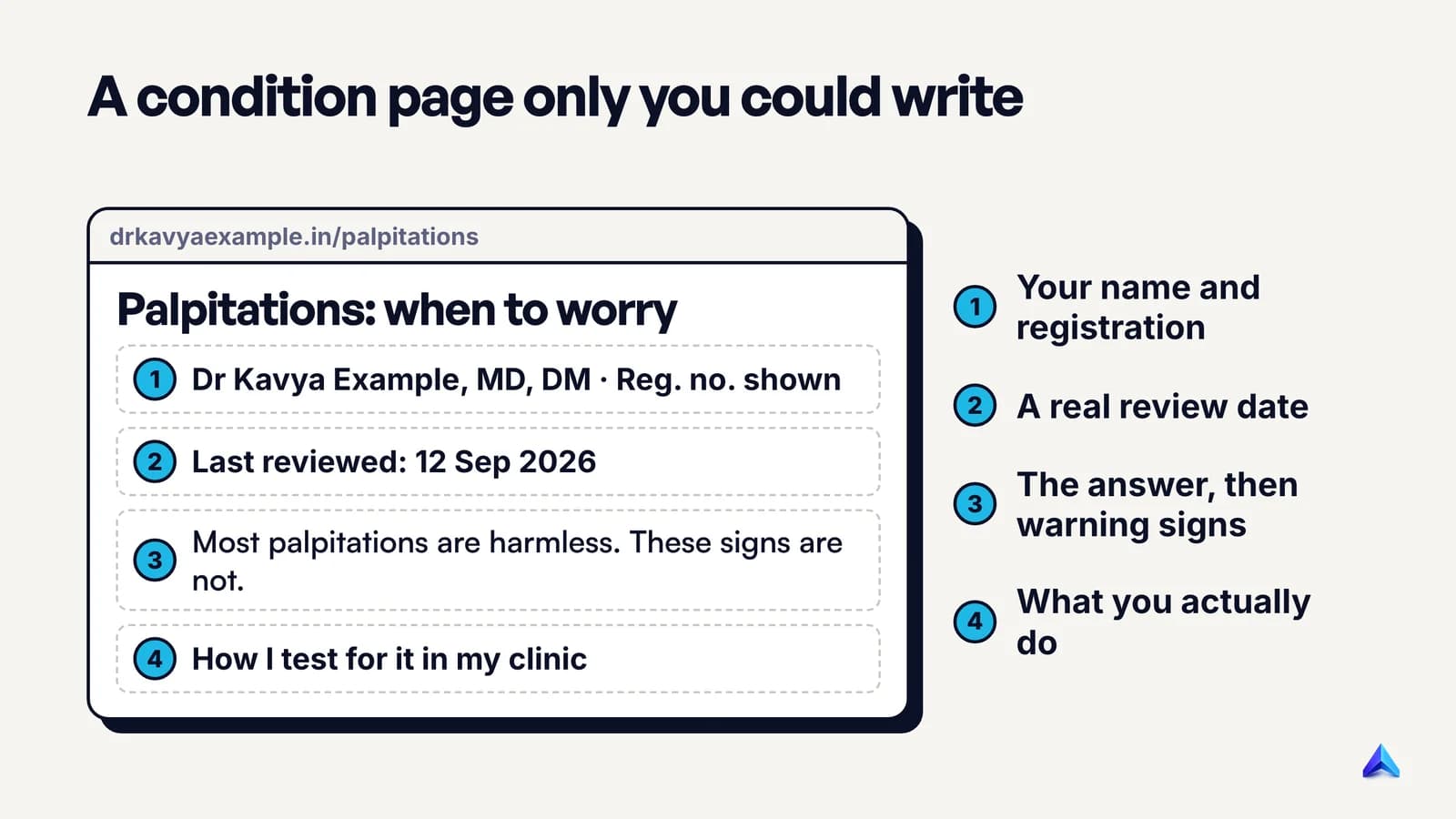
What a strong condition page has, in this order:
- A direct answer in the first few lines. "A thyroid nodule is a lump in the thyroid gland. Most are harmless, and most need only an ultrasound to check." Patients and AI summaries both read the top first.
- Your name, qualifications and registration number as the author or reviewer, linked to your About page.
- A "last reviewed" date that you actually update when guidance changes.
- When to seek urgent care. Name the warning signs plainly.
- How you treat it. The tests you order, the options you offer, what recovery looks like in your practice.
- Questions patients ask you in clinic. Each one is a search someone is typing.
Start with the five questions you answer most often in consultations. A cardiologist in Bengaluru who explains how she reads a Holter monitor report, in the plain language she uses with patients, has a page no aggregator can copy.
If you use AI to draft, read every line before your name goes on it. Google's guidance calls "fabricating creator profiles (such as by using AI-generated headshots, made-up names, or false credentials...)" deception, and a doctor's name on an unread page is a professional risk long before it is an SEO one. Project Rankup drafts articles with cited sources and FAQ markup, which can save a busy doctor the blank page, but the clinical review still has to be yours.
Telemedicine and online consultation pages
If you consult online, give it its own page. Patients searching "online endocrinologist consultation" or "video GP appointment" want specific answers before they pay, and one line on your homepage cannot give them.
The page should state:
- Where you are registered, because that limits whom you can treat. A doctor registered in one country or state should say so, and say who cannot book.
- What cannot be done online. Examinations, procedures and emergencies. Say what happens if you decide the patient needs to be seen in person.
- The platform and how to join, with no download surprises.
- Fees, in the patient's currency, including follow-up charges. A ₹800 video consultation and a ₹1,500 in-person visit should both be visible.
- Your registration number, on the page and in the confirmation the patient receives.
An online-only practice is not eligible for a Business Profile, so its visibility comes entirely from this page and your directory profiles.
What your regulator lets you publish
Every tactic above sits inside rules on how doctors may promote themselves, and those rules differ more between countries than search engines do. Read the regulator's own text.
India: the 2002 code applies today
India's National Medical Commission published new professional conduct regulations on 2 August 2023. On 23 August 2023 it held them in abeyance. The amendment notification says the 2023 regulations "shall not be operative and effective till further Gazette Notification on the subject," and that the NMC "adopts and makes effective with immediate effect" the Indian Medical Council (Professional Conduct, Etiquette and Ethics) Regulations, 2002. The NMC's rules and regulations page still lists the 2023 regulations alongside that abeyance notification, and we found no later notification there when we checked on 9 October 2026.
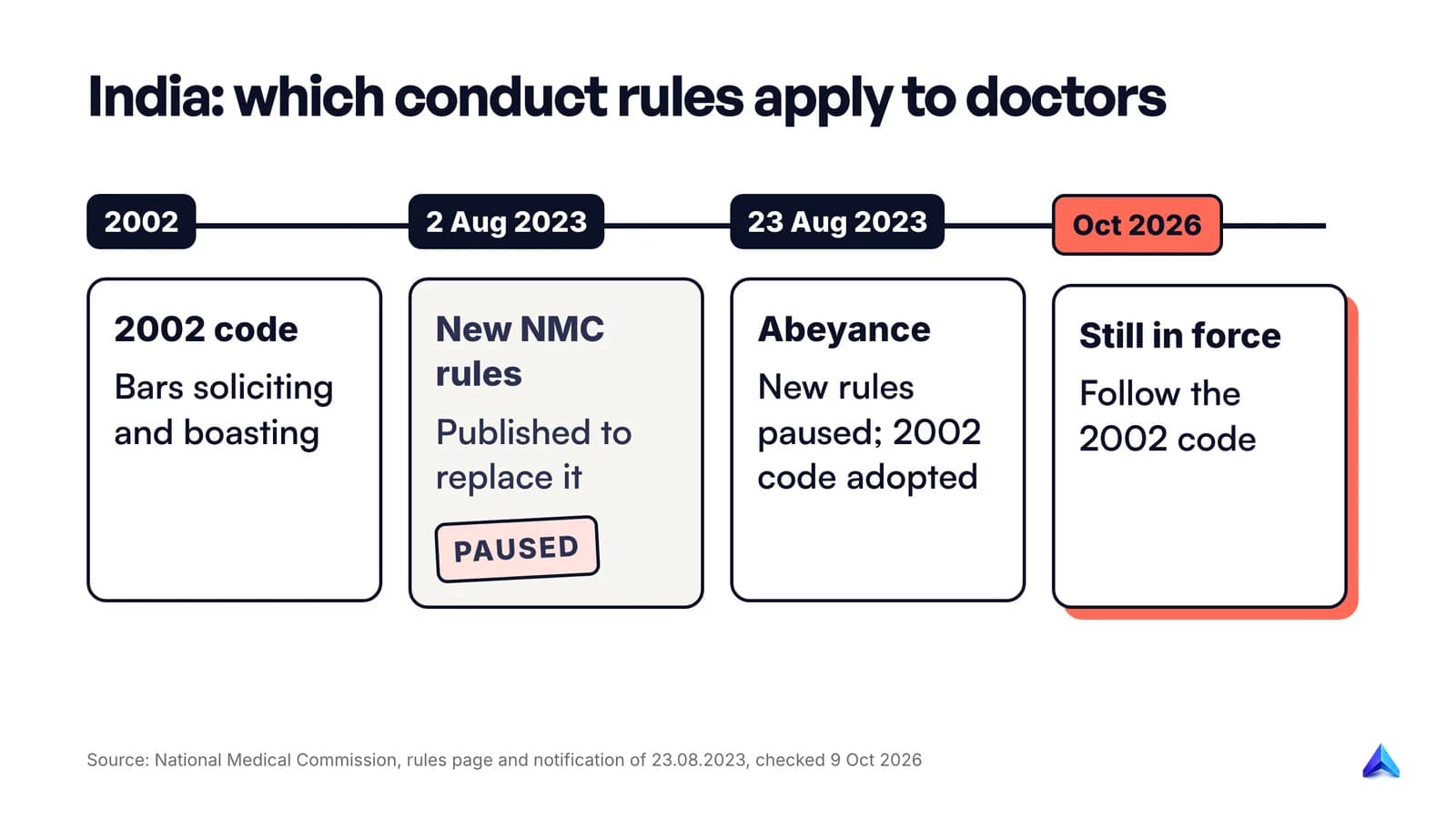
So the 2002 code, as published by the NMC, is the text to follow. It does not mention websites, so its general wording is what applies. What it says:
- No soliciting, no self-promotion. Clause 6.1.1 calls soliciting patients "directly or indirectly" unethical, and bars publicity that would "invite attention to him or to his professional position, skill, qualification, achievements" and similar. It also bars doctors to "boast of cases, operations, cures or remedies."
- Formal announcements are allowed, including on starting practice, changing address and "public declaration of charges."
- No self photograph on letterheads or signboards. Clause 6.1.2 treats this as self-advertisement, while "sketches, diagrams, picture of human system" are fine.
- Show your registration number "in his clinic and in all his prescriptions, certificates, money receipts" (clause 1.4.1), and list only recognised degrees after your name (1.4.2).
- Health education is open to you. Clause 7.11 lets a doctor "write to the lay press under his own name on matters of public health, hygienic living," but not articles "which may have the effect of advertising himself or soliciting practices."
In practice, that points Indian doctors towards factual sites: qualifications, registration, locations, timings, fees and educational condition pages. It points away from "best cardiologist in Pune" titles, patient success stories, award banners and "1,000+ successful surgeries" counters. How a State Medical Council reads a website against a 2002 text is a question for that council, so ask before you publish anything you are unsure about.
United Kingdom: Good Medical Practice
The GMC's rules on advertising sit inside Good Medical Practice, Domain 4, in force since January 2024. Paragraph 89 requires any information you communicate to be "accurate, not false or misleading," and adds that you "must not minimise or trivialise risks of harm" or "present opinion as established fact." Paragraph 90 applies this to "advertising your services" and social media, and says you "must not exploit people's vulnerability or lack of medical knowledge" and must declare conflicts of interest.
For a private GP or consultant website, that means outcome claims you can evidence, risks stated alongside benefits on every procedure page, and no countdown offers on treatments people should think about. Paragraph 82 adds that you "must always be honest about your experience, qualifications, and current role," so keep the About page current when your NHS post changes.
United States: AMA ethics and the FTC
The AMA Code of Medical Ethics opinion 9.6.1 is permissive by design: "There are no restrictions on advertising by physicians except those that can be specifically justified to protect the public from deceptive practices." The test is whether the communication "is true and not materially misleading." You may state your education, how fees are set, payment options and "any other nondeceptive information."
The opinion singles out three things that catch physician websites. Testimonials "tend to be deceptive when they do not reflect the results that patients with conditions comparable to the testimoniant's condition generally receive." Claims about experience and quality "may be made only if they are factually supportable." And saying you have successfully treated a large number of cases of a serious illness is deceptive "if it implies a certainty of result." State medical boards add their own rules, so check yours.
Reviews have separate federal rules. The FTC's rule on consumer reviews and testimonials, and what HIPAA means for replying to them, are covered in detail in our dental SEO guide; the same rules apply to physicians.
Reviews, personal details and your name in search
Reviews will sit on the first page of your name search whatever you do. The useful moves are about the rest of that page.
First, keep personal details out of it. Directories and data brokers sometimes publish a doctor's home address or mobile number. Google's Results about you tool lets you find results that show "your home address, phone number, or email address" and request their removal. It has limits worth knowing: Google says it will not remove results from sources it considers valuable to the public, including "government or educational websites, online newspapers, or business websites," and some features are still rolling out by market. For professional information posted to harm you, Google points to a separate removal request form.
Second, accept that you cannot remove an honest negative review or a news story by SEO. What you can do is make sure the results around it are accurate and complete: your site, your claimed profiles, your hospital pages, perhaps a talk or article under your name. If a page about you is genuinely false or breaks a policy, our guide on how to remove a page from Google explains which route fits which case.
A 30-minute monthly routine
Once the site and profiles are set up, half an hour a month keeps them honest:
- Search your name in a private window on your phone. Note anything new on page one.
- Check Search Console for which pages earned clicks and which searches brought them. Name searches and condition questions should both appear.
- Open your three main directory profiles. Confirm fees, hours and phone numbers.
- Review one condition page. Update it if guidance has changed, and change the "last reviewed" date only when you have actually reviewed it.
- Answer one patient question in writing. Over a year that is twelve new pages, each from your own clinic.
Success looks like this: patients who were referred to you say they found you easily; the first page of your name search is accurate; and Search Console shows clicks on condition pages from people who later book. Ranking for "best doctor in [city]" is not the goal, and in India and the UK that phrase sits badly with the conduct rules above.
常見問題
Is SEO worth it for doctors?
Yes, if you take referrals or see patients privately. Patients search a doctor's name before booking, and the first page of results shapes whether they call. Fixing your profiles and building a small website costs little compared with paid advertising, and the condition pages keep working for years once written.
Can doctors advertise in India?
Only within the 2002 professional conduct code, which the NMC adopted in August 2023 while holding its 2023 regulations in abeyance. It bars soliciting patients and self-promotion of skill or achievements, but allows formal announcements, a public declaration of charges and health education written under your own name.
Do I need a website if I already have a Practo profile?
A Practo profile is worth having, and it often ranks well. But Practo controls its layout, its competitors appear beside you, and you cannot publish detailed condition pages there. A small site of your own gives you one stable place for your qualifications, locations, fees and patient information.
How long does SEO take for a doctor?
Name searches improve fastest: claimed profiles and a new site with your name as the domain can show within weeks once Google has indexed them. Specialty-plus-city searches take months, and longer in big cities where hospitals and directories dominate. Condition pages build slowly as Google learns to trust the site.
Should a doctor hire an SEO agency?
It can make sense for the technical setup and the website build. Keep three things yourself: ownership of your domain and Business Profile, clinical review of every page that carries your name, and the final say on claims. An agency that promises the top position, or suggests patient success stories, has not read your regulator's rules.